RADIOACTIVE POLLUTION
PRESENTED BY:
ABHISHEK KUMAR (3103)
ABHISHEK KUMAR (3104)
ASHUTOSH SINGH (3118)
ABISHEK KUMAR SINGH (3105)
Defined as:
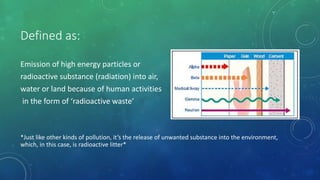
Emission of high energy particles or
radioactive substance (radiation) into air,
water or land because of human activities
in the form of ‘radioactive waste’
*Just like other kinds of pollution, it’s the release of unwanted substance into the environment,
which, in this case, is radioactive litter*
A few terms at glance…
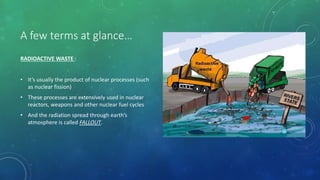
RADIOACTIVE WASTE :
• It’s usually the product of nuclear processes (such
as nuclear fission)
• These processes are extensively used in nuclear
reactors, weapons and other nuclear fuel cycles
• And the radiation spread through earth’s
atmosphere is called FALLOUT.
RADIOACTIVE DECAY :
• It’s the process of transformation of unstable isotopes of some elements into a more stable
state.
• It’s measured in terms of disintegrations/ decays/nuclear transformations per unit time.
• Common Units: 1 Becquerel = 1 disintegration/ sec
1 Curie = 3.7 x 10 10 disintegrations/ sec
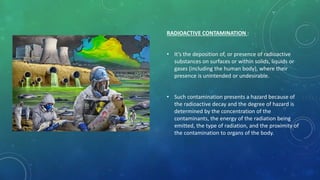
RADIOACTIVE CONTAMINATION :
• It’s the deposition of, or presence of radioactive
substances on surfaces or within solids, liquids or
gases (including the human body), where their
presence is unintended or undesirable.
• Such contamination presents a hazard because of
the radioactive decay and the degree of hazard is
determined by the concentration of the
contaminants, the energy of the radiation being
emitted, the type of radiation, and the proximity of
the contamination to organs of the body.
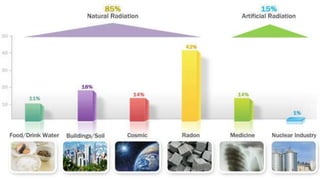
SOURCES
NATURAL
• Cosmic radiation
• Terrestrial radiation
• Internal radiation
MAN-MADE
• Production and research of
nuclear weapons
• Mining of radioactive ore
• Medical waste
• Nuclear power plants
• Industrial radiography (e.g.:
X-ray imaging)
CAUSES
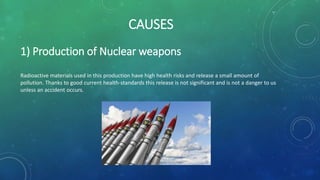
Radioactive materials used in this production have high health risks and release a small amount of
pollution. Thanks to good current health-standards this release is not significant and is not a danger to us
unless an accident occurs.
1) Production of Nuclear weapons
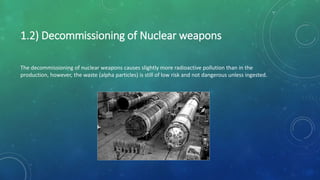
The decommissioning of nuclear weapons causes slightly more radioactive pollution than in the
production, however, the waste (alpha particles) is still of low risk and not dangerous unless ingested.
1.2) Decommissioning of Nuclear weapons
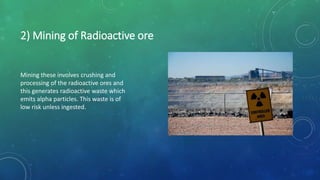
2) Mining of Radioactive ore
Mining these involves crushing and
processing of the radioactive ores and
this generates radioactive waste which
emits alpha particles. This waste is of
low risk unless ingested.
Nuclear power plants under current standards produce little radioactive pollution due to safety
precautions that must be adhered to. Accidents at these power plants can cause dangerously high
radioactive pollution, such as in the recent case of Fukushima, after the earthquake and tidal wave in
Japan.
3) Medical waste
A number of radioactive isotopes are used in medicine, either for treatment or diagnostics. These can be
left to decay over a short period after which they are able to be disposed of as normal waste.
4) Nuclear Power Plants
Classification of Radioactive pollution:
• Continuous Pollution: This type of condition exists in uranium mines, nuclear reactors, test labs etc.
where the humans are under continuous exposure to radioactive contaminants and protective clothing
is required to avoid radiation exposure.
• Accidental Pollution: This type of condition exists during accidental exposure to radiations by virtue
of equipment failure, radiation leak, faulty protective equipment etc.
• Occasional Pollution: This condition exists during isolated experiment or test of nuclear substance.
Effects on Human beings
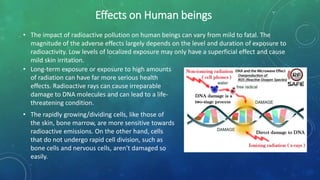
• Long-term exposure or exposure to high amounts
of radiation can have far more serious health
effects. Radioactive rays can cause irreparable
damage to DNA molecules and can lead to a life-
threatening condition.
• The rapidly growing/dividing cells, like those of
the skin, bone marrow, are more sensitive towards
radioactive emissions. On the other hand, cells
that do not undergo rapid cell division, such as
bone cells and nervous cells, aren't damaged so
easily.
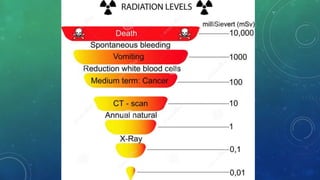
• The impact of radioactive pollution on human beings can vary from mild to fatal. The
magnitude of the adverse effects largely depends on the level and duration of exposure to
radioactivity. Low levels of localized exposure may only have a superficial effect and cause
mild skin irritation.
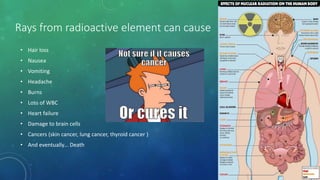
Rays from radioactive element can cause
• Hair loss
• Nausea
• Vomiting
• Headache
• Burns
• Loss of WBC
• Heart failure
• Damage to brain cells
• Cancers (skin cancer, lung cancer, thyroid cancer )
• And eventually… Death
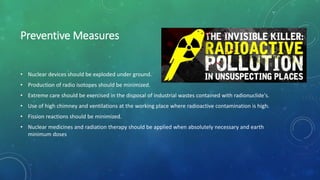
Preventive Measures
• Nuclear devices should be exploded under ground.
• Production of radio isotopes should be minimized.
• Extreme care should be exercised in the disposal of industrial wastes contained with radionuclide's.
• Use of high chimney and ventilations at the working place where radioactive contamination is high.
• Fission reactions should be minimized.
• Nuclear medicines and radiation therapy should be applied when absolutely necessary and earth
minimum doses
Treatment of radioactive pollutants
• According to a new study, contaminated sites can be treated with sludge from the treatment of distillery
wastewater in bioreactors. The study demonstrates an efficient method for decontamination of
groundwater based on bacteria in sludge that naturally convert uranium into an insoluble form that can
be more easily removed.
• Nuclear reprocessing : Already, caesium-137, strontium-90 and a few other isotopes are extracted for
certain industrial applications such as food irradiation and radioisotope thermoelectric generators.
CONCLUSION
• Overall, nuclear energy has been both boon and
bane for human kind.
• However, none of the nuclear plants, wastes, or
weapons will disappear in this world because they
overwhelmingly need a long time to be safely
disposed off.
• Even if we dispose them off, they are still around us
with the left traces. We just cannot see it. So, what
we can do is to dwindle the usage of nuclear power
for the future.
• The third nuclear plant ( of Fukushima, Japan)
disaster should be a turning point for us. It is not too
late for us to aim for better goals, although we have
a responsibility for nuclear power because we are
using it.

Radioactive pollution

  • 1.
    RADIOACTIVE POLLUTION PRESENTED BY: ABHISHEKKUMAR (3103) ABHISHEK KUMAR (3104) ASHUTOSH SINGH (3118) ABISHEK KUMAR SINGH (3105)
  • 2.
    Defined as: Emission ofhigh energy particles or radioactive substance (radiation) into air, water or land because of human activities in the form of ‘radioactive waste’ *Just like other kinds of pollution, it’s the release of unwanted substance into the environment, which, in this case, is radioactive litter*
  • 3.
    A few termsat glance… RADIOACTIVE WASTE : • It’s usually the product of nuclear processes (such as nuclear fission) • These processes are extensively used in nuclear reactors, weapons and other nuclear fuel cycles • And the radiation spread through earth’s atmosphere is called FALLOUT.
  • 4.
    RADIOACTIVE DECAY : •It’s the process of transformation of unstable isotopes of some elements into a more stable state. • It’s measured in terms of disintegrations/ decays/nuclear transformations per unit time. • Common Units: 1 Becquerel = 1 disintegration/ sec 1 Curie = 3.7 x 10 10 disintegrations/ sec
  • 5.
    RADIOACTIVE CONTAMINATION : •It’s the deposition of, or presence of radioactive substances on surfaces or within solids, liquids or gases (including the human body), where their presence is unintended or undesirable. • Such contamination presents a hazard because of the radioactive decay and the degree of hazard is determined by the concentration of the contaminants, the energy of the radiation being emitted, the type of radiation, and the proximity of the contamination to organs of the body.
  • 6.
    SOURCES NATURAL • Cosmic radiation •Terrestrial radiation • Internal radiation MAN-MADE • Production and research of nuclear weapons • Mining of radioactive ore • Medical waste • Nuclear power plants • Industrial radiography (e.g.: X-ray imaging)
  • 8.
    CAUSES Radioactive materials usedin this production have high health risks and release a small amount of pollution. Thanks to good current health-standards this release is not significant and is not a danger to us unless an accident occurs. 1) Production of Nuclear weapons
  • 9.
    The decommissioning ofnuclear weapons causes slightly more radioactive pollution than in the production, however, the waste (alpha particles) is still of low risk and not dangerous unless ingested. 1.2) Decommissioning of Nuclear weapons
  • 10.
    2) Mining ofRadioactive ore Mining these involves crushing and processing of the radioactive ores and this generates radioactive waste which emits alpha particles. This waste is of low risk unless ingested.
  • 11.
    Nuclear power plantsunder current standards produce little radioactive pollution due to safety precautions that must be adhered to. Accidents at these power plants can cause dangerously high radioactive pollution, such as in the recent case of Fukushima, after the earthquake and tidal wave in Japan. 3) Medical waste A number of radioactive isotopes are used in medicine, either for treatment or diagnostics. These can be left to decay over a short period after which they are able to be disposed of as normal waste. 4) Nuclear Power Plants
  • 12.
    Classification of Radioactivepollution: • Continuous Pollution: This type of condition exists in uranium mines, nuclear reactors, test labs etc. where the humans are under continuous exposure to radioactive contaminants and protective clothing is required to avoid radiation exposure. • Accidental Pollution: This type of condition exists during accidental exposure to radiations by virtue of equipment failure, radiation leak, faulty protective equipment etc. • Occasional Pollution: This condition exists during isolated experiment or test of nuclear substance.
  • 13.
    Effects on Humanbeings • Long-term exposure or exposure to high amounts of radiation can have far more serious health effects. Radioactive rays can cause irreparable damage to DNA molecules and can lead to a life- threatening condition. • The rapidly growing/dividing cells, like those of the skin, bone marrow, are more sensitive towards radioactive emissions. On the other hand, cells that do not undergo rapid cell division, such as bone cells and nervous cells, aren't damaged so easily. • The impact of radioactive pollution on human beings can vary from mild to fatal. The magnitude of the adverse effects largely depends on the level and duration of exposure to radioactivity. Low levels of localized exposure may only have a superficial effect and cause mild skin irritation.
  • 14.
    Rays from radioactiveelement can cause • Hair loss • Nausea • Vomiting • Headache • Burns • Loss of WBC • Heart failure • Damage to brain cells • Cancers (skin cancer, lung cancer, thyroid cancer ) • And eventually… Death
  • 16.
    Preventive Measures • Nucleardevices should be exploded under ground. • Production of radio isotopes should be minimized. • Extreme care should be exercised in the disposal of industrial wastes contained with radionuclide's. • Use of high chimney and ventilations at the working place where radioactive contamination is high. • Fission reactions should be minimized. • Nuclear medicines and radiation therapy should be applied when absolutely necessary and earth minimum doses
  • 17.
    Treatment of radioactivepollutants • According to a new study, contaminated sites can be treated with sludge from the treatment of distillery wastewater in bioreactors. The study demonstrates an efficient method for decontamination of groundwater based on bacteria in sludge that naturally convert uranium into an insoluble form that can be more easily removed. • Nuclear reprocessing : Already, caesium-137, strontium-90 and a few other isotopes are extracted for certain industrial applications such as food irradiation and radioisotope thermoelectric generators.
  • 18.
    CONCLUSION • Overall, nuclearenergy has been both boon and bane for human kind. • However, none of the nuclear plants, wastes, or weapons will disappear in this world because they overwhelmingly need a long time to be safely disposed off. • Even if we dispose them off, they are still around us with the left traces. We just cannot see it. So, what we can do is to dwindle the usage of nuclear power for the future. • The third nuclear plant ( of Fukushima, Japan) disaster should be a turning point for us. It is not too late for us to aim for better goals, although we have a responsibility for nuclear power because we are using it.