Environmental Pollution
Environmental pollution refers to the introduction of harmful pollutants into
the environment. These pollutants contaminates the environment. It has a
hazardous effect on the natural world and on the activities of living beings.
Environmental pollution is the discharge of material, in any physical state,
that is dangerous to the environment or human health. Most industrialized
and developing countries, and many intergovernmental organizations, have
developed maximum exposure values for pollutants. Many regulate atmospheric
emissions to keep their levels compatible with environmental equilibrium and
human health.
Environmental pollution became an international concern. In the late 1980s, a
series of international conferences explored the problem of climate change.
The period also witnessed the founding of scientific research bodies such as
the Intergovernmental Panel on Climate Change (IPCC). In 1987, some 50
countries adopted the Montreal Protocol, which specified a 50% reduction in
fully halogenated CFCs by the century's end. In 1990, the Montreal Protocol
was amended to include a total ban on CFCs. This was followed by the U.N.
Framework Convention on Climate Change (UNFCCC) in 1992, and the Kyoto
Protocol in 1997.
General Effectsof Pollution:
(i) Effect on Plants:
Photo-chemical smog’s, sulphur-dioxide (obtained from copper and lead smelter) and
hydrogen fluoride (obtained from fertiliser manufacturing and aluminium reduction)
cause injury to the plants and thereby reduce their growth and vegetation.
(ii) Effect on Animals:
Air pollutants cause eye and respiratory irritation in animals as well as in human
beings. Water pollutants can endanger aquatic life killing millions of fishes and other
animals every year. Sewage, toxic chemicals and diseased animals can make water
unfit for use by farm animals.
(iii) Effect on Human Beings:
Human beings are probably the most concerned about the direct and indirect effects
of pollution. Sufficiently high levels of pollutants are toxic or even lethal to every
human being, although there is a wide range of sensitivities among the human
population.
iv) Effect on materials:
Pollutants can cause deterioration of materials and constructions. Air pollutants like
SO2and H2S04 gas can corrode metals and building materials increasing the frequency
of repair and replacement. Water pollutants, like suspended particles or dissolved
inorganic compounds can also adversely affect pumps, industrial equipment’s and
bridges
(v) Synergism and Antagonism:
Multiple exposure of pollutants within or in between classes, may include synergistic
or antagonistic biological effects.
Environmental Pollution in India
1. India‟s high air pollution, ranked by the World Health Organisation among the worst in the
world, is adversely impacting the lifespan of its citizens, reducing most Indian lives by over
three years, a new study has said.
2.Over half of India‟s population – 660 million people – live in areas where fine particulate
matter pollution is above India‟s standards for what is considered safe, said the study by
economists from the University of Chicago, Harvard and Yale published in this week‟s
„Economic & Political Weekly‟.
3.Of the world‟s top 20 polluted cities, 13 are in India compared to just three in China. Air
pollution slashes life expectancy by 3.2 years for the 660 million Indians who live in cities,
including Delhi. In China, the corresponding dip is marginally lower at three years,
according to a report in The Hindustan Times.
4. In 2014, a global analysis of how nations tackle environmental challenges has ranked
India 155 among 178 nations and labelled the country‟s air quality among the worst in the
world, tying it with China in exposing its population to hazardous air pollution.
5.The Environmental Performance Index 2014, generated by researchers at Yale University
in the US, has bracketed India among “bottom performers” on several indicators such as
environmental health impact, air quality, water and sanitation..
6.The Ganga and Yamuna are ranked among the world‟s 10 most polluted rivers. China has
just one. An evaluation in February ranked Vapi in Gujarat and Sukinda in Odisha among
the 10 most environmentally-degraded zones in the world. China had no entries on the list.
7.Mindless concretization of ground and green belts and booming real estate has led to heat
island effect which is burning the Capital as short-wave radiations emanate from concrete
surfaces at night time. Concretization prevents ground water recharge thus depleting
green cover. Tall buildings also block winds thereby reducing their cooling effect.
Excessive concretization also leads to weakening of trees.
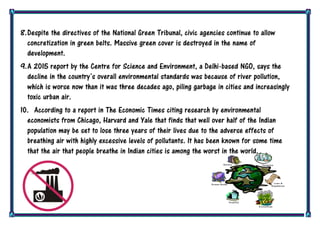
8.Despite the directives of the National Green Tribunal, civic agencies continue to allow
concretization in green belts. Massive green cover is destroyed in the name of
development.
9.A 2015 report by the Centre for Science and Environment, a Delhi-based NGO, says the
decline in the country‟s overall environmental standards was because of river pollution,
which is worse now than it was three decades ago, piling garbage in cities and increasingly
toxic urban air.
10. According to a report in The Economic Times citing research by environmental
economists from Chicago, Harvard and Yale that finds that well over half of the Indian
population may be set to lose three years of their lives due to the adverse effects of
breathing air with highly excessive levels of pollutants. It has been known for some time
that the air that people breathe in Indian cities is among the worst in the world.
Types Of Pollution
 Water Pollution =the type of pollution that involves the contamination of various water
bodies.
 Air Pollution = The contamination of the air present in the atmosphere is known as
‚Air pollution‛.
 Soil Pollution =Stripping soil of its natural fertility by using artificial chemicals like
pesticides, insecticides, ripening agents etc. is known as ‚Soil Pollution‛.
 Thermal Pollution = Rise in the temperature in the ecosystem due the release of
excessive heat energy into the environment by artificial methods or natural disasters is
called ‚Thermal Pollution‛.
 Radioactive Pollution = These types of pollution can occur by either the dumping of
radioactive waste from nuclear power plants into water bodies, damage of nuclear
reactors leading to radioactive contamination that would last for many years and many
more.
 Noise Pollution =There are different qualities of sounds. The sounds which are not
pleasant to hear are called ‘Noises’. So an excess of noise in the outdoors leads to
‚Noise Pollution‛.
 Light Pollution =Excessive light on the retina causes extreme discomfort in the eyes,
especially in dim conditions like during night time are known Light Pollution.
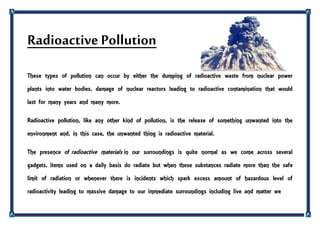
Radioactive Pollution
These types of pollution can occur by either the dumping of radioactive waste from nuclear power
plants into water bodies, damage of nuclear reactors leading to radioactive contamination that would
last for many years and many more.
Radioactive pollution, like any other kind of pollution, is the release of something unwanted into the
environment and, in this case, the unwanted thing is radioactive material.
The presence of radioactive materials in our surroundings is quite normal as we come across several
gadgets, items used on a daily basis do radiate but when these substances radiate more than the safe
limit of radiation or whenever there is incidents which spark excess amount of hazardous level of
radioactivity leading to massive damage to our immediate surroundings including live and matter we
Sources Of Radioactive Pollution
1. Radioactive Minerals: The minerals containing Uranium- 235 , Uranium-238 , Thorium-232 , Plutonium- 239
etc. are capable of emitting energetic radiations causing pollution.
2. Cosmic Rays: The cosmic rays containing highly energetic particles reach the surface of the earth causing
pollution. The intensity of cosmic rays depends on latitudes and altitude of the place. The intensity is maximum
at the poles and minimum at the equator.
3 .Radio nuclides: The unstable radio-nuclides in the atmosphere can be splatted up into smaller parts emitting
energetic radiation. The smaller radio-nuclides enter into the body of organism along with air during respiration.
4. Nuclear Power Plants: Nuclear power plants emit radiation to a very smaller extent except accidental leaks
(Chernobyl acci-dent of undivided USSR).
5.Radio-active wastes; The nuclear power plants produce a lot of nuclear radio-active wastes. The disposal of
these wastes has become a global problem. Some countries producing large quantity of nuclear wastes dump
them in ocean near other coun-tries.
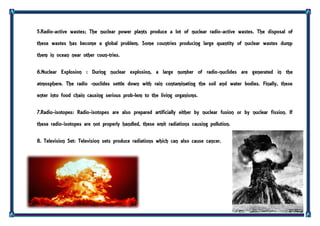
6.Nuclear Explosion : During nuclear explosion, a large number of radio-nuclides are generated in the
atmosphere. The radio -nuclides settle down with rain contaminating the soil and water bodies. Finally, these
enter into food chain causing serious prob-lem to the living organisms.
7.Radio-isotopes: Radio-isotopes are also prepared artificially either by nuclear fusion or by nuclear fission. If
these radio-isotopes are not properly handled, these emit radiations causing pollution.
8. Television Set: Television sets produce radiations which can also cause cancer.
Type Radioactive Pollution
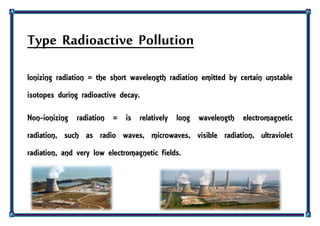
Ionizing radiation = the short wavelength radiation emitted by certain unstable
isotopes during radioactive decay.
Non-ionizing radiation = is relatively long wavelength electromagnetic
radiation, such as radio waves, microwaves, visible radiation, ultraviolet
radiation, and very low electromagnetic fields.
Effectsof Radioactive Pollution
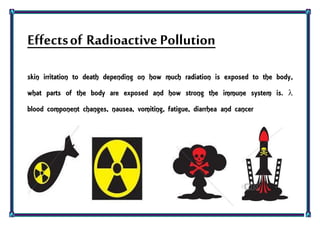
skin irritation to death depending on how much radiation is exposed to the body,
what parts of the body are exposed and how strong the immune system is. 
blood component changes, nausea, vomiting, fatigue, diarrhea and cancer
Preventionof Radioactive Pollution
1.safety measures should be enforced strictly;
2.leakages from nuclear reactors, careless handling, transport and
use of radioactive fuels,
3.fission products and radioactive isotopes have to be totally
stopped;
4.there should be regular monitoring and quantitative analysis
through frequent sampling in the risk areas;
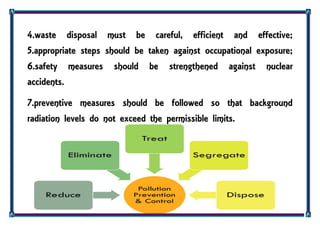
4.waste disposal must be careful, efficient and effective;
5.appropriate steps should be taken against occupational exposure;
6.safety measures should be strengthened against nuclear
accidents.
7.preventive measures should be followed so that background
radiation levels do not exceed the permissible limits.
Case Studyof Radioactive Pollution
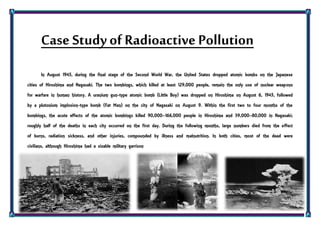
In August 1945, during the final stage of the Second World War, the United States dropped atomic bombs on the Japanese
cities of Hiroshima and Nagasaki. The two bombings, which killed at least 129,000 people, remain the only use of nuclear weapons
for warfare in human history. A uranium gun-type atomic bomb (Little Boy) was dropped on Hiroshima on August 6, 1945, followed
by a plutonium implosion-type bomb (Fat Man) on the city of Nagasaki on August 9. Within the first two to four months of the
bombings, the acute effects of the atomic bombings killed 90,000–166,000 people in Hiroshima and 39,000–80,000 in Nagasaki;
roughly half of the deaths in each city occurred on the first day. During the following months, large numbers died from the effect
of burns, radiation sickness, and other injuries, compounded by illness and malnutrition. In both cities, most of the dead were
civilians, although Hiroshima had a sizable military garrison
Thankyou
:- Pintu Bhardwaj

Environmental pollution and Radioactive Pollution

  • 1.
    Environmental Pollution Environmental pollutionrefers to the introduction of harmful pollutants into the environment. These pollutants contaminates the environment. It has a hazardous effect on the natural world and on the activities of living beings. Environmental pollution is the discharge of material, in any physical state, that is dangerous to the environment or human health. Most industrialized and developing countries, and many intergovernmental organizations, have developed maximum exposure values for pollutants. Many regulate atmospheric emissions to keep their levels compatible with environmental equilibrium and human health.
  • 2.
    Environmental pollution becamean international concern. In the late 1980s, a series of international conferences explored the problem of climate change. The period also witnessed the founding of scientific research bodies such as the Intergovernmental Panel on Climate Change (IPCC). In 1987, some 50 countries adopted the Montreal Protocol, which specified a 50% reduction in fully halogenated CFCs by the century's end. In 1990, the Montreal Protocol was amended to include a total ban on CFCs. This was followed by the U.N. Framework Convention on Climate Change (UNFCCC) in 1992, and the Kyoto Protocol in 1997.
  • 3.
    General Effectsof Pollution: (i)Effect on Plants: Photo-chemical smog’s, sulphur-dioxide (obtained from copper and lead smelter) and hydrogen fluoride (obtained from fertiliser manufacturing and aluminium reduction) cause injury to the plants and thereby reduce their growth and vegetation. (ii) Effect on Animals: Air pollutants cause eye and respiratory irritation in animals as well as in human beings. Water pollutants can endanger aquatic life killing millions of fishes and other animals every year. Sewage, toxic chemicals and diseased animals can make water unfit for use by farm animals.
  • 4.
    (iii) Effect onHuman Beings: Human beings are probably the most concerned about the direct and indirect effects of pollution. Sufficiently high levels of pollutants are toxic or even lethal to every human being, although there is a wide range of sensitivities among the human population. iv) Effect on materials: Pollutants can cause deterioration of materials and constructions. Air pollutants like SO2and H2S04 gas can corrode metals and building materials increasing the frequency of repair and replacement. Water pollutants, like suspended particles or dissolved inorganic compounds can also adversely affect pumps, industrial equipment’s and bridges (v) Synergism and Antagonism: Multiple exposure of pollutants within or in between classes, may include synergistic or antagonistic biological effects.
  • 5.
    Environmental Pollution inIndia 1. India‟s high air pollution, ranked by the World Health Organisation among the worst in the world, is adversely impacting the lifespan of its citizens, reducing most Indian lives by over three years, a new study has said. 2.Over half of India‟s population – 660 million people – live in areas where fine particulate matter pollution is above India‟s standards for what is considered safe, said the study by economists from the University of Chicago, Harvard and Yale published in this week‟s „Economic & Political Weekly‟. 3.Of the world‟s top 20 polluted cities, 13 are in India compared to just three in China. Air pollution slashes life expectancy by 3.2 years for the 660 million Indians who live in cities, including Delhi. In China, the corresponding dip is marginally lower at three years, according to a report in The Hindustan Times.
  • 6.
    4. In 2014,a global analysis of how nations tackle environmental challenges has ranked India 155 among 178 nations and labelled the country‟s air quality among the worst in the world, tying it with China in exposing its population to hazardous air pollution. 5.The Environmental Performance Index 2014, generated by researchers at Yale University in the US, has bracketed India among “bottom performers” on several indicators such as environmental health impact, air quality, water and sanitation.. 6.The Ganga and Yamuna are ranked among the world‟s 10 most polluted rivers. China has just one. An evaluation in February ranked Vapi in Gujarat and Sukinda in Odisha among the 10 most environmentally-degraded zones in the world. China had no entries on the list. 7.Mindless concretization of ground and green belts and booming real estate has led to heat island effect which is burning the Capital as short-wave radiations emanate from concrete surfaces at night time. Concretization prevents ground water recharge thus depleting green cover. Tall buildings also block winds thereby reducing their cooling effect. Excessive concretization also leads to weakening of trees.
  • 7.
    8.Despite the directivesof the National Green Tribunal, civic agencies continue to allow concretization in green belts. Massive green cover is destroyed in the name of development. 9.A 2015 report by the Centre for Science and Environment, a Delhi-based NGO, says the decline in the country‟s overall environmental standards was because of river pollution, which is worse now than it was three decades ago, piling garbage in cities and increasingly toxic urban air. 10. According to a report in The Economic Times citing research by environmental economists from Chicago, Harvard and Yale that finds that well over half of the Indian population may be set to lose three years of their lives due to the adverse effects of breathing air with highly excessive levels of pollutants. It has been known for some time that the air that people breathe in Indian cities is among the worst in the world.
  • 8.
    Types Of Pollution Water Pollution =the type of pollution that involves the contamination of various water bodies.  Air Pollution = The contamination of the air present in the atmosphere is known as ‚Air pollution‛.  Soil Pollution =Stripping soil of its natural fertility by using artificial chemicals like pesticides, insecticides, ripening agents etc. is known as ‚Soil Pollution‛.  Thermal Pollution = Rise in the temperature in the ecosystem due the release of excessive heat energy into the environment by artificial methods or natural disasters is called ‚Thermal Pollution‛.
  • 9.
     Radioactive Pollution= These types of pollution can occur by either the dumping of radioactive waste from nuclear power plants into water bodies, damage of nuclear reactors leading to radioactive contamination that would last for many years and many more.  Noise Pollution =There are different qualities of sounds. The sounds which are not pleasant to hear are called ‘Noises’. So an excess of noise in the outdoors leads to ‚Noise Pollution‛.  Light Pollution =Excessive light on the retina causes extreme discomfort in the eyes, especially in dim conditions like during night time are known Light Pollution.
  • 10.
    Radioactive Pollution These typesof pollution can occur by either the dumping of radioactive waste from nuclear power plants into water bodies, damage of nuclear reactors leading to radioactive contamination that would last for many years and many more. Radioactive pollution, like any other kind of pollution, is the release of something unwanted into the environment and, in this case, the unwanted thing is radioactive material. The presence of radioactive materials in our surroundings is quite normal as we come across several gadgets, items used on a daily basis do radiate but when these substances radiate more than the safe limit of radiation or whenever there is incidents which spark excess amount of hazardous level of radioactivity leading to massive damage to our immediate surroundings including live and matter we
  • 11.
    Sources Of RadioactivePollution 1. Radioactive Minerals: The minerals containing Uranium- 235 , Uranium-238 , Thorium-232 , Plutonium- 239 etc. are capable of emitting energetic radiations causing pollution. 2. Cosmic Rays: The cosmic rays containing highly energetic particles reach the surface of the earth causing pollution. The intensity of cosmic rays depends on latitudes and altitude of the place. The intensity is maximum at the poles and minimum at the equator. 3 .Radio nuclides: The unstable radio-nuclides in the atmosphere can be splatted up into smaller parts emitting energetic radiation. The smaller radio-nuclides enter into the body of organism along with air during respiration. 4. Nuclear Power Plants: Nuclear power plants emit radiation to a very smaller extent except accidental leaks (Chernobyl acci-dent of undivided USSR).
  • 12.
    5.Radio-active wastes; Thenuclear power plants produce a lot of nuclear radio-active wastes. The disposal of these wastes has become a global problem. Some countries producing large quantity of nuclear wastes dump them in ocean near other coun-tries. 6.Nuclear Explosion : During nuclear explosion, a large number of radio-nuclides are generated in the atmosphere. The radio -nuclides settle down with rain contaminating the soil and water bodies. Finally, these enter into food chain causing serious prob-lem to the living organisms. 7.Radio-isotopes: Radio-isotopes are also prepared artificially either by nuclear fusion or by nuclear fission. If these radio-isotopes are not properly handled, these emit radiations causing pollution. 8. Television Set: Television sets produce radiations which can also cause cancer.
  • 13.
    Type Radioactive Pollution Ionizingradiation = the short wavelength radiation emitted by certain unstable isotopes during radioactive decay. Non-ionizing radiation = is relatively long wavelength electromagnetic radiation, such as radio waves, microwaves, visible radiation, ultraviolet radiation, and very low electromagnetic fields.
  • 14.
    Effectsof Radioactive Pollution skinirritation to death depending on how much radiation is exposed to the body, what parts of the body are exposed and how strong the immune system is.  blood component changes, nausea, vomiting, fatigue, diarrhea and cancer
  • 15.
    Preventionof Radioactive Pollution 1.safetymeasures should be enforced strictly; 2.leakages from nuclear reactors, careless handling, transport and use of radioactive fuels, 3.fission products and radioactive isotopes have to be totally stopped; 4.there should be regular monitoring and quantitative analysis through frequent sampling in the risk areas;
  • 16.
    4.waste disposal mustbe careful, efficient and effective; 5.appropriate steps should be taken against occupational exposure; 6.safety measures should be strengthened against nuclear accidents. 7.preventive measures should be followed so that background radiation levels do not exceed the permissible limits.
  • 17.
    Case Studyof RadioactivePollution In August 1945, during the final stage of the Second World War, the United States dropped atomic bombs on the Japanese cities of Hiroshima and Nagasaki. The two bombings, which killed at least 129,000 people, remain the only use of nuclear weapons for warfare in human history. A uranium gun-type atomic bomb (Little Boy) was dropped on Hiroshima on August 6, 1945, followed by a plutonium implosion-type bomb (Fat Man) on the city of Nagasaki on August 9. Within the first two to four months of the bombings, the acute effects of the atomic bombings killed 90,000–166,000 people in Hiroshima and 39,000–80,000 in Nagasaki; roughly half of the deaths in each city occurred on the first day. During the following months, large numbers died from the effect of burns, radiation sickness, and other injuries, compounded by illness and malnutrition. In both cities, most of the dead were civilians, although Hiroshima had a sizable military garrison
  • 18.