MYSTERY
•Name : Nidhi
Singh
•Class: IX C
• Roll.No:06
•Subject:English
•Subject
Teacher:Miss
Mubina Malik
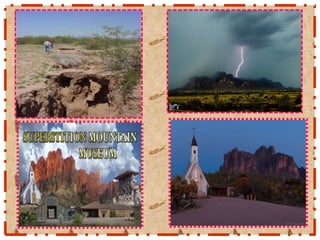
SUPERTITION MOUNTAIN
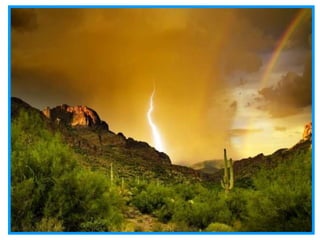
Superstition Mountain (Yavapai:
Wi:kchsawa, O'odham: Gakoḍk) is located
immediately east of the Phoenix metropolitan
area in Arizona. It anchors the west end of
the Superstition Wilderness. Although its
precise origin is debated by geologists, many
believe that the mountain was formed from
volcanic activity as far back as 25 million
years ago. The ash and basalt composed
mountain was eroded by the elements to
give it the unique form it has today, creating
the prominent landmark and popular
The mountain, located near Apache Junction and Gold
Canyon, Arizona, is easily accessible from U.S. Route 60
and State Route 88. It is a popular three season (fall,
winter, spring) hiking area. Afternoon temperatures from
June to September are usually in the range of 100 to
115°F near the mountain. Day hikers often frequent the
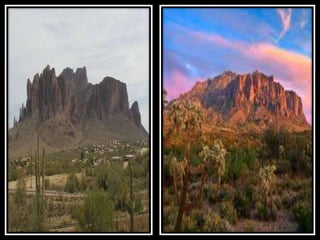
mountain during cooler months. The Lost Dutchman State
Park is located on the western side of the mountain and
includes hiking trails to notable formations such as the
Praying Hands and the Flatiron.[4] The Peralta Trail, on the
southern side of the mountain, traverses Fremont Saddle
and descends into the wilderness to the east of the
mountain.
According to legend, sometime in the 1800s a man named Jacob
Waltz discovered a huge goldmine within the mountains that has
since been dubbed the Lost Dutchman’s Gold Mine (because Waltz
was German, and eh, close enough). He kept the location a secret
until his deathbed, upon which he may or may not (depending on
which version of the story you’re reading) have told a single person
the secret. Regardless, the mine has never been found, in spite of
many expeditions. Some say the spirits of people who’ve lost their
lives in search of the gold still haunt the mountains.
One reportedly Native American legend goes that the treasures of the
mountains are guarded by creatures called Tuar-Tums (“Little
People”) that live below the mountains in caves and tunnels. Some
Apaches believe that the entrance to hell is located in the mountains.
This is, of course, ridiculous, as we all know the entrance to hell is in
Sunnydale.
Superstition Mountains Recharge Project (SMRP) provides
underground water storage capacity in the East Salt River Valley. The
project was completed in 2011 and has a capacity of 25,000 acre feet
of water.
In 2002, CAP initiated a sitting study for the SMRP. The goal of the
study was to locate areas in the east valley sub-basin of the Phoenix
AMA suitable for a large-scale surface spreading recharge
project. The East Salt River Valley is an area of historic groundwater
decline that has resulted in land subsidence and the formation of
earth fissures.
The East Salt River Valley continues to grow and the reliance on
groundwater is becoming more critical. Developers are relying on the
Central Arizona Groundwater Replenishment District (CAGRD) to
meet their 100-year assured water supply. It is projected that the
CAGRD will have a storage obligation of up to 85,000 AF per year in
the east valley. A large-scale recharge project will be required to
meet the storage obligation.
Supertition mountain

Supertition mountain

  • 1.
    MYSTERY •Name : Nidhi Singh •Class:IX C • Roll.No:06 •Subject:English •Subject Teacher:Miss Mubina Malik
  • 2.
    SUPERTITION MOUNTAIN Superstition Mountain(Yavapai: Wi:kchsawa, O'odham: Gakoḍk) is located immediately east of the Phoenix metropolitan area in Arizona. It anchors the west end of the Superstition Wilderness. Although its precise origin is debated by geologists, many believe that the mountain was formed from volcanic activity as far back as 25 million years ago. The ash and basalt composed mountain was eroded by the elements to give it the unique form it has today, creating the prominent landmark and popular
  • 3.
    The mountain, locatednear Apache Junction and Gold Canyon, Arizona, is easily accessible from U.S. Route 60 and State Route 88. It is a popular three season (fall, winter, spring) hiking area. Afternoon temperatures from June to September are usually in the range of 100 to 115°F near the mountain. Day hikers often frequent the mountain during cooler months. The Lost Dutchman State Park is located on the western side of the mountain and includes hiking trails to notable formations such as the Praying Hands and the Flatiron.[4] The Peralta Trail, on the southern side of the mountain, traverses Fremont Saddle and descends into the wilderness to the east of the mountain.
  • 5.
    According to legend,sometime in the 1800s a man named Jacob Waltz discovered a huge goldmine within the mountains that has since been dubbed the Lost Dutchman’s Gold Mine (because Waltz was German, and eh, close enough). He kept the location a secret until his deathbed, upon which he may or may not (depending on which version of the story you’re reading) have told a single person the secret. Regardless, the mine has never been found, in spite of many expeditions. Some say the spirits of people who’ve lost their lives in search of the gold still haunt the mountains. One reportedly Native American legend goes that the treasures of the mountains are guarded by creatures called Tuar-Tums (“Little People”) that live below the mountains in caves and tunnels. Some Apaches believe that the entrance to hell is located in the mountains. This is, of course, ridiculous, as we all know the entrance to hell is in Sunnydale.
  • 7.
    Superstition Mountains RechargeProject (SMRP) provides underground water storage capacity in the East Salt River Valley. The project was completed in 2011 and has a capacity of 25,000 acre feet of water. In 2002, CAP initiated a sitting study for the SMRP. The goal of the study was to locate areas in the east valley sub-basin of the Phoenix AMA suitable for a large-scale surface spreading recharge project. The East Salt River Valley is an area of historic groundwater decline that has resulted in land subsidence and the formation of earth fissures. The East Salt River Valley continues to grow and the reliance on groundwater is becoming more critical. Developers are relying on the Central Arizona Groundwater Replenishment District (CAGRD) to meet their 100-year assured water supply. It is projected that the CAGRD will have a storage obligation of up to 85,000 AF per year in the east valley. A large-scale recharge project will be required to meet the storage obligation.