1
Waste Management:
practical application of
the new ethical concepts of
Eco-Ethics International Union
BY
SHRISHTEE MOURYA
10TH-A
29
2
What are Wastes?
Basel Convention Definition of Wastes
“substances or objects which are disposed of or are intended
to be disposed of or are required to be disposed of by the
provisions of the law”
Disposal means
“any operation which may lead to resource recovery,
recycling, reclamation, direct re-use or alternative uses
(Annex IVB of the Basel convention)”
3
Kinds of Wastes
Solid wastes: domestic, commercial and industrial wastes
especially common as co-disposal of wastes
Examples: plastics, styrofoam containers, bottles,
cans, papers, scrap iron, and other trash
Liquid Wastes: wastes in liquid form
Examples: domestic washings, chemicals, oils, waste
water from ponds, manufacturing industries
and other sources
4
Classification of Wastes according
to their Properties
Bio-degradable
can be degraded (paper, wood, fruits and others)
Non-biodegradable
cannot be degraded (plastics, bottles, old machines,
cans, styrofoam containers and others)
5
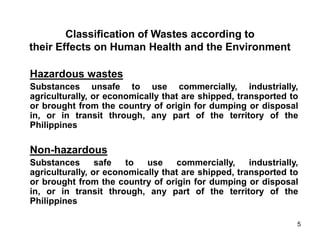
Classification of Wastes according to
their Effects on Human Health and the Environment
Hazardous wastes
Substances unsafe to use commercially, industrially,
agriculturally, or economically that are shipped, transported to
or brought from the country of origin for dumping or disposal
in, or in transit through, any part of the territory of the
Philippines
Non-hazardous
Substances safe to use commercially, industrially,
agriculturally, or economically that are shipped, transported to
or brought from the country of origin for dumping or disposal
in, or in transit through, any part of the territory of the
Philippines
6
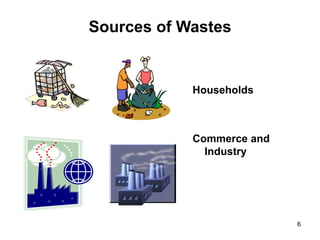
Sources of Wastes
Households
Commerce and
Industry
7
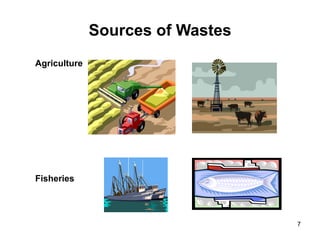
Sources of Wastes
Agriculture
Fisheries
8
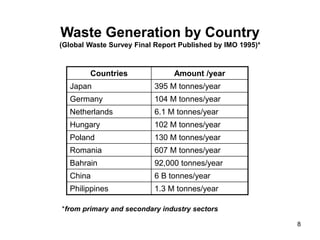
Waste Generation by Country
(Global Waste Survey Final Report Published by IMO 1995)*
Countries Amount /year
Japan 395 M tonnes/year
Germany 104 M tonnes/year
Netherlands 6.1 M tonnes/year
Hungary 102 M tonnes/year
Poland 130 M tonnes/year
Romania 607 M tonnes/year
Bahrain 92,000 tonnes/year
China 6 B tonnes/year
Philippines 1.3 M tonnes/year
*from primary and secondary industry sectors
9
Waste Generation in the Philippines
In Metro Manila:
• It is estimated that 25 million m3 of acid and alkaline
liquid waste is disposed of annually from the electronics
industry.
• Almost 2,000 m3 of solvents and 22,000 tonnes of heavy
metals, infectious wastes, biological sludges, lubricants
and intractable wastes are disposed of on land or into
water courses.
• 4,000 tonnes of solid wastes are generated daily. Of
these, only about 3,400 tonnes are collected and
transported to existing sites.
10
Waste Generation in
Iloilo Province
Hundreds of tons of domestic wastes are
generated daily by households contributing to
the enormous environmental problems the
world is facing.*
*Chua, TE (1996) Waste management in the coastal areas of
the ASEAN region. ECLARM Proceedings No. 33
11
EFFECTS OF WASTE IF NOT
MANAGED WISELY
• Affects our health
• Affects our socio-economic conditions
• Affects our coastal and marine environment
• Affects our climate
12
EFFECTS OF WASTE…
According to NAS:
• GHGs are accumulating in Earth’s atmosphere as a result of human activities,
causing global mean surface air temperature and subsurface ocean
temperature to rise.
• Rising global temperatures are expected to raise sea levels and change
precipitation and other local climate conditions.
• Changing regional climates could alter forests, crop yields, and water supplies.
• This could also affect human health, animals, and many types of ecosystems.
• Deserts might expand into existing rangelands, and features of some of our
national parks might be permanently altered.
13
EFFECTS OF WASTE…
According to NAS:
- Some countries are expected to become warmer, although sulfates might
limit warming in some areas.
- Scientists are unable to determine which parts of those countries will
become wetter or drier, but there is likely to be an overall trend toward
increased precipitation and evaporation, more intense rainstorms, and
drier soils.
- Whether rainfall increases or decreases cannot be reliably projected for
specific areas.
14
WHAT SHOULD BE DONE
• Reduce Waste
- Reduce office paper waste by implementing a formal policy
to duplex all draft reports and by making training manuals
and personnel information available electronically.
- Improve product design to use less materials.
- Redesign packaging to eliminate excess material while
maintaining strength.
- Work with customers to design and implement a packaging
return program.
- Switch to reusable transport containers.
- Purchase products in bulk.
15
WHAT SHOULD BE DONE
Donate/Exchange
- old books
- old clothes
- old computers
- excess building materials
- old equipment to local organizations
16
WHAT SHOULD BE DONE
Employee Education
- education campaign on waste management that
includes an extensive internal web site, quarterly
newsletters, daily bulletins, promotional signs and
helpful reference labels within the campus of an
institution.
17
WHAT SHOULD BE DONE
Preventing Waste
- packaging waste reductions and
changes in the manufacturing process
- use biodegradable materials
18
WHAT SHOULD BE DONE
Conduct outreach program adopting an
ecologically sound waste management
system which includes:
• waste reduction
• segregation at source
• composting
• recycling and re-use
• more efficient collection
• more environmentally sound disposal
19
ENVIRONMENTAL MANAGEMENT
SYSTEMS: EMS
What is an EMS?
An EMS is a formal set of policies and procedures that define how an
organization will evaluate, manage, and track its environmental
impact. It follows the basic model:
Plan > Do > Check > Act
This facilitates cost-effective environmental performance by defining
and continuously improving the process and actions that an
organization undertakes to meet its environmental goals.
20
EMS Development
• A Policy Statement that communicates an
organization’s environmental priorities to employees.
• Managerial endorsement of the policy statement
demonstrates the organization’s commitment to the
effort and willingness to allocate resources for
implementation.
• Once a policy statement is in place, the organization
implements it following the model.
21
Several organizations which offer
certification programs:
• American Chemistry Council
• American Forest and Paper Association
• International Chamber of Commerce
• Coalition for Environmentally Responsible
Economies
• International Organization for Standardization (ISO)
developed the most widely recognized EMS standard

Waste management

  • 1.
    1 Waste Management: practical applicationof the new ethical concepts of Eco-Ethics International Union BY SHRISHTEE MOURYA 10TH-A 29
  • 2.
    2 What are Wastes? BaselConvention Definition of Wastes “substances or objects which are disposed of or are intended to be disposed of or are required to be disposed of by the provisions of the law” Disposal means “any operation which may lead to resource recovery, recycling, reclamation, direct re-use or alternative uses (Annex IVB of the Basel convention)”
  • 3.
    3 Kinds of Wastes Solidwastes: domestic, commercial and industrial wastes especially common as co-disposal of wastes Examples: plastics, styrofoam containers, bottles, cans, papers, scrap iron, and other trash Liquid Wastes: wastes in liquid form Examples: domestic washings, chemicals, oils, waste water from ponds, manufacturing industries and other sources
  • 4.
    4 Classification of Wastesaccording to their Properties Bio-degradable can be degraded (paper, wood, fruits and others) Non-biodegradable cannot be degraded (plastics, bottles, old machines, cans, styrofoam containers and others)
  • 5.
    5 Classification of Wastesaccording to their Effects on Human Health and the Environment Hazardous wastes Substances unsafe to use commercially, industrially, agriculturally, or economically that are shipped, transported to or brought from the country of origin for dumping or disposal in, or in transit through, any part of the territory of the Philippines Non-hazardous Substances safe to use commercially, industrially, agriculturally, or economically that are shipped, transported to or brought from the country of origin for dumping or disposal in, or in transit through, any part of the territory of the Philippines
  • 6.
  • 7.
  • 8.
    8 Waste Generation byCountry (Global Waste Survey Final Report Published by IMO 1995)* Countries Amount /year Japan 395 M tonnes/year Germany 104 M tonnes/year Netherlands 6.1 M tonnes/year Hungary 102 M tonnes/year Poland 130 M tonnes/year Romania 607 M tonnes/year Bahrain 92,000 tonnes/year China 6 B tonnes/year Philippines 1.3 M tonnes/year *from primary and secondary industry sectors
  • 9.
    9 Waste Generation inthe Philippines In Metro Manila: • It is estimated that 25 million m3 of acid and alkaline liquid waste is disposed of annually from the electronics industry. • Almost 2,000 m3 of solvents and 22,000 tonnes of heavy metals, infectious wastes, biological sludges, lubricants and intractable wastes are disposed of on land or into water courses. • 4,000 tonnes of solid wastes are generated daily. Of these, only about 3,400 tonnes are collected and transported to existing sites.
  • 10.
    10 Waste Generation in IloiloProvince Hundreds of tons of domestic wastes are generated daily by households contributing to the enormous environmental problems the world is facing.* *Chua, TE (1996) Waste management in the coastal areas of the ASEAN region. ECLARM Proceedings No. 33
  • 11.
    11 EFFECTS OF WASTEIF NOT MANAGED WISELY • Affects our health • Affects our socio-economic conditions • Affects our coastal and marine environment • Affects our climate
  • 12.
    12 EFFECTS OF WASTE… Accordingto NAS: • GHGs are accumulating in Earth’s atmosphere as a result of human activities, causing global mean surface air temperature and subsurface ocean temperature to rise. • Rising global temperatures are expected to raise sea levels and change precipitation and other local climate conditions. • Changing regional climates could alter forests, crop yields, and water supplies. • This could also affect human health, animals, and many types of ecosystems. • Deserts might expand into existing rangelands, and features of some of our national parks might be permanently altered.
  • 13.
    13 EFFECTS OF WASTE… Accordingto NAS: - Some countries are expected to become warmer, although sulfates might limit warming in some areas. - Scientists are unable to determine which parts of those countries will become wetter or drier, but there is likely to be an overall trend toward increased precipitation and evaporation, more intense rainstorms, and drier soils. - Whether rainfall increases or decreases cannot be reliably projected for specific areas.
  • 14.
    14 WHAT SHOULD BEDONE • Reduce Waste - Reduce office paper waste by implementing a formal policy to duplex all draft reports and by making training manuals and personnel information available electronically. - Improve product design to use less materials. - Redesign packaging to eliminate excess material while maintaining strength. - Work with customers to design and implement a packaging return program. - Switch to reusable transport containers. - Purchase products in bulk.
  • 15.
    15 WHAT SHOULD BEDONE Donate/Exchange - old books - old clothes - old computers - excess building materials - old equipment to local organizations
  • 16.
    16 WHAT SHOULD BEDONE Employee Education - education campaign on waste management that includes an extensive internal web site, quarterly newsletters, daily bulletins, promotional signs and helpful reference labels within the campus of an institution.
  • 17.
    17 WHAT SHOULD BEDONE Preventing Waste - packaging waste reductions and changes in the manufacturing process - use biodegradable materials
  • 18.
    18 WHAT SHOULD BEDONE Conduct outreach program adopting an ecologically sound waste management system which includes: • waste reduction • segregation at source • composting • recycling and re-use • more efficient collection • more environmentally sound disposal
  • 19.
    19 ENVIRONMENTAL MANAGEMENT SYSTEMS: EMS Whatis an EMS? An EMS is a formal set of policies and procedures that define how an organization will evaluate, manage, and track its environmental impact. It follows the basic model: Plan > Do > Check > Act This facilitates cost-effective environmental performance by defining and continuously improving the process and actions that an organization undertakes to meet its environmental goals.
  • 20.
    20 EMS Development • APolicy Statement that communicates an organization’s environmental priorities to employees. • Managerial endorsement of the policy statement demonstrates the organization’s commitment to the effort and willingness to allocate resources for implementation. • Once a policy statement is in place, the organization implements it following the model.
  • 21.
    21 Several organizations whichoffer certification programs: • American Chemistry Council • American Forest and Paper Association • International Chamber of Commerce • Coalition for Environmentally Responsible Economies • International Organization for Standardization (ISO) developed the most widely recognized EMS standard