NUCLEAR POLLUTION
Presented by
SABRES
Bangladesh university of Business & Technology
SABRES
1.Yeasmin Akter
2.Rokeya Sutana Keya
3.Joynul Abedin Asif
4.IstiaqAhmed Saif
5.Md Sabbir Hossen Sonet
TOPIC TO BE DISCUSSED
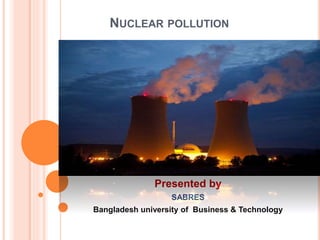
 Nuclear pollution
 Its impact on Environment
 It’s sources
 Nuclear pollution’s effect
 And it’s control
NUCLEAR POLLUTION
“We can’t see it. We can’t
smell it. We can’t touch
it. The effects may not
show up now, in this
decade, this generation
even in this
century. Nevertheless,
these senseless nuclear
impacts on us are far
beyond imagination…”
NUCLEAR POLLUTION
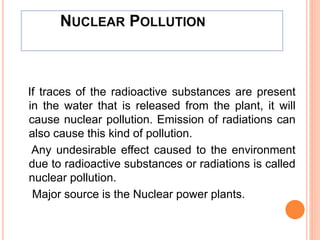
If traces of the radioactive substances are present
in the water that is released from the plant, it will
cause nuclear pollution. Emission of radiations can
also cause this kind of pollution.
Any undesirable effect caused to the environment
due to radioactive substances or radiations is called
nuclear pollution.
Major source is the Nuclear power plants.
NUCLEAR POLLUTION
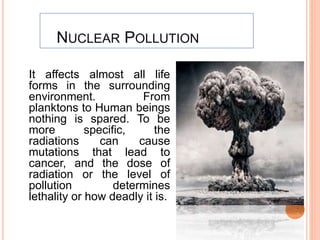
It affects almost all life
forms in the surrounding
environment. From
planktons to Human beings
nothing is spared. To be
more specific, the
radiations can cause
mutations that lead to
cancer, and the dose of
radiation or the level of
pollution determines
lethality or how deadly it is.
NUCLEAR POLLUTION
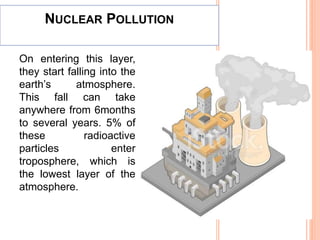
On entering this layer,
they start falling into the
earth’s atmosphere.
This fall can take
anywhere from 6months
to several years. 5% of
these radioactive
particles enter
troposphere, which is
the lowest layer of the
atmosphere.
NUCLEAR POWER
Nuclear power has developed into a mature
and commercial reality with its part of
success and threats. Although nuclear
power can be used to generate electricity in
an environment friendly manner, it is a
subject of controversies owing to the threats
related to it. Nuclear power has positive as
well as negative impacts on people, society
and environment Positive Impacts on
People.
NUCLEAR POWER
The potential of nuclear power has been
recognized by people. It is capable of providing
unlimited and easily accessible energy. Due to
the depletion in reserves of fossil fuels, costs of
fuels and power is increasing at a fast pace
which is directly affecting the people. Besides,
the use of fossil fuels results in production of
harmful oxides of carbon and nitrogen which
have an adverse effect on the health of humans
causing diseases like asthma, cancer, etc.
NUCLEAR RADIATION
Radiation is really nothing more than the emission of
energy waves through space, as well as through
physical objects. Usually these energy waves are
electromagnetic radiation which is classified into
Radio waves, Infrared waves, visible light, Ultraviolet
waves, X-ray, Gamma rays and Cosmic rays. The
actual radioactivity is a result of radioactive decay.
The three types of radiation with varying abilities to
penetrate objects or bodies are: Alpha, Beta, and
Gamma radiation.
NUCLEAR RADIATION
You can shield yourself from alpha radiation by
something as flimsy as a sheet of paper. Beta rays
need six millimeters of aluminum and gamma rays
are stopped by dense material only, like lead. These
travel easily through an inch of lead. And the higher
you are in the Earth’s atmosphere the more
exposed you are to these rays because the further
they travel into our atmosphere the more they are
slowed down. Astronauts are exposed to high levels
of cosmic radiation.
NUCLEAR POLLUTION
Nuclear hazard effects can be either initial or
residual. Initial effects occur in the immediate area
of explosion and are hazardous immediately after
the explosion where as the residual effects can last
for days or years and cause death. The principal
initial effects are blast and radiation. Blast causes
damage to lungs, ruptures eardrums, collapses
structures and causes immediate death or injury.
Thermal Radiation is the heat and light radiation,
which a nuclear explosion’s fireball emits producing
extensive fires, skin burns, and flash blindness.
NUCLEAR POLLUTION
However, nuclear pollution is
extremely hazardous in nature.
It occurs as a result of nuclear
explosions that are performed
while conducting nuclear tests.
These nuclear tests are carried
out to invent better nuclear
weapons. The explosions
cause release of 15 to 20%
radioactive material into the
stratosphere.
Nuclear radiation consists of intense
gamma rays And neutrons produced
during the first minute after
The explosion. This radiation causes
Extensive damage to cells throughout
the body. Radiation damage may cause
headaches, nausea, vomiting, diarrhea,
and even death, depending on the
radiation dose received. The sources of
Radiation pollution involve any process
That emanates radiation in the
environment.
CAUSES
 Nuclear explosions and detonations of nuclear
weapons –U-235, Pu-239 for fission, H & Li for
fusion. Fallouts contain Sr-90, Cs-137, I-131
 Nuclear waste handling and disposal-high level &
low level
 Mining –radioactive gases like radon
 Nuclear accidents
 Medical X-Rays-from diagnostic X-rays & radiation
therapy for cancer.
 Nuclear reactors-U-235, U-238, Th-232
IMPACTS
The smallest particles of the radioactive material
are called fallout. The fallout settles on the leaves
of plants and trees. These leaves are eaten by the
grazing animals. Radioactive material now enters
the ecosystem. Humans consume these particles
through the process of food chain. Serious health
problems now arise. Ingestion of radioactive material
can lead to cancer and genetic mutation in humans.
Fallouts that do not drop on leaves accumulate over
the sea. This can be harmful for the sea life, which
ultimately affects the humans.
SOURCES OF NUCLEAR POLLUTION
The sources of radioactivity include both natural
and manmade.
EFFECTS OF NUCLEAR POLLUTION
Studies have shown that the health effects
due to radiation are dependent on the level of
dose, kind of radiation, duration of exposure
and types of cells irradiated. Radiation effects
can be somatic or genetic.
1. SOMATIC EFFECTS:
Somatic effects the function of cells
and organs. It causes damages to
cell membranes, mitochondria and
cell nuclei resulting in abnormal cell
functions, cell division, growth and
death.
2. GENETIC EFFECTS:
Genetic effects the future generations.
Radiations can cause mutations, which
are changes in genetic makeup of cells.
These effects are mainly due to the
damages to DNA molecules. People
suffer from blood cancer and bone
cancer if exposed to doses around 100
to 1000 roentgens. Instantaneous
deaths on exposure in the event if
disasters are many.
MANAGEMENT OF RADIOACTIVE WASTE
 The radioactive waste which comes out from
industry, nuclear reactors should be stored and
allowed to decay either naturally in closed drums or
in very large underground air tight cemented tanks
(Delay and Decay).
 The intermediate radioactive waste should be
disposed off into the environment after diluting it
with some inert materials (Dilute and Disperse)
 Now-a-days small quantities of high activity wastes
are converted into solids such as concrete and then
it is buried underground or sea. (Concentrate and
contain)
CONTROL MEASURES
 Laboratory generated nuclear wastes should be
disposed off safely and scientifically.
 Nuclear power plants should be located in areas
after careful study of the geology of the area,
tectonic activity and meeting other established
conditions.
 Appropriate protection against occupational
exposure.
 Leakage of radioactive elements from nuclear
reactors, careless use of radioactive elements as
fuel and careless handling of radioactive isotopes
must be prevented.
CONTROL MEASURES
 Safety measure against accidental release of
radioactive elements must be ensured in nuclear
plants.
 Unless absolutely necessary, one should not
frequently go for diagnosis by x-rays.
 Regular monitoring of the presence of radioactive
substance in high risk area should be ensured.
Among the many options for waste disposal, the
scientists prefer to bury the waste in hundreds of
meters deep in the earth’s crust is considered to be
the best safety long term option.
THANK YOU

Nuclear pollution

  • 1.
    NUCLEAR POLLUTION Presented by SABRES Bangladeshuniversity of Business & Technology
  • 2.
    SABRES 1.Yeasmin Akter 2.Rokeya SutanaKeya 3.Joynul Abedin Asif 4.IstiaqAhmed Saif 5.Md Sabbir Hossen Sonet
  • 3.
    TOPIC TO BEDISCUSSED  Nuclear pollution  Its impact on Environment  It’s sources  Nuclear pollution’s effect  And it’s control
  • 4.
    NUCLEAR POLLUTION “We can’tsee it. We can’t smell it. We can’t touch it. The effects may not show up now, in this decade, this generation even in this century. Nevertheless, these senseless nuclear impacts on us are far beyond imagination…”
  • 5.
    NUCLEAR POLLUTION If tracesof the radioactive substances are present in the water that is released from the plant, it will cause nuclear pollution. Emission of radiations can also cause this kind of pollution. Any undesirable effect caused to the environment due to radioactive substances or radiations is called nuclear pollution. Major source is the Nuclear power plants.
  • 6.
    NUCLEAR POLLUTION It affectsalmost all life forms in the surrounding environment. From planktons to Human beings nothing is spared. To be more specific, the radiations can cause mutations that lead to cancer, and the dose of radiation or the level of pollution determines lethality or how deadly it is.
  • 7.
    NUCLEAR POLLUTION On enteringthis layer, they start falling into the earth’s atmosphere. This fall can take anywhere from 6months to several years. 5% of these radioactive particles enter troposphere, which is the lowest layer of the atmosphere.
  • 8.
    NUCLEAR POWER Nuclear powerhas developed into a mature and commercial reality with its part of success and threats. Although nuclear power can be used to generate electricity in an environment friendly manner, it is a subject of controversies owing to the threats related to it. Nuclear power has positive as well as negative impacts on people, society and environment Positive Impacts on People.
  • 9.
    NUCLEAR POWER The potentialof nuclear power has been recognized by people. It is capable of providing unlimited and easily accessible energy. Due to the depletion in reserves of fossil fuels, costs of fuels and power is increasing at a fast pace which is directly affecting the people. Besides, the use of fossil fuels results in production of harmful oxides of carbon and nitrogen which have an adverse effect on the health of humans causing diseases like asthma, cancer, etc.
  • 10.
    NUCLEAR RADIATION Radiation isreally nothing more than the emission of energy waves through space, as well as through physical objects. Usually these energy waves are electromagnetic radiation which is classified into Radio waves, Infrared waves, visible light, Ultraviolet waves, X-ray, Gamma rays and Cosmic rays. The actual radioactivity is a result of radioactive decay. The three types of radiation with varying abilities to penetrate objects or bodies are: Alpha, Beta, and Gamma radiation.
  • 12.
    NUCLEAR RADIATION You canshield yourself from alpha radiation by something as flimsy as a sheet of paper. Beta rays need six millimeters of aluminum and gamma rays are stopped by dense material only, like lead. These travel easily through an inch of lead. And the higher you are in the Earth’s atmosphere the more exposed you are to these rays because the further they travel into our atmosphere the more they are slowed down. Astronauts are exposed to high levels of cosmic radiation.
  • 13.
    NUCLEAR POLLUTION Nuclear hazardeffects can be either initial or residual. Initial effects occur in the immediate area of explosion and are hazardous immediately after the explosion where as the residual effects can last for days or years and cause death. The principal initial effects are blast and radiation. Blast causes damage to lungs, ruptures eardrums, collapses structures and causes immediate death or injury. Thermal Radiation is the heat and light radiation, which a nuclear explosion’s fireball emits producing extensive fires, skin burns, and flash blindness.
  • 14.
    NUCLEAR POLLUTION However, nuclearpollution is extremely hazardous in nature. It occurs as a result of nuclear explosions that are performed while conducting nuclear tests. These nuclear tests are carried out to invent better nuclear weapons. The explosions cause release of 15 to 20% radioactive material into the stratosphere.
  • 15.
    Nuclear radiation consistsof intense gamma rays And neutrons produced during the first minute after The explosion. This radiation causes Extensive damage to cells throughout the body. Radiation damage may cause headaches, nausea, vomiting, diarrhea, and even death, depending on the radiation dose received. The sources of Radiation pollution involve any process That emanates radiation in the environment.
  • 16.
    CAUSES  Nuclear explosionsand detonations of nuclear weapons –U-235, Pu-239 for fission, H & Li for fusion. Fallouts contain Sr-90, Cs-137, I-131  Nuclear waste handling and disposal-high level & low level  Mining –radioactive gases like radon  Nuclear accidents  Medical X-Rays-from diagnostic X-rays & radiation therapy for cancer.  Nuclear reactors-U-235, U-238, Th-232
  • 17.
    IMPACTS The smallest particlesof the radioactive material are called fallout. The fallout settles on the leaves of plants and trees. These leaves are eaten by the grazing animals. Radioactive material now enters the ecosystem. Humans consume these particles through the process of food chain. Serious health problems now arise. Ingestion of radioactive material can lead to cancer and genetic mutation in humans. Fallouts that do not drop on leaves accumulate over the sea. This can be harmful for the sea life, which ultimately affects the humans.
  • 18.
    SOURCES OF NUCLEARPOLLUTION The sources of radioactivity include both natural and manmade.
  • 19.
    EFFECTS OF NUCLEARPOLLUTION Studies have shown that the health effects due to radiation are dependent on the level of dose, kind of radiation, duration of exposure and types of cells irradiated. Radiation effects can be somatic or genetic.
  • 20.
    1. SOMATIC EFFECTS: Somaticeffects the function of cells and organs. It causes damages to cell membranes, mitochondria and cell nuclei resulting in abnormal cell functions, cell division, growth and death.
  • 21.
    2. GENETIC EFFECTS: Geneticeffects the future generations. Radiations can cause mutations, which are changes in genetic makeup of cells. These effects are mainly due to the damages to DNA molecules. People suffer from blood cancer and bone cancer if exposed to doses around 100 to 1000 roentgens. Instantaneous deaths on exposure in the event if disasters are many.
  • 22.
    MANAGEMENT OF RADIOACTIVEWASTE  The radioactive waste which comes out from industry, nuclear reactors should be stored and allowed to decay either naturally in closed drums or in very large underground air tight cemented tanks (Delay and Decay).  The intermediate radioactive waste should be disposed off into the environment after diluting it with some inert materials (Dilute and Disperse)  Now-a-days small quantities of high activity wastes are converted into solids such as concrete and then it is buried underground or sea. (Concentrate and contain)
  • 23.
    CONTROL MEASURES  Laboratorygenerated nuclear wastes should be disposed off safely and scientifically.  Nuclear power plants should be located in areas after careful study of the geology of the area, tectonic activity and meeting other established conditions.  Appropriate protection against occupational exposure.  Leakage of radioactive elements from nuclear reactors, careless use of radioactive elements as fuel and careless handling of radioactive isotopes must be prevented.
  • 24.
    CONTROL MEASURES  Safetymeasure against accidental release of radioactive elements must be ensured in nuclear plants.  Unless absolutely necessary, one should not frequently go for diagnosis by x-rays.  Regular monitoring of the presence of radioactive substance in high risk area should be ensured. Among the many options for waste disposal, the scientists prefer to bury the waste in hundreds of meters deep in the earth’s crust is considered to be the best safety long term option.
  • 25.