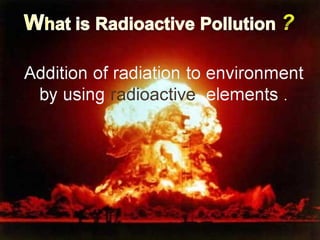
•Radioactive pollution, like any other kind of pollution, is
the release of something unwanted into the environment
and, in this case, the unwanted thing is radioactive
material.
•Radioactive pollution can be defined as the emission of
high energy particles or radioactive substance into air, water
or land due to human activities in the form of radioactive
waste
• Radioactive decay occurs because unstable isotopes tend to
transform into a more stable state. Radioactivity is measured in
terms of disintegrations, or decays, per unit time. Common units of
radioactivity are the Becquerel, equal to 1 decay per second, and the
Curie, equal to 37 billion decays per second.
Radioactive waste is usually the product of a nuclear process such as
nuclear fission, which is extensively used in nuclear reactors, nuclear
weapons and other nuclear fuel-cycles. Radioactive pollution.
Radioactive waste is spread through the earth’s atmosphere is called
“Fallout”.
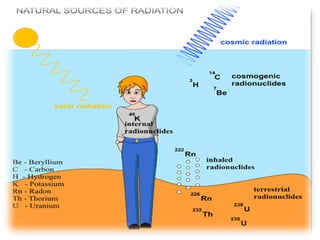
• Cosmic Radiation
• Terrestrial Radiation
• Internal Radiation
• Production and reserch of nuclear weapons
• Mining of radioactive ore
• Medical waste
• Nuclear power plants
• Industrial radiography (X-ray imaging)
• Radioactive materials used in this production have high
health risks and release a small amount of radioactive
pollution.
• Mining these involves crushing and processing of the
radioactive ores and this generates radioactive waste which
emits alpha particles
• A number of radioactive isotopes are used in medicine,
either for treatment or diagnostics. These can be left to
decay over a short period after which they are able to be
disposed of as normal waste
• Nuclear power plants under current standards produce
little radioactive pollution due to safety precautions that
must be adhered to. Accidents at these power plants can
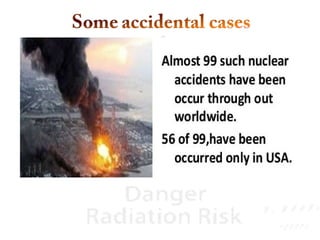
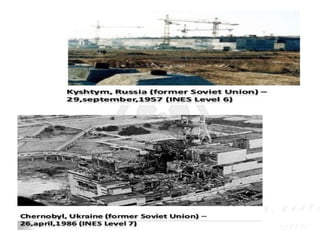
cause dangerously high radioactive pollution, such as in the
case of Chernobyl, and recently in fukushima of japan.
• Continuous Pollution: This type of condition exists in
uranium mines, nuclear reactors, test labs etc. where the
humans are under continuous exposure to radioactive
contaminants and protective clothing is required to
avoid radiation exposure.
• Accidental Pollution: This type of condition exists
during accidental exposure to radiations by virtue of
equipment failure, radiation leak, faulty protective
equipment etc.
• Occasional Pollution: This condition exists during
isolated experiment or test of nuclear substance.
In medicine
- Radiation and radioactive
substances are used for diagnosis,
treatment, and research.
In communication
- All modern communication systems use
forms of electromagnetic radiation.
Variations in the intensity of the radiation
represent changes in the sound, pictures, or
other information being transmitted.
In science
- Researchers use radioactive atoms to determine the
age of materials that were once part of a living organism.
The age of such materials can be estimated by measuring
the amount of radioactive carbon they contain in a process
called radiocarbon dating.
- Environmental scientists use radioactive atoms
known as tracer atoms to identify the pathways taken by
pollutants through the environment.
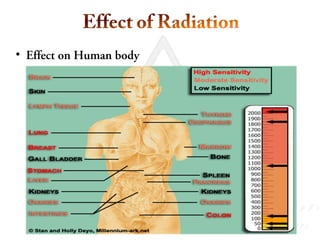
• Effect on Human body
 On Human Beings
• The impact of radioactive pollution on human beings can
vary from mild to fatal; the magnitude of the adverse
effects largely depends on the level and duration of
exposure to radioactivity. Low levels of localized exposure
may only have a superficial effect and cause mild skin
irritation.
• Long-term exposure or exposure to high amounts of
radiation can have far more serious health effects.
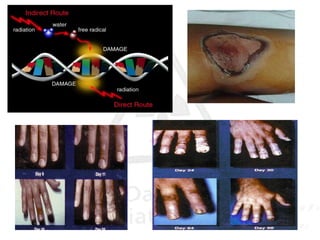
Radioactive rays can cause irreparable damage to DNA
molecules and can lead to a life-threatening condition.
• The rapidly growing/dividing cells, like those of the skin, bone
marrow, are more sensitive towards radioactive emissions.
• On the other hand, cells that do not undergo rapid cell
division, such as bone cells and nervous cells, aren't damaged
so easily.
• Rays from radioactive element can cause
-burns
-cancers (skin cancer, lung cancer, thyroid cancer )
-death
-hair loss
-heart failure
-can damage brain cells
Safety measures should be enforced strictly
Leakages from nuclear reactors, careless handling, transport
and use of radioactive fuels, fission products and radioactive
isotopes have to be totally stopped;
Regular monitoring and quantitative analysis through
frequent sampling in the risk areas;
Waste disposal must be careful, efficient and effective.
appropriate steps should be taken against occupational
exposure.
Safety measures should be strengthened against nuclear
accidents
Preventive measures should be followed so that background
radiation levels do not exceed the permissible limits
• In nuclear reactors, closed cycle coolant system with
gaseous coolants of very high purity may be used to
prevent extraneous activation products.
• Fission reactions should be minimised.
• In nuclear mines, wet drilling may be employed along
with underground drainage.
• Nuclear medicines and radiation therapy should be
applied when absolutely necessary and earth minimum
doses

radioactive-pollution slide share for effectively studying

  • 2.
    •Radioactive pollution, likeany other kind of pollution, is the release of something unwanted into the environment and, in this case, the unwanted thing is radioactive material. •Radioactive pollution can be defined as the emission of high energy particles or radioactive substance into air, water or land due to human activities in the form of radioactive waste
  • 3.
    • Radioactive decayoccurs because unstable isotopes tend to transform into a more stable state. Radioactivity is measured in terms of disintegrations, or decays, per unit time. Common units of radioactivity are the Becquerel, equal to 1 decay per second, and the Curie, equal to 37 billion decays per second. Radioactive waste is usually the product of a nuclear process such as nuclear fission, which is extensively used in nuclear reactors, nuclear weapons and other nuclear fuel-cycles. Radioactive pollution. Radioactive waste is spread through the earth’s atmosphere is called “Fallout”.
  • 4.
    • Cosmic Radiation •Terrestrial Radiation • Internal Radiation • Production and reserch of nuclear weapons • Mining of radioactive ore • Medical waste • Nuclear power plants • Industrial radiography (X-ray imaging)
  • 6.
    • Radioactive materialsused in this production have high health risks and release a small amount of radioactive pollution. • Mining these involves crushing and processing of the radioactive ores and this generates radioactive waste which emits alpha particles
  • 7.
    • A numberof radioactive isotopes are used in medicine, either for treatment or diagnostics. These can be left to decay over a short period after which they are able to be disposed of as normal waste • Nuclear power plants under current standards produce little radioactive pollution due to safety precautions that must be adhered to. Accidents at these power plants can cause dangerously high radioactive pollution, such as in the case of Chernobyl, and recently in fukushima of japan.
  • 8.
    • Continuous Pollution:This type of condition exists in uranium mines, nuclear reactors, test labs etc. where the humans are under continuous exposure to radioactive contaminants and protective clothing is required to avoid radiation exposure. • Accidental Pollution: This type of condition exists during accidental exposure to radiations by virtue of equipment failure, radiation leak, faulty protective equipment etc. • Occasional Pollution: This condition exists during isolated experiment or test of nuclear substance.
  • 9.
    In medicine - Radiationand radioactive substances are used for diagnosis, treatment, and research. In communication - All modern communication systems use forms of electromagnetic radiation. Variations in the intensity of the radiation represent changes in the sound, pictures, or other information being transmitted.
  • 10.
    In science - Researchersuse radioactive atoms to determine the age of materials that were once part of a living organism. The age of such materials can be estimated by measuring the amount of radioactive carbon they contain in a process called radiocarbon dating. - Environmental scientists use radioactive atoms known as tracer atoms to identify the pathways taken by pollutants through the environment.
  • 11.
    • Effect onHuman body
  • 12.
     On HumanBeings • The impact of radioactive pollution on human beings can vary from mild to fatal; the magnitude of the adverse effects largely depends on the level and duration of exposure to radioactivity. Low levels of localized exposure may only have a superficial effect and cause mild skin irritation. • Long-term exposure or exposure to high amounts of radiation can have far more serious health effects. Radioactive rays can cause irreparable damage to DNA molecules and can lead to a life-threatening condition.
  • 13.
    • The rapidlygrowing/dividing cells, like those of the skin, bone marrow, are more sensitive towards radioactive emissions. • On the other hand, cells that do not undergo rapid cell division, such as bone cells and nervous cells, aren't damaged so easily. • Rays from radioactive element can cause -burns -cancers (skin cancer, lung cancer, thyroid cancer ) -death -hair loss -heart failure -can damage brain cells
  • 18.
    Safety measures shouldbe enforced strictly Leakages from nuclear reactors, careless handling, transport and use of radioactive fuels, fission products and radioactive isotopes have to be totally stopped; Regular monitoring and quantitative analysis through frequent sampling in the risk areas; Waste disposal must be careful, efficient and effective. appropriate steps should be taken against occupational exposure. Safety measures should be strengthened against nuclear accidents Preventive measures should be followed so that background radiation levels do not exceed the permissible limits
  • 19.
    • In nuclearreactors, closed cycle coolant system with gaseous coolants of very high purity may be used to prevent extraneous activation products. • Fission reactions should be minimised. • In nuclear mines, wet drilling may be employed along with underground drainage. • Nuclear medicines and radiation therapy should be applied when absolutely necessary and earth minimum doses