Radioactive Pollution
Taskeen Rubab
28145
Basic ENV Chemistry
What is Radioactive pollution?
Addition of radiation to environment by using
radioactive elements
•Radioactive pollution
• is the release of something unwanted into the
environment
• in this case, the unwanted thing is radioactive material.
• Radioactive pollution
• can be defined as the emission of high energy particles
• radioactive substance into air, water or land
• due to human activities in the form of radioactive waste
Sources of radiation
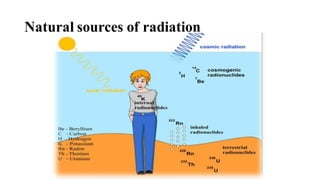
• Natural resources
• Cosmic Radiation
• Terrestrial Radiation
• Internal Radiation
• Man-made resources
• Production and
research of nuclear weapons
• Mining of radioactive ore
• Medical waste
• Nuclear power plants
• Industrial radiography (X-
ray imaging)
Natural sources of radiation
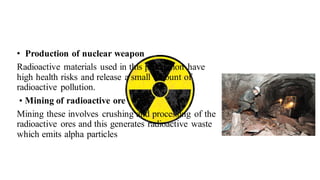
• Production of nuclear weapon
Radioactive materials used in this production have
high health risks and release a small amount of
radioactive pollution.
• Mining of radioactive ore
Mining these involves crushing and processing of the
radioactive ores and this generates radioactive waste
which emits alpha particles
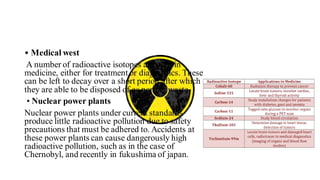
• Medical west
A number of radioactive isotopes are used in
medicine, either for treatment or diagnostics. These
can be left to decay over a short period after which
they are able to be disposed of as normal waste
• Nuclear power plants
Nuclear power plants under current standards
produce little radioactive pollution due to safety
precautions that must be adhered to. Accidents at
these power plants can cause dangerously high
radioactive pollution, such as in the case of
Chernobyl, and recently in fukushima of japan.
Uses of radiations
• In medicine - Radiation and radioactive substances are
used for diagnosis, treatment, and research.
• In communication - All modern communication systems
use forms of electromagnetic radiation. Variations in the
intensity of the radiation represent changes in the sound,
pictures, or other information being transmitted.
• Environmental scientists use radioactive atoms known as
tracer atoms to identify the pathways taken by pollutants
through the environment.
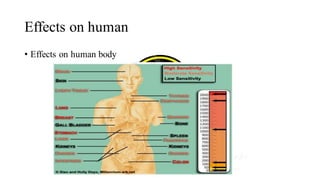
Effects on human
• Effects on human body
On Human Beings
• The impact of radioactive pollution on human beings can vary from
mild to fatal; the magnitude of the adverse effects largely depends on
the level and duration of exposure to radioactivity. Low levels of
localized exposure may only have a superficial effect and cause mild
skin irritation.
• Long-term exposure or exposure to high amounts of radiation can
have far more serious health effects. Radioactive rays can cause
irreparable damage to DNA molecules and can lead to a life-threatening
condition.
• The rapidly growing/dividing cells, like those of the skin, bone marrow, are
more sensitive towards radioactive emissions.
• On the other hand, cells that do not undergo rapid cell division, such as bone
cells and nervous cells, aren't damaged so easily
• Rays from radioactive element can cause
-burns
-cancers (skin cancer, lung cancer, thyroid cancer )
-death
-hair loss
-heart failure
-can damage brain cells
Prevention
• Safety measures should be enforced strictly
• Leakages from nuclear reactors, careless handling, transport and use
of radioactive fuels, fission products and radioactive isotopes have to
be totally stopped;
• Regular monitoring and quantitative analysis through frequent
sampling in the risk areas;
• Waste disposal must be careful, efficient and effective.
• appropriate steps should be taken against occupational exposure.
• Safety measures should be strengthened against nuclear accidents
• Preventive measures should be followed so that background radiation
levels do not exceed the permissible limits
Conclusion
• Overall, nuclear energy has several ghastly risks for us and the next
generations, and we are living with them and are responsible for them.
• None of the nuclear plants, wastes, or weapons will disappear in this
world because they overwhelmingly need a long time to be safety
disposed of, even if we can dispose of them, they are still around us,
we just cannot see it. So, what we can do is to dwindle the usage of
nuclear power for the future.
• The third nuclear plants(Chernobyl, Three Mile Island, Fukushikma)
disaster should be a turning point for us. It is not too late for us to
change our goal, although we have a responsibility for nuclear power
because we are using it. I really hope that the future without nuclear
power will come.
• Fossil fuels such as oil, gas, and uranium are finite and Non-
Renewable Resources on the earth, and global warming has become a
serious issue for us, we have started looking for alternative eco-
friendly energy sources. Like As : solar, tidal, wind, and geothermal
energy.
• Offshore wind farming will be another good alternative for us.
THANK YOU
SAY NO TO URANIUM

Radioactive pollution taskeen rubab 28145

  • 1.
  • 2.
    What is Radioactivepollution? Addition of radiation to environment by using radioactive elements
  • 3.
    •Radioactive pollution • isthe release of something unwanted into the environment • in this case, the unwanted thing is radioactive material. • Radioactive pollution • can be defined as the emission of high energy particles • radioactive substance into air, water or land • due to human activities in the form of radioactive waste
  • 4.
    Sources of radiation •Natural resources • Cosmic Radiation • Terrestrial Radiation • Internal Radiation • Man-made resources • Production and research of nuclear weapons • Mining of radioactive ore • Medical waste • Nuclear power plants • Industrial radiography (X- ray imaging)
  • 5.
  • 6.
    • Production ofnuclear weapon Radioactive materials used in this production have high health risks and release a small amount of radioactive pollution. • Mining of radioactive ore Mining these involves crushing and processing of the radioactive ores and this generates radioactive waste which emits alpha particles
  • 7.
    • Medical west Anumber of radioactive isotopes are used in medicine, either for treatment or diagnostics. These can be left to decay over a short period after which they are able to be disposed of as normal waste • Nuclear power plants Nuclear power plants under current standards produce little radioactive pollution due to safety precautions that must be adhered to. Accidents at these power plants can cause dangerously high radioactive pollution, such as in the case of Chernobyl, and recently in fukushima of japan.
  • 8.
    Uses of radiations •In medicine - Radiation and radioactive substances are used for diagnosis, treatment, and research. • In communication - All modern communication systems use forms of electromagnetic radiation. Variations in the intensity of the radiation represent changes in the sound, pictures, or other information being transmitted. • Environmental scientists use radioactive atoms known as tracer atoms to identify the pathways taken by pollutants through the environment.
  • 9.
    Effects on human •Effects on human body
  • 10.
    On Human Beings •The impact of radioactive pollution on human beings can vary from mild to fatal; the magnitude of the adverse effects largely depends on the level and duration of exposure to radioactivity. Low levels of localized exposure may only have a superficial effect and cause mild skin irritation. • Long-term exposure or exposure to high amounts of radiation can have far more serious health effects. Radioactive rays can cause irreparable damage to DNA molecules and can lead to a life-threatening condition.
  • 11.
    • The rapidlygrowing/dividing cells, like those of the skin, bone marrow, are more sensitive towards radioactive emissions. • On the other hand, cells that do not undergo rapid cell division, such as bone cells and nervous cells, aren't damaged so easily • Rays from radioactive element can cause -burns -cancers (skin cancer, lung cancer, thyroid cancer ) -death -hair loss -heart failure -can damage brain cells
  • 12.
    Prevention • Safety measuresshould be enforced strictly • Leakages from nuclear reactors, careless handling, transport and use of radioactive fuels, fission products and radioactive isotopes have to be totally stopped; • Regular monitoring and quantitative analysis through frequent sampling in the risk areas; • Waste disposal must be careful, efficient and effective. • appropriate steps should be taken against occupational exposure. • Safety measures should be strengthened against nuclear accidents • Preventive measures should be followed so that background radiation levels do not exceed the permissible limits
  • 13.
    Conclusion • Overall, nuclearenergy has several ghastly risks for us and the next generations, and we are living with them and are responsible for them. • None of the nuclear plants, wastes, or weapons will disappear in this world because they overwhelmingly need a long time to be safety disposed of, even if we can dispose of them, they are still around us, we just cannot see it. So, what we can do is to dwindle the usage of nuclear power for the future. • The third nuclear plants(Chernobyl, Three Mile Island, Fukushikma) disaster should be a turning point for us. It is not too late for us to change our goal, although we have a responsibility for nuclear power because we are using it. I really hope that the future without nuclear power will come.
  • 14.
    • Fossil fuelssuch as oil, gas, and uranium are finite and Non- Renewable Resources on the earth, and global warming has become a serious issue for us, we have started looking for alternative eco- friendly energy sources. Like As : solar, tidal, wind, and geothermal energy. • Offshore wind farming will be another good alternative for us.
  • 15.
    THANK YOU SAY NOTO URANIUM