5G Antenna Design
&
Network Planning
Challenges for 5G
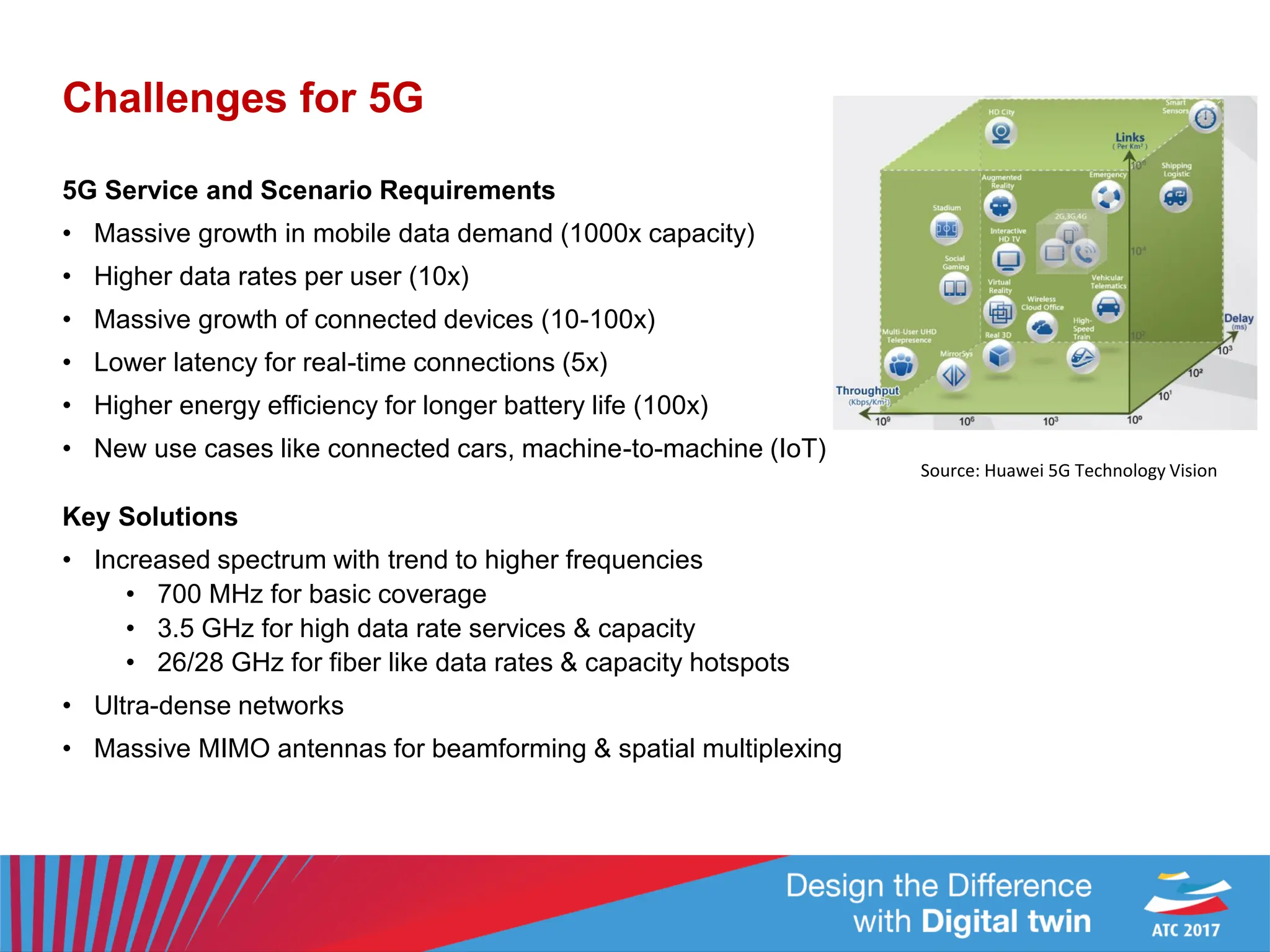
5G Service and Scenario Requirements
• Massive growth in mobile data demand (1000x capacity)
• Higher data rates per user (10x)
• Massive growth of connected devices (10-100x)
• Lower latency for real-time connections (5x)
• Higher energy efficiency for longer battery life (100x)
• New use cases like connected cars, machine-to-machine (IoT)
Key Solutions
• Increased spectrum with trend to higher frequencies
• 700 MHz for basic coverage
• 3.5 GHz for high data rate services & capacity
• 26/28 GHz for fiber like data rates & capacity hotspots
• Ultra-dense networks
• Massive MIMO antennas for beamforming & spatial multiplexing
Source: Huawei 5G Technology Vision
Introduction: Altair’s complete solutions for 5G analysis
• FEKO for 5G Antenna Design Challenges
• Case study I: Mobile antenna design at 26 GHz
• Case study II: Base-station antenna design at 26 GHz
• WinProp for 5G Radio Channel & Coverage Analysis
• Case study I: 5G radio channel statistics for beamforming
and channel analysis
• Case study II: 5G radio planning for different frequency
bands and antenna assumptions
• Conclusions
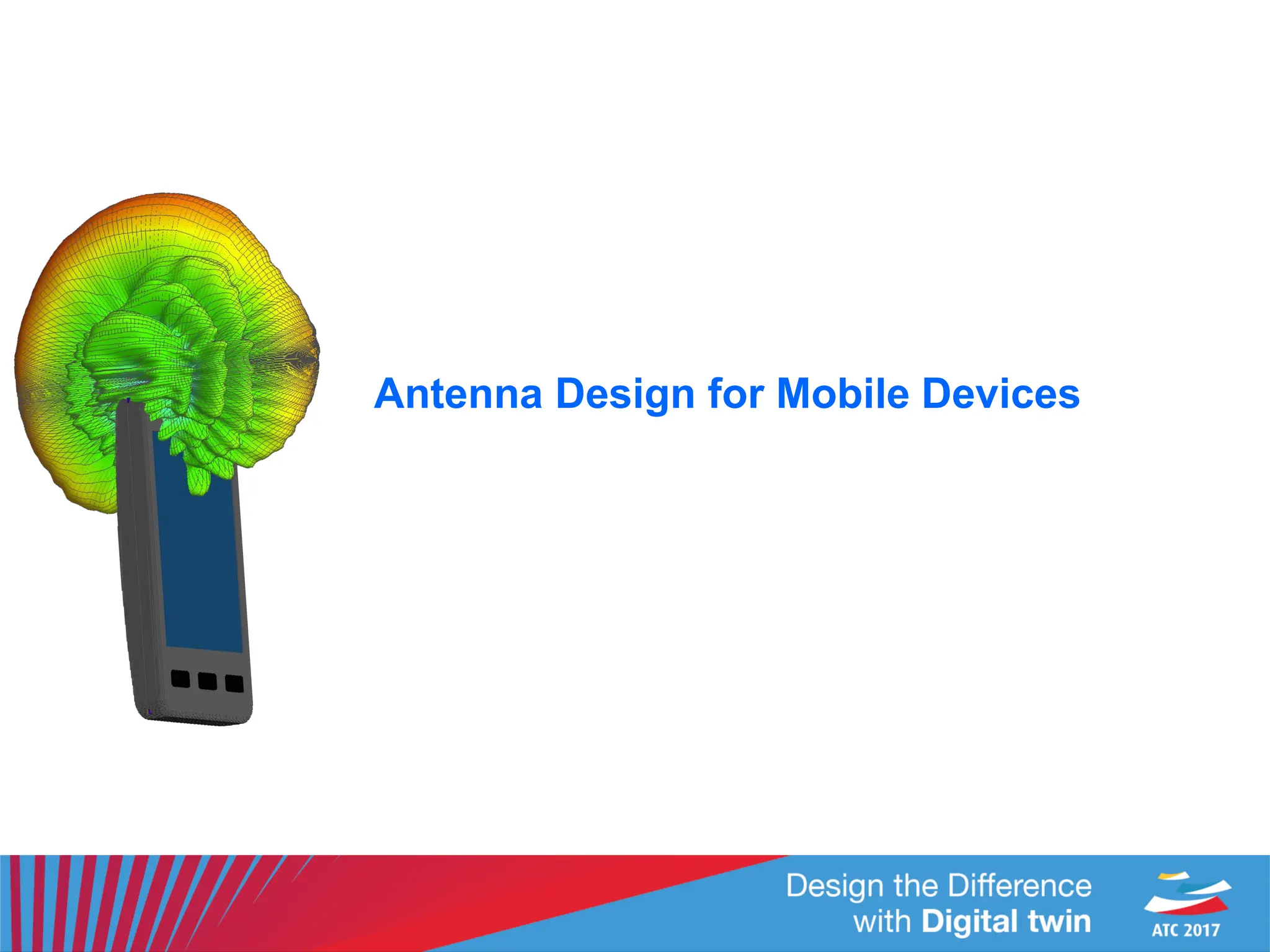
Antenna Design for Mobile Devices
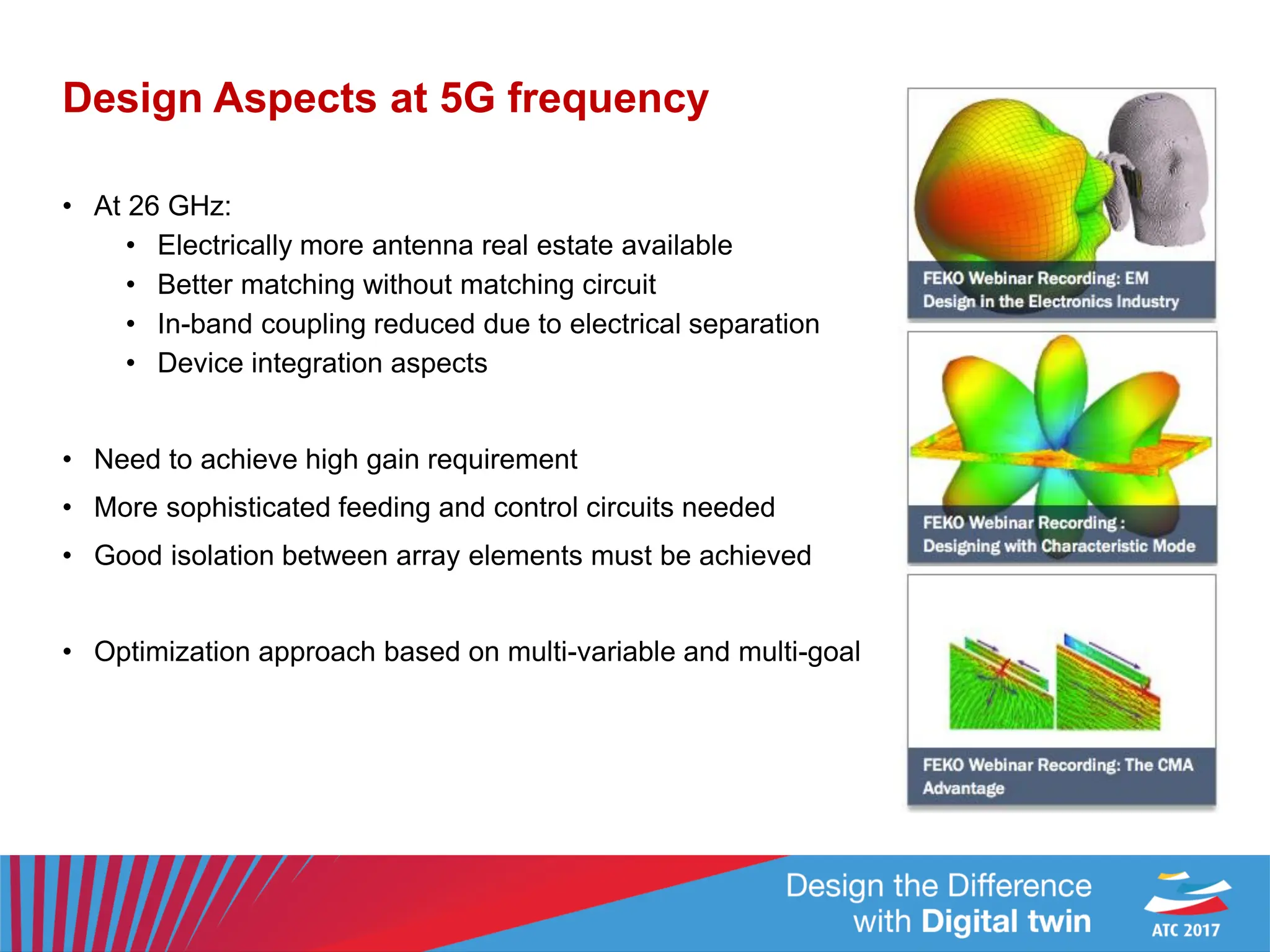
Design Aspects at 5G frequency
• At 26 GHz:
• Electrically more antenna real estate available
• Better matching without matching circuit
• In-band coupling reduced due to electrical separation
• Device integration aspects
• Need to achieve high gain requirement
• More sophisticated feeding and control circuits needed
• Good isolation between array elements must be achieved
• Optimization approach based on multi-variable and multi-goal
Array Design
• Design based on [1] re-optimized for 24-28 GHz band
• WB dipole antenna element in linear 8x array
• Printed, Rogers RT5880 substrate
• Optimization with 5x frequency points
• 8 geometric parameters considered
• Snn & Smn optimization goals
• Optimized with FEKOs GRSM method
• Optimized geometry integrated into PCB
• Simulated with FDTD for full S-parameter and far-field characterization
[1] UWB mm-Wave Antenna Array with Quasi Omnidirectional Beams
for 5G Handheld Devices - N. Parchin, et. al, ICUWB 2016
optimization model
integrated into PCB
single element
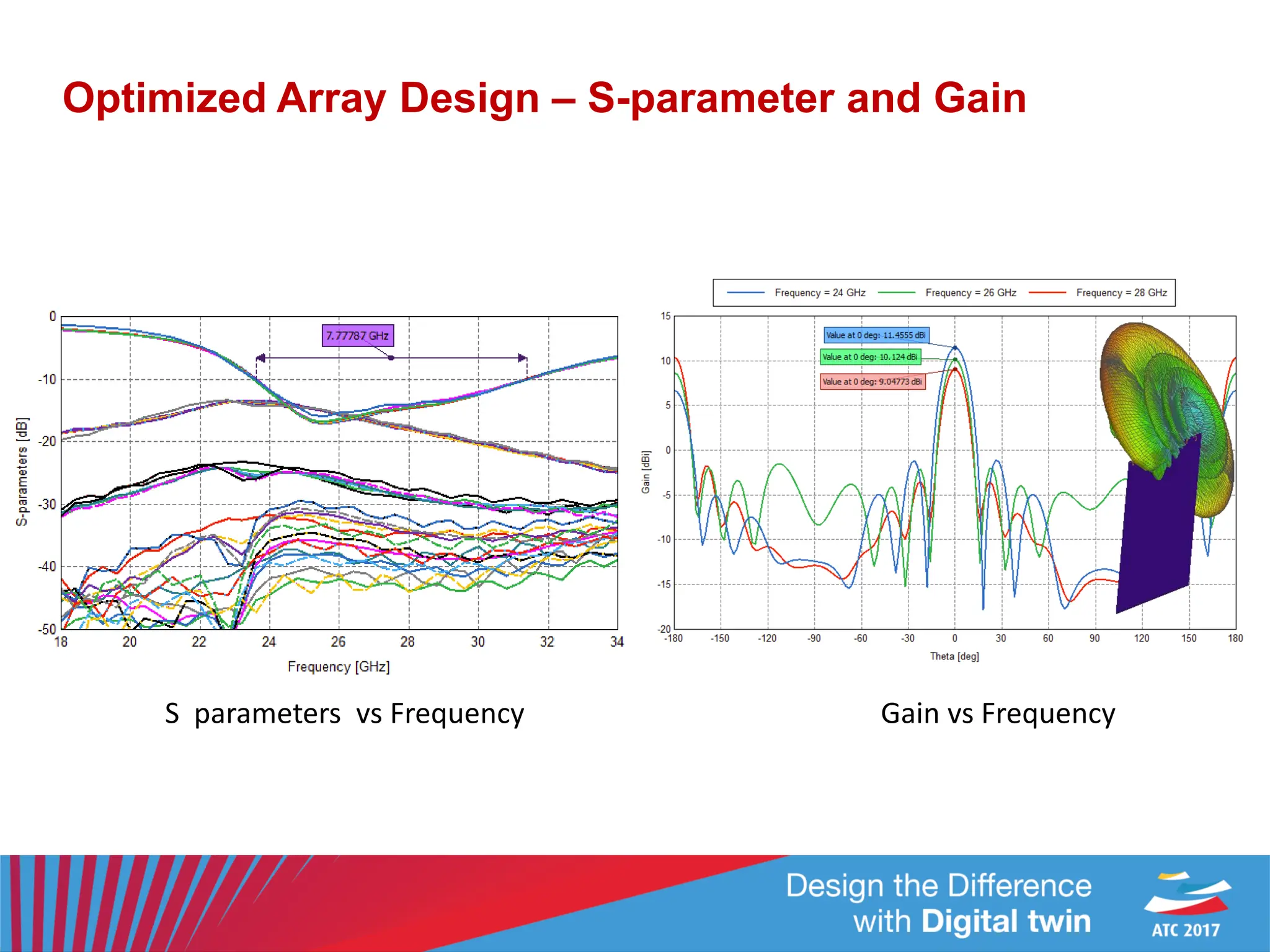
Optimized Array Design – S-parameter and Gain
S parameters vs Frequency Gain vs Frequency
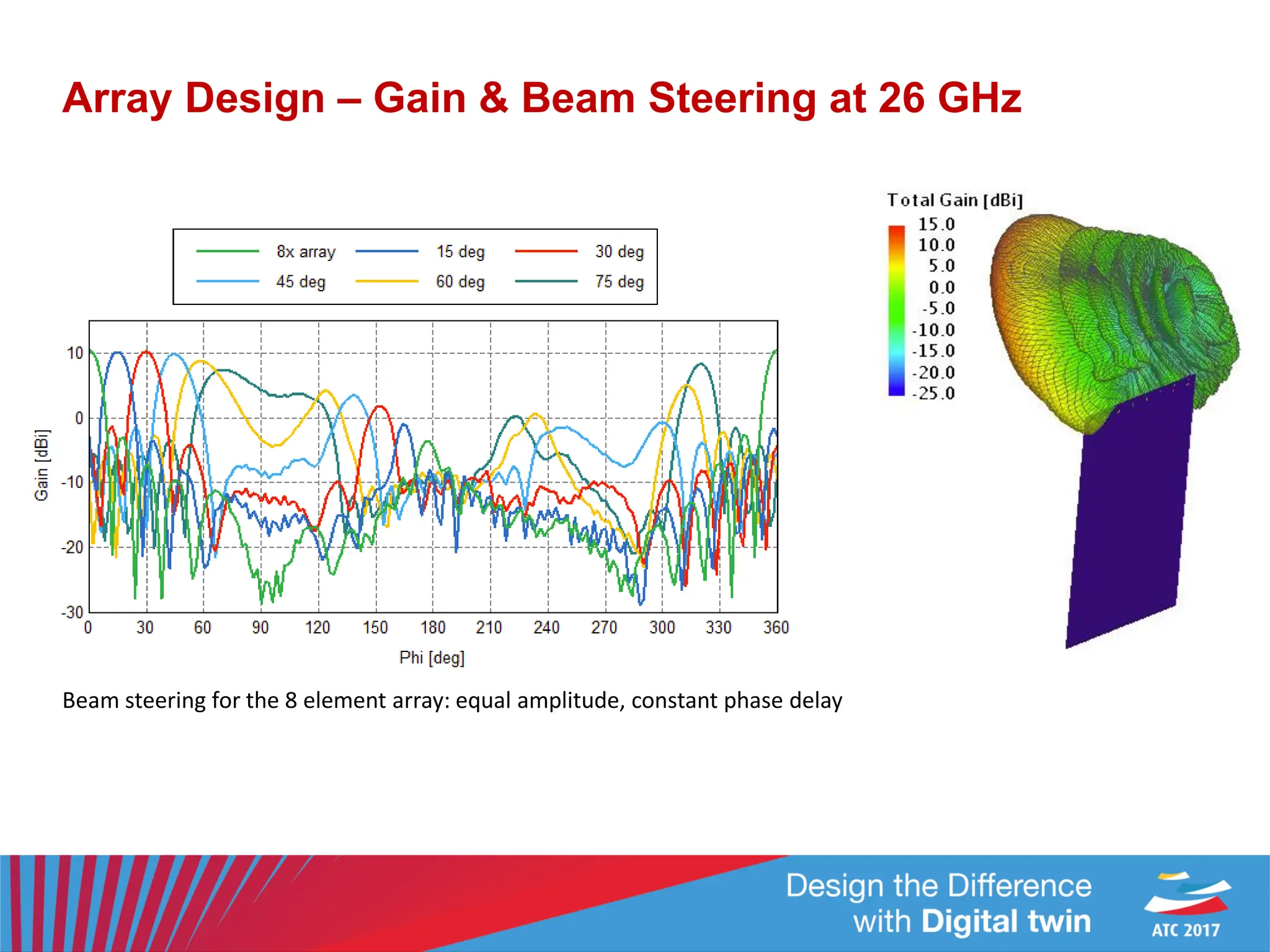
Array Design – Gain & Beam Steering at 26 GHz
Beam steering for the 8 element array: equal amplitude, constant phase delay
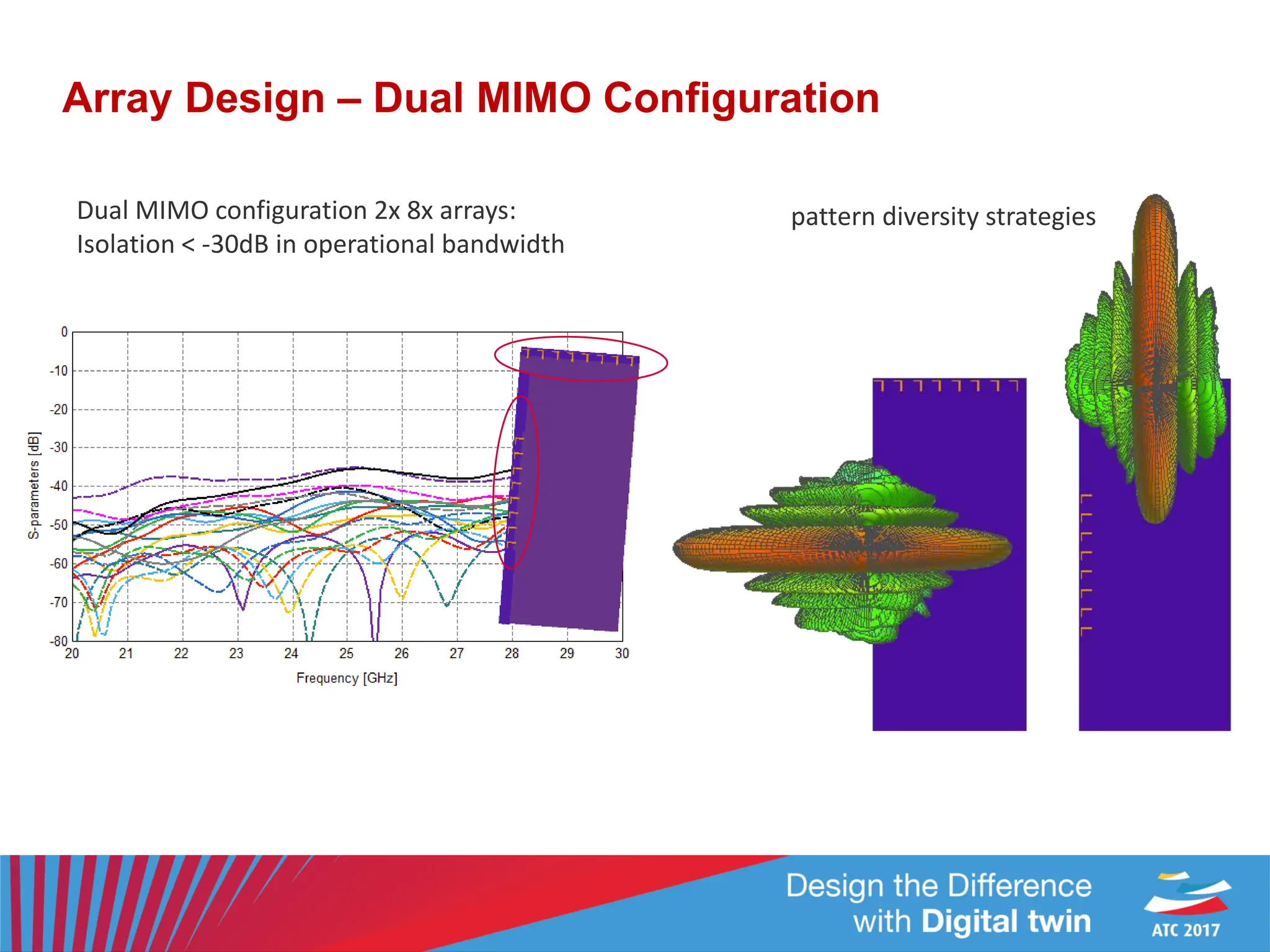
Array Design – Dual MIMO Configuration
Dual MIMO configuration 2x 8x arrays:
Isolation < -30dB in operational bandwidth
pattern diversity strategies
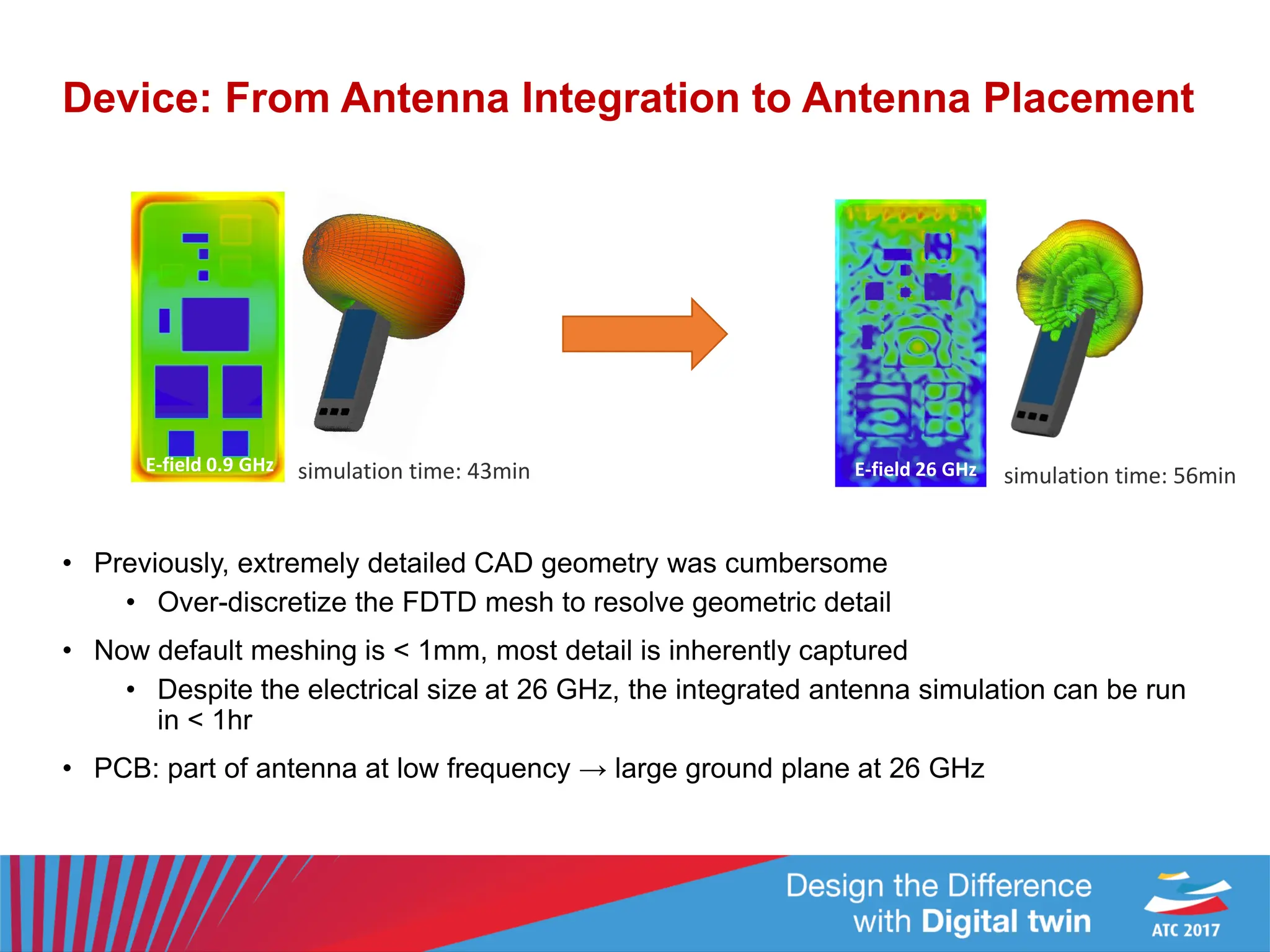
Device: From Antenna Integration to Antenna Placement
• Previously, extremely detailed CAD geometry was cumbersome
• Over-discretize the FDTD mesh to resolve geometric detail
• Now default meshing is < 1mm, most detail is inherently captured
• Despite the electrical size at 26 GHz, the integrated antenna simulation can be run
in < 1hr
• PCB: part of antenna at low frequency → large ground plane at 26 GHz
E-field 26 GHz E-field 0.9 GHz
E-field 0.9 GHz simulation time: 43min simulation time: 56min
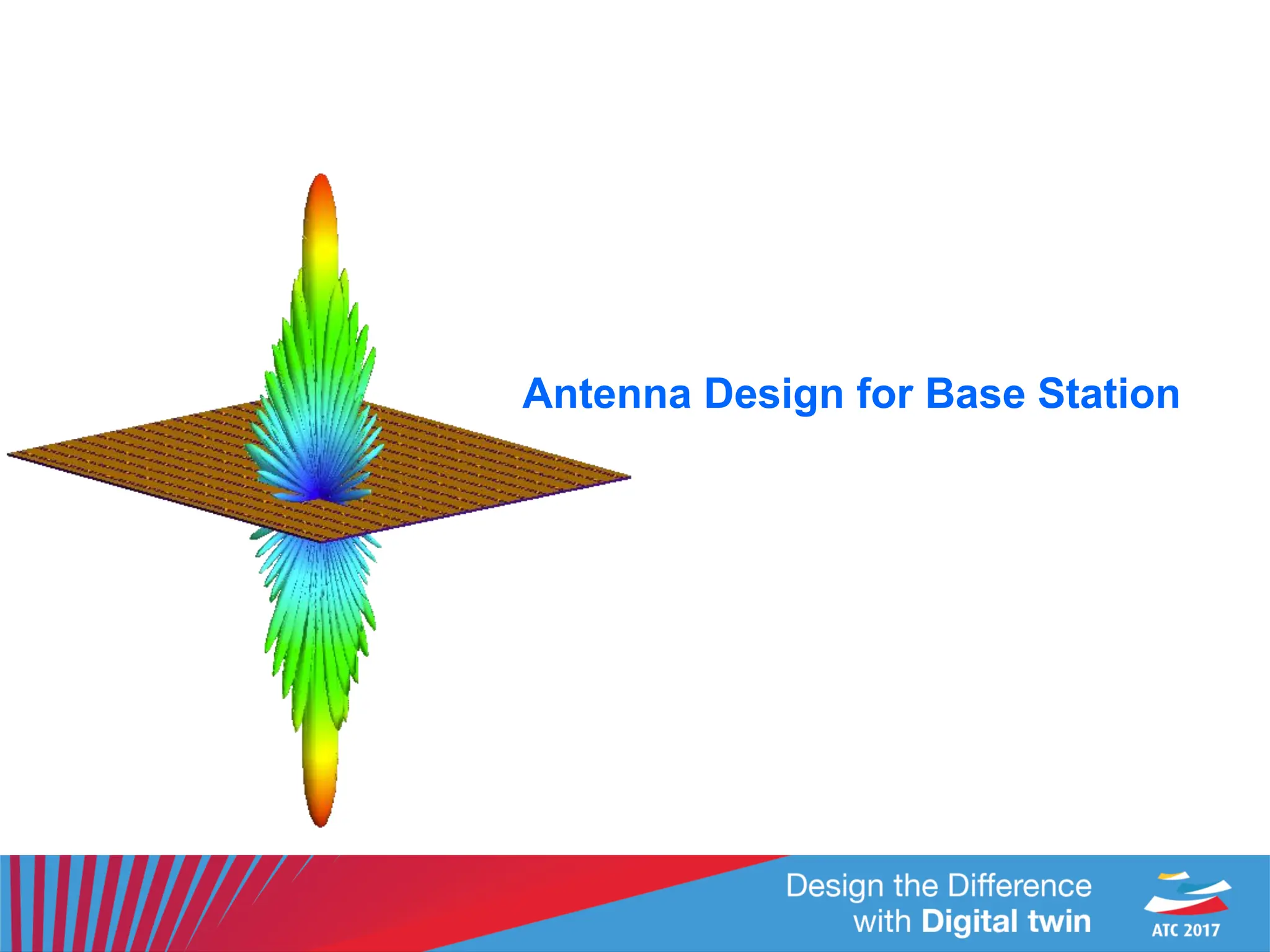
Antenna Design for Base Station
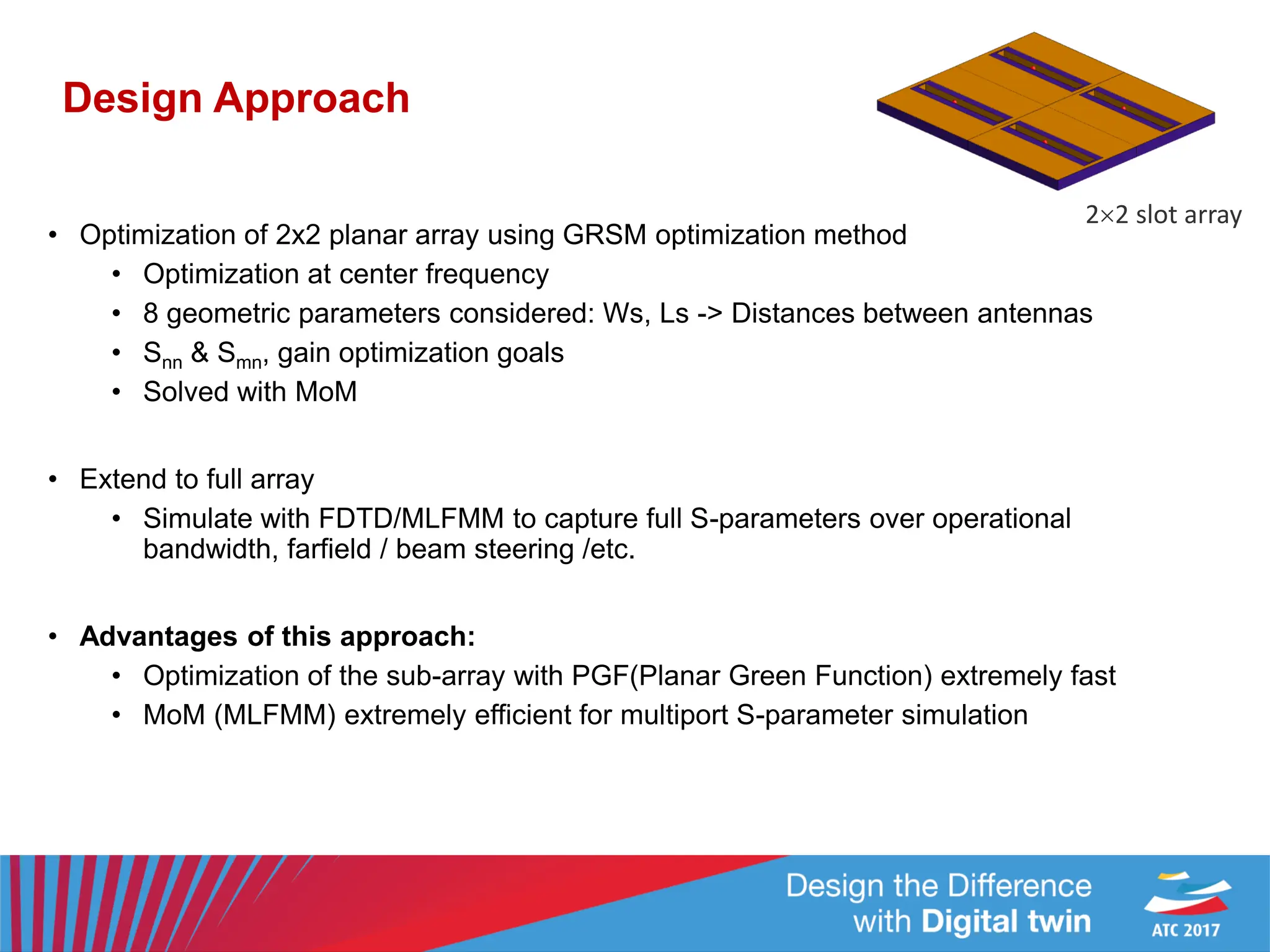
Design Approach
• Optimization of 2x2 planar array using GRSM optimization method
• Optimization at center frequency
• 8 geometric parameters considered: Ws, Ls -> Distances between antennas
• Snn & Smn, gain optimization goals
• Solved with MoM
• Extend to full array
• Simulate with FDTD/MLFMM to capture full S-parameters over operational
bandwidth, farfield / beam steering /etc.
• Advantages of this approach:
• Optimization of the sub-array with PGF(Planar Green Function) extremely fast
• MoM (MLFMM) extremely efficient for multiport S-parameter simulation
22 slot array
Array Design
• Design based on [1] (designed to operate in 22 GHz band) – re-optimized for 26 GHz band
• Loop design, including slot to increase efficiency
• Printed, low cost, FR4 substrate
initial optimization
base element
optimization model
2x2 array 4x4 array 8x8 array 16x16 array
[1] 8×8 Planar Phased Array Antenna with High Efficiency and Insensitivity
Properties for 5G Mobile Base Stations - N. Parchin, et. al, EUCAP 2016
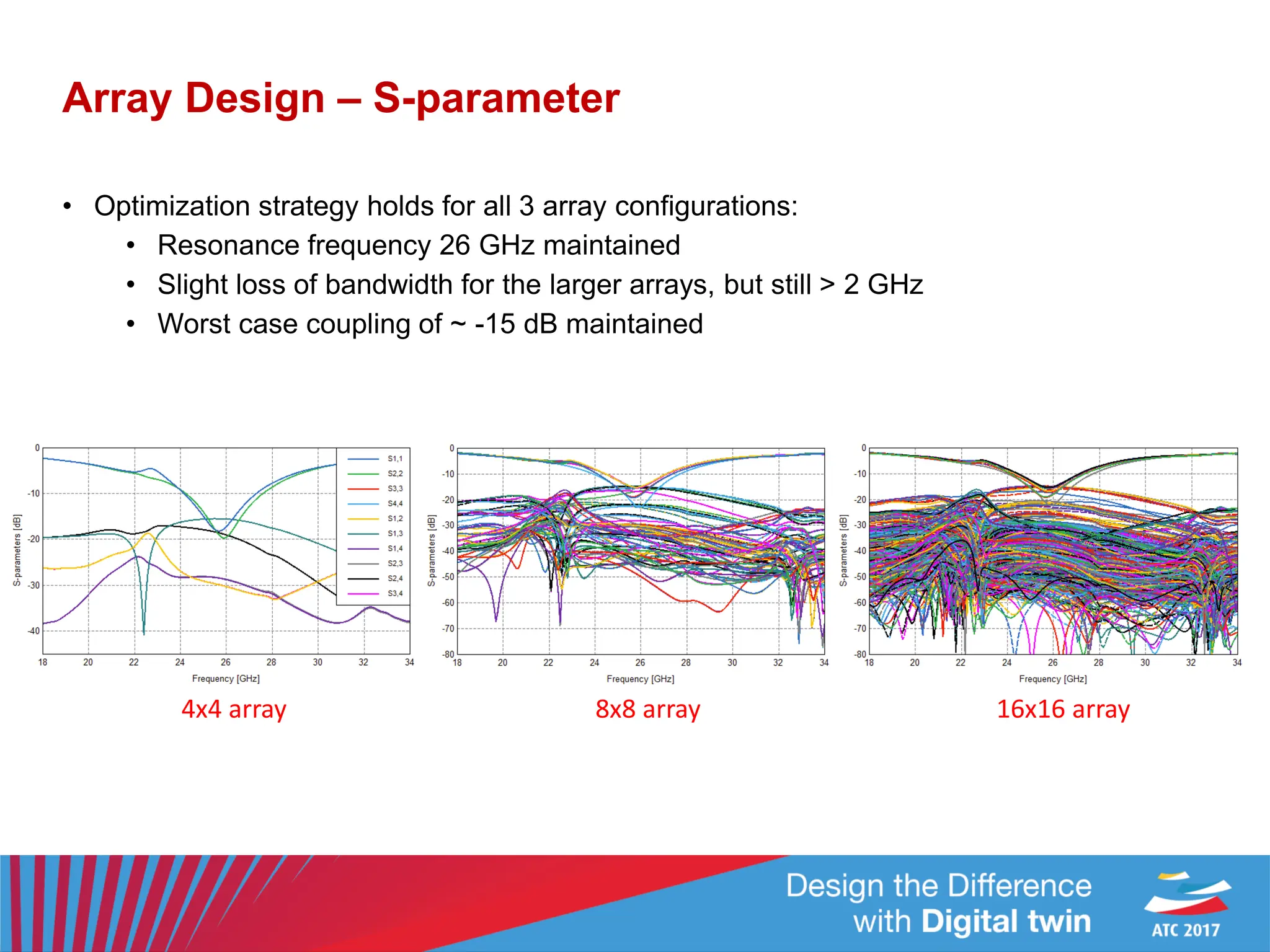
Array Design – S-parameter
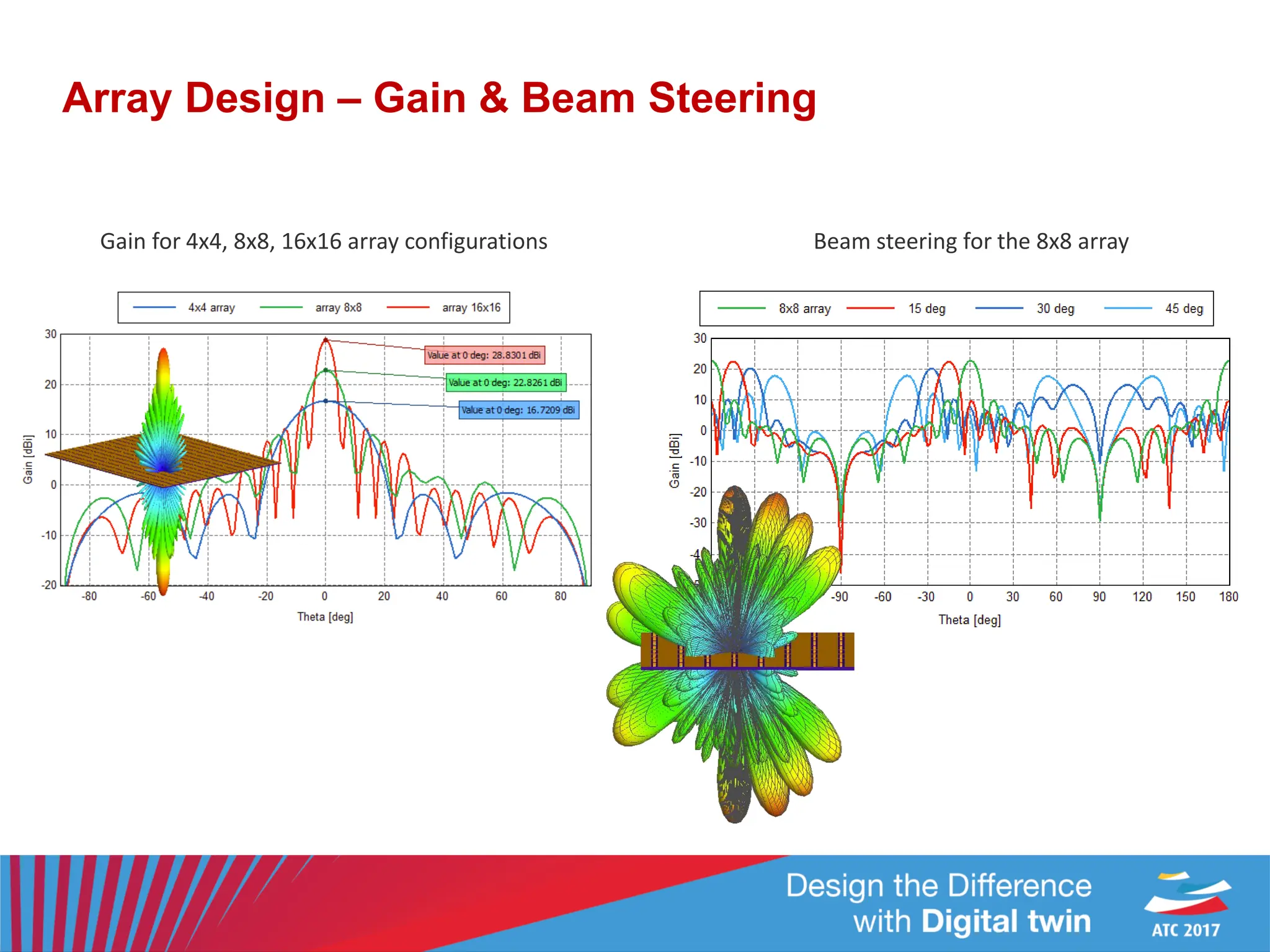
• Optimization strategy holds for all 3 array configurations:
• Resonance frequency 26 GHz maintained
• Slight loss of bandwidth for the larger arrays, but still > 2 GHz
• Worst case coupling of ~ -15 dB maintained
4x4 array 8x8 array 16x16 array
Array Design – Gain & Beam Steering
Gain for 4x4, 8x8, 16x16 array configurations Beam steering for the 8x8 array
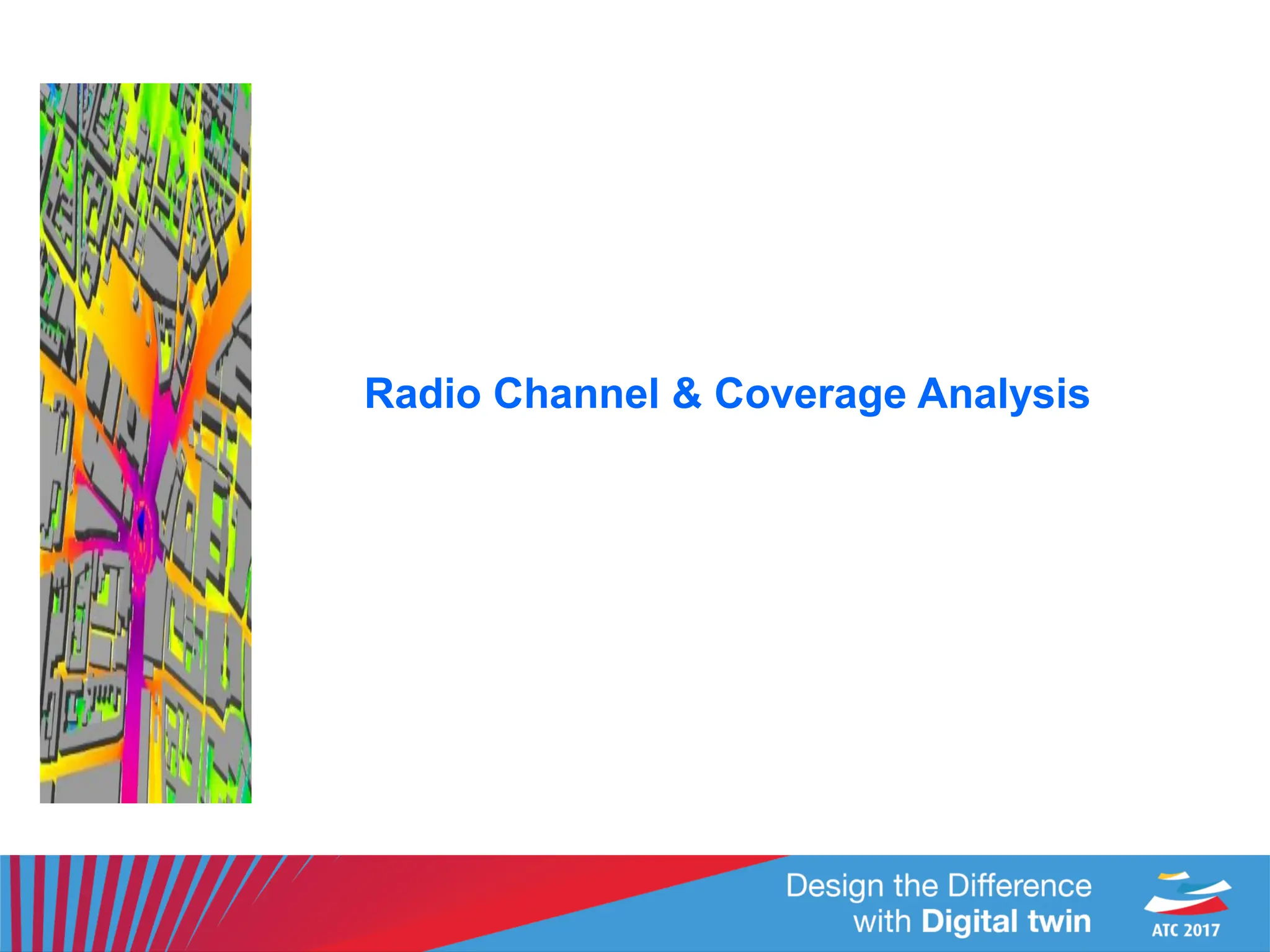
Radio Channel & Coverage Analysis
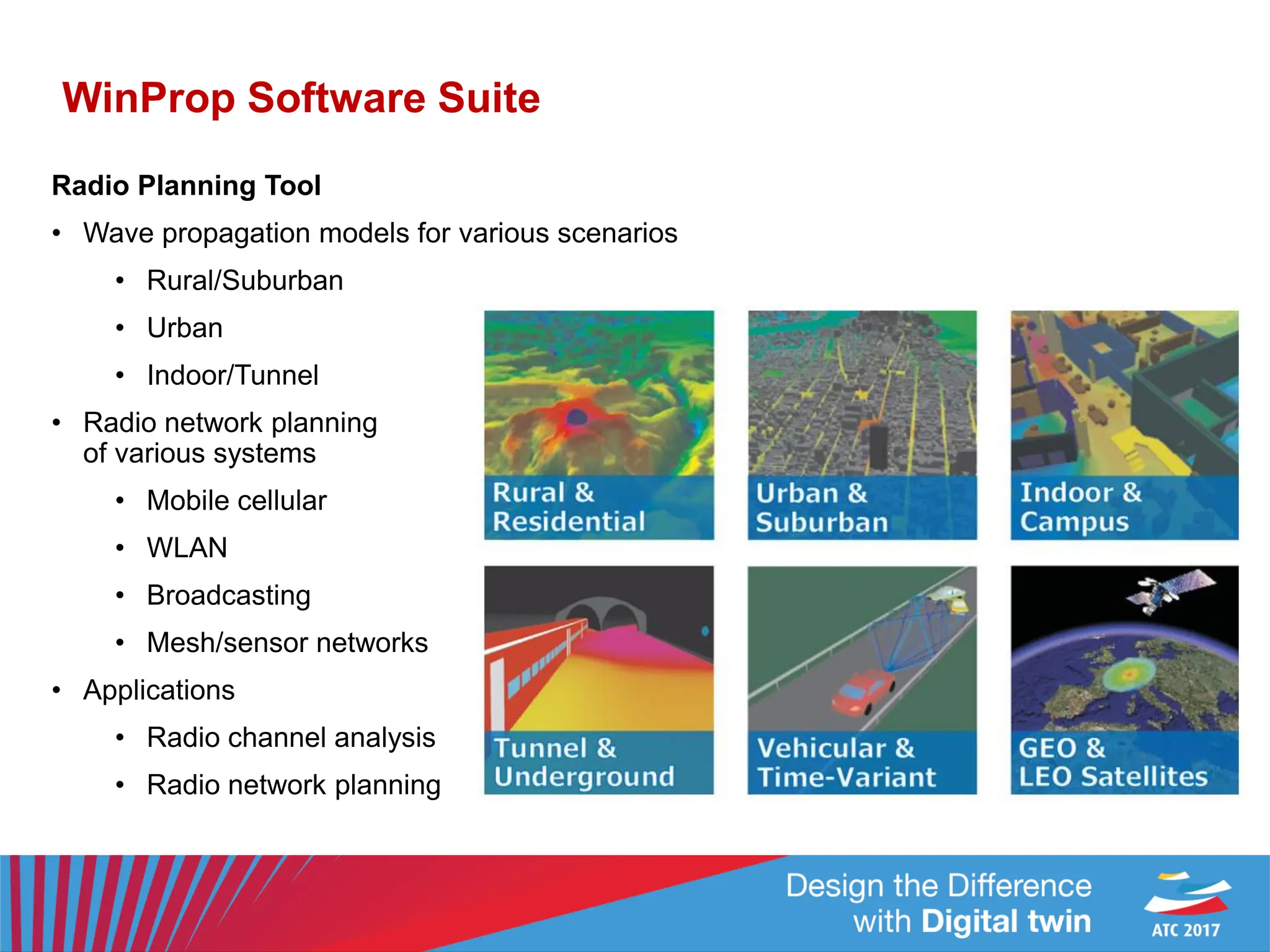
WinProp Software Suite
Radio Planning Tool
• Wave propagation models for various scenarios
• Rural/Suburban
• Urban
• Indoor/Tunnel
• Radio network planning
of various systems
• Mobile cellular
• WLAN
• Broadcasting
• Mesh/sensor networks
• Applications
• Radio channel analysis
• Radio network planning
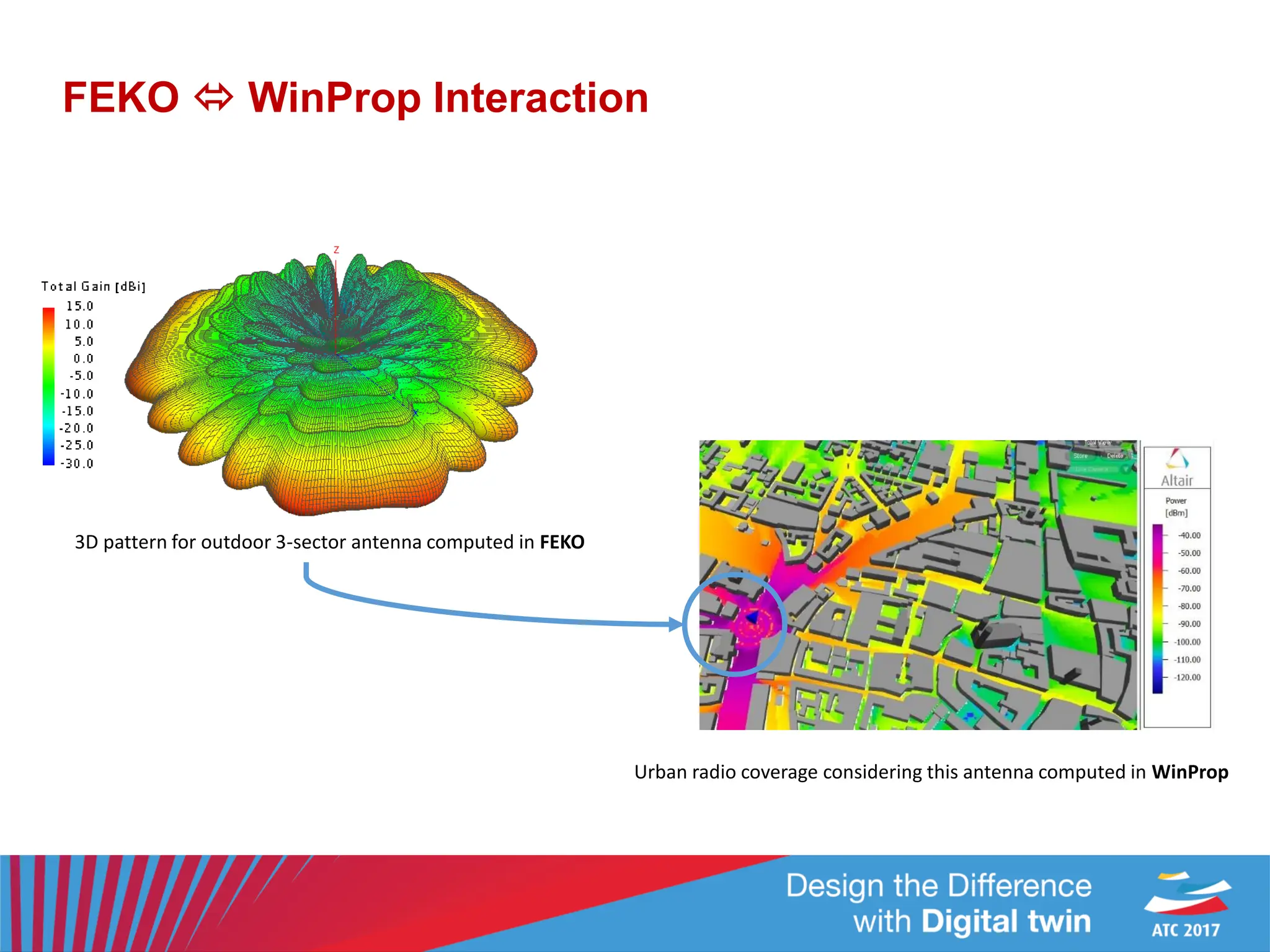
FEKO  WinProp Interaction
3D pattern for outdoor 3-sector antenna computed in FEKO
Urban radio coverage considering this antenna computed in WinProp
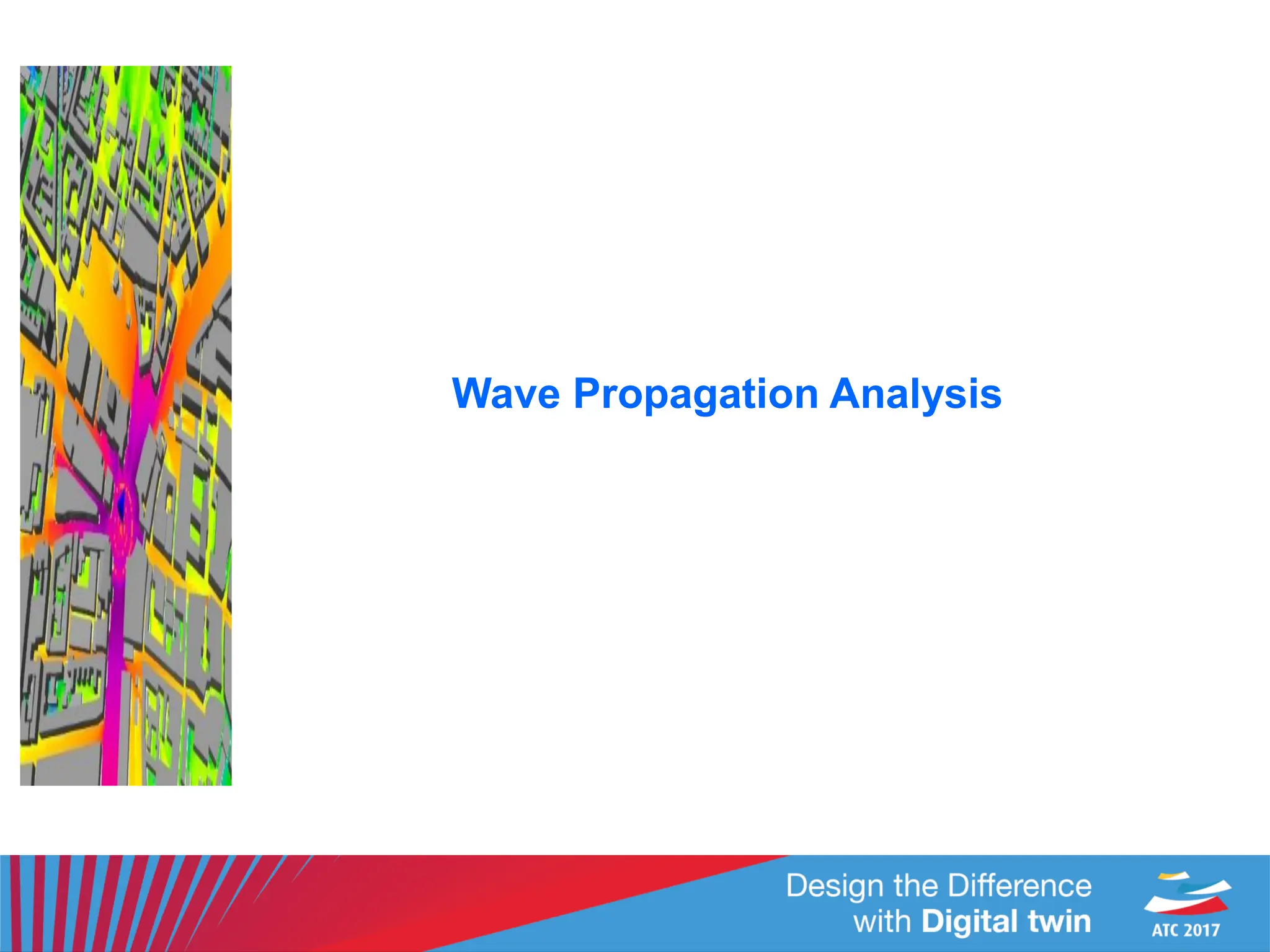
Wave Propagation Analysis
Radio Channel
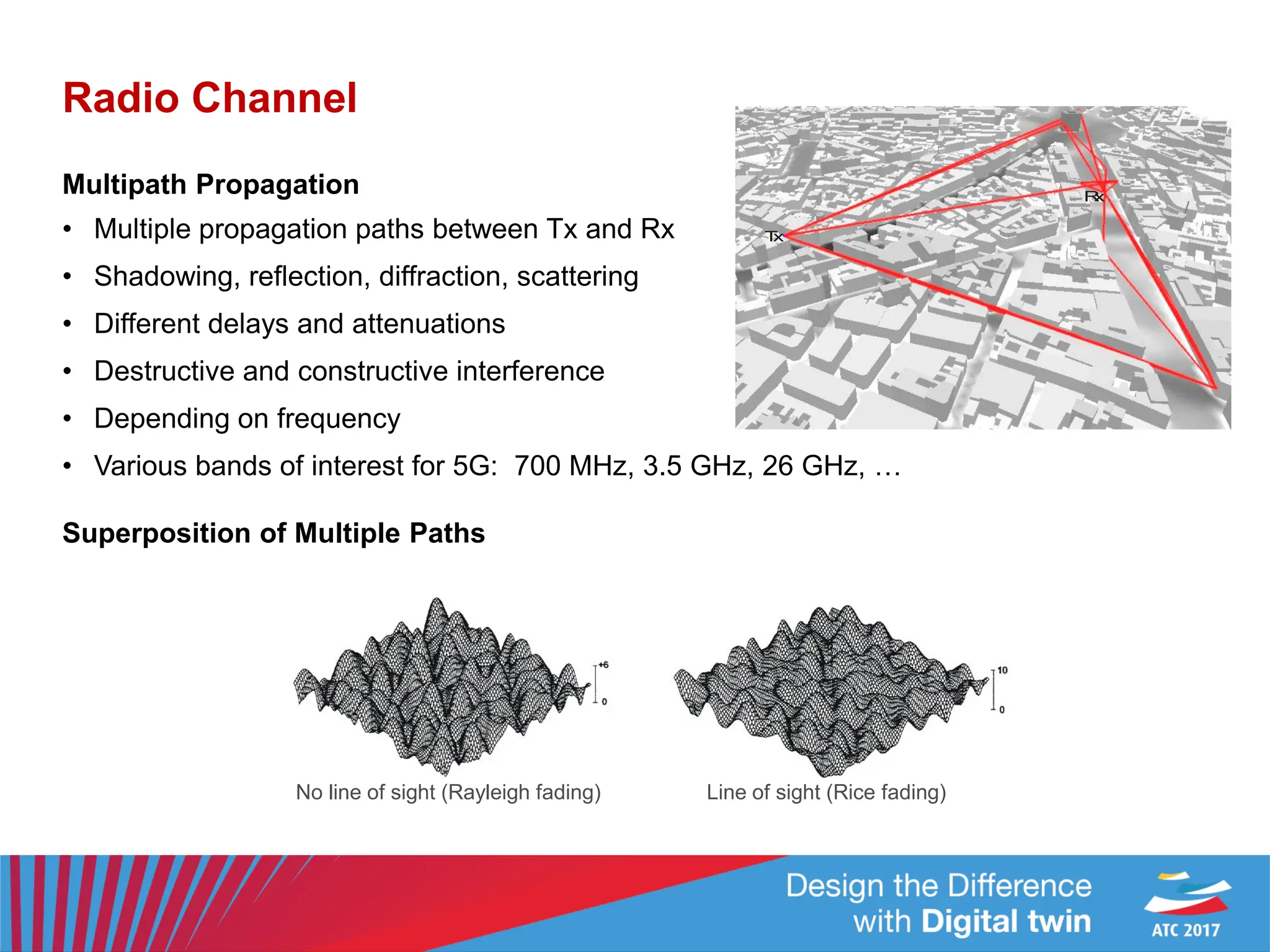
Multipath Propagation
• Multiple propagation paths between Tx and Rx
• Shadowing, reflection, diffraction, scattering
• Different delays and attenuations
• Destructive and constructive interference
• Depending on frequency
• Various bands of interest for 5G: 700 MHz, 3.5 GHz, 26 GHz, …
Superposition of Multiple Paths
No line of sight (Rayleigh fading) Line of sight (Rice fading)
R
x
T
x
Wave Propagation > 6 GHz
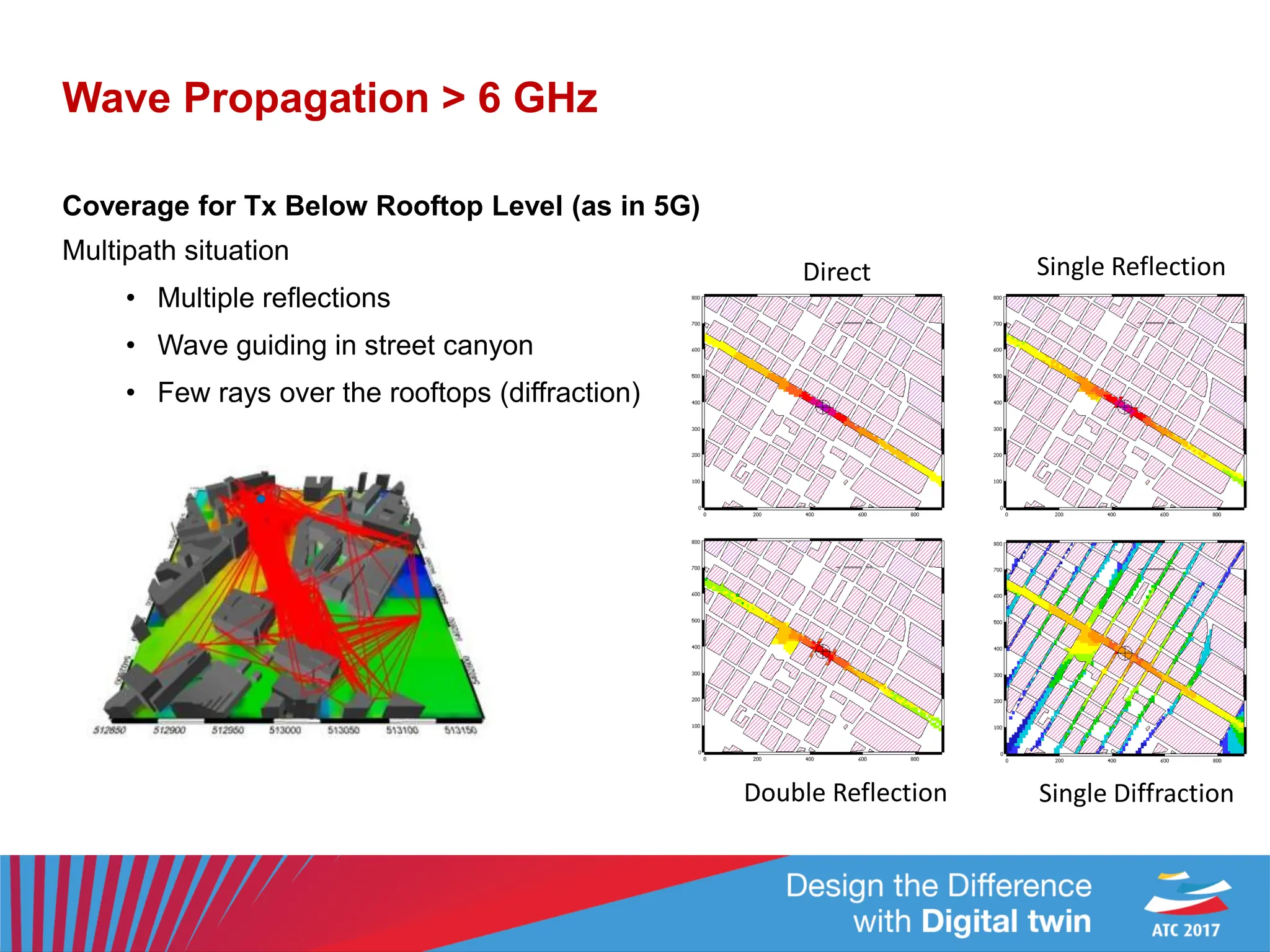
Coverage for Tx Below Rooftop Level (as in 5G)
Multipath situation
• Multiple reflections
• Wave guiding in street canyon
• Few rays over the rooftops (diffraction)
Double Reflection
Direct Single Reflection
Single Diffraction
Wave Propagation > 6 GHz
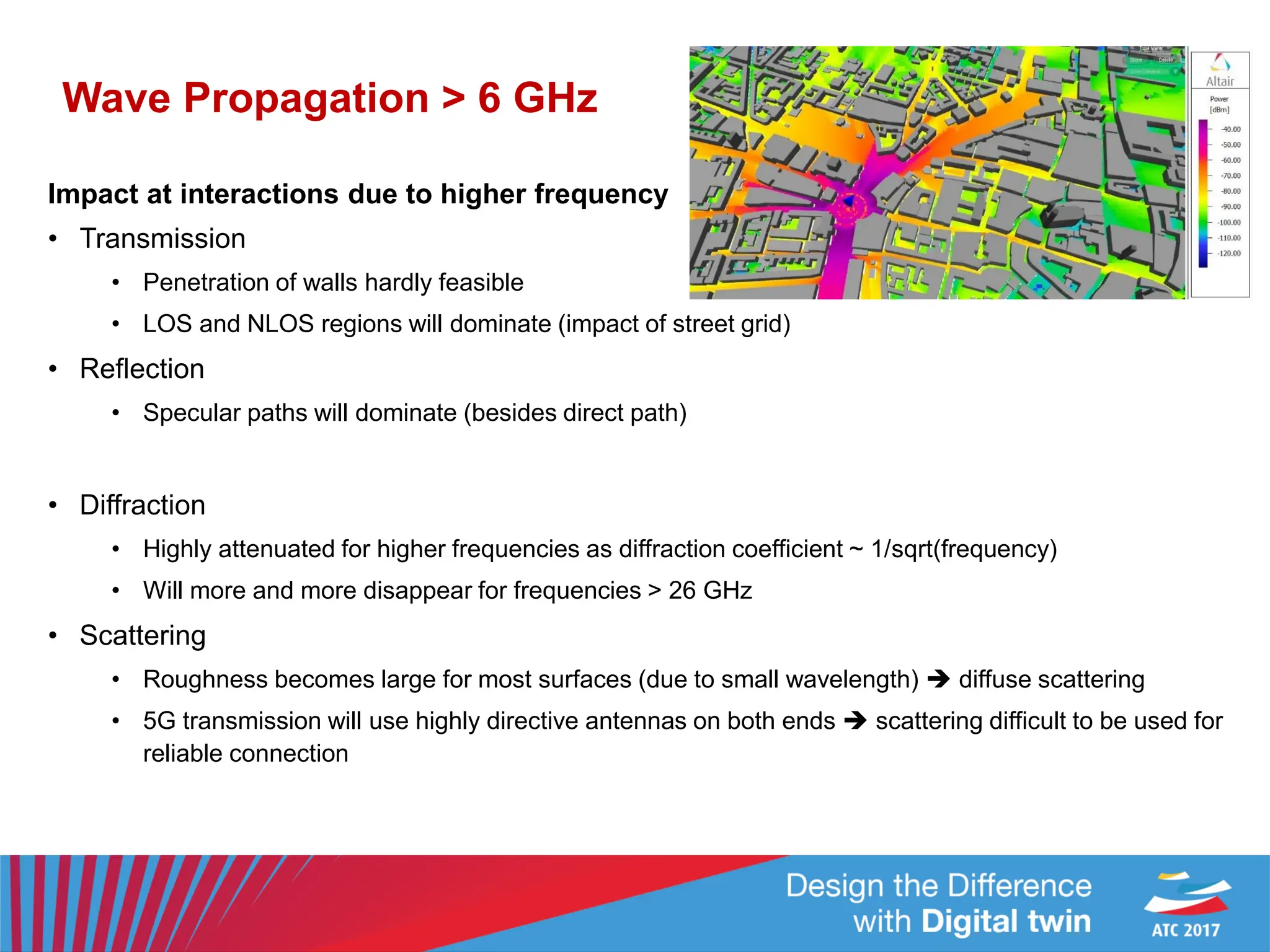
Impact at interactions due to higher frequency
• Transmission
• Penetration of walls hardly feasible
• LOS and NLOS regions will dominate (impact of street grid)
• Reflection
• Specular paths will dominate (besides direct path)
• Diffraction
• Highly attenuated for higher frequencies as diffraction coefficient ~ 1/sqrt(frequency)
• Will more and more disappear for frequencies > 26 GHz
• Scattering
• Roughness becomes large for most surfaces (due to small wavelength)  diffuse scattering
• 5G transmission will use highly directive antennas on both ends  scattering difficult to be used for
reliable connection
Wave Propagation > 6 GHz
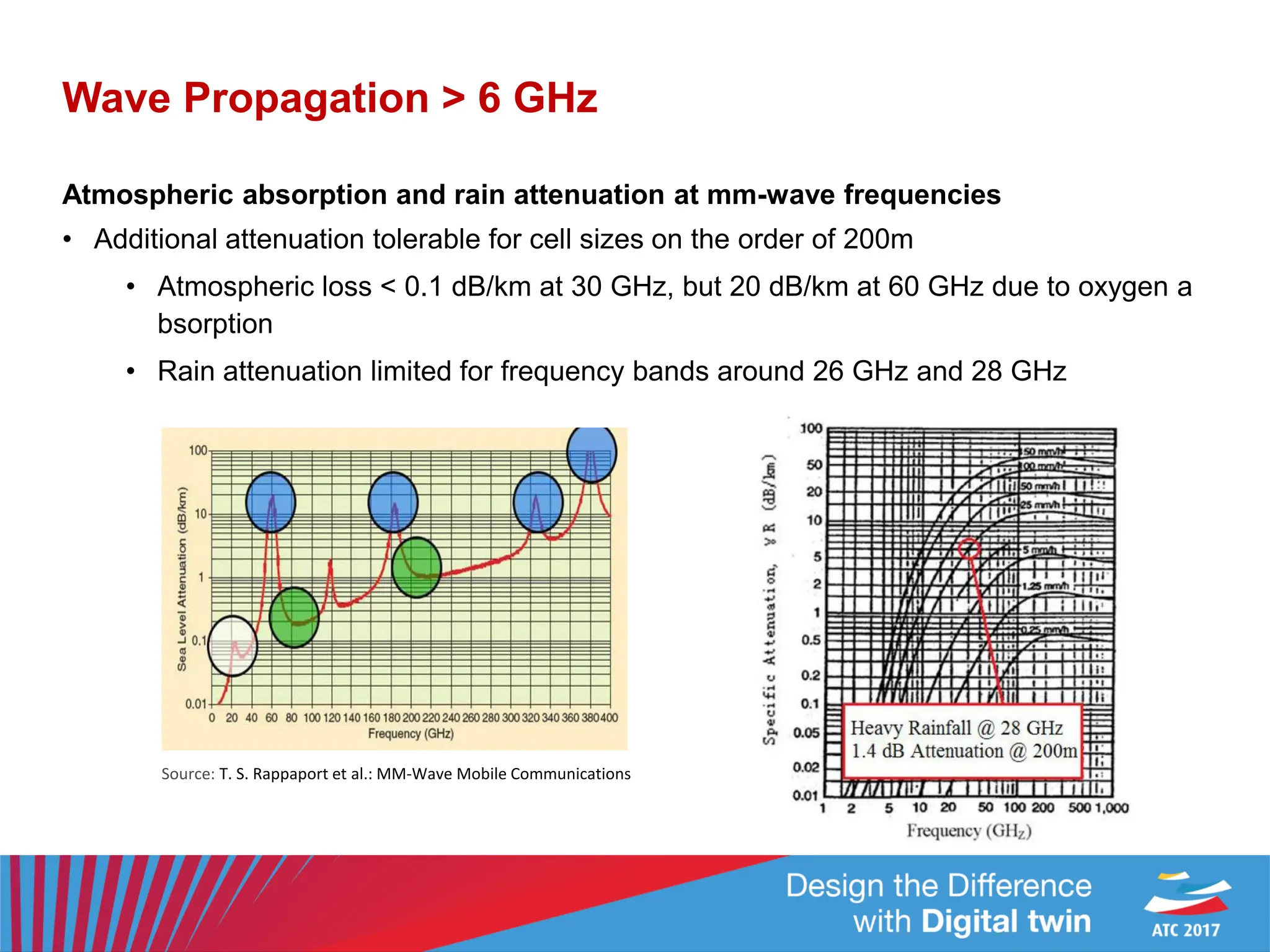
Atmospheric absorption and rain attenuation at mm-wave frequencies
• Additional attenuation tolerable for cell sizes on the order of 200m
• Atmospheric loss < 0.1 dB/km at 30 GHz, but 20 dB/km at 60 GHz due to oxygen a
bsorption
• Rain attenuation limited for frequency bands around 26 GHz and 28 GHz
Source: T. S. Rappaport et al.: MM-Wave Mobile Communications
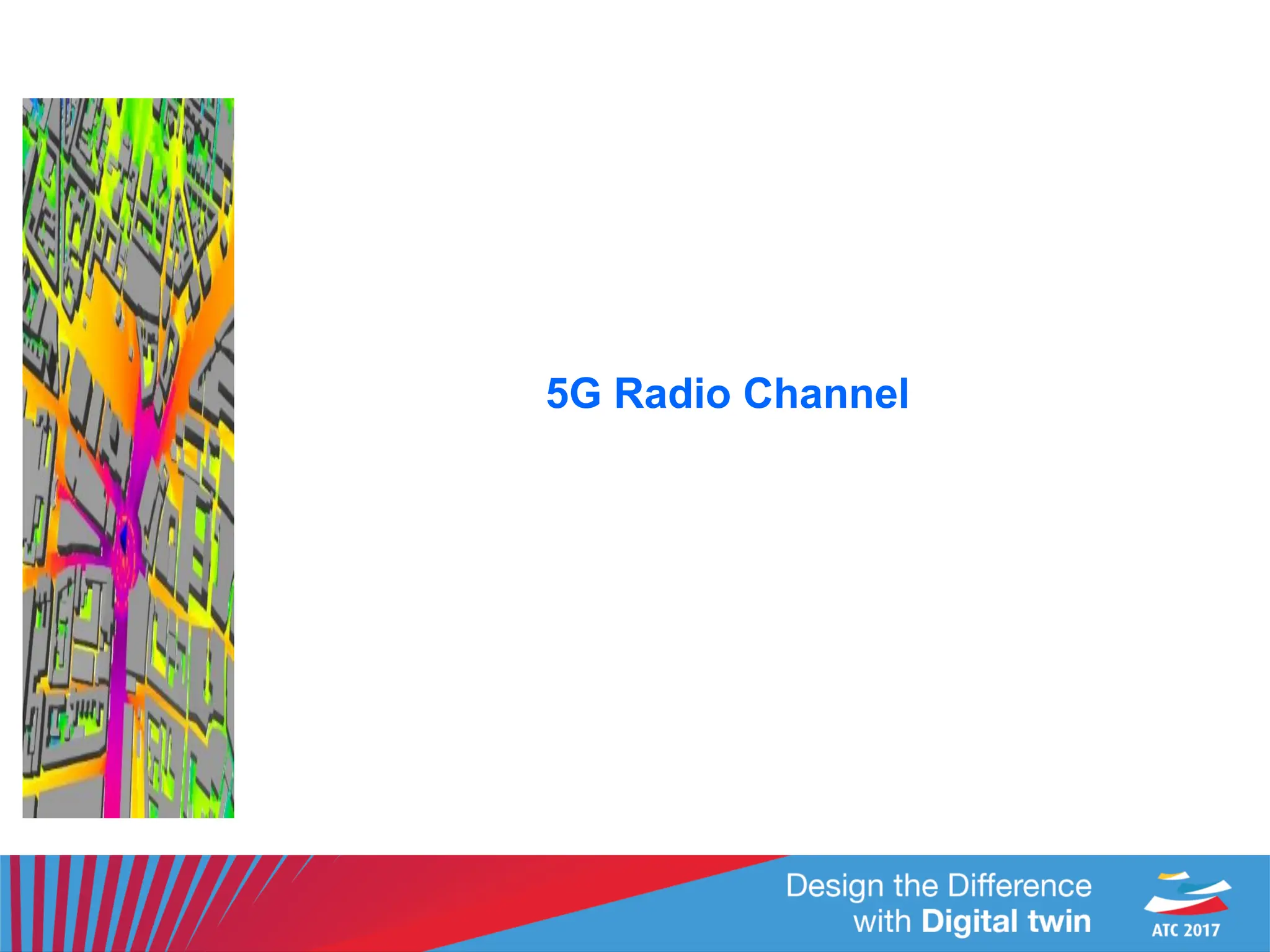
5G Radio Channel
5G Radio Channel
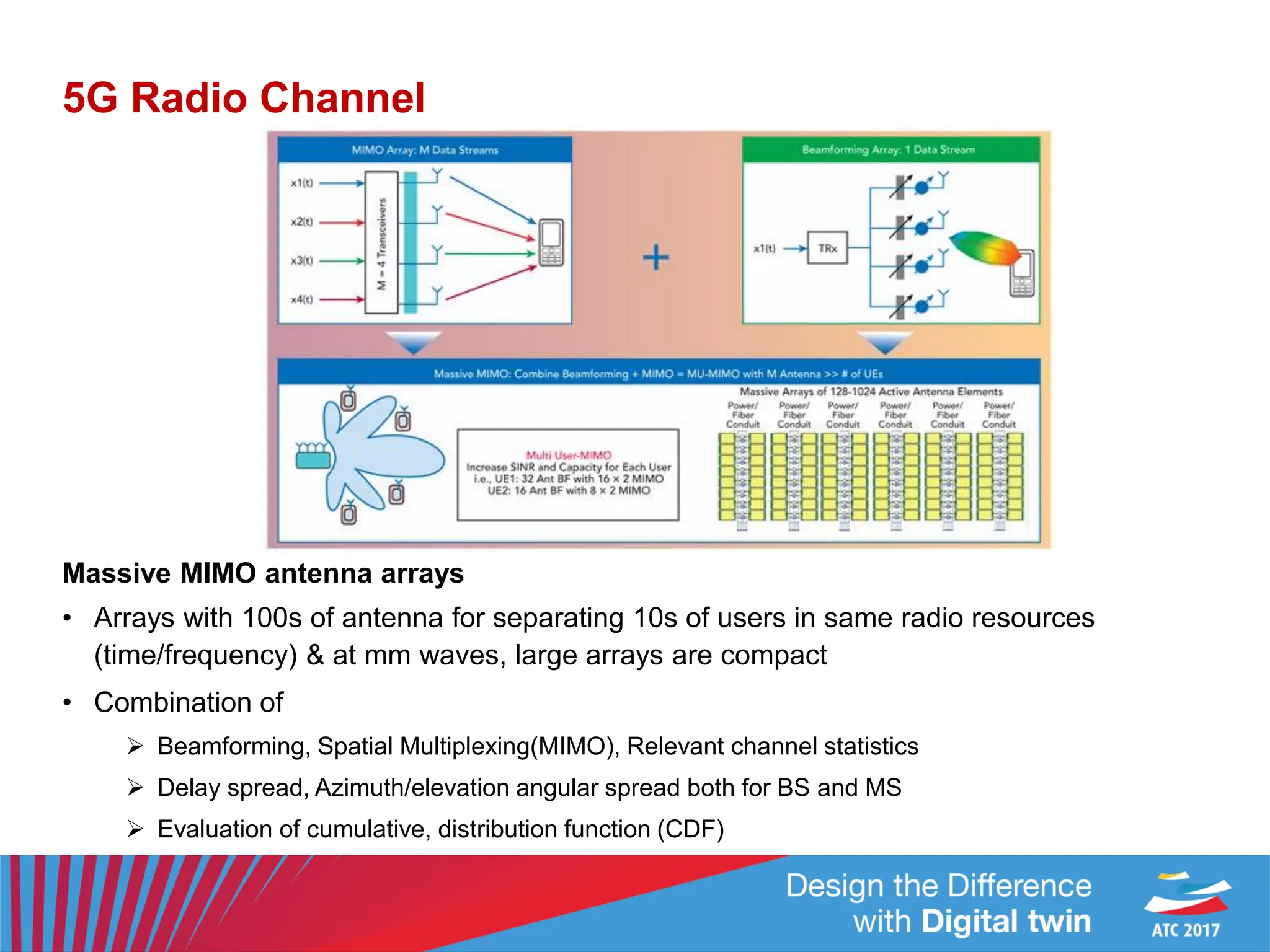
Massive MIMO antenna arrays
• Arrays with 100s of antenna for separating 10s of users in same radio resources
(time/frequency) & at mm waves, large arrays are compact
• Combination of
➢ Beamforming, Spatial Multiplexing(MIMO), Relevant channel statistics
➢ Delay spread, Azimuth/elevation angular spread both for BS and MS
➢ Evaluation of cumulative, distribution function (CDF)
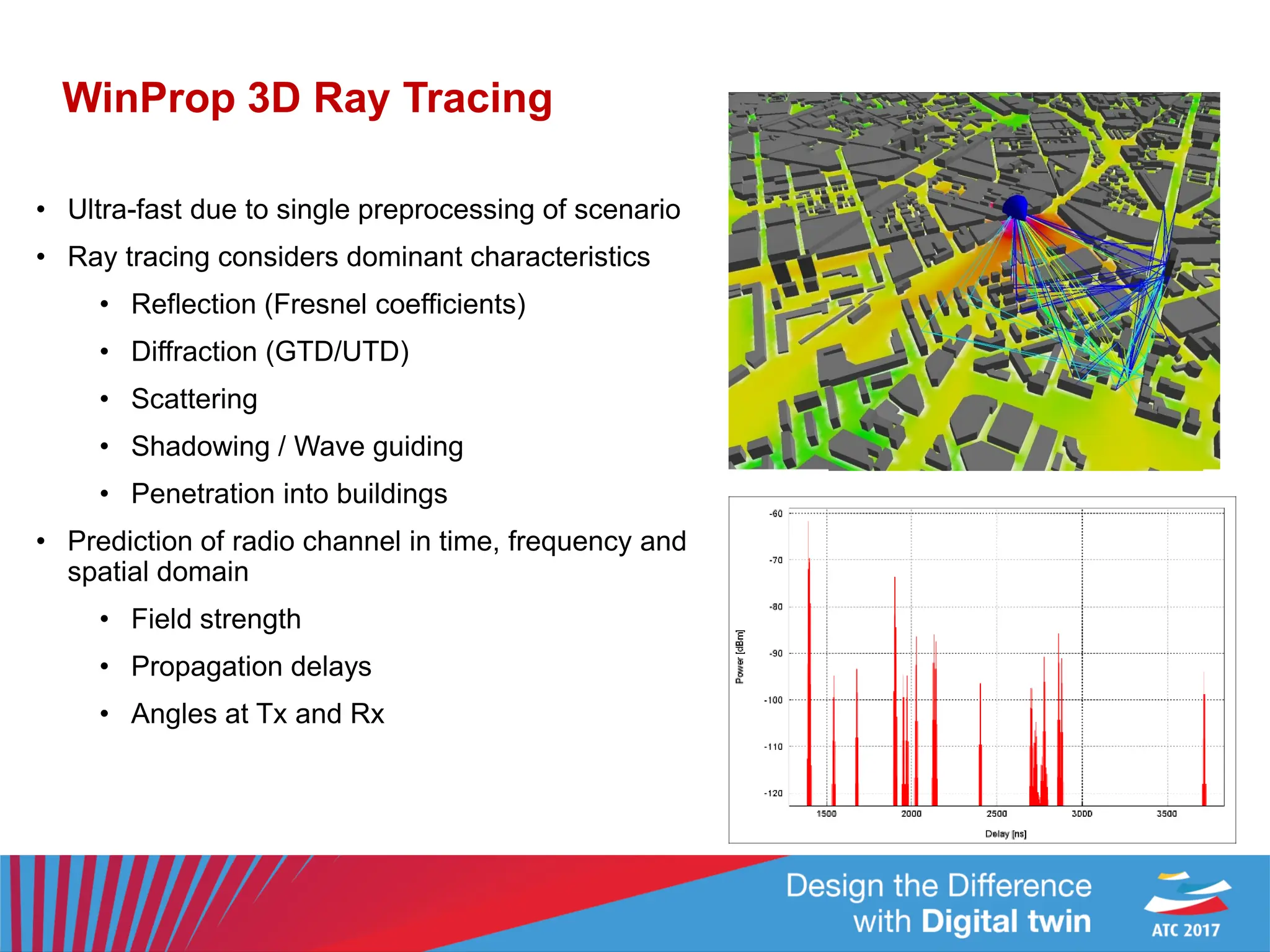
WinProp 3D Ray Tracing
• Ultra-fast due to single preprocessing of scenario
• Ray tracing considers dominant characteristics
• Reflection (Fresnel coefficients)
• Diffraction (GTD/UTD)
• Scattering
• Shadowing / Wave guiding
• Penetration into buildings
• Prediction of radio channel in time, frequency and
spatial domain
• Field strength
• Propagation delays
• Angles at Tx and Rx
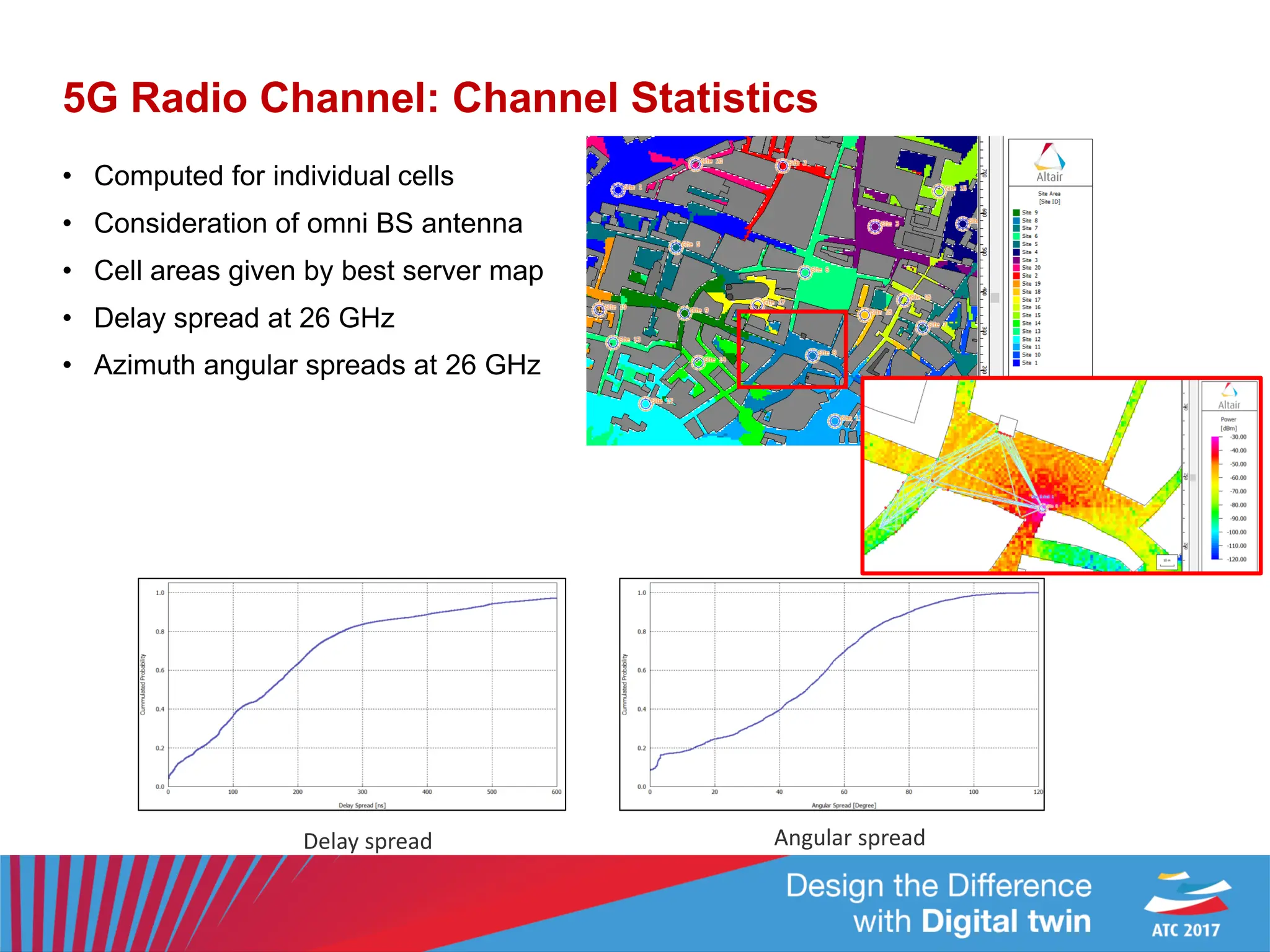
5G Radio Channel: Channel Statistics
Delay spread Angular spread
• Computed for individual cells
• Consideration of omni BS antenna
• Cell areas given by best server map
• Delay spread at 26 GHz
• Azimuth angular spreads at 26 GHz
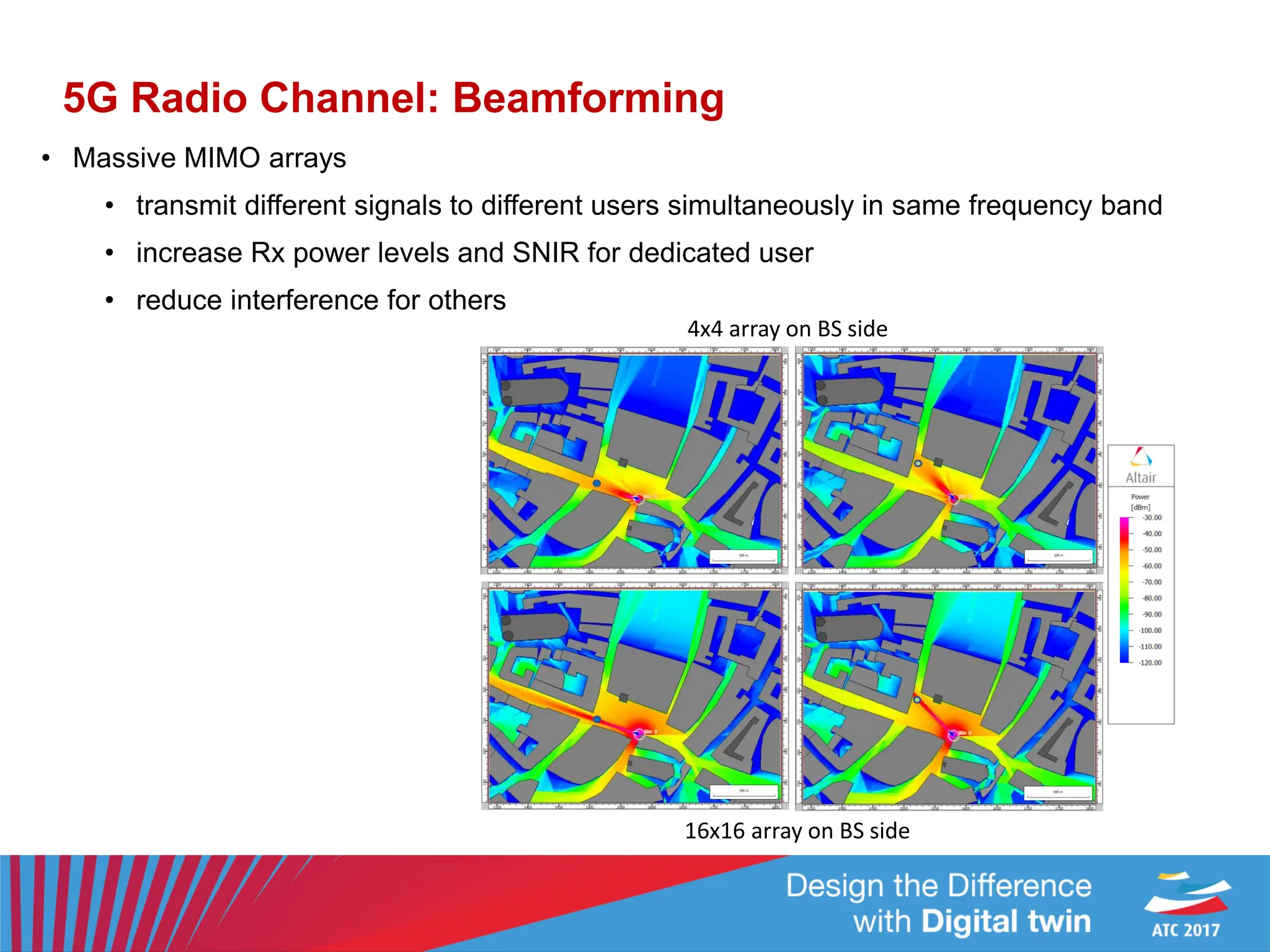
5G Radio Channel: Beamforming
• Massive MIMO arrays
• transmit different signals to different users simultaneously in same frequency band
• increase Rx power levels and SNIR for dedicated user
• reduce interference for others
4x4 array on BS side
16x16 array on BS side
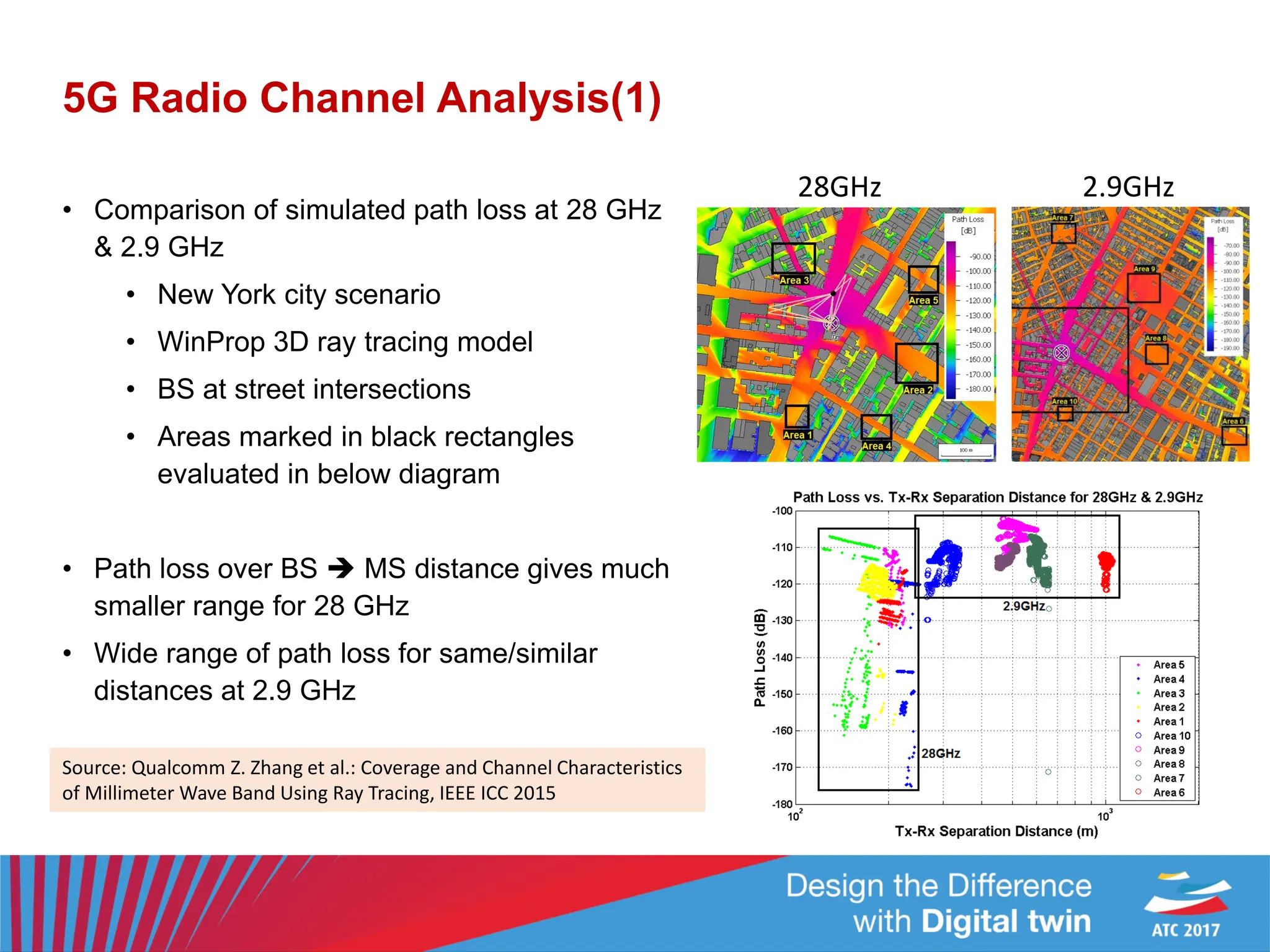
5G Radio Channel Analysis(1)
• Comparison of simulated path loss at 28 GHz
& 2.9 GHz
• New York city scenario
• WinProp 3D ray tracing model
• BS at street intersections
• Areas marked in black rectangles
evaluated in below diagram
• Path loss over BS  MS distance gives much
smaller range for 28 GHz
• Wide range of path loss for same/similar
distances at 2.9 GHz
Source: Qualcomm Z. Zhang et al.: Coverage and Channel Characteristics
of Millimeter Wave Band Using Ray Tracing, IEEE ICC 2015
28GHz 2.9GHz
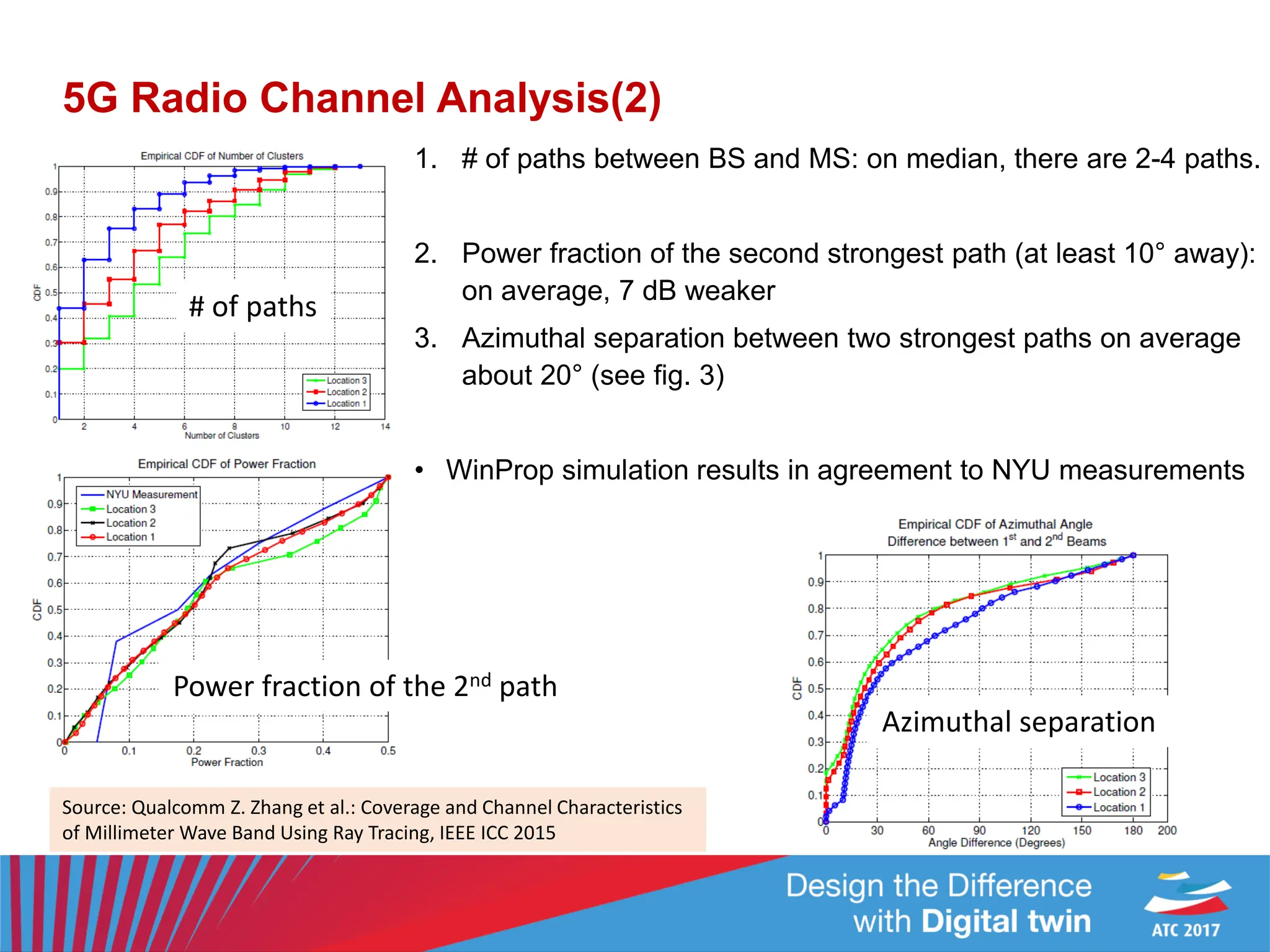
5G Radio Channel Analysis(2)
1. # of paths between BS and MS: on median, there are 2-4 paths.
2. Power fraction of the second strongest path (at least 10° away):
on average, 7 dB weaker
3. Azimuthal separation between two strongest paths on average
about 20° (see fig. 3)
• WinProp simulation results in agreement to NYU measurements
Source: Qualcomm Z. Zhang et al.: Coverage and Channel Characteristics
of Millimeter Wave Band Using Ray Tracing, IEEE ICC 2015
# of paths
Power fraction of the 2nd path
Azimuthal separation
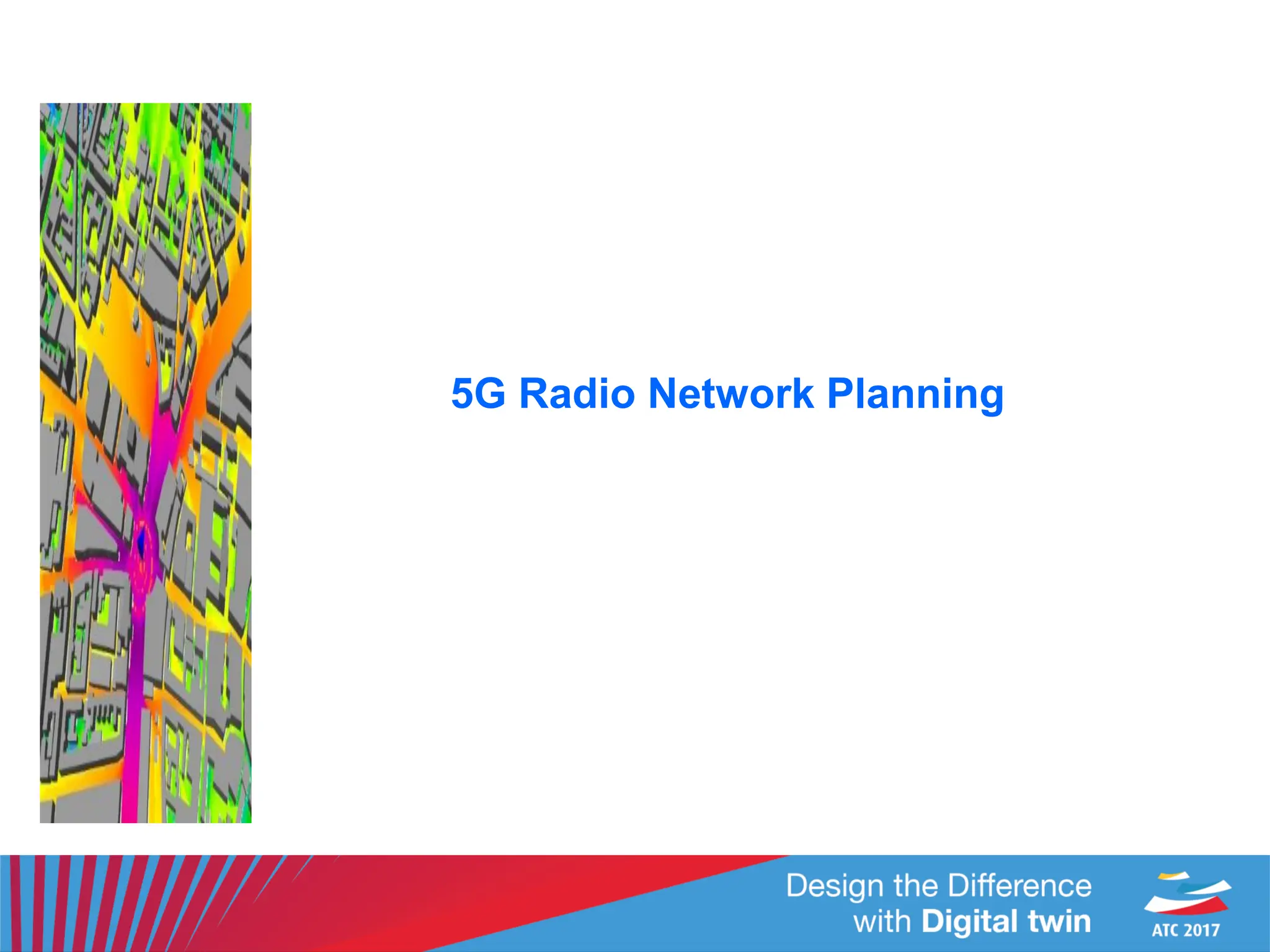
5G Radio Network Planning
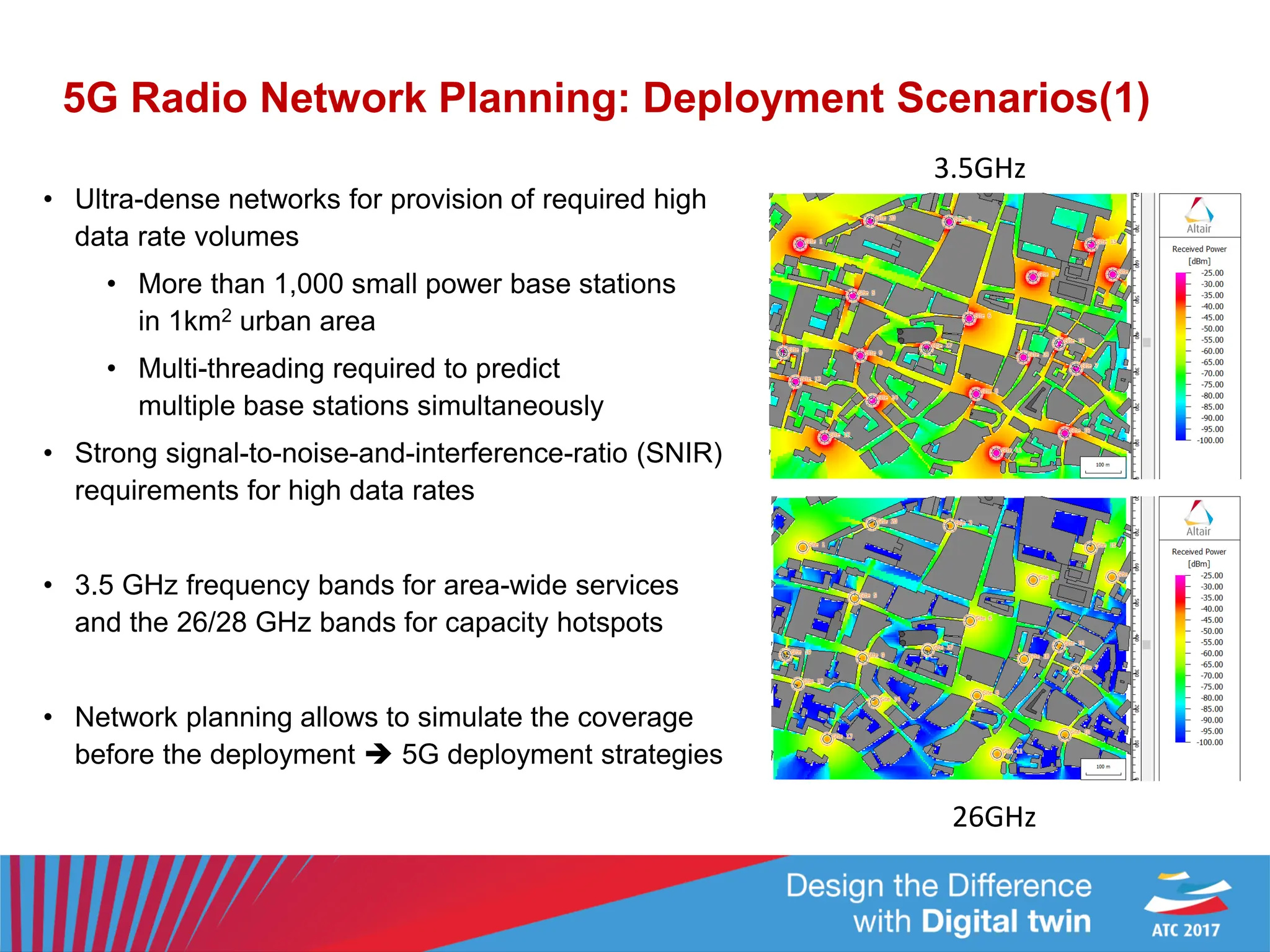
5G Radio Network Planning: Deployment Scenarios(1)
• Ultra-dense networks for provision of required high
data rate volumes
• More than 1,000 small power base stations
in 1km2 urban area
• Multi-threading required to predict
multiple base stations simultaneously
• Strong signal-to-noise-and-interference-ratio (SNIR)
requirements for high data rates
• 3.5 GHz frequency bands for area-wide services
and the 26/28 GHz bands for capacity hotspots
• Network planning allows to simulate the coverage
before the deployment  5G deployment strategies
26GHz
3.5GHz
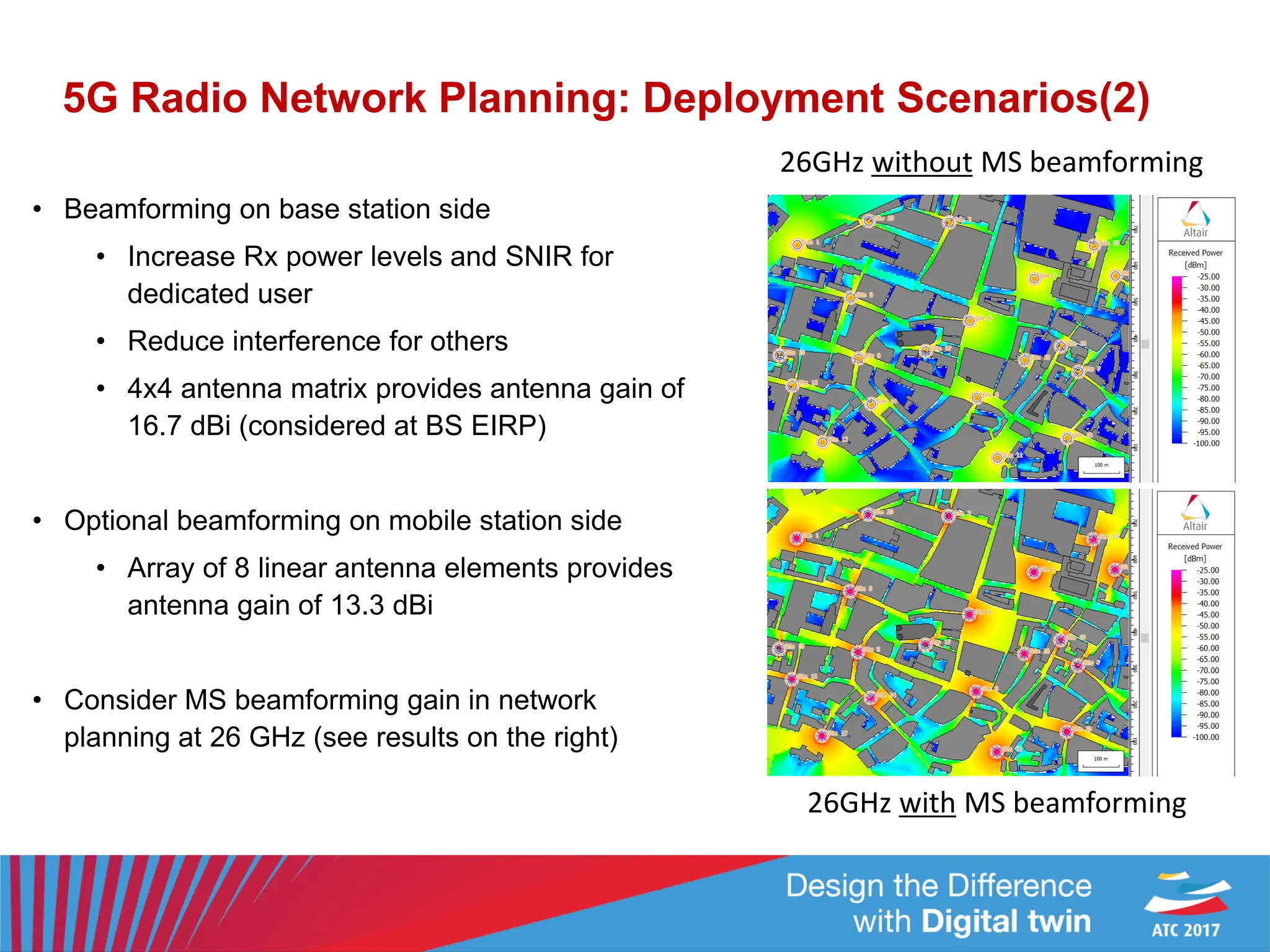
5G Radio Network Planning: Deployment Scenarios(2)
• Beamforming on base station side
• Increase Rx power levels and SNIR for
dedicated user
• Reduce interference for others
• 4x4 antenna matrix provides antenna gain of
16.7 dBi (considered at BS EIRP)
• Optional beamforming on mobile station side
• Array of 8 linear antenna elements provides
antenna gain of 13.3 dBi
• Consider MS beamforming gain in network
planning at 26 GHz (see results on the right)
26GHz without MS beamforming
26GHz with MS beamforming
Conclusions
• 5G will provide higher throughputs and many new applications
• massive MIMO usage & higher frequency bands (e.g. 26 and 28 GHz)
• 5G mobile phone and base station antenna design in FEKO
• FEKO combines optimization and dedicated solvers for arrays and electrically large
structures
• Ideal solution for 5G antenna design
• 5G radio channel and radio coverage analysis in WinProp
• For all types of environments: urban, dense urban, suburban, rural, industrial,
indoor, tunnel, stadium,…
• Evaluation of 3D spatial channel profiles and channel statistics for massive MIMO
• WinProp 3D ray tracing model correctly predicts the mm wave propagation
• Ultra-dense networks require fast model for the efficient network planning

ATC2017_5G-Antenna-Design-and-Network-Planning_Jaehoon-Kim.pdf

  • 1.
  • 2.
    Challenges for 5G 5GService and Scenario Requirements • Massive growth in mobile data demand (1000x capacity) • Higher data rates per user (10x) • Massive growth of connected devices (10-100x) • Lower latency for real-time connections (5x) • Higher energy efficiency for longer battery life (100x) • New use cases like connected cars, machine-to-machine (IoT) Key Solutions • Increased spectrum with trend to higher frequencies • 700 MHz for basic coverage • 3.5 GHz for high data rate services & capacity • 26/28 GHz for fiber like data rates & capacity hotspots • Ultra-dense networks • Massive MIMO antennas for beamforming & spatial multiplexing Source: Huawei 5G Technology Vision
  • 3.
    Introduction: Altair’s completesolutions for 5G analysis • FEKO for 5G Antenna Design Challenges • Case study I: Mobile antenna design at 26 GHz • Case study II: Base-station antenna design at 26 GHz • WinProp for 5G Radio Channel & Coverage Analysis • Case study I: 5G radio channel statistics for beamforming and channel analysis • Case study II: 5G radio planning for different frequency bands and antenna assumptions • Conclusions
  • 4.
    Antenna Design forMobile Devices
  • 5.
    Design Aspects at5G frequency • At 26 GHz: • Electrically more antenna real estate available • Better matching without matching circuit • In-band coupling reduced due to electrical separation • Device integration aspects • Need to achieve high gain requirement • More sophisticated feeding and control circuits needed • Good isolation between array elements must be achieved • Optimization approach based on multi-variable and multi-goal
  • 6.
    Array Design • Designbased on [1] re-optimized for 24-28 GHz band • WB dipole antenna element in linear 8x array • Printed, Rogers RT5880 substrate • Optimization with 5x frequency points • 8 geometric parameters considered • Snn & Smn optimization goals • Optimized with FEKOs GRSM method • Optimized geometry integrated into PCB • Simulated with FDTD for full S-parameter and far-field characterization [1] UWB mm-Wave Antenna Array with Quasi Omnidirectional Beams for 5G Handheld Devices - N. Parchin, et. al, ICUWB 2016 optimization model integrated into PCB single element
  • 7.
    Optimized Array Design– S-parameter and Gain S parameters vs Frequency Gain vs Frequency
  • 8.
    Array Design –Gain & Beam Steering at 26 GHz Beam steering for the 8 element array: equal amplitude, constant phase delay
  • 9.
    Array Design –Dual MIMO Configuration Dual MIMO configuration 2x 8x arrays: Isolation < -30dB in operational bandwidth pattern diversity strategies
  • 10.
    Device: From AntennaIntegration to Antenna Placement • Previously, extremely detailed CAD geometry was cumbersome • Over-discretize the FDTD mesh to resolve geometric detail • Now default meshing is < 1mm, most detail is inherently captured • Despite the electrical size at 26 GHz, the integrated antenna simulation can be run in < 1hr • PCB: part of antenna at low frequency → large ground plane at 26 GHz E-field 26 GHz E-field 0.9 GHz E-field 0.9 GHz simulation time: 43min simulation time: 56min
  • 11.
    Antenna Design forBase Station
  • 12.
    Design Approach • Optimizationof 2x2 planar array using GRSM optimization method • Optimization at center frequency • 8 geometric parameters considered: Ws, Ls -> Distances between antennas • Snn & Smn, gain optimization goals • Solved with MoM • Extend to full array • Simulate with FDTD/MLFMM to capture full S-parameters over operational bandwidth, farfield / beam steering /etc. • Advantages of this approach: • Optimization of the sub-array with PGF(Planar Green Function) extremely fast • MoM (MLFMM) extremely efficient for multiport S-parameter simulation 22 slot array
  • 13.
    Array Design • Designbased on [1] (designed to operate in 22 GHz band) – re-optimized for 26 GHz band • Loop design, including slot to increase efficiency • Printed, low cost, FR4 substrate initial optimization base element optimization model 2x2 array 4x4 array 8x8 array 16x16 array [1] 8×8 Planar Phased Array Antenna with High Efficiency and Insensitivity Properties for 5G Mobile Base Stations - N. Parchin, et. al, EUCAP 2016
  • 14.
    Array Design –S-parameter • Optimization strategy holds for all 3 array configurations: • Resonance frequency 26 GHz maintained • Slight loss of bandwidth for the larger arrays, but still > 2 GHz • Worst case coupling of ~ -15 dB maintained 4x4 array 8x8 array 16x16 array
  • 15.
    Array Design –Gain & Beam Steering Gain for 4x4, 8x8, 16x16 array configurations Beam steering for the 8x8 array
  • 16.
    Radio Channel &Coverage Analysis
  • 17.
    WinProp Software Suite RadioPlanning Tool • Wave propagation models for various scenarios • Rural/Suburban • Urban • Indoor/Tunnel • Radio network planning of various systems • Mobile cellular • WLAN • Broadcasting • Mesh/sensor networks • Applications • Radio channel analysis • Radio network planning
  • 18.
    FEKO  WinPropInteraction 3D pattern for outdoor 3-sector antenna computed in FEKO Urban radio coverage considering this antenna computed in WinProp
  • 19.
  • 20.
    Radio Channel Multipath Propagation •Multiple propagation paths between Tx and Rx • Shadowing, reflection, diffraction, scattering • Different delays and attenuations • Destructive and constructive interference • Depending on frequency • Various bands of interest for 5G: 700 MHz, 3.5 GHz, 26 GHz, … Superposition of Multiple Paths No line of sight (Rayleigh fading) Line of sight (Rice fading) R x T x
  • 21.
    Wave Propagation >6 GHz Coverage for Tx Below Rooftop Level (as in 5G) Multipath situation • Multiple reflections • Wave guiding in street canyon • Few rays over the rooftops (diffraction) Double Reflection Direct Single Reflection Single Diffraction
  • 22.
    Wave Propagation >6 GHz Impact at interactions due to higher frequency • Transmission • Penetration of walls hardly feasible • LOS and NLOS regions will dominate (impact of street grid) • Reflection • Specular paths will dominate (besides direct path) • Diffraction • Highly attenuated for higher frequencies as diffraction coefficient ~ 1/sqrt(frequency) • Will more and more disappear for frequencies > 26 GHz • Scattering • Roughness becomes large for most surfaces (due to small wavelength)  diffuse scattering • 5G transmission will use highly directive antennas on both ends  scattering difficult to be used for reliable connection
  • 23.
    Wave Propagation >6 GHz Atmospheric absorption and rain attenuation at mm-wave frequencies • Additional attenuation tolerable for cell sizes on the order of 200m • Atmospheric loss < 0.1 dB/km at 30 GHz, but 20 dB/km at 60 GHz due to oxygen a bsorption • Rain attenuation limited for frequency bands around 26 GHz and 28 GHz Source: T. S. Rappaport et al.: MM-Wave Mobile Communications
  • 24.
  • 25.
    5G Radio Channel MassiveMIMO antenna arrays • Arrays with 100s of antenna for separating 10s of users in same radio resources (time/frequency) & at mm waves, large arrays are compact • Combination of ➢ Beamforming, Spatial Multiplexing(MIMO), Relevant channel statistics ➢ Delay spread, Azimuth/elevation angular spread both for BS and MS ➢ Evaluation of cumulative, distribution function (CDF)
  • 26.
    WinProp 3D RayTracing • Ultra-fast due to single preprocessing of scenario • Ray tracing considers dominant characteristics • Reflection (Fresnel coefficients) • Diffraction (GTD/UTD) • Scattering • Shadowing / Wave guiding • Penetration into buildings • Prediction of radio channel in time, frequency and spatial domain • Field strength • Propagation delays • Angles at Tx and Rx
  • 27.
    5G Radio Channel:Channel Statistics Delay spread Angular spread • Computed for individual cells • Consideration of omni BS antenna • Cell areas given by best server map • Delay spread at 26 GHz • Azimuth angular spreads at 26 GHz
  • 28.
    5G Radio Channel:Beamforming • Massive MIMO arrays • transmit different signals to different users simultaneously in same frequency band • increase Rx power levels and SNIR for dedicated user • reduce interference for others 4x4 array on BS side 16x16 array on BS side
  • 29.
    5G Radio ChannelAnalysis(1) • Comparison of simulated path loss at 28 GHz & 2.9 GHz • New York city scenario • WinProp 3D ray tracing model • BS at street intersections • Areas marked in black rectangles evaluated in below diagram • Path loss over BS  MS distance gives much smaller range for 28 GHz • Wide range of path loss for same/similar distances at 2.9 GHz Source: Qualcomm Z. Zhang et al.: Coverage and Channel Characteristics of Millimeter Wave Band Using Ray Tracing, IEEE ICC 2015 28GHz 2.9GHz
  • 30.
    5G Radio ChannelAnalysis(2) 1. # of paths between BS and MS: on median, there are 2-4 paths. 2. Power fraction of the second strongest path (at least 10° away): on average, 7 dB weaker 3. Azimuthal separation between two strongest paths on average about 20° (see fig. 3) • WinProp simulation results in agreement to NYU measurements Source: Qualcomm Z. Zhang et al.: Coverage and Channel Characteristics of Millimeter Wave Band Using Ray Tracing, IEEE ICC 2015 # of paths Power fraction of the 2nd path Azimuthal separation
  • 31.
  • 32.
    5G Radio NetworkPlanning: Deployment Scenarios(1) • Ultra-dense networks for provision of required high data rate volumes • More than 1,000 small power base stations in 1km2 urban area • Multi-threading required to predict multiple base stations simultaneously • Strong signal-to-noise-and-interference-ratio (SNIR) requirements for high data rates • 3.5 GHz frequency bands for area-wide services and the 26/28 GHz bands for capacity hotspots • Network planning allows to simulate the coverage before the deployment  5G deployment strategies 26GHz 3.5GHz
  • 33.
    5G Radio NetworkPlanning: Deployment Scenarios(2) • Beamforming on base station side • Increase Rx power levels and SNIR for dedicated user • Reduce interference for others • 4x4 antenna matrix provides antenna gain of 16.7 dBi (considered at BS EIRP) • Optional beamforming on mobile station side • Array of 8 linear antenna elements provides antenna gain of 13.3 dBi • Consider MS beamforming gain in network planning at 26 GHz (see results on the right) 26GHz without MS beamforming 26GHz with MS beamforming
  • 34.
    Conclusions • 5G willprovide higher throughputs and many new applications • massive MIMO usage & higher frequency bands (e.g. 26 and 28 GHz) • 5G mobile phone and base station antenna design in FEKO • FEKO combines optimization and dedicated solvers for arrays and electrically large structures • Ideal solution for 5G antenna design • 5G radio channel and radio coverage analysis in WinProp • For all types of environments: urban, dense urban, suburban, rural, industrial, indoor, tunnel, stadium,… • Evaluation of 3D spatial channel profiles and channel statistics for massive MIMO • WinProp 3D ray tracing model correctly predicts the mm wave propagation • Ultra-dense networks require fast model for the efficient network planning