Comparison between Zero Forcing and
Maximum RatioTransmission on the
Energy Efficiency of Downlink Massive
MIMO under imperfect CSI
Proposal of project course GE501
Presented by – Gameel & Siddiqui
Agenda
• Introduction
• MIMO
• Challenges in Massive MIMO
• System Model Description
• Objective
Introduction
• Massive MIMO (Multiple Input Multiple Output) is an
emerging technology in wireless communications
that has attracted a lot of interest.
• The wireless technology improvement where the
numbers of users and applications increase rapidly.
• Wireless communications need the high data rate
and link reliability with lesser power consumption at
the same time.
• With the large number of antennas used, the base
station (BS) can focus its emitted energy into the
spatial directions where it knows that the terminals
are located, and then the system transmit power
can be minimized.
MIMO
• We use MIMO technology to increase
the data capacity with efficient
transmission and less power
consumption.
• System performance has been widely
investigated under different
assumptions on channel state
information (CSI) which corresponds
to channel response estimate.
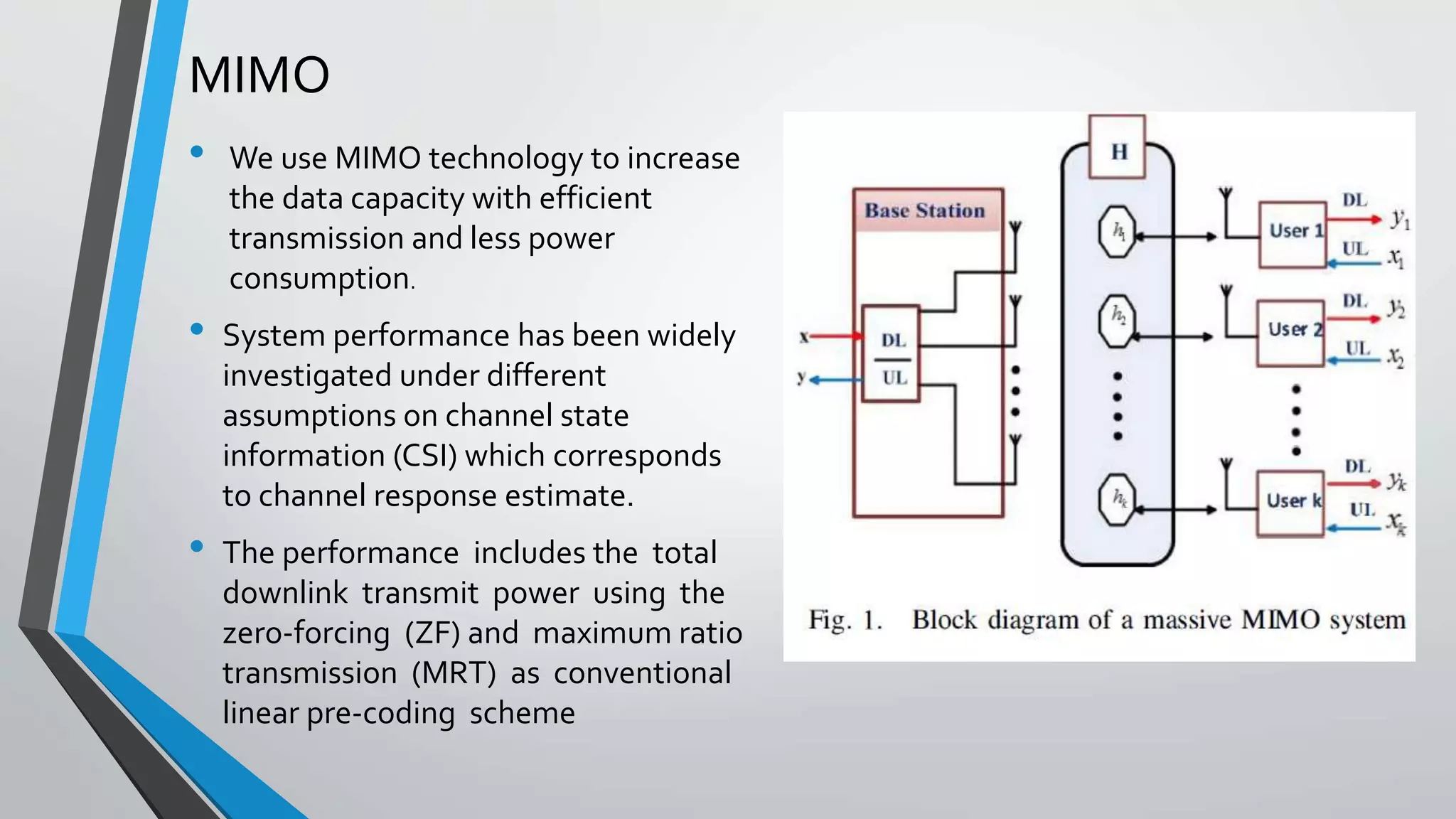
• The performance includes the total
downlink transmit power using the
zero-forcing (ZF) and maximum ratio
transmission (MRT) as conventional
linear pre-coding scheme
Massive MIMO has some challenges
• One of the challenge includes finding a way to communicate the channel
state information (CSI) from the receiver to the transmitter for pre-coding.
• Both the time-frequency resources allocated for pilot transmission and the
channel coherence time are limited ,the number of possible orthogonal
pilot sequences is limited too.
• A particular cell may get contaminated because of pilots used by other users in
their respective cell.
System Model Description
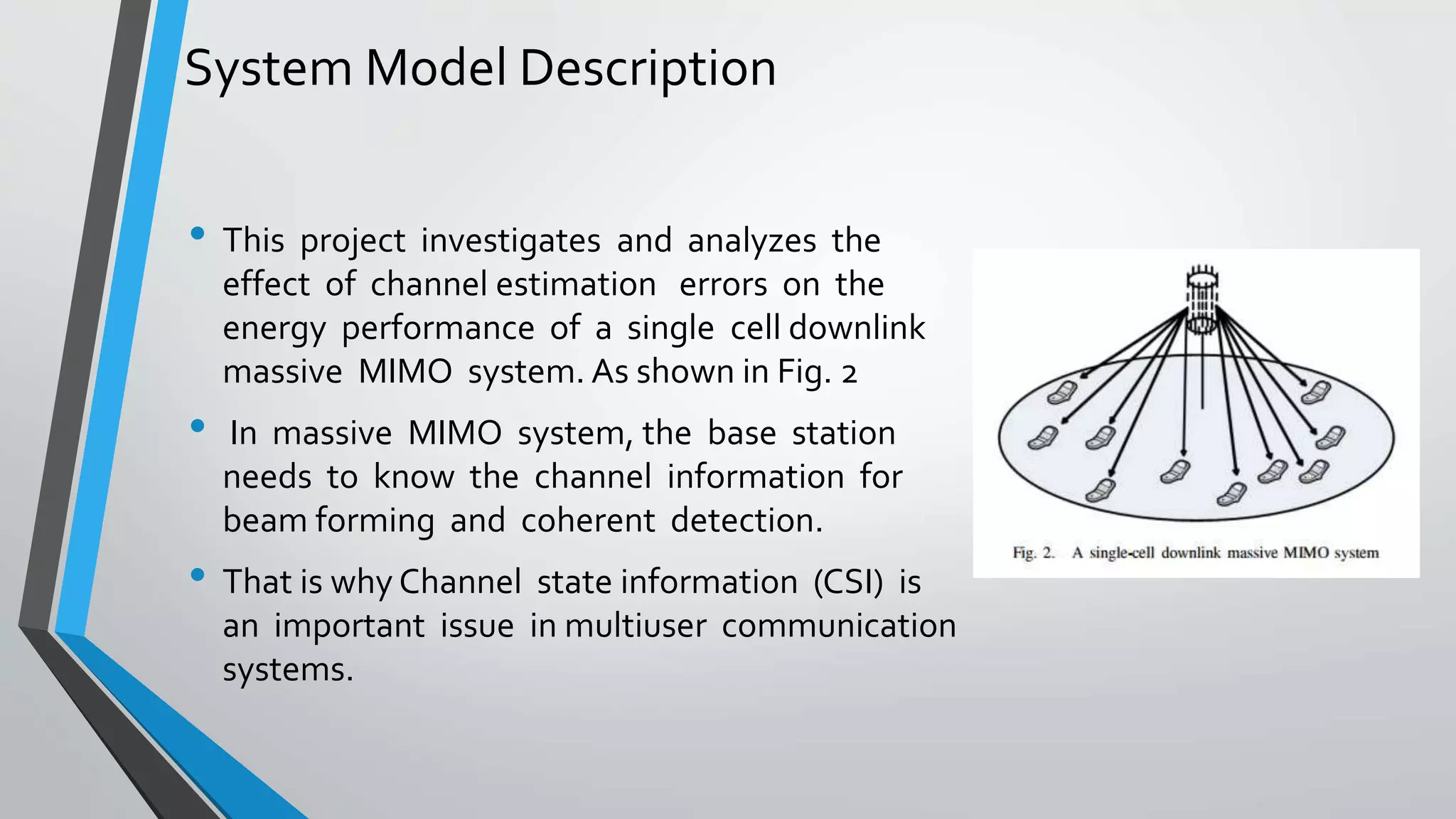
• This project investigates and analyzes the
effect of channel estimation errors on the
energy performance of a single cell downlink
massive MIMO system. As shown in Fig. 2
• In massive MIMO system, the base station
needs to know the channel information for
beam forming and coherent detection.
• That is why Channel state information (CSI) is
an important issue in multiuser communication
systems.
Objective
• To study the effect of channel estimation errors on the energy efficiency of
downlink massive MIMO systems.
• To analyze zero forcing (ZF) and maximum ratio transmission (MRT)
precoding schemes under imperfect channel state information condition.
• To observe results as the reliability of the estimation increases from zero,
power increases to a certain point and begins to decrease.
• The value of reliability where the power begins to decrease depends on the
number of base station antennas and the number of users within the cell.

Comparison between Zero Forcing (ZF) & Maximum Ratio Transmission (MRT) on the energy efficiency of Downlink Massive MIMO under imperfect CSI

  • 1.
    Comparison between ZeroForcing and Maximum RatioTransmission on the Energy Efficiency of Downlink Massive MIMO under imperfect CSI Proposal of project course GE501 Presented by – Gameel & Siddiqui
  • 2.
    Agenda • Introduction • MIMO •Challenges in Massive MIMO • System Model Description • Objective
  • 3.
    Introduction • Massive MIMO(Multiple Input Multiple Output) is an emerging technology in wireless communications that has attracted a lot of interest. • The wireless technology improvement where the numbers of users and applications increase rapidly. • Wireless communications need the high data rate and link reliability with lesser power consumption at the same time. • With the large number of antennas used, the base station (BS) can focus its emitted energy into the spatial directions where it knows that the terminals are located, and then the system transmit power can be minimized.
  • 4.
    MIMO • We useMIMO technology to increase the data capacity with efficient transmission and less power consumption. • System performance has been widely investigated under different assumptions on channel state information (CSI) which corresponds to channel response estimate. • The performance includes the total downlink transmit power using the zero-forcing (ZF) and maximum ratio transmission (MRT) as conventional linear pre-coding scheme
  • 5.
    Massive MIMO hassome challenges • One of the challenge includes finding a way to communicate the channel state information (CSI) from the receiver to the transmitter for pre-coding. • Both the time-frequency resources allocated for pilot transmission and the channel coherence time are limited ,the number of possible orthogonal pilot sequences is limited too. • A particular cell may get contaminated because of pilots used by other users in their respective cell.
  • 6.
    System Model Description •This project investigates and analyzes the effect of channel estimation errors on the energy performance of a single cell downlink massive MIMO system. As shown in Fig. 2 • In massive MIMO system, the base station needs to know the channel information for beam forming and coherent detection. • That is why Channel state information (CSI) is an important issue in multiuser communication systems.
  • 7.
    Objective • To studythe effect of channel estimation errors on the energy efficiency of downlink massive MIMO systems. • To analyze zero forcing (ZF) and maximum ratio transmission (MRT) precoding schemes under imperfect channel state information condition. • To observe results as the reliability of the estimation increases from zero, power increases to a certain point and begins to decrease. • The value of reliability where the power begins to decrease depends on the number of base station antennas and the number of users within the cell.