Radiation

Nuclear Reactors
Nuclear Reactions

 Uranium   is a fairly common element on
  Earth and was incorporated into the
  planet during the planet's formation
 U-238 makes up 99 percent of the
  uranium on the planet
 Uranium-235 makes up about 0.7
  percent of the remaining uranium found
  naturally
 Uranium-235 has an interesting
  property
Nuclear Reactions

 U-235   decays naturally, just as U-238
  does, by alpha radiation
 U-235 also undergoes spontaneous
  fission a small percentage of the time
 Fission is defined as “the splitting of an
  atom”
 Also, U-235 is one of the few materials
  that can undergo induced fission
Nuclear Reactions

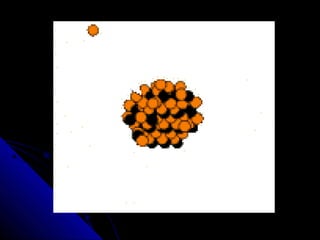
 If a free neutron runs into a U-235
  nucleus, the nucleus will absorb the
  neutron without hesitation, become
  unstable and split immediately
 The probability of a U-235 atom
  capturing a neutron as it passes by is
  fairly high
 In a reaction two or three neutrons are
  ejected from each fission causing other
  fissions to occur
Nuclear Reactions

 Theprocess of capturing the neutron
 and splitting happens very quickly
     (1 x 10-12 seconds) picoseconds
 An  incredible amount of energy is
  released, in the form of heat and
  gamma radiation, when a single atom
  splits
 The energy is released because the
  products and the neutrons, together,
  weigh less than the original U-235 atom
Nuclear Reactions

 The  difference in weight is converted
  directly to energy at a rate governed by
  the equation E = mc2
 a pound of highly enriched uranium
  used to power a nuclear submarine or
  nuclear aircraft carrier is equal to about
  a million gallons of gasoline
 a pound of uranium is smaller than a
  baseball and a million gallons of
  gasoline would fill a five-story building
Nuclear Reactions

 In order for a reactor to work, a sample
  of uranium must be enriched , so that it
  contains two to three percent or more of
  uranium-235
 Weapons-grade uranium is composed
  of 90 percent
Nuclear Power

 uranium   is formed into pellets with
  approximately the same diameter as a
  dime and an inch long
 These pellets are then placed in rods
  that are “super critical” meaning they
  would over heat and melt if left alone
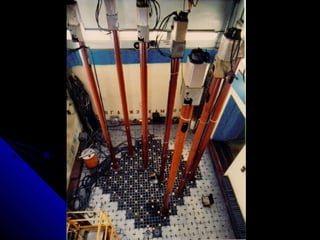
 To prevent this, control rods made of a
  material that absorbs neutrons are
  inserted
Nuclear Power

 The   depth the rods are inserted into the
  uranium, determines the amount of
  fission taking place
 All the way in… the reactions stop
 All the way out….the reactions increase
  until meltdown occurs
 The uranium bundle acts as an
  extremely high-energy source of heat. It
  heats the water and turns it to steam
Nuclear Power

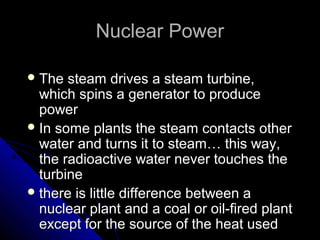
 The  steam drives a steam turbine,
  which spins a generator to produce
  power
 In some plants the steam contacts other
  water and turns it to steam… this way,
  the radioactive water never touches the
  turbine
 there is little difference between a
  nuclear plant and a coal or oil-fired plant
  except for the source of the heat used
Nuclear Power

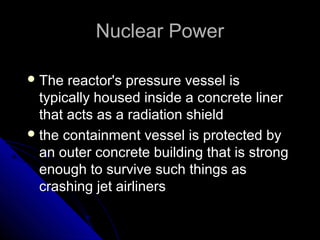
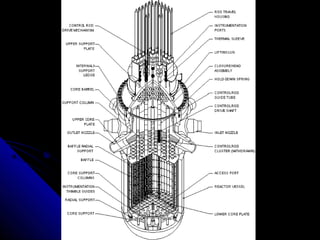
 The  reactor's pressure vessel is
  typically housed inside a concrete liner
  that acts as a radiation shield
 the containment vessel is protected by
  an outer concrete building that is strong
  enough to survive such things as
  crashing jet airliners
Nuclear Power

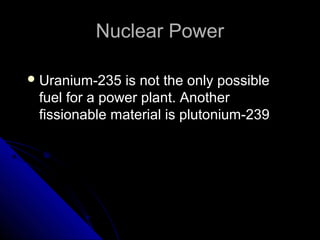
 Uranium-235  is not the only possible
 fuel for a power plant. Another
 fissionable material is plutonium-239
Nuclear Power

 Plutonium-239       can be created by U-238
  fission, therefore some reactors are
  used to make weapons grade plutonium
 If fact, the first reactors every produced
  were used for this purpose…. Atomic
  bombs
 Research reactors work on the same
  principals as power reactors, however
  are used for other purposes
Nuclear Power

 They  can be used to expose materials
  to high levels of radiation
 To bombard elements with neutrons to
  create new isotopes
 And can be used to work on new
  energy possibilities
 How safe are they? Do they hurt the
  environment?
Nuclear Safety

 Compared    with a coal-fired power plant,
  nuclear power plants are a dream come
  true from an environmental standpoint
 coal-fired power plant actually releases
  more radioactivity into the atmosphere
  than a properly-functioning nuclear
  power plant
 Fossils fuel plants (oil/coal) release
  huge amounts of carbon into the
  atmosphere, C-14 is radioactive
Nuclear Safety

 There   are also drawbacks with nuclear
  power…
 Mining and purifying uranium has not,
  historically, been a very clean process
 Improperly-functioning nuclear power
  plants can create big problems i.e. The
  Chernobyl
 Spent fuel from nuclear power plants is
  toxic for centuries and there is no safe
  permanent storage facility for it, yet
Nuclear Safety

 Transporting  nuclear fuel to and from
  plants also poses some risk
 Unfortunately, there are less new
  nuclear power plants being constructed
  due to these risks
 At some point however, there will be no
  more fossil fuel and we will have no
  choice but to build more nuclear power
  plants
Reactor Types

 There  are a couple different types of
  reactors, all use the same principle of
  nuclear fission
 The four types are …
 Graphite Moderated Reactor
 Fast Breeder Reactor (FBR)
  Liquid Metal (LMFBR) (most common
  type of breeder)
Reactor Types

 LightWater Reactor (LWR)
 Heavy Water Reactor (HWR)
 There are two types of light water
  reactors
   Boilingwater reactor
   Pressurized water reactor

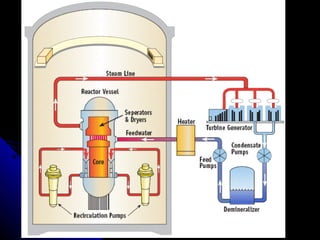
 Boiling   water reactor
   CoolantType - water
   Moderator Type – water
Reactor Types

 Fuel - uranium-dioxide (UO2)
 Comments - steam generated inside the
  reactor goes directly to the turbine
Reactor Types

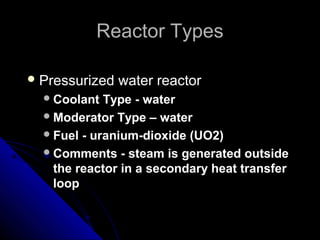
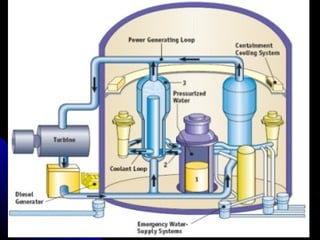
 Pressurized   water reactor
   Coolant  Type - water
   Moderator Type – water
   Fuel - uranium-dioxide (UO2)
   Comments - steam is generated outside
    the reactor in a secondary heat transfer
    loop
Reactor Types

 Heavy Water reactors work just like light
 water reactors, however, instead of
 using water H2O…. Normal hydrogen is
 replaced with deuterium H2
Reactor Types

 There
      are two types of Graphite
 moderated reactors…
   Gas Cooled
   Water Cooled

 Gas   Cooled
   Coolant   Type - gas (carbon dioxide or
    helium)
   Moderator Type – graphite
   Fuel -- uranium
Reactor Types

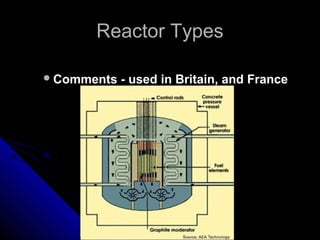
 Comments   - used in Britain, and France
Reactor Types

 Water   Cooled Reactors
   Coolant  Type – water
   Moderator Type – graphite
   Fuel -- uranium
   Comments - used in USA & former
    Soviet Union, e.g. Chernobyl
Reactor Types

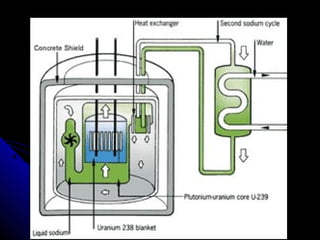
 Fast   Breeder Reactor (FBR)
   Coolant  Type – molten liquid sodium
   Moderator Type – none required
   Fuel - plutonium dioxide and uranium
    dioxide in various arrangements
   Comments - breeder reactors are
    designed to produce more fissile
    material than they consume
Radiation reactors

Radiation reactors

  • 1.
  • 2.
    Nuclear Reactions  Uranium is a fairly common element on Earth and was incorporated into the planet during the planet's formation  U-238 makes up 99 percent of the uranium on the planet  Uranium-235 makes up about 0.7 percent of the remaining uranium found naturally  Uranium-235 has an interesting property
  • 3.
    Nuclear Reactions  U-235 decays naturally, just as U-238 does, by alpha radiation  U-235 also undergoes spontaneous fission a small percentage of the time  Fission is defined as “the splitting of an atom”  Also, U-235 is one of the few materials that can undergo induced fission
  • 4.
    Nuclear Reactions  Ifa free neutron runs into a U-235 nucleus, the nucleus will absorb the neutron without hesitation, become unstable and split immediately  The probability of a U-235 atom capturing a neutron as it passes by is fairly high  In a reaction two or three neutrons are ejected from each fission causing other fissions to occur
  • 6.
    Nuclear Reactions  Theprocessof capturing the neutron and splitting happens very quickly  (1 x 10-12 seconds) picoseconds  An incredible amount of energy is released, in the form of heat and gamma radiation, when a single atom splits  The energy is released because the products and the neutrons, together, weigh less than the original U-235 atom
  • 7.
    Nuclear Reactions  The difference in weight is converted directly to energy at a rate governed by the equation E = mc2  a pound of highly enriched uranium used to power a nuclear submarine or nuclear aircraft carrier is equal to about a million gallons of gasoline  a pound of uranium is smaller than a baseball and a million gallons of gasoline would fill a five-story building
  • 8.
    Nuclear Reactions  Inorder for a reactor to work, a sample of uranium must be enriched , so that it contains two to three percent or more of uranium-235  Weapons-grade uranium is composed of 90 percent
  • 9.
    Nuclear Power  uranium is formed into pellets with approximately the same diameter as a dime and an inch long  These pellets are then placed in rods that are “super critical” meaning they would over heat and melt if left alone  To prevent this, control rods made of a material that absorbs neutrons are inserted
  • 10.
    Nuclear Power  The depth the rods are inserted into the uranium, determines the amount of fission taking place  All the way in… the reactions stop  All the way out….the reactions increase until meltdown occurs  The uranium bundle acts as an extremely high-energy source of heat. It heats the water and turns it to steam
  • 12.
    Nuclear Power  The steam drives a steam turbine, which spins a generator to produce power  In some plants the steam contacts other water and turns it to steam… this way, the radioactive water never touches the turbine  there is little difference between a nuclear plant and a coal or oil-fired plant except for the source of the heat used
  • 13.
    Nuclear Power  The reactor's pressure vessel is typically housed inside a concrete liner that acts as a radiation shield  the containment vessel is protected by an outer concrete building that is strong enough to survive such things as crashing jet airliners
  • 15.
    Nuclear Power  Uranium-235 is not the only possible fuel for a power plant. Another fissionable material is plutonium-239
  • 16.
    Nuclear Power  Plutonium-239 can be created by U-238 fission, therefore some reactors are used to make weapons grade plutonium  If fact, the first reactors every produced were used for this purpose…. Atomic bombs  Research reactors work on the same principals as power reactors, however are used for other purposes
  • 17.
    Nuclear Power  They can be used to expose materials to high levels of radiation  To bombard elements with neutrons to create new isotopes  And can be used to work on new energy possibilities  How safe are they? Do they hurt the environment?
  • 18.
    Nuclear Safety  Compared with a coal-fired power plant, nuclear power plants are a dream come true from an environmental standpoint  coal-fired power plant actually releases more radioactivity into the atmosphere than a properly-functioning nuclear power plant  Fossils fuel plants (oil/coal) release huge amounts of carbon into the atmosphere, C-14 is radioactive
  • 19.
    Nuclear Safety  There are also drawbacks with nuclear power…  Mining and purifying uranium has not, historically, been a very clean process  Improperly-functioning nuclear power plants can create big problems i.e. The Chernobyl  Spent fuel from nuclear power plants is toxic for centuries and there is no safe permanent storage facility for it, yet
  • 20.
    Nuclear Safety  Transporting nuclear fuel to and from plants also poses some risk  Unfortunately, there are less new nuclear power plants being constructed due to these risks  At some point however, there will be no more fossil fuel and we will have no choice but to build more nuclear power plants
  • 21.
    Reactor Types  There are a couple different types of reactors, all use the same principle of nuclear fission  The four types are …  Graphite Moderated Reactor  Fast Breeder Reactor (FBR) Liquid Metal (LMFBR) (most common type of breeder)
  • 22.
    Reactor Types  LightWaterReactor (LWR)  Heavy Water Reactor (HWR)  There are two types of light water reactors  Boilingwater reactor  Pressurized water reactor  Boiling water reactor  CoolantType - water  Moderator Type – water
  • 23.
    Reactor Types  Fuel- uranium-dioxide (UO2)  Comments - steam generated inside the reactor goes directly to the turbine
  • 25.
    Reactor Types  Pressurized water reactor  Coolant Type - water  Moderator Type – water  Fuel - uranium-dioxide (UO2)  Comments - steam is generated outside the reactor in a secondary heat transfer loop
  • 27.
    Reactor Types  HeavyWater reactors work just like light water reactors, however, instead of using water H2O…. Normal hydrogen is replaced with deuterium H2
  • 28.
    Reactor Types  There are two types of Graphite moderated reactors…  Gas Cooled  Water Cooled  Gas Cooled  Coolant Type - gas (carbon dioxide or helium)  Moderator Type – graphite  Fuel -- uranium
  • 29.
    Reactor Types  Comments - used in Britain, and France
  • 30.
    Reactor Types  Water Cooled Reactors  Coolant Type – water  Moderator Type – graphite  Fuel -- uranium  Comments - used in USA & former Soviet Union, e.g. Chernobyl
  • 31.
    Reactor Types  Fast Breeder Reactor (FBR)  Coolant Type – molten liquid sodium  Moderator Type – none required  Fuel - plutonium dioxide and uranium dioxide in various arrangements  Comments - breeder reactors are designed to produce more fissile material than they consume