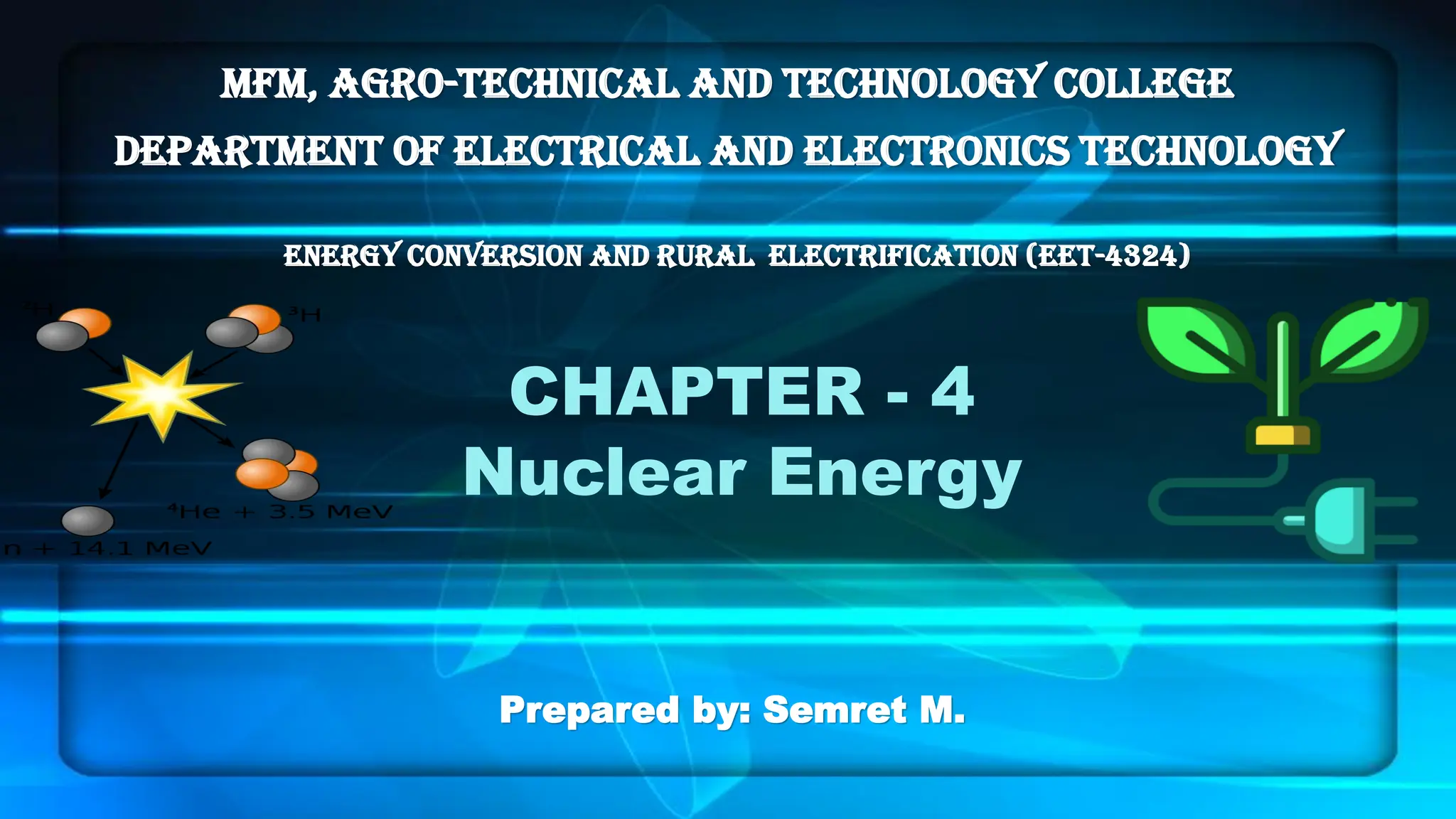
CHAPTER - 4
NuclearEnergy
MfM, Agro-Technical and Technology College
Department of Electrical and Electronics Technology
Energy Conversion and Rural Electrification (EET-4324)
Prepared by: Semret M.
2.
29 March 2024
MfM,Agro-Technical and Technology College
2
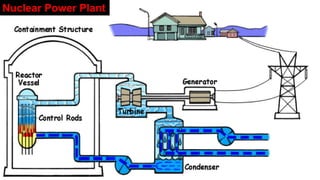
Nuclear Power Plant
3.
Introduction
29 March 2024
MfM,Agro-Technical and Technology College
3
➢ Nuclear energy is energy that comes from the nucleus (core) of an atom.
➢ Atoms are the particles that make up all objects in the universe. Atoms consist of neutrons,
protons, and electrons.
➢ Nuclear energy is released from an atom through one of two processes: Nuclear fusion or
Nuclear fission
➢ Fission is the splitting of a heavy, unstable nucleus into two lighter nuclei.
➢ Fusion is the process where two light nuclei combine together releasing vast amounts of
energy i.e. several times greater than fission.
➢ 1 kg of Uranium U-235 can produce as much energy as the burning of 4500 tons of high-
grade variety of coal or 2000 tons of oil.
4.
Common elements thatcontains nuclear energy
29 March 2024
MfM, Agro-Technical and Technology College
4
➢ Uranium and Polonium are the common elements used as an input in the nuclear power
plant.
➢ Uranium (U-235) is the fuel most widely used by nuclear plants for nuclear fission.
➢ Uranium is considered a nonrenewable energy source, even though it is a common metal
found in rocks worldwide.
➢ Nuclear power plants use a certain kind of uranium, referred to as U-235, for fuel
because its atoms are easily split apart.
5.
Working Principle
29 March2024
MfM, Agro-Technical and Technology College
5
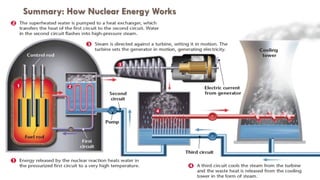
➢ A nuclear power plant works in a similar way as a thermal power plant. The difference between the two is in
the fuel they use to heat the water.
➢ Inside a nuclear power station, energy is released by nuclear fission in the core of the reactor.
➢ A nuclear reactor is driven by the splitting of atoms, a process called fission, where a particle (a ‘neutron’) is
fired at an atom, which then fissions into two smaller atoms and some additional neutrons.
❖ Some of the neutrons that are released then hit other atoms, causing them to fission too and release more
neutrons. This is called a chain reaction.
➢ The fission of atoms in the chain reaction also releases a large amount of energy as heat. The generated heat
is removed from the reactor by a circulating fluid, typically water.
➢ This heat can then be used to generate steam, which drives turbines for electricity production.
6.
Nuclear Fission
29 March2024
MfM, Agro-Technical and Technology College
6
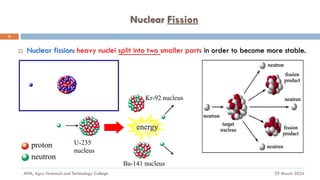
Nuclear fission: heavy nuclei split into two smaller parts in order to become more stable.
proton
neutron
U-235
nucleus
Kr-92 nucleus
Ba-141 nucleus
energy
7.
Nuclear Fission cont…
29March 2024
MfM, Agro-Technical and Technology College
7
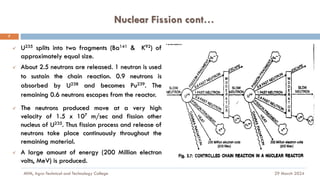
✓ U235 splits into two fragments (Ba141 & K92) of
approximately equal size.
✓ About 2.5 neutrons are released. 1 neutron is used
to sustain the chain reaction. 0.9 neutrons is
absorbed by U238 and becomes Pu239. The
remaining 0.6 neutrons escapes from the reactor.
✓ The neutrons produced move at a very high
velocity of 1.5 x 10⁷ m/sec and fission other
nucleus of U235. Thus fission process and release of
neutrons take place continuously throughout the
remaining material.
✓ A large amount of energy (200 Million electron
volts, MeV) is produced.
8.
Nuclear Chain Reaction
29March 2024
MfM, Agro-Technical and Technology College
8
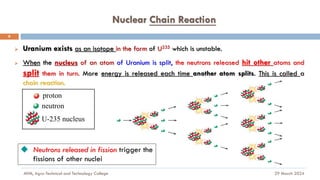
➢ Uranium exists as an isotope in the form of U235 which is unstable.
➢ When the nucleus of an atom of Uranium is split, the neutrons released hit other atoms and
split them in turn. More energy is released each time another atom splits. This is called a
chain reaction.
◆ Neutrons released in fission trigger the
fissions of other nuclei
proton
neutron
U-235 nucleus
9.
Principal Parts ofa Nuclear Reactor
29 March 2024
MfM, Agro-Technical and Technology College
9
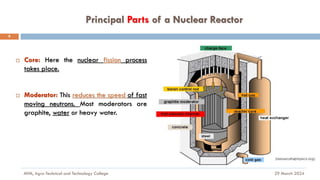
Core: Here the nuclear fission process
takes place.
Moderator: This reduces the speed of fast
moving neutrons. Most moderators are
graphite, water or heavy water.
10.
Principal Parts ofa Nuclear Reactor cont…
29 March 2024
MfM, Agro-Technical and Technology College
10
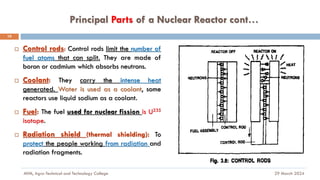
Control rods: Control rods limit the number of
fuel atoms that can split. They are made of
boron or cadmium which absorbs neutrons.
Coolant: They carry the intense heat
generated. Water is used as a coolant, some
reactors use liquid sodium as a coolant.
Fuel: The fuel used for nuclear fission is U235
isotope.
Radiation shield (thermal shielding): To
protect the people working from radiation and
radiation fragments.
11.
Uncontrolled Nuclear Reaction
29March 2024
MfM, Agro-Technical and Technology College
11
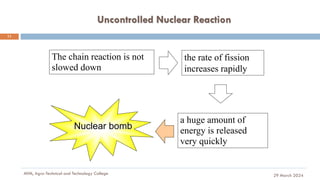
The chain reaction is not
slowed down
a huge amount of
energy is released
very quickly
the rate of fission
increases rapidly
Nuclear bomb
12.
Types of NuclearPower Plant
29 March 2024
MfM, Agro-Technical and Technology College
12
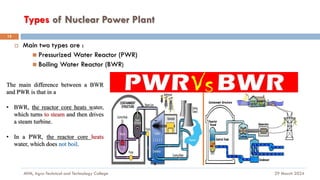
Main two types are :
◼ Pressurized Water Reactor (PWR)
◼ Boiling Water Reactor (BWR)
The main difference between a BWR
and PWR is that in a
• BWR, the reactor core heats water,
which turns to steam and then drives
a steam turbine.
• In a PWR, the reactor core heats
water, which does not boil.
13.
Pressurized Water Reactor(PWR)
29 March 2024
MfM, Agro-Technical and Technology College
13
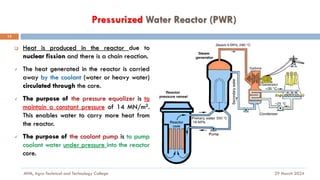
❑ Heat is produced in the reactor due to
nuclear fission and there is a chain reaction.
✓ The heat generated in the reactor is carried
away by the coolant (water or heavy water)
circulated through the core.
✓ The purpose of the pressure equalizer is to
maintain a constant pressure of 14 MN/m2.
This enables water to carry more heat from
the reactor.
✓ The purpose of the coolant pump is to pump
coolant water under pressure into the reactor
core.
14.
Pressurized Water Reactor(PWR) cont…
29 March 2024
MfM, Agro-Technical and Technology College
14
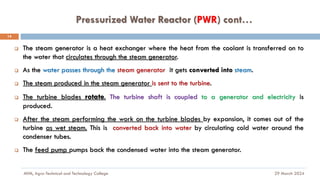
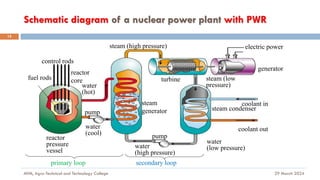
❑ The steam generator is a heat exchanger where the heat from the coolant is transferred on to
the water that circulates through the steam generator.
❑ As the water passes through the steam generator it gets converted into steam.
❑ The steam produced in the steam generator is sent to the turbine.
❑ The turbine blades rotate. The turbine shaft is coupled to a generator and electricity is
produced.
❑ After the steam performing the work on the turbine blades by expansion, it comes out of the
turbine as wet steam. This is converted back into water by circulating cold water around the
condenser tubes.
❑ The feed pump pumps back the condensed water into the steam generator.
15.
Schematic diagram ofa nuclear power plant with PWR
29 March 2024
MfM, Agro-Technical and Technology College
15
control rods
fuel rods
reactor
pressure
vessel
water
(cool)
water
(hot)
water
(high pressure)
water
(low pressure)
coolant out
coolant in
steam condenser
steam (low
pressure)
turbine
electric power
steam
generator
steam (high pressure)
pump
primary loop secondary loop
generator
reactor
core
pump
16.
control rods
reactor
pressure
vessel
water
(cool)
water
(hot)
water (high
pressure)
water(low
pressure)
coolant out
coolant in
steam condenser
steam (low
pressure)
turbine
electric
power
steam
generator
steam (high pressure)
pump
primary loop secondary loop
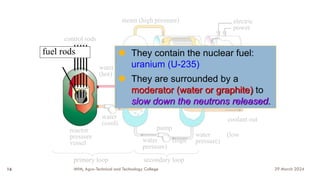
fuel rods ◆ They contain the nuclear fuel:
uranium (U-235)
◆ They are surrounded by a
moderator (water or graphite) to
slow down the neutrons released.
29 March 2024
MfM, Agro-Technical and Technology College
16
17.
control rods
reactor
pressure
vessel
water
(cool)
water
(hot)
water (high
pressure)
water(low
pressure)
coolant out
coolant in
steam condenser
steam (low
pressure)
turbine
electric
power
steam
generator
steam (high pressure)
pump
primary loop secondary loop
fuel
rods
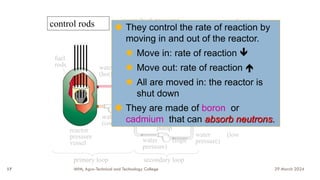
◆ They control the rate of reaction by
moving in and out of the reactor.
⚫ Move in: rate of reaction
⚫ Move out: rate of reaction
⚫ All are moved in: the reactor is
shut down
◆ They are made of boron or
cadmium that can absorb neutrons.
29 March 2024
MfM, Agro-Technical and Technology College
17
18.
control rods
reactor
pressure
vessel water(high
pressure)
water (low
pressure)
coolant out
coolant in
steam condenser
steam (low
pressure)
turbine
electric
power
pump
primary loop secondary loop
fuel
rods
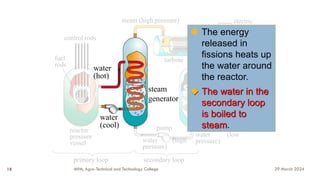
◆ The energy
released in
fissions heats up
the water around
the reactor.
◆ The water in the
secondary loop
is boiled to
steam.
water
(hot)
water
(cool)
steam
generator
steam (high pressure)
29 March 2024
MfM, Agro-Technical and Technology College
18
19.
steam
generator
control rods
reactor
pressure
vessel water(high
pressure)
water (low
pressure)
coolant out
coolant in
steam condenser
steam (high pressure)
pump
primary loop secondary loop
fuel
rods
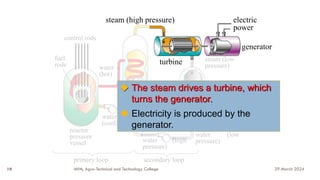
◆ The steam drives a turbine, which
turns the generator.
◆ Electricity is produced by the
generator.
water
(hot)
water
(cool)
steam (low
pressure)
turbine
electric
power
generator
29 March 2024
MfM, Agro-Technical and Technology College
19
20.
Boiling Water Reactor(BWR)
29 March 2024
MfM, Agro-Technical and Technology College
20
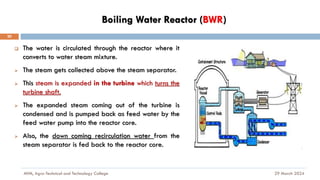
❑ The water is circulated through the reactor where it
converts to water steam mixture.
➢ The steam gets collected above the steam separator.
➢ This steam is expanded in the turbine which turns the
turbine shaft.
➢ The expanded steam coming out of the turbine is
condensed and is pumped back as feed water by the
feed water pump into the reactor core.
➢ Also, the down coming recirculation water from the
steam separator is fed back to the reactor core.
21.
Nuclear fusion
29 March2024
MfM, Agro-Technical and Technology College
21
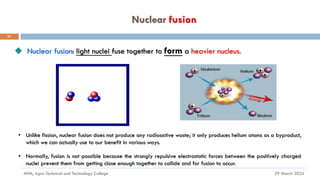
◆ Nuclear fusion: light nuclei fuse together to form a heavier nucleus.
• Unlike fission, nuclear fusion does not produce any radioactive waste; it only produces helium atoms as a byproduct,
which we can actually use to our benefit in various ways.
• Normally, fusion is not possible because the strongly repulsive electrostatic forces between the positively charged
nuclei prevent them from getting close enough together to collide and for fusion to occur.
22.
Nuclear Waste
29 March2024
MfM, Agro-Technical and Technology College
22
➢ Radioactive pollution is caused by the release of radioactive materials into the
environment.
➢ Radioactive pollution can cause a variety of health problems, including cancer and
genetic mutations. It can also damage the environment, causing the death of plants and
animals.
➢ The operation of nuclear power plants produces waste with varying levels of
radioactivity.
➢ This waste can be extremely toxic and stays radioactive for thousands of years.
➢ The government regulates how these materials are disposed of to avoid radioactive
contamination.
➢ These are managed differently depending on their level of radioactivity and purpose.
23.
Nuclear Waste cont…
29March 2024
MfM, Agro-Technical and Technology College
23
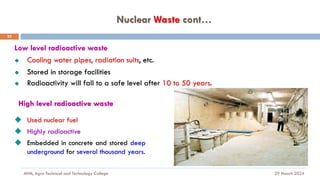
Low level radioactive waste
◆ Cooling water pipes, radiation suits, etc.
◆ Stored in storage facilities
◆ Radioactivity will fall to a safe level after 10 to 50 years.
High level radioactive waste
◆ Used nuclear fuel
◆ Highly radioactive
◆ Embedded in concrete and stored deep
underground for several thousand years.
24.
Advantages and Disadvantagesof Nuclear Energy
29 March 2024
MfM, Agro-Technical and Technology College
24
Advantages of Nuclear power plant:
▪ Space required is less when compared with other power plants.
▪ Nuclear power plant is the only source which can meet the increasing demand of electricity at a reasonable
cost.
▪ A nuclear power plant uses much less fuel than a fossil-fuel plant.
1 metric ton of uranium fuel = 3 million metric tons of coal = 12 million barrels of oil.
Disadvantages of Nuclear power plant:
o Nuclear Weapons Threat - It has potential nuclear proliferation issues. Some reactors produce plutonium
which can be used to make nuclear weapons. Nuclear weapons are a major threat to the world as they can
cause a large-scale devastation.
o High Capital Intensive
o Radioactive Waste
25.
Summary: How NuclearEnergy Works
29 March 2024
MfM, Agro-Technical and Technology College
25



![industry 4.0-Revolution-PowerPoint-Templates [Autosaved].pptx](https://cdn.slidesharecdn.com/ss_thumbnails/industry4-240910061852-d49188b5-thumbnail.jpg?width=640&height=640&fit=bounds)


