Nuclear reaction, fission and fusion reaction, critical
mass chain reaction, moderators, reactor control and
cooling, classification of reactors, different types of
reactors, radiation damages, shielding of grays
neutrons, materials for construction
Coolant
ENGR302I
Fission
Fission
 Nuclear energy is produced through a process called
Nuclear Fission in which a uranium-235 atom is struck at
low speed by a neutron. As soon as the nucleus of the
atom captures the neutron, it splits into two lighter
atoms and sends off two to three new neutrons that will
cause further fissions. A substantial amount of energy
(216MeV) in the form of heat and gamma radiation is
released in this reaction when the atom splits and the
two new atoms obtained in result also emit some
gamma and beta radiation as they settle into their new
states.
Approximate Distribution of
Fission Energy
MeV
Kinetic energy of fission fragments 165
Instantaneous gamma-ray energy 7
Kinetic energy of fission neutrons 5
Beta particles form fission products 7
Gamma rays from fission products 6
Neutrinos 10
Total fission energy 200
Neutron Balance
 Neutrons released in fission may be lost by escaping
the container, or by being absorbed by non-fissile
materials
 If more neutrons are lost than are produced, the
reaction is subcritical and dies out (“safe”)
 If the number lost equals the number produced, the
reaction is critical (steady state, e.g., a reactor)
 If the fewer neutrons are lost than are produced, the
reaction is supercritical and energy release increases
exponentially (e.g., a nuclear weapon)
FUSION
Advantage of Fusion Reaction
 More efficient (1 amu generates 6.7MeV).
 No radioactive waste.
 Clean fuel.
 Hydrogen is available in plenty.
 Disadvantage
 Process cannot be stopped until the Hydrogen burns
out. So it is a risky process.
REACTORS
 The function of a reactors is to produce heat and
transfer that heat to the coolant, maintain a pressure
boundary, so the coolant is not lost, and provide a
structure to hold the fuel.
REACTOR TYPES
 BWR-Boiling Water Reactor
 PWR-Pressurized Water Reactor
 LGR-Light Water Cooled - Graphite Moderated
Reactor
 LMFBR-Liquid Metal Fast Breeder Reactor
 LMGMR-Liquid Metal (Cooled) -Graphite
Moderated Reactor
 LWBR-Light Water Breeder Reactor
Reactor types based on Uranium
percentage
The fuel elements vary between different Reactors
 Some reactors use unenriched URANIUM
 i.e. the 235U in fuel elements is at 0.7% of fuel
 e.g. MAGNOX and CANDU reactors,
 ADVANCED GAS COOLED REACTOR (AGR) uses 2.5 – 2.8%
enrichment
 PRESSURISED WATER REACTOR (PWR) and BOILING WATER
REACTOR (BWR) use around 3.5 – 4% enrichment.
 RMBK (Russian Rector of Chernobyl fame) uses ~2% enrichment
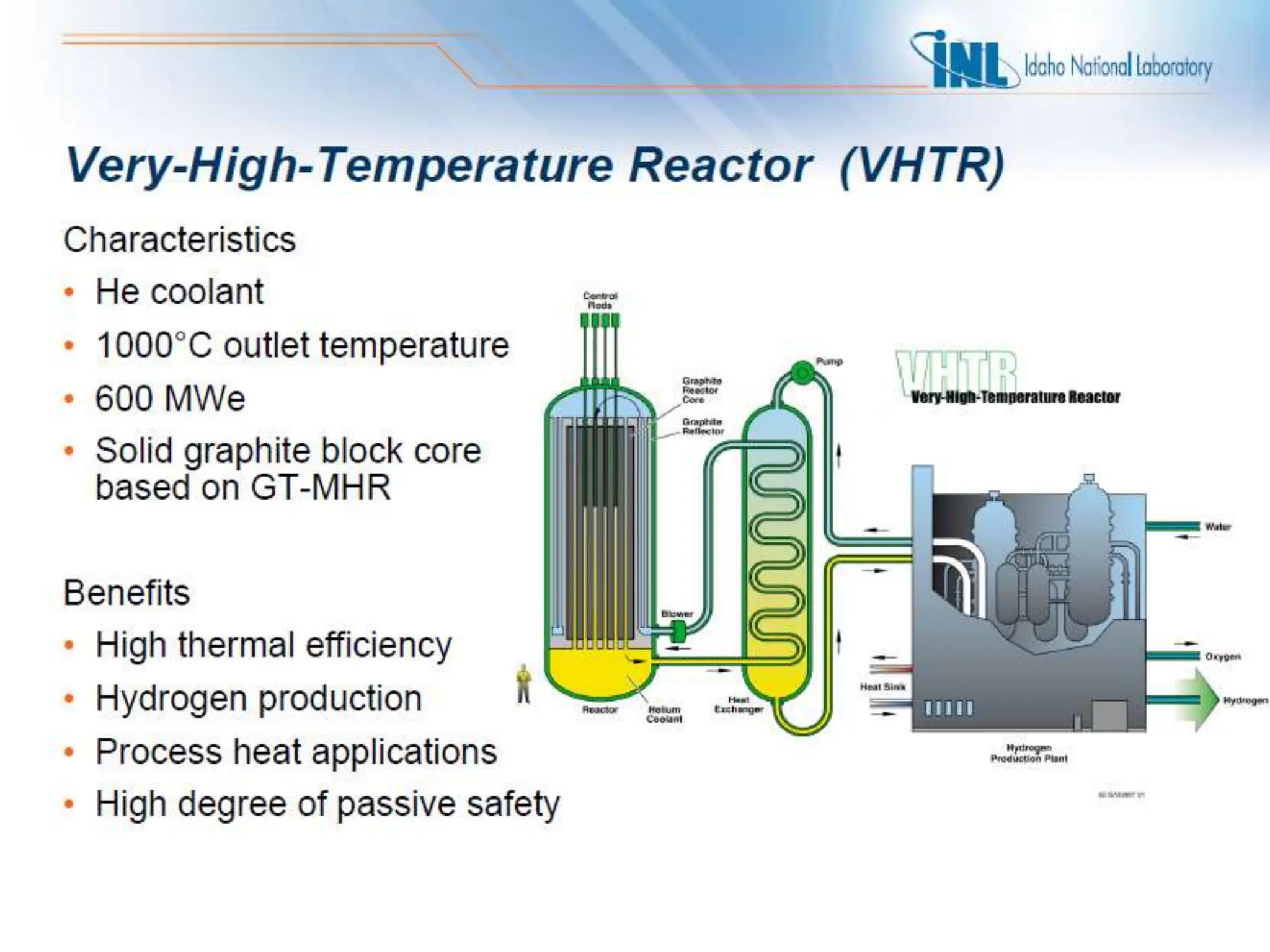
 Some experimental reactors - e.g. High Temperature Reactors (HTR)
use highly enriched URANIUM (>90%) i.e. weapons grade.
REACTOR TYPES
BWR
Nuclear Reactor Schematics
Boiling Water Nuclear Reactor
32 05/11/2023
CONTROL RODS MUST BE DRIVEN
UPWARDS - SO NEED POWER IN FAULT
CONDITIONS. Provision made to dump water
(moderator in such circumstances).
ON LOAD REFUELLING NOT
POSSIBLE - reactor must be shut down.
SIGNIFICANT CONTAMINATION OF
COOLANT CAN ARISE FROM BURST
FUEL CANS - as defective units cannot be
removed without shutting down reactor.
ALSO IN SUCH CIRCUMSTANCES
RADIOACTIVE STEAM WILL PASS
DIRECTLY TO TURBINES.
FUEL ENRICHMENT NEEDED. - 3%.
MAXIMUM EFFICIENCY ~ 34-35%
• LOSS OF COOLANT also means LOSS
OF MODERATOR so reaction ceases - but
residual decay heat can be large.
• HIGH POWER DENSITY - 100 MW/m3,
and compact. Temperature can rise
rapidly in fault conditions. NEEDS active
ECCS.
• SINGLE STEEL PRESSURE VESSEL 200
mm thick.
REACTOR TYPES
PWR
Nuclear Reactor Schematics
Pressurized Water Nuclear Reactor
35 05/11/2023
break occurs then water will flash to
steam and cooling will be less effective.
• ON LOAD REFUELLING NOT
POSSIBLE - reactor must be shut down.
• SIGNIFICANT CONTAMINATION OF
COOLANT CAN ARISE FROM BURST
FUEL CANS - as defective units cannot be
removed without shutting down reactor.
• FUEL ENRICHMENT NEEDED. - 3-4%.
• MAXIMUM EFFICIENCY ~ 31 - 32%
latest designs ~ 34%
OTHER FACTORS:-
• LOSS OF COOLANT also means LOSS
OF MODERATOR so reaction ceases - bu
residual decay heat can be large.
• HIGH POWER DENSITY - 100 MW/m3,
and compact. Temperature can rise
rapidly in fault conditions. NEEDS active
ECCS.
• SINGLE STEEL PRESSURE VESSEL 20
mm thick.
Power transfer in PWR
 Nuclear fuel in the reactor vessel is engaged in a fission chain
reaction, which produces heat, heating the water in the primary
coolant loop.
 The hot primary coolant is pumped into steam generator.
 Heat is transferred to the lower pressure secondary coolant where it
evaporates to pressurized steam.
 The pressurized steam is fed through a steam turbine which drives
an electrical generator connected to the electric grid for distribution.
 After passing through the turbine the secondary coolant is cooled
down and condensed in a condenser.
 The condenser converts the steam to a liquid so that it can be
pumped back into the steam generator.
43 05/11/2023
 FUEL TYPE - depleted Uranium or UO2
surround PU in centre of core. All
elements clad in stainless steel.
 MODERATOR - NONE
 COOLANT - LIQUID METAL
ADVANTAGES:-
 LIQUID METAL COOLANT - at
ATMOSPHERIC PRESSURE. Will even
cool by natural convection in event of
pump failure.
 BREEDS FISSILE MATERIAL from non-
fissile 238U – increases resource base 50+
times.
 HIGH EFFICIENCY (~ 40%)
 VERTICAL CONTROL RODS drop by
GRAVITY in fault conditions.
FAST BREEDER REACTORS (FBR or LMFBR)
DISADVANTAGES:-
• DEPLETED URANIUM FUEL
ELEMENTS MUST BE REPROCESSED
to recover PLUTONIUM and sustain the
breeding of more plutonium for future use.
• CURRENT DESIGNS have SECONDARY
SODIUM CIRCUIT
• WATER/SODIM HEAT EXCHANGER.
If water and sodium mix a significant
CHEMICAL explosion may occur which
might cause damage to reactor itself.
OTHER FACTORS:-
• VERY HIGH POWER DENSITY - 600
MW/m3 but rise in temperature in fault
conditions limited by natural circulation of
sodium.
Nuclear Waste
AIR
The gases released in to the atmospheric environment
from nuclear power plants come from the cooling towers,
ventilation systems, diesel generators and air ejectors
and are monitored and regulated to acceptable levels
where necessary.
 The giant cooling towers release water-vapor that is not
radioactive.
 Ventilation systems from sites within the plant that deal
with radioactivity release radioactive gases but at
acceptable amounts that are maintained by radiation
monitors.
 Diesel generators do not release radioactive gases but are
the only emitters of green house gases.
 Air ejector exhaust at PWR are not radioactive but are at
BWR plants where they are maintained at acceptable
levels by radiation monitors.
 Water used to cool the condenser in a
reactor comes from the cooling tower and is
not radioactive, but that which comes from
the steam generator and directly cools the
reactor sometimes is. water from the steam
generator is there for must be stored,
cleaned and tested to make sure its
radioactive levels are below acceptable levels
before being released from a nuclear power
plant
IAEA ACCIDENT SCALE

Nuclear%20power%20plant.pptx

  • 1.
    Nuclear reaction, fissionand fusion reaction, critical mass chain reaction, moderators, reactor control and cooling, classification of reactors, different types of reactors, radiation damages, shielding of grays neutrons, materials for construction
  • 12.
  • 17.
  • 20.
    Fission  Nuclear energyis produced through a process called Nuclear Fission in which a uranium-235 atom is struck at low speed by a neutron. As soon as the nucleus of the atom captures the neutron, it splits into two lighter atoms and sends off two to three new neutrons that will cause further fissions. A substantial amount of energy (216MeV) in the form of heat and gamma radiation is released in this reaction when the atom splits and the two new atoms obtained in result also emit some gamma and beta radiation as they settle into their new states.
  • 21.
    Approximate Distribution of FissionEnergy MeV Kinetic energy of fission fragments 165 Instantaneous gamma-ray energy 7 Kinetic energy of fission neutrons 5 Beta particles form fission products 7 Gamma rays from fission products 6 Neutrinos 10 Total fission energy 200
  • 22.
    Neutron Balance  Neutronsreleased in fission may be lost by escaping the container, or by being absorbed by non-fissile materials  If more neutrons are lost than are produced, the reaction is subcritical and dies out (“safe”)  If the number lost equals the number produced, the reaction is critical (steady state, e.g., a reactor)  If the fewer neutrons are lost than are produced, the reaction is supercritical and energy release increases exponentially (e.g., a nuclear weapon)
  • 23.
  • 25.
    Advantage of FusionReaction  More efficient (1 amu generates 6.7MeV).  No radioactive waste.  Clean fuel.  Hydrogen is available in plenty.  Disadvantage  Process cannot be stopped until the Hydrogen burns out. So it is a risky process.
  • 26.
    REACTORS  The functionof a reactors is to produce heat and transfer that heat to the coolant, maintain a pressure boundary, so the coolant is not lost, and provide a structure to hold the fuel.
  • 27.
    REACTOR TYPES  BWR-BoilingWater Reactor  PWR-Pressurized Water Reactor  LGR-Light Water Cooled - Graphite Moderated Reactor  LMFBR-Liquid Metal Fast Breeder Reactor  LMGMR-Liquid Metal (Cooled) -Graphite Moderated Reactor  LWBR-Light Water Breeder Reactor
  • 29.
    Reactor types basedon Uranium percentage The fuel elements vary between different Reactors  Some reactors use unenriched URANIUM  i.e. the 235U in fuel elements is at 0.7% of fuel  e.g. MAGNOX and CANDU reactors,  ADVANCED GAS COOLED REACTOR (AGR) uses 2.5 – 2.8% enrichment  PRESSURISED WATER REACTOR (PWR) and BOILING WATER REACTOR (BWR) use around 3.5 – 4% enrichment.  RMBK (Russian Rector of Chernobyl fame) uses ~2% enrichment  Some experimental reactors - e.g. High Temperature Reactors (HTR) use highly enriched URANIUM (>90%) i.e. weapons grade.
  • 30.
  • 31.
  • 32.
    32 05/11/2023 CONTROL RODSMUST BE DRIVEN UPWARDS - SO NEED POWER IN FAULT CONDITIONS. Provision made to dump water (moderator in such circumstances). ON LOAD REFUELLING NOT POSSIBLE - reactor must be shut down. SIGNIFICANT CONTAMINATION OF COOLANT CAN ARISE FROM BURST FUEL CANS - as defective units cannot be removed without shutting down reactor. ALSO IN SUCH CIRCUMSTANCES RADIOACTIVE STEAM WILL PASS DIRECTLY TO TURBINES. FUEL ENRICHMENT NEEDED. - 3%. MAXIMUM EFFICIENCY ~ 34-35% • LOSS OF COOLANT also means LOSS OF MODERATOR so reaction ceases - but residual decay heat can be large. • HIGH POWER DENSITY - 100 MW/m3, and compact. Temperature can rise rapidly in fault conditions. NEEDS active ECCS. • SINGLE STEEL PRESSURE VESSEL 200 mm thick.
  • 33.
  • 34.
  • 35.
    35 05/11/2023 break occursthen water will flash to steam and cooling will be less effective. • ON LOAD REFUELLING NOT POSSIBLE - reactor must be shut down. • SIGNIFICANT CONTAMINATION OF COOLANT CAN ARISE FROM BURST FUEL CANS - as defective units cannot be removed without shutting down reactor. • FUEL ENRICHMENT NEEDED. - 3-4%. • MAXIMUM EFFICIENCY ~ 31 - 32% latest designs ~ 34% OTHER FACTORS:- • LOSS OF COOLANT also means LOSS OF MODERATOR so reaction ceases - bu residual decay heat can be large. • HIGH POWER DENSITY - 100 MW/m3, and compact. Temperature can rise rapidly in fault conditions. NEEDS active ECCS. • SINGLE STEEL PRESSURE VESSEL 20 mm thick.
  • 36.
    Power transfer inPWR  Nuclear fuel in the reactor vessel is engaged in a fission chain reaction, which produces heat, heating the water in the primary coolant loop.  The hot primary coolant is pumped into steam generator.  Heat is transferred to the lower pressure secondary coolant where it evaporates to pressurized steam.  The pressurized steam is fed through a steam turbine which drives an electrical generator connected to the electric grid for distribution.  After passing through the turbine the secondary coolant is cooled down and condensed in a condenser.  The condenser converts the steam to a liquid so that it can be pumped back into the steam generator.
  • 43.
    43 05/11/2023  FUELTYPE - depleted Uranium or UO2 surround PU in centre of core. All elements clad in stainless steel.  MODERATOR - NONE  COOLANT - LIQUID METAL ADVANTAGES:-  LIQUID METAL COOLANT - at ATMOSPHERIC PRESSURE. Will even cool by natural convection in event of pump failure.  BREEDS FISSILE MATERIAL from non- fissile 238U – increases resource base 50+ times.  HIGH EFFICIENCY (~ 40%)  VERTICAL CONTROL RODS drop by GRAVITY in fault conditions. FAST BREEDER REACTORS (FBR or LMFBR) DISADVANTAGES:- • DEPLETED URANIUM FUEL ELEMENTS MUST BE REPROCESSED to recover PLUTONIUM and sustain the breeding of more plutonium for future use. • CURRENT DESIGNS have SECONDARY SODIUM CIRCUIT • WATER/SODIM HEAT EXCHANGER. If water and sodium mix a significant CHEMICAL explosion may occur which might cause damage to reactor itself. OTHER FACTORS:- • VERY HIGH POWER DENSITY - 600 MW/m3 but rise in temperature in fault conditions limited by natural circulation of sodium.
  • 44.
  • 45.
    AIR The gases releasedin to the atmospheric environment from nuclear power plants come from the cooling towers, ventilation systems, diesel generators and air ejectors and are monitored and regulated to acceptable levels where necessary.  The giant cooling towers release water-vapor that is not radioactive.  Ventilation systems from sites within the plant that deal with radioactivity release radioactive gases but at acceptable amounts that are maintained by radiation monitors.  Diesel generators do not release radioactive gases but are the only emitters of green house gases.  Air ejector exhaust at PWR are not radioactive but are at BWR plants where they are maintained at acceptable levels by radiation monitors.
  • 46.
     Water usedto cool the condenser in a reactor comes from the cooling tower and is not radioactive, but that which comes from the steam generator and directly cools the reactor sometimes is. water from the steam generator is there for must be stored, cleaned and tested to make sure its radioactive levels are below acceptable levels before being released from a nuclear power plant
  • 47.