Indian Nuclear Program
Prof. Debajyoti Bose
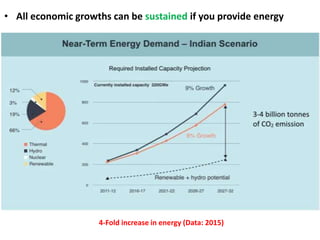
• All economic growths can be sustained if you provide energy
4-Fold increase in energy (Data: 2015)
• Additional CO2 production of 3-4 billion tonnes
Solution:
Primary Energy Sources: Solar, Wind & Nuclear.
Classification: 2 types
Intermittent
Intermittent
Continuous
5000 sq. Km
400 sq. km
2 sq. Km
Generation: 10, 000 MW
ACF: 25% ACF: 90%
ACF: 20%
ACF: Average Capacity Factor
U-235 has 2.5 million times more energy per pound than coal: 37 tons of fuel ((3%-enriched
uranium) per 1000 MW reactor per year.
Nuclear provides an emission-free heat source that can be converted into multiple products :
• Electricity (worldwide)
• Steam for industry
• Hydrogen (future with development of technology)
• Above is working for all nuclear reactors.
• Thorium is four times more abundant than Uranium
• Thorium is easily available.
• Problems: Full energy is not tapped.
• Less than a percent is utilized.
Spent fuel is reprocessed and from there the fissile and fertile material is utilized by the
reactor. And the total energy tapped is multiplied.
Good Handling of Nuclear Waste
200, 000 years
• Radiotoxicity as a function of time
• Natural level of toxicity is given the natural uranium ore line
• The total level of rest of reactor material comes to that level after
about 200, 000 years
• Human history is for 6000 years.
• Responsibility issues
Solution:
Isolate Am (Amerecium), Plutonium (Pl), Curium (Cu) and burn them in another
reactor.
This reduce the decay time.
“Hence closed fuel cycle provides more energy from fuel and also
takes care of the waste.”
Deploying Thorium Power
Can be used in different types of reactor:
• Heavy Water Reactor
• Molten Salt Reactor
• Accelerator driven sub-critical systems
“India took the initiative to design such systems, which has gone
through several international reviews.”
• Instead of 2 here 20 neutrons come out, convert fertile to fissile,
and have other reactors around it
Features of this Design
• Everything is Passive
• No Human Intervention
• No “Fukushima” Situation
It can burn:
Plutonium + Thorium
Uranium + Thorium
Low enriched Uranium+ Thorium
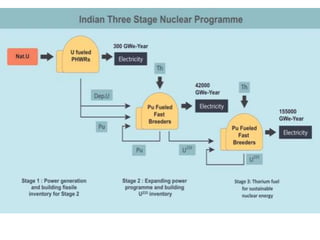
• Uranium fuel produce energy and Plutonium
• Plutonium is pumped into Fast reactor, once in fast reactor, more
neutrons than a thermal reactor
• Convert Thorium to U-233 (This is the FUTURE !)
• Making Nuclear Energy a sustainable form of Energy
Stage I: Power Generation and building the fissile inventory for the
secondary
Stage II: Expanding the power program and making the most of U-233
inventory
Stage III: Burning the fuel
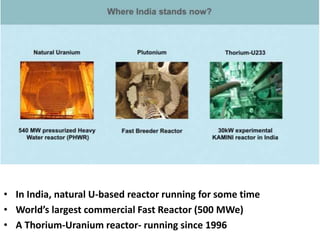
• In India, natural U-based reactor running for some time
• World’s largest commercial Fast Reactor (500 MWe)
• A Thorium-Uranium reactor- running since 1996
A Place called Kalpakkam
• All 3 reactors located in one place in India
• Close to Chennai
Not there anywhere in the WORLD !!!
Nuclear Power Generation
THE END

Indian nuclear program

  • 1.
  • 2.
    • All economicgrowths can be sustained if you provide energy 4-Fold increase in energy (Data: 2015)
  • 3.
    • Additional CO2production of 3-4 billion tonnes Solution: Primary Energy Sources: Solar, Wind & Nuclear. Classification: 2 types Intermittent Intermittent Continuous 5000 sq. Km 400 sq. km 2 sq. Km Generation: 10, 000 MW
  • 4.
    ACF: 25% ACF:90% ACF: 20% ACF: Average Capacity Factor U-235 has 2.5 million times more energy per pound than coal: 37 tons of fuel ((3%-enriched uranium) per 1000 MW reactor per year. Nuclear provides an emission-free heat source that can be converted into multiple products : • Electricity (worldwide) • Steam for industry • Hydrogen (future with development of technology)
  • 5.
    • Above isworking for all nuclear reactors. • Thorium is four times more abundant than Uranium • Thorium is easily available.
  • 6.
    • Problems: Fullenergy is not tapped. • Less than a percent is utilized. Spent fuel is reprocessed and from there the fissile and fertile material is utilized by the reactor. And the total energy tapped is multiplied. Good Handling of Nuclear Waste
  • 7.
  • 8.
    • Radiotoxicity asa function of time • Natural level of toxicity is given the natural uranium ore line • The total level of rest of reactor material comes to that level after about 200, 000 years • Human history is for 6000 years. • Responsibility issues Solution: Isolate Am (Amerecium), Plutonium (Pl), Curium (Cu) and burn them in another reactor. This reduce the decay time. “Hence closed fuel cycle provides more energy from fuel and also takes care of the waste.”
  • 9.
    Deploying Thorium Power Canbe used in different types of reactor: • Heavy Water Reactor • Molten Salt Reactor • Accelerator driven sub-critical systems “India took the initiative to design such systems, which has gone through several international reviews.”
  • 10.
    • Instead of2 here 20 neutrons come out, convert fertile to fissile, and have other reactors around it
  • 11.
    Features of thisDesign • Everything is Passive • No Human Intervention • No “Fukushima” Situation It can burn: Plutonium + Thorium Uranium + Thorium Low enriched Uranium+ Thorium
  • 13.
    • Uranium fuelproduce energy and Plutonium • Plutonium is pumped into Fast reactor, once in fast reactor, more neutrons than a thermal reactor • Convert Thorium to U-233 (This is the FUTURE !) • Making Nuclear Energy a sustainable form of Energy Stage I: Power Generation and building the fissile inventory for the secondary Stage II: Expanding the power program and making the most of U-233 inventory Stage III: Burning the fuel
  • 14.
    • In India,natural U-based reactor running for some time • World’s largest commercial Fast Reactor (500 MWe) • A Thorium-Uranium reactor- running since 1996
  • 15.
    A Place calledKalpakkam • All 3 reactors located in one place in India • Close to Chennai Not there anywhere in the WORLD !!!
  • 16.