RADAR
Main uses of radar
   Collision avoidance i.e. look-out,
    plotting, finding course & speed,
    finding closest point of approach,
    determining risk of collision
   Navigation i.e. range, bearings,
    mixed fixes
   Pilotage i.e. clearing lines
BREAK DOWN OF A RADAR SCREEN

                          Range
                          rings


Ships
head
marker
IRPCS & the use of radar
 Rule 5 (Lookout), Rule 6 (Safe speed),
  Rule 7 (Risk of collision), Rule 19 (conduct
  in restricted visability
 Rule 7b

“Proper use shall be made of radar
  equipment if fitted and operational,
  including long range scanning to obtain
  early warning of risk of collision and radar
  plotting or equivalent systematic
  observation of detected objects.”
 Rule 7c

“Assumptions shall not be made on the basis
  of scanty information, especially scanty
  radar information.”
SOLAS regulations
   Specifies that you must have a radar
    reflector !
   If your craft is over 15m in length
    then it must be a specific size.
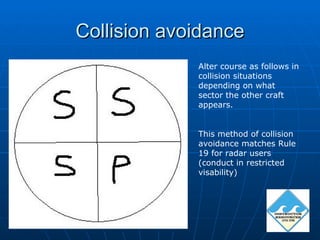
Collision avoidance
             Alter course as follows in
             collision situations
             depending on what
             sector the other craft
             appears.


             This method of collision
             avoidance matches Rule
             19 for radar users
             (conduct in restricted
             visability)
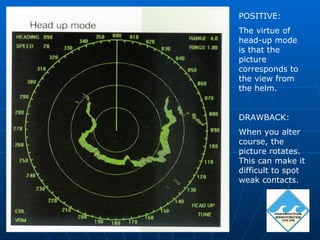
POSITIVE:
The virtue of
head-up mode
is that the
picture
corresponds to
the view from
the helm.


DRAWBACK:
When you alter
course, the
picture rotates.
This can make it
difficult to spot
weak contacts.
Postives:
Picture
corresponds to
chart.
Postive:
Similar look to
HU.
Good for
collision
avoidance but
needs to be
reset whenever
you alter your
course
Principles
 RANGE
Depends on height of scanner & target
Effected by the horizon
 TARGETS

Signal depends on size, material,
  aspect, texture, shape i.e. a port
  marker will show up better than a
  starboard marker
Beware !
 False echos
 Side echos – i.e. when a boat goes

  past you there can be a repeated
  appearance on screen
 Shadows – i.e. blind spots

 Interference – i.e. from another

  radar
**ATTEND AN RYA RADAR COURSE
  PRIOR TO USE !**

Radar

  • 1.
  • 2.
    Main uses ofradar  Collision avoidance i.e. look-out, plotting, finding course & speed, finding closest point of approach, determining risk of collision  Navigation i.e. range, bearings, mixed fixes  Pilotage i.e. clearing lines
  • 3.
    BREAK DOWN OFA RADAR SCREEN Range rings Ships head marker
  • 4.
    IRPCS & theuse of radar  Rule 5 (Lookout), Rule 6 (Safe speed), Rule 7 (Risk of collision), Rule 19 (conduct in restricted visability  Rule 7b “Proper use shall be made of radar equipment if fitted and operational, including long range scanning to obtain early warning of risk of collision and radar plotting or equivalent systematic observation of detected objects.”  Rule 7c “Assumptions shall not be made on the basis of scanty information, especially scanty radar information.”
  • 5.
    SOLAS regulations  Specifies that you must have a radar reflector !  If your craft is over 15m in length then it must be a specific size.
  • 6.
    Collision avoidance Alter course as follows in collision situations depending on what sector the other craft appears. This method of collision avoidance matches Rule 19 for radar users (conduct in restricted visability)
  • 7.
    POSITIVE: The virtue of head-upmode is that the picture corresponds to the view from the helm. DRAWBACK: When you alter course, the picture rotates. This can make it difficult to spot weak contacts.
  • 8.
  • 9.
    Postive: Similar look to HU. Goodfor collision avoidance but needs to be reset whenever you alter your course
  • 10.
    Principles  RANGE Depends onheight of scanner & target Effected by the horizon  TARGETS Signal depends on size, material, aspect, texture, shape i.e. a port marker will show up better than a starboard marker
  • 11.
    Beware !  Falseechos  Side echos – i.e. when a boat goes past you there can be a repeated appearance on screen  Shadows – i.e. blind spots  Interference – i.e. from another radar **ATTEND AN RYA RADAR COURSE PRIOR TO USE !**