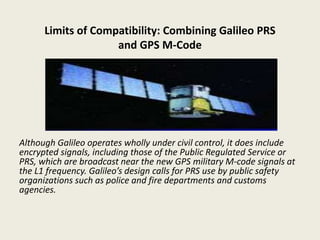
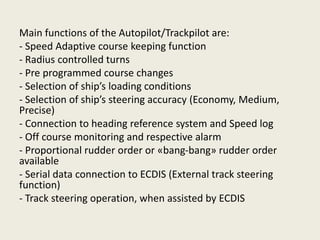
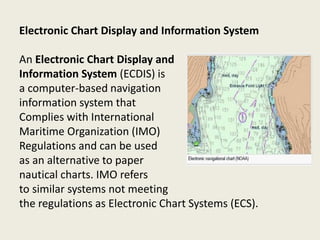
NAVIGATION 5
OPERATIONAL USE
OF
ECDIS
INSTRUCTOR
CAPT. D. TUMANENG, M. M. E.
GOOD MORNING / AFTERNOON
LADIES AND GENTLEMEN
I AM CAPT. DANIEL D. TUMANENG A LICENSED
and EXPERIENCED MASTER MARINER
(Unlimited) ON WORLDWIDE (Bulk, Ro-Ro,
Crude Oil Tanker) and FAR EAST ROUTE (Pure
Container) INCLUDING OFFSHORE.
I AM YOUR NEW INSTRUCTOR IN NAVIGATION
5: OPERATIONAL USE OF ECDIS.
THIS IS OUR 12th WEEK IN MIDTERM
OUR INITIAL TOPIC AS PER SCHOOL’s
INSTRUCTOR’s GUIDE (IG) IS ABOUT
DIFFERENTIAL GLOBAL POSITIONING SYSTEM
(DGPS).
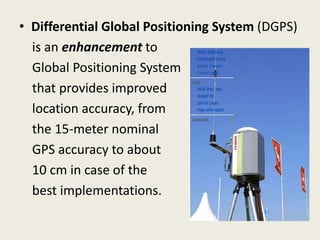
• Differential Global Positioning System (DGPS)
is an enhancement to
Global Positioning System
that provides improved
location accuracy, from
the 15-meter nominal
GPS accuracy to about
10 cm in case of the
best implementations.
• Enhancement means to raise in a higher
degree or intensify. e.g. The dynamic circuit
network is really an enhancement rather
than a replacement.
• to increase in quality or value, to change to a
product which is intended to make it better in
some way. e.g. New functions, faster or more
compatible with other system
A satellite navigation or satnav system is a system of
satellites that provide autonomous geo-spatial positioning
with global coverage. It allows small electronic receivers to
determine their location (longitude, latitude, and altitude) to
high precision (within a few metres) using time signals
transmitted along a line of sight by radio from satellites. The
signals also allow the electronic receivers to calculate the
current local time to high precision, which allows time
synchronisation.
A satellite navigation system with global
coverage may be termed a global navigation satellite
system or GNSS.
As of April 2013, only the United States
NAVSTAR Global Positioning System
(GPS) and the Russian GLONASS are
global operational GNSSs.
China is in the process of expanding its
regional Beidou navigation system into the
global Compass navigation system by 2020. The
European Union's Galileo positioning system is a
GNSS in initial deployment phase, scheduled to be
fully operational by 2020 at the earliest. France,
India, and Japan are in the process of developing
regional navigation systems.
Fundamentals
The GPS system concept is based on time. The
satellites carry atomic clocks which are synchronized and very
stable;
any drift from true time maintained on the ground is
corrected daily. Likewise, the satellite locations are monitored
precisely. User receivers have clocks as well. However, they
are not synchronized with true time, and are less stable.
GPS satellites transmit data continuously which
contains their current time and position. A GPS receiver
listens to multiple satellites and solves equations to
determine the exact position of the receiver and its deviation
from true time.
At a minimum, four satellites must be in view of the
receiver in order to compute four unknown quantities (three
position coordinates and clock deviation from satellite time).
DGPS uses a network of fixed, ground-
based reference stations to broadcast the
difference between the positions indicated by
the satellite systems and the known fixed
positions.
These stations broadcast the difference
between the measured satellite pseudoranges
and actual (internally computed)
pseudoranges, and receiver stations may
correct their pseudoranges by the same
amount.
• Q: How can Pseudorange Measurements be
Generated from Code Tracking?
• A: Every GNSS receiver processes the received
signals to obtain an estimate of the propagation
time of the signal from the satellites to the
receiver. These propagation times are then
expressed in meters to solve for the user
position using trilateration.
• Because the resulting distances are not only
related to the distance between the receiver
antenna and the satellites, i.e. the range, but also
to an imperfect alignment of the receiver’s time
scale to the GPS time scale, they are called
“pseudoranges”.
The digital correction signal
is typically broadcast locally
over ground-based transmitters
of shorter range.
The term refers to a general technique of augmentation
(the amount by which something is increased). The United States
Coast Guard (USCG) and Canadian Coast Guard (CCG)
each run such systems in the U.S. and Canada on the
longwave radio frequencies between 285 kHz and 325
kHz near major waterways and harbors.
The USCG's DGPS system has been named NDGPS
(National DGPS) and is now jointly administered by the
Coast Guard and the U.S. Department of
Transportation’s Federal Highway Administration.
It consists of broadcast sites located
throughout the inland and coastal portions of
the United States including Alaska, Hawaii and
Puerto Rico.
A similar system that transmits
corrections from orbiting satellites instead of
ground-based transmitters is called a Wide-
Area DGPS (WADGPS) or Satellite Based
Augmentation System.
HISTORY
When GPS was first being put into service, the
US military was concerned about the possibility of
enemy forces using the globally available GPS signals
to guide their own weapon systems.
Originally, the government thought the "coarse
acquisition" (C/A) signal would only give about 100
meter accuracy, but with improved receiver designs,
the actual accuracy was 20 to 30 meters.
Starting in March 1990, to avoid providing such
unexpected accuracy, the C/A signal transmitted on
the L1 frequency (1575.42 MHz) was deliberately
degraded by offsetting its clock signal by a random
amount, equivalent to about 100 meters of distance.
I
“COARSE ACQUISITION“ Initially, the highest quality signal was
reserved for military use, and the signal available for civilian use was
intentionally degraded (Selective Availability). This changed with
President Bill Clinton ordering Selective Availability to be turned off at
midnight May 1, 2000, improving the precision of civilian GPS from
100 to 20 meters (328 to 66 ft).
The executive order signed in 1996 to turn off Selective Availability in
2000 was proposed by the U.S. Secretary of Defense, William Perry,
because of the widespread growth of differential GPS services to
improve civilian accuracy and eliminate the U.S. military advantage.
This technique, known as "Selective
Availability", or SA for short, seriously
degraded the usefulness of the GPS signal
for non-military users.
More accurate guidance was possible
for users of dual frequency GPS receivers
that also received the L2 frequency (1227.6
MHz), but the L2 transmission, intended for
military use, was encrypted and was only
available to authorised users with the
encryption keys.
This presented a problem for civilian users who
relied upon ground-based radio navigation systems
such as LORAN, VHF Omnidirectional Range (VOR)
and Non-directional Beacon (NDB) systems costing
millions of dollars each year to maintain. The advent
of a global navigation satellite system (GNSS) could
provide greatly improved accuracy and performance
at a fraction of the cost.
The military received multiple requests from
the Federal Aviation Administration (FAA), United
States Coast Guard (USCG) and United States
Department of Transportation (DOT) to set S/A aside
to enable civilian use of GNSS, but remained steadfast
in its objection on grounds of security.
Through the early to mid 1980s, a number of
agencies developed a solution to the SA "problem". Since
the SA signal was changed slowly, the effect of its offset
on positioning was relatively fixed – that is, if the offset
was "100 meters to the east", that offset would be true
over a relatively wide area.
This suggested that broadcasting this offset to local
GPS receivers could eliminate the effects of SA, resulting
in measurements closer to GPS's theoretical performance,
around 15 meters.
Additionally, another major source of errors in a
GPS fix is due to transmission delays in the ionosphere,
which could also be measured and corrected for in the
broadcast. This offered an improvement to about 5
meters accuracy, more than enough for most civilian
needs.
The US Coast Guard was one of the more aggressive
proponents of the DGPS system, experimenting with the system
on an ever-wider basis through the late 1980s and early 1990s.
These signals are broadcast on marine longwave (a range of radio
waves with frequency below 300 kilohertz) frequencies, which could be
received on existing radiotelephones and fed into suitably
equipped GPS receivers.
Almost all major GPS vendors offered units with DGPS
inputs, not only for the USCG signals, but also aviation units on
either VHF or commercial AM radio bands.
They started sending out "production quality" DGPS
signals on a limited basis in 1996, and rapidly expanded the
network to cover most US ports of call, as well as the Saint
Lawrence Seaway in partnership with the Canadian Coast Guard.
Plans were put into place to expand the system across the US, but
this would not be easy.
• LEGEND
• kHz “Kilohertz” a unit of measurement of
frequency, also known as cycles per second. One
kilohertz is equal to 1,000 hertz or 1,000 cycles
per second.
• GHz “Gigahertz” is a unit of alternating current
(AC) or electromagnetic (EM) wave frequency
equal to one thousand million hertz
(1,000,000,000 Hz).
• MHz “Megahertz” is equal to 1,000,000
kilohertz. It can also be described as 1,000,000
cycles per second. MHz is use to measure wave
frequencies, as well as the speed of
microprocessors.
Operation
A reference station calculates differential
corrections for its own location and time. Users
may be up to 200 nautical miles (370 km) from
the station, however, and some of the
compensated errors vary with space: specifically,
Satellite Ephemeris Errors and those introduced
by Ionospheric and Tropospheric
distortions.
For this reason, the accuracy of DGPS
decreases with distance from the reference
station. The problem can be aggravated if the
user and the station lack "inter visibility"—when
they are unable to see the same satellites.
• Ephemeris and Clock Errors
While the ephemeris data is transmitted
every 30 seconds, the information itself may be up
to two hours old. Variability in solar radiation
pressure has an indirect effect on GPS accuracy due
to its effect on ephemeris errors.
If a fast time to first fix (TTFF) is needed, it is
possible to upload a valid ephemeris to a receiver,
and in addition to setting the time, a position fix
can be obtained in under ten seconds. It is feasible
to put such ephemeris data on the web so it can be
loaded into mobile GPS devices.
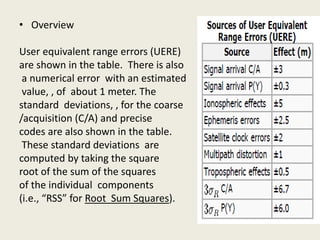
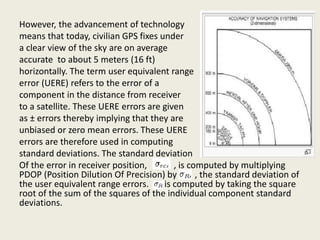
• Overview
User equivalent range errors (UERE)
are shown in the table. There is also
a numerical error with an estimated
value, , of about 1 meter. The
standard deviations, , for the coarse
/acquisition (C/A) and precise
codes are also shown in the table.
These standard deviations are
computed by taking the square
root of the sum of the squares
of the individual components
(i.e., “RSS” for Root Sum Squares).
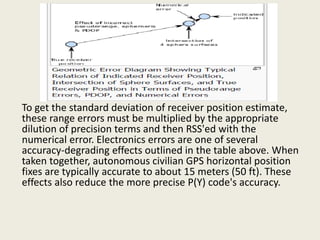
To get the standard deviation of receiver position estimate,
these range errors must be multiplied by the appropriate
dilution of precision terms and then RSS'ed with the
numerical error. Electronics errors are one of several
accuracy-degrading effects outlined in the table above. When
taken together, autonomous civilian GPS horizontal position
fixes are typically accurate to about 15 meters (50 ft). These
effects also reduce the more precise P(Y) code's accuracy.
However, the advancement of technology
means that today, civilian GPS fixes under
a clear view of the sky are on average
accurate to about 5 meters (16 ft)
horizontally. The term user equivalent range
error (UERE) refers to the error of a
component in the distance from receiver
to a satellite. These UERE errors are given
as ± errors thereby implying that they are
unbiased or zero mean errors. These UERE
errors are therefore used in computing
standard deviations. The standard deviation
Of the error in receiver position, , is computed by multiplying
PDOP (Position Dilution Of Precision) by , the standard deviation of
the user equivalent range errors. is computed by taking the square
root of the sum of the squares of the individual component standard
deviations.
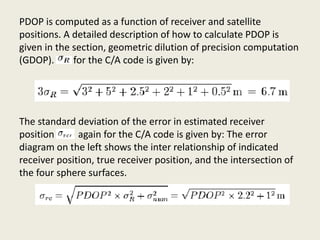
PDOP is computed as a function of receiver and satellite
positions. A detailed description of how to calculate PDOP is
given in the section, geometric dilution of precision computation
(GDOP). for the C/A code is given by:
The standard deviation of the error in estimated receiver
position again for the C/A code is given by: The error
diagram on the left shows the inter relationship of indicated
receiver position, true receiver position, and the intersection of
the four sphere surfaces.
Signal Arrival Time Measurement
The position calculated by a GPS receiver requires the current time,
the position of the satellite and the measured delay of the received
signal. The position accuracy is primarily dependent on the satellite
position and signal delay. To measure the delay, the receiver compares
the bit sequence received from the satellite with an internally
generated version.
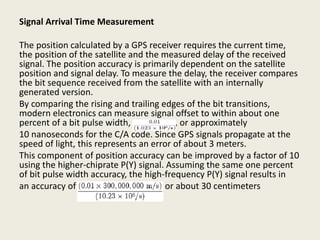
By comparing the rising and trailing edges of the bit transitions,
modern electronics can measure signal offset to within about one
percent of a bit pulse width, , or approximately
10 nanoseconds for the C/A code. Since GPS signals propagate at the
speed of light, this represents an error of about 3 meters.
This component of position accuracy can be improved by a factor of 10
using the higher-chiprate P(Y) signal. Assuming the same one percent
of bit pulse width accuracy, the high-frequency P(Y) signal results in
an accuracy of or about 30 centimeters
ACCURACY
The United States Federal Radionavigation
Plan and the IALA Recommendation on the
Performance and Monitoring of DGNSS
Services in the Band 283.5–325 kHz cite the
United States Department of
Transportation's 1993 estimated error
growth of 0.67 m per 100 km from the
broadcast site but measurements of
accuracy across the Atlantic, in Portugal,
suggest a degradation of just 0.22 m per 100
km.
VARIATIONS
DGPS can refer to any type of Ground
Based Augmentation System (GBAS). There are
many operational systems in use throughout
the world, according to the US Coast Guard, 47
countries operate systems similar to the US
NDGPS (Nationwide Differential Global
Positioning System).
European DGPS Network
The European DGPS network has been mainly developed
by the Finnish and Swedish maritime administrations in order to
improve safety in the archipelago between the two countries.
In the UK and Ireland, the system was implemented as a maritime
navigation aid to fill the gap left by the demise of the Decca
Navigator System in 2000.
With a network of 12 transmitters sited around the
coastline and three control stations, it was set up in 1998 by the
countries' respective General Lighthouse Authorities
(GLA) — Trinity House covering England, Wales and the Channel
Islands, the Northern Lighthouse Board covering Scotland and the
Isle of Man and the Commissioners of Irish Lights, covering the
whole of Ireland.
Transmitting on the 300 kHz band, the system underwent
testing and two additional transmitters were added before the
system was declared operational in 2002.
United States NDGPS
The United States Department of Transportation, in
conjunction with the Federal Highway Administration, the Federal
Railroad Administration and the National Geodetic Survey
appointed the Coast Guard as the maintaining agency for the U.S.
Nationwide DGPS network (NDGPS).
The system is an expansion of the previous Maritime
Differential GPS (MDGPS), which the Coast Guard began in the late
1980s and completed in March 1999. MDGPS only covered coastal
waters, the Great Lakes, and the Mississippi River inland
waterways, while NDGPS expands this to include complete
coverage of the continental United States.
The centralized Command and Control unit is the USCG
Navigation Center , based in Alexandria, VA.
There are currently 85 NDGPS sites in the US network,
administered by the U.S. Department of Homeland
Canadian DGPS
The Canadian system is similar to the
US system and is primarily for maritime
usage covering the Atlantic and Pacific coast
as well as the Great Lakes and Saint
Lawrence Seaway.
Australia
Australia runs three DGPS systems: one is
mainly for marine navigation, broadcasting its signal
on the longwave band; another is used for land
surveys and land navigation, and has corrections
broadcast on the Commercial FM radio band.
While the third at Sydney airport is currently
undergoing testing for precision landing of aircraft
(2011), as a backup to the Instrument Landing System
at least until 2015. It is called the Ground Based
Augmentation System.
Corrections to aircraft position are broadcast
via the aviation VHF band.
POST PROCESSING
Post-processing is used in Differential GPS to obtain precise
positions of unknown points by relating them to known points such
as survey markers.
The GPS measurements are usually stored in computer
memory in the GPS receivers, and are subsequently transferred to a
computer running the GPS post-processing software.
The software computes baselines using simultaneous
measurement data from two or more GPS receivers.
The baselines represent a three-dimensional line drawn
between the two points occupied by each pair of GPS antennas.
The post-processed measurements allow more precise
positioning, because most GPS errors affect each receiver nearly
equally, and therefore can be cancelled out in the calculations.
Differential GPS measurements can also be computed in real-
time by some GPS receivers if they receive a correction signal using a
separate radio receiver, for example in Real Time Kinematic (RTK)
surveying or navigation.
• REAL TIME KINEMATIC (RTK) satellite navigation is a technique used in
land survey based on the use of carrier phase measurements of the GPS,
GLONASS and/or Galileo signals where a single reference station provides
the real-time corrections of even to a centimeter level of accuracy. When
referring to GPS in particular, the system is also commonly referred to as
Carrier-Phase Enhancement, CPGPS.
• This GPS technique uses the radio signal (carrier) to refine it location
initially calculated using DGPS. The receivers are able to reach this level of
accuracy by performing an initialization, that requires data from at least
five common satellites to initialize on-the-fly (in motion) tracking at least
four common satellites after initializing.
• The improvement of GPS positioning doesn't require
simultaneous measurements of two or more receivers in
any case, but can also be done by special use of a single
device.
• In the 1990s when even handheld receivers were quite
expensive, some methods of Quasi-Differential [QDGPS]
were developed, using the receiver by quick turns of
positions or loops of 3-10 survey points.
• QD - The analysis of errors computed using the Global
Positioning System is important for understanding how
GPS works, and for knowing what magnitude errors
should be expected. The Global Positioning System
makes corrections for receiver clock errors and other
effects but there are still residual errors which are not
corrected.
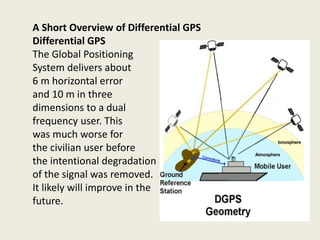
A Short Overview of Differential GPS
Differential GPS
The Global Positioning
System delivers about
6 m horizontal error
and 10 m in three
dimensions to a dual
frequency user. This
was much worse for
the civilian user before
the intentional degradation
of the signal was removed.
It likely will improve in the
future.
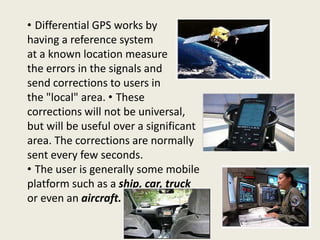
• Differential GPS works by
having a reference system
at a known location measure
the errors in the signals and
send corrections to users in
the "local" area. • These
corrections will not be universal,
but will be useful over a significant
area. The corrections are normally
sent every few seconds.
• The user is generally some mobile
platform such as a ship, car, truck
or even an aircraft.
For the majority of civilian users single
frequency receivers are used. The public ranging
modulation is currently only on the L1 signal. The only
ranging signal on L2 is encrypted.
The exceptions are survey and scientific systems
that use expensive receivers with methods to work
around the L2 encryption. The single frequency user
must deal with the error produced as the signals go
through the ionosphere.
The second frequency was put on the GPS
satellites to allow real time removal of the ionospheric
error. It does this to an accuracy better than 1 cm.
The use of differential GPS produces a position
solution much more accurate than the that of the
standalone user, either civilian or military. It does this
even for the single frequency receivers.
In fact all common DGPS systems work only
with the L1 frequency signal, even if the receiver can
track both L1 and L2 frequencies.
It is common today to have ships navigating on
DGPS with 1 to 2 meter position accuracy.
This note will address the broad topics that
lead to the GPS errors, how DGPS corrects for them,
the different DGPS techniques and philosophies.
Errors in GPS Range Measurements.
Differential GPS works by measuring
the errors in GPS signals at a reference
station(s) and sending the corrections to
users.
The errors in the signal at then antenna
should be almost the same for another
receiver close by.
The definition of "close" depends on
the specific error.
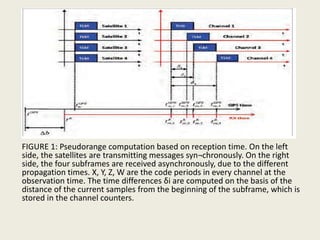
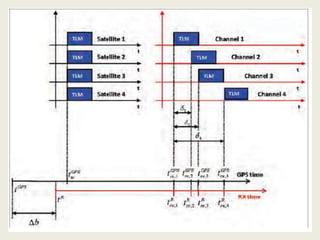
FIGURE 1: Pseudorange computation based on reception time. On the left
side, the satellites are transmitting messages syn¬chronously. On the right
side, the four subframes are received asynchronously, due to the different
propagation times. X, Y, Z, W are the code periods in every channel at the
observation time. The time differences δi are computed on the basis of the
distance of the current samples from the beginning of the subframe, which is
stored in the channel counters.
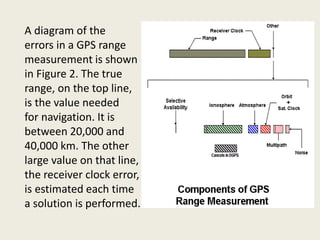
A diagram of the
errors in a GPS range
measurement is shown
in Figure 2. The true
range, on the top line,
is the value needed
for navigation. It is
between 20,000 and
40,000 km. The other
large value on that line,
the receiver clock error,
is estimated each time
a solution is performed.
It can be thousands of kilometers in some
receivers. The estimation of the receiver clock
error is usually is done each time a new solution
is done in a navigation receiver commonly every
second. The "other" item on the top line is
expanded below. It is only a few 10s of meters at
most.
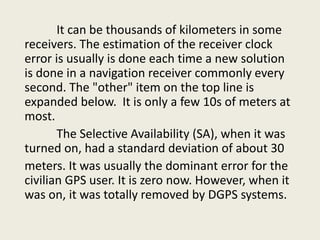
The Selective Availability (SA), when it was
turned on, had a standard deviation of about 30
meters. It was usually the dominant error for the
civilian GPS user. It is zero now. However, when it
was on, it was totally removed by DGPS systems.
The ionosphere error varies greatly with
time of day, location, and the solar cycle. It also is
a function of elevation angle. Low elevation angle
lines of sight have a longer path length within
the ionosphere than vertical paths.
At night for high elevation angles the
ionospheric error can be as low as 1 meter. In late
afternoon, in the tropics, at solar maximum, a 20
degree elevation angle observation could have a
50 m ionospheric error.
Ionosphere errors in the tropics at the
10 to 30 m level are common.
The atmospheric error is about 2.5 m for a
vertical line of sight. It varies in a very
predictable way and is well modeled in most
receivers. Only at angles below 5 degrees do
complex bending effects come into play. Only
very precise scientific work needs to go beyond
the standard modeling for this error.
The ionosphere is the dominant error for
single frequency user. The last three errors are
the dominant error sources for a dual frequency
user. They are also important for the single
frequency user.
In order to navigate, not only are good ranges
needed, but also the location of the end point of the
range. That is, the positions of the satellites are required.
Providing this information is the job of the US Air
Force, which runs the GPS system. They use a series of
monitor stations to acquire data in real time and estimate
the position, velocity, and satellite clock error of each
satellite every 15 minutes.
They use these solutions to make a prediction of
the satellite parameters for the following day. These
predictions are then parameterized and loaded into the
satellite onboard memory.
This data is sent to the user on the GPS signal. It is
called the Broadcast Ephemeris (BCE). On average this
prediction will be 12 hours old.
The largest error will be the satellite clock error. If
all the satellite clocks are not synchronized, navigation is
degraded. Setting all the GPS satellite clocks to a form of
Universal Time Coordinated (UTC) accomplishes this. (The
time differs from UTC by some integer number of seconds.
For this reason it is called GPS Time.) Even though
extremely good atomic clocks are
on each satellite, there is a wander in the clocks. This is a
random process and cannot be modeled.
There may also be some residual systematic error
in the predicted clock state. All these errors, which are
marked with a diagonal bar in Figure 2, are the same for
close receivers.
These are the errors that are removed in DGPS systems.
There are two remaining errors that are specific
to individual receivers. The multipath error is caused by
reflections of the GPS signals from metal objects near
the antenna. DGPS reference stations go to great
lengths to minimize this error though good antenna
locations.
The DGPS user may not have this option. The last
error is the thermal noise inside the receiver. This is a
function of the individual receiver design. It is lower in
more expensive receivers.
However each year the receiver noise level on new
receivers decreases some. It is like the increase in speed
on computers, but not quite as dramatic a change.
Today the receiver noise varies from 2 m to 10
cm for civilian receivers.
Today the ionosphere and Orbit-and-Clock
errors are usually the dominant errors for the
civilian navigator. DGPS essentially removes these.
The orbit error is only slightly different for
users within a 1000 km or so of the reference
station. That cannot be said of the ionosphere
error. Its change with distance from the reference
station is discussed later under ionospheric
divergence.
The remaining issues in designing or choosing
a DGPS system are how to get the errors to th user,
and what solution technique to use.
Correction Parameterization and Distribution
There are two approaches to parameterizing
the errors measured by the reference station(s). In
the most common approach, the range error is
measured for each satellite and these satellite by
satellite errors sent to the user.
This is a point approach. It is valid at the
reference receiver. Its validity will decrease with
distance from that site. In the second approach
multiple stations are used to estimate the errors
over an extended area.
This is called Wide Area DGPS (WADGPS). The
Federal Aviation Administrations (FAA) Wide Area
Augmentation System (WAAS) is this type of
system.
There are also commercial systems of this type.
The corrections are parameterized in a way that allows
the user to compute corrections based on his location.
Two users separated by a 100 km or so will get different
corrections from the same WADGPS parameter set.
In both these cases the information volume is
quite small. A few hundred bytes contain one set of
corrections for all the satellites in an area. The
corrections are sent at different rates by different
systems.
Six second updates are common. The more
accurate systems use one second updates. This is still a
very low data rate. Note that distribution of the
corrections is just a communication problem.
Standard DGPS systems normally distribute the
corrections to the user over a radio link. The
US Coast Guard has an existing system of directional radio
beacons in the 275 to 325 kHz band.
It chose to modulate the DGPS corrections from its
reference stations on these signals. If it
were not for ionospheric divergence (see below) the only
limitation on the use of the US Coast
Guard DGPS signals would the range at which these radio
beacons can be received.
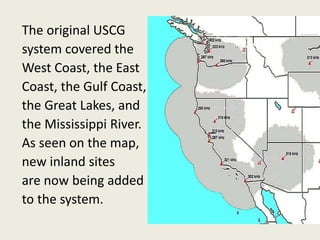
A map showing the USCG West Coast sites, the
broadcast frequencies, and their official coverage
areas is shown in Figure 3.
The original USCG
system covered the
West Coast, the East
Coast, the Gulf Coast,
the Great Lakes, and
the Mississippi River.
As seen on the map,
new inland sites
are now being added
to the system.
The FAA uses a geostationary satellite to broadcast
the WAAS corrections. The satellite has a transponder
and just retransmits a signal originating on the ground.
This same approach is used by at least one commercial
service that provides WADGPS.
Some other commercial services put the data on a
sub-carrier on FM radio broadcasts. For science and
surveying applications, a special radio link is often set up.
This is usually done when a dedicated reference
site is installed for a particular survey or science study or
campaign.
There are also experimental systems that deliver
the corrections over the Internet.
The format of the correction information
varies. There are now two public formats, the
RTCM-104 and the WAAS. The RTCM or Radio
TeleCommunications, Marine, is a standards
organization.
The format was generated by its special
committee number 104. The WAAS was
designed by a similar industry/government
organization, the RTCA.
In addition many manufactures of high end
equipment have a proprietary format. The
manufacturers formats are often aimed at the more
precise DGPS method called Kinematics.
The RTCM format was adopted by the US Coast
Guard. This has lead to its wide acceptance. Essentially
all receivers that do DGPS positioning accept RTCM-104
as one of their input formats.
The FAAs WAAS format has been standardized
more recently. However, because the signal is available
thought out North America on a free basis, it is being
incorporated into many receivers.
(The WAAS is currently in a test and evaluation
phase.) The WAAS format is mandated for use in aircraft,
but boat, car and handheld GPS receivers are available
that use it.
This format has more error checking than the
RTCM format because it is designed for a "safety
of life" function.
In most cases, a separate receiver is used to
receive the DGPS corrections. These are then feed
to the GPS receiver over a RS232 serial line. With
this architure, the corrections could come from any
of several sources.
In some instances multiple sources are on
ships and a simple switch is used to change
between sources.
In other cases standard sources (such as the
US Coast Guard) are received at some convenient
location and relayed by other means, such as
cell telephone or VHF/UHF radio links, to the user.
Ionospheric Divergence
The normal limitation on the utility of DGPS
corrections is the difference in the ionospheric
error seen by the reference station and the user.
This ionospheric error is determined by the
ionospheric conditions where the line of sight
passes through 300 to 400 km altitude.
For a vertical ray, this is overhead. For a low
elevation ray it can be 1500 km away (about 15
degrees of earth central angle).
The ionosphere is much more variable than
the atmosphere. It most dramatic variation is from
day to night. It essentially goes away late at night. It
rebuilds quickly at dawn and then intensifies
thought the day. Its decay after sunset is gradual.
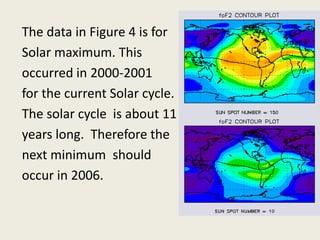
Maps of the peak electron density of the
ionosphere are shown in Figures 4 and 5. These
values are proportional to the ionospheric error.
The plots are for 1800 UT, when sunrise is in
the Pacific and sunset over the zero of longitude
line. Sunrise at 300 km occurs before it does on the
ground.
The data in Figure 4 is for
Solar maximum. This
occurred in 2000-2001
for the current Solar cycle.
The solar cycle is about 11
years long. Therefore the
next minimum should
occur in 2006.
The two humps during the day are caused
by the magnetic field of the earth. The peaks
are about 12 degrees north and south of the
geomagnetic equator, which is shown as a line
on these plots.
The precise location of these "equatorial
anomalies" can vary from day to day. These
figures are analogous to climate models, not
weather data.
The spatial gradients on the sides of these
peaks will be where the largest spatial
divergences in DGPS signals occur.
There are also large gradients a dawn.
Note that satellites to the south at 20 degrees
elevation angle seen from the extreme
southern US will be seen though this gradient
on some days.
Sites nearer the equator will experience
this more often and at higher elevation angles.
Solution Method
There are two common methods of finding a
location with differential GPS. The most common
method for navigation applications is to use
corrected ranges. This is the same solution method
used by the standalone user, but with some
systematic errors removed.
The survey community has used the carrier
phase as its basic measurement from the beginning
of GPS surveying. This was then applied to cases
where the unknown location was in motion.
This was called Kinematics.
In practice kinematics can only be done with dual
frequency data. Even though both frequencies are used, it
is sensitive to ionospheric divergence. The user usually
needs to be within 30 km of the reference site during the
day.
In the beginning, kinematics was only done on a
post-processing basis. However with the increase in
computation capabilities, it became possible to do the
kinematic solution inside the GPS receiver. This is called
Real Time Kinematics, or RTK.
Many high end dual frequency receivers now can
do RTK. It is still limited to ranges of 30 to 100 km of the
reference sites. Also the system often needs to be
initialized at 30 km or less.
The original version of the RTCM format
did not allow for the corrections necessary for
RTK.
However, revision 2 has new message
formats designed for this.
Many RTK implementations allow both the
RTCM and manufacturer proprietary DGPS
formats.
New Developments
The package of changes that was accepted
when the Selective Availability was turned off
includes two other items important to civilian DGPS
users. First the publicly available ranging signal will
be placed on both the GPS frequencies beginning
with launches in 2003.
The earlier spacecraft only had this signal on
the L1 frequency. This will make it possible for low
end receivers now to automatically correct for the
ionospheric error.
Using the L2 signal in DGPS will require some
changes to the RTCM format, but this is expected.
Beginning in about 2007, satellites
launched will have a third civilian frequency,
called L5. This will allow kinematic solutions to
be initialized and utilized at much longer ranges.
The precise ranges will have to be
determined post launch. It is likely that WAAS
will not utilize the new signal on L2, but it is
likely to use the L5 signal.
This is due to a low, but measurable,
probability of interference on L2 with some
radars and mobile communications services in
Europe.
There are many science experiments done
each year using GPS. Some, for example from
NASAs Goddard Space Flight Center, have done
kinematics out to a thousand kilometers.
Experiments have been conducted on using a
network of reference stations to generate standard
GPS corrections. Receivers are becoming immune
to multipath, at least for the top of the line
receivers.
The noise level in receivers is also coming
down. Where all this will lead is unclear, but the
results can only be beneficial to the GPS
community.
The BeiDou Navigation Satellite System (BDS
Is a Chinese satellite navigation system. It consists
of two separate satellite constellations – a limited test
system that has been operating since 2000, and a full-
scale global navigation system that is currently under
construction.
The first BeiDou system, officially called the BeiDou
Satellite Navigation Experimental System (simplified
Chinese:
traditional Chinese and also known as BeiDou-1, consists
of three satellites and offers limited coverage and
applications.
It has been offering navigation services, mainly for
customers in China and neighboring regions, since 2000.
The second generation of the system,
officially called the BeiDou Satellite Navigation
System (BDS) and also known as COMPASS or
BeiDou-2, will be a global satellite navigation
system consisting of 35 satellites, and is under
construction as of January 2013.
It became operational in China in December
2011, with 10 satellites in use, and began offering
services to customers in the Asia-Pacific region in
December 2012.
It is planned to begin serving global
customers upon its completion in 2020.
Nomenclature
The BeiDou Navigation System is named after the
Big Dipper constellation, which is known in Chinese as
Běidǒu. The name literally means "Northern Dipper", the
name given by ancient Chinese astronomers to the
seven brightest stars of the Ursa Major constellation.
Historically, this set of stars was used in navigation
to locate the North Star Polaris. As such, the name
BeiDou also serves as a metaphor for the purpose of the
satellite navigation system.
HISTORY
Conception and initial development
The original idea of a Chinese satellite navigation system was
conceived by Chen Fangyun and his colleagues in the 1980s.
According to the China National Space Administration, the
development of the system would be carried out in three steps:
1. 2000–2003: experimental BeiDou navigation system
consisting of 3 satellites
2. by 2012: regional BeiDou navigation system covering China
and neighboring regions
3. by 2020: global BeiDou navigation system
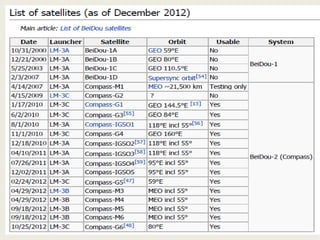
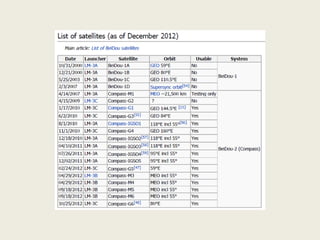
The first satellite, BeiDou-1A, was launched on 30 October
2000, followed by BeiDou-1B on 20 December 2000.
The third satellite, BeiDou-1C (a backup satellite), was put into
orbit on 25 May 2003.
The successful launch of BeiDou-1C also meant the
establishment of the BeiDou-1 navigation system. On 2
November 2006, China announced that from 2008 BeiDou
would offer an open service with an accuracy of 10 meters,
timing of 0.2 microseconds, and speed of 0.2 meters/second.
In February 2007, the fourth and last satellite of the
BeiDou-1 system, BeiDou-1D (sometimes called BeiDou-2A,
serving as a backup satellite), was sent up into space. It was
reported that the satellite had suffered from a control system
malfunction but was then fully restored.
In April 2007, the first satellite of BeiDou-2, namely
Compass-M1 (to validate frequencies for the BeiDou-2
constellation) was successfully put into its working orbit.
The second BeiDou-2 constellation satellite Compass-
G2 was launched on 15 April 2009. On 15 January 2010, the
official website of the BeiDou Navigation Satellite System
went online, and the system's third satellite (Compass-G1)
was carried into its orbit by a Long March 3C rocket on 17
January 2010.
On 2 June 2010, the fourth satellite was launched
successfully into orbit. The fifth orbiter was launched into
space from Xichang Satellite Launch Center by an LM-3I
carrier rocket on 1 August 2010.
Three months later, on 1 November 2010, the sixth
satellite was sent into orbit by LM-3C. Another satellite, the
Beidou-2/Compass IGSO-5 (fifth inclined geosynchonous
orbit) satellite, was launched from the Xichang Satellite
Launch Center by a Long March-3A on 1 December 2011
(UTC).
Chinese involvement in Galileo system
In September 2003, China intended to join the European
Galileo positioning system project and was to invest €230 million
(USD296 million, GBP160 million) in Galileo over the next few years. At
the time, it was believed that China's "BeiDou" navigation system
would then only be used by its armed forces. In October 2004, China
officially joined the Galileo project by signing the Agreement on the
Cooperation in the Galileo Program between the "Galileo Joint
Undertaking" (GJU) and the "National Remote Sensing Centre of China"
(NRSCC).
Based on the Sino-European Cooperation Agreement on
Galileo program, China Galileo Industries (CGI) , the prime contractor of
the China’s involvement in Galileo programs, was founded in December
2004. By April 2006, eleven cooperation projects within the Galileo
framework had been signed between China and EU.
However, the Hong Kong-based South China Morning Post
reported in January 2008 that China was unsatisfied with its role in the
Galileo project and was to compete with Galileo in the Asian market.
Experimental system (BeiDou-1)
Description
BeiDou-1 is an experimental regional
navigation system, which consist of four
satellites (three working satellites and one
backup satellite).
The satellites themselves were based on
the Chinese DFH-3 geostationary
communications satellite and had a launch
weight of 1,000 kilograms (2,200 pounds) each.
Unlike the American GPS, Russian
GLONASS, and European Galileo systems, which
use medium Earth orbit satellites, BeiDou-1 uses
satellites in geostationary orbit.
This means that the system does not
require a large constellation of satellites, but it
also limits the coverage to areas on Earth where
the satellites are visible.
The area that can be serviced is from
longitude 70°E to 140°E and from latitude 5°N to
55°N. A frequency of the system is 2491.75 MHz.
Completion [
The first satellite, BeiDou-1A, was launched on
October 31, 2000. The second satellite, BeiDou-1B, was
successfully launched on December 21, 2000. The last
operational satellite of the constellation, BeiDou-1C,
was launched on May 25, 2003.
Position calculation
In 2007, the official Xinhua News Agency reported
that the resolution of the BeiDou system was as high as
0.5 metres. With the existing user terminals it appears
that the calibrated accuracy is 20m (100m,
uncalibrated).
Terminals
In 2008, a BeiDou-1 ground terminal cost around
CN¥20,000RMB (US$2,929), almost 10 times the price of
a contemporary GPS terminal. The price of the terminals was
explained as being due to the cost of imported microchips.
At the China High-Tech Fair ELEXCON of November 2009 in
Shenzhen, a BeiDou terminal priced at CN¥3,000RMB was presented.
Applications
Over 1,000 BeiDou-1 terminals were used after the 2008
Sichuan earthquake, providing information
from the disaster area. As of October 2009, all Chinese border guards
in Yunnan are equipped with BeiDou-1 devices.
According to Sun Jiadong, the chief designer of the navigation
system, "Many organizations have been using our system for a while,
and they like it very much."
Global system (BeiDou Navigation Satellite System
or BeiDou-2)
Description
Older BeiDou-1, but rather supersedes it
outright. The new system will be a constellation of
35 satellites, which include 5 geostationary orbit
satellites for backward compatibility with BeiDou-1,
and 30 nongeostationary satellites in medium
earth orbit and 3 in inclined geosynchronous orbit),
that will offer complete coverage of the globe.
Accuracy
There are two levels of service provided; a free service
to civilians and licensed service to the Chinese government
and military.
The free civilian service has a 10-meter location-
tracking accuracy, synchronizes
clocks with an accuracy of 10 nanoseconds, and measures
speeds to within 0.2 m/s.
The restricted military service has a location accuracy
of 10 centimetres, can be used for
communication, and will supply information about the system
status to the user.
To date, the military service has been granted only to
the People's Liberation Army and to the Military of Pakistan.
Constellation
The new system will be a constellation of 35 satellites, which
include 5 geostationary orbit (GEO) satellites and 30 medium Earth
orbit (MEO) satellites, that will offer complete coverage of the globe.
The ranging signals are based on the CDMA principle and have
complex structure typical of Galileo or modernized GPS. Similar to the
other GNSS, there will be two levels of positioning service: open and
restricted (military).
The public service shall be available globally to general users.
When all the currently planned GNSS systems are deployed, the users
will benefit from the use of a total constellation of 75+ satellites,
which will significantly improve all the aspects of positioning,
especially availability of the signals in so-called urban canyons.
The general designer of Compass navigation system is Sun
Jiadong, who is also the general designer of its predecessor, the
original Beidou navigation system.
Frequencies
Frequencies for Compass are allocated in four bands:
E1,
E2, E5B, and E6 and overlap with Galileo. The fact of
overlapping could be convenient from the point of view of
the receiver design, but on the other hand raises the issues of
inter-system interference, especially within E1 and E2 bands,
which are allocated for Galileo's publicly regulated service.
However, under International Telecommunication
Union (ITU) policies, the first nation to start broadcasting in a
specific frequency will have priority to that frequency, and
any subsequent users will be required to obtain permission
prior to using that frequency, and otherwise ensure that their
broadcasts do not interfere with the original nation's
broadcasts. It now appears that Chinese Compass satellites
will start transmitting in the E1, E2, E5B, and E6 bands
It now appears that Chinese Compass
satellites will start transmitting in the E1, E2,
E5B, and E6 bands before Europe's Galileo
satellites and thus have primary rights to these
frequency ranges.
Although little was officially announced by
Chinese authorities about the signals of the
new system, the launch of the first Compass
satellite permitted independent researchers not
only to study general characteristics of the
signals but even to build a Compass receiver.
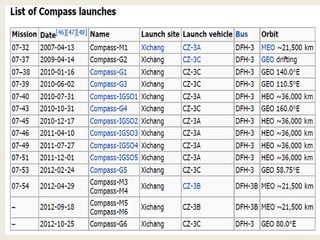
Compass-M1
Compass-M1 is an experimental satellite launched
for signal testing and validation and for the frequency
filing on 14 April 2007. The role of Compass-M1 for
Compass is similar to the role of the GIOVE satellites for
the Galileo system. The orbit of Compass-M1 is nearly
circular, has an altitude of 21,150 km and an inclination of
55.5 degrees.
Compass-M1 transmits in 3 bands: E2, E5B, and E6.
In each frequency band two coherent sub-signals have
been detected with a phase shift of 90 degrees (in
quadrature).
These signal components are further referred to as
"I" and "Q". The "I" components have shorter codes and
are likely to be intended for the open service.
The "Q" components have much longer codes, are
more interference resistive, and are probably intended
for the restricted service. IQ modulation has been the
method in both wired and wireless digital modulation
since morsetting carrier signal 100 years ago.
The investigation of the transmitted signals started
immediately after the launch of Compass -M1 on 14
April 2007. Soon after in June 2007, engineers at CNES
reported the spectrum and structure of the signals.
A month later, researchers from Stanford
University reported the complete decoding of the “I”
signals components. The knowledge of the codes
allowed a group of engineers at Septentrio to build the
COMPASS receiver and report tracking and multipath
characteristics of the “I” signals on E2 and E5B.
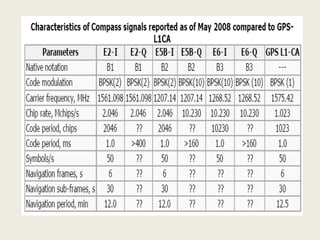
Characteristics of the "I" signals on E2 and
E5B are generally similar to the civilian codes of GPS
(L1-CA and L2C), but Compass signals have
somewhat greater power.
The notation of Compass signals used in this
page follows the naming of the frequency bands
and agrees with the notation used in the American
literature on the subject, but the notation used by
the Chinese seems to be different and is quoted in
the first row of the table.
OPERATION
In December 2011, the system went into operation on a trial
basis. It has started providing navigation, positioning and timing data
to China and the neighbouring area for free from 27 December.
During this trial run, Compass will offer positioning accuracy
to within 25 meters, but the precision will improve as more satellites
are launched.
Upon the system's official launch, it pledged to offer general
users positioning information accurate to the nearest 10 m, measure
speeds within 0.2 m per second, and provide signals for clock
synchronisation accurate to 0.02 microseconds.
The BeiDou-2 system began offering services for the Asia-
Pacific region in December 2012. At this time, the system could
provide positioning data between longitude 55°E to 180°E and from
latitude 55°S to 55°N.
COMPLETION
In December 2011, Xinhua stated that “the basic
structure of the Beidou system has now been established,
and engineers are now conducting comprehensive system
test and evaluation.
The system will provide test-run services of
positioning, navigation and time for China and the
neighboring areas before the end of this year, according
to the authorities.
"The system became operational in the China
region that same month. The global navigation system
should be finished by 2020. As of December 2012, 16
satellites for BeiDou-2 have been launched, 14 of them
are in service.
IRNSS
(INDIAN NAVIGATION SATELLITE SYSTEM)
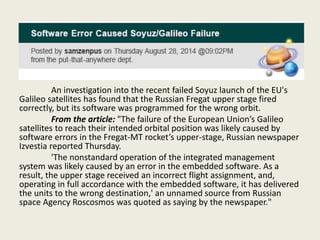
The System: Fregat Design Ambiguity Steered
Galileo Wrong
November 1, 2014 By GPS World staff
Cross-Installed Hydrazine, Helium Lines
Froze Thrusters the root cause of the anomaly
that sent two Galileo satellites into the wrong
orbit on August 22 was a shortcoming in the
system thermal analysis performed during stage
design, and not an operator error during stage
assembly, according to findings by an
independent inquiry board.
The independent inquiry board was
created by Arianespace,
According to ISRO, the document is being
released to the public to facilitate research and
development and to aid the commercial use of the
IRNSS signals for navigation-based applications.
Registration is required for ICD download
access at a new IRNSS website.
At the moment, only the ICD is available at
this website.
The next IRNSS satellite launch is scheduled
for the second week of October.
The most recent launch was in April, of the
second IRNSS satellite, IRNSS-1B.
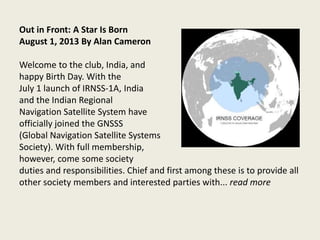
IRNSS is an independent regional navigation
satellite system being developed by India.
It is designed to provide accurate position
information service to users in India and the region
extending up to 1,500 kilometers from its
boundary.
IRNSS will provide two types of service:
Standard Positioning Service (SPS)
and Restricted Service (RS).
It is expected to provide a position accuracy
of better than 20 meters in the primary service
area.
NovAtel Supplies Reference Receivers for IRNSS
Ground Segment
December 23, 2013 By GPS World staff
NovAtel Inc., a manufacturer of GNSS precise positioning
technology, has announced an agreement with the Indian
Space Research Organisation (ISRO) to supply reference
receiver products for use in the Indian Regional
Navigation Satellite System (IRNSS) ground segment.
India-based Elcome Technologies Pvt. Limited, a sister
company to NovAtel in the Hexagon Group of Companies,
will provide local integration, training and technical.
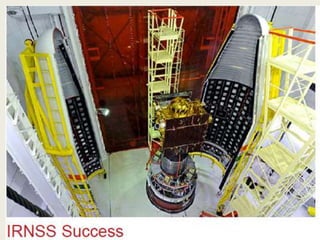
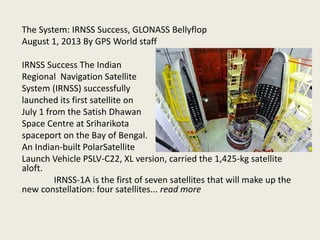
• IRNSS Success
• The Indian Regional Navigation Satellite System (IRNSS)
successfully launched
• its first satellite on July 1 from the Satish Dhawan Space
Centre at Sriharikota
• spaceport on the Bay of Bengal. An Indian-built Polar
Satellite Launch Vehicle
• PSLV-C22, XL version, carried the 1,425-kg satellite
aloft.
• IRNSS-1A is the first of seven satellites that will make up
the new constellation:
• four satellites in geosynchronous orbits inclined at 29
degrees, with three more
• in geostationary orbit. IRNSS-1A is one of the
geosynchronous satellites.
The Indian Regional Navigation Satellite
System (IRNSS) successfully launched its first
satellite on July 1 from the Satish Dhawan Space
Centre at Sriharikot spaceport on the Bay of Bengal.
An Indian-built Polar Satellite Launch Vehicle
PSLV-C22, XL version, carried the 1,425-kg satellite
aloft.
IRNSS-1A is the first of seven satellites that
will make up the new constellation: four satellites in
geosynchronous orbits inclined at 29 degrees, with
three more in geostationary orbit. IRNSS-1A is one
of the geosynchronous satellites.
Following launch, the master control facility
conducted five orbit maneuvers to position the satellite
in its circular inclined geosynchronous orbit (IGSO) with
an Equator crossing at 55 degrees east longitude.
Reports indicate that orbitraising maneuvers have
been completed, and all the spacecraft subsystems have
been evaluated and are functioning normally.
IRNSS-1A’s drift eastward from 47 degrees east
longitude on July 10 was gradually slowed, and the
satellite achieved its assigned inclined geosynchronous
orbit, with a 55-degree East equator crossing, by July 18.
The orbit inclination is 27.03 degrees.
Payloads. IRNSS-1A carries two types of
payloads, navigation and ranging.
The navigation payload will operate in L5
band (1176.45 MHz) and S band (2492.028
MHz), using a Rubidium atomic clock.
The ranging payload consists of a C-band
transponder that facilitates accurate
determination of the range of the satellite.
IRNSS-1A also carries corner-cube retro-
reflectors for laser ranging. Its mission life is 10
years.
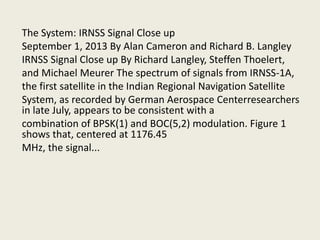
IRNSS Signal Close up
By Richard Langley, Steffen Thoelert, and Michael Meurer
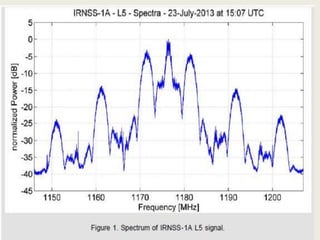
The spectrum of signals from IRNSS-1A, the first satellite in the
Indian Regional Navigation Satellite System, as recorded by German
Aerospace Center researchers in late July, appears to be consistent with a
combination of BPSK(1) and BOC(5,2) modulation.
Figure 1 shows that, centered at 1176.45 MHz, the signal has a single
symmetrical main lobe and a number of side lobes characteristic of the signal
structure that the Indian Space Research Organization (ISRO) announced
would be used for IRNSS transmissions in the L-band.
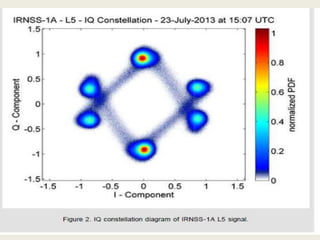
Figure 2 shows the corresponding IQ constellation diagram. Further
analysis will be required to sleuth additional signal details as ISRO, so far, has
not publicly released an IRNSS interface control document describing the
signal structure in detail.
Quasi-zenith Satellite System (QZSS)
watching Japan From Above
As mobile phones equipped with car navigation or GPS (*1) have
become widespread, positioning information using satellites is
imperative to our lives. To specify a location, we need to receive signals from
at least four satellites. However, in some urban or mountainous areas,
positioning signals from four satellites are often hampered by skyscrapers or
mountains, and that has often caused significant errors.
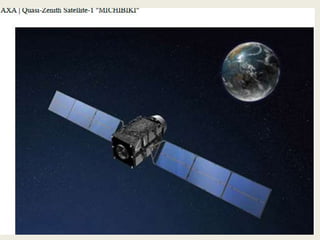
The QZSS consists of a multiple number of satellites that fly in the
orbit passing through the near zenith over Japan. By sharing almost
the same positioning signals for transmission with the currently
operated GPS as well as the new GPS, which is under development
in the U.S., the system enables us to expand the areas and time
duration of the positioning service provision in mountainous and urban
regions in Japan.
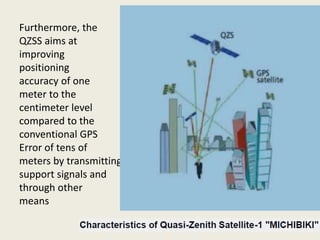
Furthermore, the
QZSS aims at
improving
positioning
accuracy of one
meter to the
centimeter level
compared to the
conventional GPS
Error of tens of
meters by transmitting
support signals and
through other
means
In order to have at least one quasi-zenith satellite
always flying near
Japan's zenith, at least three satellites are
necessary. The first quasizenith
satellite "MICHIBIKI" carries out technical and
application
verification of the satellite as the first phase, then
the verification
results will be evaluated for moving to the second
phase in which the
QZ system verification will be performed with three
QZ satellites
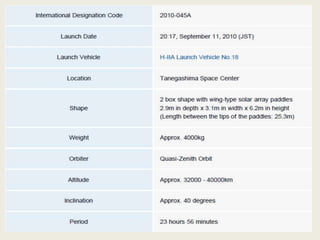
Launch date: September 11, 2010
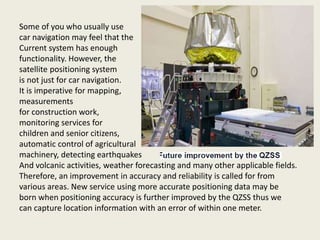
Some of you who usually use
car navigation may feel that the
Current system has enough
functionality. However, the
satellite positioning system
is not just for car navigation.
It is imperative for mapping,
measurements
for construction work,
monitoring services for
children and senior citizens,
automatic control of agricultural
machinery, detecting earthquakes
And volcanic activities, weather forecasting and many other applicable fields.
Therefore, an improvement in accuracy and reliability is called for from
various areas. New service using more accurate positioning data may be
born when positioning accuracy is further improved by the QZSS thus we
can capture location information with an error of within one meter.
Future MICHIBIKI activity
The MICHIBIKI was launched by the H-IIA Launch Vehicle No.
18 on
September 11, 2010. After being injected into the quasi-zenith orbit,
the
MICHIBIKI is now under a three-month initial functional verification.
Then, its technical and application verification will be carried
out in cooperation with concerned organizations. (During the
verification, we can receive signals from the MICHIBIKI.
However, in the early stage, we will place an alert flag as we
verify the accuracy of information contained in its signals. To use the
MICHIBIKI, please use a special receiver, which is specially processed to
not exclude MICHIBIKI data from your positioning calculation even
though an alert flag is in effect. In addition, please be aware that
positioning accuracy may deteriorate compared to that using only the
GPS.)
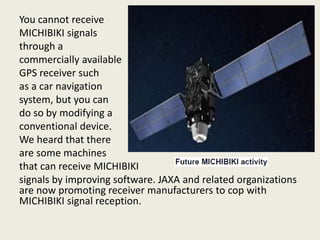
You cannot receive
MICHIBIKI signals
through a
commercially available
GPS receiver such
as a car navigation
system, but you can
do so by modifying a
conventional device.
We heard that there
are some machines
that can receive MICHIBIKI
signals by improving software. JAXA and related organizations
are now promoting receiver manufacturers to cop with
MICHIBIKI signal reception.
Doppler Orbitography and Radiopositioning
Integrated by Satellite (DORIS)
is a French satellite
system used for the
determination
of satellite orbits
(e.g. TOPEX/Poseidon)
and for positioning.
Principle
Ground-based radio beacons emit a signal
which is picked up by receiving satellites. This is
in reverse configuration to other GNSS, in which
the transmitters are space-borne and receivers
are in majority near the surface of the Earth.
A frequency shift of the signal occurs that
is caused by the movement of the satellite
(Doppler effect). From this observation satellite
orbits, ground positions, as well as other
parameters can be derived.
Organization
DORIS is a French system which was initiated and is
maintained by the French Space Agency (CNES).
It is operated from Toulouse.
Ground segment
The ground segment consists of about 50-60
stations, equally distributed over the earth and ensure a
good coverage for orbit determination. For the
installation of a beacon only electricity is required
because the station only emits a signal but does not
receive any information. DORIS beacons transmit to the
satellites on two UHF frequencies, 401.25 MHz and
2036.25 MHz.
Space segment
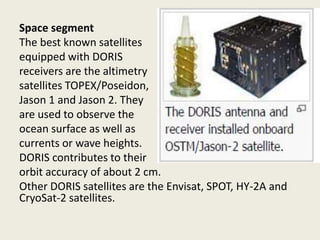
The best known satellites
equipped with DORIS
receivers are the altimetry
satellites TOPEX/Poseidon,
Jason 1 and Jason 2. They
are used to observe the
ocean surface as well as
currents or wave heights.
DORIS contributes to their
orbit accuracy of about 2 cm.
Other DORIS satellites are the Envisat, SPOT, HY-2A and
CryoSat-2 satellites.
Positioning
Apart from orbit determination, the DORIS
observations are used for positioning of ground
stations.
The accuracy is a bit lower than with GPS,
but it still contributes to the International
Terrestrial Reference
Frame (ITRF).
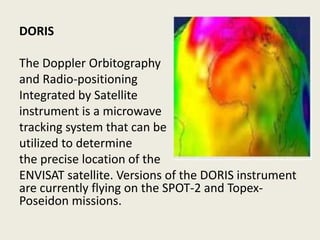
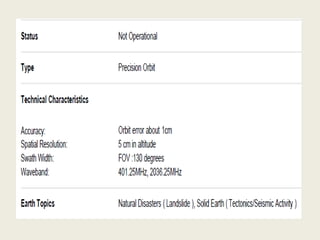
DORIS
The Doppler Orbitography
and Radio-positioning
Integrated by Satellite
instrument is a microwave
tracking system that can be
utilized to determine
the precise location of the
ENVISAT satellite. Versions of the DORIS instrument
are currently flying on the SPOT-2 and Topex-
Poseidon missions.
DORIS operates by measuring the Doppler
frequency shift of a radio signal transmitted from ground
stations and received on-board the satellite. The
reference frequency for the measurement is generated by
identical ultrastable oscillators on the ground and on-
board the spacecraft.
Currently there are about 50 ground beacons
placed around the globe which cover about 75% of the
ENVISAT orbit. On board measurements are performed
every 7 - 10 seconds.
Precise Doppler shift measurements are taken
using an S-band frequency of 2.03625 GHz, while a
second VHS
band signal at 401.25 MHz is used for ionospheric
correction of the propagation delay.
On the ground, DORIS data is used to
create precise orbit reconstruction models
which are then used for all satellite instruments
requiring precise orbit position information.
In addition, DORIS operates in a Navigator
mode in which on-board positioning calculations
are performed in real-time and relayed to the
ground segment.
GLONASS (Week 9)
GLONASS (Russian:
acronym for "Globalnaya
navigatsionnaya
sputnikovaya sistema" or
"Global Navigation Satellite
System", is a space-based satellite navigation system operated
by the Russian Aerospace Defence Forces.
It provides an alternative to Global Positioning System
(GPS) and is the second alternative navigational system in
operation with global coverage and of comparable precision.
Manufacturers of GPS devices say that adding
GLONASS made more satellites available to them, meaning
positions can be fixed more quickly and accurately, especially
in built-up areas where the view to some GPS satellites is
obscured by buildings.
Development of GLONASS began in the Soviet Union in
1976. Beginning on 12 October 1982, numerous rocket
launches added satellites to the system until the constellation
was completed in 1995. After a decline in capacity during the
late 1990s, in 2001, under Vladimir Putin's presidency, the
restoration of the system was made a top government priority
and funding was substantially increased.
GLONASS is the most expensive program of the
Russian Federal Space Agency, consuming a third of its budget
in 2010.
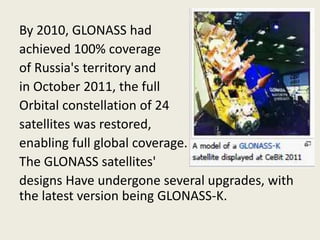
By 2010, GLONASS had
achieved 100% coverage
of Russia's territory and
in October 2011, the full
Orbital constellation of 24
satellites was restored,
enabling full global coverage.
The GLONASS satellites'
designs Have undergone several upgrades, with
the latest version being GLONASS-K.
INCEPTION and DESIGN
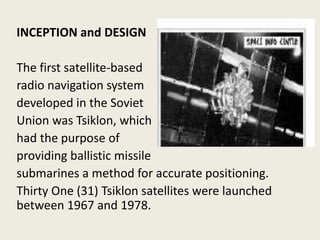
The first satellite-based
radio navigation system
developed in the Soviet
Union was Tsiklon, which
had the purpose of
providing ballistic missile
submarines a method for accurate positioning.
Thirty One (31) Tsiklon satellites were launched
between 1967 and 1978.
The main problem with the system was that, although highly
accurate for stationary or slow-moving ships, it required several hours of
observation by the receiving station to fix a position, making it unusable
for many navigation purposes and for the guidance of the new generation
of ballistic missiles. In 1968–1969, a new navigation system, which would
support not only the navy, but also the air, land and space forces, was
conceived. Formal requirements were completed in 1970; in 1976, the
government made a decision to launch development of the "Unified Space
Navigation System GLONASS".
The task of designing GLONASS was given to a group of young
specialists at NPO PM in the city of Krasnoyarsk-26 (today called
Zheleznogorsk). Under the leadership of Vladimir Cheremisin, they
developed different proposals, from which the institute's director Grigory
Chernyavsky selected the final one. The work was completed in the late
1970s; the system would consist of 24 satellites operating at an altitude of
20,000 km in medium circular orbit. It would be able to promptly fix the
receiving station's position based on signals from 4 satellites, and also
reveal the object's speed and direction.
The satellites would be launched 3 at a time on the
heavy-lift Proton rocket. Due to the large number of
satellites needed for the program, NPO PM
delegated the manufacturing of the satellites to PO
Polyot in Omsk, which had better production
capabilities.
Originally, GLONASS was designed to have an
accuracy of 65 m, but in reality it had an accuracy of
20 m in the civilian signal and 10 m in the military
signal.[6] The first generation GLONASS satellites
were 7.8 m tall, had a width of 7.2 m, measured
across their solar panels, and a mass of 1,260 kg.
Achieving Full Orbital Constellation
In the early 1980s, NPO PM received the first prototype
satellites from PO Polyot for ground tests. Many of the produced parts
were of low quality and NPO PM engineers had to perform substantial
redesigning, leading to a delay.
On 12 October 1982, three satellites, designated Kosmos-
1413, Kosmos-1414, and Kosmos-1415 were launched aboard a Proton
rocket. As only one GLONASS satellite was ready in time for the launch
instead of the expected three, it was decided to launch it along with
two mock-ups. The American media reported the event as a launch of
one satellite and "two secret objects.
" For a long time, the Americans could not find out the nature
of those "objects". The Telegraph Agency of the Soviet Union (TASS)
covered the launch, describing GLONASS as a system "created to
determine positioning of civil aviation aircraft, navy transport and
fishing-boats of the Soviet Union".
From 1982 through April 1991, the Soviet Union successfully
launched a total of 43 GLONASS-related satellites plus five test
satellites.
When the Soviet Union disintegrated in 1991, twelve
functional GLONASS satellites in two planes were operational; enough
to allow limited usage of the system (to cover the entire territory of
the country, 18 satellites would have been necessary.)
The Russian Federation took over control of the constellation
and continued it development. In 1993, the system, now consisting of
12 satellites, was formally declared operational and in December 1995,
the constellation was finally brought to its optimal status of 24
operational satellites.
This brought the precision of GLONASS on-par with the
American GPS system, which had achieved full operational capability а
year earlier.
Economic Crisis And Fall Into Disrepair
Since the first generation satellites operated for 3 years
each, to keep the system at full capacity, two launches per
year would have been necessary to maintain the full network
of 24 satellites.
However, in the financially difficult period of 1989–
1999, the space program's funding was cut by 80% and Russia
consequently found itself unable to afford this launch rate.
After the full complement was achieved in December 1995,
there were no further launches until December 1999. As a
result, the constellation reached its lowest point of just 6
operational satellites in 2001.
As a prelude to demilitarisation, responsibility of
the program was transferred from the Ministry of Defence to
Russia's civilian space agency Roscosmos.
Renewed Efforts and Modernization
Although the GLONASS constellation has reached
global coverage, its commercialisation, especially
development of the user segment, has been lacking
compared to the American GPS system.
For example, the first commercial Russian-made
GLONASS navigation device for cars, Glospace SGK-70, was
introduced in 2007, but it was much bigger and costlier than
similar GPS receivers.
In late 2010, there were only a handful of GLONASS
receivers on the market, and few of them were meant for
ordinary consumers. To improve the situation, the Russian
government has been actively promoting GLONASS for
civilian use.
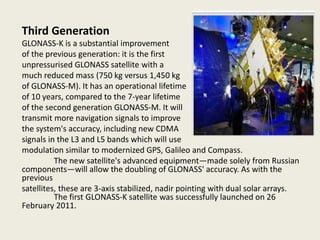
Third Generation
GLONASS-K is a substantial improvement
of the previous generation: it is the first
unpressurised GLONASS satellite with a
much reduced mass (750 kg versus 1,450 kg
of GLONASS-M). It has an operational lifetime
of 10 years, compared to the 7-year lifetime
of the second generation GLONASS-M. It will
transmit more navigation signals to improve
the system's accuracy, including new CDMA
signals in the L3 and L5 bands which will use
modulation similar to modernized GPS, Galileo and Compass.
The new satellite's advanced equipment—made solely from Russian
components—will allow the doubling of GLONASS' accuracy. As with the
previous
satellites, these are 3-axis stabilized, nadir pointing with dual solar arrays.
The first GLONASS-K satellite was successfully launched on 26
February 2011.
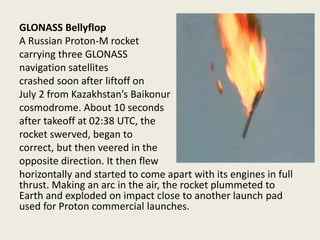
GLONASS Bellyflop
A Russian Proton-M rocket
carrying three GLONASS
navigation satellites
crashed soon after liftoff on
July 2 from Kazakhstan’s Baikonur
cosmodrome. About 10 seconds
after takeoff at 02:38 UTC, the
rocket swerved, began to
correct, but then veered in the
opposite direction. It then flew
horizontally and started to come apart with its engines in full
thrust. Making an arc in the air, the rocket plummeted to
Earth and exploded on impact close to another launch pad
used for Proton commercial launches.
Despite the loss, GLONASS still has a full
operating constellation of 24 satellites. The
crash was broadcast live across Russia. Fears of a
possible toxic fuel leak immediately surfaced
following the incident, but no such leak has
been confirmed.
The rocket was initially carrying more than
600 tons of toxic propellants. No casualties or
damage to surroundings structures or the town
of Baikonur have been reported.
The crashed Proton-M rocket employed a DM-03
booster, which was being used for the first time since
December 2010, when another Proton-M rocket with the
same booster failed to deliver another three GLONASS
satellites into orbit, crashing into the Pacific Ocean 1,500
kilometers from Honolulu.
A Russian government investigation revealed that at
least “three of six angular rate sensors [on the booster stage]
were installed incorrectly,” to be specific, upside-down.
Examination of the wreckage discovered traces of
forced, incorrect installation on three sensors. Assembly-line
testing at the factory failed to detect the faulty installation.
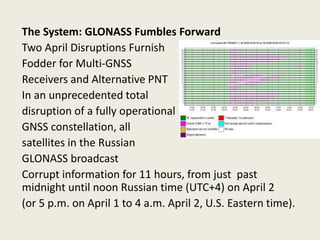
This rendered the system completely unusable to
all worldwide GLONASS receivers. Full service was
subsequently restored. “Bad ephemerides were uploaded
to satellites.
Those bad ephemerides became active at 1:00
a.m. Moscow time,” reported one knowledgeable source.
GLONASS navigation messages contain, as they do
for every GNSS in orbit, ephemeris data used to calculate
the position of each satellite in orbit, and information
about the time and status of the entire satellite
constellation (almanac); user receivers on the ground
processed this data to compute their precise position.
Trouble Chronolog.
The constellation suffered a second failure
two weeks later. On April 14, eight GLONASS
satellites were simultaneously set unhealthy
for about half an hour, meaning that most GLONASS
or multi-constellation receivers would have ignored
those satellites in positioning computations.
In addition, one other satellite in the fleet was
out of commission undergoing maintenance. This
might have left too few healthy satellites to
compute GLONASS-only receiver positions in some
locations.
Advantages and Disadvantages Global
Positioning System
GPS stands for global positioning system which was
created by US department of defense for the navigation
of military in any part of world under circumstances.
But with the time, this system is now being used
for many other purposes and GPS system has proved to
be a revolutionary technology in today's world.
There are several advantages of GPS at present and
in contrast to that there are some disadvantages also.
Some of them are:
Advantages of GPS:
• GPS is extremely easy to navigate as it tells you to the direction for each
turns you take or you have to take to reach to your destination.
• GPS works in all weather so you need not to worry of the climate as in
other navigating devices.
• The GPS costs you very low in comparison other navigation systems.
• The most attractive feature of this system is its 100% coverage on the
planet.
• It also helps you to search the nearby restaurants, hotels and gas stations
and is very useful for a new place.
• Due to its low cost, it is very easy to integrate into other technologies like
cell phone.
• The system is updated regularly by the US government and hence is very
advance.
• This is the best navigating system in water as in larger water bodies we are
often misled due to lack of proper directions.
Disadvantages of Global Positioning System
• Sometimes the GPS may fail due to certain
reasons and in that case you need to carry a
backup map and directions.
• If you are using GPS on a battery operated device,
there may be a battery failure and you may need
a external power supply which is not always
possible.
• Sometimes the GPS signals are not accurate due
to some obstacles to the signals such as buildings,
trees and sometimes by extreme atmospheric
conditions such as geomagnetic storms.
WHAT IS GALILEO? (Week 10)
Galileo is Europe’s own
global navigation satellite
system, providing a highly
accurate, guaranteed global
positioning service under
civilian control.
It is inter-operable with GPS and Glonass, the US
and Russian global satellite navigation systems.
By offering dual
frequencies as
standard, Galileo
is set to deliver
real-time positioning
accuracy down to
the metre range.
It will guarantee availability of the service under
all but the most extreme circumstances and will
inform users within seconds of any satellite failure,
making it suitable for safety-critical applications
such as guiding cars, running trains and landing
aircraft.
On 21 October 2011 came the first two of four
operational satellites designed to validate the
Galileo concept in both space and on Earth.
Two more followed on 12 October 2012. This
In-Orbit Validation (IOV) phase is now being
followed by additional satellite launches to reach
Initial Operational Capability (IOC) around mid-
decade.
Galileo services are designed with with
quality and integrity guarantees – this marks the
key difference of this first complete civil positioning
system from the military systems that have come
before.
The fully deployed Galileo system consists of
30 satellites (27 operational + 3 active spares),
positioned in three circular Medium Earth Orbit
(MEO) planes at 23 222 km altitude above the
Earth, and at an inclination of the orbital planes of
56 degrees to the equator.
Once the IOC phase is reached, The Open
Service, Search and Rescue and Public Regulated
Service will be available with initial performances.
Then as the constellation is built-up beyond that,
new services will be tested and made available to
reach Full Operational Capability (FOC).
Once this is achieved, the Galileo navigation
signals will provide good coverage even at latitudes
up to75 degrees north, which corresponds to
Norway's North Cape - the most northerly tip of
Europe – and beyond.
The large number of satellites together with
the carefully-optimised constellation design, plus
the availability of the three active spare satellites,
will ensure that the loss of one satellite should
have no discernible effect on the user.
Two Galileo Control Centres (GCCs) have been
implemented on European ground to provide for the
control of the satellites and to perform the navigation
mission management. The data provided by a global
network of Galileo Sensor Stations (GSSs) are sent to the
Galileo Control Centres through a redundant
communications network.
The GCCs use the data from the Sensor Stations to
compute the integrity information and to synchronise the
time signal of all satellites with the ground station clocks.
The exchange of the data between the Control Centres
and the satellites is performed through up-link stations.
(Week 11)
As a further feature, Galileo is providing a global
Search and Rescue (SAR) function, based on the
operational Cospas-Sarsat system. Satellites are therefore
equipped with a transponder, which is able to transfer the
distress signals from the user transmitters to regional
rescue co-ordination centres, which will then initiate the
rescue operation.
At the same time, the system will send a response
signal to the user, informing him that his situation has
been detected and that help is on the way. This latter
feature is new and is considered a major upgrade
compared to the existing system, which does not provide
user feedback.
Experimental satellites
GIOVE-A and GIOVE-B
were launched in 2005
and 2008 respectively,
serving to test critical
Galileo technologies,
while also the securing
of the Galileo frequencies
within the International
Telecommunications
Union.
Over the course of the test period,
scientific instruments also measured various
aspects of the space environment around the
orbital plane, in particular the level of radiation,
which is greater than in low Earth or
geostationary orbits.
The four operational Galileo satellites
launched in 2011 and 2012 built upon this effort
to become the operational nucleus of the full
Galileo constellation.
• OPERATIONS
• This work package concerns the provision of
Operations services of the Galileo system in the
timeframe of the FOC deployment phase.
• It comprises the operations of all deployed spacecrafts
in the Galileo constellation, including launch and early
operations, in orbit tests, routine operations,
contingency recovery operations, orbit correction,
Operations of the Ground control and ground mission
segments facility both in the Galileo Control Centres
and in the remote sites, and the management of
telecommunication network.
• The contract with Spaceopal, company created by DLR
(DE) and Telespazio (IT) was signed on 25 October
2010.
• An investigation into the recent failed Soyuz launch of the EU's Galileo
• satellites has found that the Russian Fregat upper stage fired correctly, but
• its software was programmed for the wrong orbit. From the article: "The
• failure of the European Union’s Galileo satellites to reach their intended
• orbital position was likely caused by software errors in the Fregat-MT
An investigation into the recent failed Soyuz launch of the EU's
Galileo satellites has found that the Russian Fregat upper stage fired
correctly, but its software was programmed for the wrong orbit.
From the article: "The failure of the European Union’s Galileo
satellites to reach their intended orbital position was likely caused by
software errors in the Fregat-MT rocket’s upper-stage, Russian newspaper
Izvestia reported Thursday.
'The nonstandard operation of the integrated management
system was likely caused by an error in the embedded software. As a
result, the upper stage received an incorrect flight assignment, and,
operating in full accordance with the embedded software, it has delivered
the units to the wrong destination,' an unnamed source from Russian
space Agency Roscosmos was quoted as saying by the newspaper."
Limits of Compatibility: Combining Galileo PRS
and GPS M-Code
Although Galileo operates wholly under civil control, it does include
encrypted signals, including those of the Public Regulated Service or
PRS, which are broadcast near the new GPS military M-code signals at
the L1 frequency. Galileo’s design calls for PRS use by public safety
organizations such as police and fire departments and customs
agencies.
Because of its design, PRS could also be used for
military applications; however, the European Union
(EU) has not approved such use and several EU
members have gone on
record opposing it. Nonetheless, in light of a
continuing interest in combined use of M-code and
PRS, this article examines some of the technical
issues surrounding the subject.
An agreement signed in June 2004 between
the European Union and the United States
regarding the promotion, provision, and common
use of GPS and Galileo has opened a new world of
possibilities in satellite navigation.
Simulation studies of the combined use of
Galileo and GPS civil signals have demonstrated
that users may expect a clear enhancement of
performance in terms of positioning accuracy and
navigation solution.
The compatibility and interoperability that
the Galileo signal structure will offer with respect to
GPS is especially relevant in the E2-L1-E1 band.
After lengthy negotiations, the United States and
the EU agreed on the design of the Open Service (OS)
signals to be transmitted by Galileo and the future GPS on
L1. If we take a
more detailed look into the different waveforms,
however, we see that not only the Galileo Open Service
and the GPS C/A code have a common center frequency
on L1 but also the
Galileo Public Regulated Service (PRS) and the GPS
military M-code.
Because common center frequencies are certainly
the main prerequisite for interoperability, the combined
processing of PRS and military signals from Galileo and
GPS raises the possibility of offering a better positioning
and navigation solution.
One major point during the negotiations was the necessary
coexistence of the Galileo Public Regulated Service (PRS) and Open
Service (OS) with the GPS C/A and M-code, in particular on L1 where
the necessary separation between the different services played an
outstanding role.
Thus, the final frequency and signal structure resulted also in
the same L1 center frequency for the Galileo PRS and GPS M-code.
Our previous work evaluated the accuracy of a combined Galileo OS
and GPS C/A code service. This article will present the positioning
accuracy of a combined Galileo PRS and GPS M-code service from a
purely technical point-of-view.
No doubt that military and political considerations and
decisions would be necessary to realize such a combined service
in reality. However, this paper aims to show not only a benefit to use
of the interoperability between
From a political and military point of view, the question of a
combined Galileo PRS and GPS M-code service has clearly not been
addressed yet and probably it will require time consuming and lengthy
discussions in the future, if the negotiations ever take place.
Nonetheless, from a purely technical point of view it makes
sense to evaluate the pros and cons as well as the performance that
such a service could offer some day, and the time is certainly right for
doing that now.
Therefore, this article first evaluates the performance of the
two single services separately using identical assumptions. In order to
do so, a refined methodology is proposed to estimate the different
sources of error that contribute to the User Equivalent Range Error
(UERE), particularly the ranging error caused by reflected signals or
multipath.
Afterwards the same analysis is carried out for a combined
processing of Galileo PRS and GPS M-Code signals for a joint position,
velocity, and time solution.
Multipath Error
Multipath error is the most important
unavoidable source of error contributing to the
UERE, because it is very difficult to model. As we
saw, the ionospheric error indeed presents
worse values in a general case, but an
appropriate receiver would be able to eliminate
it or at least reduce its contribution with
corrections coming from SBAS or A-GPS.
IBS (Integrated Bridge System)
1. Navigation System
General
The total Navigation System is
based on «IBS» concept
(Integrated Bridge System)
The navigation system will
adopt and follow the latest
international standards for
Navigation Systems, defined by IMO and IEC.
Standards are followed for; Navigation radars, ECDIS, Speed
log, Echo sounder, DGPD/GPS,AIS, DPS and Autopilot/Track
pilot system, Multiloading Online Control Stability System.
The main Navigation sensors/systems:
- Dual Navigation ARPA Radar system (S and X-band)
- LPI Radar Sensor
- Fully duplicated ECDIS system with the charts server
- Fiber-optic gyro system
- Fully duplicated INS (Inertial Navigation System)
- Dual action speed log (water track speed and bottom track speed)
- Passive speed log (magnetic log or pressure log)
- Two independent satellite based position equipment (DGPS-
GPS/GLONASS;
different manufacturers)
- Satellite independent positioning system or Laser based positioning
system
- Automatic Identification System AIS
- Track-pilot system (functions as a transfer Autopilot)
- Meteorological instruments
- Xenon and Halogen search lights
- Whistle
- Navigation and signal lights
- Data recorder and play-back facility for Navigation
Information- Navigation Information Display
- Navigation Data servers for transferring the information
to IMCS C2 and ANCS-System
- Time server unit
- Dynamic Positioning System (DP-System)
• Wheel house consoles are part of the Navigation
System supply.
• Tentative wheel house arrangement is illustrated
in Appendix 1.
* Consoles will also house necessary additional
components for IMCS C2 and ANCS-System,
propulsion/steering system and for machinery
monitoring, required to be operated on bridge.
* All displays in the wheel house are high contrast
TFT-type displays. Display size and modes are
according to requirements.
1.2 Navigation System integration with other
ship’s systems.
Following figure illustrates the navigation
System integration to other ship’s systems.
Navigation System to Engine Monitoring System
- Display of Engine and propulsion Information
to bridge operators
- Transfer of navigation information to Engine
monitoring system
Navigation System to IMCS C2 and AWW-System
- Transfer of Navigation Information data to IMCS
C2 and AWW-System
- Transfer of ARPA Tracked targets to IMCS C2 and
AWW-System
- Transfer of Route Information from NAV-System to
IMCS C2 -System
- Transfer of Route Information from IMCS C2 -
System to NAV-System
- Transfer of high speed hull motion information to
IMCS C2 and AWW-System
Navigation System to Dynamic position system
- Transfer of Navigation Information data to DP-System
- Transfer of Route information between NAV-System and
DP-System
Dynamic position system to IMCS C2 -System
- Transfer of route and command information from IMCS
C2 -System to DP-System
Dynamic position system and Propulsion Control system
- Transfer of Propulsion commands and feed-backs from
DP-System to Propulsion control system
• Navigation System and Dynamic position system
to Chart Server
• Enquires and its Parameters of specified Area in a
specified Scale using specified Palette.
- Building of Chart of specified Area in a specified
Scale using specified Palette.
Charts’s Contents is limited by a list of Chart Layers.
- Getting of Chart Object under a specified small
area.
- Getting of Alarms for a specified Area.
Chart Server to Navigation System and Dynamic
position system
Results of Enquires
- Electronic Chart of specified Area.
- List of Chart Objects.
- List of Alarms.
2. Navigation System components
Following section contains main navigation equipment and
their standard and special
requirements
2.1 Dual Navigation ARPA Radar system (S and X-band)
Navigation Radar System is composed of following units:
- S-Band 30 kW down mast transceiver with 12’ antenna unit
- X-Band 25 kW down mast transceiver with 9’ antenna unit
- Two fully independent ARPA radar displays with built-in radar
inter switching unit
- Radars are operated from UPS power source (3phase
230VAC)
- ARPA displays are 23.1’’ TFT screens, conforming to the
standards for IMO ARPA systems
ARPA Radar system includes following special features:
- Transfer of tracked ARPA targets to ECDIS
- Transfer of user created synthetic map information from
ECDIS to ARPA displays
- Presentation of route information and track information from
ECDIS
- Presentation of curved EBL, initiated from ECDIS/Track
steering system
- Transfer of Radar Raw image to IMCS C2 and AWW-System
- Transfer of Tracked Targets to IMCS C2 and AWW-System, via
Navigation Data Server units
- Integration of ARPA displays to LPI-radar, control of LPI radar
and display of LPI radar video
information on ARPA display
- Radar transmission blanking output
2.2 LPI Radar Sensor and Processor
LPI radar can be proposed
as option, but the
final specifications
for the performance
standardsare
defined at later
stage.LPI radar
could be fully
integrated to ARPA
radar system
2.3 Fully duplicated Chart Server
- The world-wide database of Electronic Navigational Charts (ENC) for
all available standard scales. Weekly updates.
- Source data in S57 standard, V3.1 version or more recent.
- Display of all cartographic components in accordance with S52.
- Mercator projection with WGS-84 datum or:
-Transverse Mercator
- UTM (Gauss-Krьger)
- Polar; - Radar; - Cylindrical
- Orthographic; - Stereographic; - Gnomonic
- Base, Standard, Other Display as specified in IEC61174.
- More detailed information layers in accordance with Viewing Groups
specified in S57.
- All ECDIS Palettes: DAY-BRIGHT, DAY-WHITEBACK, DAY-BLACKBACK,
DUSK, NIGHT.
- Paper chart and Simplified chart symbols.
Basic queries:
- Building of a standard chart for a specified
Area,
Scale,
Projection,
Set of layers,
Shallow, Safety and Deep Contours,
Palette.
- Building of hierarchical objects tree under the requested
area. This gets information about all
objects on the Chart.
- Alarm selection. Finding of Alarms, e.g.:
Crossing of Safety Contour, Cautionary and special Areas
Approaching to an Obstruction
Additional functions:
- Displaying and use of Additionally Military Layers AML in
accordance with STANAG-7170 and
STANAG-4564 standards.
- Extracting and export of digital information about Objects
from Electronic Navigational Charts and AML.
- Receiving, Converting and Displaying of Sea Ice Charts
produced by National Ice Center or other organization. Sea Ice
Charts have been displayed as an additional chart layer
- Navigational Calculator allows to recalculate coordinates
between any 2 Ellipsoids in accordance with S60 standard.
- Use of DEM (Data Elevation Model) Databases to get
information about height of any point on the Earth.
2.4 Fully duplicated ECDIS system
Two fully independent ECDIS are included in the
NAV-SYSTEM complying with following
standards:
- IMO resolution A.817(19), performance
standard for ECDIS
- IEC61174, Operation and performance,
method of testing
- IEC60945, EMC/Environment/General
requirements
Following main functions are included:
- Display of vector charts (IHO/S57 edition3) or Raster
charts (ARCS)
- Presentation of Additional Military Layers (AML)
- ECDIS Computers and displays are supplied from UPS
power source
- Two ECDIS computers are working in harmonised mode,
allowing automatic update of data
based in both ECDIS computers
- Continuous monitoring of ship position through multi-
sensor Kalman filter processing using;
GPS, DGPS SDME (through the water or ground tracking
speed log), gyro compasses and radar
echo reference
- Route planning and monitoring
- Grounding warning and safe depth contours
- Superimposing the radar raw video on the electronic chart
- Target vectors and data from the navigation ARPA tracked targets
- Onboard generated safety maps, routes and areas which can be
overlaid also on ARPA screens
- Area dependent and user defined notebook, which will inform user
automatically when the ship
reaches the programmed area
- Built-in voyage data logging feature, as required by ECDIS
performance standard
- Integration of Automatic Identification System (AIS) in order to
display other targets (carrying
AIS) on ECDIS screen. Read out of detailed ship information supplied
by AIS
ECDIS will accommodate a number of sensors to
be connected, with appropriate international
standards (IEC-61162-1)
Additional features for mine searching
operation:
- Mine searching plans initiated in IMCS C2-
SYSTEM, are transferred to ECIDS system
- Route plans, which are initiated in ECDIS, are
transferred to IMCS C2 and AWW-System
2.5
2.5 Fiber-optic gyro system (Navigation Gyro System)
Navigation Gyro compass system includes following main
units:
- LFK95 Fiber-optic gyro compass
- Interface and power supply unit (IPSU)
- Navigation Gyro compass control panel
- Analog repeaters in steering gear room
- Digital repeaters in wheel house
- Transmitting Magnetic compass
- Switch over unit and facilities to select the System Gyro
Compass as the main source
for heading information to all navigation sensors (ARPA
displays, ECDIS, Track pilot etc.)
Fiber-optic gyro compass supplies the following
information to navigation system:
- Ship’s heading
- Ship’s rate Of Turn
- Ship’s Roll and Pitch information
- The ships heading information is available in
analog format (Stepper output) and in serial
format (IEC61162). The serial format is available
both in standard 4800b/s and on higher serial
transmission rates (up to 38.400b/s)
Navigation Gyro information is available in Ethernet
Data format via Navigation Data Servers
Fiber-optic gyro compass supplies the following
information to navigation system:
- Ship’s heading
- Ship’s rate Of Turn
- Ship’s Roll and Pitch information
- The ships heading information is available in
analog format (Stepper output) and in serial
format (IEC61162). The serial format is available
both in standard 4800b/s and on higher serial
transmission rates (up to 38.400b/s)
Navigation Gyro information is available in Ethernet
Data format via Navigation Data Servers
Following information is available in INS:
- Ship’s heading
- Ship’s Rate Of Turn
- Ship’s Roll and Pitch Information
- Body velocities; X, Y and Z
- Accelerations; X, Y and Z
Switch Over Unit (SOU) supplies the gyro
information on 64Hz and on 512Hz up date rate
and on HDLC protocol.
Sensors, which require fast update rate information,
are connected directly to INS.
Normal navigation systems (i.e. ARPA radars) can not scope with HDLC
protocols and high
speed data streams, therefore the information is transformed to a
commonly used (in navigation
systems) data formats.
The MIPSU is included in order to have System Gyro information
available also for Navigation
Systems/sensors
System Gyro information is available in Ethernet Data format via
Navigation Data Servers.
Following information is also available to DP-System
- Ship’s heading
- Ship’s Rate Of Turn
- Ship’s Roll and Pitch Information
- Body velocities; X, Y and Z
- Accelerations; X, Y and Z
2.7 Dual action speed log (water track speed and bottom track
speed)
Dual Action speed log system is included in the Navigation system.
The system supplies both Water Track and Bottom Track information to
Navigation system
sensors.
Water track speed is used by ARPA, radars according to IMO rules.
The system has two-function log unit, working both on bottom track
principle and on water
track.
System includes required amount of interfaces to navigation systems,
and necessary amount
of speed repeaters, distributed in wheel house and engine control
room.
Water track speed log has the measuring frequency of 4Mhz and the
bottom track is working
on 150KHz frequency.
Bottom track speed log can be switched off at any time, in order to
stop the transmission
on 150KHz frequency.
The speed log system includes the following main units:
- Speed log electronic unit
- Speed log distribution unit
- Transducer unit with gate valve
- Four digital repeaters
- Speed log simulation unit (manual speed input facility)
- 200p/NM outputs to ARPA radars and Autopilot
- IEC61162-1 serial format outputs to ECDIS, Navigation Data Servers
etc.
Speed log information is distributed to IMCS C2 and AWW-System via
Navigation Data Servers.
Ship’s speed information to DP-System is also provided
2.8 Echo sounder
Navigation echo sounder function is included in the
navigation system, as a part of standard
equipment for navigation.
Navigation echo sounder has the following units and
features:
- Graphical display, which is also used as «play-back»
media for depth history.
- Transducer
- IEC61162-1 outputs to other Navigation systems
Echo sounder information is distributed to IMCS C2 and
AWW-System via Navigation Data
Servers.
2.9 Two independent satellite based position equipment
(DGPS - GPS/GLONASS)
Two independent satellite based (DGPS - GPS/GLONASS)
receivers are included in the
Navigation System.
Following special features are included:
- Possibility to receive correction signals from external
differential correction source (RTCM- 104
format)
Position information to IMCS C2 and AWW-System is
transferred via Navigation Data Servers.
Position information output to DP-System is also
provided.
2.10 Satellite independent positioning system
or Laser based positioning system
Additional position reference system,
independent to satellite based system, is
included.
The position system is based either on Radio
Navigational or on Laser principle.
The position information from satellite
independent system is used in Navigation
system, IMCS
C2 and AWW-System and in DP-System.
2.11 Automatic Identification System AIS
Automatic Identification system (AIS) is
included.
Special features:
- Own ship transmission can be suppressed on
operator’s request
- AIS targets are transferred to ECDIS and IMCS
C2 and AWW
2.12 Track-pilot system (functions as a transfer
Autopilot)
For normal navigation and ship’s transfer function, a
standard Autopilot function (also called
Trackpilot) is included into the DP-System.
Autopilot/Trackpilot has two operation modes:
- Normal Autopilot function is used when the
setting of course, turns etc. are initiated manually
- The Trackpilot function is enabled when the
Autopilot receives course and track information
from ECDIS (pre planned route)
Main functions of the Autopilot/Trackpilot are:
- Speed Adaptive course keeping function
- Radius controlled turns
- Pre programmed course changes
- Selection of ship’s loading conditions
- Selection of ship’s steering accuracy (Economy, Medium,
Precise)
- Connection to heading reference system and Speed log
- Off course monitoring and respective alarm
- Proportional rudder order or «bang-bang» rudder order
available
- Serial data connection to ECDIS (External track steering
function)
- Track steering operation, when assisted by ECDIS
2.13 Meteorological instruments
Following meteorological instruments are included
and integrated in Navigation System:
- Wind speed and direction
- Outside air temperature
- Outside air pressure
- Outside air humidity
The meteorological Information is displayed in
wheel house by means of a Conning display and
the information is also transferred to DP-System
and IMCS C2 And AWW-System
2.14 Xenon and Halogen search lights
One 2000W Halogen type search light with
remote controlled operation is included.
One 2000W Xenon type search light with
remote controlled operation is included.
2.15 Whistle
Whistle system according to rules is provided
2.16 Navigation and signal lights
Navigation and signal lights according to rules
are provided
2.17 Data recorder and play-back facility for Navigation Information
Navigation Data Recorder (recordings from Navigation Data Network)
is included.
Navigational data is stored for at least 100days, and can be recalled
and analysed by using
external lap-top computer.
It shall be possible to record data from all sensors attached to
navigation system.
Following information is recorded, at least in one Hertz frequency:
- Ship’s heading
- Ship’s speed
- Time and data
- Ship’s position
- Propulsion orders
- Depth
2.18 Navigation Information Display (i.e. Conning Display)
«Conning» Display, for the presentation of information from
Navigation sensors and Propulsion devices, is included.
Conning display presentation includes the following information (as
minimum):
- Ship’s heading (from selected System Gyro source)
- Ship’s heading from Navigation Gyro
- Rate of Turn; - Roll and Pitch; - Ship’s speed
- Depth and set depth alarm limit
- Meteorological information
- Route Information from ECDIS
- Propulsion information (RPM)
- Rudder angle orders and feed-back
- Bow thruster orders and feed-back
- Track-pilot status;
- - Steering mode
2.19 Navigation Data Servers for transfer of Navigation data
information
to IMCS C2- system and AWW
The main purpose of Navigation Data Server is to supply all navigation
related information to
IMCS C2-System and AWW.
Navigation Data Servers are duplicated, forming a fully redundant
source for Navigation
information to IMCS C2 and AWW-System.
The protocol between the Navigation Data Server and IMCS C2 and
AWW- System is based on
Finnish Navy SQ2000 data format.
Navigation data is transferred to IMCS C2 and AWW-System on
Ethernet. Ethernet uses
broadcast principle and the data is transmitted 10 times / second.
At least the following information is transferred to
IMCS C2 and AWW-System:
- Ship’s heading (from selected System Gyro source)
- Ship’s heading from Navigation Gyro
- Rate of Turn
- Roll and Pitch
- Ship’s body velocities
- Ship’s speed
- Direct position information from Position Devices
- Depth and set depth alarm limit
- Meteorological information
- ARPA Display tracked targets
2.20 Time server unit
Central Time server unit, distributing the time
for Navigation-, IMCS C2- and AWW-systems, is
included.
The system includes NTP-Server functions as
well as ASCII-based time stamp output to
Navigation Data servers and ARPA displays.
2.21 Dynamic Positioning System (DP-System)
The Dynamic Positioning system (DP-System) is used to
control the ship propulsion components
automatically in different needs and in different
operation modes.
DP-System integrates following sensors and equipment:
- Positioning systems
- Heading sensors
- Speed log
- Main propulsion devices
- Bow thrusters
- Wind-sensor
- Others, if needed
DP-System integrates following operational functions:
- Sailing plan or direction orders, which should be followed by DP-
System
- Move on planned track (slow speed or high speed tracking)
- Stay at given position (Dynamic Positioning)
- Keep heading
- Rotate around a point (fore-ship, center-ship, aft-ship or a point
outside of ship)
- Translate ship position (fore, aft, side or any resultant combination)
DP-System receives track information either from IMCS C2-System or
from Navigation System
DP-System tracks (either from navigation system or IMCS C2-System)
are displayed in ECDIS
workstations.
DP-Controls are located both in CIC and on bridge.
3 Wheel house consoles
All wheel house consoles and overhead panels are included in the
Navigation System delivery.
Console configuration is tentatively described in Appendix 1.
Recommendation for the Application of SOLAS
Regulation V/15
Bridge Design, Equipment Arrangement and
Procedures (BDEAP)
Foreword
This Recommendation sets forth a set of guidelines
for determining compliance with the principles and aims
of SOLAS regulation V/15 relating to bridge design, design
and arrangement of navigational systems and equipment
and bridge procedures when applying the requirements
of SOLAS regulations V/19, 22, 24, 25, 27 and 28 at the
time of delivery of the new building.
SOLAS V Reg. 22
Navigation Bridge
Visibility
Table B 5.8 shown
for overview of
maximum allowed
blind sectors and
minimum clear
sectors.
IEC TECHNICAL
COMMITTEE 80
MARITIME NAVIGATION
AND
RADIO
COMMUNICATION
EQUIPMENT
AND
SYSTEMS
IEC TECHNICAL
COMMITTEE 80
MARITIME NAVIGATION
AND
RADIO
COMMUNICATION
EQUIPMENT
AND
SYSTEMS
TEC IEC
The IEC, headquartered in Geneva,
Switzerland, is the world’s leading
organization that prepares and publishes
International Standards for all electrical,
Electronic and related technologies – collectively known as
“electrotechnology”.
IEC standards cover a vast range of technologies from power
generation, transmission and distribution to home appliances and
office equipment, semiconductors, fibre optics, batteries, flat panel
displays and solar energy, to mention just a few. Wherever you find
electricity and electronics, you find the IEC supporting safety and
performance, the environment, electrical energy efficiency and
renewable energies.
The IEC also administers international conformity
assessment schemes in the areas of electrical equipment
testing and certification (IECEE), quality of electronic
components, materials and processes (IECQ) and certification
of electrical equipment operated in explosive atmospheres
(IECEx).
The IEC has served the world’s electrical industry since
1906, developing International Standards to promote quality,
safety, performance, reproducibility and environmental
compatibility of materials, products and systems.
The IEC family, which now comprises more than
160 countries, includes all the world’s major trading nations.
This membership collectively represents about 85 % of
the world’s population and 95 % of the world’s electrical
generating capacity.
One of the fundamental trends in the
maritime industry over the past decades has been
an increasing reliance on electrical and electronic
technologies for navigating and communicating.
These technologies have moved well out of
the mechanical era and fully into the electronic and
information age.
This is particularly true for equipment on
ocean-going cargo and passenger vessels and for
industrial fishing fleets but now even applies to the
smallest of vessels.
Created in 1980, IEC Technical Committee
80 produces operational and performance
requirements together with test methods for
maritime navigation and Radio communication
equipment and systems.
The committee provides industry with
standards that are also accepted by
governments as suitable for type approval
where this is required by the International
Maritime Organization’s SOLAS Convention.
TC 80 does this by ensuring that it has
representatives from industry, users,
governments and test certification bodies.
There are currently 20 participating
national members in the committee and liaisons
with all the major international maritime bodies.
The committee provides industry with standards that
are also accepted by governments as suitable for type
approval where this is required by the International
Maritime Organization’s SOLAS Convention.
TC 80 does this by ensuring that it has representatives
from industry, users, governments and test certification
bodies. There are currently 20 participating national members
in the committee and liaisons with all the major international
maritime bodies.
The committee work programme is associated with
that of the IMO by mirroring the performance standards
adopted by IMO in its resolutions, with associated relevant
ITU recommendations.
TC 80 standards support IMO resolutions
and non-SOLAS and shore applications. Its scope
is “to prepare standards for maritime navigation
and Radio communication equipment and
systems, making use of electrotechnical,
electronic, electroacoustic, electro-optical and
data processing techniques for use on ships and
where appropriate on shore”.
By being represented in both IMO and ITU
this technical committee can contribute to the
performance and technical content of the
resolutions and recommendations.
This is invaluable to industry, in that the
performance and technical standards represent
the practical state of current and emerging
technology.
ORIGINS
• The origins of TC 80 date from the 1970s
When electromechanical instruments started
to be replaced by electronic instruments. In 1978 the IEC
set up a working group to propose a possible work
programme on “advanced navigational instruments”.
• The preferred approach was what today would be
called “multi-modal” covering land, sea and air
applications and the concept envisaged for navigation
included related aspects of radio communications.
• Experts from France, Germany, Japan and Norway
formed the working group with contributions from:
International Radio Consultative
Committee (CCIR) Comité International Radio-
Maritime (CIRM) International Association of
Marine Aids to Navigation and Lighthouse
Authorities (IALA) Inter-Governmental Maritime
Consultative Organization (IMCO, now IMO)
European Organisation for Civil Aviation
Electronics (EUROCAE) International
Organization for Standardization (ISO).
The working group identified a need for
standards for instruments used on ships and
possibly aircraft, noted the complex
interrelations between IMCO, EUROCAE and ISO
and centres of expertise existing within IEC,
particularly in TC 18 (Electrical installations of
ships and of mobile and fixed offshore units) and
the International Special Committee on Radio
Interference (CISPR).
The new Technical Committee held its first meeting
in June 1980 in Stockholm with delegates from China,
France, Germany, Japan, Netherlands, Sweden, UK,
USA and Yugoslavia and observers from TC 18 and
CIRM.
The top priority task identified was standards to
support the carriage requirements of the new SOLAS
1974, particularly automatic radar plotting aids (ARPA).
TC 80 subsequently specialised into the activity of
maritime instruments and has now produced some 48
standards.
General Requirements
When IEC TC 80 was
formed there were 20
classification societies,
together with the
International
Association of Classification
Societies, numerous
statutory authorities,
regional standards bodies and IMCO – all with different
ideas on what the general requirements should be for
equipment to be used on ships.
It quickly became clear that general
requirements interrelated environmental issues
with other issues concerning the design of the
equipment, its power supplies, electromagnetic
compatibility (EMC) and safety.
In 1991 the IMO, when discussing the
changes which would arise with the introduction of
the GMDSS, noted that in future, radio equipment
would be installed on the bridge alongside the
navigation equipment instead of in a special radio
room as hitherto and TC 80 standards subsequently
took this into account.
Having attained consensus in IMO for the
requirements for equipment used on the bridge
of a ship, discussions began with classification
societies, with TC 18 and with ISO to align all
their general requirements.
This resulted in the third edition of IEC
60945 in 1996 which is the industry standard on
this subject. This edition also introduced new
requirements for software, reflecting the
technological changes taking place in
equipment design.
A fourth edition of IEC 60945 appeared in
2002 which extended the detail of operational
tests, particularly for equipment which is
operated through software menus, to reflect the
importance given by IMO to human factors.
The EMC tests were also extended to
contain the increasing problems experienced by
the use of ever more electronic equipment on a
ship.
The work on general requirements was
extended in 2008 by the publication of IEC
62288.
This standard harmonizes the
requirements for the presentation of navigation-
related information on the bridge of a ship to
ensure that all navigational displays adopt a
consistent human machine interface philosophy
and implementation.
The standard also provides
standardized symbology and terminology.
INTERFACES
Interest in standard interfaces
to enable navigation equipment
to communicate developed in
the 1970s. During this decade,
CIRM took an interest in standards
for gyrocompasses, the National Marine Electronics
Association (NMEA) focused on the use of LORAN
for controlling an auto-pilot and, later, the IMO
became involved during the development of the
GMDSS.
By the mid-1980s the interface issue
looked like it might polarize into two areas:
exchange of navigational information and
exchange of radiocommunication
information.
TC 80 helped to resolve this potential
problem by developing standards suitable for all
information exchange in the IEC 61162 series
which today contains the accepted industry
standards.
THE WORK PROGRAMME
IEC TC 80 has produced
standards for all the
equipment which is
required by the Safety
of Life at Sea (SOLAS)
Convention to be carried on the bridge of a ship.
This includes the Automatic Identification
System (AIS), the Electronic Chart Display and
Information System (ECDIS), the Voyage Data
Recorder, the radio installation and the radar.
Where appropriate, such as in the case of the
Automatic Identification System, TC 80 has also
produced standards for equipment intended for use on
small vessels which has to interwork with the SOLAS
equipment and also for supporting shore-based
equipment.
Current interest in IMO is on reducing the workload of
the bridge team through better integrated navigation systems
and displays and reducing the workload of handling alarms
deriving from malfunctions of equipment and navigational
warnings.
TC 80 is developing standards for Integrated Navigation
Systems and Bridge Alarm Management to assist in these
areas.
IMO
The International Maritime Organization,
founded in 1948, is a specialized agency of the
United Nations with headquarters in London and
known until 1982 as the Inter-Governmental
Maritime Consultative Organization (IMCO).
It is a technical organization consisting of
member states which has drafted some 40
Conventions and 800 supporting Resolutions.
CIRM
The Comité International Radio-Maritime, or
International Maritime Radio Committee, promotes use of
electronic technology for shipping and the safety of life
at sea, and fosters relations between all organizations
concerned with electronic aids to marine navigation
and marine radiocommunications.
CIRM was accorded consultative status by IMCO in
1961.
It is also a Sector Member of the ITU, and is a
Liaison Member both of the ISO and of the IEC.
CIRM provides the Secretary of TC 80 under an
agreement with the British Standards Institution.
ISO
At ISO, the International Organization for
Standardization, TC 8 deals with ships and marine
technology and has subcommittee SC 5 (Navigation
and ship operation) which has a liaison with IEC TC 80.
ISO TC 8 standards which complement the work of
IEC TC 80, or have been produced jointly, include the
following:
• Magnetic compass (25862)
• Ship’s bridge layout (8468)
• Gyro-compass (8728, 16328)
• Radar reflector (8729)
• Heading controller (11674, 16329)
• Night vision (16273)
• Searchlight (17884)
• Programmable electronic systems (17894)
• ECS database (19379)
• Transmitting heading devices (22090)
• Rate of turn indicator (20672)
• Rudder indicator (20673)
• Propeller indicator (22554, 22555)
• Signal lamp (25861) and
• Wind vane (10596)
ABBREVIATIONS
AIS Automatic Identification Systems
CCIR International Radio Consultative Committee (now part of ITU-R)
CIRM International Maritime Radio Committee
CISPR International Special Committee on Radio Interference
ECDIS Electronic Chart Display and Information System
ECS Electronic Chart System
EMC Electromagnetic Compatibility
GMDSS Global Maritime Distress and Safety System
IALA International Association of Marine Aids to Navigation and Lighthouse
Authorities
IMO International Maritime Organization (formerly IMCO Inter-Governmental
Maritime Consultative Organization)
ISO International Organization for Standardization
ITU International Telecommunication Union
LORAN Long Range Radio-Navigation System
NMEA National Marine Electronics Association
SOLAS International Convention for the Safety of Life at Sea
RTCM Radio Technical Commission for Maritime Services
• WEEK 12: ELEMENTS OF ECDIS
During the last two decades there has
been a constant flow of new carriage
requirements for Bridge equipment; in most
cases giving a burden for ship owners and crew.
ECDIS can reverse this situation if it’s
properly installed, optimized for a particular
vessel and manned by a well-trained crew.
It can bring added value to a ship owner as
well as for a crew, in addition to enhanced safety
and fulfilling the ECDIS Carriage Requirement.
Manufacturer’s combined expertise with
customer experience and lessons learned over
more than 10 years of ECDIS installation and use.
This is a guide that gives some hints and
ideas to show how ECDIS can optimize our day to
day operations, saving time and money.
Proper transition to ECDIS takes time. So do
as many ship owners have already done – get
started now shall benefit navigators from ECDIS
installation on board ship.
To be able to help everyone to manage any
challenges along the way, as we seafarers move on.
• We all know what ECDIS stands for: Electronic
Chart Display and Information System.
• But it can be much more, there are many
ECDIS system from various perspective.
FFICIENT ROUTE and VOYAGE PLANNING.
Tools for automatic Route and Voyage planning
from Port A to B via C can be integrated as a part of your
ECDIS.
Optimizing the schedule taking into consideration
the latest weather forecast (weatherrouting) and using
integrated environmental databases for Tides and
Currents will allow the vessel to proceed along the route
at the safest economical speed and arrive at its final
destination on time.
Calculation of safety parameters, automatic
printing of reports and plans that fulfill all international
requirements for voyage planning will enhance the
quality of the planning and save hours during preparation
of the voyage.
HART MANAGEMENT and DIGITAL PUBLICATIONS.
ECDIS provides unique tools for management of
charts and nautical publications in digital format.
This includes ordering updates as well as the
preparation of reports. Within a few seconds they can be
sent ashore or be included as an integrated part of the
voyage plan by showing the current status of the vessels
charts and nautical publications.
Online chart ordering and delivery enables the ship
owner to minimize the chart portfolio. Providing a tailor
made coverage for the particular voyage, together with
online chart corrections, will generate significant savings.
ISPLAY OF INFORMATION.
ECDIS uniquely combines information from
different sources in one display. Optimized chart
presentation gives a perfect background for display of vital
information.
This could be weather information, online
targets, No Go areas, for example Piracy or MARPOL
areas, and additional navigation data.
All this can be made visible just by a single key
operation. With predefined layouts enabling
easy shifting between presentations and online updating
of the data, there is no better tool than ECDIS for efficient
presentation of information of interest – decision making
cannot be easier and safer.
NTEGRATION.
With ECDIS installed, the integration of all navigational sensors
and relevant data on one spot of the bridge has become reality.
Other mandatory systems like Bridge Navigation Watch Alarm
System (BNWAS) can be an integrated part of ECDIS.
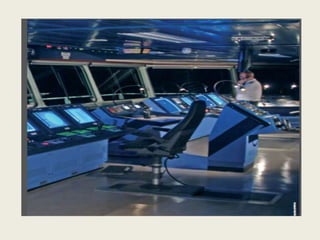
Running several applications like RADAR, ECDIS, CONNING,
AMS, E-LOG Book on the same workstation gives the officer quick
access to all information in a single position (for example, on the
bridge wing during mooring operations).
ECDIS also provides redundancy and improves efficiency by
avoiding duplication of work, such as route entry in several systems.
Integration of ECDIS with the vessel’s communication system enables
online communication from Ship to Shore for the exchange of data and
reports.
With a module for fuel optimization, integrated with the
vessel’s propulsion system, the optimization of speed along the route
brings environmental and economic benefits.
AVINGS.
With proper set up and use, streamlined procedures (ISM) on
the vessel and in the shipping company as well as a trained and
motivated crew, ECDIS is an investment with huge potential for cost
savings.
At the same time, efficiency and safety are increased.
Savings can be immediately visible, with its biggest potential in the
areas of charts and nautical publications, fuel consumption and time
spent on planning and preparation of reports.
Det Norske Veritas (DNV) Report ‘Effect on ENC Coverage on
ECDIS Risk Reduction’ from 2007 already evaluated that ECDIS is a cost
effective risk control option for large passenger ships and all other
vessel types involved in international trade, with a significant potential
to save lives by reductions the frequency of collision and grounding.
The grounding frequency reductions achievable
from implementing ECDIS vary between 11% and 38% for
the selected routes. This variation is due to variations in
ENC coverage. According to DNV, ECDIS represents a net
economic benefit itself.
• Claes Möller, Fleet Manager of Tärntank Ship
Management AB comments: ‘
“With ECDIS implementation in Tärntank Ship
Management vessels, when the vessel transferred from
paper charts and books to SENC and ADP we can say that
our cost for Charts and Nautical Publication was reduced
dramatically by more efficient charts ordering”.
• EXAMPLES FROM USERS EXPERIENCE
ECDIS in combination with Fuel Saving System, detailed
weather and current forecast enable us to proceed along the
route with the most economical speed. Recording, analysis of
data for a series of voyage makes it possible to better predict
and optimize the speed for different part of the voyage. ECDIS
and the
Fuel Saving System is a motivation factor for the officers
to minimize fuel consumption. Our savings are estimated to 3–
5%. I think that for a vessel that change from planning and
monitoring on paper charts to ECDIS with Fuel Saving System,
savings can easily exceed 10% of the fuel consumption.
* Wiggo Lander, Captain, Stena Germanica
Our conclusion today is that it’s been a long but
rewarding
way, since our Navigation officers and crew report back that
the system makes them feel more secure and that the
operation of the vessel is safer.
Capt. Tor-Arne Tönnesen,
Maritime Superintendent, Solvang
With the new IMO Requirements, Dual ECDIS without
paper charts as a back-up will save money. It’s an easy
calculation – not even that ENCs are cheaper than paper
charts but if you go halfway you will have double expenses for
both paper and ENC. With ECDIS implementation In Nordic
Tankers we also reduced time for chart corrections and
passage planning by 5 to 10 hours per week.
Soren Andersen, Marine Superintendent, SQE,
Nordic Tankers Marine A/S
We decided very early to install dual ECDIS
onboard our fleet of gas tankers. Our main goal was
to increase the safety of navigation but also to
reduce the workload for the crew onboard by
removing the time consuming task of paper chart
corrections. Both goals have been achieved.
The ECDIS provides an excellent overview for
the navigators with all important navigational
information present on a single screen and the
chart workload has been drastically reduced.
Rolf Andersen, Head of Nautical & IT, Lauritzen
Kosan A/S
IMO REQUIREMENTS
IMO Resolution A.817 (19)
“Electronic Chart Display and Information System (ECDIS)
means a navigation information system which, with adequate back up
arrangements, can be accepted as complying with the up to date chart
required by regulation V/19 and V/27 of the 1974 Safety of Lives at Sea
(SOLAS) Convention.”
An ECDIS system must at least be connected to an electronic
position fixing system (EPFS), a gyro and a log. The connection must be
made in such a way and by a certified engineer to ensure that a single
fault error cannot influence the system, which means the connection
must be made directly to the sensor.
As an ECDIS is a computer based system it must be protected
by a UPS (uninterruptible power supply) capable of handling a 45
second blackout during a switch from the vessel’s main to back-up
power source without rebooting.
IMO SOLAS V/19
2.1 All ships irrespective of size shall have:
2.1.4 Nautical charts and nautical publications
to plan and display the ship’s route for the intended
voyage and to plot and monitor positions
throughout the voyage;
an Electronic Chart Display and Information System
(ECDIS) may be accepted as meeting the chart
carriage requirements of this subparagraph.
2.1.5 Back-up arrangements to meet the
functional requirements of subparagraph if this
function is partly or fully fulfilled by electronic
means.
ECDIS CARRIAGE REQUIREMENTS
The carriage requirement means an ECDIS
must be fitted. This does not automatically
enable the vessel to sail paperless as the
requirement is for a single ECDIS.
A single ECDIS can be used for navigation
but it requires a backup by paper charts
or a secondary ECDIS.
REGULATIONS
ECDIS (as defined by IHO Publications S-52 and S-
57)[5] is an approved marine navigational chart and
information system, which is accepted as complying with
the conventional paper charts required by Regulation
V/19 of the 1974 IMO SOLAS Convention.[6] as amended.
The performance requirements for ECDIS are
defined by IMO and the consequent test standards have
been developed by the International Electrotechnical
Commission (IEC) in International Standard IEC 61174.[7]
The future standard for ENCs will be defined in IHO
Publication S-100.
Electronic Chart Display and Information System
An Electronic Chart Display and
Information System (ECDIS) is
a computer-based navigation
information system that
Complies with International
Maritime Organization (IMO)
Regulations and can be used
as an alternative to paper
nautical charts. IMO refers
to similar systems not meeting
the regulations as Electronic Chart Systems (ECS).
An ECDIS system displays the information
from electronic navigational charts (ENC) or
Digital Nautical Charts (DNC) and integrates
position information from position, heading and
speed through water reference systems and
optionally other navigational sensors.
Other sensors which could interface with
an ECDIS are radar, Navtex, automatic
identification systems (AIS), Sailing Directions
and fathometer.
ECDIS provides continuous
position and navigational
safety information.
The system generates
audible and/or visual
alarms when the vessel
is in proximity to
navigational hazards.
ELECTRONIC CHART DATA
The two most commonly used types of electronic chart data are listed below.
ENC CHARTS
ENC charts are Vector charts that conform to the requirements for
the chart databases for ECDIS, with standardized content, structure and
format, issued for use with ECDIS on the authority of government authorized
hydrographic offices. ENCs are vector charts that also conform to
International Hydrographic Organization (IHO) specifications stated in IHO
Publication S-57.
ENCs contain all the chart information necessary for safe navigation,
and may contain supplementary information in addition to that contained in
the paper chart (e.g., Sailing Directions). These supplementary information
may be considered necessary for safe navigation and can be displayed
together as a seamless chart. Systems using ENC charts can be programmed
to give warning of impending danger in relation to the vessel's position and
movement.
Chart systems certified according to marine regulations are required
to show these dangers.
RASTER CHARTS
Raster navigational charts are raster charts that
conform to IHO specifications and are produced by
converting paper charts to digital image by scanner.
The image is similar to digital camera pictures,
which could be zoomed in for more detailed information
as it does in ENCs. IHO Publication S-61 provides
guidelines for the production of raster data. IMO
Resolution MSC.86(70) permits ECDIS equipment
to operate in a Raster Chart Display System (RCDS) mode
in the absence of ENC.
According to the IMO performance standard, ECDIS
operated in the Raster Chart Display System (RCDS) mode
meets the chart carriage requirements for areas where
ENCs are not available. However, for these areas an
appropriate portfolio of up-todate paper charts should be
carried onboard in accordance with the Flag State
requirements.
Using an ECDIS in the RCDS mode in areas where
there are suitable ENCs available is not allowed.
ENCs meet SOLAS chart carriage requirements when they
are kept up-to-date and used on a type-approved ECDIS
with an adequate back-up arrangement.
A vector chart is a database, where different objects are
encoded. Your chart software may sort these objects in categories and
display them in layers.
There are many advantages of vector charts:
• Automatic alarm generation is possible
• Optional information can be displayed (customized settings)
• Zoom option with no deterioration of the readability
• They are easy to correct
• They require little memory capacity (quick loading)
• Information can be added (files, pictures etc.)
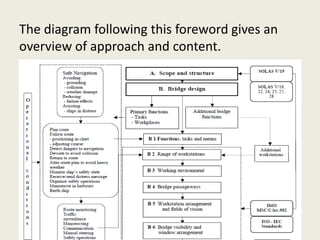
• Good readability in all presentation modes like Head-up, North-up,
Course-up
• Presentation is adapted according to the safety parameters of your
vessel
Although the worldwide
ENC coverage is improving
quickly, it does not yet cover
all sea areas in the necessary
scale. This is the reason why
private companies develop
their own vector chart
folios, such as Transas Marine TX-97 charts or C-
Map CM93. These nautical charts are not accepted
as the basis for primary navigation under the
SOLAS convention.
All ECDIS manufacturers have different
graphic layouts and hardware. But there’s one
thing they all have in common; they all read and
use S-57 ENC chart format and transfer it into
their own SENC format – System Electronic
Navigation Chart format.
This means when an ENC chart is loaded
into the system, it becomes a SENC chart. ENCs
are supplied on CDs or DVDs. The quarterly
issued Base-Set includes all available charts.
They are sent to the vessel 4 times per year.
The licence period for ENCs is 3, 6, 9 or 12
months. Additional Chart data may be added
to the licence at any point during the licence
period and there is no requirement for all
data to expire at a common date.
This allows the users to hold only the data
which is appropriate for their operations at any
given time. Some countries do not allow data to
be licensed for a shorter period than 12 months.
ISM SYSTEM
Implementation of ECDIS is not just a matter of
getting equipment installed, charts and
updates in place and providing some basic
training for a crew and then – “off they go”.
Implementation of ECDIS and, in the end
transition from paper charts to navigation by
Electronic Chart, is a fundamental change in
routines and procedures, mainly for the
vessel but also for the shipping company
operations.
All work that has been
done in paper chart to
fulfill requirements for
Voyage Planning and
Monitoring, as well as
preparation of reports,
should now be done in ECDIS – and it’s a
different way of doing it.
Therefore, changes in the ISM code
are required where at least the following
routines, procedures and checklists must
be up to date;
• Voyage Planning
• Pre-Departure Routines
• Pre-Arrival Routines
• Watch Keeping Routines
• Voyage and Monitoring Routines
• Emergency Routines for
Breakdown
• Maintenance and Chart Correction Routines
• Service and Support Routines
TRAINING
Crucial to implementing ECDIS is the
appropriate training for the crew and relevant
managerial staff ashore. All bridge officers should
have general ECDIS training that follows the IMO
Model Course 1.27. Additional equipment-specific
training for the ECDIS model in use onboard is
required for every ship, according to the ISM Code.
Until the 1st of January 2012, when the new STCW
code will include mandatory ECDIS training, two
important shipping regulations must be followed.
The IMO Standards for Training Certification and Watchkeeping (STCW)
Require the OOW to possess a “thorough knowledge of and ability to
use navigational charts and publications” and also “skills and ability to
prepare for and conduct a passage, including interpretation and applying
information from charts, must be evident”.
The STCW is currently written around paper charts but it is clearly
stated in the SOLAS convention that “ECDIS is considered to be included
under the term charts”. For some Flag States it is entirely evident that if ECDIS
is in use as the primary means of navigation, the user must demonstrate the
same degree of knowledge as when working on paper charts.
Therefore the officers of e.g. Isle of Man and UK registered ships
need to have an IMO Model Course 1.27 certificate.
The second important regulation is the IMO´s International
Safety Management code (ISM).
It states: “The company should establish procedures
that personnel are given proper familiarization with their
duties and equipment”. This strict wording refers to the
training of users of safety-related equipment, such as ECDIS.
They must receive appropriate training to the systems in use
on a particular vessel prior to use at sea.
An ECDIS manufacturer should be able to provide both
generic and equipment specific training either onboard or
ashore with a designated crew of highly qualified
trainers. Some manufacturers even offer computer based or
distance learning concepts which can be combined with
simulator training ashore.
This may save some time and money while maintaining
a high quality of training. Make sure your selected
training institute is following the IMO and manufacturer
recommended training
scheme and is certified by external auditors. In order to enjoy
a smooth transition from paper charts to ECDIS we
recommend
training designated personnel ashore. Major ECDIS
manufacturers should be able to
provide technical training and Train the Trainer courses for
internal equipment specific
training. This enables the shipping company to solve minor
difficulties by themselves
and provide ISM Code compliant training to the crew.
If you want to use ECDIS as a primary means of
navigation, it’s essential to understand
your Flag State’s requirements for certification.
Under existing regulations you will need
to obtain a certificate of equivalency to allow
ECDIS to be used and fulfill the SOLAS
chart carriage requirement. As a second step
your crew needs to prove the knowledge
and competency of ECDIS and its proper use.
National authorities may require ECDIS training
for vessels in their flag registries, or visiting their
ports. The European Union has provided
“Guidelines for Port State Control on Electronic
Charts” with the Paris Memorandum of
Understanding (PSC MOU).
Port State control is authorised to
determine if “Master and deck watchkeeping
officers are able to produce appropriate
documentation that generic and typespecific
ECDIS familiarization has been undertaken.”
Inspections might require physical demonstrations
of competency by your crew as well as evidence of
inclusion of ECDIS operation procedures in your onboard
safety
management systems.
Some commercial operators’ vetting schemes have
similar demands and non-compliance with their
requirements could ban your vessel from trade. ECDIS
training may also affect liability and insurance.
You should also talk to your classification society
and insurance/P&I club to see if they have any further
requirements. An ECDIS manufacturer will be able to
assist you.
Inspections might require physical
demonstrations of competency by your crew as well
as evidence of inclusion of ECDIS operation
procedures in your onboard safety management
systems.
Some commercial operators’ vetting schemes
have similar demands and non-compliance with
their requirements could ban your vessel from
trade. ECDIS training may also affect liability and
insurance.
You should also talk to your classification
society and insurance/P&I club to see if they have
any further requirements. An ECDIS manufacturer
will be able to assist you.
Arrangement of navigational systems and
equipment
The type and number of systems and
equipment to be installed on board the new
building for the purpose of navigation should at
least incorporate the means specified in
SOLAS regulation 19.
The systems and equipment should be
installed and arranged to meet the relevant aims
of SOLAS regulation V/15 specified under C.
Procedures related to SOLAS regulation 24, 25, 27
and 28
* The following routines should be included and
emphasized in the regular bridge
procedures:
- Use of heading and/or track control systems
- Testing of manual steering system after prolonged
use of automatic steering system
- Operation of steering gear
- Updating of nautical charts and nautical
publications
- Recording of navigational activities
A Full Range of Systems
A full range of dynamic
positioning systems to keep the
vessel within specified position
And heading limits. These systems
Are designed to minimise fuel
consumption and wear and tear
onthe propulsion equipment.
The K-Pos operator station is
available in single, dual or triple
configurations. More than 2500
dynamic positioning systems
have been supplied.
A navigator safety system or "dead man alarm" is designed to
monitor bridge activity and alert the master or other qualified
navigators if the bridge becomes unattended. The system first alerts
the officer of the watch through local alarm indication at the bridge
unit and, if he is not responding, then alerts the master or other
qualified officer.
* The development of this Recommendation has been based
on the international regulatory regime and IMO instruments
and standards already accepted and referred to by IMO. The
platform for the Recommendation is:
• the aims specified in SOLAS regulation V/15 for application
of SOLAS regulations V/19, 22, 24, 25, 27 and 28
• the content of SOLAS regulations V/19, 22, 24, 25, 27, 28
• applicable parts of MSC/Circ.982, “Guidelines on ergonomic
criteria for bridge equipment and layout”
• applicable parts of IMO resolutions and performance
standards referred to in SOLAS
• applicable parts of ISO and IEC standards referred to for
information in MSC/Circ.982
• STCW Code
• ISM Code
This Recommendation is developed to serve as a self-
contained document for the understanding
and application of the requirements, supported by:
• Annex A giving guidance and examples on how
the requirements set forth may be met by
acceptable technical solutions. The guidance is
not regarded mandatory in relation to the
requirements and does not in any way exclude
alternative solutions that may fulfil the purpose of
the requirements.
o Appendix 1 to Annex A, “Tasks and related
means – :
Examples of location of main equipment”
• Annex B “Facts and principles – Related to SOLAS V/15 and
the IACS
Recommendation” that should assist in achieving a common
understanding of the
content of SOLAS regulation 15 and the approach and
framework of the
Recommendation.
o Appendix 1 to Annex B clarifying the content of each
aim of SOLAS regulation V/15.
Chapter C 2 “Bridge alarm management” is established by
compilation of relevant IMO and classification requirements
and guidelines. The chapter is recommended for compliance
until superseded by an IMO performance standard.
The diagram following this foreword gives an
overview of approach and content.
Track Control System permits automatic steering
along the set route
FURUNO VOYAGER features Track Control System
through integration of ECDIS and autopilot. This
enables the vessel to keep on the plotted route
automatically with minimum intervention from the
navigator.
This has been achieved through:
• flexible steering control
• route planning on ECDIS
• enhanced position reliability through multi-
tiered data validation process
FURUNO VOYAGER user interface includes carefully
organized operational tools designed to make
navigational tasks simple and easy. The “Status Bar” at
the top of the screen clearly indicates operating mode
and status and offers direct single-click control of the
navigator’s principle tasks.
The “Instant Access” bar at the left of the screen
provides direct control of the features and attributes of
the on-screen presentation. These on-screen tools deliver
straightforward, task-based operation with all multi-
function display information in view at all times.
The operator can quickly perform navigational
tasks without having to enter intricate menus, thus losing
situational awareness.
Network Configuration
FURUNO VOYAGER onboard Navigation Network System
FURUNO VOYAGER integrates the following two
separate networks that link all the onboard navigation
equipment, including multifunction displays and various
sensors: Network for Integration and Interswitch and Network
for Sensor Integration.
The navigation system consists of duplicated
subsystems so that any loss of navigational functions can be
avoided in an event of single point of failure. Since MFD is
able to function as Radar, ECDIS, conning information display
and alert management system, navigation tasks can be
performed from any of the interfaced multifunction displays,
hence optimizing the system availability.
The following materials were printed with the
permission of the International Maritime
Organization.
International Conventions
• Adoption
• Entry into force
• Amendment
• Enforcement
Maritime Safety
• International Convention for the Safety of Life at Sea (SOLAS), 1960
and 1974
• International Convention on Load Lines (LL), 1966
• Special Trade Passenger Ships Agreement (STP), 1971
• Convention on the International Regulations for Preventing
Collisions at Sea (COLREG)1972
• International Convention for Safe Containers (CSC), 1972
• Convention on the International Maritime Satellite Organization
(INMARSAT), 1976
• The Torremolinos International Convention for the Safety of Fishing
Vessels (SFV), 1977
• International Convention on Standards of Training, Certification and
Watchkeeping for Seafarers (STCW), 1978
• International Convention on Maritime Search and Rescue (SAR),
1979
Marine Pollution
• International Convention for the Prevention of Pollution of the Sea
by Oil (OILPOL), 1954
• Convention on the Prevention of Marine Pollution by Dumping of
Wastes and Other
• Matter (LDC), 1972
• International Convention for the Prevention of Pollution from Ships,
1973, as modified by
• the Protocol of 1978 relating thereto (MARPOL73/78)
• International Convention Relating to Intervention on the High Seas
in Cases of Oil
• Pollution Casualties (INTERVENTION), 1969
• International Convention on Oil Pollution Preparedness, Response
and Cooperation
• (OPRC), 1990
Liability and Compensation
• International Convention on Civil Liability for Oil Pollution
Damage (CLC), 1969
• International Convention on the Establishment of an
International Fund for Compensation
• for Oil Pollution Damage (FUND), 1971
• Convention relating to Civil Liability in the Field of Maritime
Carriage of Nuclear
• Materials (NUCLEAR), 1971
• Athens Convention relating to the Carriage of Passengers
and their Luggage by Sea (PAL),
• 1974
• Convention on Limitation of Liability for Maritime Claims
(LLMC), 1976
International Conventions
The industrial revolution of the eighteenth and nineteenth
centuries and the upsurge in
international commerce which resulted led to the adoption of a
number of international treaties
related to shipping, including safety. The subjects covered included
tonnage measurement, the
prevention of collisions, signaling and others.
By the end of the nineteenth century suggestions had even
been made for the creation of a
permanent international maritime body to deal with these and future
measures. The plan was not
put into effect, but international cooperation continued in the
twentieth century, with the adoption
of still more internationally developed treaties.
By the time IMO came into existence in 1958,
several important international conventions* had
already been developed, including the International
Convention for the Safety of Life at Sea of 1948, the
International Convention for the Prevention of
Pollution of the Sea by Oil of 1954 and treaties
dealing with load lines and the prevention of
collisions at sea.
IMO was made responsible for ensuring that
the majority of these conventions were kept up to
date. It was also given the task of developing new
conventions as and when the need arose.
The creation of IMO coincided with a
period of tremendous change in world shipping
and the Organization was kept busy from the
start developing new conventions and ensuring
that existing instruments kept pace with
changes in shipping technology. It is now
responsible for 35 international conventions and
agreements and has adopted numerous
protocols and amendments.
Adopting a Convention
This is the part of the process with which IMO as
an organization is most closely involved. IMO has six main
bodies concerned with the adoption or implementation
of conventions. The Assembly and Council are the main
organs, and the committees involved are the Maritime
Safety Committee, Marine Environment Protection
Committee, Legal Committee and the Facilitation
Committee.
Developments in shipping and other related
industries are discussed by Member States in these
bodies, and the need for a new convention or
amendments to existing conventions can be raised in any
of them.
The convention thus agreed upon is then adopted
by the conference and deposited with the Secretary-
General who sends copies to Governments. The
convention is opened for signature by States, usually for
a period of 12 months. Signatories may ratify or
accept the convention while non-signatories may accede.
The drafting and adoption of a convention in IMO
can take several years to complete although in
some cases, where a quick response is required to deal
with an emergency situation, Governments have been
willing to accelerate this process considerably.
Entry into Force
The adoption of a convention marks the conclusion of only the
first stage of a long process. Before the convention comes into force -
that is, before it becomes binding upon Governments which have
ratified it - it has to be accepted formally by individual Governments.
Each convention includes appropriate provisions stipulating conditions
which have to be met before it enters into force. These conditions vary
but, generally speaking, the more important and more complex the
document, the more stringent are the conditions for its entry into
force.
For example, the International Convention for the Safety of
Life at Sea, 1974, provided that entry into force requires acceptance by
25 States whose merchant fleets comprise not less than 50 percent
of the world’s gross tonnage; for the International Convention on
Tonnage Measurement of Ships, 1969, the requirement was
acceptance by 25 States whose combined merchant fleets represent
not less than 65 percent of world tonnage.
Amendment
Technology and techniques in the shipping industry change
very rapidly these days. As a result, not only are new conventions
required but existing ones need to be kept up to date. For example,
the International Convention for the Safety of Life at Sea (SOLAS), 1960
was amended six times
after it entered into force in 1965 - in 1966, 1967, 1968, 1969, 1971
and 1973. In 1974 a completely new convention was adopted
incorporating all these amendments (and other minor changes) and
was itself modified (in 1978, 1981, 1983, 1988, 1990 and 1991).
In early conventions, amendments came into force only after a
percentage of Contracting States, usually two thirds, had accepted
them. This normally meant that more acceptances were required
to amend a convention than were originally required to bring it into
force in the first place, especially where the number of States which
are Parties to a convention is very large.
In the case of the 1974 SOLAS Convention, an
amendment to most of the Annexes (which constitute the
technical parts of the Convention) is ‘deemed to have
been accepted at the end of two years from the date on
which it is communicated to Contracting Governments...’
unless the amendment is objected to by more than one
third of Contracting Governments, or Contracting
Governments owning not less than 50 percent of the
world’s gross merchant tonnage.
This period may be varied by the Maritime Safety
Committee with a minimum limit of one year.
As was expected the "tacit acceptance" procedure
has greatly speeded up the amendment process.
Enforcement
The enforcement of IMO conventions depends upon the
Governments of Member Parties. The Organization has no powers in
this respect. Contracting Governments enforce the provisions of IMO
conventions as far as their own ships are concerned and also set the
penalties for infringements, where these are applicable. They may
also have certain limited powers in respect of the ships of other
Governments.
In some conventions, certificates are required to be carried on
board ship to show that they have been inspected and have met the
required standards. These certificates are normally accepted as
proof by authorities from other States that the vessel concerned has
reached the required standard, but in some cases further action can be
taken.
Contracting States are empowered to act against
ships of other countries which have been involved in an
accident or have been damaged on the high seas if there
is a grave risk of oil pollution occurring as a result.
The way in which these powers may be used are
very carefully defined, and in most conventions
the flag State is primarily responsible for enforcing
conventions as far as its own ships and their personnel
are concerned.
The majority of conventions adopted under the
auspices of IMO or for which the Organization is
otherwise responsible fall into three main categories.
Maritime Safety
The first group is concerned with maritime
safety; the second with the prevention of marine
pollution; and the third with liability and
compensation, especially in relation to damage
caused by pollution. Outside these major groupings
are a number of other conventions dealing with
facilitation, tonnage measurement, unlawful acts
against shipping and salvage.
International Convention for the Safety of Life
at Sea, 1960 and 1974
• 1960 Convention
• Adoption: 17 June 1960
• Entry into force: 26 May 1965
1974 version
• Adoption: 1 November 1974
• Entry into force: 25 May 1980
• The SOLAS Convention in its successive forms is generally
regarded
as the most important of all international treaties concerning
the safety of merchant ships. The first version was adopted in
1914, the second in 1929 and the third in 1948.
• The 1960 Convention was the first major task for IMO after
its creation and it represented a considerable step forward
in modernizing regulations and in keeping pace with
technical developments in the shipping industry.
• The intention was to keep the Convention up to date by
periodic amendments but in practice the amendments
procedure incorporated proved to be very slow. It became
clear that it would be impossible to secure the entry into
force of amendments within a reasonable period of time.
The 1974 Convention
• As a result, a completely new convention was adopted in 1974
which included not only the amendments agreed up until that date but
a new amendment procedure designed to ensure that changes could
be made with a specified (and acceptably short) period of time.
• The main objective of the SOLAS Convention is to specify minimum
standards for the construction, equipment and operation of ships,
compatible with their safety. Flag States are responsible for ensuring
that ships under their flag comply with its requirements, and a number
of certificates are prescribed in the Convention as proof that this has
been done.
Control provisions also allow Contracting
Governments to inspect ships of other Contracting
States if there are clear grounds for believing that
the ship and its equipment do not substantially
comply with the requirements of the Convention.
General provisions are contained in chapter I,
the most important of them concerning the survey
of the various types of ships and the issuing of
documents signifying that the ship meets the
requirements of the Convention. The chapter also
includes provisions for the control of ships in
ports of other Contracting Governments.
Subdivision and stability are dealt within
chapter II-1. The subdivision of passenger ships into
watertight compartments must be such that after
assumed damage to the ship’s hull the vessel will
remain afloat and stable. Requirements for
watertight integrity and bilge pumping
arrangements for passenger ships are also laid
down as well as stability requirements for both
passenger and cargo ships.
The degree of subdivision - measured by the
maximum permissible distance between two
adjacent bulkheads - varies with ship’s length and
the service in which it is engaged. The highest
degree of subdivision applies to passenger ships.
Machinery and electrical installations: these
requirements, contained in chapter II-1, are designed to
ensure that services which are essential for the safety of the
ship, passengers and crew are
maintained under various emergency conditions. The steering
gear requirements of this chapter are particularly important.
Fire protection, fire detection and fire extinction:
casualties to passenger ships through fire emphasized the
need to improve the fire protection provisions of the 1960
Convention, and in 1966 and 1967 amendments were
adopted by the IMO Assembly. These and other amendments,
particularly detailed fire safety provisions for tankers and
combination carriers, such as inert gas, were incorporated in
chapter II-2 of the 1974 Convention.
These provisions are based on the following principles:
1. Division of the ship into main and vertical zones by thermal and
structural boundaries.
2. Separation of accommodation spaces from the remainder of the
ship by thermal and structural
boundaries.
3. Restricted used of combustible materials.
4. Detection of any fire in the zone of origin.
5. Containment and extinction of any fire in the space of origin.
6. Protection of the means of escape or of access for firefighting
purposes.
7. Ready availability of fire-extinguishing appliances.
8. Minimization of the possibility of ignition of flammable cargo vapor.
Life-saving appliances and arrangements are dealt
with in chapter III, which was completely revised by the
1983 amendments which entered into force on 1 July
1986. The revised chapter is
divided into three parts.
• Part A contains general provisions on application of the
requirements, exemptions, definitions, evaluation,
testing and approval of appliances and arrangements
and production tests.
• Part B contains the ship requirements and is subdivided
into section I dealing with common requirements
applicable to both passenger ships and cargo ships,
section II containing additional requirements for
passenger ships and section III containing additional
requirements for cargo ships.
Part C deals with the life-saving appliance requirements and is
divided into eight sections. Section I contains general requirements,
section II requirements for personal life-saving appliances, section III
visual signal requirements, section IV requirements for survival craft,
section V rescue boat provisions, section VI requirements for launching
and embarkation appliances, section VII other life-saving appliances,
and section VIII miscellaneous matters.
Radiotelegraphy and radiotelephony form the subject matter
of chapter IV: Part A describes the type of facility to be carried
Operational requirements for watchkeeping and listening are given
in part B, while technical provisions are detailed in part C. This part
also includes technical provisions for direction-finders and for motor
lifeboat radiotelegraph installations, together with portable radio
apparatus for survival craft. The radio officer’s obligations regarding
mandatory log-book entries are listed in part D.
The chapter is closely linked to the Radio
Regulations of the International Telecommunication
Union and was completely revised in October 1988 (see
1988 (GMDSS) amendments).
Safety of navigation is dealt with in chapter V
which identifies certain navigation safety services which
should be provided by Contracting Governments and seas
forth provisions of anoperational nature applicable in
general to all ships on all voyages. This is in contrast to
the Convention as a whole, which only applies to certain
classes of ship engaged on international voyages.
The subjects covered include the maintenance of
meteorological services for ships; the ice patrol service;
routeing of ships; and the maintenance of search and
rescue services.
This chapter also includes a general obligation
for masters to proceed to the assistance of those in
distress and for Contracting Governments to ensure
that all ships shall be sufficiently and efficiently
manned from a safety point of view.
Carriage of grain forms the subject matter of
chapter VI. Shifting is an inherent characteristic of
grain, and its effect on a ship’s stability can be
disastrous. Consequently, the SOLAS Convention
contains provisions concerning stowing, trimming
and securing grain cargoes.
Provision is made for ships constructed
specially for the transport of grain, and a method
for calculating the adverse heeling moment due to
a shift of cargo surface in ships carrying bulk grain is
specified. It also provides for documents of
authorization, grain loading stability data and
associated plans of loading. Copies of all relevant
documents must be available on board to enable
the master to meet the chapter’s requirements.
This chapter was revised in 1991, to make it
applicable to all types of cargo (except liquids and
gases in bulk). (See 1991 amendments).
Carriage of dangerous goods is dealt with in
chapter VII, which contains provisions for the
classification, packing, marking, labelling and
placarding, documentation and stowage of
dangerous goods in packaged form, in solid form in
bulk, and liquid chemicals and liquefied gases in
bulk.
The classification follows the system used by
the UN for all modes of transport. The UN system
has been adapted for marine transport and the
provisions are in some cases more stringent.
Contracting Governments are required to issue
instructions at the national level. To help them do this,
the Organization developed the International Maritime
Dangerous Goods (IMDG) Code. The IMDG Code is
constantly updated to accommodate new dangerous
goods and to supplement
or revise existing provisions. Regulations concerning
substances carried in bulk in purpose-built ships were
introduced in the 1983 amendments dealt with below.
Nuclear ships are covered in chapter VIII. Only
basic requirements are given and are particularly
concerned with radiation hazards. However, a detailed
and comprehensive Code of Safety for Nuclear Merchant
Ships was adopted by the IMO Assembly in 1981 as an
indispensable companion document.
The Protocol of 1978
Adoption: 17 February 1978
Entry into force: 1 May 1981
This was adopted at the International
Conference on Tanker Safety and Pollution
Prevention and made a number of important
changes to chapter I, including the introduction of
unscheduled inspections and/or mandatory annual
surveys and the strengthening of port State control
requirements.
Chapter II-1, chapter II-2 and chapter V were also improved.
The main points are as follows:
1. New crude oil carriers and product carriers of 20,000 dwt
and above are required to be fittedwith an inert gas system.
2. An inert gas system became mandatory for existing crude
oil carriers of 70,000 dwt and above
by 1 May 1983, and by 1 May1985 for ships of 20-70,000 dwt.
3. In the case of crude oil carriers of 20-40,000 dwt there is
provision for exemption by flag States where it is considered
unreasonable or impracticable to fit an inert gas system and
highcapacity fixed washing machines are not used. But an
inert gas system is always required when crude oil washing is
operated.
4. An inert gas system was required on existing product
carriers from 1 May 1983 and by 1 May 1985 for ships of
40-70,000 dwt and down to 20,000 dwt which are fitted
with high capacity washing machines.
5. In addition to requiring that all ships of 1,600 grt and
above shall be fitted with radar, the Protocol requires that
all ships of 10,000 grt and above have two radars, each
capable of being operated independently.
6. All tankers of 10,000 grt and above shall have two
remote steering gear control systems, each operable
separately from the navigating bridge.
7. The main steering gear of new tankers of 10,000 grt
and above shall comprise two or more identical power
units, and shall be capable of operating the rudder with
one or more power units.
The 1981 amendments
Adoption: 20 November 1981
Entry into force: 1 September 1984
Perhaps the most important amendments concern
chapter II-1 and chapter II-2, both of which were virtually
rewritten and updated.
The changes to chapter II-1 include updated provisions
of revolution A.325(IX) on machinery and electrical
requirements. Further amendments to regulations 29 and 30
were agreed following the Amoco Cadiz disaster and taking
into account the 1978 SOLAS Protocol on steering gear.
The requirements introduce the concept of duplication
of steering gear control systems in tankers.
Amendments to chapter II-2 include the
requirements of resolution A.327(XI), provisions for
halogenated hydrocarbon extinguishing systems, special
requirements for ships carrying dangerous goods, and a
new regulation 62 on inert gas systems. The amendments
to chapter II-2 strengthen the requirements for cargo
ships and passenger ships to such an extent that a
complete rearrangement of that chapter became
necessary.
A few minor changes were made to chapter III but
seven regulations in chapter IV were replaced, amended
or added. Some important changes were also made to
chapter V, including the addition of new requirements
concerning the carriage of ship borne navigational
equipment.
The revised requirements cover such matters
as gyro and magnetic compasses; the mandatory
carnage of two radars and of automatic radar
plotting aids in ships of 10,000 grt and above;
echo-sounders; devices to indicate speed and
distance; rudder angle indicators; propeller
revolution indicators; rate of turn indicators; radio-
direction finding apparatus; and equipment for
homing on the radiotelephone distress frequency.
In addition a number of small changes were
made to chapter vii.
The 1983 amendments
Adoption: 17 June 1983
Entry into force: 1 July 1986
These amendments include a few minor changes to chapter II-1
and some further changes to chapter II-2 (including improvements to
the 1981 amendments) designed particularly to increase the safety of
bulk carriers and passenger ships.
The most extensive changes involve chapter III, which has been
completely rewritten. The chapter in the 1974 Convention differs little
from the texts which appeared in the 1960 and 1948 SOLAS
Conventions and the amendments are designed not only to take into
account the many technical advances which have taken place since
then but also to expedite the evaluation and introduction of further
improvements.
Some small changes were made to chapter
IV. The amendments to chapter VII extended its
application to chemical tankers and liquefied gas
carriers by making reference to two new Codes,
the International Bulk Chemical Code and the
International Gas Carrier Code. Both relate to
ships built on or after 1 July 1986.
The 1988 (April) amendments
Adoption: 21 April 1988
Entry into force: 22 October 1989
In March 1987 the car ferry Herald of Free Enterprise
apsized and sank with the loss of 193 lives. The United
Kingdom proposed a series of measures designed to prevent
a recurrence, the first package of which was adopted in April.
They affect regulations 23 and 42 of Chapter II-1 and
are intended to improve monitoring of doors and cargo areas
and to improve emergency lighting. Because of the urgency,
the "tacit acceptance" procedure was used to bring the
amendments into force only 18 months after their adoption.
The 1988 (October) amendments
Adoption: 28 October 1988
Entry into force: 29 April 1990
Some of these amendments also resulted from the
Herald of Free Enterprise disaster. They affect the intact
stability of all passenger ships; require all cargo loading doors
to be locked before a ship leaves the berth; and make it
compulsory for passenger ships to have a lightweight survey
at least every five years to ensure their stability has not been
adversely affected by the accumulation of extra weight or any
alterations to the superstructure.
Other amendments were being prepared before the
disaster, but their adoption was brought forward as a result.
They concern the stability of passenger ships in the damaged
condition, and apply to ships built after 29 April 1990.
The 1988 Protocol
Adoption: 11 November 1988
Entry into force: 12 months after being accepted by at least 15
States whose combined merchant fleets represented at least 50% of
world tonnage (but not before 1 February 1992)
Status: 6 acceptances have been received.
The Protocol introduces a new system of surveys and
certification which will harmonize with two other conventions, Load
Line (page 23) and MARPOL 73/78 (page 40). At present, requirements
in the three instruments vary and, as a result, ships may be obliged to
go into drydock for a survey required by one convention shortly after
being surveyed in connection with another.
By enabling the required surveys to be carried out at the same
time the system will reduce costs for shipowners and administrations
alike.
The 1988 (GMDSS) amendments
Adoption: 11 November 1988
Entry into force: 1 February 1992
IMO began work on the Global Maritime Distress and
Safety System in the 1970's and its introduction will mark the
System in the 1970's and its introduction will mark the biggest
change to maritime communications since the invention of
radio.
It will be introduced in stages between 1993 and 1999.
The basic concept of the system is that search and rescue
authorities ashore, as well as ships in the vicinity, will be
rapidly alerted in the
event of an emergency.
The GMDSS will make great use of the
satellite communications provided by INMARSAT
but will also use terrestrial radio.
The equipment required by ships will vary
accordingly to the area in which they operate. In
addition to distress communications, the GMDSS
will also provide for the dissemination of general
maritime safety information (such as
navigational and meteorological warnings and
urgent information to ships).
The 1989 amendments
Adoption: 11 April 1989
Entry into force: 1 February 1992
The main changes concern Chapter II-1 and II-2 of the
convention, which are respectively concerned with ships’ construction
and with fire protection, detection and extinction. Chapter II- 1 covers
subdivision and stability and machinery and electrical installations.
One of the most
important amendments is designed to reduce the number and size of
openings in watertight bulkheads in passenger ships and to ensure
that they are closed in the event of an emergency.
Chapter II-2 deals with fire protection, detection and
extinction. Improvements have been introduced to fixed gas fire-
extinguishing systems, smoke detection systems, arrangements for
fuel and other oils, the location and separation of spaces and several
other regulations.
The International Gas Carrier Code - which is mandatory under
SOLAS - was also amended.
The 1990 amendments
Adoption: May 1990
Entry into Force: 1 February 1992
Important changes have been made to the way in which the
subdivision and stability of dry cargo ships is calculated. They apply to
ships of 100 meters or more in length built after 1 February
1992.
The amendments are contained in a new part B-1 of chapter II-
1 and are based upon the so called "probabilistic" concept of survival,
which was originally developed through study of data relating to
collisions collected by IMO. This showed a pattern in accidents which
could be used in improving the design of ships: most damage, for
example, is sustained in the forward part of ships and it seemed
logical, therefore, to improve the standard of subdivision there rather
than towards the stem.
Because it is based on statistical evidence as to what
actually happens when ships collide, the probabilistic concept
provides a far more realistic scenario than the earlier
"deterministic" method, whose principles regarding the
subdivision of passenger ships are theoretical rather than
practical in concept.
At the same meeting amendments were adopted to
the International Code for the Construction and Equipment of
Ships Carrying Dangerous Chemicals in Bulk (IBC Code) and
the International Code for the Construction and Equipment of
Ships Carrying Liquified Gases in Bulk.
The 1991 amendments
Adoption: 24 May 1991
Entry into force: 1 January 1994 (expected date under "tacit
acceptance")
The most important feature of these amendments is the
complete revision of Chapter VI (carriage of grain). This has been
extended to include other cargoes. The text is shorter, but the chapter
is backed up by two new Codes. The International Grain Code will be a
mandatory instrument while the Code of Safe Practice for Cargo
Stowage and Securing is recommended. The new chapter also refers to
the Code of Safe Practice for Ships Carrying Timber Deck Cargoes and
the Code of Safe Practice for Solid Bulk Cargoes.
Fire safety requirements for passenger ships have been
improved by means of amendments to Chapter II- 1 and other changes
have been made to Chapter Ill and Chapter VI (safety of navigation).
International Convention on Load Lines, 1966
Adoption: 5 April 1966
Entry into force: 21 July 1968
It has long been recognized that limitations on the draft to
which a ship may be loaded make a significant contribution to her
safety. These limits are given in the form of freeboards, which
constitute, besides external weather tight and watertight integrity, the
main objective of the Convention.
The first International Convention on Load Lines, adopted in
1930, was based on the principle of reserve buoyancy, although it was
recognized then that the freeboard should also ensure adequate
stability and avoid excessive stress on the ship’s hull as a result of
overloading.
Provisions are made determining the freeboard of tankers by
subdivision and damage stability calculations.
The regulations take into account the potential
hazards present in different zones and different
seasons. The technical annex contains several additional
safety measures concerning doors, freeing ports,
hatchways and other items. The main purpose of these
measures is to ensure the watertight integrity of ships’
hulls below the freeboard deck.
All assigned load lines must be marked amidships
on each side of the ship, together with the deck line.
Ships intended for the carriage of timber deck cargo are
assigned a small freeboard as the deck cargo provides
protection against the impact of waves.
Amendments
Amendments were adopted to the Convention in 1971
(to make certain improvements to the text and to the chart of
zones and seasonal areas); in 1975 (to introduce the principle
f "tacit
acceptance" into the Convention); in 1979 (to make some
alterations to zone boundaries off the coast of Australia), and
in 1983 (to extend the summer and tropical zones southward
off the coast
of Chile).
None of these amendments has yet entered into force.
In each case 78 acceptances are required and, to date, the
1971 amendments have received 47 acceptances, 1975 - 42;
1979 -40; and 1983- 22.
The 1988 Protocol
Adoption: 11 November 1988
Entry into force: 12 months after being accepted by
not less than 15 States whose combined merchant
fleets constitute not less than 50 percent of world
tonnage
Status: 9 acceptances have been received
The protocol was adopted in order to
harmonize the Convention’s survey and certification
requirement with those contained in SOLAS and
MARPOL 73/78.
Convention on the International Regulations for Preventing Collisions
at Sea, 1972
Adoption: 20 October 1972
Entry into force: 15 July 1977
This Convention was designed to update and replace the
Collision Regulations of 1960 which were annexed to the SOLAS
Convention adopted in that year.
One of the most important innovations in the 1972
Regulations was the recognition given to traffic separation schemes.
Rule 10 states that vessels using these schemes will be
required to proceed in the appropriate traffic lane in the general
direction of traffic flow for that lane, keeping clear of a traffic
separation line or zone. In so far as is practicable, vessels must avoid
crossing traffic lanes. When crossing a lane is necessary, it must be
accomplished as nearly as practicable at right angles to the general
direction of the traffic flow.
The Convention groups provisions into sections
dealing with steering and sailing; lights and shapes and
sound and light signals. There are also four Annexes
containing technical requirements concerning lights and
shapes and their positioning; sound signaling appliances;
additional signals for fishing vessels when operating in
close proximity, and international distress signals.
Guidance is provided in determining safe speed,
the risk of collision and the conduct of vessels operating
in or near traffic separation schemes. Other rules concern
the operation of vessels in narrow channels, the conduct
of vessels in restricted visibility, vessels restricted in their
ability to maneuver, and provisions concerning vessels
constrained by their draught.
The rules also include requirements for
special lights for air-cushion vessels operating in the
non-displacement mode, a yellow light to be
exhibited above the white sternlight by vessels
engaged in towing, special lights and day signals for
vessels engaged in dredging or under-water
operations, and sound signals to be given in
restricted visibility.
The technical details of construction and
positioning of lights and shapes have been placed in
a separate Annex.
The 1981 amendments
Adoption: 19 November 1981
Entry into force: 1 June 1983
These were adopted by the IMO Assembly
and entered into force under the "tacit acceptance"
procedure on 1 June 1983. A number of rules are
affected but perhaps the most important change
concerns Rule 10, which has been amended to
enable vessels carrying out various safety
operations, such as dredging or surveying, to carry
out these functions in traffic separation schemes.
The 1987 amendments
Adoption: 19 November 1987
Entry into force: 19 November 1989
The amendments affect several rules, such as
Rule 1(e) - vessels of special construction: the
amendment classifies the application of the
Convention to such ships; Rule 3(h), which defines a
vessel constrained by her draught; Rule 10(c) -
crossing traffic lanes, etc.
The 1989 amendments
Adoption: 19 October 1989
Entry into force: 19 April 1989
The amendment concerns Rule 10 and is
designed to stop unnecessary use of the inshore
traffic zone.
International Convention for Safe Containers, 1972
Adoption: 2 December 1972
Entry into force: 6 September 1977
In view of the rapid increase in the use of freight
containers for the consignment of goods by sea and the
development of specialized container ships, in 1967 IMO
undertook to study the safety of containerization in marine
transport. The container itself emerged as the most important
aspect to be considered.
In 1972 a conference was held to consider a draft
convention prepared by IMO in cooperation with the Economic
Commission for Europe. The conference was jointly convened
by the United Nations and IMO.
The 1972 Convention for Safe Containers has
two goals. One is to maintain a high level of safety
of human life in the transport and handling of
containers by providing generally acceptable test
procedures and related strength requirements
which have proven adequate over the years.
The other is to facilitate the international
transport of containers by providing uniform
international safety regulations, equally applicable
to all modes of surface transport. In this way,
proliferation of divergent national safety regulations
can be avoided
The requirements of the Convention apply to the
great majority of freight containers used internationally,
except those designed specially for carriage by air. As it
was not intended that all containers, van or reusable
packing boxes should be affected, the scope of the
Convention is limited to containers of a prescribed
minimum size having corner fittings - devices which
permit handling, securing or stacking.
The Convention sets out procedures whereby
containers used in international transport will be safety-
approved by an Administration of a Contracting State or
by an organization acting on its behalf.
The Administration or its authorized representative will
authorize the manufacturer to affix to approved containers a
safety approval plate containing the relevant technical data.
The approval, evidenced by the safety approval plate
granted by one Contracting State, should be recognized by
other Contracting States. This principle of reciprocal
acceptance of safety approved
containers is the cornerstone of the Convention; and once
approved and plated it is expected that containers will move
in international transport with the minimum of safety control
formalities.
The subsequent maintenance of a safety-approved
container is the responsibility of the owner, who is required to
have the container periodically examined.
The technical Annex to the Convention
specifically requires that the container be
subjected to various tests which represent a
combination of safety requirements of both the
inland and maritime modes of transport.
Flexibility is incorporated in the
Convention by the provision of simplified
amendment procedures which make it possible
to speedily adapt the test procedures to the
requirements of international container traffic.
The 1981 amendments
Adoption: April 1981
Entry into force: 1 December 1981
The amendments provide transitional
arrangements for plating of containers (which
had to be completed by 1 January 1985), and
for the marking of the date of the container’s
next examination by 1 January 1987.
The 1983 amendments
Adoption: June 1983
Entry into force: 1 January 1984
The amendments extend the interval
between re-examination to 30 months and
permit a choice of container re-examination
procedures between the original periodic
examination scheme or a new continuous
examination program.
The 1991 amendments
Adoption: 17 May 1991
Entry into force: 1 January 1993
The amendments concern Annexes I and II
of the Convention. They include the addition of a
new Chapter V to Annex I concerning regulations
for the approval of modified containers.
Convention on the International Maritime Satellite
Organization, 1976
Adoption: 3 September 1976
Entry into force: 16 July 1979
For some years maritime radio
communications frequency bands have become
increasingly congested. With the continuous
expansion of maritime mobile communications, the
situation will continue to deteriorate. This could
have serious consequences for maritime
communications and safety at sea.
The use of space technology, however, could
help overcome the problem and many others which
have arisen in recent years. IMO has been involved
in this subject since 1966, and in 1973 decided to
convene a conference with the object of
establishing a new maritime communications
system based on satellite technology.
The Conference first met in 1975 and held
three sessions, at the third of which the Convention
was adopted, together with an Operating
Agreement.
The Convention defines the purposes of
INMARSAT as being to improve maritime
communications, thereby assisting in improving
distress and safety of life at sea communications,
the efficiency and management of ships, maritime
public correspondence services, and radio
determination capabilities.
The Organization consists of an Assembly,
Council and a Directorate headed by a Director-
General, and the functions of each are defined. An
Annex to the Convention outlines procedures
for the settlement of disputes.
The Operating Agreement set an initial
capital ceiling for the Organization of $US 200
million.
Investment shares are determined on the
basis of utilization of the INMARSAT space
segment.
INMARSAT began operations in 1981 and
has its headquarters in London.
The 1985 amendments
Adoption: 16 October 1985
Entry into force: 13 October 1989
The amendments enable INMARSAT to
provide services to aircraft as well as ships.
The 1989 amendments
Adoption: 19 January 1989
Entry into force: One year after being accepted by
two-thirds of Parties representing two-thirds
of the total investment share.
Status: The amendments have been ratified by 18
countries
The amendments will enable INMARSAT to
provide services to land-based vehicles as well as
ships and aircraft.
The Torremolinos International Convention for the
Safety of Fishing Vessels, 1977
Adoption: 2 April 1977
Entry into force: One year after 15 States with 50 percent
of the world’s fishing fleet of vessels
of 24 metres in length have ratified the Convention.
Status: The Convention has been ratified by 15 States,
(other requirements not yet met)
The Convention is the first-ever international
convention on the safety of fishing vessels, and was
adopted at a conference held in Torremolinos, Spain.
The safety of fishing vessels has been a
matter of concern to IMO since it came into
existence, but the great differences in design and
operation between fishing vessels and other types
of ships had always proved a major obstacle to their
inclusion in the Conventions on Safety of Life at Sea
and Load Lines.
The Convention contains safety requirements
for the construction and equipment of new, decked,
seagoing fishing vessels of 24 metres in length and
over, including those vessels also processing their
catch. Existing vessels are covered only in respect of
radio requirements.
One of the most important features of the
Convention is that it contains stability requirements
for the first time in an international convention.
Other chapters deal with such matters as
construction, watertight integrity and equipment;
machinery and electrical installations and
unattended machinery spaces; fire protection,
detection, extinction, and fire fighting; protection of
the crew; life-saving appliances; emergency
procedures, musters and drills; radiotelegraphy and
radiotelephony; and shipborne navigational
equipment.
International Convention on Standards of Training,
Certification and Watchkeeping for Seafarers, 1978
Adoption: 7 July 1978
Entry into force: 28 April 1984
The Convention is the first to establish basic
requirements on training, certification and
watchkeeping for seafarers on an international level.
The technical provisions of the Convention are
contained in an Annex, which is divided into six chapters.
The first contains general provisions and the contents of
the others are outlined below.
1. Master-deck department: This chapter outlines basic
principles to be observed in keeping a navigational
watch.
• It then lays down mandatory minimum requirements
for the certification of masters, chief mates and officers
in charge of navigational watches on ships of 200 grt or
more. Other regulations deal with mandatory minimum
requirements for officers in charge of navigational
watches and masters of ships of less than 200 grt and for
ratings forming part of a navigational watch.
• The chapter also includes regulations designed to
ensure the continued proficiency and updating of
knowledge for masters and deck officers. Further
requirements are contained in a number of Annexes.
2. Engine Department: This chapter outlines basic
principles to be observed in keeping an engineering
watch. It includes mandatory minimum
requirements for certification of chief and second
engineer officers of ships with main propulsion
machinery of 3000 kW or more and for ships of
between 750 kW and 3000 kW.
• Mandatory minimum requirements are also laid
down for the certification of engineer officers in
charge of a watch in a traditionally manned engine
room, or the designated engineer in a periodically
unmanned engine room, and the chapter also
establishes mandatory minimum requirements for
ratings forming part of an engine room watch.
3. Radio Department: The first regulation in this
chapter deals with radio watchkeeping and
maintenance. The chapter goes on to establish
mandatory minimum requirements for certification
of radio officers and radio operators, and
requirements to ensure their continued proficiency
and updating of knowledge. Another regulation
establishes mandatory minimum requirements for
certification of radiotelephone operators.
4. Special requirements for tankers: This chapter
deals with additional mandatory minimum
requirements for the training and qualification of
masters, officers and ratings of oil tankers, chemical
tankers and liquefied gas tankers.
5. Proficiency in survival craft: This chapter is
concerned with mandatory minimum
requirements for the issue of certificates of
proficiency in survival craft.
• The requirements of the Convention are
augmented by 23 resolutions adopted by the
Conference, many of which contain more
detailed provisions on the subjects covered by
the Convention itself.
The 1991 amendments
Adoption: 22 May 1991
Entry into force: 1 December 1992
The amendments are mostly concerned with
the additional requirements made necessary by the
implementation of the Global Maritime Distress
and Safety System (GMDSS) which will be phased in
from 1 February 1992 to 1 February 1999.
International Convention on Maritime Search and
Rescue, 1979
Adoption: 27 April 1979
Entry into force: 22 June 1985
The main purpose of the Convention is to facilitate
co-operation between Governments and between those
participating in search and rescue (SAR) operations at sea
by establishing an international SAR plan. Cooperation of
this type is encouraged by SOLAS 1974, Parties to which
undertake ‘to ensure that any necessary arrangements
are made for coast watching and for the
rescue of persons in distress round its coasts.
These arrangements should include the
establishment, operation and maintenance of such
maritime safety facilities as are deemed practicable and
necessary’.
The technical requirements of the SAR Convention
are contained in an Annex. Parties to the Convention are
required to ensure that arrangements are made for the
provision of adequate SAR services in their coastal waters.
Parties are encouraged to enter into SAR
agreements with neighboring States involving the
establishment of SAR regions, the pooling of facilities,
establishment of common procedures, training and liaison
visits.
The Convention states that Parties should
take measures to expedite entry into its territorial
waters of rescue units from other Parties.
The Convention then goes on to establish
preparatory measures which should be taken,
including the establishment of rescue coordination
centres and subcentres. It outlines operating
procedures to be followed in the event of
emergencies or alerts and during SAR operations.
This includes the designation of an on-scene
commander and his duties.
Parties to the Convention are required to
establish ship reporting systems, under which
ships report their position to a coast radio
station. This enables the interval between the
loss of contact with a vessel and the initiation of
search operations to be reduced. It also helps to
permit the rapid determination of vessels which
may be called upon to provide assistance
including medical help when required.
Marine Pollution International Convention for
the Prevention of Pollution of the Sea by Oil,
1954, as amended in 1962,1969 and 1971
International Convention for the Prevention of
Pollution of the Sea by Oil, 1954, as amended
in 1962,1969 and 1971
• Adoption: 12 May 1954
• Entry into force: 26 July 1958
• 1962 amendments adopted: April 1962
• Entry into Force: 18 May/ 28 June 1967
• 1969 amendments adopted: 21 October 1969
• Entry into Force 20 January 1978
• 1971 (Great Barrier Reef) amendments
adopted: 12 October 1971
• Entry into force:*
• 1971 (Tanks) amendments adopted: 15
October1971
• Entry into Force:*
One of the earliest indications of marine
pollution as a problem requiring international
control was pollution of the sea by oil.
In 1954, the International Convention for
the Prevention of Pollution of the Sea by Oil was
adopted. It has now been superseded by
MARPOL 73/78 (see below) but is described
here because of its historical importance.
Depositary responsibilities for this Convention
were passed to IMO when it was established in
1959. As one of its first tasks, the Organization
carried out a worldwide enquiry into the general
extent of oil pollution, the availability of shore
reception facilities and the progress of research
on methods of combating the increasing menace.
The results of this survey led IMO to convene a
conference in 1962 which extended the application
of the 1954 Convention to ships of lesser gross
tonnage, and enlarged the prohibited zones.
The Convention prohibits the deliberate
discharge of oil or oily mixtures from all sea going
vessels, except tankers of under 150 tons gross and
other ships of under 500 tons gross, in specific
areas called ‘prohibited zones’. In general these
extend at least 50 miles from all land areas,
although zones of 100 miles and more were
established in areas which included the
Mediterranean and Adriatic Seas, the Gulf and Red
Sea, the coasts of Australia, Madagascar and some
others.
The Contracting Parties undertake to promote
the provision of facilities for the reception of oil
residues and oily mixtures without causing undue
delay to ships. The Convention prescribes that
every ship which uses oil fuel and every tanker shall
be provided with a book in which all the oil
transfers and ballasting operations shall be
recorded.
The oil record book may be inspected by
authorities of any Contracting Party.
Contracting Parties have the right to inform
another Contracting Party when one of the latter’s
ships contravenes the provisions of the Convention.
The Government so informed shall investigate the
matter and, if satisfied that sufficient evidence is
available, cause proceedings to be taken. The
reporting Government and IMO shall be given the
result of such proceedings.
Any contravention of the provisions of the
Convention shall be an offence punishable under
the law of the ‘flag’ State.
Penalties for unlawful discharge outside that
State’s territorial sea shall not be less than penalties
which may be imposed for the same infringements
within its territorial sea. The Contracting
Governments agreed to report to the Organization
the penalties actually imposed for each
infringement.
Although the restrictions imposed by the
1954 Convention were very effective, the enormous
growth in oil movements during the 1960's made it
necessary to introduce more stringent regulations.
1969 amendments
In October 1969, further extensive amendments to
the Oil Pollution Convention and its Annex
were approved which are generally based upon the
principle of total prohibition of oil discharge
and give international recognition to the "load on top"
system.
The restrictions include:
(a) Limitation of the total quantity of oil which a tanker
may discharge in a ballast voyage to
1/15,000 of the ship’s total cargo-carrying capacity;
(b) Limitation of the rate at which oil may be
discharged to a maximum of 60 liters per mile
travelled by the ship;
(c) Prohibition of discharge of any oil
whatsoever from the cargo spaces of a tanker
within 50 miles of the nearest land.
A new form of oil record book was also
formulated to facilitate the task of the officials
concerned with controlling the observance of
the Convention.
1971 amendments
In 1971, two further amendments were
approved by the IMO Assembly. One recognized the
need to protect the Great Barrier Reef a an area of
unique scientific importance and set out the precise
limits of a protective zone which is considerably in
excess of that prescribed in the Convention.
The other introduced a limitation on the size
of individual cargo tanks in VLCCs and was designed
to limit the outflow of oil in the case of collision or
grounding.
The implication of this oil outflow limitation
varies according to various factors, such as the
arrangement of tanks, the fitting of double
bottoms, the interposing of clean water ballast
tanks, etc.; but in the case of normal single hull
tankers of up to 422,000 tons dwt, with two
longitudinal bulkheads, the capacity of a single
center tank and a wing tank is limited to 30,000 m3
and 15,000 m3, respectively, and thereafter
gradually increases to 40,000 m3 and 20,000 m3,
respectively, for a tanker of one million tons dwt.
Convention on the Prevention of Marine Pollution by
Dumping of Wastes and Other Matter, 1972
Adoption: 13 November 1972
Entry into force: 30 August 1975
The Inter-Governmental Conference on the
Convention on the Dumping of Wastes at Sea, which
met in London in November 1972 at the invitation of the
United Kingdom, adopted this instrument, generally
known as the London Dumping Convention.
The Convention came into force on 30 August
1975 and IMO was made responsible for the
Secretariat duties related to it.
The Convention has a global character, and
represents a further step towards the international
control and prevention of marine pollution. It
prohibits the dumping of certain hazardous
materials, requires a prior special permit for the
dumping of a number of other identified materials
and a prior general permit for other wastes or
matter.
Dumping’ has been defined as the deliberate
disposal at sea of wastes or other matter from
vessels, aircraft, platforms or other man-made
structures, as well as the deliberate disposal of
these vessels or platforms themselves.
Wastes derived from the exploration and
exploitation of sea-bed mineral resources are,
however, excluded from the definition. The
provision of the Convention shall also not apply
when it is necessary to secure the safety of human
life or of vessels in cases of force majeure.
Among other requirements, Contracting
Parties undertake to designate an authority to deal
with permits, keep records, and monitor the
condition of the sea.
Other articles are designed to promote
regional co-operation, particularly in the fields of
monitoring and scientific research.
Annexes list wastes which cannot be dumped
and others for which a special dumping permit is
required. The criteria governing the issuing of these
permits are laid down in a third Annex which deals
with the nature of the waste material, the
characteristics of the dumping site and method of
disposal.
The 1978 amendments (incineration)
Adoption: 12 October 1978
Entry into force: 11 March 1979
The amendments affect Annex I of the Convention and are
concerned with the incineration of The 1978 amendments
(incineration)
Adoption: 12 October 1978
Entry into force: 11 March 1979
The amendments affect Annex I of the Convention and are
concerned with the incineration of wastes and other matter at sea.
The 1978 amendments (disputes)
Adoption: 12 October 1978
Entry into force: 60 days after being accepted by two thirds of
Contracting Parties.
Status: The amendments have been accepted by 14 States
As these amendments affect the articles of
the Convention they are not subject to the "tacit
acceptance" procedure and will enter into force one
year after being positively accepted by two thirds of
Contracting Parties. They introduce new procedures
for the settlement of disputes.
The 1980 amendments (list of substances)
Adoption: 24 September 1980
Entry into force: 11 March 1981
These amendments are related to those
concerned with incineration and list substances
which require special care when being incinerated.
The 1989 amendments
Adoption: 3 November 1989
Entry into force: 19 May 1990
The amendments qualify the procedures to
be followed when issuing permits under Annex III.
Before this is done, consideration has to be given to
whether there is sufficient scientific information
available to assess the impact of dumping.
The International Convention for the
Prevention of Pollution from Ships, 1973, as
modified by the Protocol of 1978 relating
thereto (MARPOL 73/78)
This instrument is a combination of two
other treaties adopted in 1973 and 1978
respectively. Although it is now one instrument
it is described under two headings to show how
it evolved.
International Convention for the Prevention of Pollution
from Ships, 1973
Adoption: 2 November 1973
Entry into force: 2 October 1983
Despite the action already taken by IMO to deal
with oil pollution, far-reaching developments in modern
industrial practices soon made it clear that further action,
was required.
Accordingly the IMO Assembly decided in 1969 to
convene an international conference to prepare a suitable
international agreement for placing restraints on the
contamination of the sea, land and air by ships. That
Convention was adopted in November 1973.
It covers all the technical aspects of pollution from
ships, except the disposal of waste into the sea by dumping,
and applies to ships of all types, although it does not apply to
pollution arising out of the exploration and exploitation of
sea-bed mineral resources.
The Convention has two Protocols dealing respectively
with Reports on Incidents involving Harmful Substances and
Arbitration; and five Annexes which contain regulations for
the prevention of various forms of pollution:
(a) pollution by oil;
(b) pollution by noxious liquid substances carried in bulk; (c)
pollution by harmful substances carried in packages, portable
tanks, freight containers, or road or rail tank wagons, etc.;
(d) pollution by sewage from ships; and,
(e) pollution by garbage from ships.
The main provisions of the 1973 Convention,
supplemented as appropriate by the related decisions of the
Conference, are summarized in the following paragraphs.
Annex I: Prevention of pollution by oil
Entry into force: 2 October 1983
The Convention maintains the oil discharge criteria
prescribed in the 1969 amendments to the 1954 Oil Pollution
Convention (see above), without substantial changes, except
that the maximum quantity of oil which is permitted to be
discharged on a ballast voyage of new oil tankers has been
reduced from 1/15,000 of the cargo capacity of 1/30,000 of
the amount of cargo carried. These criteria apply equally both
to persistent (black) and non-persistent (white) oils.
A new and important feature of the 1973
Convention is the concept of "special areas" which
are considered to be so vulnerable to pollution by
oil that oil discharges within them have been
completely prohibited, with minor and well-defined
exceptions. The main special areas are the
Mediterranean Sea, the Black Sea, the Baltic Sea,
the Red Sea and the Gulfs area.
All oil-carrying ships are required to be
capable of operating the method of retaining oily
wastes on board through the "load on top" system
or for discharge to shore reception facilities.
This involves the fitting of appropriate
equipment, including an oil-discharge monitoring
and control system, oily-water separating
equipment and a filtering system, slop tanks, sludge
tanks, piping and pumping arrangements.
New oil tankers (i.e. those for which the
building contract was placed after 31 December
1975) of 70,000 tons deadweight and above, must
be fitted with segregated ballast tanks large enough
to provide adequate operating draught without the
need to carry ballast water in cargo oil tanks.
Secondly, new oil tankers are required to
meet certain subdivision and damage stability
requirements so that, in any loading conditions,
they can survive after damage by collision or
stranding.
Annex II: Control of pollution by noxious liquid
substances
Entry into force: 6 April 1967
Annex II details the discharge criteria and
measures for the control of pollution by noxious
liquid substances carried in bulk.
Some 250 substances were evaluated and included
in the list appended to the Convention. The discharge of
their residues is allowed only to reception facilities until
certain concentrations and conditions (which vary with
the category of substances) air complied with. In any
case, no discharge of residues containing noxious
substances is permitted within 12 miles of the nearest
land. More stringent restrictions apply to the Baltic and
Black Sea areas.
Annex III: Prevention of pollution by harmful substances
carried in packaged form, or in freight
containers or portable tanks or road and rail tank wagons
Entry into force: 1 July 1992
This is the first of the convention’s optional
annexes. States ratifying the Convention must accept
Annexes I and II but can choose not to accept the other
three. Consequently, the latter have all taken much
longer to meet the requirements for entry into force.
Annex III contains general requirements for the issuing of
detailed standards on packing, marking, labeling,
documentation, stowage, quantity limitations, exceptions
and notifications for preventing pollution by harmful
substances.
To help implement the Annex, the
International Maritime Dangerous Goods (IMDG)
Code has been amended to include marine
pollutants. The amendments to the Code entered
into force on 1 January 1991.
Annex IV: Prevention of pollution by sewage Entry
into force: 12 months after being ratified by 15
States whose combined fleets of merchant shipping
constitute at least 50% of the world fleet.
Status: The Annex has been accepted by 34 States
whose fleets represent 37% of world tonnage.
The second of the three optional Annexes,
these contain requirements to control pollution of
the sea by sewage.
Annex V. (garbage)
Entry into force: 31 December 1988
This deals with different types of garbage and
specifies the distances from land and the manner
in which they may be disposed of. The
requirements are much stricter in a number of
"special areas’ but perhaps the most important
feature of the Annex is the complete ban imposed
on the dumping into the sea of all forms of plastic.
Enforcement
Any violation of the Convention within the
jurisdiction of any Party to the Convention is
punishable either under the law of that Party or under
the law of the flag State. In this respect, the ten-term
‘jurisdiction’ in the Convention should be cons in the light
of international law in force at the time the Convention is
applied or interpreted.
With the exception of very small vessels, ships
engaged on international voyages must carry on board
valid international certificates which may be accepted at
foreign ports as prima facie evidence that the ship
complies with the requirements of the Convention.
If, however, there are clear grounds for believing
that the condition of the ship or its equipment does not
correspond substantially with the particulars of the
certificate, or if the ship does not carry a valid certificate,
the authority carrying out the inspection may detain the
ship until it is satisfied that the ship can proceed to sea
without presenting unreasonale threat of harm to the
marine environment.
Under article 17, the Parties to the Convention
accept the obligation to promote, in consultation with
other international bodies and with the assistance of
UNEP, support for those Parties which request technical
assistance for various purposes, such as training, the
supply of equipment, research, and combating pollution.
The Protocol of 1978
Adoption: 17 February 1978
Entry into force: 2 October 1983
The International Conference on Tanker Safety and
Pollution Prevention held from 6 to 17 February 1978,
resulted in the adoption of a number of important
measures, including Protocols to SOLAS 1974 and
MARPOL 1973. The Conference decided that the SOLAS
Protocol should be a separate instrument, and should
enter into force after the parent convention.
In the case of MARPOL, however, the
Conference adopted a different approach. At that
time the principal problems preventing early
ratification of the MARPOL Convention were those
associated with Annex II. The changes envisaged by
the Conference involved mainly Annex I and it was
therefore decided to adopt the agreed changes and
at the same time to allow
Contracting States to defer implementation of
Annex II for three years after the date of entry into
force of the Protocol (i.e. on 2 October 1986). By
then it was expected that the technical problems
would have been solved.
The Protocol makes a number of changes
to Annex I of the parent convention. Segregated
ballast tanks (SBT) are requited on all new
tankers of 20,000 dwt and above (in the parent
convention SBTs were only required on new
tankers of 70,000 dwt and above). The Protocol
also requires that SBTs be protectively located -
that is, they must be positioned in such a way
that they will help protect the cargo tanks in the
event of a collision or grounding.
Another important innovation concerned
crude oil washing (COW), which had recently
been developed by the oil industry and offered
major benefits. Under COW, tanks are washed
not with water but with crude oil - the cargo
itself COW is accepted as an alternative to SBTs
on existing tankers and is an additional
requirement on new tankers.
For existing crude oil tankers a third
alternative was permissible for a period of two to
four years after entry into force of MARPOL 73/78
This is called dedicated clean ballast tanks (CBI) and
is a system whereby certain tanks are dedicated
solely to the carriage of ballast water. This is
cheaper than a full SBT system since it utilizes
existing pumping and piping, but when the period
of grace has expired other systems must be used.
Drainage and discharge arrangements were
also altered in the Protocol, regulations for
improved stripping systems were introduced.
Some oil tankers operate solely in specific
trades between ports which are provided with
adequate reception facilities. Some others do not
use water as ballast. The TSPP Conference
recognized that such ships should not be subject to
all MARPOL requirements and they are
consequently exempted from the SBT, COW and
CBT requirements.
It is generally recognized that the
effectiveness of international conventions depends
upon the degree to which they are obeyed and this
in turn depends largely upon the extent to which
they are enforced.
The 1978 Protocol to MARPOL therefore
introduced stricter regulations for the survey and
certification of ships.
This procedure in effect meant that the
Protocol had absorbed the parent convention.
States which ratify the Protocol must also give
effect to the provisions of the 1973 Convention:
there is no need for a separate instrument of
ratification for the latter. The 1973 MARPOL
Convention and the 1978 MARPOL Protocol should
therefore be read as one instrument, which is
usually referred to as MARPOL 73/78.
The 1984 amendments
Adoption: 7 September 1984
Entry into force: 7 January 1986
The amendments are concerned with Annex I of
the Convention and are designed to make implementation
easier and more effective. New requirements are
designed to prevent oily water being discharged in special
areas, and other requirements are strengthened. But in
some cases they have been eased, provided that various
conditions are met: some discharges may now be
permitted below the waterline, for example, which helps
to cut costs by reducing the need for extra piping.
The 1985 (Annex II) amendments
Adoption: 5 December 1985
Entry into force: 6 April 1987
The amendments are concerned with Annex
III, which deals with liquid noxious substances (such
as chemicals). They take into account technological
developments since the Annex was drafted in 1973
and are also intended to simplify its
implementation. In particular they are intended to
reduce the need for reception facilities for chemical
wastes and to improve cargo tank stripping
efficiencies.
The amendments also make the
International Bulk Chemical Code mandatory.
This is important because the Annex itself is
concerned only with discharge procedures: the
Code contains carriage requirements. The Code
itself was revised to take into account anti-
pollution requirements and the result will be to
make the amended Annex more effective in
reducing accidental pollution.
The 1985 (Protocol 1) amendments
Adoption: 5 December 1985
Entry into force: 6 April 1987
The amendments make it an explicit
requirement to report incidents involving
discharge into the sea of harmful substances in
packaged form.
The 1987 amendments
Adoption: December 1978
Entry into force: 1 April 1989
The amendments extended Annex I Special Area
status to the Gulf of Aden. 1989 (March) amendments
Adoption: March 1989
Entry into force: 13 October 1990
One group of amendments affect the International
Code for the Construction and Equipment of Ships
Carrying Dangerous Chemicals in Bulk (IBC Code). This is
mandatory under both MARPOL 73/78 and SOLAS and
applies to ships built on or after 1 July 1986.
Adoption: March 1989
Entry into force: 13 October 1990
One group of amendments affect the International Code for
the Construction and Equipment of Ships Carrying Dangerous
Chemicals in Bulk (IBC Code). This is mandatory under both MARPOL
73/78 and SOLAS and applies to ships built on or after 1 July 1986.
A second group concerns the Code for the Construction and
Equipment of Ships Carrying Dangerous Chemicals in Bulk (BCH). In
both cases, the amendments include revised list of chemicals. The BCH
Code is mandatory under MARPOL 73/78 but is voluntary under SOLAS
1974.
The third group of amendments affect Annex II of MARPOL.
The lists of chemicals in appendices II and Ill are replaced by new ones.
The third group of amendments affect Annex
II of MARPOL. The lists of chemicals in
appendices II and Ill are replaced by new ones.
The October 1989 amendments
Adoption: 17 October 1989
Entry into force: 18 February 1991
The amendments make the North Sea a
"special area" under Annex V of the convention.
This greatly increases the protection of the sea
against the dumping of garbage from ships.
The 1990 (HSSC) amendments
Adoption: March 1990
Entry into force: Six months after the entry into
force of the 1988 SOLAS and Load Line
Protocols
The amendments are designed to introduce
the harmonized system of survey and certificates
(HSSC) into MARPOL 73/78 This can be done
through the "tacit acceptance" procedure, which
is not possible in the case of SOLAS and the Load
Line Convention.
The 1990 (IBC Code) amendments
Adoption: March 1990
Entry into force: On the same date as the March
1990 HSSC amendments. The amendments
introduce the HSSC into the IBC Code.
The amendments introduce the HSSC into
the IBC Code.
The 1990 (BCH) amendments
Adoption: March 1990
Entry into force: On the same date as the March
1990 HSSC amendments.
The amendments introduce the HSSC into
the BCH Code.
The 1990 (Annexes I and V) amendments
Adoption: November 1990
Entry into force: 17 March 1992
The amendments extend Special Area Status
under Annexes I and V to the Antarctic.
The 1991 amendments
Adoption: 4th July 1991
Entry into force: 4 April 1993 (under "tacit
acceptance", unless rejected).
The amendments will make the Wider
Caribbean a Special Area under Annex V.
International Convention Relating to Intervention on the
High Seas in Cases of Oil Pollution Casualties, 1969
Adoption: 29 November 1969
Entry into force: 6 May 1975
The Torrey Canyon disaster of 1967 revealed certain
doubts with regard to the powers of States, under public
international law, in respect of incidents on the high seas. In
particular, questions were raised as to the extent to which a
coastal State could take measures to protect its territory from
pollution where a casualty threatened that State with oil
pollution, especially if the measures necessary were likely to
affect the interests of foreign shipowners, cargo owners and
even flag States.
The general consensus was that there was
need for a new regime which, while recognizing the
need for some State intervention on the high seas
in cases of grave emergency, clearly restricted that
right to protect other legitimate interests. A
conference to consider such a regime was held in
Brussels in 1969.
The Convention which resulted affirms the
right of a coastal State to take such measures on
the high seas as may be necessary to prevent,
mitigate or eliminate danger to its coastline or
related interests from pollution by oil or the threat
thereof, following upon a maritime casualty.
The coastal State is, however, empowered to
take only such action as is necessary, and after due
consultations with appropriate interests including,
in particular, the flag State or States of the ship or
ships involved, the owners of the ships or cargoes in
question and, where circumstances permit,
independent experts appointed for this purpose. A
coastal State which takes measures beyond those
permitted under the Convention is liable to pay
compensation for any damage caused by such
measures. Provision is made for the settlement of
disputes arising in connection with the application
of the Convention.
The Convention applies to all seagoing vessels except
warships or other vessels owned or operated by a State and
used on Government non-commercial service.
The Protocol of 1973
Adoption: 2 November 1973
Entry into force: 30 March 1983
The 1969 Intervention Convention applied to casualties
involving pollution by oil. In view of the increasing quantity of
other substances, mainly chemical, carried by ships, some of
which would, if released, cause serious hazard to the marine
environment, the 1969 Brussels Conference recognized the
need to extend the Convention to cover substances other
than oil.
Following considerable work on this subject
within the Legal Committee, draft articles for an
instrument to extend the application of the 1969
Convention to substances other than oil were
prepared and submitted to the 1973 London
Conference on Marine Pollution.
The Conference adopted the Protocol relating
to Intervention on the High Seas in Cases of Marine
Pollution by Substances other than oil. This extends
the regime of the 1969 Intervention Convention to
substances which are either listed in the Annex to
the Protocol or which have characteristics
substantially similar to those substances.
International Convention on Oil Pollution
Preparedness, Response and Cooperation, 1990
Adoption: 30 November 1990
Entry into Force: 12 months after being accepted by
15 States
Status: No acceptances have been received In June
1989, a conference of leading industrial nations in
Paris called upon IMO to develop further measures
to prevent pollution from ships. This call was
endorsed by the IMO Assembly in November of the
same year and work began on a draft convention.
The purpose of the convention is to
provide a global framework for international
cooperation in combating major incidents or
threats of marine pollution. Parties to the
convention will be required to establish
measures for dealing with pollution accidents,
either nationally or in cooperation with other
countries. Ships are required to carry a
shipboard oil pollution emergency plan, the
contents of which are to be developed by IMO.
Ships are required to report incidents of
pollution to coastal authorities and the convention
details the actions that are then to be taken. The
convention calls for the establishment of stockpiles
of oil spill combating equipment, the holding of oil
spill combating exercise and the development of
detailed plans for dealing with pollution incidents.
Parties to the convention are required to provide
assistance to others in the event of a pollution
emergency and provision is made for the
reimbursement of any assistance provided.
The convention provides for IMO to play an
important coordinating role.
Liability and Compensation International
Convention on Civil Liability for OilPollution
Damage, 1969
Adoption: 29 November 1969
Entry into force: 19 June 1975
Another major legal issue raised by the
Torrey Canyon incident related to the basis and
extent of the ship or cargo owners’ liability for
damage suffered by States or other persons as a
result of a marine casualty involving oil pollution.
The aim of the Civil Liability Convention is to
ensure that adequate compensation is available to
persons who suffer oil pollution damage resulting from
maritime casualties involving oil-carrying ships. The
Convention places the liability for such damage on the
owner of the ship from which the polluting oil escaped or
was discharged.
Subject to a number of specific exceptions, this
liability is strict; it is the duty of the owner to prove in
each case that any of the exceptions should in fact
operate. However, except where the owner has been
guilty of actual fault, he may limit his liability in respect of
any one incident to slightly over $US 125 for each ton of
the ship’s gross tonnage, with a maximum liability of $US
14 million* for each incident.
The Convention requires ships covered by
it to maintain insurance or other financial
security in sums equivalent to the owner’s total
liability for one incident.
The Convention applies to all seagoing
vessels actually carrying oil in bulk as cargo, but
only ships carrying more than 2,000 tons of oil
are required to maintain insurance in respect of
oil pollution damage.
This does not apply to warships or other
vessels owned or operated by a State and used for
the time being for Government non-commercial
service. The Convention, however, applies in
respect of the liability and jurisdiction provisions, to
ships owned by a State and used for commercial
purposes. The only exception as regards such ships
is that they are not required to carry insurance.
Instead they must carry a certificate issued by the
appropriate authority of the State of their registry
stating that the ship’s liability under the Convention
is covered.
The Protocol of 1976
Adoption: 9 November 1976
Entry into force: 8 April 1981
The 1969 Civil Liability Convention used the ‘Poincare’,
based on the ‘official’ value of gold, as the applicable unit of
account. Experience has shown, however, that the conversion
of this goldfranc into national currencies was becoming
increasingly difficult. In view of this a Protocol to the
Convention was adopted in 1976 which provides for a new
unit of account, based on the Special Drawing Rights (SDRs) as
used by the International Monetary Fund (IMF). However, in
order to cater for those countries which are not members of
the IMF and whose laws do not permit the use of the SDRs,
the Protocol provides for an alternate monetary unit - based,
as before, on gold.
The Protocol of 1984
Adoption: 25 May 1984
Entry into force: 12 months after being accepted by 10
States, including six with tanker fleets of
at least 1 million gross tons.
Status: 7 acceptances have been received.
While the compensation system established by the
1969 CLC and 1971 Fund Convention had proved very
useful, by the mid-1980's it was generally agreed that the
limits of liability were too low to provide adequate
compensation in the event of a major pollution incident.
Under the CLC Protocol, a ship up to 5,000
gross ton will be able to limit its liability to $US
3.12 million while for ships above that figure the
limit will increase in proportion to their tonnage,
up to a maximum of $US 62 million for ships of
140,000 gross ton and above. The 1984 Protocol
provides for a new and simplified procedure for
amending the liability limits in the Protocol.
International Convention on the Establishment of an
International Fund for Compensation for Oil Pollution
Damage, 1971
Adoption: 18 December 1971
Entry into force: 16 October 1978
Although the 1969 Civil Liability Convention
provided a useful mechanism for ensuring the
payment of compensation for oil pollution damage, it did
not deal satisfactorily with all the legal, financial and
other questions raised during the Conference.
Some States objected to the regime
established, since it was based on the strict liability
of the shipowner for damage which he could not
foresee and, therefore, represented a dramatic
departure from traditional maritime law which
based liability on fault. On the other hand, some
States felt that the limitation figures adopted were
likely to be inadequate in cases of oil pollution
damage involving large tankers. They therefore
wanted an unlimited level of compensation or a
very high limitation figure.
In the light of these reservations, the 1969
Brussels Conference considered a compromise
proposal to establish an international fund, to be
subscribed to by the cargo interests, which would
be available for the dual purpose of, on the one
hand, relieving the shipowner of the burden
imposed on him by the requirements of the new
convention and, on the other hand, providing
additional compensation to the victims of pollution
damage in cases where compensation under the
1969 Civil Liability Convention was either
inadequate or unobtainable.
The Conference recommended that IMO
should prepare such a scheme. The Legal
Committee accordingly prepared draft articles and
the Convention was adopted at a Conference held
in Brussels. It is supplementary to the 1969 Civil
Liability Convention.
The purposes of the Fund Convention are:
1. To provide compensation for pollution damage to
the extent that the protection afforded by the
1969 Civil Liability Convention is inadequate.
2. To give relief to shipowners in respect of the
additional financial burden imposed on them by
the 1969 Civil Liability Convention, such relief
being subject to conditions designed to ensure
compliance with safety at sea and other
conventions.
3. To give effect to the related purposes set out
in the Convention.
Under the first of its purposes, the Fund is
under an obligation to pay compensation to
States and persons who suffer pollution
damage, if such persons are unable to obtain
compensation from the owner of the ship from
which the oil escaped or if the compensation
due from such owner is not sufficient to cover
the damage suffered.
Under the Fund Convention, victims of oil
pollution damage may be compensated beyond
the level of the shipowner’s liability. However,
the Fund’s obligations are limited so that the
total payable to victims by the shipowner and
the Fund shall not exceed $US 30 million for any
one incident. In effect, therefore, the Fund’s
maximum liability for each incident is limited to
$US 16 million.
Where, however, them is no shipowner liable
or the shipowner liable is unable to meet
hisliability, the Fund will be required to pay the
whole amount f compensation due. Under certain
circumstances, the Fund’s maximum liability may
increase to not more than $US 60 million for each
incident.
With the exception of a few cases, the Fund
will be obliged to pay compensation to the victims
of oil pollution damage who are unable to obtain
adequate or any compensation from the
shipowner or his guarantor under the 1969
Convention.
The Fund’s obligations to pay compensation is
confined to pollution damage suffered in the
territories including the territorial sea of
Contracting States. The Fund is also obliged to pay
compensation in respect of measures taken by a
Contracting State outside its territory.
The Fund can also provide assistance to
Contracting States which are threatened or affected
by pollution and wish to take measures against it.
This may take the form of personnel, material,
credit facilities or other aid.
In connection with its second main function,
the Fund is obliged to indemnify the shipowner or
his insurer for a portion of the shipowner’s liability
under the Liability Convention. This portion
is equivalent to $US 100 per ton or $US 8.3 million,
whichever is the lesser.
The Fund is not obliged to indemnify the
owner if damage is caused by his wilful misconduct
or if the accident was caused even partially because
the ship did not comply with certain
conventions.
The Convention contains provisions on the
procedure for claims, rights and obligations, and
jurisdiction.
Contributions to the Fund should be made
by all persons who receive oil by sea in
Contracting States. The Fund’s Organization
consists of an Assembly of States, a Secretariat
headed by a director appointed by the
Assembly; and an Executive Committee.
The Protocol of 1976
Adoption: 19 November 1976
Entry into force: 90 days after being accepted by
8 States which have received a total or 750
million tons of contributing oil during the
previous calendar year.
Status: 19 acceptances have been received
(representing about 75 percent of the total
contributing oil required)
The 1971 Fund Convention applied the
same unit of account as the 1969 Civil Liability
Convention, i.e. the ‘Poincare franc’. For similar
reasons the Protocol provides for a unit of
account, based on the Special Drawing Right
(SDR) as used by the International Monetary
Fund (IMF).
The Protocol of 1984
Adoption: 25 May 1984
Entry into force: 12 months after being accepted by
at least 8 States whose combined total of
contributing oil amounted to at least 600 million
tons during the previous calendar year
Status: 2 acceptances have been received
The Protocol is primarily intended to raise the limits
of liability contained in the convention andthereby
enable greater compensation to be paid to victims
of oil pollution incidents.
The basic coverage (including that under the
CLC) will be limited to a maximum of $US 140
million. But when the total quantities of
contributing oil received in three Contracting States
equals 600 million tons or more, the limit of
compensation will be increased to a maximum of
$US 208 million.
A new and simplified procedure for raising
the liability limits is also included.
Convention Relating to Civil Liability in the Field of
Maritime Carriage of Nuclear Materials, 1971
Adoption: 17 December 1971
Entry into force: 15 July 1975
In 1971 IMO, in association with the International
Atomtic Energy Agency (IAEA) and the European Nuclear
Energy Agency of the Organization for Economic
Cooperation and Development (OECD), convened a
Conference which adopted a Convention to regulate
liability in respect of damage arising from the maritime
carriage of nuclear substances.
The purpose of this Convention is to
resolve difficulties and conflicts which arise from
the simultaneous application to nuclear damage
of certain maritime conventions dealing with
shipowners’ liability, as well as other
conventions which placed liability arising from
nulear incidents on the operators of the nuclear
installations from which or to which the material
in question was being transported.
The 1971 Convention provides that a person
otherwise liable for damage caused in a nuclear
incident shall be exonerated for liability if the
operator of the nuclear installation is also liable
for such damage by virtue of the Paris Convention
of 29 July 1960 on Third Party Liability in the Field
of Nuclear Energy; or the Vienna Convention of 21
May 1963 on Civil Liability for Nuclear Damage; or
national law which is similar in the scope of
protection given to the persons who suffer damage.
Convention on Limitation of Liability for Maritime Claims,
1976
Adoption: 19 November 1976
Entry into force: 1 December 1986
The Convention replaces the International Convention
Relating to the Limitation of the Liability of Owners of
Seagoing Ships, which was signed in Brussels in 1957, and
came into force in 1968.
Under the 1976 Convention, the limit of liability for
claims covered is raised considerably, in some cases up to 250-
300 percent. Limits are specified for two types of claims -
claims for loss of life or personal injury, and property claims
(such as damage to other ships, property or harbour works).
With regard to personal claims, liability for
ships not exceeding 500 tons is limited to 330,000
units of account (equivalent to $US 400,000). For
larger vessels the following additional amounts
(given here in dollar equivalents) will be used in
calculating claims:
• l For each ton from 501 to 3,000 tons, $US 600
(approx.)
• l For each ton from 3,001 to 30,000 tons, $US 400l
• IFor each ton from 30,001 to 70,000 tons, $US 300
• l For each ton in excess of 70,000 tons, $US 200
For other claims, the limit of liability is
fixed at $US 200,000 for ships not exceeding 500
tons. For larger ships the additional amounts will
be:
• l For each ton from 501 to 30,000 tons, $US
200
• l For each ton from 30,001 to 70,000 tons, $US
150
• l For each ton in excess of 70,000 tons, $US
100
In the Convention, the limitation amounts
are expressed in terms of units of account.
These are equivalent in value to the Special
Drawing Rights (SDRs) as defined by the
International Monetary Fund (IMF), although
States which are not members of the IMF and
whose law does not allow the use of SDRs may
continue to use the old gold franc (now referred
to as ‘monetary unit’ in the Convention).
The Convention provides for a virtually
unbreakable system of limiting liability. It
declares that a person will not be able to limit
liability only if ‘it is proved that the loss resulted
from his personal act or omission, committed
with the intent to cause such a loss, or recklessly
and with knowledge that such loss would
probably result’.
Other Subjects Convention on Facilitation of
International Maritime Traffic, 1965
Adoption: 9 April 1965
Entry into force: 5 March 1967
Since the turn of the century the
requirements of statisticians and the ever-
increasing sophistication of the shipping industry
itself have led to an increase in the number of
national authorities taking an interest in the call of
ships and personnel at ports.
In the last few decades, the lack of
internationally standardized documentation
procedures has imposed a heavy and increasing
burden upon the industry’s personnel, both
shipborne and ashore and caused considerable
delays. To deal with the problems, IMO began
work on these problems soon after its inception
and in 1965 the Convention on Facilitation of
International Maritime Traffic was adopted.
In the last few decades, the lack of internationally
standardized documentation procedures has imposed a heavy and
increasing burden upon the industry’s personnel, both shipborne and
ashore and caused considerable delays. To deal with the problems,
IMO began work on these problems soon after its inception and in
1965 the Convention on Facilitation of International Maritime Traffic
was adopted.
The Convention’s main objectives are to prevent unnecessary
delays in maritime traffic, to aid cooperation between Governments,
and to secure the highest practicable degree of uniformity in
formalities and other procedures.
The Annex to the Convention contains provisions relating to
the arrival, stay and departure of ships and persons, health and
quarantine, and sanitary measures for plants and animals. These
provisions are divided into Standards and Recommended Practices,
and the documents which should be required by Governments are
listed.
The 1973 amendments
Adoption: November 1973
Entry into force: 2 June 1984
Amendments to the Annex were adopted in 1969
and 1977 and entered into force in 1977 and 1984
respectively. However, major improvements to the
Convention were rendered virtually impossible by the
cumbersome amendment procedure which required the
positive acceptance of more than 50 percent of
Contracting Parties. The 1973 amendments introduced
the "tacit acceptance" procedure included in many other
IMO conventions.
The 1986 amendments
Adoption: 7 March 1986
Entry into force: 1 October 1986
The new "tacit acceptance" procedure made
it possible to update the Convention speedily and
the 1986 amendents were designed primarily to
reduce ‘red tape’ and in particular to enable
automatic data processing techniques to be used in
shipping documentation.
The 1987 amendments
Adoption: September 1987
Entry into force: 1 January 1989
The amendments simplify the
documentation required by ships including crew
lists, and also facilitate the movement of ships
engaged in disaster relief work and similar
activities.
The May 1990 amendments
Adoption: May 1990
Entry into force: 1 September 1991
The amendments revise several
recommended practices and add others dealing
with drug trafficking and the problems of the
disabled and elderly. They encourage the
establishment of national facilitation Committees
and also cover stowaways and traffic flow
arrangements.
International Convention on Tonnage Measurement of
Ships, 1969
Adoption: 23 June 1969
Entry into force: 18 July 1982
The Convention, which was adopted by IMO in
1969, is the first successful attempt to introduce a
universal tonnage measurement system. Previously,
various systems were used to calculate the tonnage of
merchant ships. Although all went back to the method
devised by George Moorsom of the British Board of Trade
in 1854, there were considerable differences between
them and it was recognized that there was a great need
for one single international system.
The 1969 Tonnage Measurement Convention provides
for gross and net tonnages, both of which are calculated
independently. The gross tonnage is a function of the
moulded volume of all enclosed spaces of the ship. The net
tonnage is produced by a formula which is a function of the
moulded volume of all cargo spaces of the ship. The net
tonnage shall not be taken as less than30 percent of the gross
tonnage. The entry into force of the Convention was expected
to result in the eventual elimination of the shelter-deck type
vessel.
There is only one net tonnage and its change is allowed
only once a year. It applies to new ships in general from the
date of entry into force of the Convention. New ships are
defined as those whose keels have been laid or which are at a
similar stage of construction on or after the date of entry into
force.
Existing ships, if not converted, were enabled
to retain their existing tonnage for 12 years after
entry into force. This is intended to ensure that
ships are given reasonable safeguards in the
interests of the economic welfare of the shipping
industry.
On the other hand a ship may be assigned
the new tonnage if the owner so wishes. As far as
possible, the Convention was drafted to ensure
that gross and net tonnages calculated under the
new system did not differ too greatly from those
calculated under existing methods.
Convention for the Suppression of Unlawful Acts Against
the Safety of Maritime Navigation, 1988
Adoption: 10 March 1988
Entry into force: 1 March 1992
The main purpose of the convention is to ensure
that appropriate action is taken against persons
committing unlawful acts against ships. These include the
seizure of ships by force; acts of violence against persons
on board ships; and the placing of devices on board a ship
which are likely to destroy or damage it.
The convention obliges Contracting
Governments either to extradite or prosecute
alleged offenders. Protocol for the Suppression of
Unlawful Acts Against the Safety of Fixed Platforms
Located on the Continental Shelf, 1988
Adoption: 10 March 1988
Entry into force: 1 March 1992
The Protocol extends the requirements of the
Convention to fixed platforms such as those
engaged in the exploitation of offshore oil and gas.
International Convention on Salvage, 1989
Adoption: 28 April 1989
Entry into force: 1 year after being accepted by 15
States
Status: 2 acceptances have been received
The convention is intended to replace an
instrument adopted in Brussels in 1910. This
Convention incorporates the "no cure, no pay"
principle which has been in existence for many
years and is the basis of most salvage operations
today.
However, it does not take compensation
into account. The new convention seeks to
remedy this by making provisions for "special
compensation" to be paid to salvers when there
is a threat the environment.
This will consist of the salvor’s expenses
plus 30 percent if environmental damage is
minimized or prevented, but this can be
increased to 100 percent in certain
circumstances.
END OF PRESENTATION
THANK YOU
GOOD LUCK
NovAtel Supplies Reference Receivers for IRNSS
Ground Segment
December 23, 2013 By GPS World staff
NovAtel Inc., a manufacturer of GNSS precise positioning
technology, has announced an agreement with the Indian
Space Research Organisation (ISRO) to supply reference
receiver products for use in the Indian Regional
Navigation Satellite System (IRNSS) ground segment.
India-based Elcome Technologies Pvt. Limited, a sister
company to NovAtel in the Hexagon Group of Companies,
will provide local integration, training and technical.
The System: IRNSS Signal Close up
September 1, 2013 By Alan Cameron and Richard B. Langley
IRNSS Signal Close up By Richard Langley, Steffen Thoelert,
and Michael Meurer The spectrum of signals from IRNSS-1A,
the first satellite in the Indian Regional Navigation Satellite
System, as recorded by German Aerospace Centerresearchers
in late July, appears to be consistent with a
combination of BPSK(1) and BOC(5,2) modulation. Figure 1
shows that, centered at 1176.45
MHz, the signal...
Out in Front: A Star Is Born
August 1, 2013 By Alan Cameron
Welcome to the club, India, and
happy Birth Day. With the
July 1 launch of IRNSS-1A, India
and the Indian Regional
Navigation Satellite System have
officially joined the GNSSS
(Global Navigation Satellite Systems
Society). With full membership,
however, come some society
duties and responsibilities. Chief and first among these is to provide all
other society members and interested parties with... read more
The System: IRNSS Success, GLONASS Bellyflop
August 1, 2013 By GPS World staff
IRNSS Success The Indian
Regional Navigation Satellite
System (IRNSS) successfully
launched its first satellite on
July 1 from the Satish Dhawan
Space Centre at Sriharikota
spaceport on the Bay of Bengal.
An Indian-built PolarSatellite
Launch Vehicle PSLV-C22, XL version, carried the 1,425-kg satellite
aloft.
IRNSS-1A is the first of seven satellites that will make up the
new constellation: four satellites... read more
IRNSS Signal in Space ICD Released
September 25, 2014 By GPS World staff
News courtesy of CANSPACE Listserv.
The Indian Space Research Organization (ISRO)
has released Version 1 of the Indian Regional
Navigational Satellite System (IRNSS) Signal in
Space Interface Control Document for the
Standard Positioning Service.
The document provides information on
the signals and structures of the IRNSS system,
including signal modulations, frequency bands,
received power levels, the data structures and
their. interpretations, and user algorithms.
The System: GLONASS Fumbles Forward
Two April Disruptions Furnish
Fodder for Multi-GNSS
Receivers and Alternative PNT
In an unprecedented total
disruption of a fully operational
GNSS constellation, all
satellites in the Russian
GLONASS broadcast
Corrupt information for 11 hours, from just past
midnight until noon Russian time (UTC+4) on April 2
(or 5 p.m. on April 1 to 4 a.m. April 2, U.S. Eastern time).
ECDIS NAVIGATION 5
ECDIS NAVIGATION 5
ECDIS NAVIGATION 5
ECDIS NAVIGATION 5

ECDIS NAVIGATION 5

  • 1.
  • 2.
    GOOD MORNING /AFTERNOON LADIES AND GENTLEMEN I AM CAPT. DANIEL D. TUMANENG A LICENSED and EXPERIENCED MASTER MARINER (Unlimited) ON WORLDWIDE (Bulk, Ro-Ro, Crude Oil Tanker) and FAR EAST ROUTE (Pure Container) INCLUDING OFFSHORE. I AM YOUR NEW INSTRUCTOR IN NAVIGATION 5: OPERATIONAL USE OF ECDIS.
  • 3.
    THIS IS OUR12th WEEK IN MIDTERM OUR INITIAL TOPIC AS PER SCHOOL’s INSTRUCTOR’s GUIDE (IG) IS ABOUT DIFFERENTIAL GLOBAL POSITIONING SYSTEM (DGPS).
  • 4.
    • Differential GlobalPositioning System (DGPS) is an enhancement to Global Positioning System that provides improved location accuracy, from the 15-meter nominal GPS accuracy to about 10 cm in case of the best implementations.
  • 5.
    • Enhancement meansto raise in a higher degree or intensify. e.g. The dynamic circuit network is really an enhancement rather than a replacement. • to increase in quality or value, to change to a product which is intended to make it better in some way. e.g. New functions, faster or more compatible with other system
  • 6.
    A satellite navigationor satnav system is a system of satellites that provide autonomous geo-spatial positioning with global coverage. It allows small electronic receivers to determine their location (longitude, latitude, and altitude) to high precision (within a few metres) using time signals transmitted along a line of sight by radio from satellites. The signals also allow the electronic receivers to calculate the current local time to high precision, which allows time synchronisation. A satellite navigation system with global coverage may be termed a global navigation satellite system or GNSS.
  • 10.
    As of April2013, only the United States NAVSTAR Global Positioning System (GPS) and the Russian GLONASS are global operational GNSSs. China is in the process of expanding its regional Beidou navigation system into the global Compass navigation system by 2020. The European Union's Galileo positioning system is a GNSS in initial deployment phase, scheduled to be fully operational by 2020 at the earliest. France, India, and Japan are in the process of developing regional navigation systems.
  • 11.
    Fundamentals The GPS systemconcept is based on time. The satellites carry atomic clocks which are synchronized and very stable; any drift from true time maintained on the ground is corrected daily. Likewise, the satellite locations are monitored precisely. User receivers have clocks as well. However, they are not synchronized with true time, and are less stable. GPS satellites transmit data continuously which contains their current time and position. A GPS receiver listens to multiple satellites and solves equations to determine the exact position of the receiver and its deviation from true time. At a minimum, four satellites must be in view of the receiver in order to compute four unknown quantities (three position coordinates and clock deviation from satellite time).
  • 12.
    DGPS uses anetwork of fixed, ground- based reference stations to broadcast the difference between the positions indicated by the satellite systems and the known fixed positions. These stations broadcast the difference between the measured satellite pseudoranges and actual (internally computed) pseudoranges, and receiver stations may correct their pseudoranges by the same amount.
  • 13.
    • Q: Howcan Pseudorange Measurements be Generated from Code Tracking? • A: Every GNSS receiver processes the received signals to obtain an estimate of the propagation time of the signal from the satellites to the receiver. These propagation times are then expressed in meters to solve for the user position using trilateration. • Because the resulting distances are not only related to the distance between the receiver antenna and the satellites, i.e. the range, but also to an imperfect alignment of the receiver’s time scale to the GPS time scale, they are called “pseudoranges”.
  • 14.
    The digital correctionsignal is typically broadcast locally over ground-based transmitters of shorter range. The term refers to a general technique of augmentation (the amount by which something is increased). The United States Coast Guard (USCG) and Canadian Coast Guard (CCG) each run such systems in the U.S. and Canada on the longwave radio frequencies between 285 kHz and 325 kHz near major waterways and harbors. The USCG's DGPS system has been named NDGPS (National DGPS) and is now jointly administered by the Coast Guard and the U.S. Department of Transportation’s Federal Highway Administration.
  • 15.
    It consists ofbroadcast sites located throughout the inland and coastal portions of the United States including Alaska, Hawaii and Puerto Rico. A similar system that transmits corrections from orbiting satellites instead of ground-based transmitters is called a Wide- Area DGPS (WADGPS) or Satellite Based Augmentation System.
  • 16.
    HISTORY When GPS wasfirst being put into service, the US military was concerned about the possibility of enemy forces using the globally available GPS signals to guide their own weapon systems. Originally, the government thought the "coarse acquisition" (C/A) signal would only give about 100 meter accuracy, but with improved receiver designs, the actual accuracy was 20 to 30 meters. Starting in March 1990, to avoid providing such unexpected accuracy, the C/A signal transmitted on the L1 frequency (1575.42 MHz) was deliberately degraded by offsetting its clock signal by a random amount, equivalent to about 100 meters of distance.
  • 17.
    I “COARSE ACQUISITION“ Initially,the highest quality signal was reserved for military use, and the signal available for civilian use was intentionally degraded (Selective Availability). This changed with President Bill Clinton ordering Selective Availability to be turned off at midnight May 1, 2000, improving the precision of civilian GPS from 100 to 20 meters (328 to 66 ft). The executive order signed in 1996 to turn off Selective Availability in 2000 was proposed by the U.S. Secretary of Defense, William Perry, because of the widespread growth of differential GPS services to improve civilian accuracy and eliminate the U.S. military advantage.
  • 18.
    This technique, knownas "Selective Availability", or SA for short, seriously degraded the usefulness of the GPS signal for non-military users. More accurate guidance was possible for users of dual frequency GPS receivers that also received the L2 frequency (1227.6 MHz), but the L2 transmission, intended for military use, was encrypted and was only available to authorised users with the encryption keys.
  • 19.
    This presented aproblem for civilian users who relied upon ground-based radio navigation systems such as LORAN, VHF Omnidirectional Range (VOR) and Non-directional Beacon (NDB) systems costing millions of dollars each year to maintain. The advent of a global navigation satellite system (GNSS) could provide greatly improved accuracy and performance at a fraction of the cost. The military received multiple requests from the Federal Aviation Administration (FAA), United States Coast Guard (USCG) and United States Department of Transportation (DOT) to set S/A aside to enable civilian use of GNSS, but remained steadfast in its objection on grounds of security.
  • 20.
    Through the earlyto mid 1980s, a number of agencies developed a solution to the SA "problem". Since the SA signal was changed slowly, the effect of its offset on positioning was relatively fixed – that is, if the offset was "100 meters to the east", that offset would be true over a relatively wide area. This suggested that broadcasting this offset to local GPS receivers could eliminate the effects of SA, resulting in measurements closer to GPS's theoretical performance, around 15 meters. Additionally, another major source of errors in a GPS fix is due to transmission delays in the ionosphere, which could also be measured and corrected for in the broadcast. This offered an improvement to about 5 meters accuracy, more than enough for most civilian needs.
  • 21.
    The US CoastGuard was one of the more aggressive proponents of the DGPS system, experimenting with the system on an ever-wider basis through the late 1980s and early 1990s. These signals are broadcast on marine longwave (a range of radio waves with frequency below 300 kilohertz) frequencies, which could be received on existing radiotelephones and fed into suitably equipped GPS receivers. Almost all major GPS vendors offered units with DGPS inputs, not only for the USCG signals, but also aviation units on either VHF or commercial AM radio bands. They started sending out "production quality" DGPS signals on a limited basis in 1996, and rapidly expanded the network to cover most US ports of call, as well as the Saint Lawrence Seaway in partnership with the Canadian Coast Guard. Plans were put into place to expand the system across the US, but this would not be easy.
  • 22.
    • LEGEND • kHz“Kilohertz” a unit of measurement of frequency, also known as cycles per second. One kilohertz is equal to 1,000 hertz or 1,000 cycles per second. • GHz “Gigahertz” is a unit of alternating current (AC) or electromagnetic (EM) wave frequency equal to one thousand million hertz (1,000,000,000 Hz). • MHz “Megahertz” is equal to 1,000,000 kilohertz. It can also be described as 1,000,000 cycles per second. MHz is use to measure wave frequencies, as well as the speed of microprocessors.
  • 23.
    Operation A reference stationcalculates differential corrections for its own location and time. Users may be up to 200 nautical miles (370 km) from the station, however, and some of the compensated errors vary with space: specifically, Satellite Ephemeris Errors and those introduced by Ionospheric and Tropospheric distortions. For this reason, the accuracy of DGPS decreases with distance from the reference station. The problem can be aggravated if the user and the station lack "inter visibility"—when they are unable to see the same satellites.
  • 24.
    • Ephemeris andClock Errors While the ephemeris data is transmitted every 30 seconds, the information itself may be up to two hours old. Variability in solar radiation pressure has an indirect effect on GPS accuracy due to its effect on ephemeris errors. If a fast time to first fix (TTFF) is needed, it is possible to upload a valid ephemeris to a receiver, and in addition to setting the time, a position fix can be obtained in under ten seconds. It is feasible to put such ephemeris data on the web so it can be loaded into mobile GPS devices.
  • 25.
    • Overview User equivalentrange errors (UERE) are shown in the table. There is also a numerical error with an estimated value, , of about 1 meter. The standard deviations, , for the coarse /acquisition (C/A) and precise codes are also shown in the table. These standard deviations are computed by taking the square root of the sum of the squares of the individual components (i.e., “RSS” for Root Sum Squares).
  • 26.
    To get thestandard deviation of receiver position estimate, these range errors must be multiplied by the appropriate dilution of precision terms and then RSS'ed with the numerical error. Electronics errors are one of several accuracy-degrading effects outlined in the table above. When taken together, autonomous civilian GPS horizontal position fixes are typically accurate to about 15 meters (50 ft). These effects also reduce the more precise P(Y) code's accuracy.
  • 27.
    However, the advancementof technology means that today, civilian GPS fixes under a clear view of the sky are on average accurate to about 5 meters (16 ft) horizontally. The term user equivalent range error (UERE) refers to the error of a component in the distance from receiver to a satellite. These UERE errors are given as ± errors thereby implying that they are unbiased or zero mean errors. These UERE errors are therefore used in computing standard deviations. The standard deviation Of the error in receiver position, , is computed by multiplying PDOP (Position Dilution Of Precision) by , the standard deviation of the user equivalent range errors. is computed by taking the square root of the sum of the squares of the individual component standard deviations.
  • 28.
    PDOP is computedas a function of receiver and satellite positions. A detailed description of how to calculate PDOP is given in the section, geometric dilution of precision computation (GDOP). for the C/A code is given by: The standard deviation of the error in estimated receiver position again for the C/A code is given by: The error diagram on the left shows the inter relationship of indicated receiver position, true receiver position, and the intersection of the four sphere surfaces.
  • 29.
    Signal Arrival TimeMeasurement The position calculated by a GPS receiver requires the current time, the position of the satellite and the measured delay of the received signal. The position accuracy is primarily dependent on the satellite position and signal delay. To measure the delay, the receiver compares the bit sequence received from the satellite with an internally generated version. By comparing the rising and trailing edges of the bit transitions, modern electronics can measure signal offset to within about one percent of a bit pulse width, , or approximately 10 nanoseconds for the C/A code. Since GPS signals propagate at the speed of light, this represents an error of about 3 meters. This component of position accuracy can be improved by a factor of 10 using the higher-chiprate P(Y) signal. Assuming the same one percent of bit pulse width accuracy, the high-frequency P(Y) signal results in an accuracy of or about 30 centimeters
  • 30.
    ACCURACY The United StatesFederal Radionavigation Plan and the IALA Recommendation on the Performance and Monitoring of DGNSS Services in the Band 283.5–325 kHz cite the United States Department of Transportation's 1993 estimated error growth of 0.67 m per 100 km from the broadcast site but measurements of accuracy across the Atlantic, in Portugal, suggest a degradation of just 0.22 m per 100 km.
  • 31.
    VARIATIONS DGPS can referto any type of Ground Based Augmentation System (GBAS). There are many operational systems in use throughout the world, according to the US Coast Guard, 47 countries operate systems similar to the US NDGPS (Nationwide Differential Global Positioning System).
  • 32.
    European DGPS Network TheEuropean DGPS network has been mainly developed by the Finnish and Swedish maritime administrations in order to improve safety in the archipelago between the two countries. In the UK and Ireland, the system was implemented as a maritime navigation aid to fill the gap left by the demise of the Decca Navigator System in 2000. With a network of 12 transmitters sited around the coastline and three control stations, it was set up in 1998 by the countries' respective General Lighthouse Authorities (GLA) — Trinity House covering England, Wales and the Channel Islands, the Northern Lighthouse Board covering Scotland and the Isle of Man and the Commissioners of Irish Lights, covering the whole of Ireland. Transmitting on the 300 kHz band, the system underwent testing and two additional transmitters were added before the system was declared operational in 2002.
  • 33.
    United States NDGPS TheUnited States Department of Transportation, in conjunction with the Federal Highway Administration, the Federal Railroad Administration and the National Geodetic Survey appointed the Coast Guard as the maintaining agency for the U.S. Nationwide DGPS network (NDGPS). The system is an expansion of the previous Maritime Differential GPS (MDGPS), which the Coast Guard began in the late 1980s and completed in March 1999. MDGPS only covered coastal waters, the Great Lakes, and the Mississippi River inland waterways, while NDGPS expands this to include complete coverage of the continental United States. The centralized Command and Control unit is the USCG Navigation Center , based in Alexandria, VA. There are currently 85 NDGPS sites in the US network, administered by the U.S. Department of Homeland
  • 34.
    Canadian DGPS The Canadiansystem is similar to the US system and is primarily for maritime usage covering the Atlantic and Pacific coast as well as the Great Lakes and Saint Lawrence Seaway.
  • 35.
    Australia Australia runs threeDGPS systems: one is mainly for marine navigation, broadcasting its signal on the longwave band; another is used for land surveys and land navigation, and has corrections broadcast on the Commercial FM radio band. While the third at Sydney airport is currently undergoing testing for precision landing of aircraft (2011), as a backup to the Instrument Landing System at least until 2015. It is called the Ground Based Augmentation System. Corrections to aircraft position are broadcast via the aviation VHF band.
  • 36.
    POST PROCESSING Post-processing isused in Differential GPS to obtain precise positions of unknown points by relating them to known points such as survey markers. The GPS measurements are usually stored in computer memory in the GPS receivers, and are subsequently transferred to a computer running the GPS post-processing software. The software computes baselines using simultaneous measurement data from two or more GPS receivers. The baselines represent a three-dimensional line drawn between the two points occupied by each pair of GPS antennas. The post-processed measurements allow more precise positioning, because most GPS errors affect each receiver nearly equally, and therefore can be cancelled out in the calculations.
  • 37.
    Differential GPS measurementscan also be computed in real- time by some GPS receivers if they receive a correction signal using a separate radio receiver, for example in Real Time Kinematic (RTK) surveying or navigation. • REAL TIME KINEMATIC (RTK) satellite navigation is a technique used in land survey based on the use of carrier phase measurements of the GPS, GLONASS and/or Galileo signals where a single reference station provides the real-time corrections of even to a centimeter level of accuracy. When referring to GPS in particular, the system is also commonly referred to as Carrier-Phase Enhancement, CPGPS. • This GPS technique uses the radio signal (carrier) to refine it location initially calculated using DGPS. The receivers are able to reach this level of accuracy by performing an initialization, that requires data from at least five common satellites to initialize on-the-fly (in motion) tracking at least four common satellites after initializing.
  • 38.
    • The improvementof GPS positioning doesn't require simultaneous measurements of two or more receivers in any case, but can also be done by special use of a single device. • In the 1990s when even handheld receivers were quite expensive, some methods of Quasi-Differential [QDGPS] were developed, using the receiver by quick turns of positions or loops of 3-10 survey points. • QD - The analysis of errors computed using the Global Positioning System is important for understanding how GPS works, and for knowing what magnitude errors should be expected. The Global Positioning System makes corrections for receiver clock errors and other effects but there are still residual errors which are not corrected.
  • 39.
    A Short Overviewof Differential GPS Differential GPS The Global Positioning System delivers about 6 m horizontal error and 10 m in three dimensions to a dual frequency user. This was much worse for the civilian user before the intentional degradation of the signal was removed. It likely will improve in the future.
  • 40.
    • Differential GPSworks by having a reference system at a known location measure the errors in the signals and send corrections to users in the "local" area. • These corrections will not be universal, but will be useful over a significant area. The corrections are normally sent every few seconds. • The user is generally some mobile platform such as a ship, car, truck or even an aircraft.
  • 41.
    For the majorityof civilian users single frequency receivers are used. The public ranging modulation is currently only on the L1 signal. The only ranging signal on L2 is encrypted. The exceptions are survey and scientific systems that use expensive receivers with methods to work around the L2 encryption. The single frequency user must deal with the error produced as the signals go through the ionosphere. The second frequency was put on the GPS satellites to allow real time removal of the ionospheric error. It does this to an accuracy better than 1 cm.
  • 42.
    The use ofdifferential GPS produces a position solution much more accurate than the that of the standalone user, either civilian or military. It does this even for the single frequency receivers. In fact all common DGPS systems work only with the L1 frequency signal, even if the receiver can track both L1 and L2 frequencies. It is common today to have ships navigating on DGPS with 1 to 2 meter position accuracy. This note will address the broad topics that lead to the GPS errors, how DGPS corrects for them, the different DGPS techniques and philosophies.
  • 43.
    Errors in GPSRange Measurements. Differential GPS works by measuring the errors in GPS signals at a reference station(s) and sending the corrections to users. The errors in the signal at then antenna should be almost the same for another receiver close by. The definition of "close" depends on the specific error.
  • 44.
    FIGURE 1: Pseudorangecomputation based on reception time. On the left side, the satellites are transmitting messages syn¬chronously. On the right side, the four subframes are received asynchronously, due to the different propagation times. X, Y, Z, W are the code periods in every channel at the observation time. The time differences δi are computed on the basis of the distance of the current samples from the beginning of the subframe, which is stored in the channel counters.
  • 46.
    A diagram ofthe errors in a GPS range measurement is shown in Figure 2. The true range, on the top line, is the value needed for navigation. It is between 20,000 and 40,000 km. The other large value on that line, the receiver clock error, is estimated each time a solution is performed.
  • 47.
    It can bethousands of kilometers in some receivers. The estimation of the receiver clock error is usually is done each time a new solution is done in a navigation receiver commonly every second. The "other" item on the top line is expanded below. It is only a few 10s of meters at most. The Selective Availability (SA), when it was turned on, had a standard deviation of about 30 meters. It was usually the dominant error for the civilian GPS user. It is zero now. However, when it was on, it was totally removed by DGPS systems.
  • 48.
    The ionosphere errorvaries greatly with time of day, location, and the solar cycle. It also is a function of elevation angle. Low elevation angle lines of sight have a longer path length within the ionosphere than vertical paths. At night for high elevation angles the ionospheric error can be as low as 1 meter. In late afternoon, in the tropics, at solar maximum, a 20 degree elevation angle observation could have a 50 m ionospheric error. Ionosphere errors in the tropics at the 10 to 30 m level are common.
  • 49.
    The atmospheric erroris about 2.5 m for a vertical line of sight. It varies in a very predictable way and is well modeled in most receivers. Only at angles below 5 degrees do complex bending effects come into play. Only very precise scientific work needs to go beyond the standard modeling for this error. The ionosphere is the dominant error for single frequency user. The last three errors are the dominant error sources for a dual frequency user. They are also important for the single frequency user.
  • 50.
    In order tonavigate, not only are good ranges needed, but also the location of the end point of the range. That is, the positions of the satellites are required. Providing this information is the job of the US Air Force, which runs the GPS system. They use a series of monitor stations to acquire data in real time and estimate the position, velocity, and satellite clock error of each satellite every 15 minutes. They use these solutions to make a prediction of the satellite parameters for the following day. These predictions are then parameterized and loaded into the satellite onboard memory. This data is sent to the user on the GPS signal. It is called the Broadcast Ephemeris (BCE). On average this prediction will be 12 hours old.
  • 51.
    The largest errorwill be the satellite clock error. If all the satellite clocks are not synchronized, navigation is degraded. Setting all the GPS satellite clocks to a form of Universal Time Coordinated (UTC) accomplishes this. (The time differs from UTC by some integer number of seconds. For this reason it is called GPS Time.) Even though extremely good atomic clocks are on each satellite, there is a wander in the clocks. This is a random process and cannot be modeled. There may also be some residual systematic error in the predicted clock state. All these errors, which are marked with a diagonal bar in Figure 2, are the same for close receivers. These are the errors that are removed in DGPS systems.
  • 52.
    There are tworemaining errors that are specific to individual receivers. The multipath error is caused by reflections of the GPS signals from metal objects near the antenna. DGPS reference stations go to great lengths to minimize this error though good antenna locations. The DGPS user may not have this option. The last error is the thermal noise inside the receiver. This is a function of the individual receiver design. It is lower in more expensive receivers. However each year the receiver noise level on new receivers decreases some. It is like the increase in speed on computers, but not quite as dramatic a change. Today the receiver noise varies from 2 m to 10 cm for civilian receivers.
  • 53.
    Today the ionosphereand Orbit-and-Clock errors are usually the dominant errors for the civilian navigator. DGPS essentially removes these. The orbit error is only slightly different for users within a 1000 km or so of the reference station. That cannot be said of the ionosphere error. Its change with distance from the reference station is discussed later under ionospheric divergence. The remaining issues in designing or choosing a DGPS system are how to get the errors to th user, and what solution technique to use.
  • 54.
    Correction Parameterization andDistribution There are two approaches to parameterizing the errors measured by the reference station(s). In the most common approach, the range error is measured for each satellite and these satellite by satellite errors sent to the user. This is a point approach. It is valid at the reference receiver. Its validity will decrease with distance from that site. In the second approach multiple stations are used to estimate the errors over an extended area. This is called Wide Area DGPS (WADGPS). The Federal Aviation Administrations (FAA) Wide Area Augmentation System (WAAS) is this type of system.
  • 55.
    There are alsocommercial systems of this type. The corrections are parameterized in a way that allows the user to compute corrections based on his location. Two users separated by a 100 km or so will get different corrections from the same WADGPS parameter set. In both these cases the information volume is quite small. A few hundred bytes contain one set of corrections for all the satellites in an area. The corrections are sent at different rates by different systems. Six second updates are common. The more accurate systems use one second updates. This is still a very low data rate. Note that distribution of the corrections is just a communication problem.
  • 56.
    Standard DGPS systemsnormally distribute the corrections to the user over a radio link. The US Coast Guard has an existing system of directional radio beacons in the 275 to 325 kHz band. It chose to modulate the DGPS corrections from its reference stations on these signals. If it were not for ionospheric divergence (see below) the only limitation on the use of the US Coast Guard DGPS signals would the range at which these radio beacons can be received. A map showing the USCG West Coast sites, the broadcast frequencies, and their official coverage areas is shown in Figure 3.
  • 57.
    The original USCG systemcovered the West Coast, the East Coast, the Gulf Coast, the Great Lakes, and the Mississippi River. As seen on the map, new inland sites are now being added to the system.
  • 58.
    The FAA usesa geostationary satellite to broadcast the WAAS corrections. The satellite has a transponder and just retransmits a signal originating on the ground. This same approach is used by at least one commercial service that provides WADGPS. Some other commercial services put the data on a sub-carrier on FM radio broadcasts. For science and surveying applications, a special radio link is often set up. This is usually done when a dedicated reference site is installed for a particular survey or science study or campaign. There are also experimental systems that deliver the corrections over the Internet.
  • 59.
    The format ofthe correction information varies. There are now two public formats, the RTCM-104 and the WAAS. The RTCM or Radio TeleCommunications, Marine, is a standards organization. The format was generated by its special committee number 104. The WAAS was designed by a similar industry/government organization, the RTCA. In addition many manufactures of high end equipment have a proprietary format. The manufacturers formats are often aimed at the more precise DGPS method called Kinematics.
  • 60.
    The RTCM formatwas adopted by the US Coast Guard. This has lead to its wide acceptance. Essentially all receivers that do DGPS positioning accept RTCM-104 as one of their input formats. The FAAs WAAS format has been standardized more recently. However, because the signal is available thought out North America on a free basis, it is being incorporated into many receivers. (The WAAS is currently in a test and evaluation phase.) The WAAS format is mandated for use in aircraft, but boat, car and handheld GPS receivers are available that use it. This format has more error checking than the RTCM format because it is designed for a "safety of life" function.
  • 61.
    In most cases,a separate receiver is used to receive the DGPS corrections. These are then feed to the GPS receiver over a RS232 serial line. With this architure, the corrections could come from any of several sources. In some instances multiple sources are on ships and a simple switch is used to change between sources. In other cases standard sources (such as the US Coast Guard) are received at some convenient location and relayed by other means, such as cell telephone or VHF/UHF radio links, to the user.
  • 62.
    Ionospheric Divergence The normallimitation on the utility of DGPS corrections is the difference in the ionospheric error seen by the reference station and the user. This ionospheric error is determined by the ionospheric conditions where the line of sight passes through 300 to 400 km altitude. For a vertical ray, this is overhead. For a low elevation ray it can be 1500 km away (about 15 degrees of earth central angle).
  • 63.
    The ionosphere ismuch more variable than the atmosphere. It most dramatic variation is from day to night. It essentially goes away late at night. It rebuilds quickly at dawn and then intensifies thought the day. Its decay after sunset is gradual. Maps of the peak electron density of the ionosphere are shown in Figures 4 and 5. These values are proportional to the ionospheric error. The plots are for 1800 UT, when sunrise is in the Pacific and sunset over the zero of longitude line. Sunrise at 300 km occurs before it does on the ground.
  • 64.
    The data inFigure 4 is for Solar maximum. This occurred in 2000-2001 for the current Solar cycle. The solar cycle is about 11 years long. Therefore the next minimum should occur in 2006.
  • 65.
    The two humpsduring the day are caused by the magnetic field of the earth. The peaks are about 12 degrees north and south of the geomagnetic equator, which is shown as a line on these plots. The precise location of these "equatorial anomalies" can vary from day to day. These figures are analogous to climate models, not weather data.
  • 66.
    The spatial gradientson the sides of these peaks will be where the largest spatial divergences in DGPS signals occur. There are also large gradients a dawn. Note that satellites to the south at 20 degrees elevation angle seen from the extreme southern US will be seen though this gradient on some days. Sites nearer the equator will experience this more often and at higher elevation angles.
  • 67.
    Solution Method There aretwo common methods of finding a location with differential GPS. The most common method for navigation applications is to use corrected ranges. This is the same solution method used by the standalone user, but with some systematic errors removed. The survey community has used the carrier phase as its basic measurement from the beginning of GPS surveying. This was then applied to cases where the unknown location was in motion. This was called Kinematics.
  • 68.
    In practice kinematicscan only be done with dual frequency data. Even though both frequencies are used, it is sensitive to ionospheric divergence. The user usually needs to be within 30 km of the reference site during the day. In the beginning, kinematics was only done on a post-processing basis. However with the increase in computation capabilities, it became possible to do the kinematic solution inside the GPS receiver. This is called Real Time Kinematics, or RTK. Many high end dual frequency receivers now can do RTK. It is still limited to ranges of 30 to 100 km of the reference sites. Also the system often needs to be initialized at 30 km or less.
  • 69.
    The original versionof the RTCM format did not allow for the corrections necessary for RTK. However, revision 2 has new message formats designed for this. Many RTK implementations allow both the RTCM and manufacturer proprietary DGPS formats.
  • 70.
    New Developments The packageof changes that was accepted when the Selective Availability was turned off includes two other items important to civilian DGPS users. First the publicly available ranging signal will be placed on both the GPS frequencies beginning with launches in 2003. The earlier spacecraft only had this signal on the L1 frequency. This will make it possible for low end receivers now to automatically correct for the ionospheric error. Using the L2 signal in DGPS will require some changes to the RTCM format, but this is expected.
  • 71.
    Beginning in about2007, satellites launched will have a third civilian frequency, called L5. This will allow kinematic solutions to be initialized and utilized at much longer ranges. The precise ranges will have to be determined post launch. It is likely that WAAS will not utilize the new signal on L2, but it is likely to use the L5 signal. This is due to a low, but measurable, probability of interference on L2 with some radars and mobile communications services in Europe.
  • 72.
    There are manyscience experiments done each year using GPS. Some, for example from NASAs Goddard Space Flight Center, have done kinematics out to a thousand kilometers. Experiments have been conducted on using a network of reference stations to generate standard GPS corrections. Receivers are becoming immune to multipath, at least for the top of the line receivers. The noise level in receivers is also coming down. Where all this will lead is unclear, but the results can only be beneficial to the GPS community.
  • 73.
    The BeiDou NavigationSatellite System (BDS Is a Chinese satellite navigation system. It consists of two separate satellite constellations – a limited test system that has been operating since 2000, and a full- scale global navigation system that is currently under construction. The first BeiDou system, officially called the BeiDou Satellite Navigation Experimental System (simplified Chinese: traditional Chinese and also known as BeiDou-1, consists of three satellites and offers limited coverage and applications. It has been offering navigation services, mainly for customers in China and neighboring regions, since 2000.
  • 74.
    The second generationof the system, officially called the BeiDou Satellite Navigation System (BDS) and also known as COMPASS or BeiDou-2, will be a global satellite navigation system consisting of 35 satellites, and is under construction as of January 2013. It became operational in China in December 2011, with 10 satellites in use, and began offering services to customers in the Asia-Pacific region in December 2012. It is planned to begin serving global customers upon its completion in 2020.
  • 75.
    Nomenclature The BeiDou NavigationSystem is named after the Big Dipper constellation, which is known in Chinese as Běidǒu. The name literally means "Northern Dipper", the name given by ancient Chinese astronomers to the seven brightest stars of the Ursa Major constellation. Historically, this set of stars was used in navigation to locate the North Star Polaris. As such, the name BeiDou also serves as a metaphor for the purpose of the satellite navigation system.
  • 76.
    HISTORY Conception and initialdevelopment The original idea of a Chinese satellite navigation system was conceived by Chen Fangyun and his colleagues in the 1980s. According to the China National Space Administration, the development of the system would be carried out in three steps: 1. 2000–2003: experimental BeiDou navigation system consisting of 3 satellites 2. by 2012: regional BeiDou navigation system covering China and neighboring regions 3. by 2020: global BeiDou navigation system The first satellite, BeiDou-1A, was launched on 30 October 2000, followed by BeiDou-1B on 20 December 2000. The third satellite, BeiDou-1C (a backup satellite), was put into orbit on 25 May 2003.
  • 77.
    The successful launchof BeiDou-1C also meant the establishment of the BeiDou-1 navigation system. On 2 November 2006, China announced that from 2008 BeiDou would offer an open service with an accuracy of 10 meters, timing of 0.2 microseconds, and speed of 0.2 meters/second. In February 2007, the fourth and last satellite of the BeiDou-1 system, BeiDou-1D (sometimes called BeiDou-2A, serving as a backup satellite), was sent up into space. It was reported that the satellite had suffered from a control system malfunction but was then fully restored. In April 2007, the first satellite of BeiDou-2, namely Compass-M1 (to validate frequencies for the BeiDou-2 constellation) was successfully put into its working orbit.
  • 78.
    The second BeiDou-2constellation satellite Compass- G2 was launched on 15 April 2009. On 15 January 2010, the official website of the BeiDou Navigation Satellite System went online, and the system's third satellite (Compass-G1) was carried into its orbit by a Long March 3C rocket on 17 January 2010. On 2 June 2010, the fourth satellite was launched successfully into orbit. The fifth orbiter was launched into space from Xichang Satellite Launch Center by an LM-3I carrier rocket on 1 August 2010. Three months later, on 1 November 2010, the sixth satellite was sent into orbit by LM-3C. Another satellite, the Beidou-2/Compass IGSO-5 (fifth inclined geosynchonous orbit) satellite, was launched from the Xichang Satellite Launch Center by a Long March-3A on 1 December 2011 (UTC).
  • 79.
    Chinese involvement inGalileo system In September 2003, China intended to join the European Galileo positioning system project and was to invest €230 million (USD296 million, GBP160 million) in Galileo over the next few years. At the time, it was believed that China's "BeiDou" navigation system would then only be used by its armed forces. In October 2004, China officially joined the Galileo project by signing the Agreement on the Cooperation in the Galileo Program between the "Galileo Joint Undertaking" (GJU) and the "National Remote Sensing Centre of China" (NRSCC). Based on the Sino-European Cooperation Agreement on Galileo program, China Galileo Industries (CGI) , the prime contractor of the China’s involvement in Galileo programs, was founded in December 2004. By April 2006, eleven cooperation projects within the Galileo framework had been signed between China and EU. However, the Hong Kong-based South China Morning Post reported in January 2008 that China was unsatisfied with its role in the Galileo project and was to compete with Galileo in the Asian market.
  • 80.
    Experimental system (BeiDou-1) Description BeiDou-1is an experimental regional navigation system, which consist of four satellites (three working satellites and one backup satellite). The satellites themselves were based on the Chinese DFH-3 geostationary communications satellite and had a launch weight of 1,000 kilograms (2,200 pounds) each.
  • 81.
    Unlike the AmericanGPS, Russian GLONASS, and European Galileo systems, which use medium Earth orbit satellites, BeiDou-1 uses satellites in geostationary orbit. This means that the system does not require a large constellation of satellites, but it also limits the coverage to areas on Earth where the satellites are visible. The area that can be serviced is from longitude 70°E to 140°E and from latitude 5°N to 55°N. A frequency of the system is 2491.75 MHz.
  • 82.
    Completion [ The firstsatellite, BeiDou-1A, was launched on October 31, 2000. The second satellite, BeiDou-1B, was successfully launched on December 21, 2000. The last operational satellite of the constellation, BeiDou-1C, was launched on May 25, 2003. Position calculation In 2007, the official Xinhua News Agency reported that the resolution of the BeiDou system was as high as 0.5 metres. With the existing user terminals it appears that the calibrated accuracy is 20m (100m, uncalibrated).
  • 83.
    Terminals In 2008, aBeiDou-1 ground terminal cost around CN¥20,000RMB (US$2,929), almost 10 times the price of a contemporary GPS terminal. The price of the terminals was explained as being due to the cost of imported microchips. At the China High-Tech Fair ELEXCON of November 2009 in Shenzhen, a BeiDou terminal priced at CN¥3,000RMB was presented. Applications Over 1,000 BeiDou-1 terminals were used after the 2008 Sichuan earthquake, providing information from the disaster area. As of October 2009, all Chinese border guards in Yunnan are equipped with BeiDou-1 devices. According to Sun Jiadong, the chief designer of the navigation system, "Many organizations have been using our system for a while, and they like it very much."
  • 84.
    Global system (BeiDouNavigation Satellite System or BeiDou-2) Description Older BeiDou-1, but rather supersedes it outright. The new system will be a constellation of 35 satellites, which include 5 geostationary orbit satellites for backward compatibility with BeiDou-1, and 30 nongeostationary satellites in medium earth orbit and 3 in inclined geosynchronous orbit), that will offer complete coverage of the globe.
  • 85.
    Accuracy There are twolevels of service provided; a free service to civilians and licensed service to the Chinese government and military. The free civilian service has a 10-meter location- tracking accuracy, synchronizes clocks with an accuracy of 10 nanoseconds, and measures speeds to within 0.2 m/s. The restricted military service has a location accuracy of 10 centimetres, can be used for communication, and will supply information about the system status to the user. To date, the military service has been granted only to the People's Liberation Army and to the Military of Pakistan.
  • 86.
    Constellation The new systemwill be a constellation of 35 satellites, which include 5 geostationary orbit (GEO) satellites and 30 medium Earth orbit (MEO) satellites, that will offer complete coverage of the globe. The ranging signals are based on the CDMA principle and have complex structure typical of Galileo or modernized GPS. Similar to the other GNSS, there will be two levels of positioning service: open and restricted (military). The public service shall be available globally to general users. When all the currently planned GNSS systems are deployed, the users will benefit from the use of a total constellation of 75+ satellites, which will significantly improve all the aspects of positioning, especially availability of the signals in so-called urban canyons. The general designer of Compass navigation system is Sun Jiadong, who is also the general designer of its predecessor, the original Beidou navigation system.
  • 87.
    Frequencies Frequencies for Compassare allocated in four bands: E1, E2, E5B, and E6 and overlap with Galileo. The fact of overlapping could be convenient from the point of view of the receiver design, but on the other hand raises the issues of inter-system interference, especially within E1 and E2 bands, which are allocated for Galileo's publicly regulated service. However, under International Telecommunication Union (ITU) policies, the first nation to start broadcasting in a specific frequency will have priority to that frequency, and any subsequent users will be required to obtain permission prior to using that frequency, and otherwise ensure that their broadcasts do not interfere with the original nation's broadcasts. It now appears that Chinese Compass satellites will start transmitting in the E1, E2, E5B, and E6 bands
  • 88.
    It now appearsthat Chinese Compass satellites will start transmitting in the E1, E2, E5B, and E6 bands before Europe's Galileo satellites and thus have primary rights to these frequency ranges. Although little was officially announced by Chinese authorities about the signals of the new system, the launch of the first Compass satellite permitted independent researchers not only to study general characteristics of the signals but even to build a Compass receiver.
  • 89.
    Compass-M1 Compass-M1 is anexperimental satellite launched for signal testing and validation and for the frequency filing on 14 April 2007. The role of Compass-M1 for Compass is similar to the role of the GIOVE satellites for the Galileo system. The orbit of Compass-M1 is nearly circular, has an altitude of 21,150 km and an inclination of 55.5 degrees. Compass-M1 transmits in 3 bands: E2, E5B, and E6. In each frequency band two coherent sub-signals have been detected with a phase shift of 90 degrees (in quadrature). These signal components are further referred to as "I" and "Q". The "I" components have shorter codes and are likely to be intended for the open service.
  • 90.
    The "Q" componentshave much longer codes, are more interference resistive, and are probably intended for the restricted service. IQ modulation has been the method in both wired and wireless digital modulation since morsetting carrier signal 100 years ago. The investigation of the transmitted signals started immediately after the launch of Compass -M1 on 14 April 2007. Soon after in June 2007, engineers at CNES reported the spectrum and structure of the signals. A month later, researchers from Stanford University reported the complete decoding of the “I” signals components. The knowledge of the codes allowed a group of engineers at Septentrio to build the COMPASS receiver and report tracking and multipath characteristics of the “I” signals on E2 and E5B.
  • 91.
    Characteristics of the"I" signals on E2 and E5B are generally similar to the civilian codes of GPS (L1-CA and L2C), but Compass signals have somewhat greater power. The notation of Compass signals used in this page follows the naming of the frequency bands and agrees with the notation used in the American literature on the subject, but the notation used by the Chinese seems to be different and is quoted in the first row of the table.
  • 94.
    OPERATION In December 2011,the system went into operation on a trial basis. It has started providing navigation, positioning and timing data to China and the neighbouring area for free from 27 December. During this trial run, Compass will offer positioning accuracy to within 25 meters, but the precision will improve as more satellites are launched. Upon the system's official launch, it pledged to offer general users positioning information accurate to the nearest 10 m, measure speeds within 0.2 m per second, and provide signals for clock synchronisation accurate to 0.02 microseconds. The BeiDou-2 system began offering services for the Asia- Pacific region in December 2012. At this time, the system could provide positioning data between longitude 55°E to 180°E and from latitude 55°S to 55°N.
  • 95.
    COMPLETION In December 2011,Xinhua stated that “the basic structure of the Beidou system has now been established, and engineers are now conducting comprehensive system test and evaluation. The system will provide test-run services of positioning, navigation and time for China and the neighboring areas before the end of this year, according to the authorities. "The system became operational in the China region that same month. The global navigation system should be finished by 2020. As of December 2012, 16 satellites for BeiDou-2 have been launched, 14 of them are in service.
  • 97.
    IRNSS (INDIAN NAVIGATION SATELLITESYSTEM) The System: Fregat Design Ambiguity Steered Galileo Wrong November 1, 2014 By GPS World staff
  • 98.
    Cross-Installed Hydrazine, HeliumLines Froze Thrusters the root cause of the anomaly that sent two Galileo satellites into the wrong orbit on August 22 was a shortcoming in the system thermal analysis performed during stage design, and not an operator error during stage assembly, according to findings by an independent inquiry board. The independent inquiry board was created by Arianespace,
  • 99.
    According to ISRO,the document is being released to the public to facilitate research and development and to aid the commercial use of the IRNSS signals for navigation-based applications. Registration is required for ICD download access at a new IRNSS website. At the moment, only the ICD is available at this website. The next IRNSS satellite launch is scheduled for the second week of October. The most recent launch was in April, of the second IRNSS satellite, IRNSS-1B.
  • 100.
    IRNSS is anindependent regional navigation satellite system being developed by India. It is designed to provide accurate position information service to users in India and the region extending up to 1,500 kilometers from its boundary. IRNSS will provide two types of service: Standard Positioning Service (SPS) and Restricted Service (RS). It is expected to provide a position accuracy of better than 20 meters in the primary service area.
  • 101.
    NovAtel Supplies ReferenceReceivers for IRNSS Ground Segment December 23, 2013 By GPS World staff NovAtel Inc., a manufacturer of GNSS precise positioning technology, has announced an agreement with the Indian Space Research Organisation (ISRO) to supply reference receiver products for use in the Indian Regional Navigation Satellite System (IRNSS) ground segment. India-based Elcome Technologies Pvt. Limited, a sister company to NovAtel in the Hexagon Group of Companies, will provide local integration, training and technical.
  • 102.
    • IRNSS Success •The Indian Regional Navigation Satellite System (IRNSS) successfully launched • its first satellite on July 1 from the Satish Dhawan Space Centre at Sriharikota • spaceport on the Bay of Bengal. An Indian-built Polar Satellite Launch Vehicle • PSLV-C22, XL version, carried the 1,425-kg satellite aloft. • IRNSS-1A is the first of seven satellites that will make up the new constellation: • four satellites in geosynchronous orbits inclined at 29 degrees, with three more • in geostationary orbit. IRNSS-1A is one of the geosynchronous satellites.
  • 104.
    The Indian RegionalNavigation Satellite System (IRNSS) successfully launched its first satellite on July 1 from the Satish Dhawan Space Centre at Sriharikot spaceport on the Bay of Bengal. An Indian-built Polar Satellite Launch Vehicle PSLV-C22, XL version, carried the 1,425-kg satellite aloft. IRNSS-1A is the first of seven satellites that will make up the new constellation: four satellites in geosynchronous orbits inclined at 29 degrees, with three more in geostationary orbit. IRNSS-1A is one of the geosynchronous satellites.
  • 105.
    Following launch, themaster control facility conducted five orbit maneuvers to position the satellite in its circular inclined geosynchronous orbit (IGSO) with an Equator crossing at 55 degrees east longitude. Reports indicate that orbitraising maneuvers have been completed, and all the spacecraft subsystems have been evaluated and are functioning normally. IRNSS-1A’s drift eastward from 47 degrees east longitude on July 10 was gradually slowed, and the satellite achieved its assigned inclined geosynchronous orbit, with a 55-degree East equator crossing, by July 18. The orbit inclination is 27.03 degrees.
  • 106.
    Payloads. IRNSS-1A carriestwo types of payloads, navigation and ranging. The navigation payload will operate in L5 band (1176.45 MHz) and S band (2492.028 MHz), using a Rubidium atomic clock. The ranging payload consists of a C-band transponder that facilitates accurate determination of the range of the satellite. IRNSS-1A also carries corner-cube retro- reflectors for laser ranging. Its mission life is 10 years.
  • 107.
    IRNSS Signal Closeup By Richard Langley, Steffen Thoelert, and Michael Meurer The spectrum of signals from IRNSS-1A, the first satellite in the Indian Regional Navigation Satellite System, as recorded by German Aerospace Center researchers in late July, appears to be consistent with a combination of BPSK(1) and BOC(5,2) modulation. Figure 1 shows that, centered at 1176.45 MHz, the signal has a single symmetrical main lobe and a number of side lobes characteristic of the signal structure that the Indian Space Research Organization (ISRO) announced would be used for IRNSS transmissions in the L-band. Figure 2 shows the corresponding IQ constellation diagram. Further analysis will be required to sleuth additional signal details as ISRO, so far, has not publicly released an IRNSS interface control document describing the signal structure in detail.
  • 110.
    Quasi-zenith Satellite System(QZSS) watching Japan From Above As mobile phones equipped with car navigation or GPS (*1) have become widespread, positioning information using satellites is imperative to our lives. To specify a location, we need to receive signals from at least four satellites. However, in some urban or mountainous areas, positioning signals from four satellites are often hampered by skyscrapers or mountains, and that has often caused significant errors. The QZSS consists of a multiple number of satellites that fly in the orbit passing through the near zenith over Japan. By sharing almost the same positioning signals for transmission with the currently operated GPS as well as the new GPS, which is under development in the U.S., the system enables us to expand the areas and time duration of the positioning service provision in mountainous and urban regions in Japan.
  • 112.
    Furthermore, the QZSS aimsat improving positioning accuracy of one meter to the centimeter level compared to the conventional GPS Error of tens of meters by transmitting support signals and through other means
  • 113.
    In order tohave at least one quasi-zenith satellite always flying near Japan's zenith, at least three satellites are necessary. The first quasizenith satellite "MICHIBIKI" carries out technical and application verification of the satellite as the first phase, then the verification results will be evaluated for moving to the second phase in which the QZ system verification will be performed with three QZ satellites Launch date: September 11, 2010
  • 114.
    Some of youwho usually use car navigation may feel that the Current system has enough functionality. However, the satellite positioning system is not just for car navigation. It is imperative for mapping, measurements for construction work, monitoring services for children and senior citizens, automatic control of agricultural machinery, detecting earthquakes And volcanic activities, weather forecasting and many other applicable fields. Therefore, an improvement in accuracy and reliability is called for from various areas. New service using more accurate positioning data may be born when positioning accuracy is further improved by the QZSS thus we can capture location information with an error of within one meter.
  • 115.
    Future MICHIBIKI activity TheMICHIBIKI was launched by the H-IIA Launch Vehicle No. 18 on September 11, 2010. After being injected into the quasi-zenith orbit, the MICHIBIKI is now under a three-month initial functional verification. Then, its technical and application verification will be carried out in cooperation with concerned organizations. (During the verification, we can receive signals from the MICHIBIKI. However, in the early stage, we will place an alert flag as we verify the accuracy of information contained in its signals. To use the MICHIBIKI, please use a special receiver, which is specially processed to not exclude MICHIBIKI data from your positioning calculation even though an alert flag is in effect. In addition, please be aware that positioning accuracy may deteriorate compared to that using only the GPS.)
  • 116.
    You cannot receive MICHIBIKIsignals through a commercially available GPS receiver such as a car navigation system, but you can do so by modifying a conventional device. We heard that there are some machines that can receive MICHIBIKI signals by improving software. JAXA and related organizations are now promoting receiver manufacturers to cop with MICHIBIKI signal reception.
  • 118.
    Doppler Orbitography andRadiopositioning Integrated by Satellite (DORIS) is a French satellite system used for the determination of satellite orbits (e.g. TOPEX/Poseidon) and for positioning.
  • 119.
    Principle Ground-based radio beaconsemit a signal which is picked up by receiving satellites. This is in reverse configuration to other GNSS, in which the transmitters are space-borne and receivers are in majority near the surface of the Earth. A frequency shift of the signal occurs that is caused by the movement of the satellite (Doppler effect). From this observation satellite orbits, ground positions, as well as other parameters can be derived.
  • 120.
    Organization DORIS is aFrench system which was initiated and is maintained by the French Space Agency (CNES). It is operated from Toulouse. Ground segment The ground segment consists of about 50-60 stations, equally distributed over the earth and ensure a good coverage for orbit determination. For the installation of a beacon only electricity is required because the station only emits a signal but does not receive any information. DORIS beacons transmit to the satellites on two UHF frequencies, 401.25 MHz and 2036.25 MHz.
  • 121.
    Space segment The bestknown satellites equipped with DORIS receivers are the altimetry satellites TOPEX/Poseidon, Jason 1 and Jason 2. They are used to observe the ocean surface as well as currents or wave heights. DORIS contributes to their orbit accuracy of about 2 cm. Other DORIS satellites are the Envisat, SPOT, HY-2A and CryoSat-2 satellites.
  • 122.
    Positioning Apart from orbitdetermination, the DORIS observations are used for positioning of ground stations. The accuracy is a bit lower than with GPS, but it still contributes to the International Terrestrial Reference Frame (ITRF).
  • 123.
    DORIS The Doppler Orbitography andRadio-positioning Integrated by Satellite instrument is a microwave tracking system that can be utilized to determine the precise location of the ENVISAT satellite. Versions of the DORIS instrument are currently flying on the SPOT-2 and Topex- Poseidon missions.
  • 124.
    DORIS operates bymeasuring the Doppler frequency shift of a radio signal transmitted from ground stations and received on-board the satellite. The reference frequency for the measurement is generated by identical ultrastable oscillators on the ground and on- board the spacecraft. Currently there are about 50 ground beacons placed around the globe which cover about 75% of the ENVISAT orbit. On board measurements are performed every 7 - 10 seconds. Precise Doppler shift measurements are taken using an S-band frequency of 2.03625 GHz, while a second VHS band signal at 401.25 MHz is used for ionospheric correction of the propagation delay.
  • 125.
    On the ground,DORIS data is used to create precise orbit reconstruction models which are then used for all satellite instruments requiring precise orbit position information. In addition, DORIS operates in a Navigator mode in which on-board positioning calculations are performed in real-time and relayed to the ground segment.
  • 127.
    GLONASS (Week 9) GLONASS(Russian: acronym for "Globalnaya navigatsionnaya sputnikovaya sistema" or "Global Navigation Satellite System", is a space-based satellite navigation system operated by the Russian Aerospace Defence Forces. It provides an alternative to Global Positioning System (GPS) and is the second alternative navigational system in operation with global coverage and of comparable precision.
  • 128.
    Manufacturers of GPSdevices say that adding GLONASS made more satellites available to them, meaning positions can be fixed more quickly and accurately, especially in built-up areas where the view to some GPS satellites is obscured by buildings. Development of GLONASS began in the Soviet Union in 1976. Beginning on 12 October 1982, numerous rocket launches added satellites to the system until the constellation was completed in 1995. After a decline in capacity during the late 1990s, in 2001, under Vladimir Putin's presidency, the restoration of the system was made a top government priority and funding was substantially increased. GLONASS is the most expensive program of the Russian Federal Space Agency, consuming a third of its budget in 2010.
  • 129.
    By 2010, GLONASShad achieved 100% coverage of Russia's territory and in October 2011, the full Orbital constellation of 24 satellites was restored, enabling full global coverage. The GLONASS satellites' designs Have undergone several upgrades, with the latest version being GLONASS-K.
  • 130.
    INCEPTION and DESIGN Thefirst satellite-based radio navigation system developed in the Soviet Union was Tsiklon, which had the purpose of providing ballistic missile submarines a method for accurate positioning. Thirty One (31) Tsiklon satellites were launched between 1967 and 1978.
  • 131.
    The main problemwith the system was that, although highly accurate for stationary or slow-moving ships, it required several hours of observation by the receiving station to fix a position, making it unusable for many navigation purposes and for the guidance of the new generation of ballistic missiles. In 1968–1969, a new navigation system, which would support not only the navy, but also the air, land and space forces, was conceived. Formal requirements were completed in 1970; in 1976, the government made a decision to launch development of the "Unified Space Navigation System GLONASS". The task of designing GLONASS was given to a group of young specialists at NPO PM in the city of Krasnoyarsk-26 (today called Zheleznogorsk). Under the leadership of Vladimir Cheremisin, they developed different proposals, from which the institute's director Grigory Chernyavsky selected the final one. The work was completed in the late 1970s; the system would consist of 24 satellites operating at an altitude of 20,000 km in medium circular orbit. It would be able to promptly fix the receiving station's position based on signals from 4 satellites, and also reveal the object's speed and direction.
  • 132.
    The satellites wouldbe launched 3 at a time on the heavy-lift Proton rocket. Due to the large number of satellites needed for the program, NPO PM delegated the manufacturing of the satellites to PO Polyot in Omsk, which had better production capabilities. Originally, GLONASS was designed to have an accuracy of 65 m, but in reality it had an accuracy of 20 m in the civilian signal and 10 m in the military signal.[6] The first generation GLONASS satellites were 7.8 m tall, had a width of 7.2 m, measured across their solar panels, and a mass of 1,260 kg.
  • 133.
    Achieving Full OrbitalConstellation In the early 1980s, NPO PM received the first prototype satellites from PO Polyot for ground tests. Many of the produced parts were of low quality and NPO PM engineers had to perform substantial redesigning, leading to a delay. On 12 October 1982, three satellites, designated Kosmos- 1413, Kosmos-1414, and Kosmos-1415 were launched aboard a Proton rocket. As only one GLONASS satellite was ready in time for the launch instead of the expected three, it was decided to launch it along with two mock-ups. The American media reported the event as a launch of one satellite and "two secret objects. " For a long time, the Americans could not find out the nature of those "objects". The Telegraph Agency of the Soviet Union (TASS) covered the launch, describing GLONASS as a system "created to determine positioning of civil aviation aircraft, navy transport and fishing-boats of the Soviet Union".
  • 134.
    From 1982 throughApril 1991, the Soviet Union successfully launched a total of 43 GLONASS-related satellites plus five test satellites. When the Soviet Union disintegrated in 1991, twelve functional GLONASS satellites in two planes were operational; enough to allow limited usage of the system (to cover the entire territory of the country, 18 satellites would have been necessary.) The Russian Federation took over control of the constellation and continued it development. In 1993, the system, now consisting of 12 satellites, was formally declared operational and in December 1995, the constellation was finally brought to its optimal status of 24 operational satellites. This brought the precision of GLONASS on-par with the American GPS system, which had achieved full operational capability а year earlier.
  • 135.
    Economic Crisis AndFall Into Disrepair Since the first generation satellites operated for 3 years each, to keep the system at full capacity, two launches per year would have been necessary to maintain the full network of 24 satellites. However, in the financially difficult period of 1989– 1999, the space program's funding was cut by 80% and Russia consequently found itself unable to afford this launch rate. After the full complement was achieved in December 1995, there were no further launches until December 1999. As a result, the constellation reached its lowest point of just 6 operational satellites in 2001. As a prelude to demilitarisation, responsibility of the program was transferred from the Ministry of Defence to Russia's civilian space agency Roscosmos.
  • 136.
    Renewed Efforts andModernization Although the GLONASS constellation has reached global coverage, its commercialisation, especially development of the user segment, has been lacking compared to the American GPS system. For example, the first commercial Russian-made GLONASS navigation device for cars, Glospace SGK-70, was introduced in 2007, but it was much bigger and costlier than similar GPS receivers. In late 2010, there were only a handful of GLONASS receivers on the market, and few of them were meant for ordinary consumers. To improve the situation, the Russian government has been actively promoting GLONASS for civilian use.
  • 137.
    Third Generation GLONASS-K isa substantial improvement of the previous generation: it is the first unpressurised GLONASS satellite with a much reduced mass (750 kg versus 1,450 kg of GLONASS-M). It has an operational lifetime of 10 years, compared to the 7-year lifetime of the second generation GLONASS-M. It will transmit more navigation signals to improve the system's accuracy, including new CDMA signals in the L3 and L5 bands which will use modulation similar to modernized GPS, Galileo and Compass. The new satellite's advanced equipment—made solely from Russian components—will allow the doubling of GLONASS' accuracy. As with the previous satellites, these are 3-axis stabilized, nadir pointing with dual solar arrays. The first GLONASS-K satellite was successfully launched on 26 February 2011.
  • 138.
    GLONASS Bellyflop A RussianProton-M rocket carrying three GLONASS navigation satellites crashed soon after liftoff on July 2 from Kazakhstan’s Baikonur cosmodrome. About 10 seconds after takeoff at 02:38 UTC, the rocket swerved, began to correct, but then veered in the opposite direction. It then flew horizontally and started to come apart with its engines in full thrust. Making an arc in the air, the rocket plummeted to Earth and exploded on impact close to another launch pad used for Proton commercial launches.
  • 139.
    Despite the loss,GLONASS still has a full operating constellation of 24 satellites. The crash was broadcast live across Russia. Fears of a possible toxic fuel leak immediately surfaced following the incident, but no such leak has been confirmed. The rocket was initially carrying more than 600 tons of toxic propellants. No casualties or damage to surroundings structures or the town of Baikonur have been reported.
  • 140.
    The crashed Proton-Mrocket employed a DM-03 booster, which was being used for the first time since December 2010, when another Proton-M rocket with the same booster failed to deliver another three GLONASS satellites into orbit, crashing into the Pacific Ocean 1,500 kilometers from Honolulu. A Russian government investigation revealed that at least “three of six angular rate sensors [on the booster stage] were installed incorrectly,” to be specific, upside-down. Examination of the wreckage discovered traces of forced, incorrect installation on three sensors. Assembly-line testing at the factory failed to detect the faulty installation.
  • 141.
    This rendered thesystem completely unusable to all worldwide GLONASS receivers. Full service was subsequently restored. “Bad ephemerides were uploaded to satellites. Those bad ephemerides became active at 1:00 a.m. Moscow time,” reported one knowledgeable source. GLONASS navigation messages contain, as they do for every GNSS in orbit, ephemeris data used to calculate the position of each satellite in orbit, and information about the time and status of the entire satellite constellation (almanac); user receivers on the ground processed this data to compute their precise position.
  • 142.
    Trouble Chronolog. The constellationsuffered a second failure two weeks later. On April 14, eight GLONASS satellites were simultaneously set unhealthy for about half an hour, meaning that most GLONASS or multi-constellation receivers would have ignored those satellites in positioning computations. In addition, one other satellite in the fleet was out of commission undergoing maintenance. This might have left too few healthy satellites to compute GLONASS-only receiver positions in some locations.
  • 143.
    Advantages and DisadvantagesGlobal Positioning System GPS stands for global positioning system which was created by US department of defense for the navigation of military in any part of world under circumstances. But with the time, this system is now being used for many other purposes and GPS system has proved to be a revolutionary technology in today's world. There are several advantages of GPS at present and in contrast to that there are some disadvantages also. Some of them are:
  • 144.
    Advantages of GPS: •GPS is extremely easy to navigate as it tells you to the direction for each turns you take or you have to take to reach to your destination. • GPS works in all weather so you need not to worry of the climate as in other navigating devices. • The GPS costs you very low in comparison other navigation systems. • The most attractive feature of this system is its 100% coverage on the planet. • It also helps you to search the nearby restaurants, hotels and gas stations and is very useful for a new place. • Due to its low cost, it is very easy to integrate into other technologies like cell phone. • The system is updated regularly by the US government and hence is very advance. • This is the best navigating system in water as in larger water bodies we are often misled due to lack of proper directions.
  • 145.
    Disadvantages of GlobalPositioning System • Sometimes the GPS may fail due to certain reasons and in that case you need to carry a backup map and directions. • If you are using GPS on a battery operated device, there may be a battery failure and you may need a external power supply which is not always possible. • Sometimes the GPS signals are not accurate due to some obstacles to the signals such as buildings, trees and sometimes by extreme atmospheric conditions such as geomagnetic storms.
  • 146.
    WHAT IS GALILEO?(Week 10) Galileo is Europe’s own global navigation satellite system, providing a highly accurate, guaranteed global positioning service under civilian control. It is inter-operable with GPS and Glonass, the US and Russian global satellite navigation systems.
  • 147.
    By offering dual frequenciesas standard, Galileo is set to deliver real-time positioning accuracy down to the metre range.
  • 148.
    It will guaranteeavailability of the service under all but the most extreme circumstances and will inform users within seconds of any satellite failure, making it suitable for safety-critical applications such as guiding cars, running trains and landing aircraft. On 21 October 2011 came the first two of four operational satellites designed to validate the Galileo concept in both space and on Earth.
  • 149.
    Two more followedon 12 October 2012. This In-Orbit Validation (IOV) phase is now being followed by additional satellite launches to reach Initial Operational Capability (IOC) around mid- decade. Galileo services are designed with with quality and integrity guarantees – this marks the key difference of this first complete civil positioning system from the military systems that have come before.
  • 150.
    The fully deployedGalileo system consists of 30 satellites (27 operational + 3 active spares), positioned in three circular Medium Earth Orbit (MEO) planes at 23 222 km altitude above the Earth, and at an inclination of the orbital planes of 56 degrees to the equator. Once the IOC phase is reached, The Open Service, Search and Rescue and Public Regulated Service will be available with initial performances. Then as the constellation is built-up beyond that, new services will be tested and made available to reach Full Operational Capability (FOC).
  • 151.
    Once this isachieved, the Galileo navigation signals will provide good coverage even at latitudes up to75 degrees north, which corresponds to Norway's North Cape - the most northerly tip of Europe – and beyond. The large number of satellites together with the carefully-optimised constellation design, plus the availability of the three active spare satellites, will ensure that the loss of one satellite should have no discernible effect on the user.
  • 152.
    Two Galileo ControlCentres (GCCs) have been implemented on European ground to provide for the control of the satellites and to perform the navigation mission management. The data provided by a global network of Galileo Sensor Stations (GSSs) are sent to the Galileo Control Centres through a redundant communications network. The GCCs use the data from the Sensor Stations to compute the integrity information and to synchronise the time signal of all satellites with the ground station clocks. The exchange of the data between the Control Centres and the satellites is performed through up-link stations.
  • 153.
    (Week 11) As afurther feature, Galileo is providing a global Search and Rescue (SAR) function, based on the operational Cospas-Sarsat system. Satellites are therefore equipped with a transponder, which is able to transfer the distress signals from the user transmitters to regional rescue co-ordination centres, which will then initiate the rescue operation. At the same time, the system will send a response signal to the user, informing him that his situation has been detected and that help is on the way. This latter feature is new and is considered a major upgrade compared to the existing system, which does not provide user feedback.
  • 154.
    Experimental satellites GIOVE-A andGIOVE-B were launched in 2005 and 2008 respectively, serving to test critical Galileo technologies, while also the securing of the Galileo frequencies within the International Telecommunications Union.
  • 155.
    Over the courseof the test period, scientific instruments also measured various aspects of the space environment around the orbital plane, in particular the level of radiation, which is greater than in low Earth or geostationary orbits. The four operational Galileo satellites launched in 2011 and 2012 built upon this effort to become the operational nucleus of the full Galileo constellation.
  • 157.
    • OPERATIONS • Thiswork package concerns the provision of Operations services of the Galileo system in the timeframe of the FOC deployment phase. • It comprises the operations of all deployed spacecrafts in the Galileo constellation, including launch and early operations, in orbit tests, routine operations, contingency recovery operations, orbit correction, Operations of the Ground control and ground mission segments facility both in the Galileo Control Centres and in the remote sites, and the management of telecommunication network. • The contract with Spaceopal, company created by DLR (DE) and Telespazio (IT) was signed on 25 October 2010.
  • 158.
    • An investigationinto the recent failed Soyuz launch of the EU's Galileo • satellites has found that the Russian Fregat upper stage fired correctly, but • its software was programmed for the wrong orbit. From the article: "The • failure of the European Union’s Galileo satellites to reach their intended • orbital position was likely caused by software errors in the Fregat-MT An investigation into the recent failed Soyuz launch of the EU's Galileo satellites has found that the Russian Fregat upper stage fired correctly, but its software was programmed for the wrong orbit. From the article: "The failure of the European Union’s Galileo satellites to reach their intended orbital position was likely caused by software errors in the Fregat-MT rocket’s upper-stage, Russian newspaper Izvestia reported Thursday. 'The nonstandard operation of the integrated management system was likely caused by an error in the embedded software. As a result, the upper stage received an incorrect flight assignment, and, operating in full accordance with the embedded software, it has delivered the units to the wrong destination,' an unnamed source from Russian space Agency Roscosmos was quoted as saying by the newspaper."
  • 159.
    Limits of Compatibility:Combining Galileo PRS and GPS M-Code Although Galileo operates wholly under civil control, it does include encrypted signals, including those of the Public Regulated Service or PRS, which are broadcast near the new GPS military M-code signals at the L1 frequency. Galileo’s design calls for PRS use by public safety organizations such as police and fire departments and customs agencies.
  • 160.
    Because of itsdesign, PRS could also be used for military applications; however, the European Union (EU) has not approved such use and several EU members have gone on record opposing it. Nonetheless, in light of a continuing interest in combined use of M-code and PRS, this article examines some of the technical issues surrounding the subject.
  • 161.
    An agreement signedin June 2004 between the European Union and the United States regarding the promotion, provision, and common use of GPS and Galileo has opened a new world of possibilities in satellite navigation. Simulation studies of the combined use of Galileo and GPS civil signals have demonstrated that users may expect a clear enhancement of performance in terms of positioning accuracy and navigation solution. The compatibility and interoperability that the Galileo signal structure will offer with respect to GPS is especially relevant in the E2-L1-E1 band.
  • 162.
    After lengthy negotiations,the United States and the EU agreed on the design of the Open Service (OS) signals to be transmitted by Galileo and the future GPS on L1. If we take a more detailed look into the different waveforms, however, we see that not only the Galileo Open Service and the GPS C/A code have a common center frequency on L1 but also the Galileo Public Regulated Service (PRS) and the GPS military M-code. Because common center frequencies are certainly the main prerequisite for interoperability, the combined processing of PRS and military signals from Galileo and GPS raises the possibility of offering a better positioning and navigation solution.
  • 163.
    One major pointduring the negotiations was the necessary coexistence of the Galileo Public Regulated Service (PRS) and Open Service (OS) with the GPS C/A and M-code, in particular on L1 where the necessary separation between the different services played an outstanding role. Thus, the final frequency and signal structure resulted also in the same L1 center frequency for the Galileo PRS and GPS M-code. Our previous work evaluated the accuracy of a combined Galileo OS and GPS C/A code service. This article will present the positioning accuracy of a combined Galileo PRS and GPS M-code service from a purely technical point-of-view. No doubt that military and political considerations and decisions would be necessary to realize such a combined service in reality. However, this paper aims to show not only a benefit to use of the interoperability between
  • 164.
    From a politicaland military point of view, the question of a combined Galileo PRS and GPS M-code service has clearly not been addressed yet and probably it will require time consuming and lengthy discussions in the future, if the negotiations ever take place. Nonetheless, from a purely technical point of view it makes sense to evaluate the pros and cons as well as the performance that such a service could offer some day, and the time is certainly right for doing that now. Therefore, this article first evaluates the performance of the two single services separately using identical assumptions. In order to do so, a refined methodology is proposed to estimate the different sources of error that contribute to the User Equivalent Range Error (UERE), particularly the ranging error caused by reflected signals or multipath. Afterwards the same analysis is carried out for a combined processing of Galileo PRS and GPS M-Code signals for a joint position, velocity, and time solution.
  • 165.
    Multipath Error Multipath erroris the most important unavoidable source of error contributing to the UERE, because it is very difficult to model. As we saw, the ionospheric error indeed presents worse values in a general case, but an appropriate receiver would be able to eliminate it or at least reduce its contribution with corrections coming from SBAS or A-GPS.
  • 166.
    IBS (Integrated BridgeSystem) 1. Navigation System General The total Navigation System is based on «IBS» concept (Integrated Bridge System) The navigation system will adopt and follow the latest international standards for Navigation Systems, defined by IMO and IEC. Standards are followed for; Navigation radars, ECDIS, Speed log, Echo sounder, DGPD/GPS,AIS, DPS and Autopilot/Track pilot system, Multiloading Online Control Stability System.
  • 167.
    The main Navigationsensors/systems: - Dual Navigation ARPA Radar system (S and X-band) - LPI Radar Sensor - Fully duplicated ECDIS system with the charts server - Fiber-optic gyro system - Fully duplicated INS (Inertial Navigation System) - Dual action speed log (water track speed and bottom track speed) - Passive speed log (magnetic log or pressure log) - Two independent satellite based position equipment (DGPS- GPS/GLONASS; different manufacturers) - Satellite independent positioning system or Laser based positioning system
  • 168.
    - Automatic IdentificationSystem AIS - Track-pilot system (functions as a transfer Autopilot) - Meteorological instruments - Xenon and Halogen search lights - Whistle - Navigation and signal lights - Data recorder and play-back facility for Navigation Information- Navigation Information Display - Navigation Data servers for transferring the information to IMCS C2 and ANCS-System - Time server unit - Dynamic Positioning System (DP-System)
  • 169.
    • Wheel houseconsoles are part of the Navigation System supply. • Tentative wheel house arrangement is illustrated in Appendix 1. * Consoles will also house necessary additional components for IMCS C2 and ANCS-System, propulsion/steering system and for machinery monitoring, required to be operated on bridge. * All displays in the wheel house are high contrast TFT-type displays. Display size and modes are according to requirements.
  • 170.
    1.2 Navigation Systemintegration with other ship’s systems. Following figure illustrates the navigation System integration to other ship’s systems. Navigation System to Engine Monitoring System - Display of Engine and propulsion Information to bridge operators - Transfer of navigation information to Engine monitoring system
  • 171.
    Navigation System toIMCS C2 and AWW-System - Transfer of Navigation Information data to IMCS C2 and AWW-System - Transfer of ARPA Tracked targets to IMCS C2 and AWW-System - Transfer of Route Information from NAV-System to IMCS C2 -System - Transfer of Route Information from IMCS C2 - System to NAV-System - Transfer of high speed hull motion information to IMCS C2 and AWW-System
  • 172.
    Navigation System toDynamic position system - Transfer of Navigation Information data to DP-System - Transfer of Route information between NAV-System and DP-System Dynamic position system to IMCS C2 -System - Transfer of route and command information from IMCS C2 -System to DP-System Dynamic position system and Propulsion Control system - Transfer of Propulsion commands and feed-backs from DP-System to Propulsion control system
  • 173.
    • Navigation Systemand Dynamic position system to Chart Server • Enquires and its Parameters of specified Area in a specified Scale using specified Palette. - Building of Chart of specified Area in a specified Scale using specified Palette. Charts’s Contents is limited by a list of Chart Layers. - Getting of Chart Object under a specified small area. - Getting of Alarms for a specified Area.
  • 174.
    Chart Server toNavigation System and Dynamic position system Results of Enquires - Electronic Chart of specified Area. - List of Chart Objects. - List of Alarms.
  • 175.
    2. Navigation Systemcomponents Following section contains main navigation equipment and their standard and special requirements 2.1 Dual Navigation ARPA Radar system (S and X-band) Navigation Radar System is composed of following units: - S-Band 30 kW down mast transceiver with 12’ antenna unit - X-Band 25 kW down mast transceiver with 9’ antenna unit - Two fully independent ARPA radar displays with built-in radar inter switching unit - Radars are operated from UPS power source (3phase 230VAC) - ARPA displays are 23.1’’ TFT screens, conforming to the standards for IMO ARPA systems
  • 176.
    ARPA Radar systemincludes following special features: - Transfer of tracked ARPA targets to ECDIS - Transfer of user created synthetic map information from ECDIS to ARPA displays - Presentation of route information and track information from ECDIS - Presentation of curved EBL, initiated from ECDIS/Track steering system - Transfer of Radar Raw image to IMCS C2 and AWW-System - Transfer of Tracked Targets to IMCS C2 and AWW-System, via Navigation Data Server units - Integration of ARPA displays to LPI-radar, control of LPI radar and display of LPI radar video information on ARPA display - Radar transmission blanking output
  • 177.
    2.2 LPI RadarSensor and Processor LPI radar can be proposed as option, but the final specifications for the performance standardsare defined at later stage.LPI radar could be fully integrated to ARPA radar system
  • 178.
    2.3 Fully duplicatedChart Server - The world-wide database of Electronic Navigational Charts (ENC) for all available standard scales. Weekly updates. - Source data in S57 standard, V3.1 version or more recent. - Display of all cartographic components in accordance with S52. - Mercator projection with WGS-84 datum or: -Transverse Mercator - UTM (Gauss-Krьger) - Polar; - Radar; - Cylindrical - Orthographic; - Stereographic; - Gnomonic - Base, Standard, Other Display as specified in IEC61174. - More detailed information layers in accordance with Viewing Groups specified in S57. - All ECDIS Palettes: DAY-BRIGHT, DAY-WHITEBACK, DAY-BLACKBACK, DUSK, NIGHT. - Paper chart and Simplified chart symbols.
  • 179.
    Basic queries: - Buildingof a standard chart for a specified Area, Scale, Projection, Set of layers, Shallow, Safety and Deep Contours, Palette. - Building of hierarchical objects tree under the requested area. This gets information about all objects on the Chart. - Alarm selection. Finding of Alarms, e.g.: Crossing of Safety Contour, Cautionary and special Areas Approaching to an Obstruction
  • 180.
    Additional functions: - Displayingand use of Additionally Military Layers AML in accordance with STANAG-7170 and STANAG-4564 standards. - Extracting and export of digital information about Objects from Electronic Navigational Charts and AML. - Receiving, Converting and Displaying of Sea Ice Charts produced by National Ice Center or other organization. Sea Ice Charts have been displayed as an additional chart layer - Navigational Calculator allows to recalculate coordinates between any 2 Ellipsoids in accordance with S60 standard. - Use of DEM (Data Elevation Model) Databases to get information about height of any point on the Earth.
  • 181.
    2.4 Fully duplicatedECDIS system Two fully independent ECDIS are included in the NAV-SYSTEM complying with following standards: - IMO resolution A.817(19), performance standard for ECDIS - IEC61174, Operation and performance, method of testing - IEC60945, EMC/Environment/General requirements
  • 182.
    Following main functionsare included: - Display of vector charts (IHO/S57 edition3) or Raster charts (ARCS) - Presentation of Additional Military Layers (AML) - ECDIS Computers and displays are supplied from UPS power source - Two ECDIS computers are working in harmonised mode, allowing automatic update of data based in both ECDIS computers - Continuous monitoring of ship position through multi- sensor Kalman filter processing using; GPS, DGPS SDME (through the water or ground tracking speed log), gyro compasses and radar echo reference
  • 183.
    - Route planningand monitoring - Grounding warning and safe depth contours - Superimposing the radar raw video on the electronic chart - Target vectors and data from the navigation ARPA tracked targets - Onboard generated safety maps, routes and areas which can be overlaid also on ARPA screens - Area dependent and user defined notebook, which will inform user automatically when the ship reaches the programmed area - Built-in voyage data logging feature, as required by ECDIS performance standard - Integration of Automatic Identification System (AIS) in order to display other targets (carrying AIS) on ECDIS screen. Read out of detailed ship information supplied by AIS
  • 184.
    ECDIS will accommodatea number of sensors to be connected, with appropriate international standards (IEC-61162-1) Additional features for mine searching operation: - Mine searching plans initiated in IMCS C2- SYSTEM, are transferred to ECIDS system - Route plans, which are initiated in ECDIS, are transferred to IMCS C2 and AWW-System 2.5
  • 185.
    2.5 Fiber-optic gyrosystem (Navigation Gyro System) Navigation Gyro compass system includes following main units: - LFK95 Fiber-optic gyro compass - Interface and power supply unit (IPSU) - Navigation Gyro compass control panel - Analog repeaters in steering gear room - Digital repeaters in wheel house - Transmitting Magnetic compass - Switch over unit and facilities to select the System Gyro Compass as the main source for heading information to all navigation sensors (ARPA displays, ECDIS, Track pilot etc.)
  • 186.
    Fiber-optic gyro compasssupplies the following information to navigation system: - Ship’s heading - Ship’s rate Of Turn - Ship’s Roll and Pitch information - The ships heading information is available in analog format (Stepper output) and in serial format (IEC61162). The serial format is available both in standard 4800b/s and on higher serial transmission rates (up to 38.400b/s) Navigation Gyro information is available in Ethernet Data format via Navigation Data Servers
  • 187.
    Fiber-optic gyro compasssupplies the following information to navigation system: - Ship’s heading - Ship’s rate Of Turn - Ship’s Roll and Pitch information - The ships heading information is available in analog format (Stepper output) and in serial format (IEC61162). The serial format is available both in standard 4800b/s and on higher serial transmission rates (up to 38.400b/s) Navigation Gyro information is available in Ethernet Data format via Navigation Data Servers
  • 188.
    Following information isavailable in INS: - Ship’s heading - Ship’s Rate Of Turn - Ship’s Roll and Pitch Information - Body velocities; X, Y and Z - Accelerations; X, Y and Z Switch Over Unit (SOU) supplies the gyro information on 64Hz and on 512Hz up date rate and on HDLC protocol. Sensors, which require fast update rate information, are connected directly to INS.
  • 189.
    Normal navigation systems(i.e. ARPA radars) can not scope with HDLC protocols and high speed data streams, therefore the information is transformed to a commonly used (in navigation systems) data formats. The MIPSU is included in order to have System Gyro information available also for Navigation Systems/sensors System Gyro information is available in Ethernet Data format via Navigation Data Servers. Following information is also available to DP-System - Ship’s heading - Ship’s Rate Of Turn - Ship’s Roll and Pitch Information - Body velocities; X, Y and Z - Accelerations; X, Y and Z
  • 190.
    2.7 Dual actionspeed log (water track speed and bottom track speed) Dual Action speed log system is included in the Navigation system. The system supplies both Water Track and Bottom Track information to Navigation system sensors. Water track speed is used by ARPA, radars according to IMO rules. The system has two-function log unit, working both on bottom track principle and on water track. System includes required amount of interfaces to navigation systems, and necessary amount of speed repeaters, distributed in wheel house and engine control room. Water track speed log has the measuring frequency of 4Mhz and the bottom track is working on 150KHz frequency.
  • 191.
    Bottom track speedlog can be switched off at any time, in order to stop the transmission on 150KHz frequency. The speed log system includes the following main units: - Speed log electronic unit - Speed log distribution unit - Transducer unit with gate valve - Four digital repeaters - Speed log simulation unit (manual speed input facility) - 200p/NM outputs to ARPA radars and Autopilot - IEC61162-1 serial format outputs to ECDIS, Navigation Data Servers etc. Speed log information is distributed to IMCS C2 and AWW-System via Navigation Data Servers. Ship’s speed information to DP-System is also provided
  • 192.
    2.8 Echo sounder Navigationecho sounder function is included in the navigation system, as a part of standard equipment for navigation. Navigation echo sounder has the following units and features: - Graphical display, which is also used as «play-back» media for depth history. - Transducer - IEC61162-1 outputs to other Navigation systems Echo sounder information is distributed to IMCS C2 and AWW-System via Navigation Data Servers.
  • 193.
    2.9 Two independentsatellite based position equipment (DGPS - GPS/GLONASS) Two independent satellite based (DGPS - GPS/GLONASS) receivers are included in the Navigation System. Following special features are included: - Possibility to receive correction signals from external differential correction source (RTCM- 104 format) Position information to IMCS C2 and AWW-System is transferred via Navigation Data Servers. Position information output to DP-System is also provided.
  • 194.
    2.10 Satellite independentpositioning system or Laser based positioning system Additional position reference system, independent to satellite based system, is included. The position system is based either on Radio Navigational or on Laser principle. The position information from satellite independent system is used in Navigation system, IMCS C2 and AWW-System and in DP-System.
  • 195.
    2.11 Automatic IdentificationSystem AIS Automatic Identification system (AIS) is included. Special features: - Own ship transmission can be suppressed on operator’s request - AIS targets are transferred to ECDIS and IMCS C2 and AWW
  • 196.
    2.12 Track-pilot system(functions as a transfer Autopilot) For normal navigation and ship’s transfer function, a standard Autopilot function (also called Trackpilot) is included into the DP-System. Autopilot/Trackpilot has two operation modes: - Normal Autopilot function is used when the setting of course, turns etc. are initiated manually - The Trackpilot function is enabled when the Autopilot receives course and track information from ECDIS (pre planned route)
  • 197.
    Main functions ofthe Autopilot/Trackpilot are: - Speed Adaptive course keeping function - Radius controlled turns - Pre programmed course changes - Selection of ship’s loading conditions - Selection of ship’s steering accuracy (Economy, Medium, Precise) - Connection to heading reference system and Speed log - Off course monitoring and respective alarm - Proportional rudder order or «bang-bang» rudder order available - Serial data connection to ECDIS (External track steering function) - Track steering operation, when assisted by ECDIS
  • 198.
    2.13 Meteorological instruments Followingmeteorological instruments are included and integrated in Navigation System: - Wind speed and direction - Outside air temperature - Outside air pressure - Outside air humidity The meteorological Information is displayed in wheel house by means of a Conning display and the information is also transferred to DP-System and IMCS C2 And AWW-System
  • 199.
    2.14 Xenon andHalogen search lights One 2000W Halogen type search light with remote controlled operation is included. One 2000W Xenon type search light with remote controlled operation is included. 2.15 Whistle Whistle system according to rules is provided 2.16 Navigation and signal lights Navigation and signal lights according to rules are provided
  • 200.
    2.17 Data recorderand play-back facility for Navigation Information Navigation Data Recorder (recordings from Navigation Data Network) is included. Navigational data is stored for at least 100days, and can be recalled and analysed by using external lap-top computer. It shall be possible to record data from all sensors attached to navigation system. Following information is recorded, at least in one Hertz frequency: - Ship’s heading - Ship’s speed - Time and data - Ship’s position - Propulsion orders - Depth
  • 201.
    2.18 Navigation InformationDisplay (i.e. Conning Display) «Conning» Display, for the presentation of information from Navigation sensors and Propulsion devices, is included. Conning display presentation includes the following information (as minimum): - Ship’s heading (from selected System Gyro source) - Ship’s heading from Navigation Gyro - Rate of Turn; - Roll and Pitch; - Ship’s speed - Depth and set depth alarm limit - Meteorological information - Route Information from ECDIS - Propulsion information (RPM) - Rudder angle orders and feed-back - Bow thruster orders and feed-back - Track-pilot status; - - Steering mode
  • 202.
    2.19 Navigation DataServers for transfer of Navigation data information to IMCS C2- system and AWW The main purpose of Navigation Data Server is to supply all navigation related information to IMCS C2-System and AWW. Navigation Data Servers are duplicated, forming a fully redundant source for Navigation information to IMCS C2 and AWW-System. The protocol between the Navigation Data Server and IMCS C2 and AWW- System is based on Finnish Navy SQ2000 data format. Navigation data is transferred to IMCS C2 and AWW-System on Ethernet. Ethernet uses broadcast principle and the data is transmitted 10 times / second.
  • 203.
    At least thefollowing information is transferred to IMCS C2 and AWW-System: - Ship’s heading (from selected System Gyro source) - Ship’s heading from Navigation Gyro - Rate of Turn - Roll and Pitch - Ship’s body velocities - Ship’s speed - Direct position information from Position Devices - Depth and set depth alarm limit - Meteorological information - ARPA Display tracked targets
  • 204.
    2.20 Time serverunit Central Time server unit, distributing the time for Navigation-, IMCS C2- and AWW-systems, is included. The system includes NTP-Server functions as well as ASCII-based time stamp output to Navigation Data servers and ARPA displays.
  • 205.
    2.21 Dynamic PositioningSystem (DP-System) The Dynamic Positioning system (DP-System) is used to control the ship propulsion components automatically in different needs and in different operation modes. DP-System integrates following sensors and equipment: - Positioning systems - Heading sensors - Speed log - Main propulsion devices - Bow thrusters - Wind-sensor - Others, if needed
  • 206.
    DP-System integrates followingoperational functions: - Sailing plan or direction orders, which should be followed by DP- System - Move on planned track (slow speed or high speed tracking) - Stay at given position (Dynamic Positioning) - Keep heading - Rotate around a point (fore-ship, center-ship, aft-ship or a point outside of ship) - Translate ship position (fore, aft, side or any resultant combination) DP-System receives track information either from IMCS C2-System or from Navigation System DP-System tracks (either from navigation system or IMCS C2-System) are displayed in ECDIS workstations. DP-Controls are located both in CIC and on bridge.
  • 207.
    3 Wheel houseconsoles All wheel house consoles and overhead panels are included in the Navigation System delivery. Console configuration is tentatively described in Appendix 1.
  • 213.
    Recommendation for theApplication of SOLAS Regulation V/15 Bridge Design, Equipment Arrangement and Procedures (BDEAP) Foreword This Recommendation sets forth a set of guidelines for determining compliance with the principles and aims of SOLAS regulation V/15 relating to bridge design, design and arrangement of navigational systems and equipment and bridge procedures when applying the requirements of SOLAS regulations V/19, 22, 24, 25, 27 and 28 at the time of delivery of the new building.
  • 217.
    SOLAS V Reg.22 Navigation Bridge Visibility Table B 5.8 shown for overview of maximum allowed blind sectors and minimum clear sectors.
  • 220.
    IEC TECHNICAL COMMITTEE 80 MARITIMENAVIGATION AND RADIO COMMUNICATION EQUIPMENT AND SYSTEMS
  • 221.
    IEC TECHNICAL COMMITTEE 80 MARITIMENAVIGATION AND RADIO COMMUNICATION EQUIPMENT AND SYSTEMS
  • 222.
    TEC IEC The IEC,headquartered in Geneva, Switzerland, is the world’s leading organization that prepares and publishes International Standards for all electrical, Electronic and related technologies – collectively known as “electrotechnology”. IEC standards cover a vast range of technologies from power generation, transmission and distribution to home appliances and office equipment, semiconductors, fibre optics, batteries, flat panel displays and solar energy, to mention just a few. Wherever you find electricity and electronics, you find the IEC supporting safety and performance, the environment, electrical energy efficiency and renewable energies.
  • 223.
    The IEC alsoadministers international conformity assessment schemes in the areas of electrical equipment testing and certification (IECEE), quality of electronic components, materials and processes (IECQ) and certification of electrical equipment operated in explosive atmospheres (IECEx). The IEC has served the world’s electrical industry since 1906, developing International Standards to promote quality, safety, performance, reproducibility and environmental compatibility of materials, products and systems. The IEC family, which now comprises more than 160 countries, includes all the world’s major trading nations. This membership collectively represents about 85 % of the world’s population and 95 % of the world’s electrical generating capacity.
  • 224.
    One of thefundamental trends in the maritime industry over the past decades has been an increasing reliance on electrical and electronic technologies for navigating and communicating. These technologies have moved well out of the mechanical era and fully into the electronic and information age. This is particularly true for equipment on ocean-going cargo and passenger vessels and for industrial fishing fleets but now even applies to the smallest of vessels.
  • 225.
    Created in 1980,IEC Technical Committee 80 produces operational and performance requirements together with test methods for maritime navigation and Radio communication equipment and systems.
  • 226.
    The committee providesindustry with standards that are also accepted by governments as suitable for type approval where this is required by the International Maritime Organization’s SOLAS Convention. TC 80 does this by ensuring that it has representatives from industry, users, governments and test certification bodies. There are currently 20 participating national members in the committee and liaisons with all the major international maritime bodies.
  • 227.
    The committee providesindustry with standards that are also accepted by governments as suitable for type approval where this is required by the International Maritime Organization’s SOLAS Convention. TC 80 does this by ensuring that it has representatives from industry, users, governments and test certification bodies. There are currently 20 participating national members in the committee and liaisons with all the major international maritime bodies. The committee work programme is associated with that of the IMO by mirroring the performance standards adopted by IMO in its resolutions, with associated relevant ITU recommendations.
  • 228.
    TC 80 standardssupport IMO resolutions and non-SOLAS and shore applications. Its scope is “to prepare standards for maritime navigation and Radio communication equipment and systems, making use of electrotechnical, electronic, electroacoustic, electro-optical and data processing techniques for use on ships and where appropriate on shore”.
  • 229.
    By being representedin both IMO and ITU this technical committee can contribute to the performance and technical content of the resolutions and recommendations. This is invaluable to industry, in that the performance and technical standards represent the practical state of current and emerging technology.
  • 230.
    ORIGINS • The originsof TC 80 date from the 1970s When electromechanical instruments started to be replaced by electronic instruments. In 1978 the IEC set up a working group to propose a possible work programme on “advanced navigational instruments”. • The preferred approach was what today would be called “multi-modal” covering land, sea and air applications and the concept envisaged for navigation included related aspects of radio communications. • Experts from France, Germany, Japan and Norway formed the working group with contributions from:
  • 231.
    International Radio Consultative Committee(CCIR) Comité International Radio- Maritime (CIRM) International Association of Marine Aids to Navigation and Lighthouse Authorities (IALA) Inter-Governmental Maritime Consultative Organization (IMCO, now IMO) European Organisation for Civil Aviation Electronics (EUROCAE) International Organization for Standardization (ISO).
  • 232.
    The working groupidentified a need for standards for instruments used on ships and possibly aircraft, noted the complex interrelations between IMCO, EUROCAE and ISO and centres of expertise existing within IEC, particularly in TC 18 (Electrical installations of ships and of mobile and fixed offshore units) and the International Special Committee on Radio Interference (CISPR).
  • 233.
    The new TechnicalCommittee held its first meeting in June 1980 in Stockholm with delegates from China, France, Germany, Japan, Netherlands, Sweden, UK, USA and Yugoslavia and observers from TC 18 and CIRM. The top priority task identified was standards to support the carriage requirements of the new SOLAS 1974, particularly automatic radar plotting aids (ARPA). TC 80 subsequently specialised into the activity of maritime instruments and has now produced some 48 standards.
  • 234.
    General Requirements When IECTC 80 was formed there were 20 classification societies, together with the International Association of Classification Societies, numerous statutory authorities, regional standards bodies and IMCO – all with different ideas on what the general requirements should be for equipment to be used on ships.
  • 235.
    It quickly becameclear that general requirements interrelated environmental issues with other issues concerning the design of the equipment, its power supplies, electromagnetic compatibility (EMC) and safety. In 1991 the IMO, when discussing the changes which would arise with the introduction of the GMDSS, noted that in future, radio equipment would be installed on the bridge alongside the navigation equipment instead of in a special radio room as hitherto and TC 80 standards subsequently took this into account.
  • 236.
    Having attained consensusin IMO for the requirements for equipment used on the bridge of a ship, discussions began with classification societies, with TC 18 and with ISO to align all their general requirements. This resulted in the third edition of IEC 60945 in 1996 which is the industry standard on this subject. This edition also introduced new requirements for software, reflecting the technological changes taking place in equipment design.
  • 237.
    A fourth editionof IEC 60945 appeared in 2002 which extended the detail of operational tests, particularly for equipment which is operated through software menus, to reflect the importance given by IMO to human factors. The EMC tests were also extended to contain the increasing problems experienced by the use of ever more electronic equipment on a ship.
  • 238.
    The work ongeneral requirements was extended in 2008 by the publication of IEC 62288. This standard harmonizes the requirements for the presentation of navigation- related information on the bridge of a ship to ensure that all navigational displays adopt a consistent human machine interface philosophy and implementation. The standard also provides standardized symbology and terminology.
  • 240.
    INTERFACES Interest in standardinterfaces to enable navigation equipment to communicate developed in the 1970s. During this decade, CIRM took an interest in standards for gyrocompasses, the National Marine Electronics Association (NMEA) focused on the use of LORAN for controlling an auto-pilot and, later, the IMO became involved during the development of the GMDSS.
  • 241.
    By the mid-1980sthe interface issue looked like it might polarize into two areas: exchange of navigational information and exchange of radiocommunication information. TC 80 helped to resolve this potential problem by developing standards suitable for all information exchange in the IEC 61162 series which today contains the accepted industry standards.
  • 242.
    THE WORK PROGRAMME IECTC 80 has produced standards for all the equipment which is required by the Safety of Life at Sea (SOLAS) Convention to be carried on the bridge of a ship. This includes the Automatic Identification System (AIS), the Electronic Chart Display and Information System (ECDIS), the Voyage Data Recorder, the radio installation and the radar.
  • 243.
    Where appropriate, suchas in the case of the Automatic Identification System, TC 80 has also produced standards for equipment intended for use on small vessels which has to interwork with the SOLAS equipment and also for supporting shore-based equipment. Current interest in IMO is on reducing the workload of the bridge team through better integrated navigation systems and displays and reducing the workload of handling alarms deriving from malfunctions of equipment and navigational warnings. TC 80 is developing standards for Integrated Navigation Systems and Bridge Alarm Management to assist in these areas.
  • 244.
    IMO The International MaritimeOrganization, founded in 1948, is a specialized agency of the United Nations with headquarters in London and known until 1982 as the Inter-Governmental Maritime Consultative Organization (IMCO). It is a technical organization consisting of member states which has drafted some 40 Conventions and 800 supporting Resolutions.
  • 245.
    CIRM The Comité InternationalRadio-Maritime, or International Maritime Radio Committee, promotes use of electronic technology for shipping and the safety of life at sea, and fosters relations between all organizations concerned with electronic aids to marine navigation and marine radiocommunications. CIRM was accorded consultative status by IMCO in 1961. It is also a Sector Member of the ITU, and is a Liaison Member both of the ISO and of the IEC. CIRM provides the Secretary of TC 80 under an agreement with the British Standards Institution.
  • 246.
    ISO At ISO, theInternational Organization for Standardization, TC 8 deals with ships and marine technology and has subcommittee SC 5 (Navigation and ship operation) which has a liaison with IEC TC 80. ISO TC 8 standards which complement the work of IEC TC 80, or have been produced jointly, include the following: • Magnetic compass (25862) • Ship’s bridge layout (8468) • Gyro-compass (8728, 16328) • Radar reflector (8729)
  • 247.
    • Heading controller(11674, 16329) • Night vision (16273) • Searchlight (17884) • Programmable electronic systems (17894) • ECS database (19379) • Transmitting heading devices (22090) • Rate of turn indicator (20672) • Rudder indicator (20673) • Propeller indicator (22554, 22555) • Signal lamp (25861) and • Wind vane (10596)
  • 248.
    ABBREVIATIONS AIS Automatic IdentificationSystems CCIR International Radio Consultative Committee (now part of ITU-R) CIRM International Maritime Radio Committee CISPR International Special Committee on Radio Interference ECDIS Electronic Chart Display and Information System ECS Electronic Chart System EMC Electromagnetic Compatibility GMDSS Global Maritime Distress and Safety System IALA International Association of Marine Aids to Navigation and Lighthouse Authorities IMO International Maritime Organization (formerly IMCO Inter-Governmental Maritime Consultative Organization) ISO International Organization for Standardization ITU International Telecommunication Union LORAN Long Range Radio-Navigation System NMEA National Marine Electronics Association SOLAS International Convention for the Safety of Life at Sea RTCM Radio Technical Commission for Maritime Services
  • 249.
    • WEEK 12:ELEMENTS OF ECDIS
  • 251.
    During the lasttwo decades there has been a constant flow of new carriage requirements for Bridge equipment; in most cases giving a burden for ship owners and crew. ECDIS can reverse this situation if it’s properly installed, optimized for a particular vessel and manned by a well-trained crew. It can bring added value to a ship owner as well as for a crew, in addition to enhanced safety and fulfilling the ECDIS Carriage Requirement.
  • 252.
    Manufacturer’s combined expertisewith customer experience and lessons learned over more than 10 years of ECDIS installation and use. This is a guide that gives some hints and ideas to show how ECDIS can optimize our day to day operations, saving time and money. Proper transition to ECDIS takes time. So do as many ship owners have already done – get started now shall benefit navigators from ECDIS installation on board ship. To be able to help everyone to manage any challenges along the way, as we seafarers move on.
  • 253.
    • We allknow what ECDIS stands for: Electronic Chart Display and Information System. • But it can be much more, there are many ECDIS system from various perspective.
  • 254.
    FFICIENT ROUTE andVOYAGE PLANNING. Tools for automatic Route and Voyage planning from Port A to B via C can be integrated as a part of your ECDIS. Optimizing the schedule taking into consideration the latest weather forecast (weatherrouting) and using integrated environmental databases for Tides and Currents will allow the vessel to proceed along the route at the safest economical speed and arrive at its final destination on time. Calculation of safety parameters, automatic printing of reports and plans that fulfill all international requirements for voyage planning will enhance the quality of the planning and save hours during preparation of the voyage.
  • 255.
    HART MANAGEMENT andDIGITAL PUBLICATIONS. ECDIS provides unique tools for management of charts and nautical publications in digital format. This includes ordering updates as well as the preparation of reports. Within a few seconds they can be sent ashore or be included as an integrated part of the voyage plan by showing the current status of the vessels charts and nautical publications. Online chart ordering and delivery enables the ship owner to minimize the chart portfolio. Providing a tailor made coverage for the particular voyage, together with online chart corrections, will generate significant savings.
  • 256.
    ISPLAY OF INFORMATION. ECDISuniquely combines information from different sources in one display. Optimized chart presentation gives a perfect background for display of vital information. This could be weather information, online targets, No Go areas, for example Piracy or MARPOL areas, and additional navigation data. All this can be made visible just by a single key operation. With predefined layouts enabling easy shifting between presentations and online updating of the data, there is no better tool than ECDIS for efficient presentation of information of interest – decision making cannot be easier and safer.
  • 257.
    NTEGRATION. With ECDIS installed,the integration of all navigational sensors and relevant data on one spot of the bridge has become reality. Other mandatory systems like Bridge Navigation Watch Alarm System (BNWAS) can be an integrated part of ECDIS. Running several applications like RADAR, ECDIS, CONNING, AMS, E-LOG Book on the same workstation gives the officer quick access to all information in a single position (for example, on the bridge wing during mooring operations). ECDIS also provides redundancy and improves efficiency by avoiding duplication of work, such as route entry in several systems. Integration of ECDIS with the vessel’s communication system enables online communication from Ship to Shore for the exchange of data and reports. With a module for fuel optimization, integrated with the vessel’s propulsion system, the optimization of speed along the route brings environmental and economic benefits.
  • 258.
    AVINGS. With proper setup and use, streamlined procedures (ISM) on the vessel and in the shipping company as well as a trained and motivated crew, ECDIS is an investment with huge potential for cost savings. At the same time, efficiency and safety are increased. Savings can be immediately visible, with its biggest potential in the areas of charts and nautical publications, fuel consumption and time spent on planning and preparation of reports. Det Norske Veritas (DNV) Report ‘Effect on ENC Coverage on ECDIS Risk Reduction’ from 2007 already evaluated that ECDIS is a cost effective risk control option for large passenger ships and all other vessel types involved in international trade, with a significant potential to save lives by reductions the frequency of collision and grounding.
  • 259.
    The grounding frequencyreductions achievable from implementing ECDIS vary between 11% and 38% for the selected routes. This variation is due to variations in ENC coverage. According to DNV, ECDIS represents a net economic benefit itself. • Claes Möller, Fleet Manager of Tärntank Ship Management AB comments: ‘ “With ECDIS implementation in Tärntank Ship Management vessels, when the vessel transferred from paper charts and books to SENC and ADP we can say that our cost for Charts and Nautical Publication was reduced dramatically by more efficient charts ordering”.
  • 260.
    • EXAMPLES FROMUSERS EXPERIENCE ECDIS in combination with Fuel Saving System, detailed weather and current forecast enable us to proceed along the route with the most economical speed. Recording, analysis of data for a series of voyage makes it possible to better predict and optimize the speed for different part of the voyage. ECDIS and the Fuel Saving System is a motivation factor for the officers to minimize fuel consumption. Our savings are estimated to 3– 5%. I think that for a vessel that change from planning and monitoring on paper charts to ECDIS with Fuel Saving System, savings can easily exceed 10% of the fuel consumption. * Wiggo Lander, Captain, Stena Germanica
  • 261.
    Our conclusion todayis that it’s been a long but rewarding way, since our Navigation officers and crew report back that the system makes them feel more secure and that the operation of the vessel is safer. Capt. Tor-Arne Tönnesen, Maritime Superintendent, Solvang With the new IMO Requirements, Dual ECDIS without paper charts as a back-up will save money. It’s an easy calculation – not even that ENCs are cheaper than paper charts but if you go halfway you will have double expenses for both paper and ENC. With ECDIS implementation In Nordic Tankers we also reduced time for chart corrections and passage planning by 5 to 10 hours per week. Soren Andersen, Marine Superintendent, SQE, Nordic Tankers Marine A/S
  • 262.
    We decided veryearly to install dual ECDIS onboard our fleet of gas tankers. Our main goal was to increase the safety of navigation but also to reduce the workload for the crew onboard by removing the time consuming task of paper chart corrections. Both goals have been achieved. The ECDIS provides an excellent overview for the navigators with all important navigational information present on a single screen and the chart workload has been drastically reduced. Rolf Andersen, Head of Nautical & IT, Lauritzen Kosan A/S
  • 263.
    IMO REQUIREMENTS IMO ResolutionA.817 (19) “Electronic Chart Display and Information System (ECDIS) means a navigation information system which, with adequate back up arrangements, can be accepted as complying with the up to date chart required by regulation V/19 and V/27 of the 1974 Safety of Lives at Sea (SOLAS) Convention.” An ECDIS system must at least be connected to an electronic position fixing system (EPFS), a gyro and a log. The connection must be made in such a way and by a certified engineer to ensure that a single fault error cannot influence the system, which means the connection must be made directly to the sensor. As an ECDIS is a computer based system it must be protected by a UPS (uninterruptible power supply) capable of handling a 45 second blackout during a switch from the vessel’s main to back-up power source without rebooting.
  • 264.
    IMO SOLAS V/19 2.1All ships irrespective of size shall have: 2.1.4 Nautical charts and nautical publications to plan and display the ship’s route for the intended voyage and to plot and monitor positions throughout the voyage; an Electronic Chart Display and Information System (ECDIS) may be accepted as meeting the chart carriage requirements of this subparagraph. 2.1.5 Back-up arrangements to meet the functional requirements of subparagraph if this function is partly or fully fulfilled by electronic means.
  • 265.
    ECDIS CARRIAGE REQUIREMENTS Thecarriage requirement means an ECDIS must be fitted. This does not automatically enable the vessel to sail paperless as the requirement is for a single ECDIS. A single ECDIS can be used for navigation but it requires a backup by paper charts or a secondary ECDIS.
  • 268.
    REGULATIONS ECDIS (as definedby IHO Publications S-52 and S- 57)[5] is an approved marine navigational chart and information system, which is accepted as complying with the conventional paper charts required by Regulation V/19 of the 1974 IMO SOLAS Convention.[6] as amended. The performance requirements for ECDIS are defined by IMO and the consequent test standards have been developed by the International Electrotechnical Commission (IEC) in International Standard IEC 61174.[7] The future standard for ENCs will be defined in IHO Publication S-100.
  • 269.
    Electronic Chart Displayand Information System An Electronic Chart Display and Information System (ECDIS) is a computer-based navigation information system that Complies with International Maritime Organization (IMO) Regulations and can be used as an alternative to paper nautical charts. IMO refers to similar systems not meeting the regulations as Electronic Chart Systems (ECS).
  • 270.
    An ECDIS systemdisplays the information from electronic navigational charts (ENC) or Digital Nautical Charts (DNC) and integrates position information from position, heading and speed through water reference systems and optionally other navigational sensors. Other sensors which could interface with an ECDIS are radar, Navtex, automatic identification systems (AIS), Sailing Directions and fathometer.
  • 271.
    ECDIS provides continuous positionand navigational safety information. The system generates audible and/or visual alarms when the vessel is in proximity to navigational hazards.
  • 272.
    ELECTRONIC CHART DATA Thetwo most commonly used types of electronic chart data are listed below. ENC CHARTS ENC charts are Vector charts that conform to the requirements for the chart databases for ECDIS, with standardized content, structure and format, issued for use with ECDIS on the authority of government authorized hydrographic offices. ENCs are vector charts that also conform to International Hydrographic Organization (IHO) specifications stated in IHO Publication S-57. ENCs contain all the chart information necessary for safe navigation, and may contain supplementary information in addition to that contained in the paper chart (e.g., Sailing Directions). These supplementary information may be considered necessary for safe navigation and can be displayed together as a seamless chart. Systems using ENC charts can be programmed to give warning of impending danger in relation to the vessel's position and movement. Chart systems certified according to marine regulations are required to show these dangers.
  • 273.
    RASTER CHARTS Raster navigationalcharts are raster charts that conform to IHO specifications and are produced by converting paper charts to digital image by scanner. The image is similar to digital camera pictures, which could be zoomed in for more detailed information as it does in ENCs. IHO Publication S-61 provides guidelines for the production of raster data. IMO Resolution MSC.86(70) permits ECDIS equipment to operate in a Raster Chart Display System (RCDS) mode in the absence of ENC.
  • 274.
    According to theIMO performance standard, ECDIS operated in the Raster Chart Display System (RCDS) mode meets the chart carriage requirements for areas where ENCs are not available. However, for these areas an appropriate portfolio of up-todate paper charts should be carried onboard in accordance with the Flag State requirements. Using an ECDIS in the RCDS mode in areas where there are suitable ENCs available is not allowed. ENCs meet SOLAS chart carriage requirements when they are kept up-to-date and used on a type-approved ECDIS with an adequate back-up arrangement.
  • 275.
    A vector chartis a database, where different objects are encoded. Your chart software may sort these objects in categories and display them in layers. There are many advantages of vector charts: • Automatic alarm generation is possible • Optional information can be displayed (customized settings) • Zoom option with no deterioration of the readability • They are easy to correct • They require little memory capacity (quick loading) • Information can be added (files, pictures etc.) • Good readability in all presentation modes like Head-up, North-up, Course-up • Presentation is adapted according to the safety parameters of your vessel
  • 276.
    Although the worldwide ENCcoverage is improving quickly, it does not yet cover all sea areas in the necessary scale. This is the reason why private companies develop their own vector chart folios, such as Transas Marine TX-97 charts or C- Map CM93. These nautical charts are not accepted as the basis for primary navigation under the SOLAS convention.
  • 277.
    All ECDIS manufacturershave different graphic layouts and hardware. But there’s one thing they all have in common; they all read and use S-57 ENC chart format and transfer it into their own SENC format – System Electronic Navigation Chart format. This means when an ENC chart is loaded into the system, it becomes a SENC chart. ENCs are supplied on CDs or DVDs. The quarterly issued Base-Set includes all available charts. They are sent to the vessel 4 times per year.
  • 278.
    The licence periodfor ENCs is 3, 6, 9 or 12 months. Additional Chart data may be added to the licence at any point during the licence period and there is no requirement for all data to expire at a common date. This allows the users to hold only the data which is appropriate for their operations at any given time. Some countries do not allow data to be licensed for a shorter period than 12 months.
  • 279.
    ISM SYSTEM Implementation ofECDIS is not just a matter of getting equipment installed, charts and updates in place and providing some basic training for a crew and then – “off they go”. Implementation of ECDIS and, in the end transition from paper charts to navigation by Electronic Chart, is a fundamental change in routines and procedures, mainly for the vessel but also for the shipping company operations.
  • 280.
    All work thathas been done in paper chart to fulfill requirements for Voyage Planning and Monitoring, as well as preparation of reports, should now be done in ECDIS – and it’s a different way of doing it.
  • 281.
    Therefore, changes inthe ISM code are required where at least the following routines, procedures and checklists must be up to date; • Voyage Planning • Pre-Departure Routines • Pre-Arrival Routines • Watch Keeping Routines • Voyage and Monitoring Routines • Emergency Routines for Breakdown • Maintenance and Chart Correction Routines • Service and Support Routines
  • 282.
    TRAINING Crucial to implementingECDIS is the appropriate training for the crew and relevant managerial staff ashore. All bridge officers should have general ECDIS training that follows the IMO Model Course 1.27. Additional equipment-specific training for the ECDIS model in use onboard is required for every ship, according to the ISM Code. Until the 1st of January 2012, when the new STCW code will include mandatory ECDIS training, two important shipping regulations must be followed.
  • 283.
    The IMO Standardsfor Training Certification and Watchkeeping (STCW) Require the OOW to possess a “thorough knowledge of and ability to use navigational charts and publications” and also “skills and ability to prepare for and conduct a passage, including interpretation and applying information from charts, must be evident”. The STCW is currently written around paper charts but it is clearly stated in the SOLAS convention that “ECDIS is considered to be included under the term charts”. For some Flag States it is entirely evident that if ECDIS is in use as the primary means of navigation, the user must demonstrate the same degree of knowledge as when working on paper charts. Therefore the officers of e.g. Isle of Man and UK registered ships need to have an IMO Model Course 1.27 certificate.
  • 284.
    The second importantregulation is the IMO´s International Safety Management code (ISM). It states: “The company should establish procedures that personnel are given proper familiarization with their duties and equipment”. This strict wording refers to the training of users of safety-related equipment, such as ECDIS. They must receive appropriate training to the systems in use on a particular vessel prior to use at sea. An ECDIS manufacturer should be able to provide both generic and equipment specific training either onboard or ashore with a designated crew of highly qualified trainers. Some manufacturers even offer computer based or distance learning concepts which can be combined with simulator training ashore.
  • 285.
    This may savesome time and money while maintaining a high quality of training. Make sure your selected training institute is following the IMO and manufacturer recommended training scheme and is certified by external auditors. In order to enjoy a smooth transition from paper charts to ECDIS we recommend training designated personnel ashore. Major ECDIS manufacturers should be able to provide technical training and Train the Trainer courses for internal equipment specific training. This enables the shipping company to solve minor difficulties by themselves and provide ISM Code compliant training to the crew.
  • 286.
    If you wantto use ECDIS as a primary means of navigation, it’s essential to understand your Flag State’s requirements for certification. Under existing regulations you will need to obtain a certificate of equivalency to allow ECDIS to be used and fulfill the SOLAS chart carriage requirement. As a second step your crew needs to prove the knowledge and competency of ECDIS and its proper use.
  • 287.
    National authorities mayrequire ECDIS training for vessels in their flag registries, or visiting their ports. The European Union has provided “Guidelines for Port State Control on Electronic Charts” with the Paris Memorandum of Understanding (PSC MOU). Port State control is authorised to determine if “Master and deck watchkeeping officers are able to produce appropriate documentation that generic and typespecific ECDIS familiarization has been undertaken.”
  • 288.
    Inspections might requirephysical demonstrations of competency by your crew as well as evidence of inclusion of ECDIS operation procedures in your onboard safety management systems. Some commercial operators’ vetting schemes have similar demands and non-compliance with their requirements could ban your vessel from trade. ECDIS training may also affect liability and insurance. You should also talk to your classification society and insurance/P&I club to see if they have any further requirements. An ECDIS manufacturer will be able to assist you.
  • 290.
    Inspections might requirephysical demonstrations of competency by your crew as well as evidence of inclusion of ECDIS operation procedures in your onboard safety management systems. Some commercial operators’ vetting schemes have similar demands and non-compliance with their requirements could ban your vessel from trade. ECDIS training may also affect liability and insurance. You should also talk to your classification society and insurance/P&I club to see if they have any further requirements. An ECDIS manufacturer will be able to assist you.
  • 291.
    Arrangement of navigationalsystems and equipment The type and number of systems and equipment to be installed on board the new building for the purpose of navigation should at least incorporate the means specified in SOLAS regulation 19. The systems and equipment should be installed and arranged to meet the relevant aims of SOLAS regulation V/15 specified under C.
  • 292.
    Procedures related toSOLAS regulation 24, 25, 27 and 28 * The following routines should be included and emphasized in the regular bridge procedures: - Use of heading and/or track control systems - Testing of manual steering system after prolonged use of automatic steering system - Operation of steering gear - Updating of nautical charts and nautical publications - Recording of navigational activities
  • 294.
    A Full Rangeof Systems A full range of dynamic positioning systems to keep the vessel within specified position And heading limits. These systems Are designed to minimise fuel consumption and wear and tear onthe propulsion equipment. The K-Pos operator station is available in single, dual or triple configurations. More than 2500 dynamic positioning systems have been supplied.
  • 297.
    A navigator safetysystem or "dead man alarm" is designed to monitor bridge activity and alert the master or other qualified navigators if the bridge becomes unattended. The system first alerts the officer of the watch through local alarm indication at the bridge unit and, if he is not responding, then alerts the master or other qualified officer.
  • 304.
    * The developmentof this Recommendation has been based on the international regulatory regime and IMO instruments and standards already accepted and referred to by IMO. The platform for the Recommendation is: • the aims specified in SOLAS regulation V/15 for application of SOLAS regulations V/19, 22, 24, 25, 27 and 28 • the content of SOLAS regulations V/19, 22, 24, 25, 27, 28 • applicable parts of MSC/Circ.982, “Guidelines on ergonomic criteria for bridge equipment and layout” • applicable parts of IMO resolutions and performance standards referred to in SOLAS • applicable parts of ISO and IEC standards referred to for information in MSC/Circ.982 • STCW Code • ISM Code
  • 305.
    This Recommendation isdeveloped to serve as a self- contained document for the understanding and application of the requirements, supported by: • Annex A giving guidance and examples on how the requirements set forth may be met by acceptable technical solutions. The guidance is not regarded mandatory in relation to the requirements and does not in any way exclude alternative solutions that may fulfil the purpose of the requirements. o Appendix 1 to Annex A, “Tasks and related means – : Examples of location of main equipment”
  • 306.
    • Annex B“Facts and principles – Related to SOLAS V/15 and the IACS Recommendation” that should assist in achieving a common understanding of the content of SOLAS regulation 15 and the approach and framework of the Recommendation. o Appendix 1 to Annex B clarifying the content of each aim of SOLAS regulation V/15. Chapter C 2 “Bridge alarm management” is established by compilation of relevant IMO and classification requirements and guidelines. The chapter is recommended for compliance until superseded by an IMO performance standard.
  • 307.
    The diagram followingthis foreword gives an overview of approach and content.
  • 312.
    Track Control Systempermits automatic steering along the set route FURUNO VOYAGER features Track Control System through integration of ECDIS and autopilot. This enables the vessel to keep on the plotted route automatically with minimum intervention from the navigator. This has been achieved through: • flexible steering control • route planning on ECDIS • enhanced position reliability through multi- tiered data validation process
  • 317.
    FURUNO VOYAGER userinterface includes carefully organized operational tools designed to make navigational tasks simple and easy. The “Status Bar” at the top of the screen clearly indicates operating mode and status and offers direct single-click control of the navigator’s principle tasks. The “Instant Access” bar at the left of the screen provides direct control of the features and attributes of the on-screen presentation. These on-screen tools deliver straightforward, task-based operation with all multi- function display information in view at all times. The operator can quickly perform navigational tasks without having to enter intricate menus, thus losing situational awareness.
  • 320.
    Network Configuration FURUNO VOYAGERonboard Navigation Network System FURUNO VOYAGER integrates the following two separate networks that link all the onboard navigation equipment, including multifunction displays and various sensors: Network for Integration and Interswitch and Network for Sensor Integration. The navigation system consists of duplicated subsystems so that any loss of navigational functions can be avoided in an event of single point of failure. Since MFD is able to function as Radar, ECDIS, conning information display and alert management system, navigation tasks can be performed from any of the interfaced multifunction displays, hence optimizing the system availability.
  • 324.
    The following materialswere printed with the permission of the International Maritime Organization. International Conventions • Adoption • Entry into force • Amendment • Enforcement
  • 325.
    Maritime Safety • InternationalConvention for the Safety of Life at Sea (SOLAS), 1960 and 1974 • International Convention on Load Lines (LL), 1966 • Special Trade Passenger Ships Agreement (STP), 1971 • Convention on the International Regulations for Preventing Collisions at Sea (COLREG)1972 • International Convention for Safe Containers (CSC), 1972 • Convention on the International Maritime Satellite Organization (INMARSAT), 1976 • The Torremolinos International Convention for the Safety of Fishing Vessels (SFV), 1977 • International Convention on Standards of Training, Certification and Watchkeeping for Seafarers (STCW), 1978 • International Convention on Maritime Search and Rescue (SAR), 1979
  • 326.
    Marine Pollution • InternationalConvention for the Prevention of Pollution of the Sea by Oil (OILPOL), 1954 • Convention on the Prevention of Marine Pollution by Dumping of Wastes and Other • Matter (LDC), 1972 • International Convention for the Prevention of Pollution from Ships, 1973, as modified by • the Protocol of 1978 relating thereto (MARPOL73/78) • International Convention Relating to Intervention on the High Seas in Cases of Oil • Pollution Casualties (INTERVENTION), 1969 • International Convention on Oil Pollution Preparedness, Response and Cooperation • (OPRC), 1990
  • 327.
    Liability and Compensation •International Convention on Civil Liability for Oil Pollution Damage (CLC), 1969 • International Convention on the Establishment of an International Fund for Compensation • for Oil Pollution Damage (FUND), 1971 • Convention relating to Civil Liability in the Field of Maritime Carriage of Nuclear • Materials (NUCLEAR), 1971 • Athens Convention relating to the Carriage of Passengers and their Luggage by Sea (PAL), • 1974 • Convention on Limitation of Liability for Maritime Claims (LLMC), 1976
  • 328.
    International Conventions The industrialrevolution of the eighteenth and nineteenth centuries and the upsurge in international commerce which resulted led to the adoption of a number of international treaties related to shipping, including safety. The subjects covered included tonnage measurement, the prevention of collisions, signaling and others. By the end of the nineteenth century suggestions had even been made for the creation of a permanent international maritime body to deal with these and future measures. The plan was not put into effect, but international cooperation continued in the twentieth century, with the adoption of still more internationally developed treaties.
  • 329.
    By the timeIMO came into existence in 1958, several important international conventions* had already been developed, including the International Convention for the Safety of Life at Sea of 1948, the International Convention for the Prevention of Pollution of the Sea by Oil of 1954 and treaties dealing with load lines and the prevention of collisions at sea. IMO was made responsible for ensuring that the majority of these conventions were kept up to date. It was also given the task of developing new conventions as and when the need arose.
  • 330.
    The creation ofIMO coincided with a period of tremendous change in world shipping and the Organization was kept busy from the start developing new conventions and ensuring that existing instruments kept pace with changes in shipping technology. It is now responsible for 35 international conventions and agreements and has adopted numerous protocols and amendments.
  • 331.
    Adopting a Convention Thisis the part of the process with which IMO as an organization is most closely involved. IMO has six main bodies concerned with the adoption or implementation of conventions. The Assembly and Council are the main organs, and the committees involved are the Maritime Safety Committee, Marine Environment Protection Committee, Legal Committee and the Facilitation Committee. Developments in shipping and other related industries are discussed by Member States in these bodies, and the need for a new convention or amendments to existing conventions can be raised in any of them.
  • 332.
    The convention thusagreed upon is then adopted by the conference and deposited with the Secretary- General who sends copies to Governments. The convention is opened for signature by States, usually for a period of 12 months. Signatories may ratify or accept the convention while non-signatories may accede. The drafting and adoption of a convention in IMO can take several years to complete although in some cases, where a quick response is required to deal with an emergency situation, Governments have been willing to accelerate this process considerably.
  • 333.
    Entry into Force Theadoption of a convention marks the conclusion of only the first stage of a long process. Before the convention comes into force - that is, before it becomes binding upon Governments which have ratified it - it has to be accepted formally by individual Governments. Each convention includes appropriate provisions stipulating conditions which have to be met before it enters into force. These conditions vary but, generally speaking, the more important and more complex the document, the more stringent are the conditions for its entry into force. For example, the International Convention for the Safety of Life at Sea, 1974, provided that entry into force requires acceptance by 25 States whose merchant fleets comprise not less than 50 percent of the world’s gross tonnage; for the International Convention on Tonnage Measurement of Ships, 1969, the requirement was acceptance by 25 States whose combined merchant fleets represent not less than 65 percent of world tonnage.
  • 334.
    Amendment Technology and techniquesin the shipping industry change very rapidly these days. As a result, not only are new conventions required but existing ones need to be kept up to date. For example, the International Convention for the Safety of Life at Sea (SOLAS), 1960 was amended six times after it entered into force in 1965 - in 1966, 1967, 1968, 1969, 1971 and 1973. In 1974 a completely new convention was adopted incorporating all these amendments (and other minor changes) and was itself modified (in 1978, 1981, 1983, 1988, 1990 and 1991). In early conventions, amendments came into force only after a percentage of Contracting States, usually two thirds, had accepted them. This normally meant that more acceptances were required to amend a convention than were originally required to bring it into force in the first place, especially where the number of States which are Parties to a convention is very large.
  • 335.
    In the caseof the 1974 SOLAS Convention, an amendment to most of the Annexes (which constitute the technical parts of the Convention) is ‘deemed to have been accepted at the end of two years from the date on which it is communicated to Contracting Governments...’ unless the amendment is objected to by more than one third of Contracting Governments, or Contracting Governments owning not less than 50 percent of the world’s gross merchant tonnage. This period may be varied by the Maritime Safety Committee with a minimum limit of one year. As was expected the "tacit acceptance" procedure has greatly speeded up the amendment process.
  • 336.
    Enforcement The enforcement ofIMO conventions depends upon the Governments of Member Parties. The Organization has no powers in this respect. Contracting Governments enforce the provisions of IMO conventions as far as their own ships are concerned and also set the penalties for infringements, where these are applicable. They may also have certain limited powers in respect of the ships of other Governments. In some conventions, certificates are required to be carried on board ship to show that they have been inspected and have met the required standards. These certificates are normally accepted as proof by authorities from other States that the vessel concerned has reached the required standard, but in some cases further action can be taken.
  • 337.
    Contracting States areempowered to act against ships of other countries which have been involved in an accident or have been damaged on the high seas if there is a grave risk of oil pollution occurring as a result. The way in which these powers may be used are very carefully defined, and in most conventions the flag State is primarily responsible for enforcing conventions as far as its own ships and their personnel are concerned. The majority of conventions adopted under the auspices of IMO or for which the Organization is otherwise responsible fall into three main categories.
  • 338.
    Maritime Safety The firstgroup is concerned with maritime safety; the second with the prevention of marine pollution; and the third with liability and compensation, especially in relation to damage caused by pollution. Outside these major groupings are a number of other conventions dealing with facilitation, tonnage measurement, unlawful acts against shipping and salvage.
  • 339.
    International Convention forthe Safety of Life at Sea, 1960 and 1974 • 1960 Convention • Adoption: 17 June 1960 • Entry into force: 26 May 1965 1974 version • Adoption: 1 November 1974 • Entry into force: 25 May 1980
  • 340.
    • The SOLASConvention in its successive forms is generally regarded as the most important of all international treaties concerning the safety of merchant ships. The first version was adopted in 1914, the second in 1929 and the third in 1948. • The 1960 Convention was the first major task for IMO after its creation and it represented a considerable step forward in modernizing regulations and in keeping pace with technical developments in the shipping industry. • The intention was to keep the Convention up to date by periodic amendments but in practice the amendments procedure incorporated proved to be very slow. It became clear that it would be impossible to secure the entry into force of amendments within a reasonable period of time.
  • 341.
    The 1974 Convention •As a result, a completely new convention was adopted in 1974 which included not only the amendments agreed up until that date but a new amendment procedure designed to ensure that changes could be made with a specified (and acceptably short) period of time. • The main objective of the SOLAS Convention is to specify minimum standards for the construction, equipment and operation of ships, compatible with their safety. Flag States are responsible for ensuring that ships under their flag comply with its requirements, and a number of certificates are prescribed in the Convention as proof that this has been done.
  • 342.
    Control provisions alsoallow Contracting Governments to inspect ships of other Contracting States if there are clear grounds for believing that the ship and its equipment do not substantially comply with the requirements of the Convention. General provisions are contained in chapter I, the most important of them concerning the survey of the various types of ships and the issuing of documents signifying that the ship meets the requirements of the Convention. The chapter also includes provisions for the control of ships in ports of other Contracting Governments.
  • 343.
    Subdivision and stabilityare dealt within chapter II-1. The subdivision of passenger ships into watertight compartments must be such that after assumed damage to the ship’s hull the vessel will remain afloat and stable. Requirements for watertight integrity and bilge pumping arrangements for passenger ships are also laid down as well as stability requirements for both passenger and cargo ships. The degree of subdivision - measured by the maximum permissible distance between two adjacent bulkheads - varies with ship’s length and the service in which it is engaged. The highest degree of subdivision applies to passenger ships.
  • 344.
    Machinery and electricalinstallations: these requirements, contained in chapter II-1, are designed to ensure that services which are essential for the safety of the ship, passengers and crew are maintained under various emergency conditions. The steering gear requirements of this chapter are particularly important. Fire protection, fire detection and fire extinction: casualties to passenger ships through fire emphasized the need to improve the fire protection provisions of the 1960 Convention, and in 1966 and 1967 amendments were adopted by the IMO Assembly. These and other amendments, particularly detailed fire safety provisions for tankers and combination carriers, such as inert gas, were incorporated in chapter II-2 of the 1974 Convention.
  • 345.
    These provisions arebased on the following principles: 1. Division of the ship into main and vertical zones by thermal and structural boundaries. 2. Separation of accommodation spaces from the remainder of the ship by thermal and structural boundaries. 3. Restricted used of combustible materials. 4. Detection of any fire in the zone of origin. 5. Containment and extinction of any fire in the space of origin. 6. Protection of the means of escape or of access for firefighting purposes. 7. Ready availability of fire-extinguishing appliances. 8. Minimization of the possibility of ignition of flammable cargo vapor.
  • 346.
    Life-saving appliances andarrangements are dealt with in chapter III, which was completely revised by the 1983 amendments which entered into force on 1 July 1986. The revised chapter is divided into three parts. • Part A contains general provisions on application of the requirements, exemptions, definitions, evaluation, testing and approval of appliances and arrangements and production tests. • Part B contains the ship requirements and is subdivided into section I dealing with common requirements applicable to both passenger ships and cargo ships, section II containing additional requirements for passenger ships and section III containing additional requirements for cargo ships.
  • 347.
    Part C dealswith the life-saving appliance requirements and is divided into eight sections. Section I contains general requirements, section II requirements for personal life-saving appliances, section III visual signal requirements, section IV requirements for survival craft, section V rescue boat provisions, section VI requirements for launching and embarkation appliances, section VII other life-saving appliances, and section VIII miscellaneous matters. Radiotelegraphy and radiotelephony form the subject matter of chapter IV: Part A describes the type of facility to be carried Operational requirements for watchkeeping and listening are given in part B, while technical provisions are detailed in part C. This part also includes technical provisions for direction-finders and for motor lifeboat radiotelegraph installations, together with portable radio apparatus for survival craft. The radio officer’s obligations regarding mandatory log-book entries are listed in part D.
  • 348.
    The chapter isclosely linked to the Radio Regulations of the International Telecommunication Union and was completely revised in October 1988 (see 1988 (GMDSS) amendments). Safety of navigation is dealt with in chapter V which identifies certain navigation safety services which should be provided by Contracting Governments and seas forth provisions of anoperational nature applicable in general to all ships on all voyages. This is in contrast to the Convention as a whole, which only applies to certain classes of ship engaged on international voyages. The subjects covered include the maintenance of meteorological services for ships; the ice patrol service; routeing of ships; and the maintenance of search and rescue services.
  • 349.
    This chapter alsoincludes a general obligation for masters to proceed to the assistance of those in distress and for Contracting Governments to ensure that all ships shall be sufficiently and efficiently manned from a safety point of view. Carriage of grain forms the subject matter of chapter VI. Shifting is an inherent characteristic of grain, and its effect on a ship’s stability can be disastrous. Consequently, the SOLAS Convention contains provisions concerning stowing, trimming and securing grain cargoes.
  • 350.
    Provision is madefor ships constructed specially for the transport of grain, and a method for calculating the adverse heeling moment due to a shift of cargo surface in ships carrying bulk grain is specified. It also provides for documents of authorization, grain loading stability data and associated plans of loading. Copies of all relevant documents must be available on board to enable the master to meet the chapter’s requirements. This chapter was revised in 1991, to make it applicable to all types of cargo (except liquids and gases in bulk). (See 1991 amendments).
  • 351.
    Carriage of dangerousgoods is dealt with in chapter VII, which contains provisions for the classification, packing, marking, labelling and placarding, documentation and stowage of dangerous goods in packaged form, in solid form in bulk, and liquid chemicals and liquefied gases in bulk. The classification follows the system used by the UN for all modes of transport. The UN system has been adapted for marine transport and the provisions are in some cases more stringent.
  • 352.
    Contracting Governments arerequired to issue instructions at the national level. To help them do this, the Organization developed the International Maritime Dangerous Goods (IMDG) Code. The IMDG Code is constantly updated to accommodate new dangerous goods and to supplement or revise existing provisions. Regulations concerning substances carried in bulk in purpose-built ships were introduced in the 1983 amendments dealt with below. Nuclear ships are covered in chapter VIII. Only basic requirements are given and are particularly concerned with radiation hazards. However, a detailed and comprehensive Code of Safety for Nuclear Merchant Ships was adopted by the IMO Assembly in 1981 as an indispensable companion document.
  • 353.
    The Protocol of1978 Adoption: 17 February 1978 Entry into force: 1 May 1981 This was adopted at the International Conference on Tanker Safety and Pollution Prevention and made a number of important changes to chapter I, including the introduction of unscheduled inspections and/or mandatory annual surveys and the strengthening of port State control requirements.
  • 354.
    Chapter II-1, chapterII-2 and chapter V were also improved. The main points are as follows: 1. New crude oil carriers and product carriers of 20,000 dwt and above are required to be fittedwith an inert gas system. 2. An inert gas system became mandatory for existing crude oil carriers of 70,000 dwt and above by 1 May 1983, and by 1 May1985 for ships of 20-70,000 dwt. 3. In the case of crude oil carriers of 20-40,000 dwt there is provision for exemption by flag States where it is considered unreasonable or impracticable to fit an inert gas system and highcapacity fixed washing machines are not used. But an inert gas system is always required when crude oil washing is operated.
  • 355.
    4. An inertgas system was required on existing product carriers from 1 May 1983 and by 1 May 1985 for ships of 40-70,000 dwt and down to 20,000 dwt which are fitted with high capacity washing machines. 5. In addition to requiring that all ships of 1,600 grt and above shall be fitted with radar, the Protocol requires that all ships of 10,000 grt and above have two radars, each capable of being operated independently. 6. All tankers of 10,000 grt and above shall have two remote steering gear control systems, each operable separately from the navigating bridge. 7. The main steering gear of new tankers of 10,000 grt and above shall comprise two or more identical power units, and shall be capable of operating the rudder with one or more power units.
  • 356.
    The 1981 amendments Adoption:20 November 1981 Entry into force: 1 September 1984 Perhaps the most important amendments concern chapter II-1 and chapter II-2, both of which were virtually rewritten and updated. The changes to chapter II-1 include updated provisions of revolution A.325(IX) on machinery and electrical requirements. Further amendments to regulations 29 and 30 were agreed following the Amoco Cadiz disaster and taking into account the 1978 SOLAS Protocol on steering gear. The requirements introduce the concept of duplication of steering gear control systems in tankers.
  • 357.
    Amendments to chapterII-2 include the requirements of resolution A.327(XI), provisions for halogenated hydrocarbon extinguishing systems, special requirements for ships carrying dangerous goods, and a new regulation 62 on inert gas systems. The amendments to chapter II-2 strengthen the requirements for cargo ships and passenger ships to such an extent that a complete rearrangement of that chapter became necessary. A few minor changes were made to chapter III but seven regulations in chapter IV were replaced, amended or added. Some important changes were also made to chapter V, including the addition of new requirements concerning the carriage of ship borne navigational equipment.
  • 358.
    The revised requirementscover such matters as gyro and magnetic compasses; the mandatory carnage of two radars and of automatic radar plotting aids in ships of 10,000 grt and above; echo-sounders; devices to indicate speed and distance; rudder angle indicators; propeller revolution indicators; rate of turn indicators; radio- direction finding apparatus; and equipment for homing on the radiotelephone distress frequency. In addition a number of small changes were made to chapter vii.
  • 359.
    The 1983 amendments Adoption:17 June 1983 Entry into force: 1 July 1986 These amendments include a few minor changes to chapter II-1 and some further changes to chapter II-2 (including improvements to the 1981 amendments) designed particularly to increase the safety of bulk carriers and passenger ships. The most extensive changes involve chapter III, which has been completely rewritten. The chapter in the 1974 Convention differs little from the texts which appeared in the 1960 and 1948 SOLAS Conventions and the amendments are designed not only to take into account the many technical advances which have taken place since then but also to expedite the evaluation and introduction of further improvements.
  • 360.
    Some small changeswere made to chapter IV. The amendments to chapter VII extended its application to chemical tankers and liquefied gas carriers by making reference to two new Codes, the International Bulk Chemical Code and the International Gas Carrier Code. Both relate to ships built on or after 1 July 1986.
  • 361.
    The 1988 (April)amendments Adoption: 21 April 1988 Entry into force: 22 October 1989 In March 1987 the car ferry Herald of Free Enterprise apsized and sank with the loss of 193 lives. The United Kingdom proposed a series of measures designed to prevent a recurrence, the first package of which was adopted in April. They affect regulations 23 and 42 of Chapter II-1 and are intended to improve monitoring of doors and cargo areas and to improve emergency lighting. Because of the urgency, the "tacit acceptance" procedure was used to bring the amendments into force only 18 months after their adoption.
  • 362.
    The 1988 (October)amendments Adoption: 28 October 1988 Entry into force: 29 April 1990 Some of these amendments also resulted from the Herald of Free Enterprise disaster. They affect the intact stability of all passenger ships; require all cargo loading doors to be locked before a ship leaves the berth; and make it compulsory for passenger ships to have a lightweight survey at least every five years to ensure their stability has not been adversely affected by the accumulation of extra weight or any alterations to the superstructure. Other amendments were being prepared before the disaster, but their adoption was brought forward as a result. They concern the stability of passenger ships in the damaged condition, and apply to ships built after 29 April 1990.
  • 363.
    The 1988 Protocol Adoption:11 November 1988 Entry into force: 12 months after being accepted by at least 15 States whose combined merchant fleets represented at least 50% of world tonnage (but not before 1 February 1992) Status: 6 acceptances have been received. The Protocol introduces a new system of surveys and certification which will harmonize with two other conventions, Load Line (page 23) and MARPOL 73/78 (page 40). At present, requirements in the three instruments vary and, as a result, ships may be obliged to go into drydock for a survey required by one convention shortly after being surveyed in connection with another. By enabling the required surveys to be carried out at the same time the system will reduce costs for shipowners and administrations alike.
  • 364.
    The 1988 (GMDSS)amendments Adoption: 11 November 1988 Entry into force: 1 February 1992 IMO began work on the Global Maritime Distress and Safety System in the 1970's and its introduction will mark the System in the 1970's and its introduction will mark the biggest change to maritime communications since the invention of radio. It will be introduced in stages between 1993 and 1999. The basic concept of the system is that search and rescue authorities ashore, as well as ships in the vicinity, will be rapidly alerted in the event of an emergency.
  • 365.
    The GMDSS willmake great use of the satellite communications provided by INMARSAT but will also use terrestrial radio. The equipment required by ships will vary accordingly to the area in which they operate. In addition to distress communications, the GMDSS will also provide for the dissemination of general maritime safety information (such as navigational and meteorological warnings and urgent information to ships).
  • 366.
    The 1989 amendments Adoption:11 April 1989 Entry into force: 1 February 1992 The main changes concern Chapter II-1 and II-2 of the convention, which are respectively concerned with ships’ construction and with fire protection, detection and extinction. Chapter II- 1 covers subdivision and stability and machinery and electrical installations. One of the most important amendments is designed to reduce the number and size of openings in watertight bulkheads in passenger ships and to ensure that they are closed in the event of an emergency. Chapter II-2 deals with fire protection, detection and extinction. Improvements have been introduced to fixed gas fire- extinguishing systems, smoke detection systems, arrangements for fuel and other oils, the location and separation of spaces and several other regulations. The International Gas Carrier Code - which is mandatory under SOLAS - was also amended.
  • 367.
    The 1990 amendments Adoption:May 1990 Entry into Force: 1 February 1992 Important changes have been made to the way in which the subdivision and stability of dry cargo ships is calculated. They apply to ships of 100 meters or more in length built after 1 February 1992. The amendments are contained in a new part B-1 of chapter II- 1 and are based upon the so called "probabilistic" concept of survival, which was originally developed through study of data relating to collisions collected by IMO. This showed a pattern in accidents which could be used in improving the design of ships: most damage, for example, is sustained in the forward part of ships and it seemed logical, therefore, to improve the standard of subdivision there rather than towards the stem.
  • 368.
    Because it isbased on statistical evidence as to what actually happens when ships collide, the probabilistic concept provides a far more realistic scenario than the earlier "deterministic" method, whose principles regarding the subdivision of passenger ships are theoretical rather than practical in concept. At the same meeting amendments were adopted to the International Code for the Construction and Equipment of Ships Carrying Dangerous Chemicals in Bulk (IBC Code) and the International Code for the Construction and Equipment of Ships Carrying Liquified Gases in Bulk.
  • 369.
    The 1991 amendments Adoption:24 May 1991 Entry into force: 1 January 1994 (expected date under "tacit acceptance") The most important feature of these amendments is the complete revision of Chapter VI (carriage of grain). This has been extended to include other cargoes. The text is shorter, but the chapter is backed up by two new Codes. The International Grain Code will be a mandatory instrument while the Code of Safe Practice for Cargo Stowage and Securing is recommended. The new chapter also refers to the Code of Safe Practice for Ships Carrying Timber Deck Cargoes and the Code of Safe Practice for Solid Bulk Cargoes. Fire safety requirements for passenger ships have been improved by means of amendments to Chapter II- 1 and other changes have been made to Chapter Ill and Chapter VI (safety of navigation).
  • 370.
    International Convention onLoad Lines, 1966 Adoption: 5 April 1966 Entry into force: 21 July 1968 It has long been recognized that limitations on the draft to which a ship may be loaded make a significant contribution to her safety. These limits are given in the form of freeboards, which constitute, besides external weather tight and watertight integrity, the main objective of the Convention. The first International Convention on Load Lines, adopted in 1930, was based on the principle of reserve buoyancy, although it was recognized then that the freeboard should also ensure adequate stability and avoid excessive stress on the ship’s hull as a result of overloading. Provisions are made determining the freeboard of tankers by subdivision and damage stability calculations.
  • 371.
    The regulations takeinto account the potential hazards present in different zones and different seasons. The technical annex contains several additional safety measures concerning doors, freeing ports, hatchways and other items. The main purpose of these measures is to ensure the watertight integrity of ships’ hulls below the freeboard deck. All assigned load lines must be marked amidships on each side of the ship, together with the deck line. Ships intended for the carriage of timber deck cargo are assigned a small freeboard as the deck cargo provides protection against the impact of waves.
  • 372.
    Amendments Amendments were adoptedto the Convention in 1971 (to make certain improvements to the text and to the chart of zones and seasonal areas); in 1975 (to introduce the principle f "tacit acceptance" into the Convention); in 1979 (to make some alterations to zone boundaries off the coast of Australia), and in 1983 (to extend the summer and tropical zones southward off the coast of Chile). None of these amendments has yet entered into force. In each case 78 acceptances are required and, to date, the 1971 amendments have received 47 acceptances, 1975 - 42; 1979 -40; and 1983- 22.
  • 373.
    The 1988 Protocol Adoption:11 November 1988 Entry into force: 12 months after being accepted by not less than 15 States whose combined merchant fleets constitute not less than 50 percent of world tonnage Status: 9 acceptances have been received The protocol was adopted in order to harmonize the Convention’s survey and certification requirement with those contained in SOLAS and MARPOL 73/78.
  • 374.
    Convention on theInternational Regulations for Preventing Collisions at Sea, 1972 Adoption: 20 October 1972 Entry into force: 15 July 1977 This Convention was designed to update and replace the Collision Regulations of 1960 which were annexed to the SOLAS Convention adopted in that year. One of the most important innovations in the 1972 Regulations was the recognition given to traffic separation schemes. Rule 10 states that vessels using these schemes will be required to proceed in the appropriate traffic lane in the general direction of traffic flow for that lane, keeping clear of a traffic separation line or zone. In so far as is practicable, vessels must avoid crossing traffic lanes. When crossing a lane is necessary, it must be accomplished as nearly as practicable at right angles to the general direction of the traffic flow.
  • 375.
    The Convention groupsprovisions into sections dealing with steering and sailing; lights and shapes and sound and light signals. There are also four Annexes containing technical requirements concerning lights and shapes and their positioning; sound signaling appliances; additional signals for fishing vessels when operating in close proximity, and international distress signals. Guidance is provided in determining safe speed, the risk of collision and the conduct of vessels operating in or near traffic separation schemes. Other rules concern the operation of vessels in narrow channels, the conduct of vessels in restricted visibility, vessels restricted in their ability to maneuver, and provisions concerning vessels constrained by their draught.
  • 376.
    The rules alsoinclude requirements for special lights for air-cushion vessels operating in the non-displacement mode, a yellow light to be exhibited above the white sternlight by vessels engaged in towing, special lights and day signals for vessels engaged in dredging or under-water operations, and sound signals to be given in restricted visibility. The technical details of construction and positioning of lights and shapes have been placed in a separate Annex.
  • 377.
    The 1981 amendments Adoption:19 November 1981 Entry into force: 1 June 1983 These were adopted by the IMO Assembly and entered into force under the "tacit acceptance" procedure on 1 June 1983. A number of rules are affected but perhaps the most important change concerns Rule 10, which has been amended to enable vessels carrying out various safety operations, such as dredging or surveying, to carry out these functions in traffic separation schemes.
  • 378.
    The 1987 amendments Adoption:19 November 1987 Entry into force: 19 November 1989 The amendments affect several rules, such as Rule 1(e) - vessels of special construction: the amendment classifies the application of the Convention to such ships; Rule 3(h), which defines a vessel constrained by her draught; Rule 10(c) - crossing traffic lanes, etc.
  • 379.
    The 1989 amendments Adoption:19 October 1989 Entry into force: 19 April 1989 The amendment concerns Rule 10 and is designed to stop unnecessary use of the inshore traffic zone.
  • 380.
    International Convention forSafe Containers, 1972 Adoption: 2 December 1972 Entry into force: 6 September 1977 In view of the rapid increase in the use of freight containers for the consignment of goods by sea and the development of specialized container ships, in 1967 IMO undertook to study the safety of containerization in marine transport. The container itself emerged as the most important aspect to be considered. In 1972 a conference was held to consider a draft convention prepared by IMO in cooperation with the Economic Commission for Europe. The conference was jointly convened by the United Nations and IMO.
  • 381.
    The 1972 Conventionfor Safe Containers has two goals. One is to maintain a high level of safety of human life in the transport and handling of containers by providing generally acceptable test procedures and related strength requirements which have proven adequate over the years. The other is to facilitate the international transport of containers by providing uniform international safety regulations, equally applicable to all modes of surface transport. In this way, proliferation of divergent national safety regulations can be avoided
  • 382.
    The requirements ofthe Convention apply to the great majority of freight containers used internationally, except those designed specially for carriage by air. As it was not intended that all containers, van or reusable packing boxes should be affected, the scope of the Convention is limited to containers of a prescribed minimum size having corner fittings - devices which permit handling, securing or stacking. The Convention sets out procedures whereby containers used in international transport will be safety- approved by an Administration of a Contracting State or by an organization acting on its behalf.
  • 383.
    The Administration orits authorized representative will authorize the manufacturer to affix to approved containers a safety approval plate containing the relevant technical data. The approval, evidenced by the safety approval plate granted by one Contracting State, should be recognized by other Contracting States. This principle of reciprocal acceptance of safety approved containers is the cornerstone of the Convention; and once approved and plated it is expected that containers will move in international transport with the minimum of safety control formalities. The subsequent maintenance of a safety-approved container is the responsibility of the owner, who is required to have the container periodically examined.
  • 384.
    The technical Annexto the Convention specifically requires that the container be subjected to various tests which represent a combination of safety requirements of both the inland and maritime modes of transport. Flexibility is incorporated in the Convention by the provision of simplified amendment procedures which make it possible to speedily adapt the test procedures to the requirements of international container traffic.
  • 385.
    The 1981 amendments Adoption:April 1981 Entry into force: 1 December 1981 The amendments provide transitional arrangements for plating of containers (which had to be completed by 1 January 1985), and for the marking of the date of the container’s next examination by 1 January 1987.
  • 386.
    The 1983 amendments Adoption:June 1983 Entry into force: 1 January 1984 The amendments extend the interval between re-examination to 30 months and permit a choice of container re-examination procedures between the original periodic examination scheme or a new continuous examination program.
  • 387.
    The 1991 amendments Adoption:17 May 1991 Entry into force: 1 January 1993 The amendments concern Annexes I and II of the Convention. They include the addition of a new Chapter V to Annex I concerning regulations for the approval of modified containers.
  • 388.
    Convention on theInternational Maritime Satellite Organization, 1976 Adoption: 3 September 1976 Entry into force: 16 July 1979 For some years maritime radio communications frequency bands have become increasingly congested. With the continuous expansion of maritime mobile communications, the situation will continue to deteriorate. This could have serious consequences for maritime communications and safety at sea.
  • 389.
    The use ofspace technology, however, could help overcome the problem and many others which have arisen in recent years. IMO has been involved in this subject since 1966, and in 1973 decided to convene a conference with the object of establishing a new maritime communications system based on satellite technology. The Conference first met in 1975 and held three sessions, at the third of which the Convention was adopted, together with an Operating Agreement.
  • 390.
    The Convention definesthe purposes of INMARSAT as being to improve maritime communications, thereby assisting in improving distress and safety of life at sea communications, the efficiency and management of ships, maritime public correspondence services, and radio determination capabilities. The Organization consists of an Assembly, Council and a Directorate headed by a Director- General, and the functions of each are defined. An Annex to the Convention outlines procedures for the settlement of disputes.
  • 391.
    The Operating Agreementset an initial capital ceiling for the Organization of $US 200 million. Investment shares are determined on the basis of utilization of the INMARSAT space segment. INMARSAT began operations in 1981 and has its headquarters in London.
  • 392.
    The 1985 amendments Adoption:16 October 1985 Entry into force: 13 October 1989 The amendments enable INMARSAT to provide services to aircraft as well as ships.
  • 393.
    The 1989 amendments Adoption:19 January 1989 Entry into force: One year after being accepted by two-thirds of Parties representing two-thirds of the total investment share. Status: The amendments have been ratified by 18 countries The amendments will enable INMARSAT to provide services to land-based vehicles as well as ships and aircraft.
  • 394.
    The Torremolinos InternationalConvention for the Safety of Fishing Vessels, 1977 Adoption: 2 April 1977 Entry into force: One year after 15 States with 50 percent of the world’s fishing fleet of vessels of 24 metres in length have ratified the Convention. Status: The Convention has been ratified by 15 States, (other requirements not yet met) The Convention is the first-ever international convention on the safety of fishing vessels, and was adopted at a conference held in Torremolinos, Spain.
  • 395.
    The safety offishing vessels has been a matter of concern to IMO since it came into existence, but the great differences in design and operation between fishing vessels and other types of ships had always proved a major obstacle to their inclusion in the Conventions on Safety of Life at Sea and Load Lines. The Convention contains safety requirements for the construction and equipment of new, decked, seagoing fishing vessels of 24 metres in length and over, including those vessels also processing their catch. Existing vessels are covered only in respect of radio requirements.
  • 396.
    One of themost important features of the Convention is that it contains stability requirements for the first time in an international convention. Other chapters deal with such matters as construction, watertight integrity and equipment; machinery and electrical installations and unattended machinery spaces; fire protection, detection, extinction, and fire fighting; protection of the crew; life-saving appliances; emergency procedures, musters and drills; radiotelegraphy and radiotelephony; and shipborne navigational equipment.
  • 397.
    International Convention onStandards of Training, Certification and Watchkeeping for Seafarers, 1978 Adoption: 7 July 1978 Entry into force: 28 April 1984 The Convention is the first to establish basic requirements on training, certification and watchkeeping for seafarers on an international level. The technical provisions of the Convention are contained in an Annex, which is divided into six chapters. The first contains general provisions and the contents of the others are outlined below.
  • 398.
    1. Master-deck department:This chapter outlines basic principles to be observed in keeping a navigational watch. • It then lays down mandatory minimum requirements for the certification of masters, chief mates and officers in charge of navigational watches on ships of 200 grt or more. Other regulations deal with mandatory minimum requirements for officers in charge of navigational watches and masters of ships of less than 200 grt and for ratings forming part of a navigational watch. • The chapter also includes regulations designed to ensure the continued proficiency and updating of knowledge for masters and deck officers. Further requirements are contained in a number of Annexes.
  • 399.
    2. Engine Department:This chapter outlines basic principles to be observed in keeping an engineering watch. It includes mandatory minimum requirements for certification of chief and second engineer officers of ships with main propulsion machinery of 3000 kW or more and for ships of between 750 kW and 3000 kW. • Mandatory minimum requirements are also laid down for the certification of engineer officers in charge of a watch in a traditionally manned engine room, or the designated engineer in a periodically unmanned engine room, and the chapter also establishes mandatory minimum requirements for ratings forming part of an engine room watch.
  • 400.
    3. Radio Department:The first regulation in this chapter deals with radio watchkeeping and maintenance. The chapter goes on to establish mandatory minimum requirements for certification of radio officers and radio operators, and requirements to ensure their continued proficiency and updating of knowledge. Another regulation establishes mandatory minimum requirements for certification of radiotelephone operators. 4. Special requirements for tankers: This chapter deals with additional mandatory minimum requirements for the training and qualification of masters, officers and ratings of oil tankers, chemical tankers and liquefied gas tankers.
  • 401.
    5. Proficiency insurvival craft: This chapter is concerned with mandatory minimum requirements for the issue of certificates of proficiency in survival craft. • The requirements of the Convention are augmented by 23 resolutions adopted by the Conference, many of which contain more detailed provisions on the subjects covered by the Convention itself.
  • 402.
    The 1991 amendments Adoption:22 May 1991 Entry into force: 1 December 1992 The amendments are mostly concerned with the additional requirements made necessary by the implementation of the Global Maritime Distress and Safety System (GMDSS) which will be phased in from 1 February 1992 to 1 February 1999.
  • 403.
    International Convention onMaritime Search and Rescue, 1979 Adoption: 27 April 1979 Entry into force: 22 June 1985 The main purpose of the Convention is to facilitate co-operation between Governments and between those participating in search and rescue (SAR) operations at sea by establishing an international SAR plan. Cooperation of this type is encouraged by SOLAS 1974, Parties to which undertake ‘to ensure that any necessary arrangements are made for coast watching and for the rescue of persons in distress round its coasts.
  • 404.
    These arrangements shouldinclude the establishment, operation and maintenance of such maritime safety facilities as are deemed practicable and necessary’. The technical requirements of the SAR Convention are contained in an Annex. Parties to the Convention are required to ensure that arrangements are made for the provision of adequate SAR services in their coastal waters. Parties are encouraged to enter into SAR agreements with neighboring States involving the establishment of SAR regions, the pooling of facilities, establishment of common procedures, training and liaison visits.
  • 405.
    The Convention statesthat Parties should take measures to expedite entry into its territorial waters of rescue units from other Parties. The Convention then goes on to establish preparatory measures which should be taken, including the establishment of rescue coordination centres and subcentres. It outlines operating procedures to be followed in the event of emergencies or alerts and during SAR operations. This includes the designation of an on-scene commander and his duties.
  • 406.
    Parties to theConvention are required to establish ship reporting systems, under which ships report their position to a coast radio station. This enables the interval between the loss of contact with a vessel and the initiation of search operations to be reduced. It also helps to permit the rapid determination of vessels which may be called upon to provide assistance including medical help when required.
  • 407.
    Marine Pollution InternationalConvention for the Prevention of Pollution of the Sea by Oil, 1954, as amended in 1962,1969 and 1971 International Convention for the Prevention of Pollution of the Sea by Oil, 1954, as amended in 1962,1969 and 1971 • Adoption: 12 May 1954 • Entry into force: 26 July 1958 • 1962 amendments adopted: April 1962 • Entry into Force: 18 May/ 28 June 1967
  • 408.
    • 1969 amendmentsadopted: 21 October 1969 • Entry into Force 20 January 1978 • 1971 (Great Barrier Reef) amendments adopted: 12 October 1971 • Entry into force:* • 1971 (Tanks) amendments adopted: 15 October1971 • Entry into Force:*
  • 409.
    One of theearliest indications of marine pollution as a problem requiring international control was pollution of the sea by oil. In 1954, the International Convention for the Prevention of Pollution of the Sea by Oil was adopted. It has now been superseded by MARPOL 73/78 (see below) but is described here because of its historical importance.
  • 410.
    Depositary responsibilities forthis Convention were passed to IMO when it was established in 1959. As one of its first tasks, the Organization carried out a worldwide enquiry into the general extent of oil pollution, the availability of shore reception facilities and the progress of research on methods of combating the increasing menace. The results of this survey led IMO to convene a conference in 1962 which extended the application of the 1954 Convention to ships of lesser gross tonnage, and enlarged the prohibited zones.
  • 411.
    The Convention prohibitsthe deliberate discharge of oil or oily mixtures from all sea going vessels, except tankers of under 150 tons gross and other ships of under 500 tons gross, in specific areas called ‘prohibited zones’. In general these extend at least 50 miles from all land areas, although zones of 100 miles and more were established in areas which included the Mediterranean and Adriatic Seas, the Gulf and Red Sea, the coasts of Australia, Madagascar and some others.
  • 412.
    The Contracting Partiesundertake to promote the provision of facilities for the reception of oil residues and oily mixtures without causing undue delay to ships. The Convention prescribes that every ship which uses oil fuel and every tanker shall be provided with a book in which all the oil transfers and ballasting operations shall be recorded. The oil record book may be inspected by authorities of any Contracting Party.
  • 413.
    Contracting Parties havethe right to inform another Contracting Party when one of the latter’s ships contravenes the provisions of the Convention. The Government so informed shall investigate the matter and, if satisfied that sufficient evidence is available, cause proceedings to be taken. The reporting Government and IMO shall be given the result of such proceedings. Any contravention of the provisions of the Convention shall be an offence punishable under the law of the ‘flag’ State.
  • 414.
    Penalties for unlawfuldischarge outside that State’s territorial sea shall not be less than penalties which may be imposed for the same infringements within its territorial sea. The Contracting Governments agreed to report to the Organization the penalties actually imposed for each infringement. Although the restrictions imposed by the 1954 Convention were very effective, the enormous growth in oil movements during the 1960's made it necessary to introduce more stringent regulations.
  • 415.
    1969 amendments In October1969, further extensive amendments to the Oil Pollution Convention and its Annex were approved which are generally based upon the principle of total prohibition of oil discharge and give international recognition to the "load on top" system. The restrictions include: (a) Limitation of the total quantity of oil which a tanker may discharge in a ballast voyage to 1/15,000 of the ship’s total cargo-carrying capacity;
  • 416.
    (b) Limitation ofthe rate at which oil may be discharged to a maximum of 60 liters per mile travelled by the ship; (c) Prohibition of discharge of any oil whatsoever from the cargo spaces of a tanker within 50 miles of the nearest land. A new form of oil record book was also formulated to facilitate the task of the officials concerned with controlling the observance of the Convention.
  • 417.
    1971 amendments In 1971,two further amendments were approved by the IMO Assembly. One recognized the need to protect the Great Barrier Reef a an area of unique scientific importance and set out the precise limits of a protective zone which is considerably in excess of that prescribed in the Convention. The other introduced a limitation on the size of individual cargo tanks in VLCCs and was designed to limit the outflow of oil in the case of collision or grounding.
  • 418.
    The implication ofthis oil outflow limitation varies according to various factors, such as the arrangement of tanks, the fitting of double bottoms, the interposing of clean water ballast tanks, etc.; but in the case of normal single hull tankers of up to 422,000 tons dwt, with two longitudinal bulkheads, the capacity of a single center tank and a wing tank is limited to 30,000 m3 and 15,000 m3, respectively, and thereafter gradually increases to 40,000 m3 and 20,000 m3, respectively, for a tanker of one million tons dwt.
  • 419.
    Convention on thePrevention of Marine Pollution by Dumping of Wastes and Other Matter, 1972 Adoption: 13 November 1972 Entry into force: 30 August 1975 The Inter-Governmental Conference on the Convention on the Dumping of Wastes at Sea, which met in London in November 1972 at the invitation of the United Kingdom, adopted this instrument, generally known as the London Dumping Convention.
  • 420.
    The Convention cameinto force on 30 August 1975 and IMO was made responsible for the Secretariat duties related to it. The Convention has a global character, and represents a further step towards the international control and prevention of marine pollution. It prohibits the dumping of certain hazardous materials, requires a prior special permit for the dumping of a number of other identified materials and a prior general permit for other wastes or matter.
  • 421.
    Dumping’ has beendefined as the deliberate disposal at sea of wastes or other matter from vessels, aircraft, platforms or other man-made structures, as well as the deliberate disposal of these vessels or platforms themselves. Wastes derived from the exploration and exploitation of sea-bed mineral resources are, however, excluded from the definition. The provision of the Convention shall also not apply when it is necessary to secure the safety of human life or of vessels in cases of force majeure.
  • 422.
    Among other requirements,Contracting Parties undertake to designate an authority to deal with permits, keep records, and monitor the condition of the sea. Other articles are designed to promote regional co-operation, particularly in the fields of monitoring and scientific research. Annexes list wastes which cannot be dumped and others for which a special dumping permit is required. The criteria governing the issuing of these permits are laid down in a third Annex which deals with the nature of the waste material, the characteristics of the dumping site and method of disposal.
  • 423.
    The 1978 amendments(incineration) Adoption: 12 October 1978 Entry into force: 11 March 1979 The amendments affect Annex I of the Convention and are concerned with the incineration of The 1978 amendments (incineration) Adoption: 12 October 1978 Entry into force: 11 March 1979 The amendments affect Annex I of the Convention and are concerned with the incineration of wastes and other matter at sea. The 1978 amendments (disputes) Adoption: 12 October 1978 Entry into force: 60 days after being accepted by two thirds of Contracting Parties. Status: The amendments have been accepted by 14 States
  • 424.
    As these amendmentsaffect the articles of the Convention they are not subject to the "tacit acceptance" procedure and will enter into force one year after being positively accepted by two thirds of Contracting Parties. They introduce new procedures for the settlement of disputes. The 1980 amendments (list of substances) Adoption: 24 September 1980 Entry into force: 11 March 1981 These amendments are related to those concerned with incineration and list substances which require special care when being incinerated.
  • 425.
    The 1989 amendments Adoption:3 November 1989 Entry into force: 19 May 1990 The amendments qualify the procedures to be followed when issuing permits under Annex III. Before this is done, consideration has to be given to whether there is sufficient scientific information available to assess the impact of dumping.
  • 426.
    The International Conventionfor the Prevention of Pollution from Ships, 1973, as modified by the Protocol of 1978 relating thereto (MARPOL 73/78) This instrument is a combination of two other treaties adopted in 1973 and 1978 respectively. Although it is now one instrument it is described under two headings to show how it evolved.
  • 427.
    International Convention forthe Prevention of Pollution from Ships, 1973 Adoption: 2 November 1973 Entry into force: 2 October 1983 Despite the action already taken by IMO to deal with oil pollution, far-reaching developments in modern industrial practices soon made it clear that further action, was required. Accordingly the IMO Assembly decided in 1969 to convene an international conference to prepare a suitable international agreement for placing restraints on the contamination of the sea, land and air by ships. That Convention was adopted in November 1973.
  • 428.
    It covers allthe technical aspects of pollution from ships, except the disposal of waste into the sea by dumping, and applies to ships of all types, although it does not apply to pollution arising out of the exploration and exploitation of sea-bed mineral resources. The Convention has two Protocols dealing respectively with Reports on Incidents involving Harmful Substances and Arbitration; and five Annexes which contain regulations for the prevention of various forms of pollution: (a) pollution by oil; (b) pollution by noxious liquid substances carried in bulk; (c) pollution by harmful substances carried in packages, portable tanks, freight containers, or road or rail tank wagons, etc.; (d) pollution by sewage from ships; and, (e) pollution by garbage from ships.
  • 429.
    The main provisionsof the 1973 Convention, supplemented as appropriate by the related decisions of the Conference, are summarized in the following paragraphs. Annex I: Prevention of pollution by oil Entry into force: 2 October 1983 The Convention maintains the oil discharge criteria prescribed in the 1969 amendments to the 1954 Oil Pollution Convention (see above), without substantial changes, except that the maximum quantity of oil which is permitted to be discharged on a ballast voyage of new oil tankers has been reduced from 1/15,000 of the cargo capacity of 1/30,000 of the amount of cargo carried. These criteria apply equally both to persistent (black) and non-persistent (white) oils.
  • 430.
    A new andimportant feature of the 1973 Convention is the concept of "special areas" which are considered to be so vulnerable to pollution by oil that oil discharges within them have been completely prohibited, with minor and well-defined exceptions. The main special areas are the Mediterranean Sea, the Black Sea, the Baltic Sea, the Red Sea and the Gulfs area. All oil-carrying ships are required to be capable of operating the method of retaining oily wastes on board through the "load on top" system or for discharge to shore reception facilities.
  • 431.
    This involves thefitting of appropriate equipment, including an oil-discharge monitoring and control system, oily-water separating equipment and a filtering system, slop tanks, sludge tanks, piping and pumping arrangements. New oil tankers (i.e. those for which the building contract was placed after 31 December 1975) of 70,000 tons deadweight and above, must be fitted with segregated ballast tanks large enough to provide adequate operating draught without the need to carry ballast water in cargo oil tanks.
  • 432.
    Secondly, new oiltankers are required to meet certain subdivision and damage stability requirements so that, in any loading conditions, they can survive after damage by collision or stranding. Annex II: Control of pollution by noxious liquid substances Entry into force: 6 April 1967 Annex II details the discharge criteria and measures for the control of pollution by noxious liquid substances carried in bulk.
  • 433.
    Some 250 substanceswere evaluated and included in the list appended to the Convention. The discharge of their residues is allowed only to reception facilities until certain concentrations and conditions (which vary with the category of substances) air complied with. In any case, no discharge of residues containing noxious substances is permitted within 12 miles of the nearest land. More stringent restrictions apply to the Baltic and Black Sea areas. Annex III: Prevention of pollution by harmful substances carried in packaged form, or in freight containers or portable tanks or road and rail tank wagons
  • 434.
    Entry into force:1 July 1992 This is the first of the convention’s optional annexes. States ratifying the Convention must accept Annexes I and II but can choose not to accept the other three. Consequently, the latter have all taken much longer to meet the requirements for entry into force. Annex III contains general requirements for the issuing of detailed standards on packing, marking, labeling, documentation, stowage, quantity limitations, exceptions and notifications for preventing pollution by harmful substances.
  • 435.
    To help implementthe Annex, the International Maritime Dangerous Goods (IMDG) Code has been amended to include marine pollutants. The amendments to the Code entered into force on 1 January 1991. Annex IV: Prevention of pollution by sewage Entry into force: 12 months after being ratified by 15 States whose combined fleets of merchant shipping constitute at least 50% of the world fleet. Status: The Annex has been accepted by 34 States whose fleets represent 37% of world tonnage.
  • 436.
    The second ofthe three optional Annexes, these contain requirements to control pollution of the sea by sewage. Annex V. (garbage) Entry into force: 31 December 1988 This deals with different types of garbage and specifies the distances from land and the manner in which they may be disposed of. The requirements are much stricter in a number of "special areas’ but perhaps the most important feature of the Annex is the complete ban imposed on the dumping into the sea of all forms of plastic.
  • 437.
    Enforcement Any violation ofthe Convention within the jurisdiction of any Party to the Convention is punishable either under the law of that Party or under the law of the flag State. In this respect, the ten-term ‘jurisdiction’ in the Convention should be cons in the light of international law in force at the time the Convention is applied or interpreted. With the exception of very small vessels, ships engaged on international voyages must carry on board valid international certificates which may be accepted at foreign ports as prima facie evidence that the ship complies with the requirements of the Convention.
  • 438.
    If, however, thereare clear grounds for believing that the condition of the ship or its equipment does not correspond substantially with the particulars of the certificate, or if the ship does not carry a valid certificate, the authority carrying out the inspection may detain the ship until it is satisfied that the ship can proceed to sea without presenting unreasonale threat of harm to the marine environment. Under article 17, the Parties to the Convention accept the obligation to promote, in consultation with other international bodies and with the assistance of UNEP, support for those Parties which request technical assistance for various purposes, such as training, the supply of equipment, research, and combating pollution.
  • 439.
    The Protocol of1978 Adoption: 17 February 1978 Entry into force: 2 October 1983 The International Conference on Tanker Safety and Pollution Prevention held from 6 to 17 February 1978, resulted in the adoption of a number of important measures, including Protocols to SOLAS 1974 and MARPOL 1973. The Conference decided that the SOLAS Protocol should be a separate instrument, and should enter into force after the parent convention.
  • 440.
    In the caseof MARPOL, however, the Conference adopted a different approach. At that time the principal problems preventing early ratification of the MARPOL Convention were those associated with Annex II. The changes envisaged by the Conference involved mainly Annex I and it was therefore decided to adopt the agreed changes and at the same time to allow Contracting States to defer implementation of Annex II for three years after the date of entry into force of the Protocol (i.e. on 2 October 1986). By then it was expected that the technical problems would have been solved.
  • 441.
    The Protocol makesa number of changes to Annex I of the parent convention. Segregated ballast tanks (SBT) are requited on all new tankers of 20,000 dwt and above (in the parent convention SBTs were only required on new tankers of 70,000 dwt and above). The Protocol also requires that SBTs be protectively located - that is, they must be positioned in such a way that they will help protect the cargo tanks in the event of a collision or grounding.
  • 442.
    Another important innovationconcerned crude oil washing (COW), which had recently been developed by the oil industry and offered major benefits. Under COW, tanks are washed not with water but with crude oil - the cargo itself COW is accepted as an alternative to SBTs on existing tankers and is an additional requirement on new tankers.
  • 443.
    For existing crudeoil tankers a third alternative was permissible for a period of two to four years after entry into force of MARPOL 73/78 This is called dedicated clean ballast tanks (CBI) and is a system whereby certain tanks are dedicated solely to the carriage of ballast water. This is cheaper than a full SBT system since it utilizes existing pumping and piping, but when the period of grace has expired other systems must be used. Drainage and discharge arrangements were also altered in the Protocol, regulations for improved stripping systems were introduced.
  • 444.
    Some oil tankersoperate solely in specific trades between ports which are provided with adequate reception facilities. Some others do not use water as ballast. The TSPP Conference recognized that such ships should not be subject to all MARPOL requirements and they are consequently exempted from the SBT, COW and CBT requirements. It is generally recognized that the effectiveness of international conventions depends upon the degree to which they are obeyed and this in turn depends largely upon the extent to which they are enforced.
  • 445.
    The 1978 Protocolto MARPOL therefore introduced stricter regulations for the survey and certification of ships. This procedure in effect meant that the Protocol had absorbed the parent convention. States which ratify the Protocol must also give effect to the provisions of the 1973 Convention: there is no need for a separate instrument of ratification for the latter. The 1973 MARPOL Convention and the 1978 MARPOL Protocol should therefore be read as one instrument, which is usually referred to as MARPOL 73/78.
  • 446.
    The 1984 amendments Adoption:7 September 1984 Entry into force: 7 January 1986 The amendments are concerned with Annex I of the Convention and are designed to make implementation easier and more effective. New requirements are designed to prevent oily water being discharged in special areas, and other requirements are strengthened. But in some cases they have been eased, provided that various conditions are met: some discharges may now be permitted below the waterline, for example, which helps to cut costs by reducing the need for extra piping.
  • 447.
    The 1985 (AnnexII) amendments Adoption: 5 December 1985 Entry into force: 6 April 1987 The amendments are concerned with Annex III, which deals with liquid noxious substances (such as chemicals). They take into account technological developments since the Annex was drafted in 1973 and are also intended to simplify its implementation. In particular they are intended to reduce the need for reception facilities for chemical wastes and to improve cargo tank stripping efficiencies.
  • 448.
    The amendments alsomake the International Bulk Chemical Code mandatory. This is important because the Annex itself is concerned only with discharge procedures: the Code contains carriage requirements. The Code itself was revised to take into account anti- pollution requirements and the result will be to make the amended Annex more effective in reducing accidental pollution.
  • 449.
    The 1985 (Protocol1) amendments Adoption: 5 December 1985 Entry into force: 6 April 1987 The amendments make it an explicit requirement to report incidents involving discharge into the sea of harmful substances in packaged form.
  • 450.
    The 1987 amendments Adoption:December 1978 Entry into force: 1 April 1989 The amendments extended Annex I Special Area status to the Gulf of Aden. 1989 (March) amendments Adoption: March 1989 Entry into force: 13 October 1990 One group of amendments affect the International Code for the Construction and Equipment of Ships Carrying Dangerous Chemicals in Bulk (IBC Code). This is mandatory under both MARPOL 73/78 and SOLAS and applies to ships built on or after 1 July 1986.
  • 451.
    Adoption: March 1989 Entryinto force: 13 October 1990 One group of amendments affect the International Code for the Construction and Equipment of Ships Carrying Dangerous Chemicals in Bulk (IBC Code). This is mandatory under both MARPOL 73/78 and SOLAS and applies to ships built on or after 1 July 1986. A second group concerns the Code for the Construction and Equipment of Ships Carrying Dangerous Chemicals in Bulk (BCH). In both cases, the amendments include revised list of chemicals. The BCH Code is mandatory under MARPOL 73/78 but is voluntary under SOLAS 1974. The third group of amendments affect Annex II of MARPOL. The lists of chemicals in appendices II and Ill are replaced by new ones.
  • 452.
    The third groupof amendments affect Annex II of MARPOL. The lists of chemicals in appendices II and Ill are replaced by new ones. The October 1989 amendments Adoption: 17 October 1989 Entry into force: 18 February 1991 The amendments make the North Sea a "special area" under Annex V of the convention. This greatly increases the protection of the sea against the dumping of garbage from ships.
  • 453.
    The 1990 (HSSC)amendments Adoption: March 1990 Entry into force: Six months after the entry into force of the 1988 SOLAS and Load Line Protocols The amendments are designed to introduce the harmonized system of survey and certificates (HSSC) into MARPOL 73/78 This can be done through the "tacit acceptance" procedure, which is not possible in the case of SOLAS and the Load Line Convention.
  • 454.
    The 1990 (IBCCode) amendments Adoption: March 1990 Entry into force: On the same date as the March 1990 HSSC amendments. The amendments introduce the HSSC into the IBC Code. The amendments introduce the HSSC into the IBC Code.
  • 455.
    The 1990 (BCH)amendments Adoption: March 1990 Entry into force: On the same date as the March 1990 HSSC amendments. The amendments introduce the HSSC into the BCH Code.
  • 456.
    The 1990 (AnnexesI and V) amendments Adoption: November 1990 Entry into force: 17 March 1992 The amendments extend Special Area Status under Annexes I and V to the Antarctic. The 1991 amendments Adoption: 4th July 1991 Entry into force: 4 April 1993 (under "tacit acceptance", unless rejected). The amendments will make the Wider Caribbean a Special Area under Annex V.
  • 457.
    International Convention Relatingto Intervention on the High Seas in Cases of Oil Pollution Casualties, 1969 Adoption: 29 November 1969 Entry into force: 6 May 1975 The Torrey Canyon disaster of 1967 revealed certain doubts with regard to the powers of States, under public international law, in respect of incidents on the high seas. In particular, questions were raised as to the extent to which a coastal State could take measures to protect its territory from pollution where a casualty threatened that State with oil pollution, especially if the measures necessary were likely to affect the interests of foreign shipowners, cargo owners and even flag States.
  • 458.
    The general consensuswas that there was need for a new regime which, while recognizing the need for some State intervention on the high seas in cases of grave emergency, clearly restricted that right to protect other legitimate interests. A conference to consider such a regime was held in Brussels in 1969. The Convention which resulted affirms the right of a coastal State to take such measures on the high seas as may be necessary to prevent, mitigate or eliminate danger to its coastline or related interests from pollution by oil or the threat thereof, following upon a maritime casualty.
  • 459.
    The coastal Stateis, however, empowered to take only such action as is necessary, and after due consultations with appropriate interests including, in particular, the flag State or States of the ship or ships involved, the owners of the ships or cargoes in question and, where circumstances permit, independent experts appointed for this purpose. A coastal State which takes measures beyond those permitted under the Convention is liable to pay compensation for any damage caused by such measures. Provision is made for the settlement of disputes arising in connection with the application of the Convention.
  • 460.
    The Convention appliesto all seagoing vessels except warships or other vessels owned or operated by a State and used on Government non-commercial service. The Protocol of 1973 Adoption: 2 November 1973 Entry into force: 30 March 1983 The 1969 Intervention Convention applied to casualties involving pollution by oil. In view of the increasing quantity of other substances, mainly chemical, carried by ships, some of which would, if released, cause serious hazard to the marine environment, the 1969 Brussels Conference recognized the need to extend the Convention to cover substances other than oil.
  • 461.
    Following considerable workon this subject within the Legal Committee, draft articles for an instrument to extend the application of the 1969 Convention to substances other than oil were prepared and submitted to the 1973 London Conference on Marine Pollution. The Conference adopted the Protocol relating to Intervention on the High Seas in Cases of Marine Pollution by Substances other than oil. This extends the regime of the 1969 Intervention Convention to substances which are either listed in the Annex to the Protocol or which have characteristics substantially similar to those substances.
  • 462.
    International Convention onOil Pollution Preparedness, Response and Cooperation, 1990 Adoption: 30 November 1990 Entry into Force: 12 months after being accepted by 15 States Status: No acceptances have been received In June 1989, a conference of leading industrial nations in Paris called upon IMO to develop further measures to prevent pollution from ships. This call was endorsed by the IMO Assembly in November of the same year and work began on a draft convention.
  • 463.
    The purpose ofthe convention is to provide a global framework for international cooperation in combating major incidents or threats of marine pollution. Parties to the convention will be required to establish measures for dealing with pollution accidents, either nationally or in cooperation with other countries. Ships are required to carry a shipboard oil pollution emergency plan, the contents of which are to be developed by IMO.
  • 464.
    Ships are requiredto report incidents of pollution to coastal authorities and the convention details the actions that are then to be taken. The convention calls for the establishment of stockpiles of oil spill combating equipment, the holding of oil spill combating exercise and the development of detailed plans for dealing with pollution incidents. Parties to the convention are required to provide assistance to others in the event of a pollution emergency and provision is made for the reimbursement of any assistance provided. The convention provides for IMO to play an important coordinating role.
  • 465.
    Liability and CompensationInternational Convention on Civil Liability for OilPollution Damage, 1969 Adoption: 29 November 1969 Entry into force: 19 June 1975 Another major legal issue raised by the Torrey Canyon incident related to the basis and extent of the ship or cargo owners’ liability for damage suffered by States or other persons as a result of a marine casualty involving oil pollution.
  • 466.
    The aim ofthe Civil Liability Convention is to ensure that adequate compensation is available to persons who suffer oil pollution damage resulting from maritime casualties involving oil-carrying ships. The Convention places the liability for such damage on the owner of the ship from which the polluting oil escaped or was discharged. Subject to a number of specific exceptions, this liability is strict; it is the duty of the owner to prove in each case that any of the exceptions should in fact operate. However, except where the owner has been guilty of actual fault, he may limit his liability in respect of any one incident to slightly over $US 125 for each ton of the ship’s gross tonnage, with a maximum liability of $US 14 million* for each incident.
  • 467.
    The Convention requiresships covered by it to maintain insurance or other financial security in sums equivalent to the owner’s total liability for one incident. The Convention applies to all seagoing vessels actually carrying oil in bulk as cargo, but only ships carrying more than 2,000 tons of oil are required to maintain insurance in respect of oil pollution damage.
  • 468.
    This does notapply to warships or other vessels owned or operated by a State and used for the time being for Government non-commercial service. The Convention, however, applies in respect of the liability and jurisdiction provisions, to ships owned by a State and used for commercial purposes. The only exception as regards such ships is that they are not required to carry insurance. Instead they must carry a certificate issued by the appropriate authority of the State of their registry stating that the ship’s liability under the Convention is covered.
  • 469.
    The Protocol of1976 Adoption: 9 November 1976 Entry into force: 8 April 1981 The 1969 Civil Liability Convention used the ‘Poincare’, based on the ‘official’ value of gold, as the applicable unit of account. Experience has shown, however, that the conversion of this goldfranc into national currencies was becoming increasingly difficult. In view of this a Protocol to the Convention was adopted in 1976 which provides for a new unit of account, based on the Special Drawing Rights (SDRs) as used by the International Monetary Fund (IMF). However, in order to cater for those countries which are not members of the IMF and whose laws do not permit the use of the SDRs, the Protocol provides for an alternate monetary unit - based, as before, on gold.
  • 470.
    The Protocol of1984 Adoption: 25 May 1984 Entry into force: 12 months after being accepted by 10 States, including six with tanker fleets of at least 1 million gross tons. Status: 7 acceptances have been received. While the compensation system established by the 1969 CLC and 1971 Fund Convention had proved very useful, by the mid-1980's it was generally agreed that the limits of liability were too low to provide adequate compensation in the event of a major pollution incident.
  • 471.
    Under the CLCProtocol, a ship up to 5,000 gross ton will be able to limit its liability to $US 3.12 million while for ships above that figure the limit will increase in proportion to their tonnage, up to a maximum of $US 62 million for ships of 140,000 gross ton and above. The 1984 Protocol provides for a new and simplified procedure for amending the liability limits in the Protocol.
  • 472.
    International Convention onthe Establishment of an International Fund for Compensation for Oil Pollution Damage, 1971 Adoption: 18 December 1971 Entry into force: 16 October 1978 Although the 1969 Civil Liability Convention provided a useful mechanism for ensuring the payment of compensation for oil pollution damage, it did not deal satisfactorily with all the legal, financial and other questions raised during the Conference.
  • 473.
    Some States objectedto the regime established, since it was based on the strict liability of the shipowner for damage which he could not foresee and, therefore, represented a dramatic departure from traditional maritime law which based liability on fault. On the other hand, some States felt that the limitation figures adopted were likely to be inadequate in cases of oil pollution damage involving large tankers. They therefore wanted an unlimited level of compensation or a very high limitation figure.
  • 474.
    In the lightof these reservations, the 1969 Brussels Conference considered a compromise proposal to establish an international fund, to be subscribed to by the cargo interests, which would be available for the dual purpose of, on the one hand, relieving the shipowner of the burden imposed on him by the requirements of the new convention and, on the other hand, providing additional compensation to the victims of pollution damage in cases where compensation under the 1969 Civil Liability Convention was either inadequate or unobtainable.
  • 475.
    The Conference recommendedthat IMO should prepare such a scheme. The Legal Committee accordingly prepared draft articles and the Convention was adopted at a Conference held in Brussels. It is supplementary to the 1969 Civil Liability Convention. The purposes of the Fund Convention are: 1. To provide compensation for pollution damage to the extent that the protection afforded by the 1969 Civil Liability Convention is inadequate.
  • 476.
    2. To giverelief to shipowners in respect of the additional financial burden imposed on them by the 1969 Civil Liability Convention, such relief being subject to conditions designed to ensure compliance with safety at sea and other conventions. 3. To give effect to the related purposes set out in the Convention.
  • 477.
    Under the firstof its purposes, the Fund is under an obligation to pay compensation to States and persons who suffer pollution damage, if such persons are unable to obtain compensation from the owner of the ship from which the oil escaped or if the compensation due from such owner is not sufficient to cover the damage suffered.
  • 478.
    Under the FundConvention, victims of oil pollution damage may be compensated beyond the level of the shipowner’s liability. However, the Fund’s obligations are limited so that the total payable to victims by the shipowner and the Fund shall not exceed $US 30 million for any one incident. In effect, therefore, the Fund’s maximum liability for each incident is limited to $US 16 million.
  • 479.
    Where, however, themis no shipowner liable or the shipowner liable is unable to meet hisliability, the Fund will be required to pay the whole amount f compensation due. Under certain circumstances, the Fund’s maximum liability may increase to not more than $US 60 million for each incident. With the exception of a few cases, the Fund will be obliged to pay compensation to the victims of oil pollution damage who are unable to obtain adequate or any compensation from the shipowner or his guarantor under the 1969 Convention.
  • 480.
    The Fund’s obligationsto pay compensation is confined to pollution damage suffered in the territories including the territorial sea of Contracting States. The Fund is also obliged to pay compensation in respect of measures taken by a Contracting State outside its territory. The Fund can also provide assistance to Contracting States which are threatened or affected by pollution and wish to take measures against it. This may take the form of personnel, material, credit facilities or other aid.
  • 481.
    In connection withits second main function, the Fund is obliged to indemnify the shipowner or his insurer for a portion of the shipowner’s liability under the Liability Convention. This portion is equivalent to $US 100 per ton or $US 8.3 million, whichever is the lesser. The Fund is not obliged to indemnify the owner if damage is caused by his wilful misconduct or if the accident was caused even partially because the ship did not comply with certain conventions.
  • 482.
    The Convention containsprovisions on the procedure for claims, rights and obligations, and jurisdiction. Contributions to the Fund should be made by all persons who receive oil by sea in Contracting States. The Fund’s Organization consists of an Assembly of States, a Secretariat headed by a director appointed by the Assembly; and an Executive Committee.
  • 483.
    The Protocol of1976 Adoption: 19 November 1976 Entry into force: 90 days after being accepted by 8 States which have received a total or 750 million tons of contributing oil during the previous calendar year. Status: 19 acceptances have been received (representing about 75 percent of the total contributing oil required)
  • 484.
    The 1971 FundConvention applied the same unit of account as the 1969 Civil Liability Convention, i.e. the ‘Poincare franc’. For similar reasons the Protocol provides for a unit of account, based on the Special Drawing Right (SDR) as used by the International Monetary Fund (IMF).
  • 485.
    The Protocol of1984 Adoption: 25 May 1984 Entry into force: 12 months after being accepted by at least 8 States whose combined total of contributing oil amounted to at least 600 million tons during the previous calendar year Status: 2 acceptances have been received The Protocol is primarily intended to raise the limits of liability contained in the convention andthereby enable greater compensation to be paid to victims of oil pollution incidents.
  • 486.
    The basic coverage(including that under the CLC) will be limited to a maximum of $US 140 million. But when the total quantities of contributing oil received in three Contracting States equals 600 million tons or more, the limit of compensation will be increased to a maximum of $US 208 million. A new and simplified procedure for raising the liability limits is also included.
  • 487.
    Convention Relating toCivil Liability in the Field of Maritime Carriage of Nuclear Materials, 1971 Adoption: 17 December 1971 Entry into force: 15 July 1975 In 1971 IMO, in association with the International Atomtic Energy Agency (IAEA) and the European Nuclear Energy Agency of the Organization for Economic Cooperation and Development (OECD), convened a Conference which adopted a Convention to regulate liability in respect of damage arising from the maritime carriage of nuclear substances.
  • 488.
    The purpose ofthis Convention is to resolve difficulties and conflicts which arise from the simultaneous application to nuclear damage of certain maritime conventions dealing with shipowners’ liability, as well as other conventions which placed liability arising from nulear incidents on the operators of the nuclear installations from which or to which the material in question was being transported.
  • 489.
    The 1971 Conventionprovides that a person otherwise liable for damage caused in a nuclear incident shall be exonerated for liability if the operator of the nuclear installation is also liable for such damage by virtue of the Paris Convention of 29 July 1960 on Third Party Liability in the Field of Nuclear Energy; or the Vienna Convention of 21 May 1963 on Civil Liability for Nuclear Damage; or national law which is similar in the scope of protection given to the persons who suffer damage.
  • 490.
    Convention on Limitationof Liability for Maritime Claims, 1976 Adoption: 19 November 1976 Entry into force: 1 December 1986 The Convention replaces the International Convention Relating to the Limitation of the Liability of Owners of Seagoing Ships, which was signed in Brussels in 1957, and came into force in 1968. Under the 1976 Convention, the limit of liability for claims covered is raised considerably, in some cases up to 250- 300 percent. Limits are specified for two types of claims - claims for loss of life or personal injury, and property claims (such as damage to other ships, property or harbour works).
  • 491.
    With regard topersonal claims, liability for ships not exceeding 500 tons is limited to 330,000 units of account (equivalent to $US 400,000). For larger vessels the following additional amounts (given here in dollar equivalents) will be used in calculating claims: • l For each ton from 501 to 3,000 tons, $US 600 (approx.) • l For each ton from 3,001 to 30,000 tons, $US 400l • IFor each ton from 30,001 to 70,000 tons, $US 300 • l For each ton in excess of 70,000 tons, $US 200
  • 492.
    For other claims,the limit of liability is fixed at $US 200,000 for ships not exceeding 500 tons. For larger ships the additional amounts will be: • l For each ton from 501 to 30,000 tons, $US 200 • l For each ton from 30,001 to 70,000 tons, $US 150 • l For each ton in excess of 70,000 tons, $US 100
  • 493.
    In the Convention,the limitation amounts are expressed in terms of units of account. These are equivalent in value to the Special Drawing Rights (SDRs) as defined by the International Monetary Fund (IMF), although States which are not members of the IMF and whose law does not allow the use of SDRs may continue to use the old gold franc (now referred to as ‘monetary unit’ in the Convention).
  • 494.
    The Convention providesfor a virtually unbreakable system of limiting liability. It declares that a person will not be able to limit liability only if ‘it is proved that the loss resulted from his personal act or omission, committed with the intent to cause such a loss, or recklessly and with knowledge that such loss would probably result’.
  • 495.
    Other Subjects Conventionon Facilitation of International Maritime Traffic, 1965 Adoption: 9 April 1965 Entry into force: 5 March 1967 Since the turn of the century the requirements of statisticians and the ever- increasing sophistication of the shipping industry itself have led to an increase in the number of national authorities taking an interest in the call of ships and personnel at ports.
  • 496.
    In the lastfew decades, the lack of internationally standardized documentation procedures has imposed a heavy and increasing burden upon the industry’s personnel, both shipborne and ashore and caused considerable delays. To deal with the problems, IMO began work on these problems soon after its inception and in 1965 the Convention on Facilitation of International Maritime Traffic was adopted.
  • 497.
    In the lastfew decades, the lack of internationally standardized documentation procedures has imposed a heavy and increasing burden upon the industry’s personnel, both shipborne and ashore and caused considerable delays. To deal with the problems, IMO began work on these problems soon after its inception and in 1965 the Convention on Facilitation of International Maritime Traffic was adopted. The Convention’s main objectives are to prevent unnecessary delays in maritime traffic, to aid cooperation between Governments, and to secure the highest practicable degree of uniformity in formalities and other procedures. The Annex to the Convention contains provisions relating to the arrival, stay and departure of ships and persons, health and quarantine, and sanitary measures for plants and animals. These provisions are divided into Standards and Recommended Practices, and the documents which should be required by Governments are listed.
  • 498.
    The 1973 amendments Adoption:November 1973 Entry into force: 2 June 1984 Amendments to the Annex were adopted in 1969 and 1977 and entered into force in 1977 and 1984 respectively. However, major improvements to the Convention were rendered virtually impossible by the cumbersome amendment procedure which required the positive acceptance of more than 50 percent of Contracting Parties. The 1973 amendments introduced the "tacit acceptance" procedure included in many other IMO conventions.
  • 499.
    The 1986 amendments Adoption:7 March 1986 Entry into force: 1 October 1986 The new "tacit acceptance" procedure made it possible to update the Convention speedily and the 1986 amendents were designed primarily to reduce ‘red tape’ and in particular to enable automatic data processing techniques to be used in shipping documentation.
  • 500.
    The 1987 amendments Adoption:September 1987 Entry into force: 1 January 1989 The amendments simplify the documentation required by ships including crew lists, and also facilitate the movement of ships engaged in disaster relief work and similar activities.
  • 501.
    The May 1990amendments Adoption: May 1990 Entry into force: 1 September 1991 The amendments revise several recommended practices and add others dealing with drug trafficking and the problems of the disabled and elderly. They encourage the establishment of national facilitation Committees and also cover stowaways and traffic flow arrangements.
  • 502.
    International Convention onTonnage Measurement of Ships, 1969 Adoption: 23 June 1969 Entry into force: 18 July 1982 The Convention, which was adopted by IMO in 1969, is the first successful attempt to introduce a universal tonnage measurement system. Previously, various systems were used to calculate the tonnage of merchant ships. Although all went back to the method devised by George Moorsom of the British Board of Trade in 1854, there were considerable differences between them and it was recognized that there was a great need for one single international system.
  • 503.
    The 1969 TonnageMeasurement Convention provides for gross and net tonnages, both of which are calculated independently. The gross tonnage is a function of the moulded volume of all enclosed spaces of the ship. The net tonnage is produced by a formula which is a function of the moulded volume of all cargo spaces of the ship. The net tonnage shall not be taken as less than30 percent of the gross tonnage. The entry into force of the Convention was expected to result in the eventual elimination of the shelter-deck type vessel. There is only one net tonnage and its change is allowed only once a year. It applies to new ships in general from the date of entry into force of the Convention. New ships are defined as those whose keels have been laid or which are at a similar stage of construction on or after the date of entry into force.
  • 504.
    Existing ships, ifnot converted, were enabled to retain their existing tonnage for 12 years after entry into force. This is intended to ensure that ships are given reasonable safeguards in the interests of the economic welfare of the shipping industry. On the other hand a ship may be assigned the new tonnage if the owner so wishes. As far as possible, the Convention was drafted to ensure that gross and net tonnages calculated under the new system did not differ too greatly from those calculated under existing methods.
  • 505.
    Convention for theSuppression of Unlawful Acts Against the Safety of Maritime Navigation, 1988 Adoption: 10 March 1988 Entry into force: 1 March 1992 The main purpose of the convention is to ensure that appropriate action is taken against persons committing unlawful acts against ships. These include the seizure of ships by force; acts of violence against persons on board ships; and the placing of devices on board a ship which are likely to destroy or damage it.
  • 506.
    The convention obligesContracting Governments either to extradite or prosecute alleged offenders. Protocol for the Suppression of Unlawful Acts Against the Safety of Fixed Platforms Located on the Continental Shelf, 1988 Adoption: 10 March 1988 Entry into force: 1 March 1992 The Protocol extends the requirements of the Convention to fixed platforms such as those engaged in the exploitation of offshore oil and gas.
  • 507.
    International Convention onSalvage, 1989 Adoption: 28 April 1989 Entry into force: 1 year after being accepted by 15 States Status: 2 acceptances have been received The convention is intended to replace an instrument adopted in Brussels in 1910. This Convention incorporates the "no cure, no pay" principle which has been in existence for many years and is the basis of most salvage operations today.
  • 508.
    However, it doesnot take compensation into account. The new convention seeks to remedy this by making provisions for "special compensation" to be paid to salvers when there is a threat the environment. This will consist of the salvor’s expenses plus 30 percent if environmental damage is minimized or prevented, but this can be increased to 100 percent in certain circumstances.
  • 509.
  • 514.
    NovAtel Supplies ReferenceReceivers for IRNSS Ground Segment December 23, 2013 By GPS World staff NovAtel Inc., a manufacturer of GNSS precise positioning technology, has announced an agreement with the Indian Space Research Organisation (ISRO) to supply reference receiver products for use in the Indian Regional Navigation Satellite System (IRNSS) ground segment. India-based Elcome Technologies Pvt. Limited, a sister company to NovAtel in the Hexagon Group of Companies, will provide local integration, training and technical.
  • 515.
    The System: IRNSSSignal Close up September 1, 2013 By Alan Cameron and Richard B. Langley IRNSS Signal Close up By Richard Langley, Steffen Thoelert, and Michael Meurer The spectrum of signals from IRNSS-1A, the first satellite in the Indian Regional Navigation Satellite System, as recorded by German Aerospace Centerresearchers in late July, appears to be consistent with a combination of BPSK(1) and BOC(5,2) modulation. Figure 1 shows that, centered at 1176.45 MHz, the signal...
  • 516.
    Out in Front:A Star Is Born August 1, 2013 By Alan Cameron Welcome to the club, India, and happy Birth Day. With the July 1 launch of IRNSS-1A, India and the Indian Regional Navigation Satellite System have officially joined the GNSSS (Global Navigation Satellite Systems Society). With full membership, however, come some society duties and responsibilities. Chief and first among these is to provide all other society members and interested parties with... read more
  • 517.
    The System: IRNSSSuccess, GLONASS Bellyflop August 1, 2013 By GPS World staff IRNSS Success The Indian Regional Navigation Satellite System (IRNSS) successfully launched its first satellite on July 1 from the Satish Dhawan Space Centre at Sriharikota spaceport on the Bay of Bengal. An Indian-built PolarSatellite Launch Vehicle PSLV-C22, XL version, carried the 1,425-kg satellite aloft. IRNSS-1A is the first of seven satellites that will make up the new constellation: four satellites... read more
  • 522.
    IRNSS Signal inSpace ICD Released September 25, 2014 By GPS World staff News courtesy of CANSPACE Listserv. The Indian Space Research Organization (ISRO) has released Version 1 of the Indian Regional Navigational Satellite System (IRNSS) Signal in Space Interface Control Document for the Standard Positioning Service. The document provides information on the signals and structures of the IRNSS system, including signal modulations, frequency bands, received power levels, the data structures and their. interpretations, and user algorithms.
  • 524.
    The System: GLONASSFumbles Forward Two April Disruptions Furnish Fodder for Multi-GNSS Receivers and Alternative PNT In an unprecedented total disruption of a fully operational GNSS constellation, all satellites in the Russian GLONASS broadcast Corrupt information for 11 hours, from just past midnight until noon Russian time (UTC+4) on April 2 (or 5 p.m. on April 1 to 4 a.m. April 2, U.S. Eastern time).