Radar is an electromagnetic system used to detect
and locate objects. It operates by sending a specific
type of waveform (such as a pulse-modulated sine
wave) and detects the nature of the echo signal.
Radar is used to expand the individual's ability to perceive
the environment, especially vision. The value of radar is not
to replace the eyes, but to do things that the eyes cannot
do.
The advantage of radar is that it can measure the distance
or range to an object. This may be its most important
attribute.
The basic forms of radar include: a transmitting antenna,
which emits electromagnetic radiation generated by a
certain oscillator; a receiving antenna; and an energy
detection device or receiver. Part of the transmitted signal
is intercepted by the reflecting object (target) and re-
radiated in all directions.
What radar is most concerned about is the energy radiated
in the opposite direction. The receiving antenna collects the
returned energy and transmits it to the receiver, where it is
processed to detect the presence of the target and extract
its position and relative velocity.
The distance to the target is determined by measuring the
time it takes for the radar signal to reach the target and
return to the target. The direction or angular position of the
target can be determined according to the direction of
arrival of the reflected wavefront.
The common method of measuring the direction of arrival
is to use a narrow antenna beam. If there is relative motion
between the target and the radar, the shirt in the reflected
wave carrier frequency (Doppler detection) is a measure of
the target's relative (radial) speed, which can be used to
distinguish moving targets from stationary objects.
Radar System Training, basic knowledge of modern radar by
Tonex
Training content:
• Basic design of a RADAR system
• Functionality, equations, search and track functions
• Target detection
• Signal processing
• Architecture
• Critical components
• Electronic attack and protection
• Transmitter/Receiver
• Antenna
Learning Objectives:
• List the basic terms, principles and concepts related to
modern radar systems and operations
• Express the working principle of simple radar,
including radar ranging equation, waveform design,
doppler effect, resolution, coverage and multipath
• Clarify the working principle of radar and compare the
functions, configurations and related applications of
different types of radar systems
• Talk about the principles, procedures, techniques and
development of RADAR technology
Learning Objectives:
• Check RADAR's concept of operation (ConOps),
functional architecture, system requirements, system
design, architecture, operation and maintenance, and
troubleshooting
• Describe the high-level architecture of a simple
RADAR system, which covers components and
subsystems including transmitter, receiver, antenna,
clutter and noise, detection, and signal processing
modules
• Establish the basic RADAR system performance
according to the RADAR environment
Learning Objectives:
• Use different radar systems to provide detection,
recognition and classification of objects/targets
• Know the impact of environment and terrain on radar
operation
• Converse the applications and technologies behind
microwave and millimeter wave radar systems
• Talk about the development of RADAR technology
Who should participate?
• Engineers
• Technical managers
• Technicians
• Logistics and support
• Pilots
• Procurement
Course Topics
• Introduction to Modern RADAR Systems
• RADAR Systems and Concepts
• RADAR Bands, Frequencies and Wavelength
• Block Diagram of a Primary Radar
• Basic Development and Design of a Modern RADAR
System
• Modern RADAR System Classification and Evolution
• Antenna Characteristics of Radar
• RADAR Transmitter and Intrapulse Modulation
• Testing, Evaluation and Operation of Modern RADAR
Systems
Tonex offers more courses on Radar System
• Fundamentals of RADAR and LiDAR Systems
• Phased-Array Radar Systems Engineering Bootcamp
• Radar Communications Training
• Radar Systems Design and Engineering Training
• Radar Systems Training | Fundamental Radar
Concepts
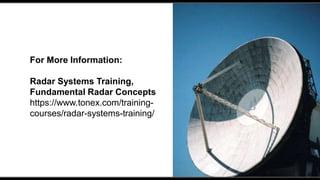
For More Information:
Radar Systems Training,
Fundamental Radar Concepts
https://www.tonex.com/training-
courses/radar-systems-training/

Fundamental Radar Concepts, Radar Systems Training

  • 2.
    Radar is anelectromagnetic system used to detect and locate objects. It operates by sending a specific type of waveform (such as a pulse-modulated sine wave) and detects the nature of the echo signal.
  • 3.
    Radar is usedto expand the individual's ability to perceive the environment, especially vision. The value of radar is not to replace the eyes, but to do things that the eyes cannot do. The advantage of radar is that it can measure the distance or range to an object. This may be its most important attribute.
  • 4.
    The basic formsof radar include: a transmitting antenna, which emits electromagnetic radiation generated by a certain oscillator; a receiving antenna; and an energy detection device or receiver. Part of the transmitted signal is intercepted by the reflecting object (target) and re- radiated in all directions.
  • 5.
    What radar ismost concerned about is the energy radiated in the opposite direction. The receiving antenna collects the returned energy and transmits it to the receiver, where it is processed to detect the presence of the target and extract its position and relative velocity.
  • 6.
    The distance tothe target is determined by measuring the time it takes for the radar signal to reach the target and return to the target. The direction or angular position of the target can be determined according to the direction of arrival of the reflected wavefront.
  • 7.
    The common methodof measuring the direction of arrival is to use a narrow antenna beam. If there is relative motion between the target and the radar, the shirt in the reflected wave carrier frequency (Doppler detection) is a measure of the target's relative (radial) speed, which can be used to distinguish moving targets from stationary objects.
  • 8.
    Radar System Training,basic knowledge of modern radar by Tonex
  • 9.
    Training content: • Basicdesign of a RADAR system • Functionality, equations, search and track functions • Target detection • Signal processing • Architecture • Critical components • Electronic attack and protection • Transmitter/Receiver • Antenna
  • 10.
    Learning Objectives: • Listthe basic terms, principles and concepts related to modern radar systems and operations • Express the working principle of simple radar, including radar ranging equation, waveform design, doppler effect, resolution, coverage and multipath • Clarify the working principle of radar and compare the functions, configurations and related applications of different types of radar systems • Talk about the principles, procedures, techniques and development of RADAR technology
  • 11.
    Learning Objectives: • CheckRADAR's concept of operation (ConOps), functional architecture, system requirements, system design, architecture, operation and maintenance, and troubleshooting • Describe the high-level architecture of a simple RADAR system, which covers components and subsystems including transmitter, receiver, antenna, clutter and noise, detection, and signal processing modules • Establish the basic RADAR system performance according to the RADAR environment
  • 12.
    Learning Objectives: • Usedifferent radar systems to provide detection, recognition and classification of objects/targets • Know the impact of environment and terrain on radar operation • Converse the applications and technologies behind microwave and millimeter wave radar systems • Talk about the development of RADAR technology
  • 13.
    Who should participate? •Engineers • Technical managers • Technicians • Logistics and support • Pilots • Procurement
  • 14.
    Course Topics • Introductionto Modern RADAR Systems • RADAR Systems and Concepts • RADAR Bands, Frequencies and Wavelength • Block Diagram of a Primary Radar • Basic Development and Design of a Modern RADAR System • Modern RADAR System Classification and Evolution • Antenna Characteristics of Radar • RADAR Transmitter and Intrapulse Modulation • Testing, Evaluation and Operation of Modern RADAR Systems
  • 15.
    Tonex offers morecourses on Radar System • Fundamentals of RADAR and LiDAR Systems • Phased-Array Radar Systems Engineering Bootcamp • Radar Communications Training • Radar Systems Design and Engineering Training • Radar Systems Training | Fundamental Radar Concepts
  • 16.
    For More Information: RadarSystems Training, Fundamental Radar Concepts https://www.tonex.com/training- courses/radar-systems-training/