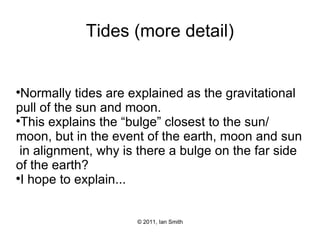
Tides (more detail) Normally tides are explained as the gravitational pull of the sun and moon. This explains the “bulge” closest to the sun/ moon, but in the event of the earth, moon and sun  in alignment, why is there a bulge on the far side of the earth? I hope to explain... © 2011, Ian Smith
More tides This is the situation I'll discuss (please note drawings not to scale!): © 2011, Ian Smith Earth Moon Sun
More tides (2) Due to gravity – we accept there are two tides a day – but why is there a bulge on the opposite side of the earth to the moon and sun? © 2011, Ian Smith Earth Moon Sun Earth
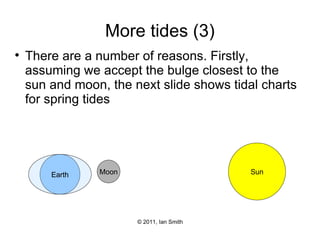
More tides (3) There are a number of reasons. Firstly, assuming we accept the bulge closest to the sun and moon, the next slide shows tidal charts for spring tides © 2011, Ian Smith Earth Moon Sun Earth
More tides (4 – New Moon -25/11/11) © 2011, Ian Smith Earth Moon Sun Earth
More tides (4 – Full Moon 10/11/11) © 2011, Ian Smith Earth Moon Sun Earth
More Tides (5) Hopefully it can be seen that the tides are higher in a new moon than full moon In a new moon, the difference between the two high tides in one day are also greater. The case if the new moon will be dealt with in more detail to explain why... © 2011, Ian Smith
New Moon tides In the case of the new moon, there is the combined gravitational pull from the moon and the sun acting on the tides. The gravitational pull, combined with the earth's rotation, does make the earth slightly “squashed” (25 miles, so not significant 1 ) © 2011, Ian Smith Earth Moon Sun Earth
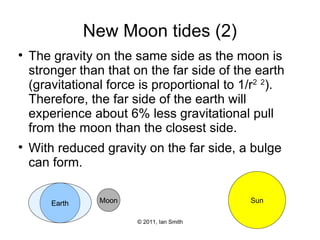
New Moon tides (2) The gravity on the same side as the moon is stronger than that on the far side of the earth (gravitational force is proportional to 1/r 2   2 ). Therefore, the far side of the earth will experience about 6% less gravitational pull from the moon than the closest side. With reduced gravity on the far side, a bulge can form. © 2011, Ian Smith Earth Moon Sun Earth
New Moon tides (3) However, the gravity doesn't just pull on the water, but on the earth itself, thereby pulling the earth and moon closer. This results in the centre of rotation of the earth and moon being about 4700km from the earth's centre  3  (about 3/4 of the earth's radius). This will result in the earth being closer to the sun in a new moon as well. © 2011, Ian Smith Earth Moon Sun Earth
References http://geography.about.com/library/faq/blqzdiameter.htm http://www.physicsclassroom.com/class/circles/u6l3c.cfm http://en.wikipedia.org/wiki/Orbit_of_the_moon © 2011, Ian Smith

Tides

  • 1.
    Tides (more detail)Normally tides are explained as the gravitational pull of the sun and moon. This explains the “bulge” closest to the sun/ moon, but in the event of the earth, moon and sun in alignment, why is there a bulge on the far side of the earth? I hope to explain... © 2011, Ian Smith
  • 2.
    More tides Thisis the situation I'll discuss (please note drawings not to scale!): © 2011, Ian Smith Earth Moon Sun
  • 3.
    More tides (2)Due to gravity – we accept there are two tides a day – but why is there a bulge on the opposite side of the earth to the moon and sun? © 2011, Ian Smith Earth Moon Sun Earth
  • 4.
    More tides (3)There are a number of reasons. Firstly, assuming we accept the bulge closest to the sun and moon, the next slide shows tidal charts for spring tides © 2011, Ian Smith Earth Moon Sun Earth
  • 5.
    More tides (4– New Moon -25/11/11) © 2011, Ian Smith Earth Moon Sun Earth
  • 6.
    More tides (4– Full Moon 10/11/11) © 2011, Ian Smith Earth Moon Sun Earth
  • 7.
    More Tides (5)Hopefully it can be seen that the tides are higher in a new moon than full moon In a new moon, the difference between the two high tides in one day are also greater. The case if the new moon will be dealt with in more detail to explain why... © 2011, Ian Smith
  • 8.
    New Moon tidesIn the case of the new moon, there is the combined gravitational pull from the moon and the sun acting on the tides. The gravitational pull, combined with the earth's rotation, does make the earth slightly “squashed” (25 miles, so not significant 1 ) © 2011, Ian Smith Earth Moon Sun Earth
  • 9.
    New Moon tides(2) The gravity on the same side as the moon is stronger than that on the far side of the earth (gravitational force is proportional to 1/r 2 2 ). Therefore, the far side of the earth will experience about 6% less gravitational pull from the moon than the closest side. With reduced gravity on the far side, a bulge can form. © 2011, Ian Smith Earth Moon Sun Earth
  • 10.
    New Moon tides(3) However, the gravity doesn't just pull on the water, but on the earth itself, thereby pulling the earth and moon closer. This results in the centre of rotation of the earth and moon being about 4700km from the earth's centre 3 (about 3/4 of the earth's radius). This will result in the earth being closer to the sun in a new moon as well. © 2011, Ian Smith Earth Moon Sun Earth
  • 11.