Grunt Productions 2007
A Brief By Lance Grindley
Emergency Position Indicating Radio Beacon &
Search And Radar Transponder
Grunt Productions 2007
Emergency Position Indicating Radio Beacon
The 406 MHz satellite EPIRB transmits a 5W radio
frequency (RF) burst of approximately 0.5s duration
every 50 seconds. Improved frequency stability ensures
improved location accuracy, while the high peak power
increases the probability of detection. The low duty cycle
provides good multiple-access capability, with a
system capacity of 90 activated beacons simultaneously
in view of the satellite, and low mean power
consumption.
Grunt Productions 2007
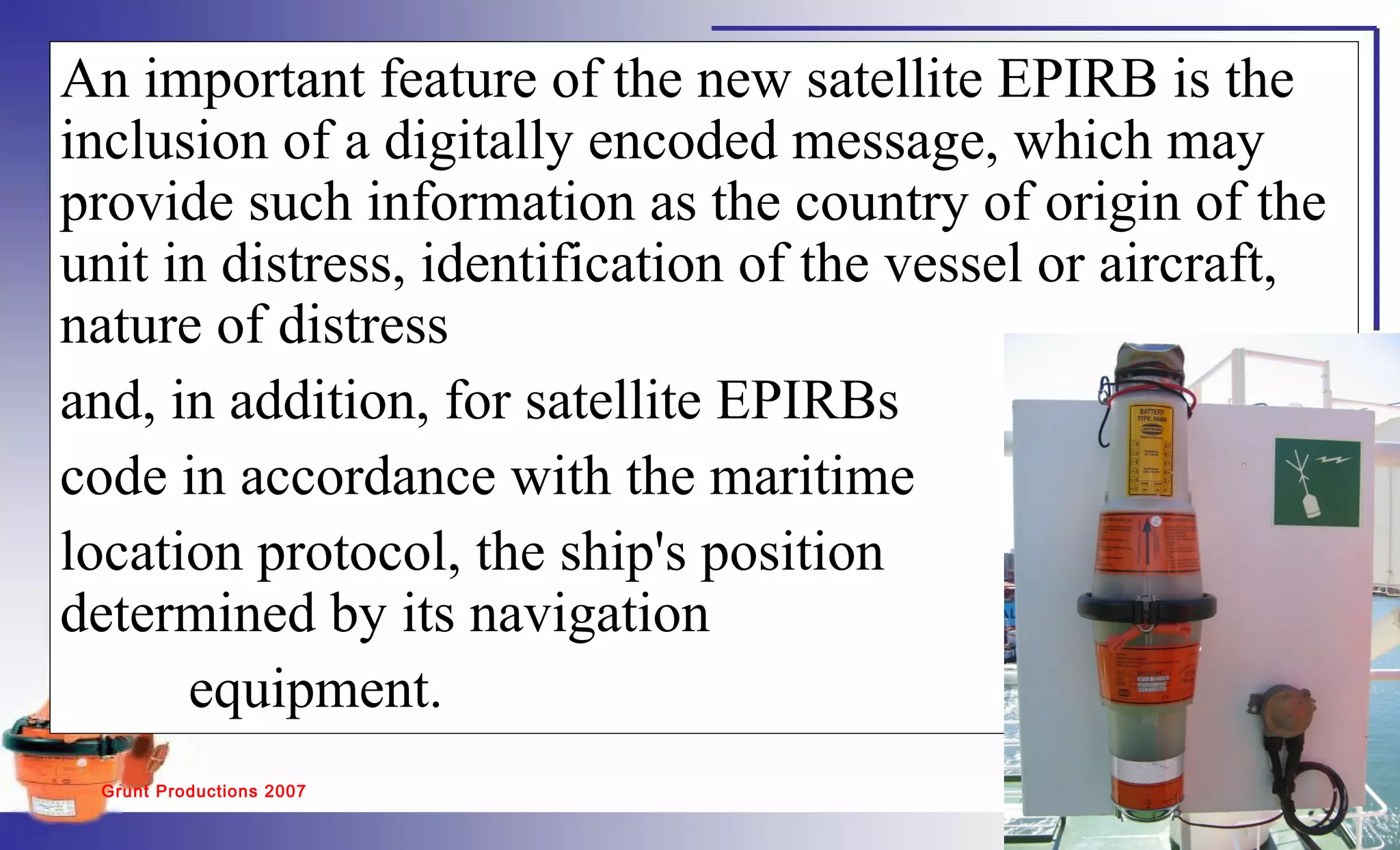
An important feature of the new satellite EPIRB is the
inclusion of a digitally encoded message, which may
provide such information as the country of origin of the
unit in distress, identification of the vessel or aircraft,
nature of distress
and, in addition, for satellite EPIRBs
code in accordance with the maritime
location protocol, the ship's position as
determined by its navigation
equipment.
Grunt Productions 2007
Satellite EPIRBs are dual-frequency 121.5/406
MHz beacons. This enables suitably equipped SAR
units to home in on the 121.5 MHz transmission and
permits over flight monitoring by aircraft.
Depending on the type of
beacon (maritime, airborne or land),
beacons can be activated either
manually or automatically.
Grunt Productions 2007
System Performance and Operations Performance
parameters
The following parameters are particularly important
for the user:
• EPIRB location probability;
• EPIRB location error;
• ambiguity resolution probability;
• capacity;
• coverage; and
• notification time.
Grunt Productions 2007
EPIRBEPIRB
1
2
3
EARTH
1. EPIRB detectionEPIRB detection
probabilityprobability for the 406
MHz satellite EPIRB is
defined as the probability
of detection by LUT of at
least one message with a
correct code--protected
section from the first
tracked satellite.
EARTH
EPIRBEPIRB
1
2
3
Grunt Productions 2007
2. EPIRB location probabilityEPIRB location probability for the 406 MHz
satellite EPIRB is defined as the probability of
detecting and decoding at least four individual
messages bursts during a single satellite pass so that a
Doppler curve-set estimate can be generated by the
LUT. At 121.5 MHz, EPIRB location probability is
defined as the probability of location during a satellite
pass above 10° elevation with respect to the beacon.
EPIRB location probability relates to the two
solutions ("true" and "mirror") and not to
a single unambiguous result.
Grunt Productions 2007
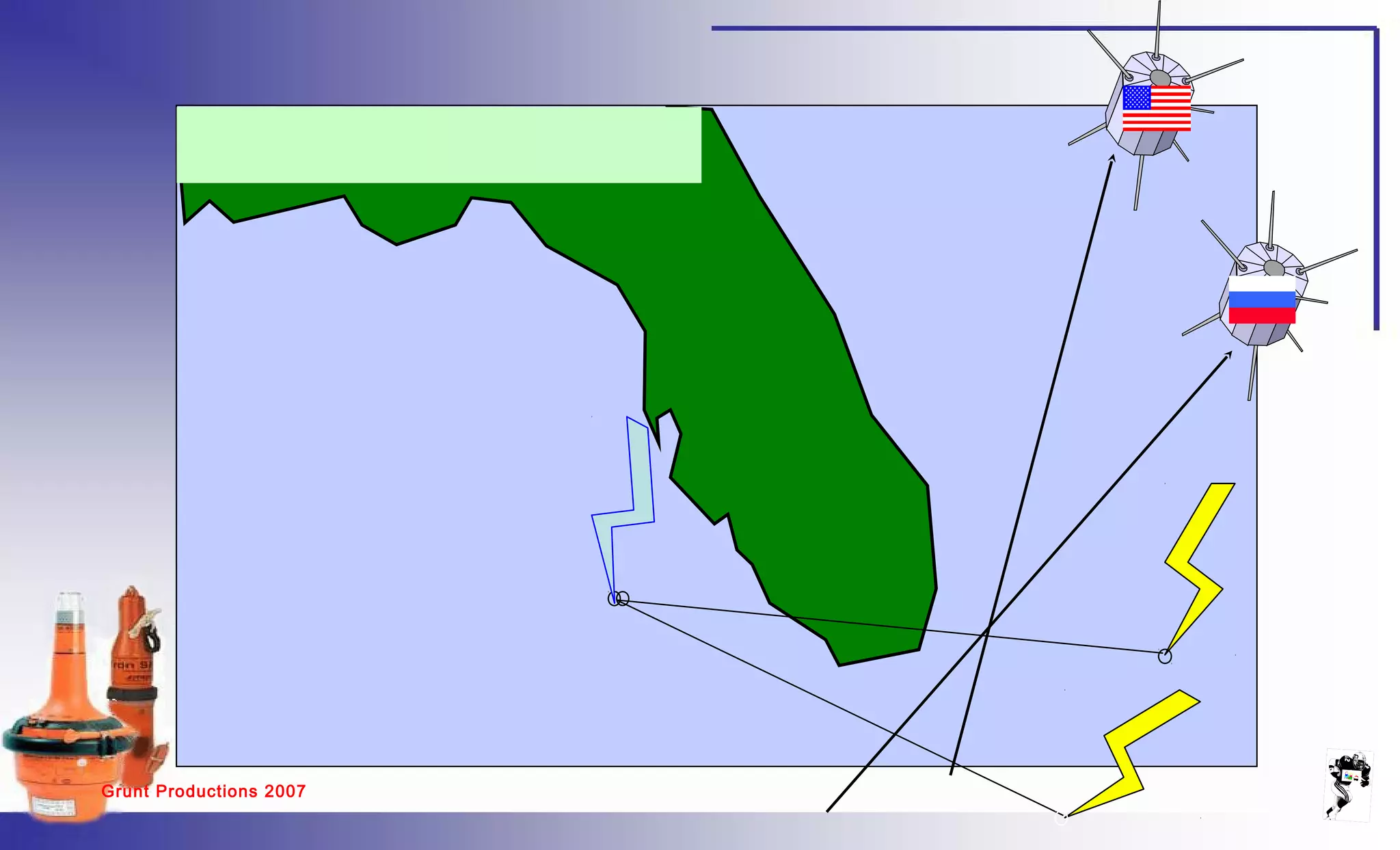
TWO EARTH POSITIONS INDICATEDTWO EARTH POSITIONS INDICATED
ON OPPOSITE SIDES OF THE SATELLITE TRACKON OPPOSITE SIDES OF THE SATELLITE TRACK
WHICH ONE IS THEWHICH ONE IS THE REALREAL ONE?ONE?
Grunt Productions 2007
3. EPIRB location accuracyEPIRB location accuracy is
defined as the difference
between the location
calculated by the system using
measured Doppler frequencies
and the actual location.
Grunt Productions 2007
406: 2 NM
406 w/GPS: 0.05 NM
121.5: 12 NM
Grunt Productions 2007
4. Ambiguity resolution probabilityAmbiguity resolution probability is
defined as the ability of the system to
select the "true" rather than the "mirror"
location.
Grunt Productions 2007
LATITUDE
DISTANCE
LOCATION?• Latitude and distance is
determined
• Target could be on either
orange dot
• We can’t know
which! (yet)
Grunt Productions 2007
LATITUDE
DISTANCE
LOCATION!
Grunt Productions 2007
5. CapacityCapacity is defined as the number
of EPIRBs in common view of the
spacecraft which the system can process
simultaneously.
Grunt Productions 2007
6. Notification timeNotification time is the period from
activation of an EPIRB spectral
characteristic. The values given below
were confirmed by statistical analysis of
over 5,000 beacons during the
development and experiment phase.
121.5 MHz EPIRB - Average 6 Hour Notification
406 MHz EPIRB - Average 1 Hour Notification
406 EPIRB with GPS - Average 5 minute Notification
Grunt Productions 2007
1: Beacon 2: Satellite 3: LUT 4: MCC 5: RCC
Best Case:
8 min. 5 min. 1 min. 1 min.8 min. 5 min. 1 min. 1 min.
Worst Case:
100 min. 10 min. 5 min. 1 min.100 min. 10 min. 5 min. 1 min.
2 Hours
15 min.
COSPAS-SARSAT Rescue Timeline
Grunt Productions 2007
Search and Rescue Radar Transponders (SARTs)
Search and rescue radar transponders (SARTs) are main
means in the GMDSS for locating ships in distress or their
survival craft, and their carriage on board ships is mandatory.
The SART operates in the 9GHz frequency band and
generates a series of response signals on being interrogated by
any ordinary 9GHz shipborne radar or suitable airborne
radar. No modification is needed to a ship's radar equipment
for detecting SART signals. SARTs can be either portable, for
use on board ship or carrying into any survival craft,
installed on the ship and in each survival craft, or so as to
operate after floating free from the sinking ship. They may also
be incorporated into a float-free satellite EPIRB.
Grunt Productions 2007
Operational and technical characteristics of SART
1. The SART can be activated manually or
automatically when placed into the water so that it
will thereafter respond when interrogated.
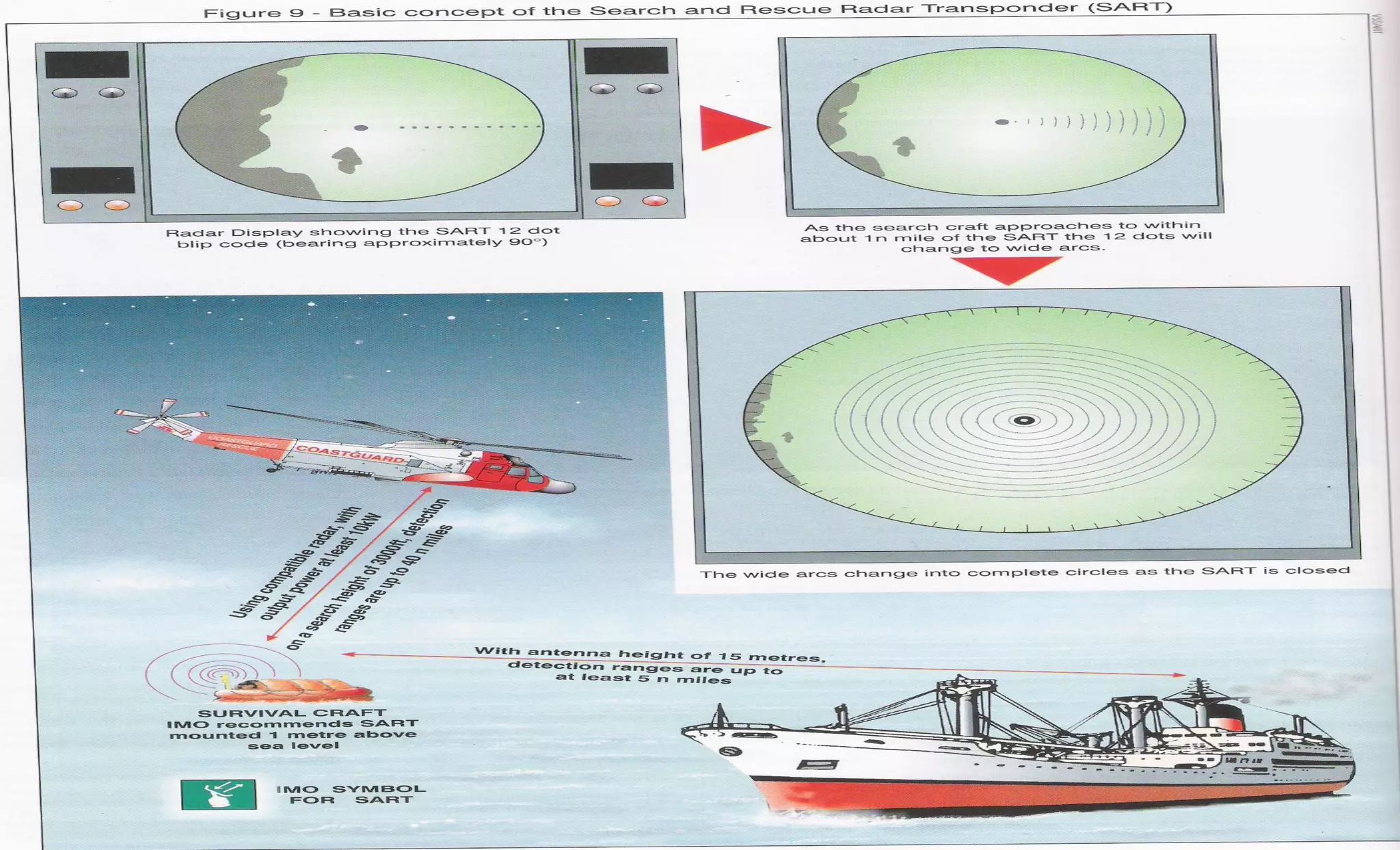
2. When activated in a distress situation the SART
respond to radar interrogated by transmitting a
swept-frequency signal which generates a line of
blip code on a radar screen outward from the
SART’s position along its line of bearing. This
unique radar signal is easily recognized on the radar
screen and the rescue vessel (and aircraft, if
equipped with suitable radar) can detect the
survivors even in poor visibility or at night.
Grunt Productions 2007
3.The SART provides a visual or audible indication of its
correct operation and will also inform survivors when it
is interrogated by a radar.
4.The SART will have sufficient battery capacity to operate
in the stand-by condition for 96 hours and 8
hours in the transmission mode and will be able to operate
under ambient temperatures of -20°C to +55°C.
5. The vertical polar diagram of the antenna and the
hydrodynamic characteristics of the device will permit the
SART to respond to radar under heavy swell conditions.
SART transmission is substantially omnidirectional in the
horizontal plane.
Grunt Productions 2007

Epirb and sart lrg

  • 1.
    Grunt Productions 2007 ABrief By Lance Grindley Emergency Position Indicating Radio Beacon & Search And Radar Transponder
  • 2.
    Grunt Productions 2007 EmergencyPosition Indicating Radio Beacon The 406 MHz satellite EPIRB transmits a 5W radio frequency (RF) burst of approximately 0.5s duration every 50 seconds. Improved frequency stability ensures improved location accuracy, while the high peak power increases the probability of detection. The low duty cycle provides good multiple-access capability, with a system capacity of 90 activated beacons simultaneously in view of the satellite, and low mean power consumption.
  • 3.
    Grunt Productions 2007 Animportant feature of the new satellite EPIRB is the inclusion of a digitally encoded message, which may provide such information as the country of origin of the unit in distress, identification of the vessel or aircraft, nature of distress and, in addition, for satellite EPIRBs code in accordance with the maritime location protocol, the ship's position as determined by its navigation equipment.
  • 4.
    Grunt Productions 2007 SatelliteEPIRBs are dual-frequency 121.5/406 MHz beacons. This enables suitably equipped SAR units to home in on the 121.5 MHz transmission and permits over flight monitoring by aircraft. Depending on the type of beacon (maritime, airborne or land), beacons can be activated either manually or automatically.
  • 5.
    Grunt Productions 2007 SystemPerformance and Operations Performance parameters The following parameters are particularly important for the user: • EPIRB location probability; • EPIRB location error; • ambiguity resolution probability; • capacity; • coverage; and • notification time.
  • 6.
    Grunt Productions 2007 EPIRBEPIRB 1 2 3 EARTH 1.EPIRB detectionEPIRB detection probabilityprobability for the 406 MHz satellite EPIRB is defined as the probability of detection by LUT of at least one message with a correct code--protected section from the first tracked satellite. EARTH EPIRBEPIRB 1 2 3
  • 7.
    Grunt Productions 2007 2.EPIRB location probabilityEPIRB location probability for the 406 MHz satellite EPIRB is defined as the probability of detecting and decoding at least four individual messages bursts during a single satellite pass so that a Doppler curve-set estimate can be generated by the LUT. At 121.5 MHz, EPIRB location probability is defined as the probability of location during a satellite pass above 10° elevation with respect to the beacon. EPIRB location probability relates to the two solutions ("true" and "mirror") and not to a single unambiguous result.
  • 8.
    Grunt Productions 2007 TWOEARTH POSITIONS INDICATEDTWO EARTH POSITIONS INDICATED ON OPPOSITE SIDES OF THE SATELLITE TRACKON OPPOSITE SIDES OF THE SATELLITE TRACK WHICH ONE IS THEWHICH ONE IS THE REALREAL ONE?ONE?
  • 9.
  • 10.
    Grunt Productions 2007 3.EPIRB location accuracyEPIRB location accuracy is defined as the difference between the location calculated by the system using measured Doppler frequencies and the actual location.
  • 11.
    Grunt Productions 2007 406:2 NM 406 w/GPS: 0.05 NM 121.5: 12 NM
  • 12.
    Grunt Productions 2007 4.Ambiguity resolution probabilityAmbiguity resolution probability is defined as the ability of the system to select the "true" rather than the "mirror" location.
  • 13.
    Grunt Productions 2007 LATITUDE DISTANCE LOCATION?•Latitude and distance is determined • Target could be on either orange dot • We can’t know which! (yet)
  • 14.
  • 15.
    Grunt Productions 2007 5.CapacityCapacity is defined as the number of EPIRBs in common view of the spacecraft which the system can process simultaneously.
  • 16.
    Grunt Productions 2007 6.Notification timeNotification time is the period from activation of an EPIRB spectral characteristic. The values given below were confirmed by statistical analysis of over 5,000 beacons during the development and experiment phase. 121.5 MHz EPIRB - Average 6 Hour Notification 406 MHz EPIRB - Average 1 Hour Notification 406 EPIRB with GPS - Average 5 minute Notification
  • 17.
    Grunt Productions 2007 1:Beacon 2: Satellite 3: LUT 4: MCC 5: RCC Best Case: 8 min. 5 min. 1 min. 1 min.8 min. 5 min. 1 min. 1 min. Worst Case: 100 min. 10 min. 5 min. 1 min.100 min. 10 min. 5 min. 1 min. 2 Hours 15 min. COSPAS-SARSAT Rescue Timeline
  • 18.
    Grunt Productions 2007 Searchand Rescue Radar Transponders (SARTs) Search and rescue radar transponders (SARTs) are main means in the GMDSS for locating ships in distress or their survival craft, and their carriage on board ships is mandatory. The SART operates in the 9GHz frequency band and generates a series of response signals on being interrogated by any ordinary 9GHz shipborne radar or suitable airborne radar. No modification is needed to a ship's radar equipment for detecting SART signals. SARTs can be either portable, for use on board ship or carrying into any survival craft, installed on the ship and in each survival craft, or so as to operate after floating free from the sinking ship. They may also be incorporated into a float-free satellite EPIRB.
  • 19.
    Grunt Productions 2007 Operationaland technical characteristics of SART 1. The SART can be activated manually or automatically when placed into the water so that it will thereafter respond when interrogated. 2. When activated in a distress situation the SART respond to radar interrogated by transmitting a swept-frequency signal which generates a line of blip code on a radar screen outward from the SART’s position along its line of bearing. This unique radar signal is easily recognized on the radar screen and the rescue vessel (and aircraft, if equipped with suitable radar) can detect the survivors even in poor visibility or at night.
  • 20.
    Grunt Productions 2007 3.TheSART provides a visual or audible indication of its correct operation and will also inform survivors when it is interrogated by a radar. 4.The SART will have sufficient battery capacity to operate in the stand-by condition for 96 hours and 8 hours in the transmission mode and will be able to operate under ambient temperatures of -20°C to +55°C. 5. The vertical polar diagram of the antenna and the hydrodynamic characteristics of the device will permit the SART to respond to radar under heavy swell conditions. SART transmission is substantially omnidirectional in the horizontal plane.
  • 21.