Lakshmi Narayana M
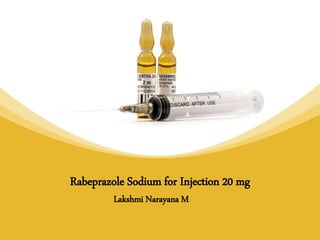
Rabeprazole Sodium for Injection 20 mg
Our Path…..
Introduction
Mechanism of action
Pharmacokinetics
Indications
Recommended dosing schedule
Not to prescribe or take care
Possible side effects of pantoprazole
Introduction…..
Proton pump inhibitors (PPIs) are a group of drugs whose main action is a
pronounced and long-lasting reduction of gastric acid production
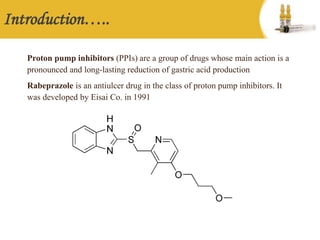
Rabeprazole is an antiulcer drug in the class of proton pump inhibitors. It
was developed by Eisai Co. in 1991
Mechanism of action…..
Rabiprazol is a proton pump inhibitor (PPI) that suppresses the final step in
gastric acid production by covalently binding to the (H+, K+)-ATPase
enzyme system at the secretory surface of the gastric parietal cell. This effect
leads to inhibition of both basal and stimulated gastric acid secretion,
irrespective of the stimulus. The binding of pantoprazole to H+/K+-ATPase
is irreversible in nature, and effectively inhibits acid secretion until new
enzyme is synthesized.
Pharmacokinetics…..
Absolute bioavailability rabeprazole I.V. is 100%. Rabeprazole is 96.3%
bound to human plasma proteins. plasma half-life ranges from 1 to 2 hr.
approximately 90% of the drug was eliminated in the urine The remainder
of the dose was recovered in the faeces
Indications…..
1. Active duodenal ulcer with bleeding or severe erosions.
2. Active gastric ulcer with bleeding or severe erosions.
3. Short-term treatment of erosive or ulcerative gastroesophageal reflux disease
4. (GERD)
5. Prevention of acid-aspiration.
6. Stress-induced mucosal injury in critical care.
7. Pathological hypersecretory conditions, including Zollinger-Ellison
syndrome.
Recommended dosing schedule…..
1. The intravenous administration is recommended only in cases where the oral
administration is not indicated. As soon as an oral therapy is possible the
intravenous therapy should be discontinued.
2. Recommended dose is intravenous administration of the content of one vial
(20 mg rabeprazole) once daily. Parenteral routes of administration other than
intravenous are not recommended.
1. Pregnancy: US FDA pregnancy category C: Animal reproduction studies
have shown an adverse effect on the fetus and there are no adequate and
well-controlled studies in humans, but potential benefits may warrant use of
the drug in pregnant women despite potential risks.
2. Lactation: Use is not recommended and a decision should be made to
discontinue breastfeeding or discontinue the drug, taking into account the
importance of the drug to the mother. Excreted into human milk: Unknown
Excreted into animal milk: Yes Comments: The effects in the nursing infant
are unknown.
Not to prescribe or take care…..
Possible side effects…..
1. Hypersensitivity Reactions
2. Acute Interstitial Nephritis
3. Clostridium difficile-Associated Diarrhea.
4. Bone Fracture.
5. Cutaneous and Systemic Lupus Erythematosus.
6. Cyanocobalamin (Vitamin B-12) Deficiency.
7. Hypomagnesemia
Rabiprazol

Rabiprazol

  • 1.
    Lakshmi Narayana M RabeprazoleSodium for Injection 20 mg
  • 2.
    Our Path….. Introduction Mechanism ofaction Pharmacokinetics Indications Recommended dosing schedule Not to prescribe or take care Possible side effects of pantoprazole
  • 3.
    Introduction….. Proton pump inhibitors(PPIs) are a group of drugs whose main action is a pronounced and long-lasting reduction of gastric acid production Rabeprazole is an antiulcer drug in the class of proton pump inhibitors. It was developed by Eisai Co. in 1991
  • 4.
    Mechanism of action….. Rabiprazolis a proton pump inhibitor (PPI) that suppresses the final step in gastric acid production by covalently binding to the (H+, K+)-ATPase enzyme system at the secretory surface of the gastric parietal cell. This effect leads to inhibition of both basal and stimulated gastric acid secretion, irrespective of the stimulus. The binding of pantoprazole to H+/K+-ATPase is irreversible in nature, and effectively inhibits acid secretion until new enzyme is synthesized.
  • 5.
    Pharmacokinetics….. Absolute bioavailability rabeprazoleI.V. is 100%. Rabeprazole is 96.3% bound to human plasma proteins. plasma half-life ranges from 1 to 2 hr. approximately 90% of the drug was eliminated in the urine The remainder of the dose was recovered in the faeces
  • 6.
    Indications….. 1. Active duodenalulcer with bleeding or severe erosions. 2. Active gastric ulcer with bleeding or severe erosions. 3. Short-term treatment of erosive or ulcerative gastroesophageal reflux disease 4. (GERD) 5. Prevention of acid-aspiration. 6. Stress-induced mucosal injury in critical care. 7. Pathological hypersecretory conditions, including Zollinger-Ellison syndrome.
  • 7.
    Recommended dosing schedule….. 1.The intravenous administration is recommended only in cases where the oral administration is not indicated. As soon as an oral therapy is possible the intravenous therapy should be discontinued. 2. Recommended dose is intravenous administration of the content of one vial (20 mg rabeprazole) once daily. Parenteral routes of administration other than intravenous are not recommended.
  • 8.
    1. Pregnancy: USFDA pregnancy category C: Animal reproduction studies have shown an adverse effect on the fetus and there are no adequate and well-controlled studies in humans, but potential benefits may warrant use of the drug in pregnant women despite potential risks. 2. Lactation: Use is not recommended and a decision should be made to discontinue breastfeeding or discontinue the drug, taking into account the importance of the drug to the mother. Excreted into human milk: Unknown Excreted into animal milk: Yes Comments: The effects in the nursing infant are unknown. Not to prescribe or take care…..
  • 9.
    Possible side effects….. 1.Hypersensitivity Reactions 2. Acute Interstitial Nephritis 3. Clostridium difficile-Associated Diarrhea. 4. Bone Fracture. 5. Cutaneous and Systemic Lupus Erythematosus. 6. Cyanocobalamin (Vitamin B-12) Deficiency. 7. Hypomagnesemia