ORAL CONTRACEPTIVES
Prepared by: Mirza Anwar Baig
M.Pharm (Pharmacology)
Anjuman I Islam's Kalsekar Technical Campus,
School of Pharmacy.
New Panvel,Navi Mumbai
Outlines:
1.Secretion of FSH & LH
2.Role of estrogen and progesterone
3.Events in hormonal secretion
4.Menstrual cycle
5.Mechanism of action
6.Methods of use
COMPILED BY: PROF.ANWAR BAIG
(AIKTC,SOP)
2
17/08/15 COMPILED BY: PROF.ANWAR BAIG(AIKTC,SOP)
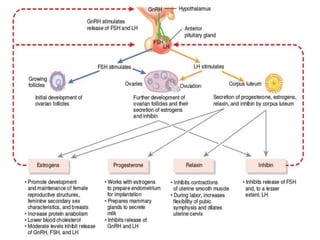
Secretion of Estrogen ad Progesterone
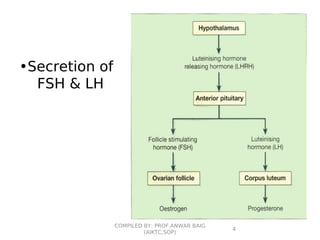
•Secretion of
FSH & LH
4
COMPILED BY: PROF.ANWAR BAIG
(AIKTC,SOP)
5
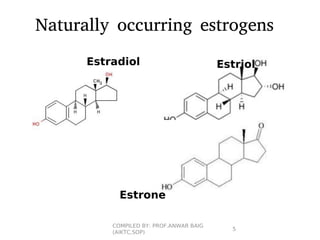
Naturally occurring estrogens
Estradiol
Estrone
Estriol
COMPILED BY: PROF.ANWAR BAIG
(AIKTC,SOP)
6
Synthetic Estrogens
COMPILED BY: PROF.ANWAR BAIG
(AIKTC,SOP)
7
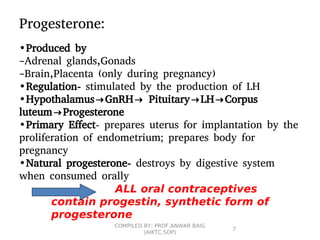
Progesterone:
•Produced by
–Adrenal glands,Gonads
–Brain,Placenta (only during pregnancy)
•Regulation- stimulated by the production of LH
•Hypothalamus→GnRH→ Pituitary→LH→Corpus
luteum→Progesterone
•Primary Effect- prepares uterus for implantation by the
proliferation of endometrium; prepares body for
pregnancy
•Natural progesterone- destroys by digestive system
when consumed orally
ALL oral contraceptives
contain progestin, synthetic form of
progesterone
COMPILED BY: PROF.ANWAR BAIG
(AIKTC,SOP)
8
Progestins
•Types
1) C19- derived from testosterone
2) C21- derived from progesterone
•Role
–in adequate doses it inhibits ovulation
–Reduces levels of FSH and LH
•Binding
–Interacts with progesterone receptors either by
entering cells through phospholipid bilayer or by
interacting with surface proteins
COMPILED BY: PROF.ANWAR BAIG
(AIKTC,SOP)
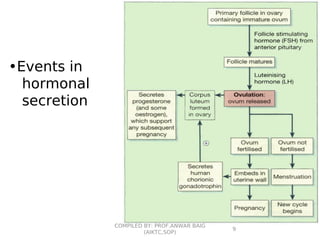
•Events in
hormonal
secretion
9
COMPILED BY: PROF.ANWAR BAIG
(AIKTC,SOP)
10
COMPILED BY: PROF.ANWAR BAIG
(AIKTC,SOP)
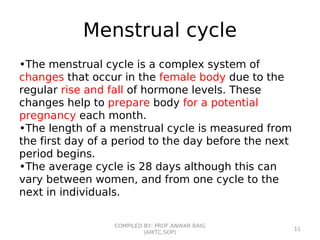
Menstrual cycle
•The menstrual cycle is a complex system of
changes that occur in the female body due to the
regular rise and fall of hormone levels. These
changes help to prepare body for a potential
pregnancy each month.
•The length of a menstrual cycle is measured from
the first day of a period to the day before the next
period begins.
•The average cycle is 28 days although this can
vary between women, and from one cycle to the
next in individuals.
COMPILED BY: PROF.ANWAR BAIG
(AIKTC,SOP)
11
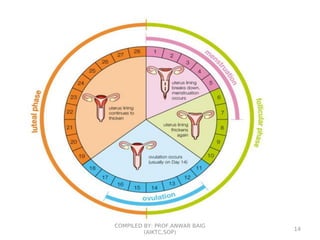
•The menstrual cycle is controlled by a
number of glands and a series of hormonal
changes beginning in the brain. A brain
structure called the hypothalamus signals the
nearby pituitary gland to release hormones
known as FSH & LH which prompt the ovaries
to secrete the sex hormones, oestrogen and
progesterone.
•There are four distinct phases of the
menstrual cycle.
COMPILED BY: PROF.ANWAR BAIG
(AIKTC,SOP)
12
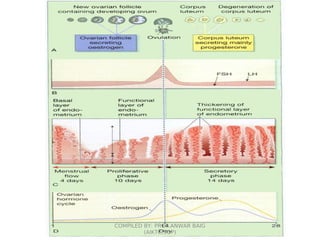
1. The follicular phase
•The follicular phase is the time from the first day of
menstruation until the moment of ovulation.
•During this phase, the pituitary gland releases a
hormone which causes between 10 and 20 follicles
to begin developing within the ovary.
•These follicles, each housing an immature egg
(ovum), bead on the surface of the ovary. Usually,
only one follicle will mature into an egg (FSH)
•The growth of the follicles produces the hormone
oestrogen, which causes the lining of the uterus
(endometrium) to become thick in preparation for
the possible embedding of a fertilised egg.
COMPILED BY: PROF.ANWAR BAIG
(AIKTC,SOP)
13
COMPILED BY: PROF.ANWAR BAIG
(AIKTC,SOP)
14
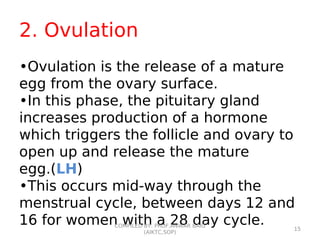
2. Ovulation
•Ovulation is the release of a mature
egg from the ovary surface.
•In this phase, the pituitary gland
increases production of a hormone
which triggers the follicle and ovary to
open up and release the mature
egg.(LH)
•This occurs mid-way through the
menstrual cycle, between days 12 and
16 for women with a 28 day cycle.COMPILED BY: PROF.ANWAR BAIG
(AIKTC,SOP)
15
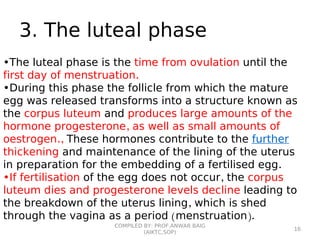
3. The luteal phase
•The luteal phase is the time from ovulation until the
first day of menstruation.
•During this phase the follicle from which the mature
egg was released transforms into a structure known as
the corpus luteum and produces large amounts of the
hormone progesterone, as well as small amounts of
oestrogen., These hormones contribute to the further
thickening and maintenance of the lining of the uterus
in preparation for the embedding of a fertilised egg.
•If fertilisation of the egg does not occur, the corpus
luteum dies and progesterone levels decline leading to
the breakdown of the uterus lining, which is shed
through the vagina as a period (menstruation).
COMPILED BY: PROF.ANWAR BAIG
(AIKTC,SOP)
16
4.Menstruation
•Menstruation occurs when the broken
down lining of the uterus flows from
the body through the vagina.
•Menstruation generally lasts from 3 to
7 days. The length of a period can
differ between women, and between
cycles in individuals.
COMPILED BY: PROF.ANWAR BAIG
(AIKTC,SOP)
17
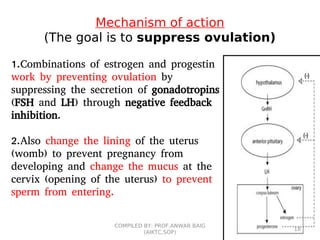
Mechanism of action
(The goal is to suppress ovulation)
1.Combinations of estrogen and progestin
work by preventing ovulation by
suppressing the secretion of gonadotropins
(FSH and LH) through negative feedback
inhibition.
2.Also change the lining of the uterus
(womb) to prevent pregnancy from
developing and change the mucus at the
cervix (opening of the uterus) to prevent
sperm from entering.
COMPILED BY: PROF.ANWAR BAIG
(AIKTC,SOP)
18
17/08/15 COMPILED BY: PROF.ANWAR BAIG(AIKTC,SOP)
Mechanism of Action:
1.low dose of progesterone prepration alter the endometrium
and put it out of phase with ovulation.
•There is no disruption of the cycle and ovulation continues.
2.Large dose of oestrogen in case of post coital pills alter the
motility of fallopian tube and character of the endometrium.
•therefore there is interferacne between the process of
fertilization.
17/08/15 COMPILED BY: PROF.ANWAR BAIG(AIKTC,SOP)
Special precautions:
•each women before starting oral contraceptive must be
subjected to gynocological examination,evaluation of cvs
and liver function.
Drug interaction:
•May be with
Rifampicine, tetracycline & anticonvulsants causes failure
of oral contraception.
17/08/15 COMPILED BY: PROF.ANWAR BAIG(AIKTC,SOP)
Types of Formulation:
1.Oestrogen-Progesterone combination:
The combination pill is adminestered from day5 to day 25 of
MC, in between have 7 pill free day.
On repeating the schedule the cycle becomes anovulatory
with regular cyclic bleeding.
Almost 100 percent effective in preventing conception.
2. Sequentional oestrogen-progesterone prepration:
It is adminestered from day5 to day 25 of MC, in between
have 7 pill free day during which withdrawal bleeding occurs.
Serial packs are available having 16 pill of estrogen,5
estrogen and progesterone pills and 7 placebo pills.
Inhibition of ovulation is due to oestrogen and progesterone
is added for satisfactory bleeding.
3. Low dosage progesterone prepration:
containing progesterone alone.
taken daily to control fertility.
Less effective than combined and sequential regimen.
17/08/15 COMPILED BY: PROF.ANWAR BAIG(AIKTC,SOP)
Side effects
•Mild side effects:
•Nausea,vomitting , headache,lethargy,breast
discomfort,breakthrough bleeding (spotting), mild depression.
•serious side effects:
•weight gain,amenorrhoea, increased skin pigmentation.
•very serious side effects:
•deep vain thrombosis, pulmonary embolism, cerebral and cronary
thrombosis,hypertension, decreased glucose tolerance,liver damage
and juandice.
•severe depression may require urgent cessation of therapy.
•Antenatal exposure of oral contraceptive may give birth defects.
•Benefit to risk ratio justify their use as reversible oral
contraceptives
17/08/15 COMPILED BY: PROF.ANWAR BAIG(AIKTC,SOP)
Formulation of oral contraceptives
(Combined pills / Sequentional pills)
17/08/15 COMPILED BY: PROF.ANWAR BAIG(AIKTC,SOP)
THANK YOU

4. Oral contraceptives

  • 1.
    ORAL CONTRACEPTIVES Prepared by:Mirza Anwar Baig M.Pharm (Pharmacology) Anjuman I Islam's Kalsekar Technical Campus, School of Pharmacy. New Panvel,Navi Mumbai
  • 2.
    Outlines: 1.Secretion of FSH& LH 2.Role of estrogen and progesterone 3.Events in hormonal secretion 4.Menstrual cycle 5.Mechanism of action 6.Methods of use COMPILED BY: PROF.ANWAR BAIG (AIKTC,SOP) 2
  • 3.
    17/08/15 COMPILED BY:PROF.ANWAR BAIG(AIKTC,SOP) Secretion of Estrogen ad Progesterone
  • 4.
    •Secretion of FSH &LH 4 COMPILED BY: PROF.ANWAR BAIG (AIKTC,SOP)
  • 5.
  • 6.
    6 Synthetic Estrogens COMPILED BY:PROF.ANWAR BAIG (AIKTC,SOP)
  • 7.
    7 Progesterone: •Produced by –Adrenal glands,Gonads –Brain,Placenta(only during pregnancy) •Regulation- stimulated by the production of LH •Hypothalamus→GnRH→ Pituitary→LH→Corpus luteum→Progesterone •Primary Effect- prepares uterus for implantation by the proliferation of endometrium; prepares body for pregnancy •Natural progesterone- destroys by digestive system when consumed orally ALL oral contraceptives contain progestin, synthetic form of progesterone COMPILED BY: PROF.ANWAR BAIG (AIKTC,SOP)
  • 8.
    8 Progestins •Types 1) C19- derivedfrom testosterone 2) C21- derived from progesterone •Role –in adequate doses it inhibits ovulation –Reduces levels of FSH and LH •Binding –Interacts with progesterone receptors either by entering cells through phospholipid bilayer or by interacting with surface proteins COMPILED BY: PROF.ANWAR BAIG (AIKTC,SOP)
  • 9.
  • 10.
  • 11.
    Menstrual cycle •The menstrualcycle is a complex system of changes that occur in the female body due to the regular rise and fall of hormone levels. These changes help to prepare body for a potential pregnancy each month. •The length of a menstrual cycle is measured from the first day of a period to the day before the next period begins. •The average cycle is 28 days although this can vary between women, and from one cycle to the next in individuals. COMPILED BY: PROF.ANWAR BAIG (AIKTC,SOP) 11
  • 12.
    •The menstrual cycleis controlled by a number of glands and a series of hormonal changes beginning in the brain. A brain structure called the hypothalamus signals the nearby pituitary gland to release hormones known as FSH & LH which prompt the ovaries to secrete the sex hormones, oestrogen and progesterone. •There are four distinct phases of the menstrual cycle. COMPILED BY: PROF.ANWAR BAIG (AIKTC,SOP) 12
  • 13.
    1. The follicularphase •The follicular phase is the time from the first day of menstruation until the moment of ovulation. •During this phase, the pituitary gland releases a hormone which causes between 10 and 20 follicles to begin developing within the ovary. •These follicles, each housing an immature egg (ovum), bead on the surface of the ovary. Usually, only one follicle will mature into an egg (FSH) •The growth of the follicles produces the hormone oestrogen, which causes the lining of the uterus (endometrium) to become thick in preparation for the possible embedding of a fertilised egg. COMPILED BY: PROF.ANWAR BAIG (AIKTC,SOP) 13
  • 14.
    COMPILED BY: PROF.ANWARBAIG (AIKTC,SOP) 14
  • 15.
    2. Ovulation •Ovulation isthe release of a mature egg from the ovary surface. •In this phase, the pituitary gland increases production of a hormone which triggers the follicle and ovary to open up and release the mature egg.(LH) •This occurs mid-way through the menstrual cycle, between days 12 and 16 for women with a 28 day cycle.COMPILED BY: PROF.ANWAR BAIG (AIKTC,SOP) 15
  • 16.
    3. The lutealphase •The luteal phase is the time from ovulation until the first day of menstruation. •During this phase the follicle from which the mature egg was released transforms into a structure known as the corpus luteum and produces large amounts of the hormone progesterone, as well as small amounts of oestrogen., These hormones contribute to the further thickening and maintenance of the lining of the uterus in preparation for the embedding of a fertilised egg. •If fertilisation of the egg does not occur, the corpus luteum dies and progesterone levels decline leading to the breakdown of the uterus lining, which is shed through the vagina as a period (menstruation). COMPILED BY: PROF.ANWAR BAIG (AIKTC,SOP) 16
  • 17.
    4.Menstruation •Menstruation occurs whenthe broken down lining of the uterus flows from the body through the vagina. •Menstruation generally lasts from 3 to 7 days. The length of a period can differ between women, and between cycles in individuals. COMPILED BY: PROF.ANWAR BAIG (AIKTC,SOP) 17
  • 18.
    Mechanism of action (Thegoal is to suppress ovulation) 1.Combinations of estrogen and progestin work by preventing ovulation by suppressing the secretion of gonadotropins (FSH and LH) through negative feedback inhibition. 2.Also change the lining of the uterus (womb) to prevent pregnancy from developing and change the mucus at the cervix (opening of the uterus) to prevent sperm from entering. COMPILED BY: PROF.ANWAR BAIG (AIKTC,SOP) 18
  • 19.
    17/08/15 COMPILED BY:PROF.ANWAR BAIG(AIKTC,SOP) Mechanism of Action: 1.low dose of progesterone prepration alter the endometrium and put it out of phase with ovulation. •There is no disruption of the cycle and ovulation continues. 2.Large dose of oestrogen in case of post coital pills alter the motility of fallopian tube and character of the endometrium. •therefore there is interferacne between the process of fertilization.
  • 20.
    17/08/15 COMPILED BY:PROF.ANWAR BAIG(AIKTC,SOP) Special precautions: •each women before starting oral contraceptive must be subjected to gynocological examination,evaluation of cvs and liver function. Drug interaction: •May be with Rifampicine, tetracycline & anticonvulsants causes failure of oral contraception.
  • 21.
    17/08/15 COMPILED BY:PROF.ANWAR BAIG(AIKTC,SOP) Types of Formulation: 1.Oestrogen-Progesterone combination: The combination pill is adminestered from day5 to day 25 of MC, in between have 7 pill free day. On repeating the schedule the cycle becomes anovulatory with regular cyclic bleeding. Almost 100 percent effective in preventing conception. 2. Sequentional oestrogen-progesterone prepration: It is adminestered from day5 to day 25 of MC, in between have 7 pill free day during which withdrawal bleeding occurs. Serial packs are available having 16 pill of estrogen,5 estrogen and progesterone pills and 7 placebo pills. Inhibition of ovulation is due to oestrogen and progesterone is added for satisfactory bleeding. 3. Low dosage progesterone prepration: containing progesterone alone. taken daily to control fertility. Less effective than combined and sequential regimen.
  • 22.
    17/08/15 COMPILED BY:PROF.ANWAR BAIG(AIKTC,SOP) Side effects •Mild side effects: •Nausea,vomitting , headache,lethargy,breast discomfort,breakthrough bleeding (spotting), mild depression. •serious side effects: •weight gain,amenorrhoea, increased skin pigmentation. •very serious side effects: •deep vain thrombosis, pulmonary embolism, cerebral and cronary thrombosis,hypertension, decreased glucose tolerance,liver damage and juandice. •severe depression may require urgent cessation of therapy. •Antenatal exposure of oral contraceptive may give birth defects. •Benefit to risk ratio justify their use as reversible oral contraceptives
  • 23.
    17/08/15 COMPILED BY:PROF.ANWAR BAIG(AIKTC,SOP) Formulation of oral contraceptives (Combined pills / Sequentional pills)
  • 24.
    17/08/15 COMPILED BY:PROF.ANWAR BAIG(AIKTC,SOP) THANK YOU