ACHARYA N.G. RANGA AGRICULTURAL UNIVERSITY
AGRICULTURAL COLLEGE
COURSE NO- AGRO 501
TITLE:- MODERN CONCEPTS OF CROP PRODUCTION
TOPIC:- CROP-WEATHER MODELING
SUBMITTED BY-
B.VENKATAKRISHNA
BAM-18-09
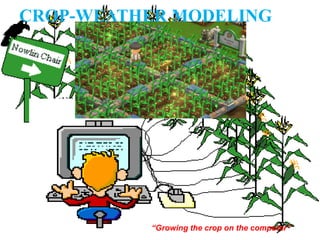
CROP-WEATHER MODELING
“Growing the crop on the computer”
CONTENTS
 INTRODUCTION,DEFINATION
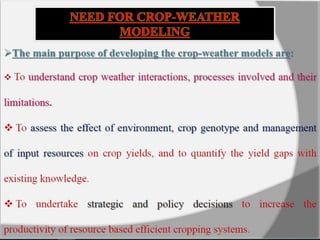
 NEED FOR CROP-WEATHER MODEL
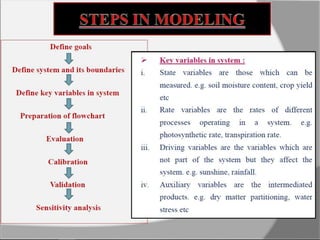
 STEPS IN CROP-WEATHER MODELING
 DEFINATION
 ADVANTAGES
 TYPES OF MODELS
 APPLICATION OF MODELING
 CONCLUSION
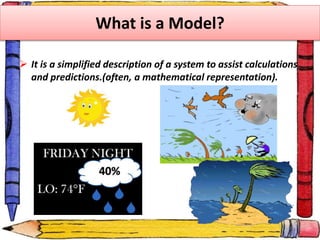
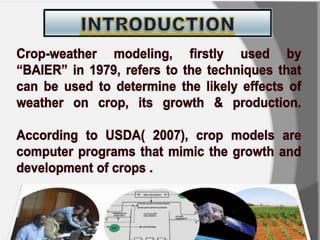
What is a Model?
 It is a simplified description of a system to assist calculations
and predictions.(often, a mathematical representation).
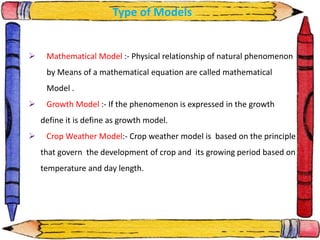
 Mathematical Model :- Physical relationship of natural phenomenon
by Means of a mathematical equation are called mathematical
Model .
 Growth Model :- If the phenomenon is expressed in the growth
define it is define as growth model.
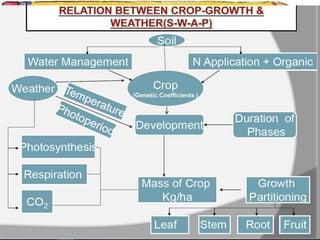
 Crop Weather Model:- Crop weather model is based on the principle
that govern the development of crop and its growing period based on
temperature and day length.
Type of Models
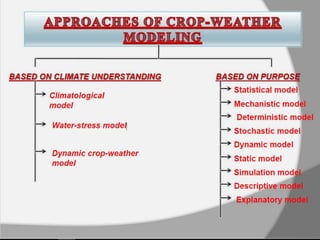
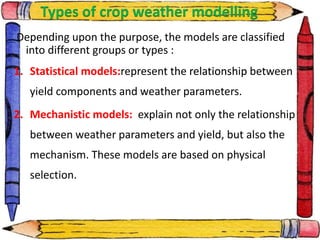
Depending upon the purpose, the models are classified
into different groups or types :
1. Statistical models:represent the relationship between
yield components and weather parameters.
2. Mechanistic models: explain not only the relationship
between weather parameters and yield, but also the
mechanism. These models are based on physical
selection.
Types of crop weather modelling
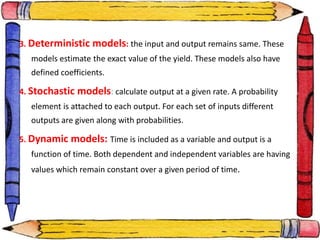
3. Deterministic models: the input and output remains same. These
models estimate the exact value of the yield. These models also have
defined coefficients.
4. Stochastic models: calculate output at a given rate. A probability
element is attached to each output. For each set of inputs different
outputs are given along with probabilities.
5. Dynamic models: Time is included as a variable and output is a
function of time. Both dependent and independent variables are having
values which remain constant over a given period of time.
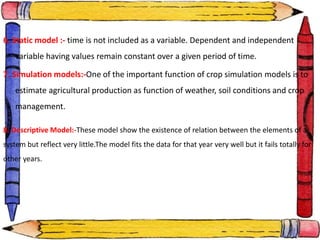
6. Static model :- time is not included as a variable. Dependent and independent
variable having values remain constant over a given period of time.
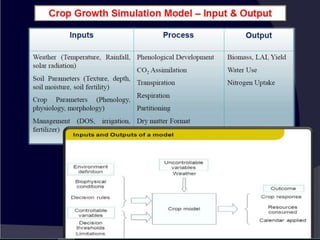
7. Simulation models:-One of the important function of crop simulation models is to
estimate agricultural production as function of weather, soil conditions and crop
management.
8. Descriptive Model:-These model show the existence of relation between the elements of a
system but reflect very little.The model fits the data for that year very well but it fails totally for
other years.
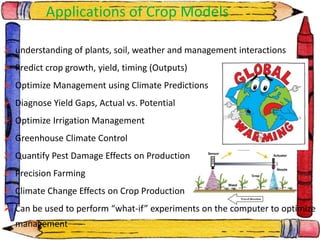
 understanding of plants, soil, weather and management interactions
 Predict crop growth, yield, timing (Outputs)
 Optimize Management using Climate Predictions
 Diagnose Yield Gaps, Actual vs. Potential
 Optimize Irrigation Management
 Greenhouse Climate Control
 Quantify Pest Damage Effects on Production
 Precision Farming
 Climate Change Effects on Crop Production
 Can be used to perform “what-if” experiments on the computer to optimize
management
Applications of Crop Models
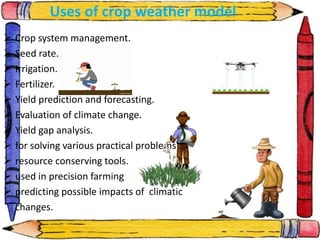
 Crop system management.
 Seed rate.
 Irrigation.
 Fertilizer.
 Yield prediction and forecasting.
 Evaluation of climate change.
 Yield gap analysis.
 for solving various practical problems
 resource conserving tools.
 used in precision farming
 predicting possible impacts of climatic
changes.
Uses of crop weather model
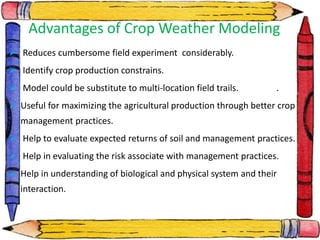
 Reduces cumbersome field experiment considerably.
 Identify crop production constrains.
 Model could be substitute to multi-location field trails. .
 Useful for maximizing the agricultural production through better crop
management practices.
 Help to evaluate expected returns of soil and management practices.
 Help in evaluating the risk associate with management practices.
 Help in understanding of biological and physical system and their
interaction.
Advantages of Crop Weather Modeling
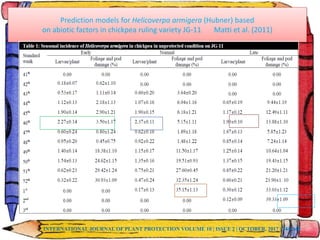
Prediction models for Helicoverpa armigera (Hubner) based
on abiotic factors in chickpea ruling variety JG-11 Matti et al. (2011)
INTERNATIONAL JOURNAL OF PLANT PROTECTION VOLUME 10 | ISSUE 2 | OCTOBER, 2017 | 344-348
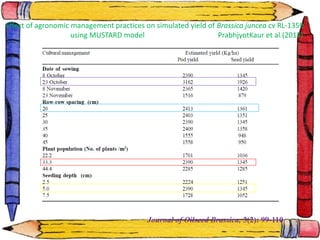
Effect of agronomic management practices on simulated yield of Brassica juncea cv RL-1359
using MUSTARD model PrabhjyotKaur et al.(2012)
Journal of Oilseed Brassica, 3(2): 99-110
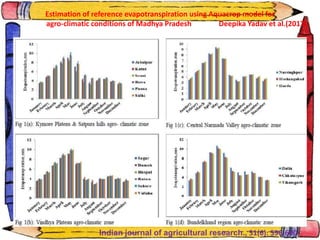
Estimation of reference evapotranspiration using Aquacrop model for
agro-climatic conditions of Madhya Pradesh Deepika Yadav et al.(2017)
Indian journal of agricultural research., 51(6): 596-600
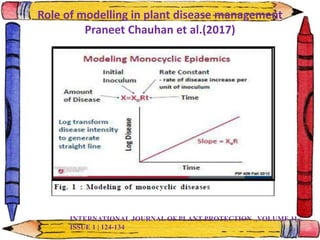
Role of modelling in plant disease management
Praneet Chauhan et al.(2017)
INTERNATIONAL JOURNAL OF PLANT PROTECTION .,VOLUME 11 |
ISSUE 1 | 124-134
PRE-HARVEST FORECAST OF PIGEON-PEA YIELD USING
REGRESSION ANALYSIS OF WEATHER VARIABLES
Yadav et al.(2012)
Plant Archives Vol. 18 No. 1, pp. 913-916
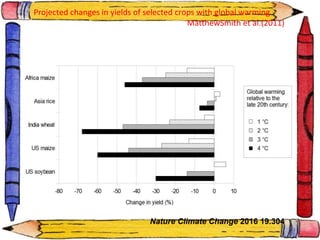
Projected changes in yields of selected crops with global warming
MatthewSmith et al.(2011)
Nature Climate Change 2016 19.304
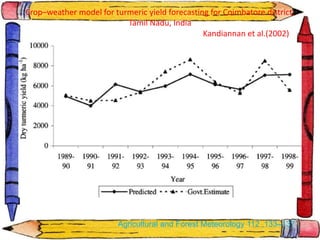
Crop–weather model for turmeric yield forecasting for Coimbatore district,
Tamil Nadu, India
Kandiannan et al.(2002)
Agricultural and Forest Meteorology 112 ,133–137
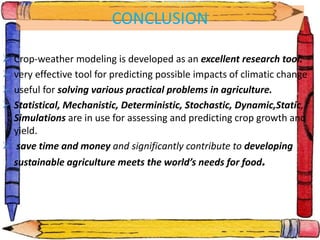
CONCLUSION
 Crop-weather modeling is developed as an excellent research tool.
 very effective tool for predicting possible impacts of climatic change
 useful for solving various practical problems in agriculture.
 Statistical, Mechanistic, Deterministic, Stochastic, Dynamic,Static,
Simulations are in use for assessing and predicting crop growth and
yield.
 save time and money and significantly contribute to developing
sustainable agriculture meets the world’s needs for food.
CROP WEATHER MODELING

CROP WEATHER MODELING

  • 2.
    ACHARYA N.G. RANGAAGRICULTURAL UNIVERSITY AGRICULTURAL COLLEGE COURSE NO- AGRO 501 TITLE:- MODERN CONCEPTS OF CROP PRODUCTION TOPIC:- CROP-WEATHER MODELING SUBMITTED BY- B.VENKATAKRISHNA BAM-18-09
  • 3.
    CROP-WEATHER MODELING “Growing thecrop on the computer”
  • 4.
    CONTENTS  INTRODUCTION,DEFINATION  NEEDFOR CROP-WEATHER MODEL  STEPS IN CROP-WEATHER MODELING  DEFINATION  ADVANTAGES  TYPES OF MODELS  APPLICATION OF MODELING  CONCLUSION
  • 5.
    What is aModel?  It is a simplified description of a system to assist calculations and predictions.(often, a mathematical representation).
  • 11.
     Mathematical Model:- Physical relationship of natural phenomenon by Means of a mathematical equation are called mathematical Model .  Growth Model :- If the phenomenon is expressed in the growth define it is define as growth model.  Crop Weather Model:- Crop weather model is based on the principle that govern the development of crop and its growing period based on temperature and day length. Type of Models
  • 12.
    Depending upon thepurpose, the models are classified into different groups or types : 1. Statistical models:represent the relationship between yield components and weather parameters. 2. Mechanistic models: explain not only the relationship between weather parameters and yield, but also the mechanism. These models are based on physical selection. Types of crop weather modelling
  • 13.
    3. Deterministic models:the input and output remains same. These models estimate the exact value of the yield. These models also have defined coefficients. 4. Stochastic models: calculate output at a given rate. A probability element is attached to each output. For each set of inputs different outputs are given along with probabilities. 5. Dynamic models: Time is included as a variable and output is a function of time. Both dependent and independent variables are having values which remain constant over a given period of time.
  • 14.
    6. Static model:- time is not included as a variable. Dependent and independent variable having values remain constant over a given period of time. 7. Simulation models:-One of the important function of crop simulation models is to estimate agricultural production as function of weather, soil conditions and crop management. 8. Descriptive Model:-These model show the existence of relation between the elements of a system but reflect very little.The model fits the data for that year very well but it fails totally for other years.
  • 16.
     understanding ofplants, soil, weather and management interactions  Predict crop growth, yield, timing (Outputs)  Optimize Management using Climate Predictions  Diagnose Yield Gaps, Actual vs. Potential  Optimize Irrigation Management  Greenhouse Climate Control  Quantify Pest Damage Effects on Production  Precision Farming  Climate Change Effects on Crop Production  Can be used to perform “what-if” experiments on the computer to optimize management Applications of Crop Models
  • 17.
     Crop systemmanagement.  Seed rate.  Irrigation.  Fertilizer.  Yield prediction and forecasting.  Evaluation of climate change.  Yield gap analysis.  for solving various practical problems  resource conserving tools.  used in precision farming  predicting possible impacts of climatic changes. Uses of crop weather model
  • 18.
     Reduces cumbersomefield experiment considerably.  Identify crop production constrains.  Model could be substitute to multi-location field trails. .  Useful for maximizing the agricultural production through better crop management practices.  Help to evaluate expected returns of soil and management practices.  Help in evaluating the risk associate with management practices.  Help in understanding of biological and physical system and their interaction. Advantages of Crop Weather Modeling
  • 20.
    Prediction models forHelicoverpa armigera (Hubner) based on abiotic factors in chickpea ruling variety JG-11 Matti et al. (2011) INTERNATIONAL JOURNAL OF PLANT PROTECTION VOLUME 10 | ISSUE 2 | OCTOBER, 2017 | 344-348
  • 21.
    Effect of agronomicmanagement practices on simulated yield of Brassica juncea cv RL-1359 using MUSTARD model PrabhjyotKaur et al.(2012) Journal of Oilseed Brassica, 3(2): 99-110
  • 22.
    Estimation of referenceevapotranspiration using Aquacrop model for agro-climatic conditions of Madhya Pradesh Deepika Yadav et al.(2017) Indian journal of agricultural research., 51(6): 596-600
  • 23.
    Role of modellingin plant disease management Praneet Chauhan et al.(2017) INTERNATIONAL JOURNAL OF PLANT PROTECTION .,VOLUME 11 | ISSUE 1 | 124-134
  • 25.
    PRE-HARVEST FORECAST OFPIGEON-PEA YIELD USING REGRESSION ANALYSIS OF WEATHER VARIABLES Yadav et al.(2012) Plant Archives Vol. 18 No. 1, pp. 913-916
  • 26.
    Projected changes inyields of selected crops with global warming MatthewSmith et al.(2011) Nature Climate Change 2016 19.304
  • 28.
    Crop–weather model forturmeric yield forecasting for Coimbatore district, Tamil Nadu, India Kandiannan et al.(2002) Agricultural and Forest Meteorology 112 ,133–137
  • 29.
    CONCLUSION  Crop-weather modelingis developed as an excellent research tool.  very effective tool for predicting possible impacts of climatic change  useful for solving various practical problems in agriculture.  Statistical, Mechanistic, Deterministic, Stochastic, Dynamic,Static, Simulations are in use for assessing and predicting crop growth and yield.  save time and money and significantly contribute to developing sustainable agriculture meets the world’s needs for food.