Crop Modelling
Introduction to Crop Modelling
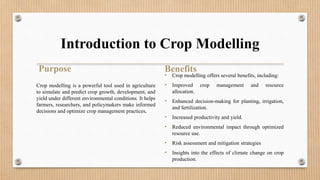
Purpose
Crop modelling is a powerful tool used in agriculture
to simulate and predict crop growth, development, and
yield under different environmental conditions. It helps
farmers, researchers, and policymakers make informed
decisions and optimize crop management practices.
Benefits
• Crop modelling offers several benefits, including:
• Improved crop management and resource
allocation.
• Enhanced decision-making for planting, irrigation,
and fertilization.
• Increased productivity and yield.
• Reduced environmental impact through optimized
resource use.
• Risk assessment and mitigation strategies
• Insights into the effects of climate change on crop
production.
Types of Crop Models
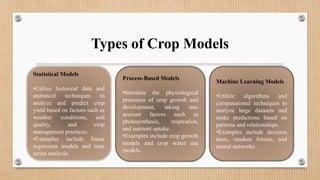
Statistical Models
•Utilize historical data and
statistical techniques to
analyze and predict crop
yield based on factors such as
weather conditions, soil
quality, and crop
management practices.
•Examples include linear
regression models and time
series analysis.
Process-Based Models
•Simulate the physiological
processes of crop growth and
development, taking into
account factors such as
photosynthesis, respiration,
and nutrient uptake.
•Examples include crop growth
models and crop water use
models.
Machine Learning Models
•Utilize algorithms and
computational techniques to
analyze large datasets and
make predictions based on
patterns and relationships.
•Examples include decision
trees, random forests, and
neural networks.
Data Collection and Analysis
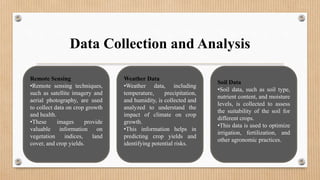
Remote Sensing
•Remote sensing techniques,
such as satellite imagery and
aerial photography, are used
to collect data on crop growth
and health.
•These images provide
valuable information on
vegetation indices, land
cover, and crop yields.
Weather Data
•Weather data, including
temperature, precipitation,
and humidity, is collected and
analyzed to understand the
impact of climate on crop
growth.
•This information helps in
predicting crop yields and
identifying potential risks.
Soil Data
•Soil data, such as soil type,
nutrient content, and moisture
levels, is collected to assess
the suitability of the soil for
different crops.
•This data is used to optimize
irrigation, fertilization, and
other agronomic practices.
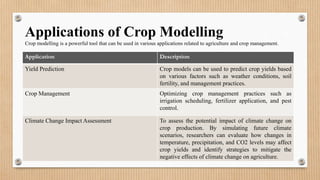
Applications of Crop Modelling
Crop modelling is a powerful tool that can be used in various applications related to agriculture and crop management.
Application Description
Yield Prediction Crop models can be used to predict crop yields based
on various factors such as weather conditions, soil
fertility, and management practices.
Crop Management Optimizing crop management practices such as
irrigation scheduling, fertilizer application, and pest
control.
Climate Change Impact Assessment To assess the potential impact of climate change on
crop production. By simulating future climate
scenarios, researchers can evaluate how changes in
temperature, precipitation, and CO2 levels may affect
crop yields and identify strategies to mitigate the
negative effects of climate change on agriculture.
Crop Modelling
Softwares
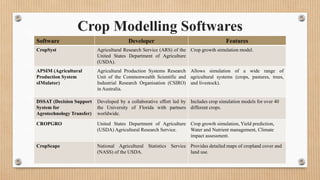
Crop Modelling Softwares
Software Developer Features
CropSyst Agricultural Research Service (ARS) of the
United States Department of Agriculture
(USDA).
Crop growth simulation model.
APSIM (Agricultural
Production System
sIMulator)
Agricultural Production Systems Research
Unit of the Commonwealth Scientific and
Industrial Research Organisation (CSIRO)
in Australia.
Allows simulation of a wide range of
agricultural systems (crops, pastures, trees,
and livestock).
DSSAT (Decision Support
System for
Agrotechnology Transfer)
Developed by a collaborative effort led by
the University of Florida with partners
worldwide.
Includes crop simulation models for over 40
different crops.
CROPGRO United States Department of Agriculture
(USDA) Agricultural Research Service.
Crop growth simulation, Yield prediction,
Water and Nutrient management, Climate
impact assessment.
CropScape National Agricultural Statistics Service
(NASS) of the USDA.
Provides detailed maps of cropland cover and
land use.
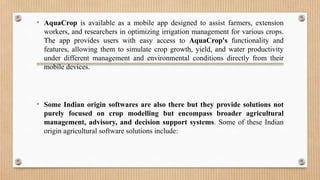
• AquaCrop is available as a mobile app designed to assist farmers, extension
workers, and researchers in optimizing irrigation management for various crops.
The app provides users with easy access to AquaCrop's functionality and
features, allowing them to simulate crop growth, yield, and water productivity
under different management and environmental conditions directly from their
mobile devices.
• Some Indian origin softwares are also there but they provide solutions not
purely focused on crop modelling but encompass broader agricultural
management, advisory, and decision support systems. Some of these Indian
origin agricultural software solutions include:
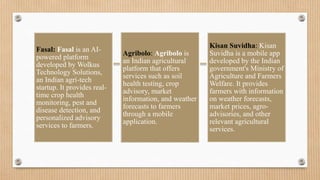
Fasal: Fasal is an AI-
powered platform
developed by Wolkus
Technology Solutions,
an Indian agri-tech
startup. It provides real-
time crop health
monitoring, pest and
disease detection, and
personalized advisory
services to farmers.
Agribolo: Agribolo is
an Indian agricultural
platform that offers
services such as soil
health testing, crop
advisory, market
information, and weather
forecasts to farmers
through a mobile
application.
Kisan Suvidha: Kisan
Suvidha is a mobile app
developed by the Indian
government's Ministry of
Agriculture and Farmers
Welfare. It provides
farmers with information
on weather forecasts,
market prices, agro-
advisories, and other
relevant agricultural
services.
THANK YOU

Crop Modelling and its types and softwares used

  • 1.
  • 2.
    Introduction to CropModelling Purpose Crop modelling is a powerful tool used in agriculture to simulate and predict crop growth, development, and yield under different environmental conditions. It helps farmers, researchers, and policymakers make informed decisions and optimize crop management practices. Benefits • Crop modelling offers several benefits, including: • Improved crop management and resource allocation. • Enhanced decision-making for planting, irrigation, and fertilization. • Increased productivity and yield. • Reduced environmental impact through optimized resource use. • Risk assessment and mitigation strategies • Insights into the effects of climate change on crop production.
  • 3.
    Types of CropModels Statistical Models •Utilize historical data and statistical techniques to analyze and predict crop yield based on factors such as weather conditions, soil quality, and crop management practices. •Examples include linear regression models and time series analysis. Process-Based Models •Simulate the physiological processes of crop growth and development, taking into account factors such as photosynthesis, respiration, and nutrient uptake. •Examples include crop growth models and crop water use models. Machine Learning Models •Utilize algorithms and computational techniques to analyze large datasets and make predictions based on patterns and relationships. •Examples include decision trees, random forests, and neural networks.
  • 4.
    Data Collection andAnalysis Remote Sensing •Remote sensing techniques, such as satellite imagery and aerial photography, are used to collect data on crop growth and health. •These images provide valuable information on vegetation indices, land cover, and crop yields. Weather Data •Weather data, including temperature, precipitation, and humidity, is collected and analyzed to understand the impact of climate on crop growth. •This information helps in predicting crop yields and identifying potential risks. Soil Data •Soil data, such as soil type, nutrient content, and moisture levels, is collected to assess the suitability of the soil for different crops. •This data is used to optimize irrigation, fertilization, and other agronomic practices.
  • 5.
    Applications of CropModelling Crop modelling is a powerful tool that can be used in various applications related to agriculture and crop management. Application Description Yield Prediction Crop models can be used to predict crop yields based on various factors such as weather conditions, soil fertility, and management practices. Crop Management Optimizing crop management practices such as irrigation scheduling, fertilizer application, and pest control. Climate Change Impact Assessment To assess the potential impact of climate change on crop production. By simulating future climate scenarios, researchers can evaluate how changes in temperature, precipitation, and CO2 levels may affect crop yields and identify strategies to mitigate the negative effects of climate change on agriculture.
  • 6.
  • 7.
    Crop Modelling Softwares SoftwareDeveloper Features CropSyst Agricultural Research Service (ARS) of the United States Department of Agriculture (USDA). Crop growth simulation model. APSIM (Agricultural Production System sIMulator) Agricultural Production Systems Research Unit of the Commonwealth Scientific and Industrial Research Organisation (CSIRO) in Australia. Allows simulation of a wide range of agricultural systems (crops, pastures, trees, and livestock). DSSAT (Decision Support System for Agrotechnology Transfer) Developed by a collaborative effort led by the University of Florida with partners worldwide. Includes crop simulation models for over 40 different crops. CROPGRO United States Department of Agriculture (USDA) Agricultural Research Service. Crop growth simulation, Yield prediction, Water and Nutrient management, Climate impact assessment. CropScape National Agricultural Statistics Service (NASS) of the USDA. Provides detailed maps of cropland cover and land use.
  • 8.
    • AquaCrop isavailable as a mobile app designed to assist farmers, extension workers, and researchers in optimizing irrigation management for various crops. The app provides users with easy access to AquaCrop's functionality and features, allowing them to simulate crop growth, yield, and water productivity under different management and environmental conditions directly from their mobile devices. • Some Indian origin softwares are also there but they provide solutions not purely focused on crop modelling but encompass broader agricultural management, advisory, and decision support systems. Some of these Indian origin agricultural software solutions include:
  • 9.
    Fasal: Fasal isan AI- powered platform developed by Wolkus Technology Solutions, an Indian agri-tech startup. It provides real- time crop health monitoring, pest and disease detection, and personalized advisory services to farmers. Agribolo: Agribolo is an Indian agricultural platform that offers services such as soil health testing, crop advisory, market information, and weather forecasts to farmers through a mobile application. Kisan Suvidha: Kisan Suvidha is a mobile app developed by the Indian government's Ministry of Agriculture and Farmers Welfare. It provides farmers with information on weather forecasts, market prices, agro- advisories, and other relevant agricultural services.
  • 10.

Editor's Notes

  • #6 This information can help farmers make informed decisions about planting, harvesting, and marketing their crops. By simulating different scenarios, farmers can identify the most effective and sustainable practices to maximize crop productivity and minimize resource use.