Quotations and Attributions
Types of Quotations
• Complete direct quotations
• Partial quotations
• Indirect/paraphrased quotations
Using Direct Quotes
• Use quote if it is particularly articulate or
powerful in the wording
• Most people do not speak in a way that
translates well into a quote
Using Direct Quotes
• Only use a quote if it conveys something that
can’t be communicated better in your own
words
• If it isn’t articulate, then a better strategy is
paraphrasing what the subject has told you
Direct Quotes
• If the subject is well known, then a direct
quote may be appropriate
– The more significant the interviewee is, the more
likely a reader will be interested
• Make sure that the quote is used to add a
unique angle or credibility to the story
Direct Quotes
• If the quote is quirky or captures the source’s
personality
• If it is emotional or highly opinionated
Quote Problems
• Avoid rambling quotes
• Avoid quotes with too much technical lingo
Quoting Accurately
• If the grammar is poor, then some reporters
will “clean up” the quote
• This practice varies by publication
• HOWEVER, if the interview was witnessed by
multiple media outlets (example: press
conference) then you should leave the quotes
alone
(sic)
• If you want to be cautious, then you can use
the “(sic)” notation in your printed quote to
notate a grammatical error made by your
subject
Editing Quotes
• Never make up a quote
• Don’t add words to a quote
• Exception: You may “clean up” the grammar if
it is minimal and does not change the context
– [Be sure to put the changed words in brackets]
Holy S---!
• Most publications shy away from obscenities,
unless:
– It is part of a quote
– It is relevant for the story or point
• In many cases, the obscenity is altered with
dashes
– S---!
– F---!
Attribution
• In most cases, the simple verb “said” is
appropriate since it is neutral
– Example: “This is a quote,” the teacher said.
• There are other verbs you can use, but be
conservative
Verbs to Avoid
• Minimize use of attribution verbs that are not
neutral
• “ ,” he cried.
• “ ,” she emphasized.
• “ ,” she contended.
Identification in Attribution
• Attribute with the name and job title.
– AFTER Example: “This year’s textbooks are going
to be more expensive,” said The Bookie sales
manager Mary Smith.
– BEFORE Example: Mary Smith, a sales manager at
The Bookie, said “This year’s textbooks are going
to be more expensive.”
Middle Initials
• AP Stylebook recommends that you use them.
– Particularly in hard news stories where they help
identify a specific individual, such as casualty lists
and stories naming the accused in a crime. This
helps to minimize confusion.
• A middle initial may be dropped if a person
does not use one or is publicly known without
it: Mickey Mantle (not Mickey C.), the Rev.
Billy Graham (not Billy F.).
Talking to Sources
• Many of the best stories will not originate from a
news release
• By nurturing your sources, you will be more likely to
get closer to the truth
• The longer you work with a source, the more likely
you are to determine the relevance of the
information that comes from that source
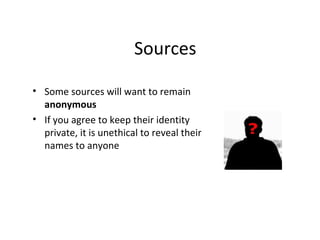
Sources
• Some sources will want to remain
anonymous
• If you agree to keep their identity
private, it is unethical to reveal their
names to anyone
Exceptions:
• Government subpoena
– If it is determined to jeopardize the national
security or is essential is solving a crime
• Publication policy
– Due to some problems with reporter integrity,
some publications are now requiring reporters to
share the identity of the anonymous reporter with
their supervising editor
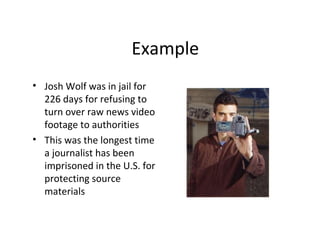
Example
• Josh Wolf was in jail for
226 days for refusing to
turn over raw news video
footage to authorities
• This was the longest time
a journalist has been
imprisoned in the U.S. for
protecting source
materials
Use Caution
• Be aware of sources that have an axe to grind
• Do they have an agenda?
• Are they telling the truth?
• Are they reliable?
– Substance abuse = suspicion
• Do they really have a direct connection to the
news event?
– Be careful of “hearsay”
Gossip Alert
• A newspaper is not supposed to
be a tabloid
• Verify information provided by
your sources
• Is the information relevant to
the news value of the story?
– Juicy “gossip” may not equate to
news
Anonymous Sources
• On the record – Everything can be quoted
with attribution
• Background – Everything can be quoted but
no attribution
• Deep background – No quotes can be used,
no attribution – but information can be used
• Off the record – No quotes, no attribution
Policies
• Some publications do not allow anonymous
sources
• Some require you to disclose the info to your
superior
“Off the Record”
• Hotly debated topic
• Is it ethical to gather info “off the record”?
• Should everything be fair game?
• Can you use information gained “off the
record” without directly quoting the
information or source?

Quotations And Attributions

  • 1.
  • 2.
    Types of Quotations •Complete direct quotations • Partial quotations • Indirect/paraphrased quotations
  • 3.
    Using Direct Quotes •Use quote if it is particularly articulate or powerful in the wording • Most people do not speak in a way that translates well into a quote
  • 4.
    Using Direct Quotes •Only use a quote if it conveys something that can’t be communicated better in your own words • If it isn’t articulate, then a better strategy is paraphrasing what the subject has told you
  • 5.
    Direct Quotes • Ifthe subject is well known, then a direct quote may be appropriate – The more significant the interviewee is, the more likely a reader will be interested • Make sure that the quote is used to add a unique angle or credibility to the story
  • 6.
    Direct Quotes • Ifthe quote is quirky or captures the source’s personality • If it is emotional or highly opinionated
  • 7.
    Quote Problems • Avoidrambling quotes • Avoid quotes with too much technical lingo
  • 8.
    Quoting Accurately • Ifthe grammar is poor, then some reporters will “clean up” the quote • This practice varies by publication • HOWEVER, if the interview was witnessed by multiple media outlets (example: press conference) then you should leave the quotes alone
  • 9.
    (sic) • If youwant to be cautious, then you can use the “(sic)” notation in your printed quote to notate a grammatical error made by your subject
  • 10.
    Editing Quotes • Nevermake up a quote • Don’t add words to a quote • Exception: You may “clean up” the grammar if it is minimal and does not change the context – [Be sure to put the changed words in brackets]
  • 11.
    Holy S---! • Mostpublications shy away from obscenities, unless: – It is part of a quote – It is relevant for the story or point • In many cases, the obscenity is altered with dashes – S---! – F---!
  • 12.
    Attribution • In mostcases, the simple verb “said” is appropriate since it is neutral – Example: “This is a quote,” the teacher said. • There are other verbs you can use, but be conservative
  • 13.
    Verbs to Avoid •Minimize use of attribution verbs that are not neutral • “ ,” he cried. • “ ,” she emphasized. • “ ,” she contended.
  • 14.
    Identification in Attribution •Attribute with the name and job title. – AFTER Example: “This year’s textbooks are going to be more expensive,” said The Bookie sales manager Mary Smith. – BEFORE Example: Mary Smith, a sales manager at The Bookie, said “This year’s textbooks are going to be more expensive.”
  • 15.
    Middle Initials • APStylebook recommends that you use them. – Particularly in hard news stories where they help identify a specific individual, such as casualty lists and stories naming the accused in a crime. This helps to minimize confusion. • A middle initial may be dropped if a person does not use one or is publicly known without it: Mickey Mantle (not Mickey C.), the Rev. Billy Graham (not Billy F.).
  • 16.
    Talking to Sources •Many of the best stories will not originate from a news release • By nurturing your sources, you will be more likely to get closer to the truth • The longer you work with a source, the more likely you are to determine the relevance of the information that comes from that source
  • 17.
    Sources • Some sourceswill want to remain anonymous • If you agree to keep their identity private, it is unethical to reveal their names to anyone
  • 18.
    Exceptions: • Government subpoena –If it is determined to jeopardize the national security or is essential is solving a crime • Publication policy – Due to some problems with reporter integrity, some publications are now requiring reporters to share the identity of the anonymous reporter with their supervising editor
  • 19.
    Example • Josh Wolfwas in jail for 226 days for refusing to turn over raw news video footage to authorities • This was the longest time a journalist has been imprisoned in the U.S. for protecting source materials
  • 20.
    Use Caution • Beaware of sources that have an axe to grind • Do they have an agenda? • Are they telling the truth? • Are they reliable? – Substance abuse = suspicion • Do they really have a direct connection to the news event? – Be careful of “hearsay”
  • 21.
    Gossip Alert • Anewspaper is not supposed to be a tabloid • Verify information provided by your sources • Is the information relevant to the news value of the story? – Juicy “gossip” may not equate to news
  • 22.
    Anonymous Sources • Onthe record – Everything can be quoted with attribution • Background – Everything can be quoted but no attribution • Deep background – No quotes can be used, no attribution – but information can be used • Off the record – No quotes, no attribution
  • 23.
    Policies • Some publicationsdo not allow anonymous sources • Some require you to disclose the info to your superior
  • 24.
    “Off the Record” •Hotly debated topic • Is it ethical to gather info “off the record”? • Should everything be fair game? • Can you use information gained “off the record” without directly quoting the information or source?