News


       Writing
What is
news?
Dictionary defines news as;
   A report of recent events
   A material reported
  in a newspaper or news
  periodical or on a newscast
   A matter that is news worthy
Reporters and editors must
think about their readers as
  this will help them decide
what stories are newsworthy.
They should be guided by questions
like:
• What is the news here?
• Why should my readers care?
• What does this mean to them?
• What questions will the reader
    have that I need to answer?
Major types of stories found in newspaper and
magazines are:
1.   Soft news- a news story that can wait for
     publication and is usually about a trend,
     an on-going event or about an
     interesting person.
2.   Feature- an in-depth, magazine-length
     story
3.   Personality Profile- a story that explore a
     person in the news, or an interesting but
     not-so-prominent person
4.   Backgrounder- a story providing
     additional information on a news event
     (often called “sidebars”, and it may
     accompany a longer news story).
News values

     -a criteria which enable to
     determine whether a story
     makes into news.
Common news values are:
1. Immediacy
2.   Significance
3.   Proximity or nearness
4.   Prominence
5.   Human interest
6.   Negativity
7.   Conflict
8.   Oddity
9.   Humor
News Qualities
       - A news reporter is imbued
       many powers: to inform, to
    influence decisions, and to help
      shape public opinion, among
                 others.
Following are the qualities that a news
story should have:
1. Accuracy
2. Clarity
3. Objectivity
4. Balance and fairness
5. Attribution
6. Style
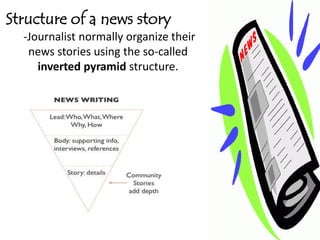
Structure of a news story
  -Journalist normally organize their
   news stories using the so-called
     inverted pyramid structure.
The lead
-the opening paragraph of a news
story. It is typically a one-sentence
paragraph that summarizes the
basic facts of a story and conveys to
the reader what the reporter found
out in his/her reporting. It provides
answer to the five Ws and one H of
news reporting-who, what, where,
when, why and how.
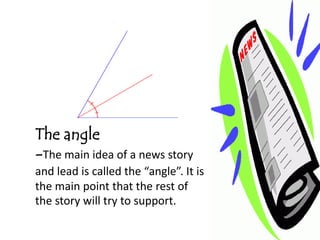
The angle
-The main idea of a news story
and lead is called the “angle”. It is
the main point that the rest of
the story will try to support.
Body of a story
  -The rest of the story is called the
  body. A story should proceed in a
  natural and chronological order.
  Sticking to a logical order will make
  it easier to write the story, as well
  as to allow you to keep track of your
  ideas and materials.
The Ending
-wraps up the remaining details of
the story. One way to end is with a
“kicker”, which is often a catchy
quote.
Writing the news story
-all the work of crafting a news
story is pointless if the story does
not engage the reader immediately.


Basic steps in writing the news story:
1. List all your facts.
2. Arrange your facts in a descending
   order, or form the most important
   (or most interesting) to the least
   important (or least interesting).
3. Always put the news at the
beginning (lead). Write the lead
making sure to play up the most
interesting or important points.
4. Write the next paragraph or
paragraphs presenting the other
highlights or answering the
questions not answered.
5. Add other facts, keeping in mind
their descending order of
importance.
Pointers in writing the news
Story
1. One idea per sentence-As much as
 possible, write one-idea, one-sentence
Paragraphs.
2. Limit the sentence length to not more
than 25 words-Simplify. The simplest and
clearest way of saying something is often
the shortest and most eloquent.
3. Follow the subject-verb-object format-
Good news writing starts with good sentence
structure, and that means simple construction:
Subject-verb-object. Refrain from using a lot of
commas.
4. Use strong verbs and an active
voice- write most of your sentences
like this: “somebody does
something”. Note also that when a
sentence is recast into active voice,
it becomes shorter.
5. Reduce difficult words to their
simplest terms- as much as
possible, use words that are
understandable by the average
reader. When it is necessary to use
unfamiliar or technical terms,
explain them briefly. Prefer
concrete, specific words to
abstract. General ones.
6. Use no more than three
prepositional phrases per sentence.
7. Choose the precise word.
8. Keep it simple- write to express
not to impress.
9. Show, don’t tell- don’t just
describe something. Reveal a piece
of the world to yourself and to your
readers.
10. Give your source when
necessary- Those people and
documents need to be cited in
attribution because that helps the
the reader evaluate the reliability of
information.
11. Identify all persons- write their full
names the first time they are
mentioned.
12. Keep it objective- stay completely
impartial. Do not use “I” and “me”
unless you are quoting someone.
13. Have an angle- it can help make the
purpose of the story clear and give it
focus.
14. Quote people.
15. Avoid preaching at the end of the
story.
16. Be very careful- choose your
words with care. Do not assume their
meaning. Use dictionary to make sure
of word meanings. Watch your
grammar, spelling, capitalization,
punctuation, use of abbreviations
and sentence construction.
17. Read newspaper everyday- study
constantly the construction of news
stories in good national newspaper to
improve your writing style and
technique.
Tips in news gathering
1. See for your self
2. Find the person who knows
3. Compare all versions
4. Get both sides
5. Do not give up too easily
6. Be tactful and courteous
7. Make and keep friends
8. Get into print
9. Research
10. Observe proper attribution.

News writing presentation

  • 1.
    News Writing
  • 2.
  • 3.
    Dictionary defines newsas;  A report of recent events  A material reported in a newspaper or news periodical or on a newscast  A matter that is news worthy
  • 4.
    Reporters and editorsmust think about their readers as this will help them decide what stories are newsworthy.
  • 5.
    They should beguided by questions like: • What is the news here? • Why should my readers care? • What does this mean to them? • What questions will the reader have that I need to answer?
  • 6.
    Major types ofstories found in newspaper and magazines are: 1. Soft news- a news story that can wait for publication and is usually about a trend, an on-going event or about an interesting person. 2. Feature- an in-depth, magazine-length story 3. Personality Profile- a story that explore a person in the news, or an interesting but not-so-prominent person 4. Backgrounder- a story providing additional information on a news event (often called “sidebars”, and it may accompany a longer news story).
  • 7.
    News values -a criteria which enable to determine whether a story makes into news.
  • 8.
    Common news valuesare: 1. Immediacy 2. Significance 3. Proximity or nearness 4. Prominence 5. Human interest 6. Negativity 7. Conflict 8. Oddity 9. Humor
  • 9.
    News Qualities - A news reporter is imbued many powers: to inform, to influence decisions, and to help shape public opinion, among others.
  • 10.
    Following are thequalities that a news story should have: 1. Accuracy 2. Clarity 3. Objectivity 4. Balance and fairness 5. Attribution 6. Style
  • 11.
    Structure of anews story -Journalist normally organize their news stories using the so-called inverted pyramid structure.
  • 12.
    The lead -the openingparagraph of a news story. It is typically a one-sentence paragraph that summarizes the basic facts of a story and conveys to the reader what the reporter found out in his/her reporting. It provides answer to the five Ws and one H of news reporting-who, what, where, when, why and how.
  • 13.
    The angle -The mainidea of a news story and lead is called the “angle”. It is the main point that the rest of the story will try to support.
  • 14.
    Body of astory -The rest of the story is called the body. A story should proceed in a natural and chronological order. Sticking to a logical order will make it easier to write the story, as well as to allow you to keep track of your ideas and materials.
  • 15.
    The Ending -wraps upthe remaining details of the story. One way to end is with a “kicker”, which is often a catchy quote.
  • 16.
    Writing the newsstory -all the work of crafting a news story is pointless if the story does not engage the reader immediately. Basic steps in writing the news story: 1. List all your facts. 2. Arrange your facts in a descending order, or form the most important (or most interesting) to the least important (or least interesting).
  • 17.
    3. Always putthe news at the beginning (lead). Write the lead making sure to play up the most interesting or important points. 4. Write the next paragraph or paragraphs presenting the other highlights or answering the questions not answered. 5. Add other facts, keeping in mind their descending order of importance.
  • 18.
    Pointers in writingthe news Story 1. One idea per sentence-As much as possible, write one-idea, one-sentence Paragraphs. 2. Limit the sentence length to not more than 25 words-Simplify. The simplest and clearest way of saying something is often the shortest and most eloquent. 3. Follow the subject-verb-object format- Good news writing starts with good sentence structure, and that means simple construction: Subject-verb-object. Refrain from using a lot of commas.
  • 19.
    4. Use strongverbs and an active voice- write most of your sentences like this: “somebody does something”. Note also that when a sentence is recast into active voice, it becomes shorter. 5. Reduce difficult words to their simplest terms- as much as possible, use words that are understandable by the average reader. When it is necessary to use unfamiliar or technical terms, explain them briefly. Prefer concrete, specific words to abstract. General ones.
  • 20.
    6. Use nomore than three prepositional phrases per sentence. 7. Choose the precise word. 8. Keep it simple- write to express not to impress. 9. Show, don’t tell- don’t just describe something. Reveal a piece of the world to yourself and to your readers. 10. Give your source when necessary- Those people and documents need to be cited in attribution because that helps the
  • 21.
    the reader evaluatethe reliability of information. 11. Identify all persons- write their full names the first time they are mentioned. 12. Keep it objective- stay completely impartial. Do not use “I” and “me” unless you are quoting someone. 13. Have an angle- it can help make the purpose of the story clear and give it focus. 14. Quote people. 15. Avoid preaching at the end of the story.
  • 22.
    16. Be verycareful- choose your words with care. Do not assume their meaning. Use dictionary to make sure of word meanings. Watch your grammar, spelling, capitalization, punctuation, use of abbreviations and sentence construction. 17. Read newspaper everyday- study constantly the construction of news stories in good national newspaper to improve your writing style and technique.
  • 23.
    Tips in newsgathering 1. See for your self 2. Find the person who knows 3. Compare all versions 4. Get both sides 5. Do not give up too easily 6. Be tactful and courteous 7. Make and keep friends 8. Get into print 9. Research 10. Observe proper attribution.