Quotations and Attributions 
1 Stratton 2011
Basic Rules to Follow 
Rule #1: Never create, invent or manufacture 
quotations 
Rule #2: Always be a good observer 
Rule #3: Choose quotes wisely 
Rule #4: Better to not use quote than use poor 
quote 
Rule #5: Punctuation marks go inside quotes 
Rule #6: Always attribute every statement & 
opinion 
Rule #7: Quotations should begin new paragraph 
Rule #8: If a quote needs explaining then 
paraphrase instead
Uses of Quotes 
1.Provides color 
2.Lends authenticity and realism to the story 
3.Increase reader interest in the story 
4.Personalizes the story for the reader 
5.Moves the story along 
6.Reveals something crucial about the subject 
7.Expresses a thought better than the writer can 
8.Reveals character traits about a subject 
9.Captures dramatic moments better than exposition could 
10.Suggest universal truths
Types of Quotations 
1. Direct quotations 
2. Indirect quotations 
3. Paraphrased quotations 
4. Partial quotations 
5. Dialogue
Direct Quotes 
 Uses the person's exact words. 
 Contained in quotation marks. 
 Reports word-for-word what a speaker 
said.
Direct Quotes 
 Faulty grammar may be polished if the 
person you are quoting would recognize 
the error in print. 
 Quote must… 
 the substance of the remark in full 
accuracy 
 the spirit in which the remark was made 
 the typical language used by the speaker
Using Direct Quotes 
 Use quote if it is particularly 
articulate or powerful in the wording 
 Most people do not speak in a way 
which translates well into a quote
Using Direct Quotes 
 Only use a quote if it conveys 
something not communicated better in 
your own words 
 If it isn’t articulate (clear), then a 
better strategy is paraphrasing what 
the subject has told you
Direct Quote Example 
 In an interview, for example, the speaker 
may tend to ramble. Suppose the speaker, 
Principal Don Jackson, actually said: 
 “Well, ah, what I’m trying to get across is, 
maybe we ought to consider, ah, whether or not 
the students, you know, should be allowed to 
smoke anywhere on this campus.” 
 In print the quoted remark probably would 
be simplified to: 
 “We ought to consider whether or not students 
should be allowed to smoke anywhere on this 
campus.”
Direct Quotes 
 If the subject is well known, then a 
direct quote may be appropriate 
 The more significant the interviewee is, 
the more likely a reader will be 
interested 
 Make sure the quote is used to add a 
unique angle or credibility to the 
story
Direct Quotes 
 If the quote is quirky or captures the 
source’s personality 
 If it is emotional or highly 
opinionated
Indirect quotations 
 Mostly uses the person's ideas in 
their words. 
 A few words my be changed for 
clarification. 
 Not in quotation marks as words are 
not exactly what person said.
Paraphrased quotations 
 Paraphrasing means using the ideas of 
an author, but not using his or her 
exact words. 
 Uses the reporters words & terms. 
 The meaning should be the same. 
 No quotation marks used.
Partial quotations 
 A combination of direct and 
paraphrased quotations. 
 Will have some words in quotation 
marks. 
 AP states this style is overused by 
professionals.
Dialogue 
 Combines two or more speakers. 
 Often seen in feature stories & 
magazines. 
 May be seen in trial court reporting.
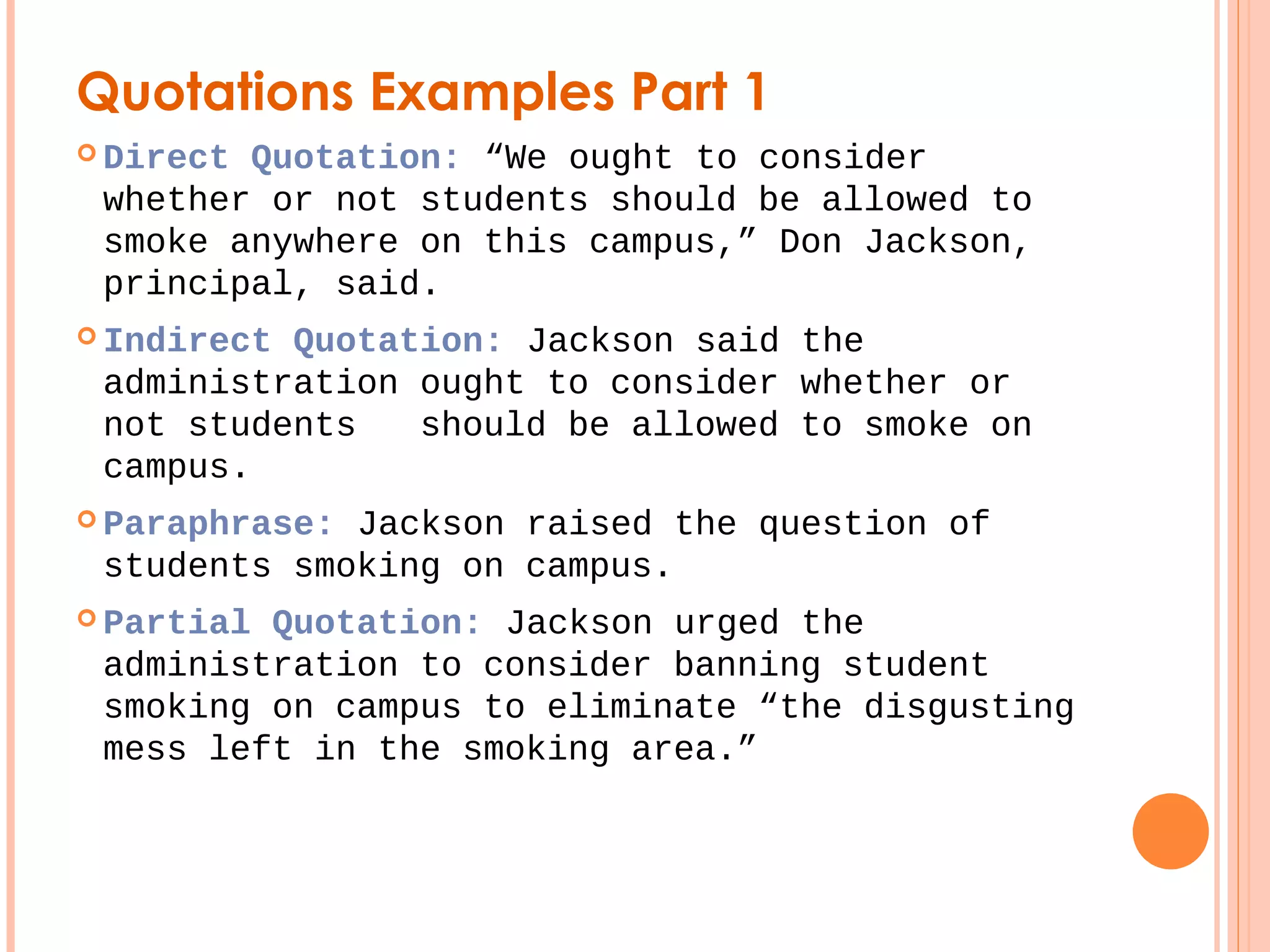
Quotations Examples Part 1 
 Direct Quotation: “We ought to consider 
whether or not students should be allowed to 
smoke anywhere on this campus,” Don Jackson, 
principal, said. 
 Indirect Quotation: Jackson said the 
administration ought to consider whether or 
not students should be allowed to smoke on 
campus. 
 Paraphrase: Jackson raised the question of 
students smoking on campus. 
 Partial Quotation: Jackson urged the 
administration to consider banning student 
smoking on campus to eliminate “the disgusting 
mess left in the smoking area.”
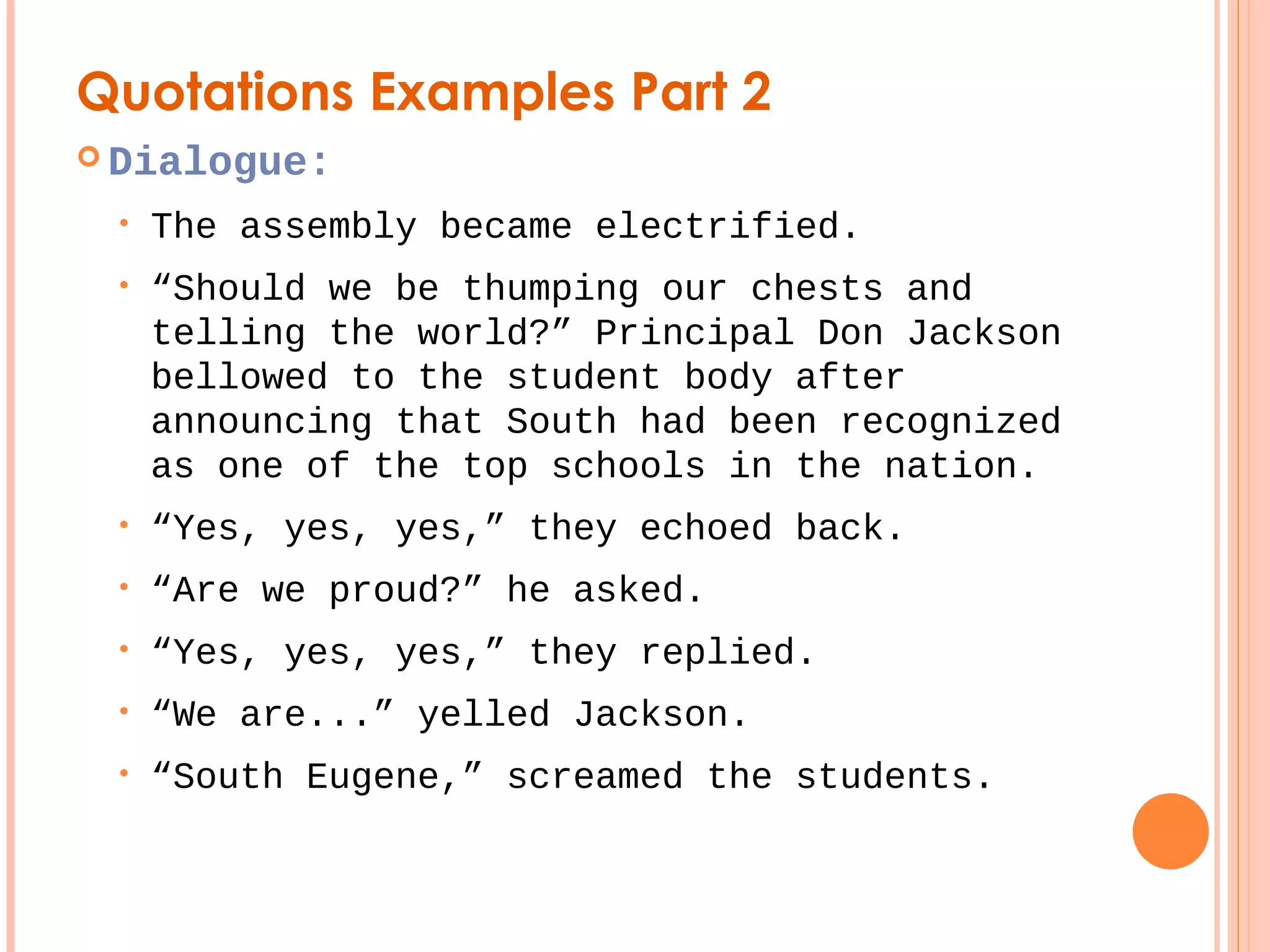
Quotations Examples Part 2 
 Dialogue: 
• The assembly became electrified. 
• “Should we be thumping our chests and 
telling the world?” Principal Don Jackson 
bellowed to the student body after 
announcing that South had been recognized 
as one of the top schools in the nation. 
• “Yes, yes, yes,” they echoed back. 
• “Are we proud?” he asked. 
• “Yes, yes, yes,” they replied. 
• “We are...” yelled Jackson. 
• “South Eugene,” screamed the students.
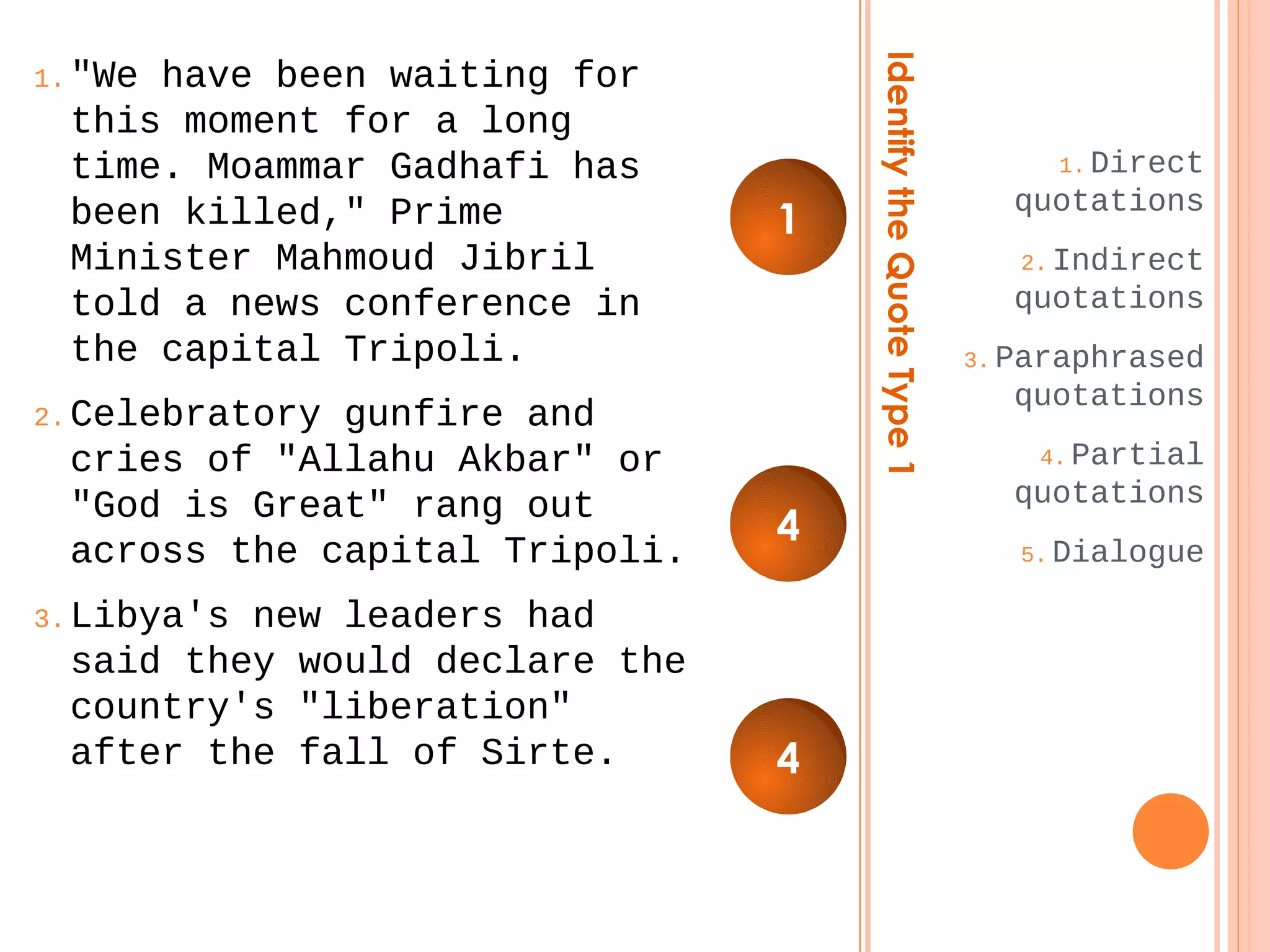
Identify the Quote Type 1 
1.Direct 
quotations 
2.Indirect 
quotations 
3.Paraphrased 
quotations 
4.Partial 
quotations 
5.Dialogue 
1."We have been waiting for 
this moment for a long 
time. Moammar Gadhafi has 
been killed," Prime 
Minister Mahmoud Jibril 
told a news conference in 
the capital Tripoli. 
2.Celebratory gunfire and 
cries of "Allahu Akbar" or 
"God is Great" rang out 
across the capital Tripoli. 
3.Libya's new leaders had 
said they would declare the 
country's "liberation" 
after the fall of Sirte. 
1 
4 
4
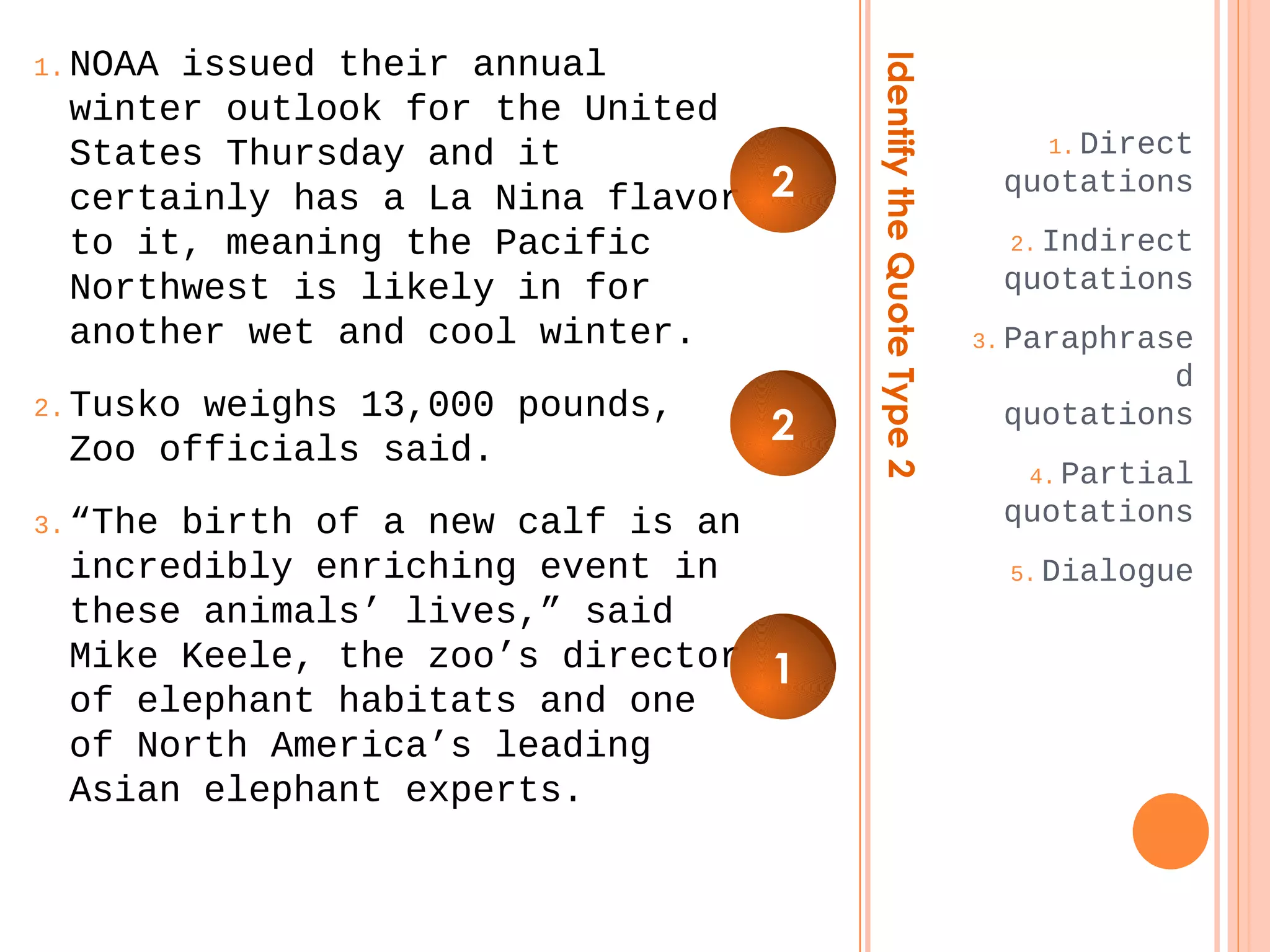
Identify the Quote Type 2 
1.Direct 
quotations 
2.Indirect 
quotations 
3.Paraphrase 
d 
quotations 
4.Partial 
quotations 
5.Dialogue 
1.NOAA issued their annual 
winter outlook for the United 
States Thursday and it 
certainly has a La Nina flavor 
to it, meaning the Pacific 
Northwest is likely in for 
another wet and cool winter. 
2.Tusko weighs 13,000 pounds, 
Zoo officials said. 
3.“The birth of a new calf is an 
incredibly enriching event in 
these animals’ lives,” said 
Mike Keele, the zoo’s director 
of elephant habitats and one 
of North America’s leading 
Asian elephant experts. 
2 
2 
1
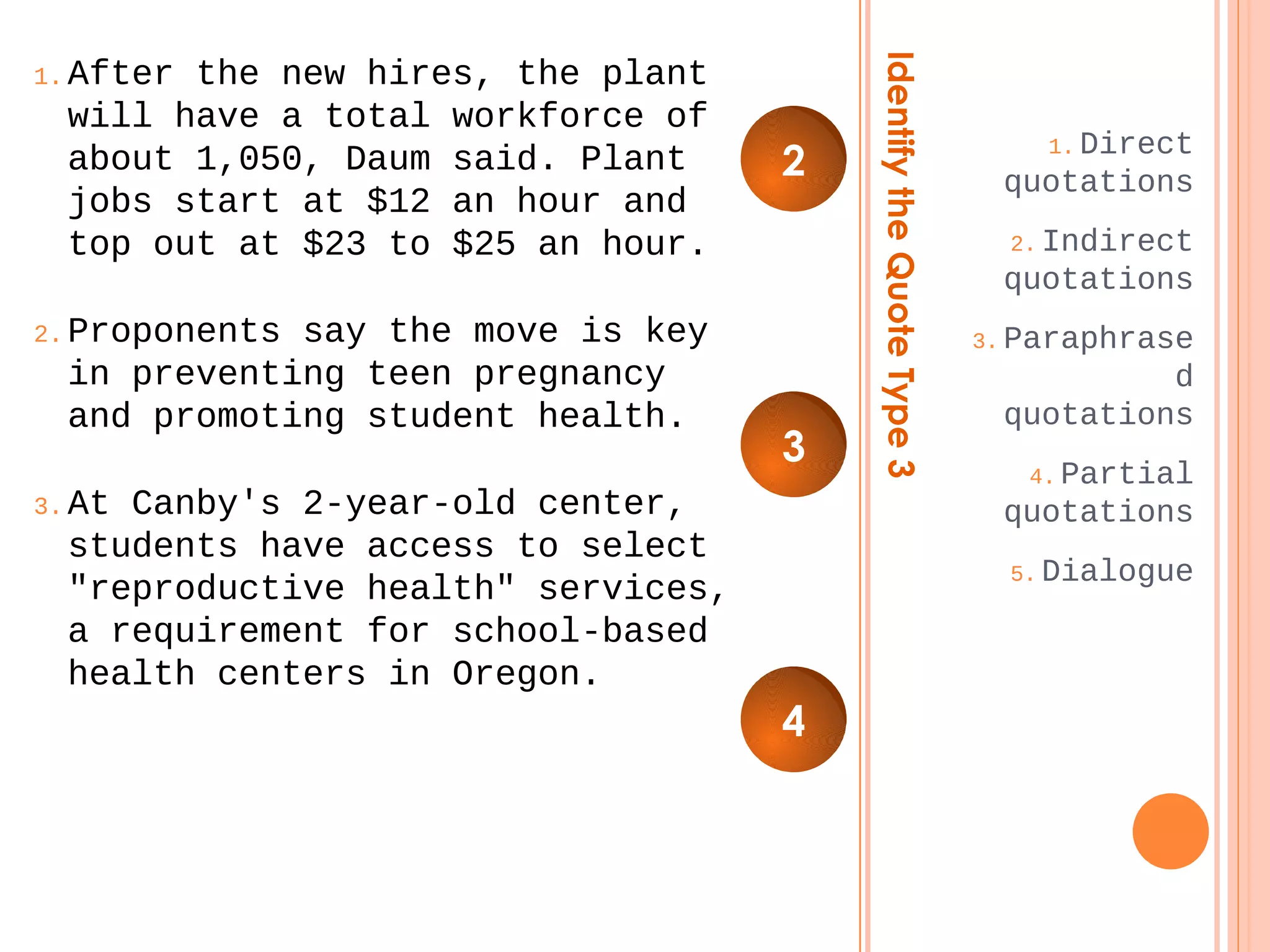
Identify the Quote Type 3 
1.Direct 
quotations 
2.Indirect 
quotations 
3.Paraphrase 
d 
quotations 
4.Partial 
quotations 
5.Dialogue 
1.After the new hires, the plant 
will have a total workforce of 
about 1,050, Daum said. Plant 
jobs start at $12 an hour and 
top out at $23 to $25 an hour. 
2.Proponents say the move is key 
in preventing teen pregnancy 
and promoting student health. 
3.At Canby's 2-year-old center, 
students have access to select 
"reproductive health" services, 
a requirement for school-based 
health centers in Oregon. 
2 
3 
4
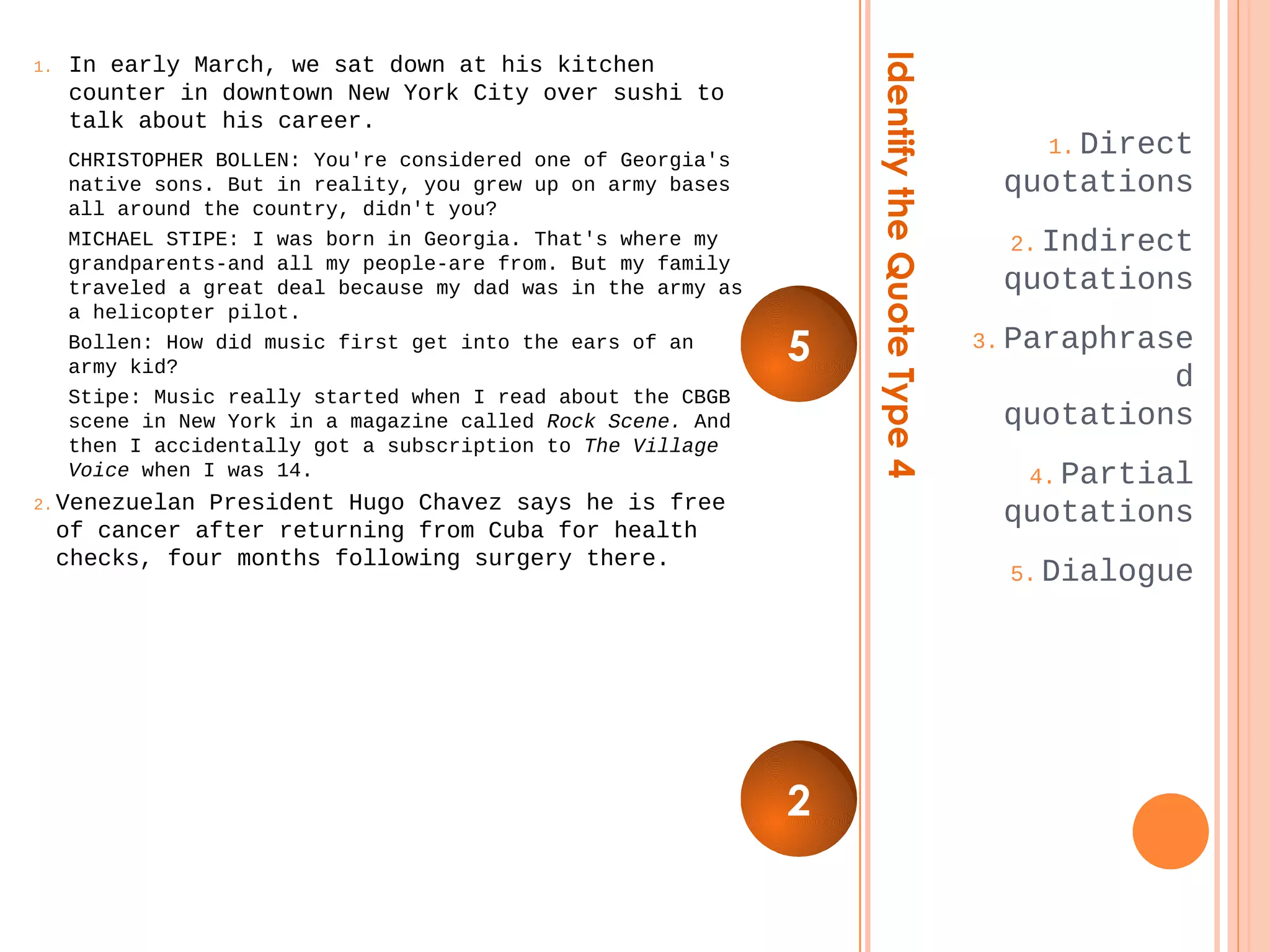
Identify the Quote Type 4 
1.Direct 
quotations 
2.Indirect 
quotations 
3.Paraphrase 
d 
quotations 
4.Partial 
quotations 
5.Dialogue 
1. In early March, we sat down at his kitchen 
counter in downtown New York City over sushi to 
talk about his career. 
CHRISTOPHER BOLLEN: You're considered one of Georgia's 
native sons. But in reality, you grew up on army bases 
all around the country, didn't you? 
MICHAEL STIPE: I was born in Georgia. That's where my 
grandparents-and all my people-are from. But my family 
traveled a great deal because my dad was in the army as 
a helicopter pilot. 
Bollen: How did music first get into the ears of an 
army kid? 
Stipe: Music really started when I read about the CBGB 
scene in New York in a magazine called Rock Scene. And 
then I accidentally got a subscription to The Village 
Voice when I was 14. 
2.Venezuelan President Hugo Chavez says he is free 
of cancer after returning from Cuba for health 
checks, four months following surgery there. 
5 
2
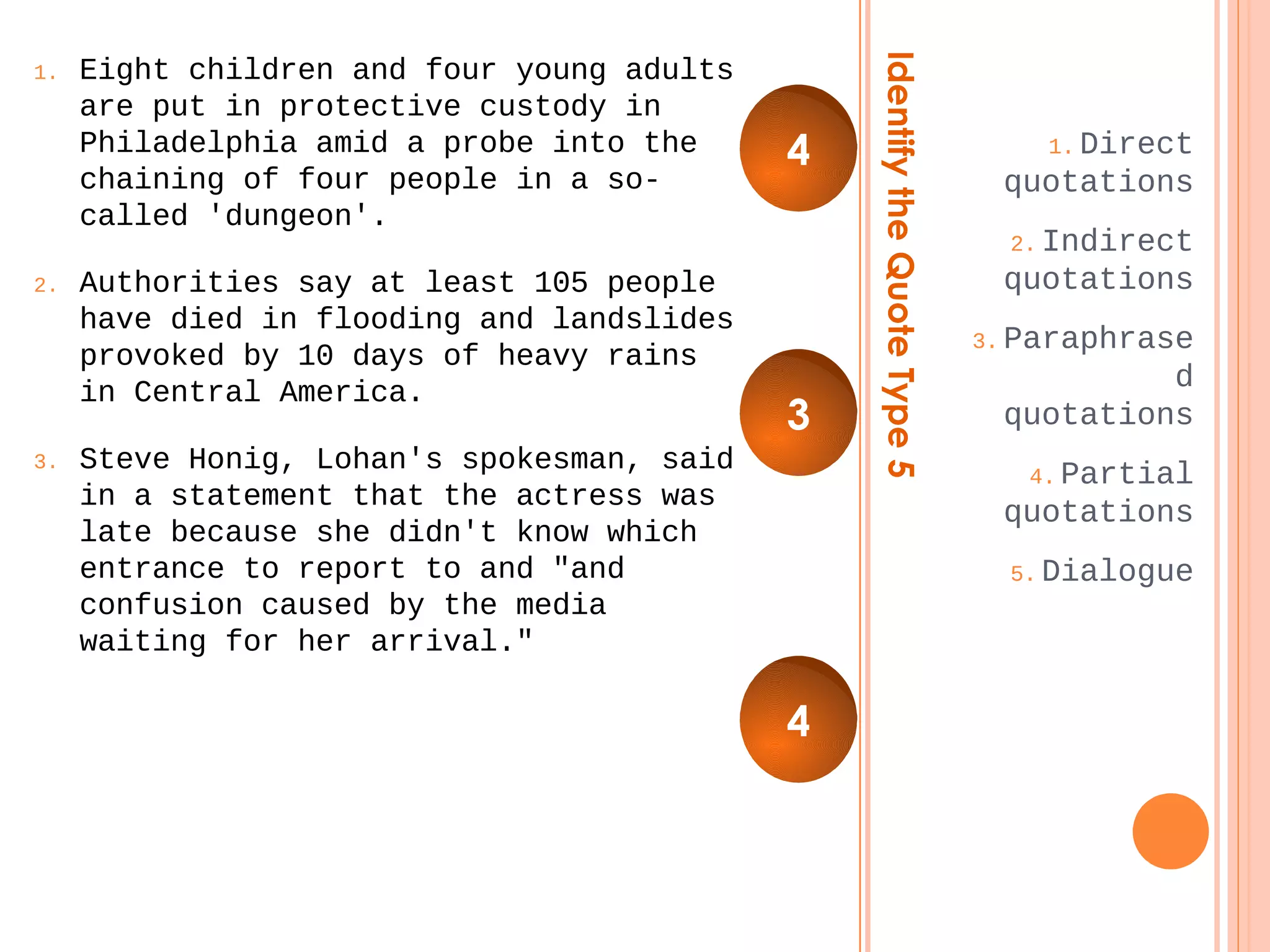
Identify the Quote Type 5 
1.Direct 
quotations 
2.Indirect 
quotations 
3.Paraphrase 
d 
quotations 
4.Partial 
quotations 
5.Dialogue 
1. Eight children and four young adults 
are put in protective custody in 
Philadelphia amid a probe into the 
chaining of four people in a so-called 
'dungeon'. 
2. Authorities say at least 105 people 
have died in flooding and landslides 
provoked by 10 days of heavy rains 
in Central America. 
3. Steve Honig, Lohan's spokesman, said 
in a statement that the actress was 
late because she didn't know which 
entrance to report to and "and 
confusion caused by the media 
waiting for her arrival." 
4 
3 
4
Quote Problems 
 Avoid rambling quotes 
 Avoid quotes with too much technical 
lingo
Quoting Accurately 
 If the grammar is poor, then some 
reporters will “clean up” the quote 
 This practice varies by publication 
 Generally not done 
 HOWEVER, if the interview was 
witnessed by multiple media outlets 
(example: press conference) then you 
should leave the quotes alone
(sic) 
 If you want to be cautious, then you 
can use the “(sic)” notation in your 
printed quote to notate a grammatical 
error made by your subject
Editing Quotes 
 Never make up a quote 
 Don’t add words to a quote 
 Exception: You may “clean up” the 
grammar if it is minimal and does not 
change the context or meaning 
 [Be sure to put the changed words in 
brackets]
Attribution 
 In most cases, the simple verb “said” 
is appropriate since it is neutral 
Example: “This is a quote,” the 
teacher said. 
 There are other verbs you can use, but 
be conservative
Verbs to Avoid 
 Minimize use of attribution verbs 
which are not neutral 
 “ ,” he cried. 
 “ ,” she emphasized. 
 “ ,” she contended.
Identification in Attribution 
 Attribute with the name and job title. 
 AFTER Example: “This year’s textbooks are 
going to be more expensive,” Mary Smith, 
librarian, said. 
 Use this method! 
 BEFORE Example: Mary Smith, librarian, 
said “This year’s textbooks are going to 
be more expensive.” 
 Avoid this method
Middle Initials 
 AP Stylebook recommends that you use 
them. 
 Particularly in hard news stories where 
they help identify a specific individual, 
such as casualty lists and stories naming 
the accused in a crime. This helps to 
minimize confusion. 
 A middle initial may be dropped if a 
person does not use one or is publicly 
known without it: Mickey Mantle (not 
Mickey C.), the Rev. Billy Graham (not 
Billy F.).
Talking to Sources 
 Many of the best stories will not 
originate from a news release 
 By nurturing your sources, you will 
be more likely to get closer to the 
truth 
 The longer you work with a source, 
the more likely you are to determine 
the relevance of the information 
that comes from that source
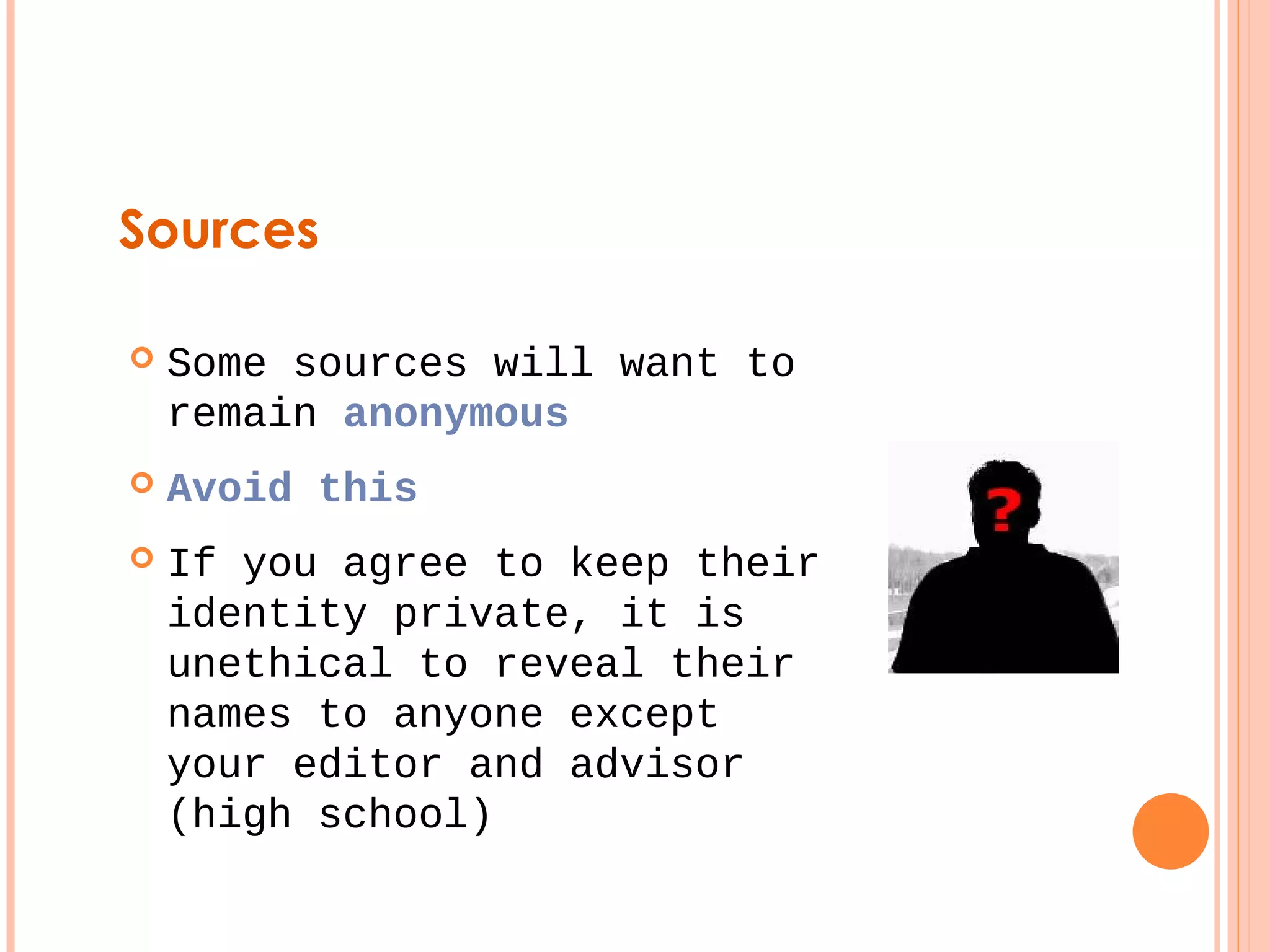
Sources 
 Some sources will want to 
remain anonymous 
 Avoid this 
 If you agree to keep their 
identity private, it is 
unethical to reveal their 
names to anyone except 
your editor and advisor 
(high school)
Exceptions: 
 Government subpoena (real world only) 
 If it is determined to jeopardize the 
national security or is essential is 
solving a crime 
 Publication policy 
 Due to some problems with reporter 
integrity, some publications are now 
requiring reporters to share the identity 
of the anonymous reporter with their 
supervising editor or advisor
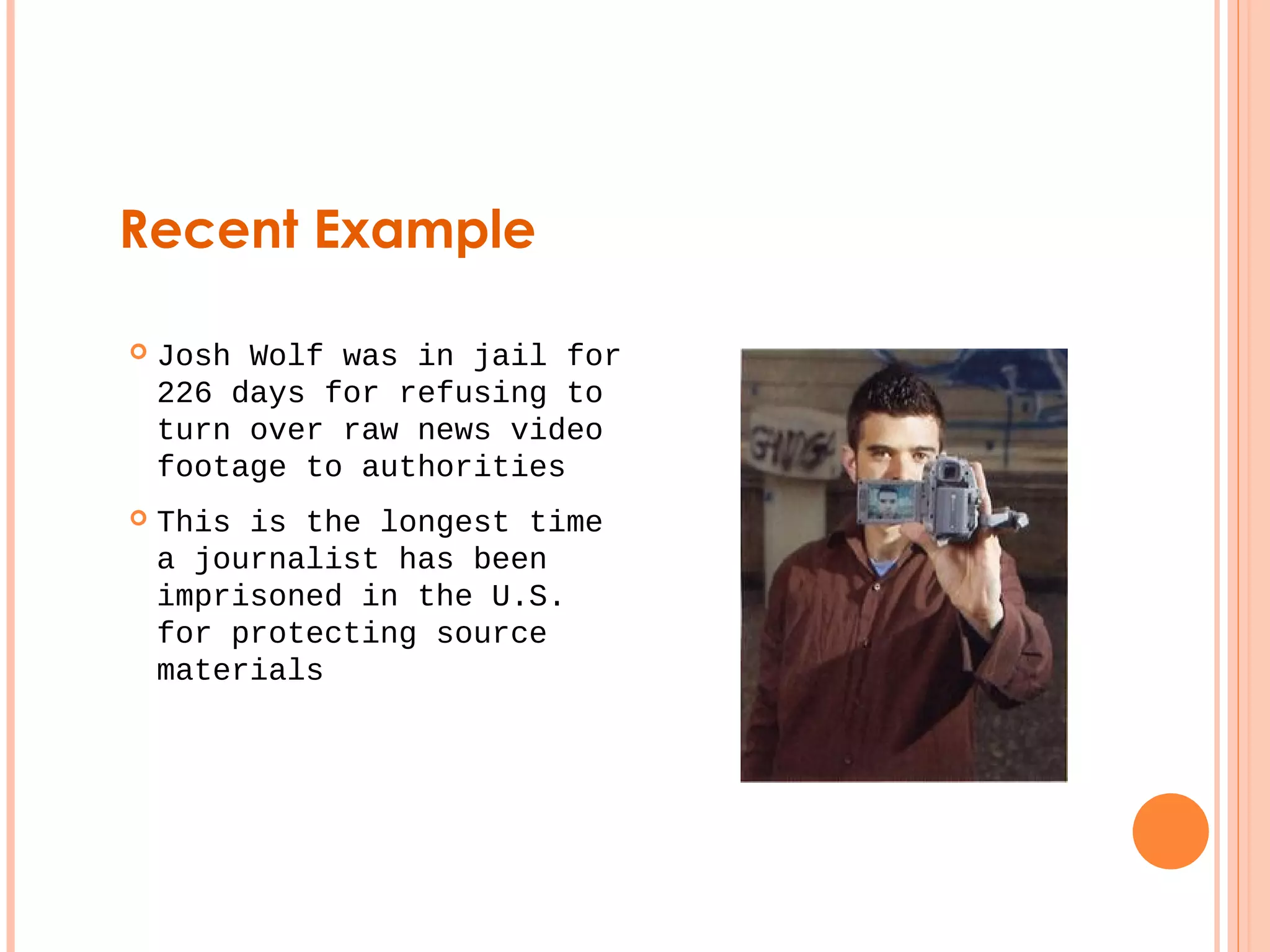
Recent Example 
 Josh Wolf was in jail for 
226 days for refusing to 
turn over raw news video 
footage to authorities 
 This is the longest time 
a journalist has been 
imprisoned in the U.S. 
for protecting source 
materials
Use Caution 
 Be aware of sources that have an axe 
to grind 
 Do they have an agenda? 
 Are they telling the truth? 
 Are they reliable? 
 Substance abuse = suspicion 
 Do they really have a direct 
connection to the news event? 
 Be careful of “hearsay”
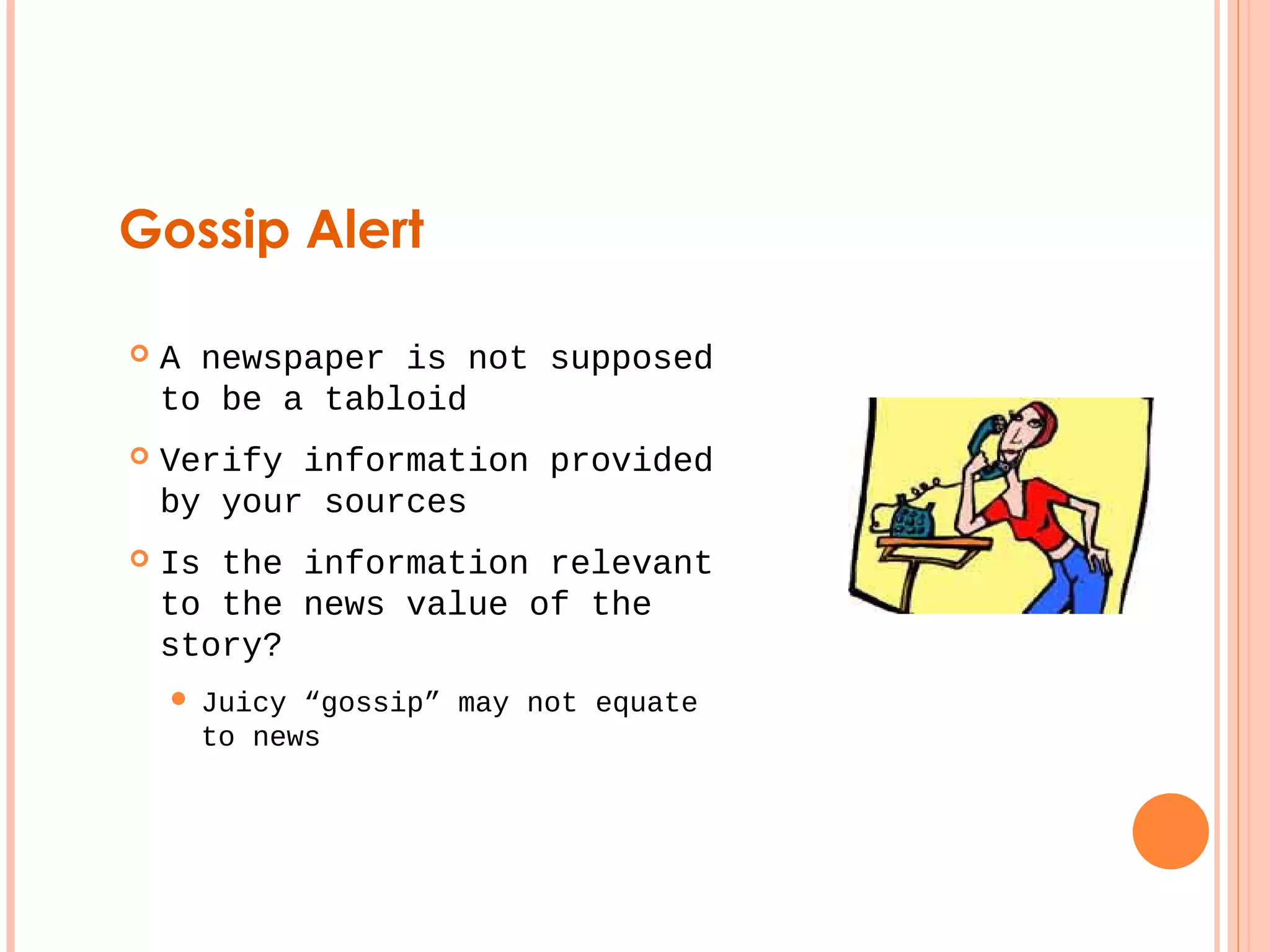
Gossip Alert 
 A newspaper is not supposed 
to be a tabloid 
 Verify information provided 
by your sources 
 Is the information relevant 
to the news value of the 
story? 
 Juicy “gossip” may not equate 
to news
Anonymous Sources 
 On the record – Everything can be 
quoted with attribution 
 Background – Everything can be quoted 
but no attribution 
 Deep background – No quotes can be 
used, no attribution – but information 
can be used 
 Off the record – No quotes, no 
attribution
Policies 
 Some publications do not allow 
anonymous sources, especially high 
school publications 
 Some require you to disclose the info 
to your superior; editor, advisor
“Off the Record” 
 Hotly debated topic 
 Is it ethical to gather info “off the 
record”? 
 Should everything be fair game? 
 Can you use information gained “off 
the record” without directly quoting 
the information or source?
Remember: Basic Rules to Follow 
Rule #1: Never create, invent or manufacture 
quotations 
Rule #2: Always be a good observer 
Rule #3: Choose quotes wisely 
Rule #4: Better to not use quote than use poor 
quote 
Rule #5: Punctuation marks go inside quotes 
Rule #6: Always attribute every statement & 
opinion 
Rule #7: Quotations should begin new paragraph 
Rule #8: If a quote needs explaining then 
paraphrase instead

Quotations and Attributions 2011

  • 1.
  • 2.
    Basic Rules toFollow Rule #1: Never create, invent or manufacture quotations Rule #2: Always be a good observer Rule #3: Choose quotes wisely Rule #4: Better to not use quote than use poor quote Rule #5: Punctuation marks go inside quotes Rule #6: Always attribute every statement & opinion Rule #7: Quotations should begin new paragraph Rule #8: If a quote needs explaining then paraphrase instead
  • 3.
    Uses of Quotes 1.Provides color 2.Lends authenticity and realism to the story 3.Increase reader interest in the story 4.Personalizes the story for the reader 5.Moves the story along 6.Reveals something crucial about the subject 7.Expresses a thought better than the writer can 8.Reveals character traits about a subject 9.Captures dramatic moments better than exposition could 10.Suggest universal truths
  • 4.
    Types of Quotations 1. Direct quotations 2. Indirect quotations 3. Paraphrased quotations 4. Partial quotations 5. Dialogue
  • 5.
    Direct Quotes Uses the person's exact words.  Contained in quotation marks.  Reports word-for-word what a speaker said.
  • 6.
    Direct Quotes Faulty grammar may be polished if the person you are quoting would recognize the error in print.  Quote must…  the substance of the remark in full accuracy  the spirit in which the remark was made  the typical language used by the speaker
  • 7.
    Using Direct Quotes  Use quote if it is particularly articulate or powerful in the wording  Most people do not speak in a way which translates well into a quote
  • 8.
    Using Direct Quotes  Only use a quote if it conveys something not communicated better in your own words  If it isn’t articulate (clear), then a better strategy is paraphrasing what the subject has told you
  • 9.
    Direct Quote Example  In an interview, for example, the speaker may tend to ramble. Suppose the speaker, Principal Don Jackson, actually said:  “Well, ah, what I’m trying to get across is, maybe we ought to consider, ah, whether or not the students, you know, should be allowed to smoke anywhere on this campus.”  In print the quoted remark probably would be simplified to:  “We ought to consider whether or not students should be allowed to smoke anywhere on this campus.”
  • 10.
    Direct Quotes If the subject is well known, then a direct quote may be appropriate  The more significant the interviewee is, the more likely a reader will be interested  Make sure the quote is used to add a unique angle or credibility to the story
  • 11.
    Direct Quotes If the quote is quirky or captures the source’s personality  If it is emotional or highly opinionated
  • 12.
    Indirect quotations Mostly uses the person's ideas in their words.  A few words my be changed for clarification.  Not in quotation marks as words are not exactly what person said.
  • 13.
    Paraphrased quotations Paraphrasing means using the ideas of an author, but not using his or her exact words.  Uses the reporters words & terms.  The meaning should be the same.  No quotation marks used.
  • 14.
    Partial quotations A combination of direct and paraphrased quotations.  Will have some words in quotation marks.  AP states this style is overused by professionals.
  • 15.
    Dialogue  Combinestwo or more speakers.  Often seen in feature stories & magazines.  May be seen in trial court reporting.
  • 16.
    Quotations Examples Part1  Direct Quotation: “We ought to consider whether or not students should be allowed to smoke anywhere on this campus,” Don Jackson, principal, said.  Indirect Quotation: Jackson said the administration ought to consider whether or not students should be allowed to smoke on campus.  Paraphrase: Jackson raised the question of students smoking on campus.  Partial Quotation: Jackson urged the administration to consider banning student smoking on campus to eliminate “the disgusting mess left in the smoking area.”
  • 17.
    Quotations Examples Part2  Dialogue: • The assembly became electrified. • “Should we be thumping our chests and telling the world?” Principal Don Jackson bellowed to the student body after announcing that South had been recognized as one of the top schools in the nation. • “Yes, yes, yes,” they echoed back. • “Are we proud?” he asked. • “Yes, yes, yes,” they replied. • “We are...” yelled Jackson. • “South Eugene,” screamed the students.
  • 18.
    Identify the QuoteType 1 1.Direct quotations 2.Indirect quotations 3.Paraphrased quotations 4.Partial quotations 5.Dialogue 1."We have been waiting for this moment for a long time. Moammar Gadhafi has been killed," Prime Minister Mahmoud Jibril told a news conference in the capital Tripoli. 2.Celebratory gunfire and cries of "Allahu Akbar" or "God is Great" rang out across the capital Tripoli. 3.Libya's new leaders had said they would declare the country's "liberation" after the fall of Sirte. 1 4 4
  • 19.
    Identify the QuoteType 2 1.Direct quotations 2.Indirect quotations 3.Paraphrase d quotations 4.Partial quotations 5.Dialogue 1.NOAA issued their annual winter outlook for the United States Thursday and it certainly has a La Nina flavor to it, meaning the Pacific Northwest is likely in for another wet and cool winter. 2.Tusko weighs 13,000 pounds, Zoo officials said. 3.“The birth of a new calf is an incredibly enriching event in these animals’ lives,” said Mike Keele, the zoo’s director of elephant habitats and one of North America’s leading Asian elephant experts. 2 2 1
  • 20.
    Identify the QuoteType 3 1.Direct quotations 2.Indirect quotations 3.Paraphrase d quotations 4.Partial quotations 5.Dialogue 1.After the new hires, the plant will have a total workforce of about 1,050, Daum said. Plant jobs start at $12 an hour and top out at $23 to $25 an hour. 2.Proponents say the move is key in preventing teen pregnancy and promoting student health. 3.At Canby's 2-year-old center, students have access to select "reproductive health" services, a requirement for school-based health centers in Oregon. 2 3 4
  • 21.
    Identify the QuoteType 4 1.Direct quotations 2.Indirect quotations 3.Paraphrase d quotations 4.Partial quotations 5.Dialogue 1. In early March, we sat down at his kitchen counter in downtown New York City over sushi to talk about his career. CHRISTOPHER BOLLEN: You're considered one of Georgia's native sons. But in reality, you grew up on army bases all around the country, didn't you? MICHAEL STIPE: I was born in Georgia. That's where my grandparents-and all my people-are from. But my family traveled a great deal because my dad was in the army as a helicopter pilot. Bollen: How did music first get into the ears of an army kid? Stipe: Music really started when I read about the CBGB scene in New York in a magazine called Rock Scene. And then I accidentally got a subscription to The Village Voice when I was 14. 2.Venezuelan President Hugo Chavez says he is free of cancer after returning from Cuba for health checks, four months following surgery there. 5 2
  • 22.
    Identify the QuoteType 5 1.Direct quotations 2.Indirect quotations 3.Paraphrase d quotations 4.Partial quotations 5.Dialogue 1. Eight children and four young adults are put in protective custody in Philadelphia amid a probe into the chaining of four people in a so-called 'dungeon'. 2. Authorities say at least 105 people have died in flooding and landslides provoked by 10 days of heavy rains in Central America. 3. Steve Honig, Lohan's spokesman, said in a statement that the actress was late because she didn't know which entrance to report to and "and confusion caused by the media waiting for her arrival." 4 3 4
  • 23.
    Quote Problems Avoid rambling quotes  Avoid quotes with too much technical lingo
  • 24.
    Quoting Accurately If the grammar is poor, then some reporters will “clean up” the quote  This practice varies by publication  Generally not done  HOWEVER, if the interview was witnessed by multiple media outlets (example: press conference) then you should leave the quotes alone
  • 25.
    (sic)  Ifyou want to be cautious, then you can use the “(sic)” notation in your printed quote to notate a grammatical error made by your subject
  • 26.
    Editing Quotes Never make up a quote  Don’t add words to a quote  Exception: You may “clean up” the grammar if it is minimal and does not change the context or meaning  [Be sure to put the changed words in brackets]
  • 27.
    Attribution  Inmost cases, the simple verb “said” is appropriate since it is neutral Example: “This is a quote,” the teacher said.  There are other verbs you can use, but be conservative
  • 28.
    Verbs to Avoid  Minimize use of attribution verbs which are not neutral  “ ,” he cried.  “ ,” she emphasized.  “ ,” she contended.
  • 29.
    Identification in Attribution  Attribute with the name and job title.  AFTER Example: “This year’s textbooks are going to be more expensive,” Mary Smith, librarian, said.  Use this method!  BEFORE Example: Mary Smith, librarian, said “This year’s textbooks are going to be more expensive.”  Avoid this method
  • 30.
    Middle Initials AP Stylebook recommends that you use them.  Particularly in hard news stories where they help identify a specific individual, such as casualty lists and stories naming the accused in a crime. This helps to minimize confusion.  A middle initial may be dropped if a person does not use one or is publicly known without it: Mickey Mantle (not Mickey C.), the Rev. Billy Graham (not Billy F.).
  • 31.
    Talking to Sources  Many of the best stories will not originate from a news release  By nurturing your sources, you will be more likely to get closer to the truth  The longer you work with a source, the more likely you are to determine the relevance of the information that comes from that source
  • 32.
    Sources  Somesources will want to remain anonymous  Avoid this  If you agree to keep their identity private, it is unethical to reveal their names to anyone except your editor and advisor (high school)
  • 33.
    Exceptions:  Governmentsubpoena (real world only)  If it is determined to jeopardize the national security or is essential is solving a crime  Publication policy  Due to some problems with reporter integrity, some publications are now requiring reporters to share the identity of the anonymous reporter with their supervising editor or advisor
  • 34.
    Recent Example Josh Wolf was in jail for 226 days for refusing to turn over raw news video footage to authorities  This is the longest time a journalist has been imprisoned in the U.S. for protecting source materials
  • 35.
    Use Caution Be aware of sources that have an axe to grind  Do they have an agenda?  Are they telling the truth?  Are they reliable?  Substance abuse = suspicion  Do they really have a direct connection to the news event?  Be careful of “hearsay”
  • 36.
    Gossip Alert A newspaper is not supposed to be a tabloid  Verify information provided by your sources  Is the information relevant to the news value of the story?  Juicy “gossip” may not equate to news
  • 37.
    Anonymous Sources On the record – Everything can be quoted with attribution  Background – Everything can be quoted but no attribution  Deep background – No quotes can be used, no attribution – but information can be used  Off the record – No quotes, no attribution
  • 38.
    Policies  Somepublications do not allow anonymous sources, especially high school publications  Some require you to disclose the info to your superior; editor, advisor
  • 39.
    “Off the Record”  Hotly debated topic  Is it ethical to gather info “off the record”?  Should everything be fair game?  Can you use information gained “off the record” without directly quoting the information or source?
  • 40.
    Remember: Basic Rulesto Follow Rule #1: Never create, invent or manufacture quotations Rule #2: Always be a good observer Rule #3: Choose quotes wisely Rule #4: Better to not use quote than use poor quote Rule #5: Punctuation marks go inside quotes Rule #6: Always attribute every statement & opinion Rule #7: Quotations should begin new paragraph Rule #8: If a quote needs explaining then paraphrase instead

Editor's Notes

  • #2 <number>
  • #5 <number>
  • #8 <number>
  • #9 <number>
  • #11 <number>
  • #12 <number>
  • #24 <number>
  • #25 <number>
  • #26 <number>
  • #27 <number>
  • #28 <number>
  • #29 <number>
  • #30 <number>
  • #31 <number>
  • #32 <number>
  • #33 <number>
  • #34 <number>
  • #35 <number>
  • #36 <number>
  • #37 <number>
  • #38 <number>
  • #39 <number>
  • #40 <number>