COMP0005 (Algorithms)
Quicksort
Vasileios Lampos
Computer Science, UCL
@lampos
lampos.net www
Slides (with potential revisions)
lampos.net/slides/quicksort2019.pdf
About this lecture
• Quicksort (yet another sorting algorithm)
— Description
— Performance analysis
• Material
— Cormen, Leiserson, Rivest and Stein. Introduction
to Algorithms. MIT Press, 3rd Edition, 2009
(mainly Chapter 7)
— Alternative slides at https://algs4.cs.princeton.edu/lectures/
(Sedgewick and Wayne)
Quicksort divides & conquers
Given an array A with n elements, A[1…n]:
• DIVIDE (step 1)

Partition, i.e. re-arrange the elements of, array A[1…n] so that
for some element A[q]:
1. all elements on the left of A[q], i.e. A[1…q−1], are less than or
equal to A[q], and
2. all elements on the right of A[q], i.e. A[q+1…n], are greater
than or equal to A[q].

Quicksort divides & conquers
Given an array A with n elements, A[1…n]:
• DIVIDE (step 1)

Partition, i.e. re-arrange the elements of, array A[1…n] so that
for some element A[q]:
1. all elements on the left of A[q], i.e. A[1…q−1], are less than or
equal to A[q], and
2. all elements on the right of A[q], i.e. A[q+1…n], are greater
than or equal to A[q].

• CONQUER (step 2)

Sort sub-arrays A[1…q−1] and A[q+1…n] by recursive
executions of step 1.

Quicksort divides & conquers
Given an array A with n elements, A[1…n]:
• DIVIDE (step 1)

Partition, i.e. re-arrange the elements of, array A[1…n] so that
for some element A[q]:
1. all elements on the left of A[q], i.e. A[1…q−1], are less than or
equal to A[q], and
2. all elements on the right of A[q], i.e. A[q+1…n], are greater
than or equal to A[q].

• CONQUER (step 2)

Sort sub-arrays A[1…q−1] and A[q+1…n] by recursive
executions of step 1.

• COMBINE (step 3)

Just by joining the sorted sub-arrays we obtain a sorted array.
Quicksort divides & conquers
Given an array A with n elements, A[1…n]:
• DIVIDE (step 1)

Partition, i.e. re-arrange the elements of, array A[1…n] so that
for some element A[q]:
1. all elements on the left of A[q], i.e. A[1…q−1], are less than or
equal to A[q], and
2. all elements on the right of A[q], i.e. A[q+1…n], are greater
than or equal to A[q].

• CONQUER (step 2)

Sort sub-arrays A[1…q−1] and A[q+1…n] by recursive
executions of step 1.

• COMBINE (step 3)

Just by joining the sorted sub-arrays we obtain a sorted array.
Quicksort divides & conquers
Note:
• We will assume that the
elements of A are distinct.
• We will be sorting the elements
of A in an ascending order.
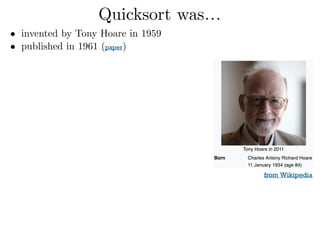
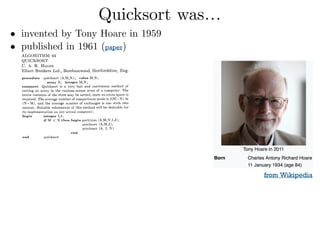
Quicksort was…
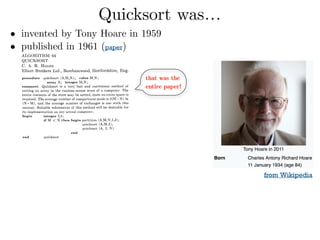
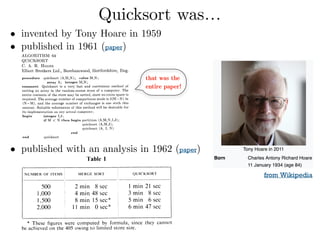
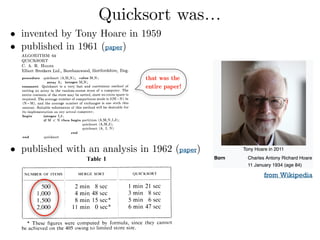
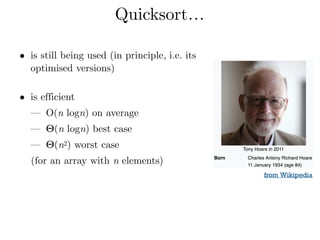
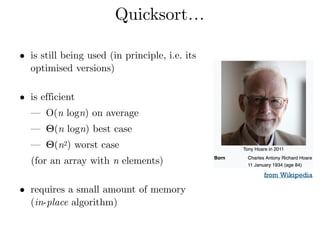
• invented by Tony Hoare in 1959
• published in 1961 (paper)


from Wikipedia
Quicksort was…
• invented by Tony Hoare in 1959
• published in 1961 (paper)


from Wikipedia
Quicksort was…
• invented by Tony Hoare in 1959
• published in 1961 (paper)


from Wikipedia
that was the
entire paper!
Quicksort was…
• invented by Tony Hoare in 1959
• published in 1961 (paper)


• published with an analysis in 1962 (paper)


from Wikipedia
that was the
entire paper!
Quicksort was…
• invented by Tony Hoare in 1959
• published in 1961 (paper)


• published with an analysis in 1962 (paper)


from Wikipedia
that was the
entire paper!
Quicksort…
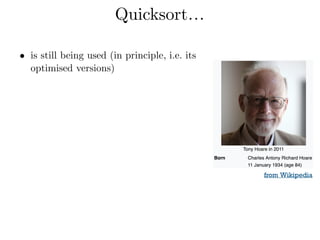
• is still being used (in principle, i.e. its
optimised versions)

from Wikipedia
Quicksort…
• is still being used (in principle, i.e. its
optimised versions)

• is efficient
— O(n logn) on average
— Θ(n logn) best case
— Θ(n2) worst case
(for an array with n elements)

from Wikipedia
Quicksort…
• is still being used (in principle, i.e. its
optimised versions)

• is efficient
— O(n logn) on average
— Θ(n logn) best case
— Θ(n2) worst case
(for an array with n elements)

• requires a small amount of memory
(in-place algorithm)
from Wikipedia
Quicksort7.1 Description of quicksort
Combine: Because the subarrays are already
them: the entire array AŒp : : r is now sort
The following procedure implements quicksor
QUICKSORT.A; p; r/
1 if p < r
2 q D PARTITION.A; p; r/
3 QUICKSORT.A; p; q 1/
4 QUICKSORT.A; q C 1; r/
p r
… 6 5 1 … 22 9 2 …
}sub-array A[p…r]
both p, r are array indices
Quicksort
p q r
… 1 2 6 … 22 9 5 …
}sub-array A[p…r]
p, r, q are array indices
7.1 Description of quicksort
Combine: Because the subarrays are already
them: the entire array AŒp : : r is now sort
The following procedure implements quicksor
QUICKSORT.A; p; r/
1 if p < r
2 q D PARTITION.A; p; r/
3 QUICKSORT.A; p; q 1/
4 QUICKSORT.A; q C 1; r/
Quicksort — Partition
2 q D PARTITION.A; p; r/
3 QUICKSORT.A; p; q 1/
4 QUICKSORT.A; q C 1; r/
To sort an entire array A, the initial call is QUICKSORT.A; 1; A:length/.
Partitioning the array
The key to the algorithm is the PARTITION procedure, which rearranges the su
ray AŒp : : r in place.
PARTITION.A; p; r/
1 x D AŒr
2 i D p 1
3 for j D p to r 1
4 if AŒj  Ä x
5 i D i C 1
6 exchange AŒi with AŒj 
7 exchange AŒi C 1 with AŒr
8 return i C 1
7.1 Description of quicksort
Combine: Because the subarrays are alr
them: the entire array AŒp : : r is no
The following procedure implements qu
QUICKSORT.A; p; r/
1 if p < r
2 q D PARTITION.A; p; r/
3 QUICKSORT.A; p; q 1/
4 QUICKSORT.A; q C 1; r/
To sort an entire array A, the initial call
Partition is the central sorting
operation of quicksort
p q? r
… 1 2 6 … 22 9 5 …
}sub-array A[p…r]
p, r, q are array indices
Step-by-step exampleCombine: Because the subarrays are already sorted, no work is needed to combine
them: the entire array AŒp : : r is now sorted.
The following procedure implements quicksort:
QUICKSORT.A; p; r/
1 if p < r
2 q D PARTITION.A; p; r/
3 QUICKSORT.A; p; q 1/
4 QUICKSORT.A; q C 1; r/
To sort an entire array A, the initial call is QUICKSORT.A; 1; A:length/.
Partitioning the array
The key to the algorithm is the PARTITION procedure, which rearranges the subar-
ray AŒp : : r in place.
PARTITION.A; p; r/
1 x D AŒr
2 i D p 1
3 for j D p to r 1
4 if AŒj  Ä x
5 i D i C 1
6 exchange AŒi with AŒj 
7 exchange AŒi C 1 with AŒr
8 return i C 1
QUICKSORT.A; p; r/
1 if p < r
2 q D PARTITION.A; p; r/
3 QUICKSORT.A; p; q 1/
4 QUICKSORT.A; q C 1; r/
To sort an entire array A, the initial call is QUICKSORT.A; 1; A:length/.
Partitioning the array
The key to the algorithm is the PARTITION procedure, which rearranges the subar-
ray AŒp : : r in place.
PARTITION.A; p; r/
1 x D AŒr
2 i D p 1
3 for j D p to r 1
4 if AŒj  Ä x
5 i D i C 1
6 exchange AŒi with AŒj 
7 exchange AŒi C 1 with AŒr
8 return i C 1
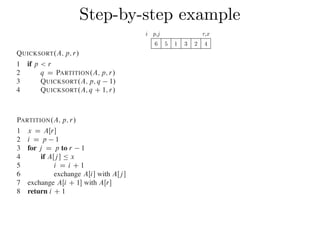
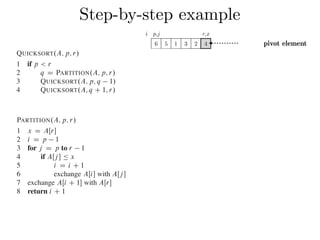
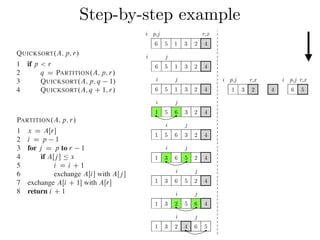
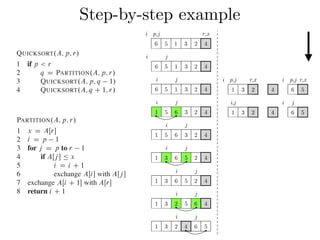
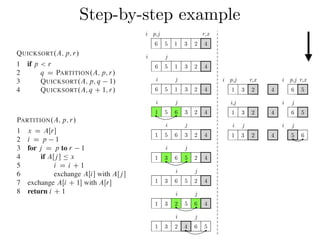
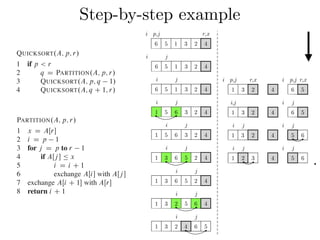
Figure 7.1 shows how PARTITION works on an 8-element array. PARTITION
always selects an element x D AŒr as a pivot element around which to partition the
subarray AŒp : : r. As the procedure runs, it partitions the array into four (possibly
empty) regions. At the start of each iteration of the for loop in lines 3–6, the regions
i p,j r,x
6 5 1 3 2 4
Step-by-step exampleCombine: Because the subarrays are already sorted, no work is needed to combine
them: the entire array AŒp : : r is now sorted.
The following procedure implements quicksort:
QUICKSORT.A; p; r/
1 if p < r
2 q D PARTITION.A; p; r/
3 QUICKSORT.A; p; q 1/
4 QUICKSORT.A; q C 1; r/
To sort an entire array A, the initial call is QUICKSORT.A; 1; A:length/.
Partitioning the array
The key to the algorithm is the PARTITION procedure, which rearranges the subar-
ray AŒp : : r in place.
PARTITION.A; p; r/
1 x D AŒr
2 i D p 1
3 for j D p to r 1
4 if AŒj  Ä x
5 i D i C 1
6 exchange AŒi with AŒj 
7 exchange AŒi C 1 with AŒr
8 return i C 1
QUICKSORT.A; p; r/
1 if p < r
2 q D PARTITION.A; p; r/
3 QUICKSORT.A; p; q 1/
4 QUICKSORT.A; q C 1; r/
To sort an entire array A, the initial call is QUICKSORT.A; 1; A:length/.
Partitioning the array
The key to the algorithm is the PARTITION procedure, which rearranges the subar-
ray AŒp : : r in place.
PARTITION.A; p; r/
1 x D AŒr
2 i D p 1
3 for j D p to r 1
4 if AŒj  Ä x
5 i D i C 1
6 exchange AŒi with AŒj 
7 exchange AŒi C 1 with AŒr
8 return i C 1
Figure 7.1 shows how PARTITION works on an 8-element array. PARTITION
always selects an element x D AŒr as a pivot element around which to partition the
subarray AŒp : : r. As the procedure runs, it partitions the array into four (possibly
empty) regions. At the start of each iteration of the for loop in lines 3–6, the regions
i p,j r,x
6 5 1 3 2 4 pivot element
Step-by-step exampleCombine: Because the subarrays are already sorted, no work is needed to combine
them: the entire array AŒp : : r is now sorted.
The following procedure implements quicksort:
QUICKSORT.A; p; r/
1 if p < r
2 q D PARTITION.A; p; r/
3 QUICKSORT.A; p; q 1/
4 QUICKSORT.A; q C 1; r/
To sort an entire array A, the initial call is QUICKSORT.A; 1; A:length/.
Partitioning the array
The key to the algorithm is the PARTITION procedure, which rearranges the subar-
ray AŒp : : r in place.
PARTITION.A; p; r/
1 x D AŒr
2 i D p 1
3 for j D p to r 1
4 if AŒj  Ä x
5 i D i C 1
6 exchange AŒi with AŒj 
7 exchange AŒi C 1 with AŒr
8 return i C 1
QUICKSORT.A; p; r/
1 if p < r
2 q D PARTITION.A; p; r/
3 QUICKSORT.A; p; q 1/
4 QUICKSORT.A; q C 1; r/
To sort an entire array A, the initial call is QUICKSORT.A; 1; A:length/.
Partitioning the array
The key to the algorithm is the PARTITION procedure, which rearranges the subar-
ray AŒp : : r in place.
PARTITION.A; p; r/
1 x D AŒr
2 i D p 1
3 for j D p to r 1
4 if AŒj  Ä x
5 i D i C 1
6 exchange AŒi with AŒj 
7 exchange AŒi C 1 with AŒr
8 return i C 1
Figure 7.1 shows how PARTITION works on an 8-element array. PARTITION
always selects an element x D AŒr as a pivot element around which to partition the
subarray AŒp : : r. As the procedure runs, it partitions the array into four (possibly
empty) regions. At the start of each iteration of the for loop in lines 3–6, the regions
i j
6 5 1 3 2 4 x = 4, A[j = p+1] = 5 > x
i p,j r,x
6 5 1 3 2 4 pivot element
Step-by-step exampleCombine: Because the subarrays are already sorted, no work is needed to combine
them: the entire array AŒp : : r is now sorted.
The following procedure implements quicksort:
QUICKSORT.A; p; r/
1 if p < r
2 q D PARTITION.A; p; r/
3 QUICKSORT.A; p; q 1/
4 QUICKSORT.A; q C 1; r/
To sort an entire array A, the initial call is QUICKSORT.A; 1; A:length/.
Partitioning the array
The key to the algorithm is the PARTITION procedure, which rearranges the subar-
ray AŒp : : r in place.
PARTITION.A; p; r/
1 x D AŒr
2 i D p 1
3 for j D p to r 1
4 if AŒj  Ä x
5 i D i C 1
6 exchange AŒi with AŒj 
7 exchange AŒi C 1 with AŒr
8 return i C 1
QUICKSORT.A; p; r/
1 if p < r
2 q D PARTITION.A; p; r/
3 QUICKSORT.A; p; q 1/
4 QUICKSORT.A; q C 1; r/
To sort an entire array A, the initial call is QUICKSORT.A; 1; A:length/.
Partitioning the array
The key to the algorithm is the PARTITION procedure, which rearranges the subar-
ray AŒp : : r in place.
PARTITION.A; p; r/
1 x D AŒr
2 i D p 1
3 for j D p to r 1
4 if AŒj  Ä x
5 i D i C 1
6 exchange AŒi with AŒj 
7 exchange AŒi C 1 with AŒr
8 return i C 1
Figure 7.1 shows how PARTITION works on an 8-element array. PARTITION
always selects an element x D AŒr as a pivot element around which to partition the
subarray AŒp : : r. As the procedure runs, it partitions the array into four (possibly
empty) regions. At the start of each iteration of the for loop in lines 3–6, the regions
i j
6 5 1 3 2 4
i j
6 5 1 3 2 4
x = 4, A[j = p+1] = 5 > x
A[j = p+2] = 1 < x, i = i+1
i p,j r,x
6 5 1 3 2 4 pivot element
Step-by-step exampleCombine: Because the subarrays are already sorted, no work is needed to combine
them: the entire array AŒp : : r is now sorted.
The following procedure implements quicksort:
QUICKSORT.A; p; r/
1 if p < r
2 q D PARTITION.A; p; r/
3 QUICKSORT.A; p; q 1/
4 QUICKSORT.A; q C 1; r/
To sort an entire array A, the initial call is QUICKSORT.A; 1; A:length/.
Partitioning the array
The key to the algorithm is the PARTITION procedure, which rearranges the subar-
ray AŒp : : r in place.
PARTITION.A; p; r/
1 x D AŒr
2 i D p 1
3 for j D p to r 1
4 if AŒj  Ä x
5 i D i C 1
6 exchange AŒi with AŒj 
7 exchange AŒi C 1 with AŒr
8 return i C 1
QUICKSORT.A; p; r/
1 if p < r
2 q D PARTITION.A; p; r/
3 QUICKSORT.A; p; q 1/
4 QUICKSORT.A; q C 1; r/
To sort an entire array A, the initial call is QUICKSORT.A; 1; A:length/.
Partitioning the array
The key to the algorithm is the PARTITION procedure, which rearranges the subar-
ray AŒp : : r in place.
PARTITION.A; p; r/
1 x D AŒr
2 i D p 1
3 for j D p to r 1
4 if AŒj  Ä x
5 i D i C 1
6 exchange AŒi with AŒj 
7 exchange AŒi C 1 with AŒr
8 return i C 1
Figure 7.1 shows how PARTITION works on an 8-element array. PARTITION
always selects an element x D AŒr as a pivot element around which to partition the
subarray AŒp : : r. As the procedure runs, it partitions the array into four (possibly
empty) regions. At the start of each iteration of the for loop in lines 3–6, the regions
i j
6 5 1 3 2 4
i j
6 5 1 3 2 4
i j
1 5 6 3 2 4
x = 4, A[j = p+1] = 5 > x
A[j = p+2] = 1 < x, i = i+1
and A[i]↔A[j]
i p,j r,x
6 5 1 3 2 4 pivot element
Step-by-step exampleCombine: Because the subarrays are already sorted, no work is needed to combine
them: the entire array AŒp : : r is now sorted.
The following procedure implements quicksort:
QUICKSORT.A; p; r/
1 if p < r
2 q D PARTITION.A; p; r/
3 QUICKSORT.A; p; q 1/
4 QUICKSORT.A; q C 1; r/
To sort an entire array A, the initial call is QUICKSORT.A; 1; A:length/.
Partitioning the array
The key to the algorithm is the PARTITION procedure, which rearranges the subar-
ray AŒp : : r in place.
PARTITION.A; p; r/
1 x D AŒr
2 i D p 1
3 for j D p to r 1
4 if AŒj  Ä x
5 i D i C 1
6 exchange AŒi with AŒj 
7 exchange AŒi C 1 with AŒr
8 return i C 1
QUICKSORT.A; p; r/
1 if p < r
2 q D PARTITION.A; p; r/
3 QUICKSORT.A; p; q 1/
4 QUICKSORT.A; q C 1; r/
To sort an entire array A, the initial call is QUICKSORT.A; 1; A:length/.
Partitioning the array
The key to the algorithm is the PARTITION procedure, which rearranges the subar-
ray AŒp : : r in place.
PARTITION.A; p; r/
1 x D AŒr
2 i D p 1
3 for j D p to r 1
4 if AŒj  Ä x
5 i D i C 1
6 exchange AŒi with AŒj 
7 exchange AŒi C 1 with AŒr
8 return i C 1
Figure 7.1 shows how PARTITION works on an 8-element array. PARTITION
always selects an element x D AŒr as a pivot element around which to partition the
subarray AŒp : : r. As the procedure runs, it partitions the array into four (possibly
empty) regions. At the start of each iteration of the for loop in lines 3–6, the regions
i j
6 5 1 3 2 4
i j
6 5 1 3 2 4
i j
1 5 6 3 2 4
i j
1 5 6 3 2 4
x = 4, A[j = p+1] = 5 > x
A[j = p+2] = 1 < x, i = i+1
and A[i]↔A[j]
A[j = p+3] = 3 < x, i = i+1
i p,j r,x
6 5 1 3 2 4 pivot element
Step-by-step exampleCombine: Because the subarrays are already sorted, no work is needed to combine
them: the entire array AŒp : : r is now sorted.
The following procedure implements quicksort:
QUICKSORT.A; p; r/
1 if p < r
2 q D PARTITION.A; p; r/
3 QUICKSORT.A; p; q 1/
4 QUICKSORT.A; q C 1; r/
To sort an entire array A, the initial call is QUICKSORT.A; 1; A:length/.
Partitioning the array
The key to the algorithm is the PARTITION procedure, which rearranges the subar-
ray AŒp : : r in place.
PARTITION.A; p; r/
1 x D AŒr
2 i D p 1
3 for j D p to r 1
4 if AŒj  Ä x
5 i D i C 1
6 exchange AŒi with AŒj 
7 exchange AŒi C 1 with AŒr
8 return i C 1
QUICKSORT.A; p; r/
1 if p < r
2 q D PARTITION.A; p; r/
3 QUICKSORT.A; p; q 1/
4 QUICKSORT.A; q C 1; r/
To sort an entire array A, the initial call is QUICKSORT.A; 1; A:length/.
Partitioning the array
The key to the algorithm is the PARTITION procedure, which rearranges the subar-
ray AŒp : : r in place.
PARTITION.A; p; r/
1 x D AŒr
2 i D p 1
3 for j D p to r 1
4 if AŒj  Ä x
5 i D i C 1
6 exchange AŒi with AŒj 
7 exchange AŒi C 1 with AŒr
8 return i C 1
Figure 7.1 shows how PARTITION works on an 8-element array. PARTITION
always selects an element x D AŒr as a pivot element around which to partition the
subarray AŒp : : r. As the procedure runs, it partitions the array into four (possibly
empty) regions. At the start of each iteration of the for loop in lines 3–6, the regions
i j
6 5 1 3 2 4
i j
6 5 1 3 2 4
i j
1 5 6 3 2 4
i j
1 5 6 3 2 4
i j
1 3 6 5 2 4
x = 4, A[j = p+1] = 5 > x
A[j = p+2] = 1 < x, i = i+1
and A[i]↔A[j]
A[j = p+3] = 3 < x, i = i+1
and A[i]↔A[j]
i p,j r,x
6 5 1 3 2 4 pivot element
Step-by-step exampleCombine: Because the subarrays are already sorted, no work is needed to combine
them: the entire array AŒp : : r is now sorted.
The following procedure implements quicksort:
QUICKSORT.A; p; r/
1 if p < r
2 q D PARTITION.A; p; r/
3 QUICKSORT.A; p; q 1/
4 QUICKSORT.A; q C 1; r/
To sort an entire array A, the initial call is QUICKSORT.A; 1; A:length/.
Partitioning the array
The key to the algorithm is the PARTITION procedure, which rearranges the subar-
ray AŒp : : r in place.
PARTITION.A; p; r/
1 x D AŒr
2 i D p 1
3 for j D p to r 1
4 if AŒj  Ä x
5 i D i C 1
6 exchange AŒi with AŒj 
7 exchange AŒi C 1 with AŒr
8 return i C 1
QUICKSORT.A; p; r/
1 if p < r
2 q D PARTITION.A; p; r/
3 QUICKSORT.A; p; q 1/
4 QUICKSORT.A; q C 1; r/
To sort an entire array A, the initial call is QUICKSORT.A; 1; A:length/.
Partitioning the array
The key to the algorithm is the PARTITION procedure, which rearranges the subar-
ray AŒp : : r in place.
PARTITION.A; p; r/
1 x D AŒr
2 i D p 1
3 for j D p to r 1
4 if AŒj  Ä x
5 i D i C 1
6 exchange AŒi with AŒj 
7 exchange AŒi C 1 with AŒr
8 return i C 1
Figure 7.1 shows how PARTITION works on an 8-element array. PARTITION
always selects an element x D AŒr as a pivot element around which to partition the
subarray AŒp : : r. As the procedure runs, it partitions the array into four (possibly
empty) regions. At the start of each iteration of the for loop in lines 3–6, the regions
i j
6 5 1 3 2 4
i j
6 5 1 3 2 4
i j
1 5 6 3 2 4
i j
1 5 6 3 2 4
i j
1 3 6 5 2 4
i j
1 3 6 5 2 4
x = 4, A[j = p+1] = 5 > x
A[j = p+2] = 1 < x, i = i+1
and A[i]↔A[j]
A[j = p+3] = 3 < x, i = i+1
and A[i]↔A[j]
i p,j r,x
6 5 1 3 2 4 pivot element
Step-by-step exampleCombine: Because the subarrays are already sorted, no work is needed to combine
them: the entire array AŒp : : r is now sorted.
The following procedure implements quicksort:
QUICKSORT.A; p; r/
1 if p < r
2 q D PARTITION.A; p; r/
3 QUICKSORT.A; p; q 1/
4 QUICKSORT.A; q C 1; r/
To sort an entire array A, the initial call is QUICKSORT.A; 1; A:length/.
Partitioning the array
The key to the algorithm is the PARTITION procedure, which rearranges the subar-
ray AŒp : : r in place.
PARTITION.A; p; r/
1 x D AŒr
2 i D p 1
3 for j D p to r 1
4 if AŒj  Ä x
5 i D i C 1
6 exchange AŒi with AŒj 
7 exchange AŒi C 1 with AŒr
8 return i C 1
QUICKSORT.A; p; r/
1 if p < r
2 q D PARTITION.A; p; r/
3 QUICKSORT.A; p; q 1/
4 QUICKSORT.A; q C 1; r/
To sort an entire array A, the initial call is QUICKSORT.A; 1; A:length/.
Partitioning the array
The key to the algorithm is the PARTITION procedure, which rearranges the subar-
ray AŒp : : r in place.
PARTITION.A; p; r/
1 x D AŒr
2 i D p 1
3 for j D p to r 1
4 if AŒj  Ä x
5 i D i C 1
6 exchange AŒi with AŒj 
7 exchange AŒi C 1 with AŒr
8 return i C 1
Figure 7.1 shows how PARTITION works on an 8-element array. PARTITION
always selects an element x D AŒr as a pivot element around which to partition the
subarray AŒp : : r. As the procedure runs, it partitions the array into four (possibly
empty) regions. At the start of each iteration of the for loop in lines 3–6, the regions
i j
6 5 1 3 2 4
i j
6 5 1 3 2 4
i j
1 5 6 3 2 4
i j
1 5 6 3 2 4
i j
1 3 6 5 2 4
i j
1 3 6 5 2 4
i j
1 3 2 5 6 4
x = 4, A[j = p+1] = 5 > x
A[j = p+2] = 1 < x, i = i+1
and A[i]↔A[j]
A[j = p+3] = 3 < x, i = i+1
and A[i]↔A[j]
i p,j r,x
6 5 1 3 2 4 pivot element
Step-by-step exampleCombine: Because the subarrays are already sorted, no work is needed to combine
them: the entire array AŒp : : r is now sorted.
The following procedure implements quicksort:
QUICKSORT.A; p; r/
1 if p < r
2 q D PARTITION.A; p; r/
3 QUICKSORT.A; p; q 1/
4 QUICKSORT.A; q C 1; r/
To sort an entire array A, the initial call is QUICKSORT.A; 1; A:length/.
Partitioning the array
The key to the algorithm is the PARTITION procedure, which rearranges the subar-
ray AŒp : : r in place.
PARTITION.A; p; r/
1 x D AŒr
2 i D p 1
3 for j D p to r 1
4 if AŒj  Ä x
5 i D i C 1
6 exchange AŒi with AŒj 
7 exchange AŒi C 1 with AŒr
8 return i C 1
QUICKSORT.A; p; r/
1 if p < r
2 q D PARTITION.A; p; r/
3 QUICKSORT.A; p; q 1/
4 QUICKSORT.A; q C 1; r/
To sort an entire array A, the initial call is QUICKSORT.A; 1; A:length/.
Partitioning the array
The key to the algorithm is the PARTITION procedure, which rearranges the subar-
ray AŒp : : r in place.
PARTITION.A; p; r/
1 x D AŒr
2 i D p 1
3 for j D p to r 1
4 if AŒj  Ä x
5 i D i C 1
6 exchange AŒi with AŒj 
7 exchange AŒi C 1 with AŒr
8 return i C 1
Figure 7.1 shows how PARTITION works on an 8-element array. PARTITION
always selects an element x D AŒr as a pivot element around which to partition the
subarray AŒp : : r. As the procedure runs, it partitions the array into four (possibly
empty) regions. At the start of each iteration of the for loop in lines 3–6, the regions
i j
6 5 1 3 2 4
i j
6 5 1 3 2 4
i j
1 5 6 3 2 4
i j
1 5 6 3 2 4
i j
1 3 6 5 2 4
i j
1 3 6 5 2 4
i j
1 3 2 5 6 4
i j
1 3 2 4 6 5
x = 4, A[j = p+1] = 5 > x
A[j = p+2] = 1 < x, i = i+1
and A[i]↔A[j]
A[j = p+3] = 3 < x, i = i+1
and A[i]↔A[j]
j = r−1, A[i+1]↔A[r]
i p,j r,x
6 5 1 3 2 4 pivot element
Step-by-step exampleCombine: Because the subarrays are already sorted, no work is needed to combine
them: the entire array AŒp : : r is now sorted.
The following procedure implements quicksort:
QUICKSORT.A; p; r/
1 if p < r
2 q D PARTITION.A; p; r/
3 QUICKSORT.A; p; q 1/
4 QUICKSORT.A; q C 1; r/
To sort an entire array A, the initial call is QUICKSORT.A; 1; A:length/.
Partitioning the array
The key to the algorithm is the PARTITION procedure, which rearranges the subar-
ray AŒp : : r in place.
PARTITION.A; p; r/
1 x D AŒr
2 i D p 1
3 for j D p to r 1
4 if AŒj  Ä x
5 i D i C 1
6 exchange AŒi with AŒj 
7 exchange AŒi C 1 with AŒr
8 return i C 1
QUICKSORT.A; p; r/
1 if p < r
2 q D PARTITION.A; p; r/
3 QUICKSORT.A; p; q 1/
4 QUICKSORT.A; q C 1; r/
To sort an entire array A, the initial call is QUICKSORT.A; 1; A:length/.
Partitioning the array
The key to the algorithm is the PARTITION procedure, which rearranges the subar-
ray AŒp : : r in place.
PARTITION.A; p; r/
1 x D AŒr
2 i D p 1
3 for j D p to r 1
4 if AŒj  Ä x
5 i D i C 1
6 exchange AŒi with AŒj 
7 exchange AŒi C 1 with AŒr
8 return i C 1
Figure 7.1 shows how PARTITION works on an 8-element array. PARTITION
always selects an element x D AŒr as a pivot element around which to partition the
subarray AŒp : : r. As the procedure runs, it partitions the array into four (possibly
empty) regions. At the start of each iteration of the for loop in lines 3–6, the regions
i p,j r,x i p,j r,x
1 3 2 4 6 5
i p,j r,x
6 5 1 3 2 4
i j
6 5 1 3 2 4
i j
6 5 1 3 2 4
i j
1 5 6 3 2 4
i j
1 5 6 3 2 4
i j
1 3 6 5 2 4
i j
1 3 6 5 2 4
i j
1 3 2 5 6 4
i j
1 3 2 4 6 5
Step-by-step exampleCombine: Because the subarrays are already sorted, no work is needed to combine
them: the entire array AŒp : : r is now sorted.
The following procedure implements quicksort:
QUICKSORT.A; p; r/
1 if p < r
2 q D PARTITION.A; p; r/
3 QUICKSORT.A; p; q 1/
4 QUICKSORT.A; q C 1; r/
To sort an entire array A, the initial call is QUICKSORT.A; 1; A:length/.
Partitioning the array
The key to the algorithm is the PARTITION procedure, which rearranges the subar-
ray AŒp : : r in place.
PARTITION.A; p; r/
1 x D AŒr
2 i D p 1
3 for j D p to r 1
4 if AŒj  Ä x
5 i D i C 1
6 exchange AŒi with AŒj 
7 exchange AŒi C 1 with AŒr
8 return i C 1
QUICKSORT.A; p; r/
1 if p < r
2 q D PARTITION.A; p; r/
3 QUICKSORT.A; p; q 1/
4 QUICKSORT.A; q C 1; r/
To sort an entire array A, the initial call is QUICKSORT.A; 1; A:length/.
Partitioning the array
The key to the algorithm is the PARTITION procedure, which rearranges the subar-
ray AŒp : : r in place.
PARTITION.A; p; r/
1 x D AŒr
2 i D p 1
3 for j D p to r 1
4 if AŒj  Ä x
5 i D i C 1
6 exchange AŒi with AŒj 
7 exchange AŒi C 1 with AŒr
8 return i C 1
Figure 7.1 shows how PARTITION works on an 8-element array. PARTITION
always selects an element x D AŒr as a pivot element around which to partition the
subarray AŒp : : r. As the procedure runs, it partitions the array into four (possibly
empty) regions. At the start of each iteration of the for loop in lines 3–6, the regions
i,j i j
1 3 2 4 6 5
i p,j r,x
6 5 1 3 2 4
i j
6 5 1 3 2 4
i j
6 5 1 3 2 4
i j
1 5 6 3 2 4
i j
1 5 6 3 2 4
i j
1 3 6 5 2 4
i j
1 3 6 5 2 4
i j
1 3 2 5 6 4
i j
1 3 2 4 6 5
i p,j r,x i p,j r,x
1 3 2 4 6 5
Step-by-step exampleCombine: Because the subarrays are already sorted, no work is needed to combine
them: the entire array AŒp : : r is now sorted.
The following procedure implements quicksort:
QUICKSORT.A; p; r/
1 if p < r
2 q D PARTITION.A; p; r/
3 QUICKSORT.A; p; q 1/
4 QUICKSORT.A; q C 1; r/
To sort an entire array A, the initial call is QUICKSORT.A; 1; A:length/.
Partitioning the array
The key to the algorithm is the PARTITION procedure, which rearranges the subar-
ray AŒp : : r in place.
PARTITION.A; p; r/
1 x D AŒr
2 i D p 1
3 for j D p to r 1
4 if AŒj  Ä x
5 i D i C 1
6 exchange AŒi with AŒj 
7 exchange AŒi C 1 with AŒr
8 return i C 1
QUICKSORT.A; p; r/
1 if p < r
2 q D PARTITION.A; p; r/
3 QUICKSORT.A; p; q 1/
4 QUICKSORT.A; q C 1; r/
To sort an entire array A, the initial call is QUICKSORT.A; 1; A:length/.
Partitioning the array
The key to the algorithm is the PARTITION procedure, which rearranges the subar-
ray AŒp : : r in place.
PARTITION.A; p; r/
1 x D AŒr
2 i D p 1
3 for j D p to r 1
4 if AŒj  Ä x
5 i D i C 1
6 exchange AŒi with AŒj 
7 exchange AŒi C 1 with AŒr
8 return i C 1
Figure 7.1 shows how PARTITION works on an 8-element array. PARTITION
always selects an element x D AŒr as a pivot element around which to partition the
subarray AŒp : : r. As the procedure runs, it partitions the array into four (possibly
empty) regions. At the start of each iteration of the for loop in lines 3–6, the regions
i j i j
1 3 2 4 5 6
i p,j r,x
6 5 1 3 2 4
i j
6 5 1 3 2 4
i j
6 5 1 3 2 4
i j
1 5 6 3 2 4
i j
1 5 6 3 2 4
i j
1 3 6 5 2 4
i j
1 3 6 5 2 4
i j
1 3 2 5 6 4
i j
1 3 2 4 6 5
i,j i j
1 3 2 4 6 5
i p,j r,x i p,j r,x
1 3 2 4 6 5
Step-by-step exampleCombine: Because the subarrays are already sorted, no work is needed to combine
them: the entire array AŒp : : r is now sorted.
The following procedure implements quicksort:
QUICKSORT.A; p; r/
1 if p < r
2 q D PARTITION.A; p; r/
3 QUICKSORT.A; p; q 1/
4 QUICKSORT.A; q C 1; r/
To sort an entire array A, the initial call is QUICKSORT.A; 1; A:length/.
Partitioning the array
The key to the algorithm is the PARTITION procedure, which rearranges the subar-
ray AŒp : : r in place.
PARTITION.A; p; r/
1 x D AŒr
2 i D p 1
3 for j D p to r 1
4 if AŒj  Ä x
5 i D i C 1
6 exchange AŒi with AŒj 
7 exchange AŒi C 1 with AŒr
8 return i C 1
QUICKSORT.A; p; r/
1 if p < r
2 q D PARTITION.A; p; r/
3 QUICKSORT.A; p; q 1/
4 QUICKSORT.A; q C 1; r/
To sort an entire array A, the initial call is QUICKSORT.A; 1; A:length/.
Partitioning the array
The key to the algorithm is the PARTITION procedure, which rearranges the subar-
ray AŒp : : r in place.
PARTITION.A; p; r/
1 x D AŒr
2 i D p 1
3 for j D p to r 1
4 if AŒj  Ä x
5 i D i C 1
6 exchange AŒi with AŒj 
7 exchange AŒi C 1 with AŒr
8 return i C 1
Figure 7.1 shows how PARTITION works on an 8-element array. PARTITION
always selects an element x D AŒr as a pivot element around which to partition the
subarray AŒp : : r. As the procedure runs, it partitions the array into four (possibly
empty) regions. At the start of each iteration of the for loop in lines 3–6, the regions
i j i j
1 2 3 4 5 6
i p,j r,x
6 5 1 3 2 4
i j
6 5 1 3 2 4
i j
6 5 1 3 2 4
i j
1 5 6 3 2 4
i j
1 5 6 3 2 4
i j
1 3 6 5 2 4
i j
1 3 6 5 2 4
i j
1 3 2 5 6 4
i j
1 3 2 4 6 5
i j i j
1 3 2 4 5 6
i,j i j
1 3 2 4 6 5
i p,j r,x i p,j r,x
1 3 2 4 6 5
.
Why does quicksort work?
QUICKSORT.A; p; r/
1 if p < r
2 q D PARTITION.A; p; r/
3 QUICKSORT.A; p; q 1/
4 QUICKSORT.A; q C 1; r/
To sort an entire array A, the initial call is QUICKSO
Partitioning the array
The key to the algorithm is the PARTITION procedur
ray AŒp : : r in place.
PARTITION.A; p; r/
1 x D AŒr
2 i D p 1
3 for j D p to r 1
4 if AŒj  Ä x
5 i D i C 1
6 exchange AŒi with AŒj 
7 exchange AŒi C 1 with AŒr
8 return i C 1
i p,j r,x
6 5 1 3 2 4
i j
6 5 1 3 2 4
i j
6 5 1 3 2 4
i j
1 5 6 3 2 4
i j
1 5 6 3 2 4
i j
1 3 6 5 2 4
i j
1 3 6 5 2 4
i j
1 3 2 5 6 4
i j
1 3 2 4 6 5
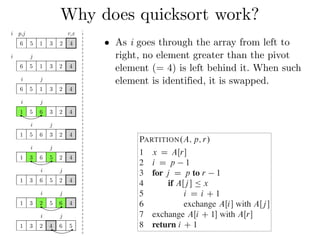
• As i goes through the array from left to
right, no element greater than the pivot
element (= 4) is left behind it. When such
element is identified, it is swapped.
Why does quicksort work?
QUICKSORT.A; p; r/
1 if p < r
2 q D PARTITION.A; p; r/
3 QUICKSORT.A; p; q 1/
4 QUICKSORT.A; q C 1; r/
To sort an entire array A, the initial call is QUICKSO
Partitioning the array
The key to the algorithm is the PARTITION procedur
ray AŒp : : r in place.
PARTITION.A; p; r/
1 x D AŒr
2 i D p 1
3 for j D p to r 1
4 if AŒj  Ä x
5 i D i C 1
6 exchange AŒi with AŒj 
7 exchange AŒi C 1 with AŒr
8 return i C 1
i p,j r,x
6 5 1 3 2 4
i j
6 5 1 3 2 4
i j
6 5 1 3 2 4
i j
1 5 6 3 2 4
i j
1 5 6 3 2 4
i j
1 3 6 5 2 4
i j
1 3 6 5 2 4
i j
1 3 2 5 6 4
i j
1 3 2 4 6 5
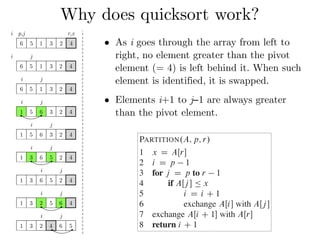
• As i goes through the array from left to
right, no element greater than the pivot
element (= 4) is left behind it. When such
element is identified, it is swapped.
• Elements i+1 to j−1 are always greater
than the pivot element.
Quicksort’s performance
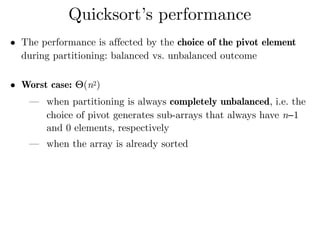
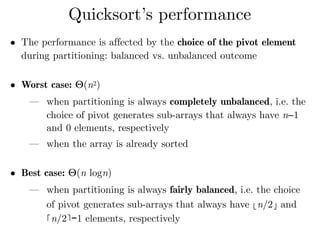
• The performance is affected by the choice of the pivot element
during partitioning: balanced vs. unbalanced outcome

Quicksort’s performance
• The performance is affected by the choice of the pivot element
during partitioning: balanced vs. unbalanced outcome

• Worst case: Θ(n2)
— when partitioning is always completely unbalanced, i.e. the
choice of pivot generates sub-arrays that always have n−1
and 0 elements, respectively
— when the array is already sorted

Quicksort’s performance
• The performance is affected by the choice of the pivot element
during partitioning: balanced vs. unbalanced outcome

• Worst case: Θ(n2)
— when partitioning is always completely unbalanced, i.e. the
choice of pivot generates sub-arrays that always have n−1
and 0 elements, respectively
— when the array is already sorted

• Best case: Θ(n logn)
— when partitioning is always fairly balanced, i.e. the choice
of pivot generates sub-arrays that always have ⌊n/2⌋ and
⌈n/2⌉−1 elements, respectively
Quicksort’s performance
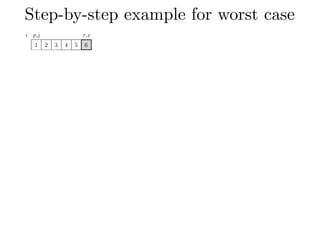
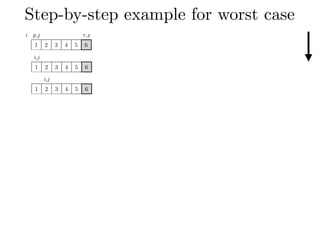
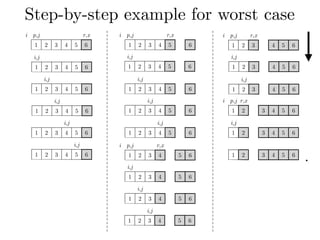
Step-by-step example for worst case
i p,j r,x
1 2 3 4 5 6
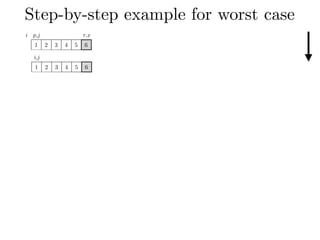
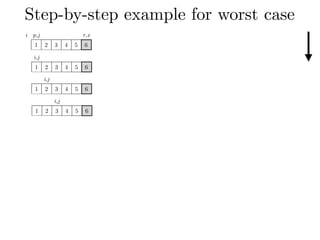
Step-by-step example for worst case
i p,j r,x
1 2 3 4 5 6
i,j
1 2 3 4 5 6
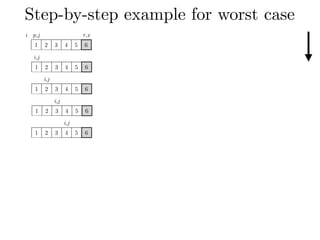
Step-by-step example for worst case
i p,j r,x
1 2 3 4 5 6
i,j
1 2 3 4 5 6
i,j
1 2 3 4 5 6
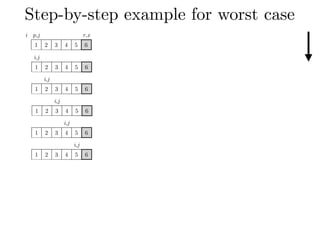
Step-by-step example for worst case
i p,j r,x
1 2 3 4 5 6
i,j
1 2 3 4 5 6
i,j
1 2 3 4 5 6
i,j
1 2 3 4 5 6
Step-by-step example for worst case
i p,j r,x
1 2 3 4 5 6
i,j
1 2 3 4 5 6
i,j
1 2 3 4 5 6
i,j
1 2 3 4 5 6
i,j
1 2 3 4 5 6
Step-by-step example for worst case
i p,j r,x
1 2 3 4 5 6
i,j
1 2 3 4 5 6
i,j
1 2 3 4 5 6
i,j
1 2 3 4 5 6
i,j
1 2 3 4 5 6
i,j
1 2 3 4 5 6
Step-by-step example for worst case
i p,j r,x
1 2 3 4 5 6
i,j
1 2 3 4 5 6
i,j
1 2 3 4 5 6
i,j
1 2 3 4 5 6
i,j
1 2 3 4 5 6
i,j
1 2 3 4 5 6
i p,j r,x
1 2 3 4 5 6
i,j
1 2 3 4 5 6
i,j
1 2 3 4 5 6
i,j
1 2 3 4 5 6
i,j
1 2 3 4 5 6
i p,j r,x
1 2 3 4 5 6
i,j
1 2 3 4 5 6
i,j
1 2 3 4 5 6
i,j
1 2 3 4 5 6
i p,j r,x
1 2 3 4 5 6
i,j
1 2 3 4 5 6
i,j
1 2 3 4 5 6
i p,j r,x
1 2 3 4 5 6
i,j
1 2 3 4 5 6
1 2 3 4 5 6
.
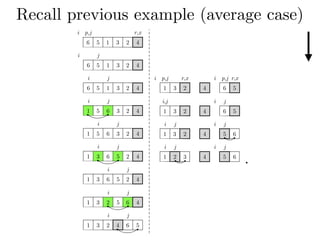
Recall previous example (average case)
i j i j
1 2 3 4 5 6
i p,j r,x
6 5 1 3 2 4
i j
6 5 1 3 2 4
i j
6 5 1 3 2 4
i j
1 5 6 3 2 4
i j
1 5 6 3 2 4
i j
1 3 6 5 2 4
i j
1 3 6 5 2 4
i j
1 3 2 5 6 4
i j
1 3 2 4 6 5
i j i j
1 3 2 4 5 6
i,j i j
1 3 2 4 6 5
i p,j r,x i p,j r,x
1 3 2 4 6 5
.
Cost estimation (running time)To sort an entire array A, the initial call is QUICKSORT.A; 1; A:length/.
Partitioning the array
The key to the algorithm is the PARTITION procedure, which rearranges th
ray AŒp : : r in place.
PARTITION.A; p; r/
1 x D AŒr
2 i D p 1
3 for j D p to r 1
4 if AŒj  Ä x
5 i D i C 1
6 exchange AŒi with AŒj 
7 exchange AŒi C 1 with AŒr
8 return i C 1
Figure 7.1 shows how PARTITION works on an 8-element array. PA
Combine: Because the subarrays are already sorted, no work is needed to combine
them: the entire array AŒp : : r is now sorted.
The following procedure implements quicksort:
QUICKSORT.A; p; r/
1 if p < r
2 q D PARTITION.A; p; r/
3 QUICKSORT.A; p; q 1/
4 QUICKSORT.A; q C 1; r/
To sort an entire array A, the initial call is QUICKSORT.A; 1; A:length/.
Partitioning the array
The key to the algorithm is the PARTITION procedure, which rearranges the subar-
ray AŒp : : r in place.
PARTITION.A; p; r/
1 x D AŒr
2 i D p 1
3 for j D p to r 1
4 if AŒj  Ä x
5 i D i C 1
6 exchange AŒi with AŒj 
7 exchange AŒi C 1 with AŒr
8 return i C 1
Figure 7.1 shows how PARTITION works on an 8-element array. PARTITION
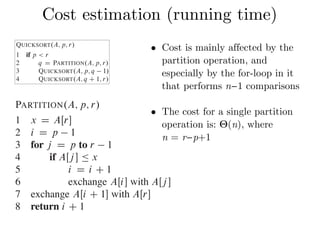
• Cost is mainly affected by the
partition operation, and
especially by the for-loop in it
that performs n−1 comparisons
• The cost for a single partition
operation is: Θ(n), where 

n = r−p+1
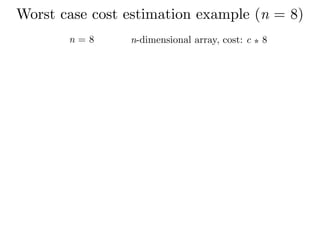
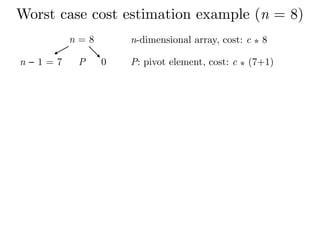
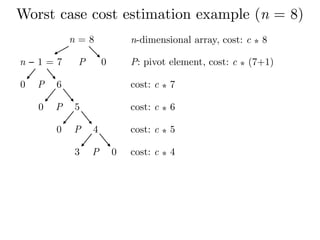
Worst case cost estimation example (n = 8)
n = 8 n-dimensional array, cost: c ⁎ 8
Worst case cost estimation example (n = 8)
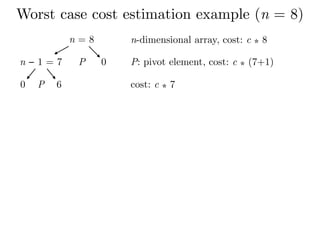
n = 8
n − 1 = 7 P 0
n-dimensional array, cost: c ⁎ 8
P: pivot element, cost: c ⁎ (7+1)
Worst case cost estimation example (n = 8)
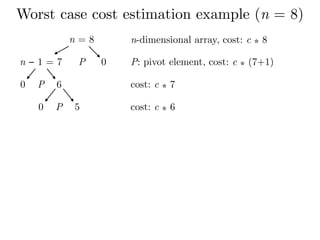
n = 8
n − 1 = 7 P 0
n-dimensional array, cost: c ⁎ 8
P: pivot element, cost: c ⁎ (7+1)
P 60 cost: c ⁎ 7
Worst case cost estimation example (n = 8)
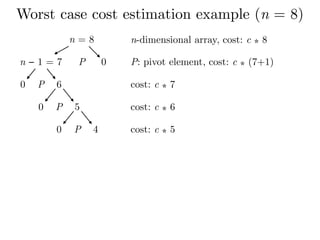
n = 8
n − 1 = 7 P 0
n-dimensional array, cost: c ⁎ 8
P: pivot element, cost: c ⁎ (7+1)
P 60
P 50
cost: c ⁎ 7
cost: c ⁎ 6
Worst case cost estimation example (n = 8)
n = 8
n − 1 = 7 P 0
n-dimensional array, cost: c ⁎ 8
P: pivot element, cost: c ⁎ (7+1)
P 60
P 50
P 40
cost: c ⁎ 7
cost: c ⁎ 6
cost: c ⁎ 5
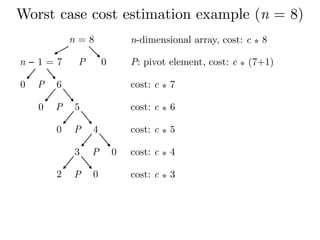
Worst case cost estimation example (n = 8)
n = 8
n − 1 = 7 P 0
n-dimensional array, cost: c ⁎ 8
P: pivot element, cost: c ⁎ (7+1)
P 60
P 50
P 40
P 03
cost: c ⁎ 7
cost: c ⁎ 6
cost: c ⁎ 5
cost: c ⁎ 4
Worst case cost estimation example (n = 8)
n = 8
n − 1 = 7 P 0
n-dimensional array, cost: c ⁎ 8
P: pivot element, cost: c ⁎ (7+1)
P 60
P 50
P 40
P 03
cost: c ⁎ 7
cost: c ⁎ 6
cost: c ⁎ 5
P 02
cost: c ⁎ 4
cost: c ⁎ 3
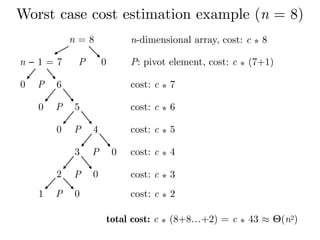
Worst case cost estimation example (n = 8)
n = 8
n − 1 = 7 P 0
n-dimensional array, cost: c ⁎ 8
P: pivot element, cost: c ⁎ (7+1)
P 60
P 50
P 40
P 03
cost: c ⁎ 7
cost: c ⁎ 6
cost: c ⁎ 5
P 02
P 01
cost: c ⁎ 4
cost: c ⁎ 3
total cost: c ⁎ (8+8…+2) = c ⁎ 43 ≈ Θ(n2)
cost: c ⁎ 2
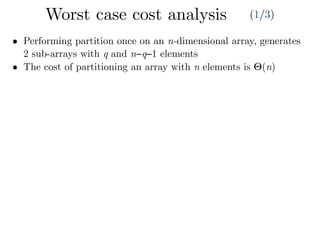
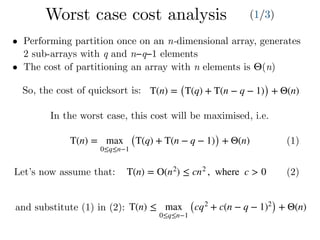
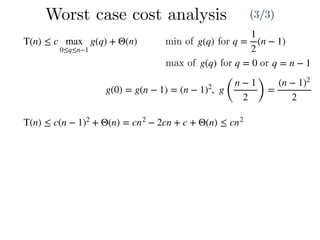
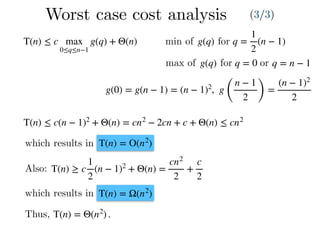
Worst case cost analysis (1/3)
• Performing partition once on an n-dimensional array, generates
2 sub-arrays with q and n−q−1 elements
• Performing partition once on an n-dimensional array, generates
2 sub-arrays with q and n−q−1 elements
• The cost of partitioning an array with n elements is Θ(n)
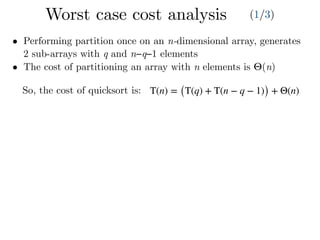
Worst case cost analysis (1/3)
• Performing partition once on an n-dimensional array, generates
2 sub-arrays with q and n−q−1 elements
• The cost of partitioning an array with n elements is Θ(n)
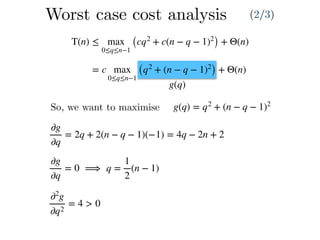
T(n) = (T(q) + T(n − q − 1)) + Θ(n)So, the cost of quicksort is:
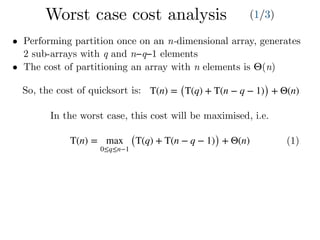
Worst case cost analysis (1/3)
T(n) = max
0≤q≤n−1
(T(q) + T(n − q − 1)) + Θ(n) (1)
• Performing partition once on an n-dimensional array, generates
2 sub-arrays with q and n−q−1 elements
• The cost of partitioning an array with n elements is Θ(n)
In the worst case, this cost will be maximised, i.e.
T(n) = (T(q) + T(n − q − 1)) + Θ(n)So, the cost of quicksort is:
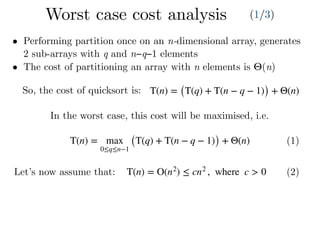
Worst case cost analysis (1/3)
T(n) = max
0≤q≤n−1
(T(q) + T(n − q − 1)) + Θ(n) (1)
T(n) = O(n2
) ≤ cn2
, where c > 0 (2)
• Performing partition once on an n-dimensional array, generates
2 sub-arrays with q and n−q−1 elements
• The cost of partitioning an array with n elements is Θ(n)
In the worst case, this cost will be maximised, i.e.
Let’s now assume that:
T(n) = (T(q) + T(n − q − 1)) + Θ(n)So, the cost of quicksort is:
Worst case cost analysis (1/3)
T(n) = max
0≤q≤n−1
(T(q) + T(n − q − 1)) + Θ(n) (1)
T(n) = O(n2
) ≤ cn2
, where c > 0 (2)
• Performing partition once on an n-dimensional array, generates
2 sub-arrays with q and n−q−1 elements
• The cost of partitioning an array with n elements is Θ(n)
In the worst case, this cost will be maximised, i.e.
Let’s now assume that:
and substitute (1) in (2): T(n) ≤ max
0≤q≤n−1
(cq2
+ c(n − q − 1)2
) + Θ(n)
T(n) = (T(q) + T(n − q − 1)) + Θ(n)So, the cost of quicksort is:
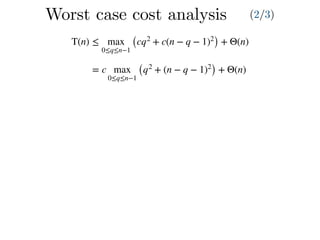
Worst case cost analysis (1/3)
T(n) ≤ max
0≤q≤n−1
(cq2
+ c(n − q − 1)2
) + Θ(n)
= c max
0≤q≤n−1
(q2
+ (n − q − 1)2
) + Θ(n)
Worst case cost analysis (2/3)
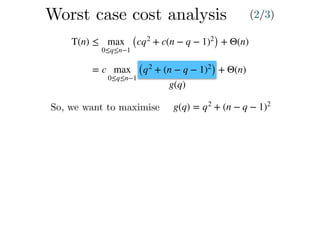
T(n) ≤ max
0≤q≤n−1
(cq2
+ c(n − q − 1)2
) + Θ(n)
= c max
0≤q≤n−1
(q2
+ (n − q − 1)2
) + Θ(n)
g(q)
So, we want to maximise g(q) = q2
+ (n − q − 1)2
Worst case cost analysis (2/3)
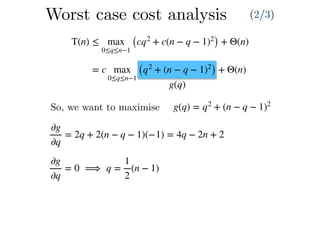
T(n) ≤ max
0≤q≤n−1
(cq2
+ c(n − q − 1)2
) + Θ(n)
= c max
0≤q≤n−1
(q2
+ (n − q − 1)2
) + Θ(n)
g(q)
So, we want to maximise g(q) = q2
+ (n − q − 1)2
∂g
∂q
= 2q + 2(n − q − 1)(−1) = 4q − 2n + 2
∂g
∂q
= 0 ⟹ q =
1
2
(n − 1)
Worst case cost analysis (2/3)
T(n) ≤ max
0≤q≤n−1
(cq2
+ c(n − q − 1)2
) + Θ(n)
= c max
0≤q≤n−1
(q2
+ (n − q − 1)2
) + Θ(n)
g(q)
So, we want to maximise g(q) = q2
+ (n − q − 1)2
∂g
∂q
= 2q + 2(n − q − 1)(−1) = 4q − 2n + 2
∂g
∂q
= 0 ⟹ q =
1
2
(n − 1)
∂2
g
∂q2
= 4 > 0
Worst case cost analysis (2/3)
T(n) ≤ max
0≤q≤n−1
(cq2
+ c(n − q − 1)2
) + Θ(n)
= c max
0≤q≤n−1
(q2
+ (n − q − 1)2
) + Θ(n)
g(q)
So, we want to maximise g(q) = q2
+ (n − q − 1)2
∂g
∂q
= 2q + 2(n − q − 1)(−1) = 4q − 2n + 2
∂g
∂q
= 0 ⟹ q =
1
2
(n − 1)
∂2
g
∂q2
= 4 > 0
this is a local minimum of g(q)
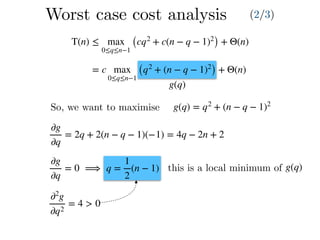
Worst case cost analysis (2/3)
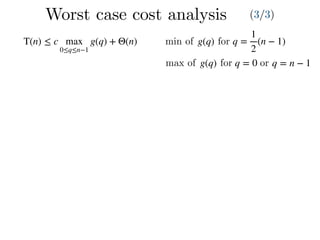
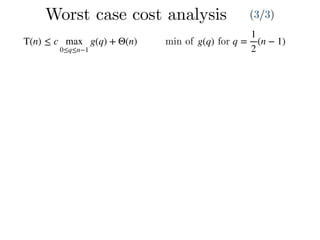
Worst case cost analysis (3/3)
T(n) ≤ c max
0≤q≤n−1
g(q) + Θ(n) q =
1
2
(n − 1)g(q)min of for
Worst case cost analysis (3/3)
T(n) ≤ c max
0≤q≤n−1
g(q) + Θ(n) q =
1
2
(n − 1)g(q)min of for
max of g(q) for q = 0 or q = n − 1
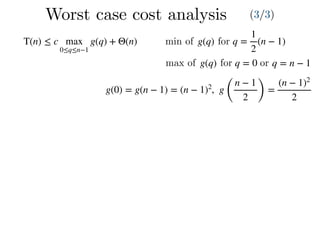
Worst case cost analysis (3/3)
T(n) ≤ c max
0≤q≤n−1
g(q) + Θ(n) q =
1
2
(n − 1)g(q)min of for
max of g(q) for q = 0 or q = n − 1
g(0) = g(n − 1) = (n − 1)2
, g
(
n − 1
2 )
=
(n − 1)2
2
Worst case cost analysis (3/3)
T(n) ≤ c max
0≤q≤n−1
g(q) + Θ(n) q =
1
2
(n − 1)g(q)min of for
max of g(q) for q = 0 or q = n − 1
g(0) = g(n − 1) = (n − 1)2
, g
(
n − 1
2 )
=
(n − 1)2
2
T(n) ≤ c(n − 1)2
+ Θ(n) = cn2
− 2cn + c + Θ(n) ≤ cn2
Worst case cost analysis (3/3)
T(n) ≤ c max
0≤q≤n−1
g(q) + Θ(n) q =
1
2
(n − 1)g(q)min of for
max of g(q) for q = 0 or q = n − 1
g(0) = g(n − 1) = (n − 1)2
, g
(
n − 1
2 )
=
(n − 1)2
2
T(n) ≤ c(n − 1)2
+ Θ(n) = cn2
− 2cn + c + Θ(n) ≤ cn2
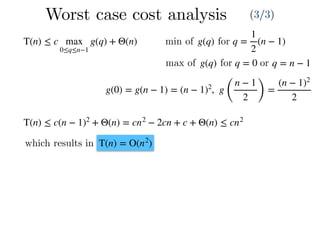
which results in T(n) = O(n2
)
Worst case cost analysis (3/3)
T(n) ≤ c max
0≤q≤n−1
g(q) + Θ(n) q =
1
2
(n − 1)g(q)min of for
max of g(q) for q = 0 or q = n − 1
g(0) = g(n − 1) = (n − 1)2
, g
(
n − 1
2 )
=
(n − 1)2
2
T(n) ≤ c(n − 1)2
+ Θ(n) = cn2
− 2cn + c + Θ(n) ≤ cn2
which results in T(n) = O(n2
)
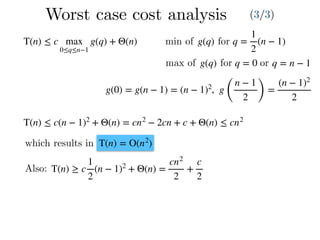
Also: T(n) ≥ c
1
2
(n − 1)2
+ Θ(n) =
cn2
2
+
c
2
Worst case cost analysis (3/3)
T(n) ≤ c max
0≤q≤n−1
g(q) + Θ(n) q =
1
2
(n − 1)g(q)min of for
max of g(q) for q = 0 or q = n − 1
g(0) = g(n − 1) = (n − 1)2
, g
(
n − 1
2 )
=
(n − 1)2
2
T(n) ≤ c(n − 1)2
+ Θ(n) = cn2
− 2cn + c + Θ(n) ≤ cn2
which results in T(n) = O(n2
)
Also: T(n) ≥ c
1
2
(n − 1)2
+ Θ(n) =
cn2
2
+
c
2
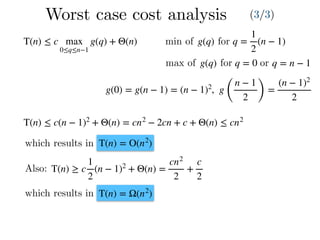
T(n) = Ω(n2
)which results in
Worst case cost analysis (3/3)
T(n) ≤ c max
0≤q≤n−1
g(q) + Θ(n) q =
1
2
(n − 1)g(q)min of for
max of g(q) for q = 0 or q = n − 1
g(0) = g(n − 1) = (n − 1)2
, g
(
n − 1
2 )
=
(n − 1)2
2
T(n) ≤ c(n − 1)2
+ Θ(n) = cn2
− 2cn + c + Θ(n) ≤ cn2
which results in T(n) = O(n2
)
Also: T(n) ≥ c
1
2
(n − 1)2
+ Θ(n) =
cn2
2
+
c
2
T(n) = Ω(n2
)which results in
Thus, T(n) = Θ(n2
) .
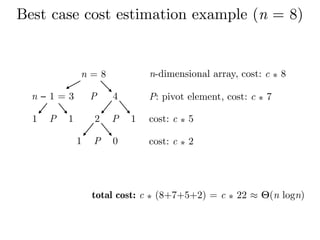
Best case cost estimation example (n = 8)
n = 8
n − 1 = 3 P 4
n-dimensional array, cost: c ⁎ 8
P: pivot element, cost: c ⁎ 7
P 11 P 12
P 01
cost: c ⁎ 5
cost: c ⁎ 2
total cost: c ⁎ (8+7+5+2) = c ⁎ 22 ≈ Θ(n logn)
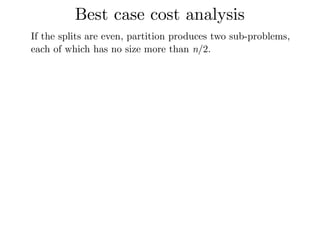
Best case cost analysis
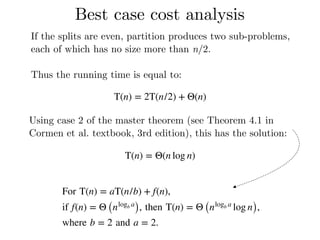
If the splits are even, partition produces two sub-problems,
each of which has no size more than n/2.
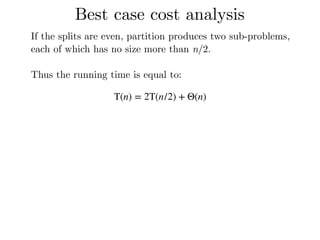
Best case cost analysis
If the splits are even, partition produces two sub-problems,
each of which has no size more than n/2.
Thus the running time is equal to:
T(n) = 2T(n/2) + Θ(n)
Best case cost analysis
If the splits are even, partition produces two sub-problems,
each of which has no size more than n/2.
Thus the running time is equal to:
T(n) = 2T(n/2) + Θ(n)
Using case 2 of the master theorem (see Theorem 4.1 in
Cormen et al. textbook, 3rd edition), this has the solution:
T(n) = Θ(n log n)
For T(n) = aT(n/b) + f(n),
if f(n) = Θ (nlogb a
), then T(n) = Θ (nlogb a
log n),
where b = 2 and a = 2.
• Instead of using the right-most element, A[r], as the pivot…
Randomised quicksort
element x D AŒr is equally likely to be any of the r p C 1 elements in the
subarray. Because we randomly choose the pivot element, we expect the split of
the input array to be reasonably well balanced on average.
The changes to PARTITION and QUICKSORT are small. In the new partition
procedure, we simply implement the swap before actually partitioning:
RANDOMIZED-PARTITION.A; p; r/
1 i D RANDOM.p; r/
2 exchange AŒr with AŒi
3 return PARTITION.A; p; r/
The new quicksort calls RANDOMIZED-PARTITION in place of PARTITION:
RANDOMIZED-QUICKSORT.A; p; r/
1 if p < r
2 q D RANDOMIZED-PARTITION.A; p; r/
3 RANDOMIZED-QUICKSORT.A; p; q 1/
4 RANDOMIZED-QUICKSORT.A; q C 1; r/
We analyze this algorithm in the next section.
subarray. Because we randomly choose the pivot element, we expect the split of
the input array to be reasonably well balanced on average.
The changes to PARTITION and QUICKSORT are small. In the new partition
procedure, we simply implement the swap before actually partitioning:
RANDOMIZED-PARTITION.A; p; r/
1 i D RANDOM.p; r/
2 exchange AŒr with AŒi
3 return PARTITION.A; p; r/
The new quicksort calls RANDOMIZED-PARTITION in place of PARTITION:
RANDOMIZED-QUICKSORT.A; p; r/
1 if p < r
2 q D RANDOMIZED-PARTITION.A; p; r/
3 RANDOMIZED-QUICKSORT.A; p; q 1/
4 RANDOMIZED-QUICKSORT.A; q C 1; r/
We analyze this algorithm in the next section.
• Instead of using the right-most element, A[r], as the pivot…
Randomised quicksort
element x D AŒr is equally likely to be any of the r p C 1 elements in the
subarray. Because we randomly choose the pivot element, we expect the split of
the input array to be reasonably well balanced on average.
The changes to PARTITION and QUICKSORT are small. In the new partition
procedure, we simply implement the swap before actually partitioning:
RANDOMIZED-PARTITION.A; p; r/
1 i D RANDOM.p; r/
2 exchange AŒr with AŒi
3 return PARTITION.A; p; r/
The new quicksort calls RANDOMIZED-PARTITION in place of PARTITION:
RANDOMIZED-QUICKSORT.A; p; r/
1 if p < r
2 q D RANDOMIZED-PARTITION.A; p; r/
3 RANDOMIZED-QUICKSORT.A; p; q 1/
4 RANDOMIZED-QUICKSORT.A; q C 1; r/
We analyze this algorithm in the next section.
subarray. Because we randomly choose the pivot element, we expect the split of
the input array to be reasonably well balanced on average.
The changes to PARTITION and QUICKSORT are small. In the new partition
procedure, we simply implement the swap before actually partitioning:
RANDOMIZED-PARTITION.A; p; r/
1 i D RANDOM.p; r/
2 exchange AŒr with AŒi
3 return PARTITION.A; p; r/
The new quicksort calls RANDOMIZED-PARTITION in place of PARTITION:
RANDOMIZED-QUICKSORT.A; p; r/
1 if p < r
2 q D RANDOMIZED-PARTITION.A; p; r/
3 RANDOMIZED-QUICKSORT.A; p; q 1/
4 RANDOMIZED-QUICKSORT.A; q C 1; r/
We analyze this algorithm in the next section.
• Why? By adding randomisation, obtaining the average expected
performance is more likely than obtaining the worst case
performance.
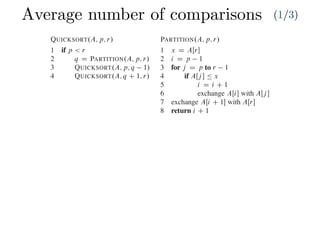
Average number of comparisons (1/3)
Combine: Because the subarrays are already sorted, no work is needed to combine
them: the entire array AŒp : : r is now sorted.
The following procedure implements quicksort:
QUICKSORT.A; p; r/
1 if p < r
2 q D PARTITION.A; p; r/
3 QUICKSORT.A; p; q 1/
4 QUICKSORT.A; q C 1; r/
To sort an entire array A, the initial call is QUICKSORT.A; 1; A:length/.
Partitioning the array
The key to the algorithm is the PARTITION procedure, which rearranges the subar-
ray AŒp : : r in place.
PARTITION.A; p; r/
1 x D AŒr
2 i D p 1
3 for j D p to r 1
4 if AŒj  Ä x
5 i D i C 1
6 exchange AŒi with AŒj 
7 exchange AŒi C 1 with AŒr
8 return i C 1
Partitioning the array
The key to the algorithm is the PARTITION procedure, w
ray AŒp : : r in place.
PARTITION.A; p; r/
1 x D AŒr
2 i D p 1
3 for j D p to r 1
4 if AŒj  Ä x
5 i D i C 1
6 exchange AŒi with AŒj 
7 exchange AŒi C 1 with AŒr
8 return i C 1
Figure 7.1 shows how PARTITION works on an 8-e
always selects an element x D AŒr as a pivot element ar
subarray AŒp : : r. As the procedure runs, it partitions t
empty) regions. At the start of each iteration of the for lo
satisfy certain properties, shown in Figure 7.2. We stat
invariant:
At the beginning of each iteration of the loop of l
index k,
1. If p Ä k Ä i, then AŒk Ä x.
2. If i C 1 Ä k Ä j 1, then AŒk > x.
3. If k D r, then AŒk D x.
Average number of comparisons (1/3)
Combine: Because the subarrays are already sorted, no work is needed to combine
them: the entire array AŒp : : r is now sorted.
The following procedure implements quicksort:
QUICKSORT.A; p; r/
1 if p < r
2 q D PARTITION.A; p; r/
3 QUICKSORT.A; p; q 1/
4 QUICKSORT.A; q C 1; r/
To sort an entire array A, the initial call is QUICKSORT.A; 1; A:length/.
Partitioning the array
The key to the algorithm is the PARTITION procedure, which rearranges the subar-
ray AŒp : : r in place.
PARTITION.A; p; r/
1 x D AŒr
2 i D p 1
3 for j D p to r 1
4 if AŒj  Ä x
5 i D i C 1
6 exchange AŒi with AŒj 
7 exchange AŒi C 1 with AŒr
8 return i C 1
Partitioning the array
The key to the algorithm is the PARTITION procedure, w
ray AŒp : : r in place.
PARTITION.A; p; r/
1 x D AŒr
2 i D p 1
3 for j D p to r 1
4 if AŒj  Ä x
5 i D i C 1
6 exchange AŒi with AŒj 
7 exchange AŒi C 1 with AŒr
8 return i C 1
Figure 7.1 shows how PARTITION works on an 8-e
always selects an element x D AŒr as a pivot element ar
subarray AŒp : : r. As the procedure runs, it partitions t
empty) regions. At the start of each iteration of the for lo
satisfy certain properties, shown in Figure 7.2. We stat
invariant:
At the beginning of each iteration of the loop of l
index k,
1. If p Ä k Ä i, then AŒk Ä x.
2. If i C 1 Ä k Ä j 1, then AŒk > x.
3. If k D r, then AŒk D x.
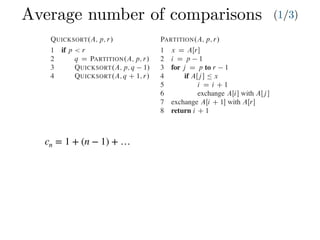
cn = 1 + (n − 1) + …
Average number of comparisons (1/3)
cn = n +
1
n [(c0 + cn−1) + (c1 + cn−2) + … + (cn−1 + c0)]
Combine: Because the subarrays are already sorted, no work is needed to combine
them: the entire array AŒp : : r is now sorted.
The following procedure implements quicksort:
QUICKSORT.A; p; r/
1 if p < r
2 q D PARTITION.A; p; r/
3 QUICKSORT.A; p; q 1/
4 QUICKSORT.A; q C 1; r/
To sort an entire array A, the initial call is QUICKSORT.A; 1; A:length/.
Partitioning the array
The key to the algorithm is the PARTITION procedure, which rearranges the subar-
ray AŒp : : r in place.
PARTITION.A; p; r/
1 x D AŒr
2 i D p 1
3 for j D p to r 1
4 if AŒj  Ä x
5 i D i C 1
6 exchange AŒi with AŒj 
7 exchange AŒi C 1 with AŒr
8 return i C 1
Partitioning the array
The key to the algorithm is the PARTITION procedure, w
ray AŒp : : r in place.
PARTITION.A; p; r/
1 x D AŒr
2 i D p 1
3 for j D p to r 1
4 if AŒj  Ä x
5 i D i C 1
6 exchange AŒi with AŒj 
7 exchange AŒi C 1 with AŒr
8 return i C 1
Figure 7.1 shows how PARTITION works on an 8-e
always selects an element x D AŒr as a pivot element ar
subarray AŒp : : r. As the procedure runs, it partitions t
empty) regions. At the start of each iteration of the for lo
satisfy certain properties, shown in Figure 7.2. We stat
invariant:
At the beginning of each iteration of the loop of l
index k,
1. If p Ä k Ä i, then AŒk Ä x.
2. If i C 1 Ä k Ä j 1, then AŒk > x.
3. If k D r, then AŒk D x.
Average number of comparisons (1/3)
cn = n +
1
n [(c0 + cn−1) + (c1 + cn−2) + … + (cn−1 + c0)]
Combine: Because the subarrays are already sorted, no work is needed to combine
them: the entire array AŒp : : r is now sorted.
The following procedure implements quicksort:
QUICKSORT.A; p; r/
1 if p < r
2 q D PARTITION.A; p; r/
3 QUICKSORT.A; p; q 1/
4 QUICKSORT.A; q C 1; r/
To sort an entire array A, the initial call is QUICKSORT.A; 1; A:length/.
Partitioning the array
The key to the algorithm is the PARTITION procedure, which rearranges the subar-
ray AŒp : : r in place.
PARTITION.A; p; r/
1 x D AŒr
2 i D p 1
3 for j D p to r 1
4 if AŒj  Ä x
5 i D i C 1
6 exchange AŒi with AŒj 
7 exchange AŒi C 1 with AŒr
8 return i C 1
Partitioning the array
The key to the algorithm is the PARTITION procedure, w
ray AŒp : : r in place.
PARTITION.A; p; r/
1 x D AŒr
2 i D p 1
3 for j D p to r 1
4 if AŒj  Ä x
5 i D i C 1
6 exchange AŒi with AŒj 
7 exchange AŒi C 1 with AŒr
8 return i C 1
Figure 7.1 shows how PARTITION works on an 8-e
always selects an element x D AŒr as a pivot element ar
subarray AŒp : : r. As the procedure runs, it partitions t
empty) regions. At the start of each iteration of the for lo
satisfy certain properties, shown in Figure 7.2. We stat
invariant:
At the beginning of each iteration of the loop of l
index k,
1. If p Ä k Ä i, then AŒk Ä x.
2. If i C 1 Ä k Ä j 1, then AŒk > x.
3. If k D r, then AŒk D x.
total number of
comparisons
Average number of comparisons (1/3)
cn = n +
1
n [(c0 + cn−1) + (c1 + cn−2) + … + (cn−1 + c0)]
Combine: Because the subarrays are already sorted, no work is needed to combine
them: the entire array AŒp : : r is now sorted.
The following procedure implements quicksort:
QUICKSORT.A; p; r/
1 if p < r
2 q D PARTITION.A; p; r/
3 QUICKSORT.A; p; q 1/
4 QUICKSORT.A; q C 1; r/
To sort an entire array A, the initial call is QUICKSORT.A; 1; A:length/.
Partitioning the array
The key to the algorithm is the PARTITION procedure, which rearranges the subar-
ray AŒp : : r in place.
PARTITION.A; p; r/
1 x D AŒr
2 i D p 1
3 for j D p to r 1
4 if AŒj  Ä x
5 i D i C 1
6 exchange AŒi with AŒj 
7 exchange AŒi C 1 with AŒr
8 return i C 1
Partitioning the array
The key to the algorithm is the PARTITION procedure, w
ray AŒp : : r in place.
PARTITION.A; p; r/
1 x D AŒr
2 i D p 1
3 for j D p to r 1
4 if AŒj  Ä x
5 i D i C 1
6 exchange AŒi with AŒj 
7 exchange AŒi C 1 with AŒr
8 return i C 1
Figure 7.1 shows how PARTITION works on an 8-e
always selects an element x D AŒr as a pivot element ar
subarray AŒp : : r. As the procedure runs, it partitions t
empty) regions. At the start of each iteration of the for lo
satisfy certain properties, shown in Figure 7.2. We stat
invariant:
At the beginning of each iteration of the loop of l
index k,
1. If p Ä k Ä i, then AŒk Ä x.
2. If i C 1 Ä k Ä j 1, then AŒk > x.
3. If k D r, then AŒk D x.
total number of
comparisons
probability of a
split — n pivot
choices
Average number of comparisons (1/3)
cn = n +
1
n [(c0 + cn−1) + (c1 + cn−2) + … + (cn−1 + c0)]
Combine: Because the subarrays are already sorted, no work is needed to combine
them: the entire array AŒp : : r is now sorted.
The following procedure implements quicksort:
QUICKSORT.A; p; r/
1 if p < r
2 q D PARTITION.A; p; r/
3 QUICKSORT.A; p; q 1/
4 QUICKSORT.A; q C 1; r/
To sort an entire array A, the initial call is QUICKSORT.A; 1; A:length/.
Partitioning the array
The key to the algorithm is the PARTITION procedure, which rearranges the subar-
ray AŒp : : r in place.
PARTITION.A; p; r/
1 x D AŒr
2 i D p 1
3 for j D p to r 1
4 if AŒj  Ä x
5 i D i C 1
6 exchange AŒi with AŒj 
7 exchange AŒi C 1 with AŒr
8 return i C 1
Partitioning the array
The key to the algorithm is the PARTITION procedure, w
ray AŒp : : r in place.
PARTITION.A; p; r/
1 x D AŒr
2 i D p 1
3 for j D p to r 1
4 if AŒj  Ä x
5 i D i C 1
6 exchange AŒi with AŒj 
7 exchange AŒi C 1 with AŒr
8 return i C 1
Figure 7.1 shows how PARTITION works on an 8-e
always selects an element x D AŒr as a pivot element ar
subarray AŒp : : r. As the procedure runs, it partitions t
empty) regions. At the start of each iteration of the for lo
satisfy certain properties, shown in Figure 7.2. We stat
invariant:
At the beginning of each iteration of the loop of l
index k,
1. If p Ä k Ä i, then AŒk Ä x.
2. If i C 1 Ä k Ä j 1, then AŒk > x.
3. If k D r, then AŒk D x.
total number of
comparisons
probability of a
split — n pivot
choices
sub-array sizes
cn = n +
1
n [(c0 + cn−1) + (c1 + cn−2) + … + (cn−1 + c0)]
= n +
2
n
(c0 + c1 + … + cn−1) ⟹
Average number of comparisons (2/3)
cn = n +
1
n [(c0 + cn−1) + (c1 + cn−2) + … + (cn−1 + c0)]
= n +
2
n
(c0 + c1 + … + cn−1) ⟹
ncn = n2
+ 2 (c0 + c1 + … + cn−1)
Average number of comparisons (2/3)
cn = n +
1
n [(c0 + cn−1) + (c1 + cn−2) + … + (cn−1 + c0)]
= n +
2
n
(c0 + c1 + … + cn−1) ⟹
ncn = n2
+ 2 (c0 + c1 + … + cn−1)
(n − 1)cn−1 = (n − 1)2
+ 2 (c0 + c1 + … + cn−2)
Average number of comparisons (2/3)
Replace n → n−1
cn = n +
1
n [(c0 + cn−1) + (c1 + cn−2) + … + (cn−1 + c0)]
= n +
2
n
(c0 + c1 + … + cn−1) ⟹
ncn = n2
+ 2 (c0 + c1 + … + cn−1)
(n − 1)cn−1 = (n − 1)2
+ 2 (c0 + c1 + … + cn−2)
Average number of comparisons (2/3)
subtract
cn = n +
1
n [(c0 + cn−1) + (c1 + cn−2) + … + (cn−1 + c0)]
= n +
2
n
(c0 + c1 + … + cn−1) ⟹
ncn = n2
+ 2 (c0 + c1 + … + cn−1)
(n − 1)cn−1 = (n − 1)2
+ 2 (c0 + c1 + … + cn−2)
ncn − (n − 1)cn−1 = 2(n − 1) + 2cn−1 ⟹
Average number of comparisons (2/3)
subtract
cn = n +
1
n [(c0 + cn−1) + (c1 + cn−2) + … + (cn−1 + c0)]
= n +
2
n
(c0 + c1 + … + cn−1) ⟹
ncn = n2
+ 2 (c0 + c1 + … + cn−1)
(n − 1)cn−1 = (n − 1)2
+ 2 (c0 + c1 + … + cn−2)
ncn − (n − 1)cn−1 = 2(n − 1) + 2cn−1 ⟹
Average number of comparisons (2/3)
subtract
cn =
2n − 1
n
+
(n + 1)cn−1
n
⟹
cn = n +
1
n [(c0 + cn−1) + (c1 + cn−2) + … + (cn−1 + c0)]
= n +
2
n
(c0 + c1 + … + cn−1) ⟹
ncn = n2
+ 2 (c0 + c1 + … + cn−1)
(n − 1)cn−1 = (n − 1)2
+ 2 (c0 + c1 + … + cn−2)
ncn − (n − 1)cn−1 = 2(n − 1) + 2cn−1 ⟹
Average number of comparisons (2/3)
subtract
cn =
2n − 1
n
+
(n + 1)cn−1
n
⟹ divide by n + 1
cn = n +
1
n [(c0 + cn−1) + (c1 + cn−2) + … + (cn−1 + c0)]
= n +
2
n
(c0 + c1 + … + cn−1) ⟹
ncn = n2
+ 2 (c0 + c1 + … + cn−1)
(n − 1)cn−1 = (n − 1)2
+ 2 (c0 + c1 + … + cn−2)
ncn − (n − 1)cn−1 = 2(n − 1) + 2cn−1 ⟹
cn
n + 1
=
2
n + 1
−
1
n(n + 1)
+
cn−1
n
Average number of comparisons (2/3)
subtract
cn =
2n − 1
n
+
(n + 1)cn−1
n
⟹ divide by n + 1
cn = n +
1
n [(c0 + cn−1) + (c1 + cn−2) + … + (cn−1 + c0)]
= n +
2
n
(c0 + c1 + … + cn−1) ⟹
ncn = n2
+ 2 (c0 + c1 + … + cn−1)
(n − 1)cn−1 = (n − 1)2
+ 2 (c0 + c1 + … + cn−2)
ncn − (n − 1)cn−1 = 2(n − 1) + 2cn−1 ⟹
cn
n + 1
=
2
n + 1
−
1
n(n + 1)
+
cn−1
n
Average number of comparisons (2/3)
subtract
cn =
2n − 1
n
+
(n + 1)cn−1
n
⟹ divide by n + 1
≤
2
n + 1
+
cn−1
n
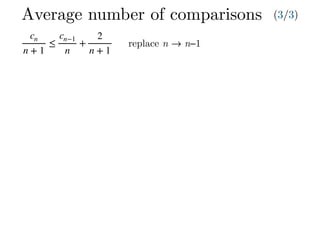
Average number of comparisons (3/3)
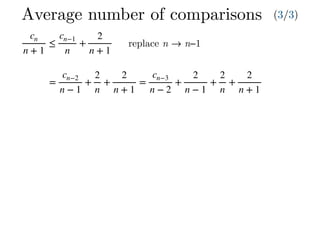
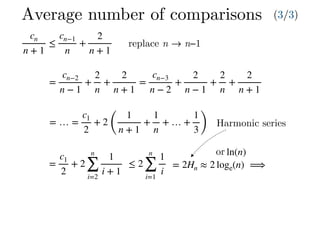
cn
n + 1
≤
cn−1
n
+
2
n + 1
replace n → n−1
=
cn−2
n − 1
+
2
n
+
2
n + 1
=
cn−3
n − 2
+
2
n − 1
+
2
n
+
2
n + 1
Average number of comparisons (3/3)
cn
n + 1
≤
cn−1
n
+
2
n + 1
replace n → n−1
=
cn−2
n − 1
+
2
n
+
2
n + 1
=
cn−3
n − 2
+
2
n − 1
+
2
n
+
2
n + 1
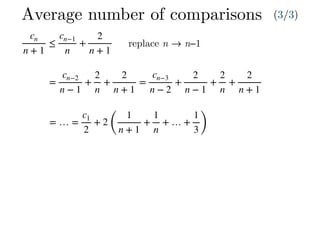
= … =
c1
2
+ 2
(
1
n + 1
+
1
n
+ … +
1
3)
Average number of comparisons (3/3)
cn
n + 1
≤
cn−1
n
+
2
n + 1
replace n → n−1
=
cn−2
n − 1
+
2
n
+
2
n + 1
=
cn−3
n − 2
+
2
n − 1
+
2
n
+
2
n + 1
= … =
c1
2
+ 2
(
1
n + 1
+
1
n
+ … +
1
3)
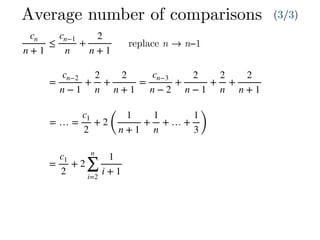
=
c1
2
+ 2
n
∑
i=2
1
i + 1
Average number of comparisons (3/3)
cn
n + 1
≤
cn−1
n
+
2
n + 1
replace n → n−1
=
cn−2
n − 1
+
2
n
+
2
n + 1
=
cn−3
n − 2
+
2
n − 1
+
2
n
+
2
n + 1
= … =
c1
2
+ 2
(
1
n + 1
+
1
n
+ … +
1
3)
=
c1
2
+ 2
n
∑
i=2
1
i + 1
Average number of comparisons (3/3)
cn
n + 1
≤
cn−1
n
+
2
n + 1
replace n → n−1
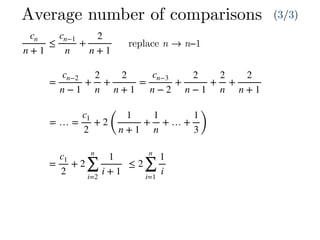
≤ 2
n
∑
i=1
1
i
=
cn−2
n − 1
+
2
n
+
2
n + 1
=
cn−3
n − 2
+
2
n − 1
+
2
n
+
2
n + 1
= … =
c1
2
+ 2
(
1
n + 1
+
1
n
+ … +
1
3)
=
c1
2
+ 2
n
∑
i=2
1
i + 1
Average number of comparisons (3/3)
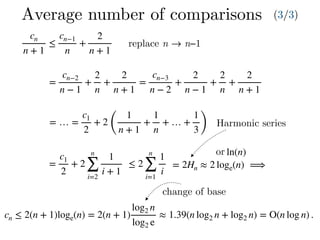
cn
n + 1
≤
cn−1
n
+
2
n + 1
replace n → n−1
≤ 2
n
∑
i=1
1
i
= 2Hn ≈ 2 loge(n) ⟹
Harmonic series
or ln(n)
=
cn−2
n − 1
+
2
n
+
2
n + 1
=
cn−3
n − 2
+
2
n − 1
+
2
n
+
2
n + 1
= … =
c1
2
+ 2
(
1
n + 1
+
1
n
+ … +
1
3)
=
c1
2
+ 2
n
∑
i=2
1
i + 1
cn ≤ 2(n + 1)loge(n) = 2(n + 1)
log2 n
log2 e
≈ 1.39(n log2 n + log2 n) = O(n log n) .
Average number of comparisons (3/3)
cn
n + 1
≤
cn−1
n
+
2
n + 1
replace n → n−1
≤ 2
n
∑
i=1
1
i
= 2Hn ≈ 2 loge(n) ⟹
Harmonic series
change of base
or ln(n)
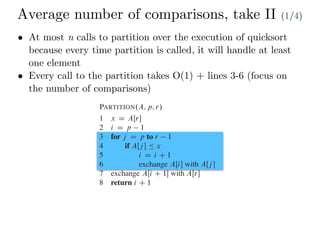
Average number of comparisons, take II (1/4)
• At most n calls to partition over the execution of quicksort
because every time partition is called, it will handle at least
one element
• Every call to the partition takes O(1) + lines 3-6 (focus on
the number of comparisons)
1 if p < r
2 q D PARTITION.A; p; r/
3 QUICKSORT.A; p; q 1/
4 QUICKSORT.A; q C 1; r/
To sort an entire array A, the initial call is QUICKSORT.A; 1; A:length/.
Partitioning the array
The key to the algorithm is the PARTITION procedure, which rearranges
ray AŒp : : r in place.
PARTITION.A; p; r/
1 x D AŒr
2 i D p 1
3 for j D p to r 1
4 if AŒj  Ä x
5 i D i C 1
6 exchange AŒi with AŒj 
7 exchange AŒi C 1 with AŒr
8 return i C 1
Figure 7.1 shows how PARTITION works on an 8-element array. P
always selects an element x D AŒr as a pivot element around which to p
subarray AŒp : : r. As the procedure runs, it partitions the array into fou
empty) regions. At the start of each iteration of the for loop in lines 3–6, t
satisfy certain properties, shown in Figure 7.2. We state these propertie
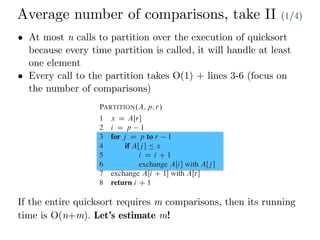
Average number of comparisons, take II (1/4)
• At most n calls to partition over the execution of quicksort
because every time partition is called, it will handle at least
one element
• Every call to the partition takes O(1) + lines 3-6 (focus on
the number of comparisons)
1 if p < r
2 q D PARTITION.A; p; r/
3 QUICKSORT.A; p; q 1/
4 QUICKSORT.A; q C 1; r/
To sort an entire array A, the initial call is QUICKSORT.A; 1; A:length/.
Partitioning the array
The key to the algorithm is the PARTITION procedure, which rearranges
ray AŒp : : r in place.
PARTITION.A; p; r/
1 x D AŒr
2 i D p 1
3 for j D p to r 1
4 if AŒj  Ä x
5 i D i C 1
6 exchange AŒi with AŒj 
7 exchange AŒi C 1 with AŒr
8 return i C 1
Figure 7.1 shows how PARTITION works on an 8-element array. P
always selects an element x D AŒr as a pivot element around which to p
subarray AŒp : : r. As the procedure runs, it partitions the array into fou
empty) regions. At the start of each iteration of the for loop in lines 3–6, t
satisfy certain properties, shown in Figure 7.2. We state these propertie
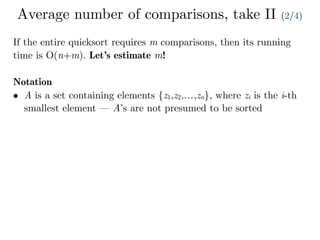
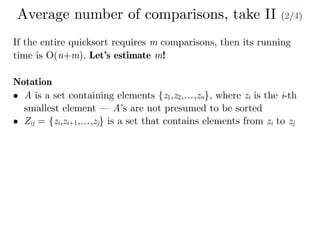
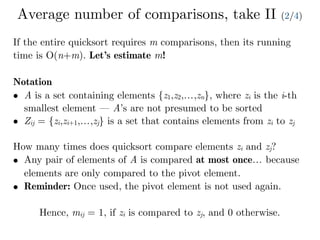
If the entire quicksort requires m comparisons, then its running
time is O(n+m). Let’s estimate m!
Average number of comparisons, take II (2/4)
If the entire quicksort requires m comparisons, then its running
time is O(n+m). Let’s estimate m!
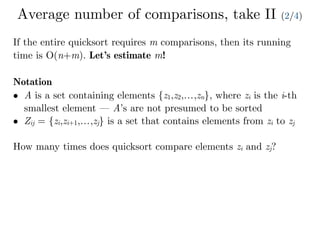
Notation
• A is a set containing elements {z1,z2,…,zn}, where zi is the i-th
smallest element — A’s are not presumed to be sorted
Average number of comparisons, take II (2/4)
If the entire quicksort requires m comparisons, then its running
time is O(n+m). Let’s estimate m!
Notation
• A is a set containing elements {z1,z2,…,zn}, where zi is the i-th
smallest element — A’s are not presumed to be sorted
• Zij = {zi,zi+1,…,zj} is a set that contains elements from zi to zj
Average number of comparisons, take II (2/4)
If the entire quicksort requires m comparisons, then its running
time is O(n+m). Let’s estimate m!
Notation
• A is a set containing elements {z1,z2,…,zn}, where zi is the i-th
smallest element — A’s are not presumed to be sorted
• Zij = {zi,zi+1,…,zj} is a set that contains elements from zi to zj
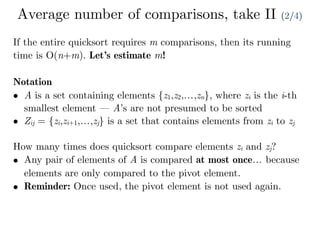
How many times does quicksort compare elements zi and zj?
Average number of comparisons, take II (2/4)
If the entire quicksort requires m comparisons, then its running
time is O(n+m). Let’s estimate m!
Notation
• A is a set containing elements {z1,z2,…,zn}, where zi is the i-th
smallest element — A’s are not presumed to be sorted
• Zij = {zi,zi+1,…,zj} is a set that contains elements from zi to zj
How many times does quicksort compare elements zi and zj?
• Any pair of elements of A is compared at most once… because
elements are only compared to the pivot element.
• Reminder: Once used, the pivot element is not used again.
Average number of comparisons, take II (2/4)
If the entire quicksort requires m comparisons, then its running
time is O(n+m). Let’s estimate m!
Notation
• A is a set containing elements {z1,z2,…,zn}, where zi is the i-th
smallest element — A’s are not presumed to be sorted
• Zij = {zi,zi+1,…,zj} is a set that contains elements from zi to zj
How many times does quicksort compare elements zi and zj?
• Any pair of elements of A is compared at most once… because
elements are only compared to the pivot element.
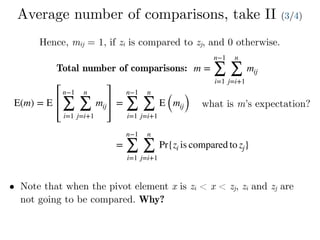
• Reminder: Once used, the pivot element is not used again.
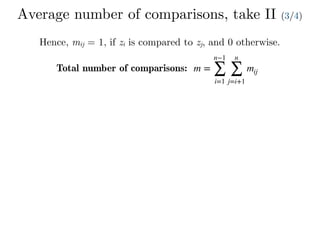
Hence, mij = 1, if zi is compared to zj, and 0 otherwise.
Average number of comparisons, take II (3/4)
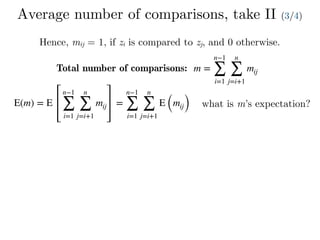
Hence, mij = 1, if zi is compared to zj, and 0 otherwise.
Total number of comparisons: m =
n−1
∑
i=1
n
∑
j=i+1
mij
Average number of comparisons, take II (3/4)
Hence, mij = 1, if zi is compared to zj, and 0 otherwise.
Total number of comparisons: m =
n−1
∑
i=1
n
∑
j=i+1
mij
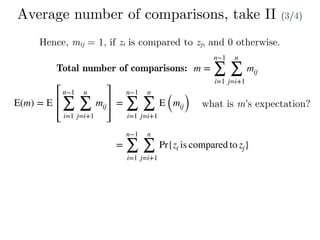
E(m) = E
n−1
∑
i=1
n
∑
j=i+1
mij =
n−1
∑
i=1
n
∑
j=i+1
E (mij) what is m’s expectation?
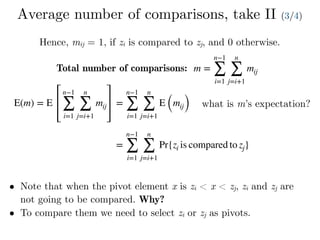
Average number of comparisons, take II (3/4)
Hence, mij = 1, if zi is compared to zj, and 0 otherwise.
Total number of comparisons: m =
n−1
∑
i=1
n
∑
j=i+1
mij
E(m) = E
n−1
∑
i=1
n
∑
j=i+1
mij =
n−1
∑
i=1
n
∑
j=i+1
E (mij) what is m’s expectation?
=
n−1
∑
i=1
n
∑
j=i+1
Pr{zi is compared to zj}
Average number of comparisons, take II (3/4)
Hence, mij = 1, if zi is compared to zj, and 0 otherwise.
Total number of comparisons: m =
n−1
∑
i=1
n
∑
j=i+1
mij
E(m) = E
n−1
∑
i=1
n
∑
j=i+1
mij =
n−1
∑
i=1
n
∑
j=i+1
E (mij) what is m’s expectation?
=
n−1
∑
i=1
n
∑
j=i+1
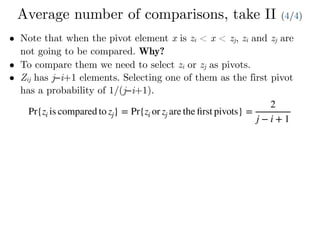
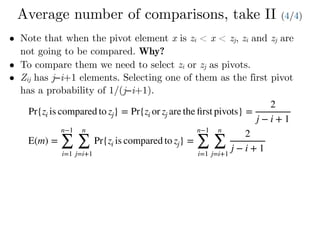
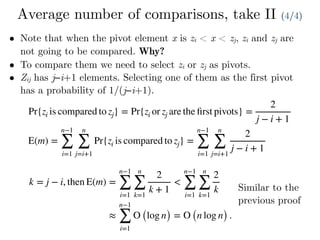
Pr{zi is compared to zj}
• Note that when the pivot element x is zi < x < zj, zi and zj are
not going to be compared. Why?
Average number of comparisons, take II (3/4)
Hence, mij = 1, if zi is compared to zj, and 0 otherwise.
Total number of comparisons: m =
n−1
∑
i=1
n
∑
j=i+1
mij
E(m) = E
n−1
∑
i=1
n
∑
j=i+1
mij =
n−1
∑
i=1
n
∑
j=i+1
E (mij) what is m’s expectation?
=
n−1
∑
i=1
n
∑
j=i+1
Pr{zi is compared to zj}
• Note that when the pivot element x is zi < x < zj, zi and zj are
not going to be compared. Why?
• To compare them we need to select zi or zj as pivots.
Average number of comparisons, take II (4/4)
• Note that when the pivot element x is zi < x < zj, zi and zj are
not going to be compared. Why?
• To compare them we need to select zi or zj as pivots.
Average number of comparisons, take II (4/4)
• Note that when the pivot element x is zi < x < zj, zi and zj are
not going to be compared. Why?
• To compare them we need to select zi or zj as pivots.
• Zij has j−i+1 elements. Selecting one of them as the first pivot
has a probability of 1/(j−i+1).
Average number of comparisons, take II (4/4)
• Note that when the pivot element x is zi < x < zj, zi and zj are
not going to be compared. Why?
• To compare them we need to select zi or zj as pivots.
• Zij has j−i+1 elements. Selecting one of them as the first pivot
has a probability of 1/(j−i+1).
Pr{zi is compared to zj} = Pr{zi or zj are the first pivots} =
2
j − i + 1
Average number of comparisons, take II (4/4)
• Note that when the pivot element x is zi < x < zj, zi and zj are
not going to be compared. Why?
• To compare them we need to select zi or zj as pivots.
• Zij has j−i+1 elements. Selecting one of them as the first pivot
has a probability of 1/(j−i+1).
Pr{zi is compared to zj} = Pr{zi or zj are the first pivots} =
2
j − i + 1
E(m) =
n−1
∑
i=1
n
∑
j=i+1
Pr{zi is compared to zj} =
n−1
∑
i=1
n
∑
j=i+1
2
j − i + 1
Average number of comparisons, take II (4/4)
• Note that when the pivot element x is zi < x < zj, zi and zj are
not going to be compared. Why?
• To compare them we need to select zi or zj as pivots.
• Zij has j−i+1 elements. Selecting one of them as the first pivot
has a probability of 1/(j−i+1).
Pr{zi is compared to zj} = Pr{zi or zj are the first pivots} =
2
j − i + 1
E(m) =
n−1
∑
i=1
n
∑
j=i+1
Pr{zi is compared to zj} =
n−1
∑
i=1
n
∑
j=i+1
2
j − i + 1
k = j − i, then E(m) =
n−1
∑
i=1
n
∑
k=1
2
k + 1
<
n−1
∑
i=1
n
∑
k=1
2
k
≈
n−1
∑
i=1
O (log n) = O (n log n) .
Similar to the
previous proof
end_of_lecture
@lampos
lampos.net www
Slides (with potential revisions)
lampos.net/slides/quicksort2019.pdf

Quicksort

  • 1.
    COMP0005 (Algorithms) Quicksort Vasileios Lampos ComputerScience, UCL @lampos lampos.net www Slides (with potential revisions) lampos.net/slides/quicksort2019.pdf
  • 2.
    About this lecture •Quicksort (yet another sorting algorithm) — Description — Performance analysis • Material — Cormen, Leiserson, Rivest and Stein. Introduction to Algorithms. MIT Press, 3rd Edition, 2009 (mainly Chapter 7) — Alternative slides at https://algs4.cs.princeton.edu/lectures/ (Sedgewick and Wayne)
  • 3.
  • 4.
    Given an arrayA with n elements, A[1…n]: • DIVIDE (step 1)
 Partition, i.e. re-arrange the elements of, array A[1…n] so that for some element A[q]: 1. all elements on the left of A[q], i.e. A[1…q−1], are less than or equal to A[q], and 2. all elements on the right of A[q], i.e. A[q+1…n], are greater than or equal to A[q].
 Quicksort divides & conquers
  • 5.
    Given an arrayA with n elements, A[1…n]: • DIVIDE (step 1)
 Partition, i.e. re-arrange the elements of, array A[1…n] so that for some element A[q]: 1. all elements on the left of A[q], i.e. A[1…q−1], are less than or equal to A[q], and 2. all elements on the right of A[q], i.e. A[q+1…n], are greater than or equal to A[q].
 • CONQUER (step 2)
 Sort sub-arrays A[1…q−1] and A[q+1…n] by recursive executions of step 1.
 Quicksort divides & conquers
  • 6.
    Given an arrayA with n elements, A[1…n]: • DIVIDE (step 1)
 Partition, i.e. re-arrange the elements of, array A[1…n] so that for some element A[q]: 1. all elements on the left of A[q], i.e. A[1…q−1], are less than or equal to A[q], and 2. all elements on the right of A[q], i.e. A[q+1…n], are greater than or equal to A[q].
 • CONQUER (step 2)
 Sort sub-arrays A[1…q−1] and A[q+1…n] by recursive executions of step 1.
 • COMBINE (step 3)
 Just by joining the sorted sub-arrays we obtain a sorted array. Quicksort divides & conquers
  • 7.
    Given an arrayA with n elements, A[1…n]: • DIVIDE (step 1)
 Partition, i.e. re-arrange the elements of, array A[1…n] so that for some element A[q]: 1. all elements on the left of A[q], i.e. A[1…q−1], are less than or equal to A[q], and 2. all elements on the right of A[q], i.e. A[q+1…n], are greater than or equal to A[q].
 • CONQUER (step 2)
 Sort sub-arrays A[1…q−1] and A[q+1…n] by recursive executions of step 1.
 • COMBINE (step 3)
 Just by joining the sorted sub-arrays we obtain a sorted array. Quicksort divides & conquers Note: • We will assume that the elements of A are distinct. • We will be sorting the elements of A in an ascending order.
  • 8.
    Quicksort was… • inventedby Tony Hoare in 1959 • published in 1961 (paper)


 from Wikipedia
  • 9.
    Quicksort was… • inventedby Tony Hoare in 1959 • published in 1961 (paper)


 from Wikipedia
  • 10.
    Quicksort was… • inventedby Tony Hoare in 1959 • published in 1961 (paper)


 from Wikipedia that was the entire paper!
  • 11.
    Quicksort was… • inventedby Tony Hoare in 1959 • published in 1961 (paper)


 • published with an analysis in 1962 (paper)


 from Wikipedia that was the entire paper!
  • 12.
    Quicksort was… • inventedby Tony Hoare in 1959 • published in 1961 (paper)


 • published with an analysis in 1962 (paper)


 from Wikipedia that was the entire paper!
  • 13.
    Quicksort… • is stillbeing used (in principle, i.e. its optimised versions)
 from Wikipedia
  • 14.
    Quicksort… • is stillbeing used (in principle, i.e. its optimised versions)
 • is efficient — O(n logn) on average — Θ(n logn) best case — Θ(n2) worst case (for an array with n elements)
 from Wikipedia
  • 15.
    Quicksort… • is stillbeing used (in principle, i.e. its optimised versions)
 • is efficient — O(n logn) on average — Θ(n logn) best case — Θ(n2) worst case (for an array with n elements)
 • requires a small amount of memory (in-place algorithm) from Wikipedia
  • 16.
    Quicksort7.1 Description ofquicksort Combine: Because the subarrays are already them: the entire array AŒp : : r is now sort The following procedure implements quicksor QUICKSORT.A; p; r/ 1 if p < r 2 q D PARTITION.A; p; r/ 3 QUICKSORT.A; p; q 1/ 4 QUICKSORT.A; q C 1; r/ p r … 6 5 1 … 22 9 2 … }sub-array A[p…r] both p, r are array indices
  • 17.
    Quicksort p q r …1 2 6 … 22 9 5 … }sub-array A[p…r] p, r, q are array indices 7.1 Description of quicksort Combine: Because the subarrays are already them: the entire array AŒp : : r is now sort The following procedure implements quicksor QUICKSORT.A; p; r/ 1 if p < r 2 q D PARTITION.A; p; r/ 3 QUICKSORT.A; p; q 1/ 4 QUICKSORT.A; q C 1; r/
  • 18.
    Quicksort — Partition 2q D PARTITION.A; p; r/ 3 QUICKSORT.A; p; q 1/ 4 QUICKSORT.A; q C 1; r/ To sort an entire array A, the initial call is QUICKSORT.A; 1; A:length/. Partitioning the array The key to the algorithm is the PARTITION procedure, which rearranges the su ray AŒp : : r in place. PARTITION.A; p; r/ 1 x D AŒr 2 i D p 1 3 for j D p to r 1 4 if AŒj  Ä x 5 i D i C 1 6 exchange AŒi with AŒj  7 exchange AŒi C 1 with AŒr 8 return i C 1 7.1 Description of quicksort Combine: Because the subarrays are alr them: the entire array AŒp : : r is no The following procedure implements qu QUICKSORT.A; p; r/ 1 if p < r 2 q D PARTITION.A; p; r/ 3 QUICKSORT.A; p; q 1/ 4 QUICKSORT.A; q C 1; r/ To sort an entire array A, the initial call Partition is the central sorting operation of quicksort p q? r … 1 2 6 … 22 9 5 … }sub-array A[p…r] p, r, q are array indices
  • 19.
    Step-by-step exampleCombine: Becausethe subarrays are already sorted, no work is needed to combine them: the entire array AŒp : : r is now sorted. The following procedure implements quicksort: QUICKSORT.A; p; r/ 1 if p < r 2 q D PARTITION.A; p; r/ 3 QUICKSORT.A; p; q 1/ 4 QUICKSORT.A; q C 1; r/ To sort an entire array A, the initial call is QUICKSORT.A; 1; A:length/. Partitioning the array The key to the algorithm is the PARTITION procedure, which rearranges the subar- ray AŒp : : r in place. PARTITION.A; p; r/ 1 x D AŒr 2 i D p 1 3 for j D p to r 1 4 if AŒj  Ä x 5 i D i C 1 6 exchange AŒi with AŒj  7 exchange AŒi C 1 with AŒr 8 return i C 1 QUICKSORT.A; p; r/ 1 if p < r 2 q D PARTITION.A; p; r/ 3 QUICKSORT.A; p; q 1/ 4 QUICKSORT.A; q C 1; r/ To sort an entire array A, the initial call is QUICKSORT.A; 1; A:length/. Partitioning the array The key to the algorithm is the PARTITION procedure, which rearranges the subar- ray AŒp : : r in place. PARTITION.A; p; r/ 1 x D AŒr 2 i D p 1 3 for j D p to r 1 4 if AŒj  Ä x 5 i D i C 1 6 exchange AŒi with AŒj  7 exchange AŒi C 1 with AŒr 8 return i C 1 Figure 7.1 shows how PARTITION works on an 8-element array. PARTITION always selects an element x D AŒr as a pivot element around which to partition the subarray AŒp : : r. As the procedure runs, it partitions the array into four (possibly empty) regions. At the start of each iteration of the for loop in lines 3–6, the regions i p,j r,x 6 5 1 3 2 4
  • 20.
    Step-by-step exampleCombine: Becausethe subarrays are already sorted, no work is needed to combine them: the entire array AŒp : : r is now sorted. The following procedure implements quicksort: QUICKSORT.A; p; r/ 1 if p < r 2 q D PARTITION.A; p; r/ 3 QUICKSORT.A; p; q 1/ 4 QUICKSORT.A; q C 1; r/ To sort an entire array A, the initial call is QUICKSORT.A; 1; A:length/. Partitioning the array The key to the algorithm is the PARTITION procedure, which rearranges the subar- ray AŒp : : r in place. PARTITION.A; p; r/ 1 x D AŒr 2 i D p 1 3 for j D p to r 1 4 if AŒj  Ä x 5 i D i C 1 6 exchange AŒi with AŒj  7 exchange AŒi C 1 with AŒr 8 return i C 1 QUICKSORT.A; p; r/ 1 if p < r 2 q D PARTITION.A; p; r/ 3 QUICKSORT.A; p; q 1/ 4 QUICKSORT.A; q C 1; r/ To sort an entire array A, the initial call is QUICKSORT.A; 1; A:length/. Partitioning the array The key to the algorithm is the PARTITION procedure, which rearranges the subar- ray AŒp : : r in place. PARTITION.A; p; r/ 1 x D AŒr 2 i D p 1 3 for j D p to r 1 4 if AŒj  Ä x 5 i D i C 1 6 exchange AŒi with AŒj  7 exchange AŒi C 1 with AŒr 8 return i C 1 Figure 7.1 shows how PARTITION works on an 8-element array. PARTITION always selects an element x D AŒr as a pivot element around which to partition the subarray AŒp : : r. As the procedure runs, it partitions the array into four (possibly empty) regions. At the start of each iteration of the for loop in lines 3–6, the regions i p,j r,x 6 5 1 3 2 4 pivot element
  • 21.
    Step-by-step exampleCombine: Becausethe subarrays are already sorted, no work is needed to combine them: the entire array AŒp : : r is now sorted. The following procedure implements quicksort: QUICKSORT.A; p; r/ 1 if p < r 2 q D PARTITION.A; p; r/ 3 QUICKSORT.A; p; q 1/ 4 QUICKSORT.A; q C 1; r/ To sort an entire array A, the initial call is QUICKSORT.A; 1; A:length/. Partitioning the array The key to the algorithm is the PARTITION procedure, which rearranges the subar- ray AŒp : : r in place. PARTITION.A; p; r/ 1 x D AŒr 2 i D p 1 3 for j D p to r 1 4 if AŒj  Ä x 5 i D i C 1 6 exchange AŒi with AŒj  7 exchange AŒi C 1 with AŒr 8 return i C 1 QUICKSORT.A; p; r/ 1 if p < r 2 q D PARTITION.A; p; r/ 3 QUICKSORT.A; p; q 1/ 4 QUICKSORT.A; q C 1; r/ To sort an entire array A, the initial call is QUICKSORT.A; 1; A:length/. Partitioning the array The key to the algorithm is the PARTITION procedure, which rearranges the subar- ray AŒp : : r in place. PARTITION.A; p; r/ 1 x D AŒr 2 i D p 1 3 for j D p to r 1 4 if AŒj  Ä x 5 i D i C 1 6 exchange AŒi with AŒj  7 exchange AŒi C 1 with AŒr 8 return i C 1 Figure 7.1 shows how PARTITION works on an 8-element array. PARTITION always selects an element x D AŒr as a pivot element around which to partition the subarray AŒp : : r. As the procedure runs, it partitions the array into four (possibly empty) regions. At the start of each iteration of the for loop in lines 3–6, the regions i j 6 5 1 3 2 4 x = 4, A[j = p+1] = 5 > x i p,j r,x 6 5 1 3 2 4 pivot element
  • 22.
    Step-by-step exampleCombine: Becausethe subarrays are already sorted, no work is needed to combine them: the entire array AŒp : : r is now sorted. The following procedure implements quicksort: QUICKSORT.A; p; r/ 1 if p < r 2 q D PARTITION.A; p; r/ 3 QUICKSORT.A; p; q 1/ 4 QUICKSORT.A; q C 1; r/ To sort an entire array A, the initial call is QUICKSORT.A; 1; A:length/. Partitioning the array The key to the algorithm is the PARTITION procedure, which rearranges the subar- ray AŒp : : r in place. PARTITION.A; p; r/ 1 x D AŒr 2 i D p 1 3 for j D p to r 1 4 if AŒj  Ä x 5 i D i C 1 6 exchange AŒi with AŒj  7 exchange AŒi C 1 with AŒr 8 return i C 1 QUICKSORT.A; p; r/ 1 if p < r 2 q D PARTITION.A; p; r/ 3 QUICKSORT.A; p; q 1/ 4 QUICKSORT.A; q C 1; r/ To sort an entire array A, the initial call is QUICKSORT.A; 1; A:length/. Partitioning the array The key to the algorithm is the PARTITION procedure, which rearranges the subar- ray AŒp : : r in place. PARTITION.A; p; r/ 1 x D AŒr 2 i D p 1 3 for j D p to r 1 4 if AŒj  Ä x 5 i D i C 1 6 exchange AŒi with AŒj  7 exchange AŒi C 1 with AŒr 8 return i C 1 Figure 7.1 shows how PARTITION works on an 8-element array. PARTITION always selects an element x D AŒr as a pivot element around which to partition the subarray AŒp : : r. As the procedure runs, it partitions the array into four (possibly empty) regions. At the start of each iteration of the for loop in lines 3–6, the regions i j 6 5 1 3 2 4 i j 6 5 1 3 2 4 x = 4, A[j = p+1] = 5 > x A[j = p+2] = 1 < x, i = i+1 i p,j r,x 6 5 1 3 2 4 pivot element
  • 23.
    Step-by-step exampleCombine: Becausethe subarrays are already sorted, no work is needed to combine them: the entire array AŒp : : r is now sorted. The following procedure implements quicksort: QUICKSORT.A; p; r/ 1 if p < r 2 q D PARTITION.A; p; r/ 3 QUICKSORT.A; p; q 1/ 4 QUICKSORT.A; q C 1; r/ To sort an entire array A, the initial call is QUICKSORT.A; 1; A:length/. Partitioning the array The key to the algorithm is the PARTITION procedure, which rearranges the subar- ray AŒp : : r in place. PARTITION.A; p; r/ 1 x D AŒr 2 i D p 1 3 for j D p to r 1 4 if AŒj  Ä x 5 i D i C 1 6 exchange AŒi with AŒj  7 exchange AŒi C 1 with AŒr 8 return i C 1 QUICKSORT.A; p; r/ 1 if p < r 2 q D PARTITION.A; p; r/ 3 QUICKSORT.A; p; q 1/ 4 QUICKSORT.A; q C 1; r/ To sort an entire array A, the initial call is QUICKSORT.A; 1; A:length/. Partitioning the array The key to the algorithm is the PARTITION procedure, which rearranges the subar- ray AŒp : : r in place. PARTITION.A; p; r/ 1 x D AŒr 2 i D p 1 3 for j D p to r 1 4 if AŒj  Ä x 5 i D i C 1 6 exchange AŒi with AŒj  7 exchange AŒi C 1 with AŒr 8 return i C 1 Figure 7.1 shows how PARTITION works on an 8-element array. PARTITION always selects an element x D AŒr as a pivot element around which to partition the subarray AŒp : : r. As the procedure runs, it partitions the array into four (possibly empty) regions. At the start of each iteration of the for loop in lines 3–6, the regions i j 6 5 1 3 2 4 i j 6 5 1 3 2 4 i j 1 5 6 3 2 4 x = 4, A[j = p+1] = 5 > x A[j = p+2] = 1 < x, i = i+1 and A[i]↔A[j] i p,j r,x 6 5 1 3 2 4 pivot element
  • 24.
    Step-by-step exampleCombine: Becausethe subarrays are already sorted, no work is needed to combine them: the entire array AŒp : : r is now sorted. The following procedure implements quicksort: QUICKSORT.A; p; r/ 1 if p < r 2 q D PARTITION.A; p; r/ 3 QUICKSORT.A; p; q 1/ 4 QUICKSORT.A; q C 1; r/ To sort an entire array A, the initial call is QUICKSORT.A; 1; A:length/. Partitioning the array The key to the algorithm is the PARTITION procedure, which rearranges the subar- ray AŒp : : r in place. PARTITION.A; p; r/ 1 x D AŒr 2 i D p 1 3 for j D p to r 1 4 if AŒj  Ä x 5 i D i C 1 6 exchange AŒi with AŒj  7 exchange AŒi C 1 with AŒr 8 return i C 1 QUICKSORT.A; p; r/ 1 if p < r 2 q D PARTITION.A; p; r/ 3 QUICKSORT.A; p; q 1/ 4 QUICKSORT.A; q C 1; r/ To sort an entire array A, the initial call is QUICKSORT.A; 1; A:length/. Partitioning the array The key to the algorithm is the PARTITION procedure, which rearranges the subar- ray AŒp : : r in place. PARTITION.A; p; r/ 1 x D AŒr 2 i D p 1 3 for j D p to r 1 4 if AŒj  Ä x 5 i D i C 1 6 exchange AŒi with AŒj  7 exchange AŒi C 1 with AŒr 8 return i C 1 Figure 7.1 shows how PARTITION works on an 8-element array. PARTITION always selects an element x D AŒr as a pivot element around which to partition the subarray AŒp : : r. As the procedure runs, it partitions the array into four (possibly empty) regions. At the start of each iteration of the for loop in lines 3–6, the regions i j 6 5 1 3 2 4 i j 6 5 1 3 2 4 i j 1 5 6 3 2 4 i j 1 5 6 3 2 4 x = 4, A[j = p+1] = 5 > x A[j = p+2] = 1 < x, i = i+1 and A[i]↔A[j] A[j = p+3] = 3 < x, i = i+1 i p,j r,x 6 5 1 3 2 4 pivot element
  • 25.
    Step-by-step exampleCombine: Becausethe subarrays are already sorted, no work is needed to combine them: the entire array AŒp : : r is now sorted. The following procedure implements quicksort: QUICKSORT.A; p; r/ 1 if p < r 2 q D PARTITION.A; p; r/ 3 QUICKSORT.A; p; q 1/ 4 QUICKSORT.A; q C 1; r/ To sort an entire array A, the initial call is QUICKSORT.A; 1; A:length/. Partitioning the array The key to the algorithm is the PARTITION procedure, which rearranges the subar- ray AŒp : : r in place. PARTITION.A; p; r/ 1 x D AŒr 2 i D p 1 3 for j D p to r 1 4 if AŒj  Ä x 5 i D i C 1 6 exchange AŒi with AŒj  7 exchange AŒi C 1 with AŒr 8 return i C 1 QUICKSORT.A; p; r/ 1 if p < r 2 q D PARTITION.A; p; r/ 3 QUICKSORT.A; p; q 1/ 4 QUICKSORT.A; q C 1; r/ To sort an entire array A, the initial call is QUICKSORT.A; 1; A:length/. Partitioning the array The key to the algorithm is the PARTITION procedure, which rearranges the subar- ray AŒp : : r in place. PARTITION.A; p; r/ 1 x D AŒr 2 i D p 1 3 for j D p to r 1 4 if AŒj  Ä x 5 i D i C 1 6 exchange AŒi with AŒj  7 exchange AŒi C 1 with AŒr 8 return i C 1 Figure 7.1 shows how PARTITION works on an 8-element array. PARTITION always selects an element x D AŒr as a pivot element around which to partition the subarray AŒp : : r. As the procedure runs, it partitions the array into four (possibly empty) regions. At the start of each iteration of the for loop in lines 3–6, the regions i j 6 5 1 3 2 4 i j 6 5 1 3 2 4 i j 1 5 6 3 2 4 i j 1 5 6 3 2 4 i j 1 3 6 5 2 4 x = 4, A[j = p+1] = 5 > x A[j = p+2] = 1 < x, i = i+1 and A[i]↔A[j] A[j = p+3] = 3 < x, i = i+1 and A[i]↔A[j] i p,j r,x 6 5 1 3 2 4 pivot element
  • 26.
    Step-by-step exampleCombine: Becausethe subarrays are already sorted, no work is needed to combine them: the entire array AŒp : : r is now sorted. The following procedure implements quicksort: QUICKSORT.A; p; r/ 1 if p < r 2 q D PARTITION.A; p; r/ 3 QUICKSORT.A; p; q 1/ 4 QUICKSORT.A; q C 1; r/ To sort an entire array A, the initial call is QUICKSORT.A; 1; A:length/. Partitioning the array The key to the algorithm is the PARTITION procedure, which rearranges the subar- ray AŒp : : r in place. PARTITION.A; p; r/ 1 x D AŒr 2 i D p 1 3 for j D p to r 1 4 if AŒj  Ä x 5 i D i C 1 6 exchange AŒi with AŒj  7 exchange AŒi C 1 with AŒr 8 return i C 1 QUICKSORT.A; p; r/ 1 if p < r 2 q D PARTITION.A; p; r/ 3 QUICKSORT.A; p; q 1/ 4 QUICKSORT.A; q C 1; r/ To sort an entire array A, the initial call is QUICKSORT.A; 1; A:length/. Partitioning the array The key to the algorithm is the PARTITION procedure, which rearranges the subar- ray AŒp : : r in place. PARTITION.A; p; r/ 1 x D AŒr 2 i D p 1 3 for j D p to r 1 4 if AŒj  Ä x 5 i D i C 1 6 exchange AŒi with AŒj  7 exchange AŒi C 1 with AŒr 8 return i C 1 Figure 7.1 shows how PARTITION works on an 8-element array. PARTITION always selects an element x D AŒr as a pivot element around which to partition the subarray AŒp : : r. As the procedure runs, it partitions the array into four (possibly empty) regions. At the start of each iteration of the for loop in lines 3–6, the regions i j 6 5 1 3 2 4 i j 6 5 1 3 2 4 i j 1 5 6 3 2 4 i j 1 5 6 3 2 4 i j 1 3 6 5 2 4 i j 1 3 6 5 2 4 x = 4, A[j = p+1] = 5 > x A[j = p+2] = 1 < x, i = i+1 and A[i]↔A[j] A[j = p+3] = 3 < x, i = i+1 and A[i]↔A[j] i p,j r,x 6 5 1 3 2 4 pivot element
  • 27.
    Step-by-step exampleCombine: Becausethe subarrays are already sorted, no work is needed to combine them: the entire array AŒp : : r is now sorted. The following procedure implements quicksort: QUICKSORT.A; p; r/ 1 if p < r 2 q D PARTITION.A; p; r/ 3 QUICKSORT.A; p; q 1/ 4 QUICKSORT.A; q C 1; r/ To sort an entire array A, the initial call is QUICKSORT.A; 1; A:length/. Partitioning the array The key to the algorithm is the PARTITION procedure, which rearranges the subar- ray AŒp : : r in place. PARTITION.A; p; r/ 1 x D AŒr 2 i D p 1 3 for j D p to r 1 4 if AŒj  Ä x 5 i D i C 1 6 exchange AŒi with AŒj  7 exchange AŒi C 1 with AŒr 8 return i C 1 QUICKSORT.A; p; r/ 1 if p < r 2 q D PARTITION.A; p; r/ 3 QUICKSORT.A; p; q 1/ 4 QUICKSORT.A; q C 1; r/ To sort an entire array A, the initial call is QUICKSORT.A; 1; A:length/. Partitioning the array The key to the algorithm is the PARTITION procedure, which rearranges the subar- ray AŒp : : r in place. PARTITION.A; p; r/ 1 x D AŒr 2 i D p 1 3 for j D p to r 1 4 if AŒj  Ä x 5 i D i C 1 6 exchange AŒi with AŒj  7 exchange AŒi C 1 with AŒr 8 return i C 1 Figure 7.1 shows how PARTITION works on an 8-element array. PARTITION always selects an element x D AŒr as a pivot element around which to partition the subarray AŒp : : r. As the procedure runs, it partitions the array into four (possibly empty) regions. At the start of each iteration of the for loop in lines 3–6, the regions i j 6 5 1 3 2 4 i j 6 5 1 3 2 4 i j 1 5 6 3 2 4 i j 1 5 6 3 2 4 i j 1 3 6 5 2 4 i j 1 3 6 5 2 4 i j 1 3 2 5 6 4 x = 4, A[j = p+1] = 5 > x A[j = p+2] = 1 < x, i = i+1 and A[i]↔A[j] A[j = p+3] = 3 < x, i = i+1 and A[i]↔A[j] i p,j r,x 6 5 1 3 2 4 pivot element
  • 28.
    Step-by-step exampleCombine: Becausethe subarrays are already sorted, no work is needed to combine them: the entire array AŒp : : r is now sorted. The following procedure implements quicksort: QUICKSORT.A; p; r/ 1 if p < r 2 q D PARTITION.A; p; r/ 3 QUICKSORT.A; p; q 1/ 4 QUICKSORT.A; q C 1; r/ To sort an entire array A, the initial call is QUICKSORT.A; 1; A:length/. Partitioning the array The key to the algorithm is the PARTITION procedure, which rearranges the subar- ray AŒp : : r in place. PARTITION.A; p; r/ 1 x D AŒr 2 i D p 1 3 for j D p to r 1 4 if AŒj  Ä x 5 i D i C 1 6 exchange AŒi with AŒj  7 exchange AŒi C 1 with AŒr 8 return i C 1 QUICKSORT.A; p; r/ 1 if p < r 2 q D PARTITION.A; p; r/ 3 QUICKSORT.A; p; q 1/ 4 QUICKSORT.A; q C 1; r/ To sort an entire array A, the initial call is QUICKSORT.A; 1; A:length/. Partitioning the array The key to the algorithm is the PARTITION procedure, which rearranges the subar- ray AŒp : : r in place. PARTITION.A; p; r/ 1 x D AŒr 2 i D p 1 3 for j D p to r 1 4 if AŒj  Ä x 5 i D i C 1 6 exchange AŒi with AŒj  7 exchange AŒi C 1 with AŒr 8 return i C 1 Figure 7.1 shows how PARTITION works on an 8-element array. PARTITION always selects an element x D AŒr as a pivot element around which to partition the subarray AŒp : : r. As the procedure runs, it partitions the array into four (possibly empty) regions. At the start of each iteration of the for loop in lines 3–6, the regions i j 6 5 1 3 2 4 i j 6 5 1 3 2 4 i j 1 5 6 3 2 4 i j 1 5 6 3 2 4 i j 1 3 6 5 2 4 i j 1 3 6 5 2 4 i j 1 3 2 5 6 4 i j 1 3 2 4 6 5 x = 4, A[j = p+1] = 5 > x A[j = p+2] = 1 < x, i = i+1 and A[i]↔A[j] A[j = p+3] = 3 < x, i = i+1 and A[i]↔A[j] j = r−1, A[i+1]↔A[r] i p,j r,x 6 5 1 3 2 4 pivot element
  • 29.
    Step-by-step exampleCombine: Becausethe subarrays are already sorted, no work is needed to combine them: the entire array AŒp : : r is now sorted. The following procedure implements quicksort: QUICKSORT.A; p; r/ 1 if p < r 2 q D PARTITION.A; p; r/ 3 QUICKSORT.A; p; q 1/ 4 QUICKSORT.A; q C 1; r/ To sort an entire array A, the initial call is QUICKSORT.A; 1; A:length/. Partitioning the array The key to the algorithm is the PARTITION procedure, which rearranges the subar- ray AŒp : : r in place. PARTITION.A; p; r/ 1 x D AŒr 2 i D p 1 3 for j D p to r 1 4 if AŒj  Ä x 5 i D i C 1 6 exchange AŒi with AŒj  7 exchange AŒi C 1 with AŒr 8 return i C 1 QUICKSORT.A; p; r/ 1 if p < r 2 q D PARTITION.A; p; r/ 3 QUICKSORT.A; p; q 1/ 4 QUICKSORT.A; q C 1; r/ To sort an entire array A, the initial call is QUICKSORT.A; 1; A:length/. Partitioning the array The key to the algorithm is the PARTITION procedure, which rearranges the subar- ray AŒp : : r in place. PARTITION.A; p; r/ 1 x D AŒr 2 i D p 1 3 for j D p to r 1 4 if AŒj  Ä x 5 i D i C 1 6 exchange AŒi with AŒj  7 exchange AŒi C 1 with AŒr 8 return i C 1 Figure 7.1 shows how PARTITION works on an 8-element array. PARTITION always selects an element x D AŒr as a pivot element around which to partition the subarray AŒp : : r. As the procedure runs, it partitions the array into four (possibly empty) regions. At the start of each iteration of the for loop in lines 3–6, the regions i p,j r,x i p,j r,x 1 3 2 4 6 5 i p,j r,x 6 5 1 3 2 4 i j 6 5 1 3 2 4 i j 6 5 1 3 2 4 i j 1 5 6 3 2 4 i j 1 5 6 3 2 4 i j 1 3 6 5 2 4 i j 1 3 6 5 2 4 i j 1 3 2 5 6 4 i j 1 3 2 4 6 5
  • 30.
    Step-by-step exampleCombine: Becausethe subarrays are already sorted, no work is needed to combine them: the entire array AŒp : : r is now sorted. The following procedure implements quicksort: QUICKSORT.A; p; r/ 1 if p < r 2 q D PARTITION.A; p; r/ 3 QUICKSORT.A; p; q 1/ 4 QUICKSORT.A; q C 1; r/ To sort an entire array A, the initial call is QUICKSORT.A; 1; A:length/. Partitioning the array The key to the algorithm is the PARTITION procedure, which rearranges the subar- ray AŒp : : r in place. PARTITION.A; p; r/ 1 x D AŒr 2 i D p 1 3 for j D p to r 1 4 if AŒj  Ä x 5 i D i C 1 6 exchange AŒi with AŒj  7 exchange AŒi C 1 with AŒr 8 return i C 1 QUICKSORT.A; p; r/ 1 if p < r 2 q D PARTITION.A; p; r/ 3 QUICKSORT.A; p; q 1/ 4 QUICKSORT.A; q C 1; r/ To sort an entire array A, the initial call is QUICKSORT.A; 1; A:length/. Partitioning the array The key to the algorithm is the PARTITION procedure, which rearranges the subar- ray AŒp : : r in place. PARTITION.A; p; r/ 1 x D AŒr 2 i D p 1 3 for j D p to r 1 4 if AŒj  Ä x 5 i D i C 1 6 exchange AŒi with AŒj  7 exchange AŒi C 1 with AŒr 8 return i C 1 Figure 7.1 shows how PARTITION works on an 8-element array. PARTITION always selects an element x D AŒr as a pivot element around which to partition the subarray AŒp : : r. As the procedure runs, it partitions the array into four (possibly empty) regions. At the start of each iteration of the for loop in lines 3–6, the regions i,j i j 1 3 2 4 6 5 i p,j r,x 6 5 1 3 2 4 i j 6 5 1 3 2 4 i j 6 5 1 3 2 4 i j 1 5 6 3 2 4 i j 1 5 6 3 2 4 i j 1 3 6 5 2 4 i j 1 3 6 5 2 4 i j 1 3 2 5 6 4 i j 1 3 2 4 6 5 i p,j r,x i p,j r,x 1 3 2 4 6 5
  • 31.
    Step-by-step exampleCombine: Becausethe subarrays are already sorted, no work is needed to combine them: the entire array AŒp : : r is now sorted. The following procedure implements quicksort: QUICKSORT.A; p; r/ 1 if p < r 2 q D PARTITION.A; p; r/ 3 QUICKSORT.A; p; q 1/ 4 QUICKSORT.A; q C 1; r/ To sort an entire array A, the initial call is QUICKSORT.A; 1; A:length/. Partitioning the array The key to the algorithm is the PARTITION procedure, which rearranges the subar- ray AŒp : : r in place. PARTITION.A; p; r/ 1 x D AŒr 2 i D p 1 3 for j D p to r 1 4 if AŒj  Ä x 5 i D i C 1 6 exchange AŒi with AŒj  7 exchange AŒi C 1 with AŒr 8 return i C 1 QUICKSORT.A; p; r/ 1 if p < r 2 q D PARTITION.A; p; r/ 3 QUICKSORT.A; p; q 1/ 4 QUICKSORT.A; q C 1; r/ To sort an entire array A, the initial call is QUICKSORT.A; 1; A:length/. Partitioning the array The key to the algorithm is the PARTITION procedure, which rearranges the subar- ray AŒp : : r in place. PARTITION.A; p; r/ 1 x D AŒr 2 i D p 1 3 for j D p to r 1 4 if AŒj  Ä x 5 i D i C 1 6 exchange AŒi with AŒj  7 exchange AŒi C 1 with AŒr 8 return i C 1 Figure 7.1 shows how PARTITION works on an 8-element array. PARTITION always selects an element x D AŒr as a pivot element around which to partition the subarray AŒp : : r. As the procedure runs, it partitions the array into four (possibly empty) regions. At the start of each iteration of the for loop in lines 3–6, the regions i j i j 1 3 2 4 5 6 i p,j r,x 6 5 1 3 2 4 i j 6 5 1 3 2 4 i j 6 5 1 3 2 4 i j 1 5 6 3 2 4 i j 1 5 6 3 2 4 i j 1 3 6 5 2 4 i j 1 3 6 5 2 4 i j 1 3 2 5 6 4 i j 1 3 2 4 6 5 i,j i j 1 3 2 4 6 5 i p,j r,x i p,j r,x 1 3 2 4 6 5
  • 32.
    Step-by-step exampleCombine: Becausethe subarrays are already sorted, no work is needed to combine them: the entire array AŒp : : r is now sorted. The following procedure implements quicksort: QUICKSORT.A; p; r/ 1 if p < r 2 q D PARTITION.A; p; r/ 3 QUICKSORT.A; p; q 1/ 4 QUICKSORT.A; q C 1; r/ To sort an entire array A, the initial call is QUICKSORT.A; 1; A:length/. Partitioning the array The key to the algorithm is the PARTITION procedure, which rearranges the subar- ray AŒp : : r in place. PARTITION.A; p; r/ 1 x D AŒr 2 i D p 1 3 for j D p to r 1 4 if AŒj  Ä x 5 i D i C 1 6 exchange AŒi with AŒj  7 exchange AŒi C 1 with AŒr 8 return i C 1 QUICKSORT.A; p; r/ 1 if p < r 2 q D PARTITION.A; p; r/ 3 QUICKSORT.A; p; q 1/ 4 QUICKSORT.A; q C 1; r/ To sort an entire array A, the initial call is QUICKSORT.A; 1; A:length/. Partitioning the array The key to the algorithm is the PARTITION procedure, which rearranges the subar- ray AŒp : : r in place. PARTITION.A; p; r/ 1 x D AŒr 2 i D p 1 3 for j D p to r 1 4 if AŒj  Ä x 5 i D i C 1 6 exchange AŒi with AŒj  7 exchange AŒi C 1 with AŒr 8 return i C 1 Figure 7.1 shows how PARTITION works on an 8-element array. PARTITION always selects an element x D AŒr as a pivot element around which to partition the subarray AŒp : : r. As the procedure runs, it partitions the array into four (possibly empty) regions. At the start of each iteration of the for loop in lines 3–6, the regions i j i j 1 2 3 4 5 6 i p,j r,x 6 5 1 3 2 4 i j 6 5 1 3 2 4 i j 6 5 1 3 2 4 i j 1 5 6 3 2 4 i j 1 5 6 3 2 4 i j 1 3 6 5 2 4 i j 1 3 6 5 2 4 i j 1 3 2 5 6 4 i j 1 3 2 4 6 5 i j i j 1 3 2 4 5 6 i,j i j 1 3 2 4 6 5 i p,j r,x i p,j r,x 1 3 2 4 6 5 .
  • 33.
    Why does quicksortwork? QUICKSORT.A; p; r/ 1 if p < r 2 q D PARTITION.A; p; r/ 3 QUICKSORT.A; p; q 1/ 4 QUICKSORT.A; q C 1; r/ To sort an entire array A, the initial call is QUICKSO Partitioning the array The key to the algorithm is the PARTITION procedur ray AŒp : : r in place. PARTITION.A; p; r/ 1 x D AŒr 2 i D p 1 3 for j D p to r 1 4 if AŒj  Ä x 5 i D i C 1 6 exchange AŒi with AŒj  7 exchange AŒi C 1 with AŒr 8 return i C 1 i p,j r,x 6 5 1 3 2 4 i j 6 5 1 3 2 4 i j 6 5 1 3 2 4 i j 1 5 6 3 2 4 i j 1 5 6 3 2 4 i j 1 3 6 5 2 4 i j 1 3 6 5 2 4 i j 1 3 2 5 6 4 i j 1 3 2 4 6 5 • As i goes through the array from left to right, no element greater than the pivot element (= 4) is left behind it. When such element is identified, it is swapped.
  • 34.
    Why does quicksortwork? QUICKSORT.A; p; r/ 1 if p < r 2 q D PARTITION.A; p; r/ 3 QUICKSORT.A; p; q 1/ 4 QUICKSORT.A; q C 1; r/ To sort an entire array A, the initial call is QUICKSO Partitioning the array The key to the algorithm is the PARTITION procedur ray AŒp : : r in place. PARTITION.A; p; r/ 1 x D AŒr 2 i D p 1 3 for j D p to r 1 4 if AŒj  Ä x 5 i D i C 1 6 exchange AŒi with AŒj  7 exchange AŒi C 1 with AŒr 8 return i C 1 i p,j r,x 6 5 1 3 2 4 i j 6 5 1 3 2 4 i j 6 5 1 3 2 4 i j 1 5 6 3 2 4 i j 1 5 6 3 2 4 i j 1 3 6 5 2 4 i j 1 3 6 5 2 4 i j 1 3 2 5 6 4 i j 1 3 2 4 6 5 • As i goes through the array from left to right, no element greater than the pivot element (= 4) is left behind it. When such element is identified, it is swapped. • Elements i+1 to j−1 are always greater than the pivot element.
  • 35.
  • 36.
    • The performanceis affected by the choice of the pivot element during partitioning: balanced vs. unbalanced outcome
 Quicksort’s performance
  • 37.
    • The performanceis affected by the choice of the pivot element during partitioning: balanced vs. unbalanced outcome
 • Worst case: Θ(n2) — when partitioning is always completely unbalanced, i.e. the choice of pivot generates sub-arrays that always have n−1 and 0 elements, respectively — when the array is already sorted
 Quicksort’s performance
  • 38.
    • The performanceis affected by the choice of the pivot element during partitioning: balanced vs. unbalanced outcome
 • Worst case: Θ(n2) — when partitioning is always completely unbalanced, i.e. the choice of pivot generates sub-arrays that always have n−1 and 0 elements, respectively — when the array is already sorted
 • Best case: Θ(n logn) — when partitioning is always fairly balanced, i.e. the choice of pivot generates sub-arrays that always have ⌊n/2⌋ and ⌈n/2⌉−1 elements, respectively Quicksort’s performance
  • 39.
    Step-by-step example forworst case i p,j r,x 1 2 3 4 5 6
  • 40.
    Step-by-step example forworst case i p,j r,x 1 2 3 4 5 6 i,j 1 2 3 4 5 6
  • 41.
    Step-by-step example forworst case i p,j r,x 1 2 3 4 5 6 i,j 1 2 3 4 5 6 i,j 1 2 3 4 5 6
  • 42.
    Step-by-step example forworst case i p,j r,x 1 2 3 4 5 6 i,j 1 2 3 4 5 6 i,j 1 2 3 4 5 6 i,j 1 2 3 4 5 6
  • 43.
    Step-by-step example forworst case i p,j r,x 1 2 3 4 5 6 i,j 1 2 3 4 5 6 i,j 1 2 3 4 5 6 i,j 1 2 3 4 5 6 i,j 1 2 3 4 5 6
  • 44.
    Step-by-step example forworst case i p,j r,x 1 2 3 4 5 6 i,j 1 2 3 4 5 6 i,j 1 2 3 4 5 6 i,j 1 2 3 4 5 6 i,j 1 2 3 4 5 6 i,j 1 2 3 4 5 6
  • 45.
    Step-by-step example forworst case i p,j r,x 1 2 3 4 5 6 i,j 1 2 3 4 5 6 i,j 1 2 3 4 5 6 i,j 1 2 3 4 5 6 i,j 1 2 3 4 5 6 i,j 1 2 3 4 5 6 i p,j r,x 1 2 3 4 5 6 i,j 1 2 3 4 5 6 i,j 1 2 3 4 5 6 i,j 1 2 3 4 5 6 i,j 1 2 3 4 5 6 i p,j r,x 1 2 3 4 5 6 i,j 1 2 3 4 5 6 i,j 1 2 3 4 5 6 i,j 1 2 3 4 5 6 i p,j r,x 1 2 3 4 5 6 i,j 1 2 3 4 5 6 i,j 1 2 3 4 5 6 i p,j r,x 1 2 3 4 5 6 i,j 1 2 3 4 5 6 1 2 3 4 5 6 .
  • 46.
    Recall previous example(average case) i j i j 1 2 3 4 5 6 i p,j r,x 6 5 1 3 2 4 i j 6 5 1 3 2 4 i j 6 5 1 3 2 4 i j 1 5 6 3 2 4 i j 1 5 6 3 2 4 i j 1 3 6 5 2 4 i j 1 3 6 5 2 4 i j 1 3 2 5 6 4 i j 1 3 2 4 6 5 i j i j 1 3 2 4 5 6 i,j i j 1 3 2 4 6 5 i p,j r,x i p,j r,x 1 3 2 4 6 5 .
  • 47.
    Cost estimation (runningtime)To sort an entire array A, the initial call is QUICKSORT.A; 1; A:length/. Partitioning the array The key to the algorithm is the PARTITION procedure, which rearranges th ray AŒp : : r in place. PARTITION.A; p; r/ 1 x D AŒr 2 i D p 1 3 for j D p to r 1 4 if AŒj  Ä x 5 i D i C 1 6 exchange AŒi with AŒj  7 exchange AŒi C 1 with AŒr 8 return i C 1 Figure 7.1 shows how PARTITION works on an 8-element array. PA Combine: Because the subarrays are already sorted, no work is needed to combine them: the entire array AŒp : : r is now sorted. The following procedure implements quicksort: QUICKSORT.A; p; r/ 1 if p < r 2 q D PARTITION.A; p; r/ 3 QUICKSORT.A; p; q 1/ 4 QUICKSORT.A; q C 1; r/ To sort an entire array A, the initial call is QUICKSORT.A; 1; A:length/. Partitioning the array The key to the algorithm is the PARTITION procedure, which rearranges the subar- ray AŒp : : r in place. PARTITION.A; p; r/ 1 x D AŒr 2 i D p 1 3 for j D p to r 1 4 if AŒj  Ä x 5 i D i C 1 6 exchange AŒi with AŒj  7 exchange AŒi C 1 with AŒr 8 return i C 1 Figure 7.1 shows how PARTITION works on an 8-element array. PARTITION • Cost is mainly affected by the partition operation, and especially by the for-loop in it that performs n−1 comparisons • The cost for a single partition operation is: Θ(n), where 
 n = r−p+1
  • 48.
    Worst case costestimation example (n = 8) n = 8 n-dimensional array, cost: c ⁎ 8
  • 49.
    Worst case costestimation example (n = 8) n = 8 n − 1 = 7 P 0 n-dimensional array, cost: c ⁎ 8 P: pivot element, cost: c ⁎ (7+1)
  • 50.
    Worst case costestimation example (n = 8) n = 8 n − 1 = 7 P 0 n-dimensional array, cost: c ⁎ 8 P: pivot element, cost: c ⁎ (7+1) P 60 cost: c ⁎ 7
  • 51.
    Worst case costestimation example (n = 8) n = 8 n − 1 = 7 P 0 n-dimensional array, cost: c ⁎ 8 P: pivot element, cost: c ⁎ (7+1) P 60 P 50 cost: c ⁎ 7 cost: c ⁎ 6
  • 52.
    Worst case costestimation example (n = 8) n = 8 n − 1 = 7 P 0 n-dimensional array, cost: c ⁎ 8 P: pivot element, cost: c ⁎ (7+1) P 60 P 50 P 40 cost: c ⁎ 7 cost: c ⁎ 6 cost: c ⁎ 5
  • 53.
    Worst case costestimation example (n = 8) n = 8 n − 1 = 7 P 0 n-dimensional array, cost: c ⁎ 8 P: pivot element, cost: c ⁎ (7+1) P 60 P 50 P 40 P 03 cost: c ⁎ 7 cost: c ⁎ 6 cost: c ⁎ 5 cost: c ⁎ 4
  • 54.
    Worst case costestimation example (n = 8) n = 8 n − 1 = 7 P 0 n-dimensional array, cost: c ⁎ 8 P: pivot element, cost: c ⁎ (7+1) P 60 P 50 P 40 P 03 cost: c ⁎ 7 cost: c ⁎ 6 cost: c ⁎ 5 P 02 cost: c ⁎ 4 cost: c ⁎ 3
  • 55.
    Worst case costestimation example (n = 8) n = 8 n − 1 = 7 P 0 n-dimensional array, cost: c ⁎ 8 P: pivot element, cost: c ⁎ (7+1) P 60 P 50 P 40 P 03 cost: c ⁎ 7 cost: c ⁎ 6 cost: c ⁎ 5 P 02 P 01 cost: c ⁎ 4 cost: c ⁎ 3 total cost: c ⁎ (8+8…+2) = c ⁎ 43 ≈ Θ(n2) cost: c ⁎ 2
  • 56.
    Worst case costanalysis (1/3) • Performing partition once on an n-dimensional array, generates 2 sub-arrays with q and n−q−1 elements
  • 57.
    • Performing partitiononce on an n-dimensional array, generates 2 sub-arrays with q and n−q−1 elements • The cost of partitioning an array with n elements is Θ(n) Worst case cost analysis (1/3)
  • 58.
    • Performing partitiononce on an n-dimensional array, generates 2 sub-arrays with q and n−q−1 elements • The cost of partitioning an array with n elements is Θ(n) T(n) = (T(q) + T(n − q − 1)) + Θ(n)So, the cost of quicksort is: Worst case cost analysis (1/3)
  • 59.
    T(n) = max 0≤q≤n−1 (T(q)+ T(n − q − 1)) + Θ(n) (1) • Performing partition once on an n-dimensional array, generates 2 sub-arrays with q and n−q−1 elements • The cost of partitioning an array with n elements is Θ(n) In the worst case, this cost will be maximised, i.e. T(n) = (T(q) + T(n − q − 1)) + Θ(n)So, the cost of quicksort is: Worst case cost analysis (1/3)
  • 60.
    T(n) = max 0≤q≤n−1 (T(q)+ T(n − q − 1)) + Θ(n) (1) T(n) = O(n2 ) ≤ cn2 , where c > 0 (2) • Performing partition once on an n-dimensional array, generates 2 sub-arrays with q and n−q−1 elements • The cost of partitioning an array with n elements is Θ(n) In the worst case, this cost will be maximised, i.e. Let’s now assume that: T(n) = (T(q) + T(n − q − 1)) + Θ(n)So, the cost of quicksort is: Worst case cost analysis (1/3)
  • 61.
    T(n) = max 0≤q≤n−1 (T(q)+ T(n − q − 1)) + Θ(n) (1) T(n) = O(n2 ) ≤ cn2 , where c > 0 (2) • Performing partition once on an n-dimensional array, generates 2 sub-arrays with q and n−q−1 elements • The cost of partitioning an array with n elements is Θ(n) In the worst case, this cost will be maximised, i.e. Let’s now assume that: and substitute (1) in (2): T(n) ≤ max 0≤q≤n−1 (cq2 + c(n − q − 1)2 ) + Θ(n) T(n) = (T(q) + T(n − q − 1)) + Θ(n)So, the cost of quicksort is: Worst case cost analysis (1/3)
  • 62.
    T(n) ≤ max 0≤q≤n−1 (cq2 +c(n − q − 1)2 ) + Θ(n) = c max 0≤q≤n−1 (q2 + (n − q − 1)2 ) + Θ(n) Worst case cost analysis (2/3)
  • 63.
    T(n) ≤ max 0≤q≤n−1 (cq2 +c(n − q − 1)2 ) + Θ(n) = c max 0≤q≤n−1 (q2 + (n − q − 1)2 ) + Θ(n) g(q) So, we want to maximise g(q) = q2 + (n − q − 1)2 Worst case cost analysis (2/3)
  • 64.
    T(n) ≤ max 0≤q≤n−1 (cq2 +c(n − q − 1)2 ) + Θ(n) = c max 0≤q≤n−1 (q2 + (n − q − 1)2 ) + Θ(n) g(q) So, we want to maximise g(q) = q2 + (n − q − 1)2 ∂g ∂q = 2q + 2(n − q − 1)(−1) = 4q − 2n + 2 ∂g ∂q = 0 ⟹ q = 1 2 (n − 1) Worst case cost analysis (2/3)
  • 65.
    T(n) ≤ max 0≤q≤n−1 (cq2 +c(n − q − 1)2 ) + Θ(n) = c max 0≤q≤n−1 (q2 + (n − q − 1)2 ) + Θ(n) g(q) So, we want to maximise g(q) = q2 + (n − q − 1)2 ∂g ∂q = 2q + 2(n − q − 1)(−1) = 4q − 2n + 2 ∂g ∂q = 0 ⟹ q = 1 2 (n − 1) ∂2 g ∂q2 = 4 > 0 Worst case cost analysis (2/3)
  • 66.
    T(n) ≤ max 0≤q≤n−1 (cq2 +c(n − q − 1)2 ) + Θ(n) = c max 0≤q≤n−1 (q2 + (n − q − 1)2 ) + Θ(n) g(q) So, we want to maximise g(q) = q2 + (n − q − 1)2 ∂g ∂q = 2q + 2(n − q − 1)(−1) = 4q − 2n + 2 ∂g ∂q = 0 ⟹ q = 1 2 (n − 1) ∂2 g ∂q2 = 4 > 0 this is a local minimum of g(q) Worst case cost analysis (2/3)
  • 67.
    Worst case costanalysis (3/3) T(n) ≤ c max 0≤q≤n−1 g(q) + Θ(n) q = 1 2 (n − 1)g(q)min of for
  • 68.
    Worst case costanalysis (3/3) T(n) ≤ c max 0≤q≤n−1 g(q) + Θ(n) q = 1 2 (n − 1)g(q)min of for max of g(q) for q = 0 or q = n − 1
  • 69.
    Worst case costanalysis (3/3) T(n) ≤ c max 0≤q≤n−1 g(q) + Θ(n) q = 1 2 (n − 1)g(q)min of for max of g(q) for q = 0 or q = n − 1 g(0) = g(n − 1) = (n − 1)2 , g ( n − 1 2 ) = (n − 1)2 2
  • 70.
    Worst case costanalysis (3/3) T(n) ≤ c max 0≤q≤n−1 g(q) + Θ(n) q = 1 2 (n − 1)g(q)min of for max of g(q) for q = 0 or q = n − 1 g(0) = g(n − 1) = (n − 1)2 , g ( n − 1 2 ) = (n − 1)2 2 T(n) ≤ c(n − 1)2 + Θ(n) = cn2 − 2cn + c + Θ(n) ≤ cn2
  • 71.
    Worst case costanalysis (3/3) T(n) ≤ c max 0≤q≤n−1 g(q) + Θ(n) q = 1 2 (n − 1)g(q)min of for max of g(q) for q = 0 or q = n − 1 g(0) = g(n − 1) = (n − 1)2 , g ( n − 1 2 ) = (n − 1)2 2 T(n) ≤ c(n − 1)2 + Θ(n) = cn2 − 2cn + c + Θ(n) ≤ cn2 which results in T(n) = O(n2 )
  • 72.
    Worst case costanalysis (3/3) T(n) ≤ c max 0≤q≤n−1 g(q) + Θ(n) q = 1 2 (n − 1)g(q)min of for max of g(q) for q = 0 or q = n − 1 g(0) = g(n − 1) = (n − 1)2 , g ( n − 1 2 ) = (n − 1)2 2 T(n) ≤ c(n − 1)2 + Θ(n) = cn2 − 2cn + c + Θ(n) ≤ cn2 which results in T(n) = O(n2 ) Also: T(n) ≥ c 1 2 (n − 1)2 + Θ(n) = cn2 2 + c 2
  • 73.
    Worst case costanalysis (3/3) T(n) ≤ c max 0≤q≤n−1 g(q) + Θ(n) q = 1 2 (n − 1)g(q)min of for max of g(q) for q = 0 or q = n − 1 g(0) = g(n − 1) = (n − 1)2 , g ( n − 1 2 ) = (n − 1)2 2 T(n) ≤ c(n − 1)2 + Θ(n) = cn2 − 2cn + c + Θ(n) ≤ cn2 which results in T(n) = O(n2 ) Also: T(n) ≥ c 1 2 (n − 1)2 + Θ(n) = cn2 2 + c 2 T(n) = Ω(n2 )which results in
  • 74.
    Worst case costanalysis (3/3) T(n) ≤ c max 0≤q≤n−1 g(q) + Θ(n) q = 1 2 (n − 1)g(q)min of for max of g(q) for q = 0 or q = n − 1 g(0) = g(n − 1) = (n − 1)2 , g ( n − 1 2 ) = (n − 1)2 2 T(n) ≤ c(n − 1)2 + Θ(n) = cn2 − 2cn + c + Θ(n) ≤ cn2 which results in T(n) = O(n2 ) Also: T(n) ≥ c 1 2 (n − 1)2 + Θ(n) = cn2 2 + c 2 T(n) = Ω(n2 )which results in Thus, T(n) = Θ(n2 ) .
  • 75.
    Best case costestimation example (n = 8) n = 8 n − 1 = 3 P 4 n-dimensional array, cost: c ⁎ 8 P: pivot element, cost: c ⁎ 7 P 11 P 12 P 01 cost: c ⁎ 5 cost: c ⁎ 2 total cost: c ⁎ (8+7+5+2) = c ⁎ 22 ≈ Θ(n logn)
  • 76.
    Best case costanalysis If the splits are even, partition produces two sub-problems, each of which has no size more than n/2.
  • 77.
    Best case costanalysis If the splits are even, partition produces two sub-problems, each of which has no size more than n/2. Thus the running time is equal to: T(n) = 2T(n/2) + Θ(n)
  • 78.
    Best case costanalysis If the splits are even, partition produces two sub-problems, each of which has no size more than n/2. Thus the running time is equal to: T(n) = 2T(n/2) + Θ(n) Using case 2 of the master theorem (see Theorem 4.1 in Cormen et al. textbook, 3rd edition), this has the solution: T(n) = Θ(n log n) For T(n) = aT(n/b) + f(n), if f(n) = Θ (nlogb a ), then T(n) = Θ (nlogb a log n), where b = 2 and a = 2.
  • 79.
    • Instead ofusing the right-most element, A[r], as the pivot… Randomised quicksort element x D AŒr is equally likely to be any of the r p C 1 elements in the subarray. Because we randomly choose the pivot element, we expect the split of the input array to be reasonably well balanced on average. The changes to PARTITION and QUICKSORT are small. In the new partition procedure, we simply implement the swap before actually partitioning: RANDOMIZED-PARTITION.A; p; r/ 1 i D RANDOM.p; r/ 2 exchange AŒr with AŒi 3 return PARTITION.A; p; r/ The new quicksort calls RANDOMIZED-PARTITION in place of PARTITION: RANDOMIZED-QUICKSORT.A; p; r/ 1 if p < r 2 q D RANDOMIZED-PARTITION.A; p; r/ 3 RANDOMIZED-QUICKSORT.A; p; q 1/ 4 RANDOMIZED-QUICKSORT.A; q C 1; r/ We analyze this algorithm in the next section. subarray. Because we randomly choose the pivot element, we expect the split of the input array to be reasonably well balanced on average. The changes to PARTITION and QUICKSORT are small. In the new partition procedure, we simply implement the swap before actually partitioning: RANDOMIZED-PARTITION.A; p; r/ 1 i D RANDOM.p; r/ 2 exchange AŒr with AŒi 3 return PARTITION.A; p; r/ The new quicksort calls RANDOMIZED-PARTITION in place of PARTITION: RANDOMIZED-QUICKSORT.A; p; r/ 1 if p < r 2 q D RANDOMIZED-PARTITION.A; p; r/ 3 RANDOMIZED-QUICKSORT.A; p; q 1/ 4 RANDOMIZED-QUICKSORT.A; q C 1; r/ We analyze this algorithm in the next section.
  • 80.
    • Instead ofusing the right-most element, A[r], as the pivot… Randomised quicksort element x D AŒr is equally likely to be any of the r p C 1 elements in the subarray. Because we randomly choose the pivot element, we expect the split of the input array to be reasonably well balanced on average. The changes to PARTITION and QUICKSORT are small. In the new partition procedure, we simply implement the swap before actually partitioning: RANDOMIZED-PARTITION.A; p; r/ 1 i D RANDOM.p; r/ 2 exchange AŒr with AŒi 3 return PARTITION.A; p; r/ The new quicksort calls RANDOMIZED-PARTITION in place of PARTITION: RANDOMIZED-QUICKSORT.A; p; r/ 1 if p < r 2 q D RANDOMIZED-PARTITION.A; p; r/ 3 RANDOMIZED-QUICKSORT.A; p; q 1/ 4 RANDOMIZED-QUICKSORT.A; q C 1; r/ We analyze this algorithm in the next section. subarray. Because we randomly choose the pivot element, we expect the split of the input array to be reasonably well balanced on average. The changes to PARTITION and QUICKSORT are small. In the new partition procedure, we simply implement the swap before actually partitioning: RANDOMIZED-PARTITION.A; p; r/ 1 i D RANDOM.p; r/ 2 exchange AŒr with AŒi 3 return PARTITION.A; p; r/ The new quicksort calls RANDOMIZED-PARTITION in place of PARTITION: RANDOMIZED-QUICKSORT.A; p; r/ 1 if p < r 2 q D RANDOMIZED-PARTITION.A; p; r/ 3 RANDOMIZED-QUICKSORT.A; p; q 1/ 4 RANDOMIZED-QUICKSORT.A; q C 1; r/ We analyze this algorithm in the next section. • Why? By adding randomisation, obtaining the average expected performance is more likely than obtaining the worst case performance.
  • 81.
    Average number ofcomparisons (1/3) Combine: Because the subarrays are already sorted, no work is needed to combine them: the entire array AŒp : : r is now sorted. The following procedure implements quicksort: QUICKSORT.A; p; r/ 1 if p < r 2 q D PARTITION.A; p; r/ 3 QUICKSORT.A; p; q 1/ 4 QUICKSORT.A; q C 1; r/ To sort an entire array A, the initial call is QUICKSORT.A; 1; A:length/. Partitioning the array The key to the algorithm is the PARTITION procedure, which rearranges the subar- ray AŒp : : r in place. PARTITION.A; p; r/ 1 x D AŒr 2 i D p 1 3 for j D p to r 1 4 if AŒj  Ä x 5 i D i C 1 6 exchange AŒi with AŒj  7 exchange AŒi C 1 with AŒr 8 return i C 1 Partitioning the array The key to the algorithm is the PARTITION procedure, w ray AŒp : : r in place. PARTITION.A; p; r/ 1 x D AŒr 2 i D p 1 3 for j D p to r 1 4 if AŒj  Ä x 5 i D i C 1 6 exchange AŒi with AŒj  7 exchange AŒi C 1 with AŒr 8 return i C 1 Figure 7.1 shows how PARTITION works on an 8-e always selects an element x D AŒr as a pivot element ar subarray AŒp : : r. As the procedure runs, it partitions t empty) regions. At the start of each iteration of the for lo satisfy certain properties, shown in Figure 7.2. We stat invariant: At the beginning of each iteration of the loop of l index k, 1. If p Ä k Ä i, then AŒk Ä x. 2. If i C 1 Ä k Ä j 1, then AŒk > x. 3. If k D r, then AŒk D x.
  • 82.
    Average number ofcomparisons (1/3) Combine: Because the subarrays are already sorted, no work is needed to combine them: the entire array AŒp : : r is now sorted. The following procedure implements quicksort: QUICKSORT.A; p; r/ 1 if p < r 2 q D PARTITION.A; p; r/ 3 QUICKSORT.A; p; q 1/ 4 QUICKSORT.A; q C 1; r/ To sort an entire array A, the initial call is QUICKSORT.A; 1; A:length/. Partitioning the array The key to the algorithm is the PARTITION procedure, which rearranges the subar- ray AŒp : : r in place. PARTITION.A; p; r/ 1 x D AŒr 2 i D p 1 3 for j D p to r 1 4 if AŒj  Ä x 5 i D i C 1 6 exchange AŒi with AŒj  7 exchange AŒi C 1 with AŒr 8 return i C 1 Partitioning the array The key to the algorithm is the PARTITION procedure, w ray AŒp : : r in place. PARTITION.A; p; r/ 1 x D AŒr 2 i D p 1 3 for j D p to r 1 4 if AŒj  Ä x 5 i D i C 1 6 exchange AŒi with AŒj  7 exchange AŒi C 1 with AŒr 8 return i C 1 Figure 7.1 shows how PARTITION works on an 8-e always selects an element x D AŒr as a pivot element ar subarray AŒp : : r. As the procedure runs, it partitions t empty) regions. At the start of each iteration of the for lo satisfy certain properties, shown in Figure 7.2. We stat invariant: At the beginning of each iteration of the loop of l index k, 1. If p Ä k Ä i, then AŒk Ä x. 2. If i C 1 Ä k Ä j 1, then AŒk > x. 3. If k D r, then AŒk D x. cn = 1 + (n − 1) + …
  • 83.
    Average number ofcomparisons (1/3) cn = n + 1 n [(c0 + cn−1) + (c1 + cn−2) + … + (cn−1 + c0)] Combine: Because the subarrays are already sorted, no work is needed to combine them: the entire array AŒp : : r is now sorted. The following procedure implements quicksort: QUICKSORT.A; p; r/ 1 if p < r 2 q D PARTITION.A; p; r/ 3 QUICKSORT.A; p; q 1/ 4 QUICKSORT.A; q C 1; r/ To sort an entire array A, the initial call is QUICKSORT.A; 1; A:length/. Partitioning the array The key to the algorithm is the PARTITION procedure, which rearranges the subar- ray AŒp : : r in place. PARTITION.A; p; r/ 1 x D AŒr 2 i D p 1 3 for j D p to r 1 4 if AŒj  Ä x 5 i D i C 1 6 exchange AŒi with AŒj  7 exchange AŒi C 1 with AŒr 8 return i C 1 Partitioning the array The key to the algorithm is the PARTITION procedure, w ray AŒp : : r in place. PARTITION.A; p; r/ 1 x D AŒr 2 i D p 1 3 for j D p to r 1 4 if AŒj  Ä x 5 i D i C 1 6 exchange AŒi with AŒj  7 exchange AŒi C 1 with AŒr 8 return i C 1 Figure 7.1 shows how PARTITION works on an 8-e always selects an element x D AŒr as a pivot element ar subarray AŒp : : r. As the procedure runs, it partitions t empty) regions. At the start of each iteration of the for lo satisfy certain properties, shown in Figure 7.2. We stat invariant: At the beginning of each iteration of the loop of l index k, 1. If p Ä k Ä i, then AŒk Ä x. 2. If i C 1 Ä k Ä j 1, then AŒk > x. 3. If k D r, then AŒk D x.
  • 84.
    Average number ofcomparisons (1/3) cn = n + 1 n [(c0 + cn−1) + (c1 + cn−2) + … + (cn−1 + c0)] Combine: Because the subarrays are already sorted, no work is needed to combine them: the entire array AŒp : : r is now sorted. The following procedure implements quicksort: QUICKSORT.A; p; r/ 1 if p < r 2 q D PARTITION.A; p; r/ 3 QUICKSORT.A; p; q 1/ 4 QUICKSORT.A; q C 1; r/ To sort an entire array A, the initial call is QUICKSORT.A; 1; A:length/. Partitioning the array The key to the algorithm is the PARTITION procedure, which rearranges the subar- ray AŒp : : r in place. PARTITION.A; p; r/ 1 x D AŒr 2 i D p 1 3 for j D p to r 1 4 if AŒj  Ä x 5 i D i C 1 6 exchange AŒi with AŒj  7 exchange AŒi C 1 with AŒr 8 return i C 1 Partitioning the array The key to the algorithm is the PARTITION procedure, w ray AŒp : : r in place. PARTITION.A; p; r/ 1 x D AŒr 2 i D p 1 3 for j D p to r 1 4 if AŒj  Ä x 5 i D i C 1 6 exchange AŒi with AŒj  7 exchange AŒi C 1 with AŒr 8 return i C 1 Figure 7.1 shows how PARTITION works on an 8-e always selects an element x D AŒr as a pivot element ar subarray AŒp : : r. As the procedure runs, it partitions t empty) regions. At the start of each iteration of the for lo satisfy certain properties, shown in Figure 7.2. We stat invariant: At the beginning of each iteration of the loop of l index k, 1. If p Ä k Ä i, then AŒk Ä x. 2. If i C 1 Ä k Ä j 1, then AŒk > x. 3. If k D r, then AŒk D x. total number of comparisons
  • 85.
    Average number ofcomparisons (1/3) cn = n + 1 n [(c0 + cn−1) + (c1 + cn−2) + … + (cn−1 + c0)] Combine: Because the subarrays are already sorted, no work is needed to combine them: the entire array AŒp : : r is now sorted. The following procedure implements quicksort: QUICKSORT.A; p; r/ 1 if p < r 2 q D PARTITION.A; p; r/ 3 QUICKSORT.A; p; q 1/ 4 QUICKSORT.A; q C 1; r/ To sort an entire array A, the initial call is QUICKSORT.A; 1; A:length/. Partitioning the array The key to the algorithm is the PARTITION procedure, which rearranges the subar- ray AŒp : : r in place. PARTITION.A; p; r/ 1 x D AŒr 2 i D p 1 3 for j D p to r 1 4 if AŒj  Ä x 5 i D i C 1 6 exchange AŒi with AŒj  7 exchange AŒi C 1 with AŒr 8 return i C 1 Partitioning the array The key to the algorithm is the PARTITION procedure, w ray AŒp : : r in place. PARTITION.A; p; r/ 1 x D AŒr 2 i D p 1 3 for j D p to r 1 4 if AŒj  Ä x 5 i D i C 1 6 exchange AŒi with AŒj  7 exchange AŒi C 1 with AŒr 8 return i C 1 Figure 7.1 shows how PARTITION works on an 8-e always selects an element x D AŒr as a pivot element ar subarray AŒp : : r. As the procedure runs, it partitions t empty) regions. At the start of each iteration of the for lo satisfy certain properties, shown in Figure 7.2. We stat invariant: At the beginning of each iteration of the loop of l index k, 1. If p Ä k Ä i, then AŒk Ä x. 2. If i C 1 Ä k Ä j 1, then AŒk > x. 3. If k D r, then AŒk D x. total number of comparisons probability of a split — n pivot choices
  • 86.
    Average number ofcomparisons (1/3) cn = n + 1 n [(c0 + cn−1) + (c1 + cn−2) + … + (cn−1 + c0)] Combine: Because the subarrays are already sorted, no work is needed to combine them: the entire array AŒp : : r is now sorted. The following procedure implements quicksort: QUICKSORT.A; p; r/ 1 if p < r 2 q D PARTITION.A; p; r/ 3 QUICKSORT.A; p; q 1/ 4 QUICKSORT.A; q C 1; r/ To sort an entire array A, the initial call is QUICKSORT.A; 1; A:length/. Partitioning the array The key to the algorithm is the PARTITION procedure, which rearranges the subar- ray AŒp : : r in place. PARTITION.A; p; r/ 1 x D AŒr 2 i D p 1 3 for j D p to r 1 4 if AŒj  Ä x 5 i D i C 1 6 exchange AŒi with AŒj  7 exchange AŒi C 1 with AŒr 8 return i C 1 Partitioning the array The key to the algorithm is the PARTITION procedure, w ray AŒp : : r in place. PARTITION.A; p; r/ 1 x D AŒr 2 i D p 1 3 for j D p to r 1 4 if AŒj  Ä x 5 i D i C 1 6 exchange AŒi with AŒj  7 exchange AŒi C 1 with AŒr 8 return i C 1 Figure 7.1 shows how PARTITION works on an 8-e always selects an element x D AŒr as a pivot element ar subarray AŒp : : r. As the procedure runs, it partitions t empty) regions. At the start of each iteration of the for lo satisfy certain properties, shown in Figure 7.2. We stat invariant: At the beginning of each iteration of the loop of l index k, 1. If p Ä k Ä i, then AŒk Ä x. 2. If i C 1 Ä k Ä j 1, then AŒk > x. 3. If k D r, then AŒk D x. total number of comparisons probability of a split — n pivot choices sub-array sizes
  • 87.
    cn = n+ 1 n [(c0 + cn−1) + (c1 + cn−2) + … + (cn−1 + c0)] = n + 2 n (c0 + c1 + … + cn−1) ⟹ Average number of comparisons (2/3)
  • 88.
    cn = n+ 1 n [(c0 + cn−1) + (c1 + cn−2) + … + (cn−1 + c0)] = n + 2 n (c0 + c1 + … + cn−1) ⟹ ncn = n2 + 2 (c0 + c1 + … + cn−1) Average number of comparisons (2/3)
  • 89.
    cn = n+ 1 n [(c0 + cn−1) + (c1 + cn−2) + … + (cn−1 + c0)] = n + 2 n (c0 + c1 + … + cn−1) ⟹ ncn = n2 + 2 (c0 + c1 + … + cn−1) (n − 1)cn−1 = (n − 1)2 + 2 (c0 + c1 + … + cn−2) Average number of comparisons (2/3) Replace n → n−1
  • 90.
    cn = n+ 1 n [(c0 + cn−1) + (c1 + cn−2) + … + (cn−1 + c0)] = n + 2 n (c0 + c1 + … + cn−1) ⟹ ncn = n2 + 2 (c0 + c1 + … + cn−1) (n − 1)cn−1 = (n − 1)2 + 2 (c0 + c1 + … + cn−2) Average number of comparisons (2/3) subtract
  • 91.
    cn = n+ 1 n [(c0 + cn−1) + (c1 + cn−2) + … + (cn−1 + c0)] = n + 2 n (c0 + c1 + … + cn−1) ⟹ ncn = n2 + 2 (c0 + c1 + … + cn−1) (n − 1)cn−1 = (n − 1)2 + 2 (c0 + c1 + … + cn−2) ncn − (n − 1)cn−1 = 2(n − 1) + 2cn−1 ⟹ Average number of comparisons (2/3) subtract
  • 92.
    cn = n+ 1 n [(c0 + cn−1) + (c1 + cn−2) + … + (cn−1 + c0)] = n + 2 n (c0 + c1 + … + cn−1) ⟹ ncn = n2 + 2 (c0 + c1 + … + cn−1) (n − 1)cn−1 = (n − 1)2 + 2 (c0 + c1 + … + cn−2) ncn − (n − 1)cn−1 = 2(n − 1) + 2cn−1 ⟹ Average number of comparisons (2/3) subtract cn = 2n − 1 n + (n + 1)cn−1 n ⟹
  • 93.
    cn = n+ 1 n [(c0 + cn−1) + (c1 + cn−2) + … + (cn−1 + c0)] = n + 2 n (c0 + c1 + … + cn−1) ⟹ ncn = n2 + 2 (c0 + c1 + … + cn−1) (n − 1)cn−1 = (n − 1)2 + 2 (c0 + c1 + … + cn−2) ncn − (n − 1)cn−1 = 2(n − 1) + 2cn−1 ⟹ Average number of comparisons (2/3) subtract cn = 2n − 1 n + (n + 1)cn−1 n ⟹ divide by n + 1
  • 94.
    cn = n+ 1 n [(c0 + cn−1) + (c1 + cn−2) + … + (cn−1 + c0)] = n + 2 n (c0 + c1 + … + cn−1) ⟹ ncn = n2 + 2 (c0 + c1 + … + cn−1) (n − 1)cn−1 = (n − 1)2 + 2 (c0 + c1 + … + cn−2) ncn − (n − 1)cn−1 = 2(n − 1) + 2cn−1 ⟹ cn n + 1 = 2 n + 1 − 1 n(n + 1) + cn−1 n Average number of comparisons (2/3) subtract cn = 2n − 1 n + (n + 1)cn−1 n ⟹ divide by n + 1
  • 95.
    cn = n+ 1 n [(c0 + cn−1) + (c1 + cn−2) + … + (cn−1 + c0)] = n + 2 n (c0 + c1 + … + cn−1) ⟹ ncn = n2 + 2 (c0 + c1 + … + cn−1) (n − 1)cn−1 = (n − 1)2 + 2 (c0 + c1 + … + cn−2) ncn − (n − 1)cn−1 = 2(n − 1) + 2cn−1 ⟹ cn n + 1 = 2 n + 1 − 1 n(n + 1) + cn−1 n Average number of comparisons (2/3) subtract cn = 2n − 1 n + (n + 1)cn−1 n ⟹ divide by n + 1 ≤ 2 n + 1 + cn−1 n
  • 96.
    Average number ofcomparisons (3/3) cn n + 1 ≤ cn−1 n + 2 n + 1 replace n → n−1
  • 97.
    = cn−2 n − 1 + 2 n + 2 n+ 1 = cn−3 n − 2 + 2 n − 1 + 2 n + 2 n + 1 Average number of comparisons (3/3) cn n + 1 ≤ cn−1 n + 2 n + 1 replace n → n−1
  • 98.
    = cn−2 n − 1 + 2 n + 2 n+ 1 = cn−3 n − 2 + 2 n − 1 + 2 n + 2 n + 1 = … = c1 2 + 2 ( 1 n + 1 + 1 n + … + 1 3) Average number of comparisons (3/3) cn n + 1 ≤ cn−1 n + 2 n + 1 replace n → n−1
  • 99.
    = cn−2 n − 1 + 2 n + 2 n+ 1 = cn−3 n − 2 + 2 n − 1 + 2 n + 2 n + 1 = … = c1 2 + 2 ( 1 n + 1 + 1 n + … + 1 3) = c1 2 + 2 n ∑ i=2 1 i + 1 Average number of comparisons (3/3) cn n + 1 ≤ cn−1 n + 2 n + 1 replace n → n−1
  • 100.
    = cn−2 n − 1 + 2 n + 2 n+ 1 = cn−3 n − 2 + 2 n − 1 + 2 n + 2 n + 1 = … = c1 2 + 2 ( 1 n + 1 + 1 n + … + 1 3) = c1 2 + 2 n ∑ i=2 1 i + 1 Average number of comparisons (3/3) cn n + 1 ≤ cn−1 n + 2 n + 1 replace n → n−1 ≤ 2 n ∑ i=1 1 i
  • 101.
    = cn−2 n − 1 + 2 n + 2 n+ 1 = cn−3 n − 2 + 2 n − 1 + 2 n + 2 n + 1 = … = c1 2 + 2 ( 1 n + 1 + 1 n + … + 1 3) = c1 2 + 2 n ∑ i=2 1 i + 1 Average number of comparisons (3/3) cn n + 1 ≤ cn−1 n + 2 n + 1 replace n → n−1 ≤ 2 n ∑ i=1 1 i = 2Hn ≈ 2 loge(n) ⟹ Harmonic series or ln(n)
  • 102.
    = cn−2 n − 1 + 2 n + 2 n+ 1 = cn−3 n − 2 + 2 n − 1 + 2 n + 2 n + 1 = … = c1 2 + 2 ( 1 n + 1 + 1 n + … + 1 3) = c1 2 + 2 n ∑ i=2 1 i + 1 cn ≤ 2(n + 1)loge(n) = 2(n + 1) log2 n log2 e ≈ 1.39(n log2 n + log2 n) = O(n log n) . Average number of comparisons (3/3) cn n + 1 ≤ cn−1 n + 2 n + 1 replace n → n−1 ≤ 2 n ∑ i=1 1 i = 2Hn ≈ 2 loge(n) ⟹ Harmonic series change of base or ln(n)
  • 103.
    Average number ofcomparisons, take II (1/4) • At most n calls to partition over the execution of quicksort because every time partition is called, it will handle at least one element • Every call to the partition takes O(1) + lines 3-6 (focus on the number of comparisons) 1 if p < r 2 q D PARTITION.A; p; r/ 3 QUICKSORT.A; p; q 1/ 4 QUICKSORT.A; q C 1; r/ To sort an entire array A, the initial call is QUICKSORT.A; 1; A:length/. Partitioning the array The key to the algorithm is the PARTITION procedure, which rearranges ray AŒp : : r in place. PARTITION.A; p; r/ 1 x D AŒr 2 i D p 1 3 for j D p to r 1 4 if AŒj  Ä x 5 i D i C 1 6 exchange AŒi with AŒj  7 exchange AŒi C 1 with AŒr 8 return i C 1 Figure 7.1 shows how PARTITION works on an 8-element array. P always selects an element x D AŒr as a pivot element around which to p subarray AŒp : : r. As the procedure runs, it partitions the array into fou empty) regions. At the start of each iteration of the for loop in lines 3–6, t satisfy certain properties, shown in Figure 7.2. We state these propertie
  • 104.
    Average number ofcomparisons, take II (1/4) • At most n calls to partition over the execution of quicksort because every time partition is called, it will handle at least one element • Every call to the partition takes O(1) + lines 3-6 (focus on the number of comparisons) 1 if p < r 2 q D PARTITION.A; p; r/ 3 QUICKSORT.A; p; q 1/ 4 QUICKSORT.A; q C 1; r/ To sort an entire array A, the initial call is QUICKSORT.A; 1; A:length/. Partitioning the array The key to the algorithm is the PARTITION procedure, which rearranges ray AŒp : : r in place. PARTITION.A; p; r/ 1 x D AŒr 2 i D p 1 3 for j D p to r 1 4 if AŒj  Ä x 5 i D i C 1 6 exchange AŒi with AŒj  7 exchange AŒi C 1 with AŒr 8 return i C 1 Figure 7.1 shows how PARTITION works on an 8-element array. P always selects an element x D AŒr as a pivot element around which to p subarray AŒp : : r. As the procedure runs, it partitions the array into fou empty) regions. At the start of each iteration of the for loop in lines 3–6, t satisfy certain properties, shown in Figure 7.2. We state these propertie If the entire quicksort requires m comparisons, then its running time is O(n+m). Let’s estimate m!
  • 105.
    Average number ofcomparisons, take II (2/4) If the entire quicksort requires m comparisons, then its running time is O(n+m). Let’s estimate m! Notation • A is a set containing elements {z1,z2,…,zn}, where zi is the i-th smallest element — A’s are not presumed to be sorted
  • 106.
    Average number ofcomparisons, take II (2/4) If the entire quicksort requires m comparisons, then its running time is O(n+m). Let’s estimate m! Notation • A is a set containing elements {z1,z2,…,zn}, where zi is the i-th smallest element — A’s are not presumed to be sorted • Zij = {zi,zi+1,…,zj} is a set that contains elements from zi to zj
  • 107.
    Average number ofcomparisons, take II (2/4) If the entire quicksort requires m comparisons, then its running time is O(n+m). Let’s estimate m! Notation • A is a set containing elements {z1,z2,…,zn}, where zi is the i-th smallest element — A’s are not presumed to be sorted • Zij = {zi,zi+1,…,zj} is a set that contains elements from zi to zj How many times does quicksort compare elements zi and zj?
  • 108.
    Average number ofcomparisons, take II (2/4) If the entire quicksort requires m comparisons, then its running time is O(n+m). Let’s estimate m! Notation • A is a set containing elements {z1,z2,…,zn}, where zi is the i-th smallest element — A’s are not presumed to be sorted • Zij = {zi,zi+1,…,zj} is a set that contains elements from zi to zj How many times does quicksort compare elements zi and zj? • Any pair of elements of A is compared at most once… because elements are only compared to the pivot element. • Reminder: Once used, the pivot element is not used again.
  • 109.
    Average number ofcomparisons, take II (2/4) If the entire quicksort requires m comparisons, then its running time is O(n+m). Let’s estimate m! Notation • A is a set containing elements {z1,z2,…,zn}, where zi is the i-th smallest element — A’s are not presumed to be sorted • Zij = {zi,zi+1,…,zj} is a set that contains elements from zi to zj How many times does quicksort compare elements zi and zj? • Any pair of elements of A is compared at most once… because elements are only compared to the pivot element. • Reminder: Once used, the pivot element is not used again. Hence, mij = 1, if zi is compared to zj, and 0 otherwise.
  • 110.
    Average number ofcomparisons, take II (3/4) Hence, mij = 1, if zi is compared to zj, and 0 otherwise. Total number of comparisons: m = n−1 ∑ i=1 n ∑ j=i+1 mij
  • 111.
    Average number ofcomparisons, take II (3/4) Hence, mij = 1, if zi is compared to zj, and 0 otherwise. Total number of comparisons: m = n−1 ∑ i=1 n ∑ j=i+1 mij E(m) = E n−1 ∑ i=1 n ∑ j=i+1 mij = n−1 ∑ i=1 n ∑ j=i+1 E (mij) what is m’s expectation?
  • 112.
    Average number ofcomparisons, take II (3/4) Hence, mij = 1, if zi is compared to zj, and 0 otherwise. Total number of comparisons: m = n−1 ∑ i=1 n ∑ j=i+1 mij E(m) = E n−1 ∑ i=1 n ∑ j=i+1 mij = n−1 ∑ i=1 n ∑ j=i+1 E (mij) what is m’s expectation? = n−1 ∑ i=1 n ∑ j=i+1 Pr{zi is compared to zj}
  • 113.
    Average number ofcomparisons, take II (3/4) Hence, mij = 1, if zi is compared to zj, and 0 otherwise. Total number of comparisons: m = n−1 ∑ i=1 n ∑ j=i+1 mij E(m) = E n−1 ∑ i=1 n ∑ j=i+1 mij = n−1 ∑ i=1 n ∑ j=i+1 E (mij) what is m’s expectation? = n−1 ∑ i=1 n ∑ j=i+1 Pr{zi is compared to zj} • Note that when the pivot element x is zi < x < zj, zi and zj are not going to be compared. Why?
  • 114.
    Average number ofcomparisons, take II (3/4) Hence, mij = 1, if zi is compared to zj, and 0 otherwise. Total number of comparisons: m = n−1 ∑ i=1 n ∑ j=i+1 mij E(m) = E n−1 ∑ i=1 n ∑ j=i+1 mij = n−1 ∑ i=1 n ∑ j=i+1 E (mij) what is m’s expectation? = n−1 ∑ i=1 n ∑ j=i+1 Pr{zi is compared to zj} • Note that when the pivot element x is zi < x < zj, zi and zj are not going to be compared. Why? • To compare them we need to select zi or zj as pivots.
  • 115.
    Average number ofcomparisons, take II (4/4) • Note that when the pivot element x is zi < x < zj, zi and zj are not going to be compared. Why? • To compare them we need to select zi or zj as pivots.
  • 116.
    Average number ofcomparisons, take II (4/4) • Note that when the pivot element x is zi < x < zj, zi and zj are not going to be compared. Why? • To compare them we need to select zi or zj as pivots. • Zij has j−i+1 elements. Selecting one of them as the first pivot has a probability of 1/(j−i+1).
  • 117.
    Average number ofcomparisons, take II (4/4) • Note that when the pivot element x is zi < x < zj, zi and zj are not going to be compared. Why? • To compare them we need to select zi or zj as pivots. • Zij has j−i+1 elements. Selecting one of them as the first pivot has a probability of 1/(j−i+1). Pr{zi is compared to zj} = Pr{zi or zj are the first pivots} = 2 j − i + 1
  • 118.
    Average number ofcomparisons, take II (4/4) • Note that when the pivot element x is zi < x < zj, zi and zj are not going to be compared. Why? • To compare them we need to select zi or zj as pivots. • Zij has j−i+1 elements. Selecting one of them as the first pivot has a probability of 1/(j−i+1). Pr{zi is compared to zj} = Pr{zi or zj are the first pivots} = 2 j − i + 1 E(m) = n−1 ∑ i=1 n ∑ j=i+1 Pr{zi is compared to zj} = n−1 ∑ i=1 n ∑ j=i+1 2 j − i + 1
  • 119.
    Average number ofcomparisons, take II (4/4) • Note that when the pivot element x is zi < x < zj, zi and zj are not going to be compared. Why? • To compare them we need to select zi or zj as pivots. • Zij has j−i+1 elements. Selecting one of them as the first pivot has a probability of 1/(j−i+1). Pr{zi is compared to zj} = Pr{zi or zj are the first pivots} = 2 j − i + 1 E(m) = n−1 ∑ i=1 n ∑ j=i+1 Pr{zi is compared to zj} = n−1 ∑ i=1 n ∑ j=i+1 2 j − i + 1 k = j − i, then E(m) = n−1 ∑ i=1 n ∑ k=1 2 k + 1 < n−1 ∑ i=1 n ∑ k=1 2 k ≈ n−1 ∑ i=1 O (log n) = O (n log n) . Similar to the previous proof
  • 120.
    end_of_lecture @lampos lampos.net www Slides (withpotential revisions) lampos.net/slides/quicksort2019.pdf