Quicksort is a sorting algorithm that works by partitioning an array around a pivot value, and then recursively sorting the sub-partitions. It chooses a pivot element and partitions the array based on whether elements are less than or greater than the pivot. Elements are swapped so that those less than the pivot are moved left and those greater are moved right. The process recursively partitions the sub-arrays until the entire array is sorted.
![QuickSort
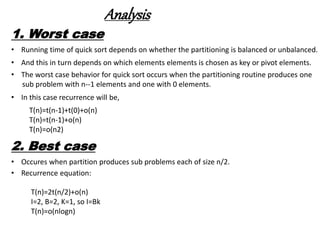
• Quick sort works by partitioning the array to be sorted.
• each partition is internally sorted recursively.
• As a first Step, this algorithm chooses one elements of an array as a pivot or a key element.
• the array is then partitioned on either side of the pivot.
• elements are moved so that those greater then the pivot are shifted to its right where as
the others are shifted to its left.
• two pointers low and up are initialized to the lower and upper boundes of the sub array.
• up pointer will be decremented and low pointer will be incremented as per following
condition.
1. Increase low pointer until t[low] > pivot.
2. Decrease up pointer until t[up] <= pivot.
3. If low < up then interchange t[low] with t[up].
4. If up <= low then interchange t[up] with t[i].](https://image.slidesharecdn.com/quicksort-181009161203/85/Quick-sort-1-320.jpg)
![QuickSort
• Quick sort works by partitioning the array to be sorted.
• each partition is internally sorted recursively.
• As a first Step, this algorithm chooses one elements of an array as a pivot or a key element.
• the array is then partitioned on either side of the pivot.
• elements are moved so that those greater then the pivot are shifted to its right where as
the others are shifted to its left.
• two pointers low and up are initialized to the lower and upper boundes of the sub array.
• up pointer will be decremented and low pointer will be incremented as per following
condition.
1. Increase low pointer until t[low] > pivot.
2. Decrease up pointer until t[up] <= pivot.
3. If low < up then interchange t[low] with t[up].
4. If up <= low then interchange t[up] with t[i].](https://image.slidesharecdn.com/quicksort-181009161203/75/Quick-sort-1-2048.jpg)
![Algorithm
Produce pivot(T[i,...,j];var |)
{Permutes the elements in array T[i,...,j] and returns a value i such that, at the end, i<=1<=j,
T[k]<=p for all i<=k<i, t[i]=p, and t[k]>p for all i<k<=j, where p is the initial value t[i]}
P<--T[i]
K<--I; I<--J+1
Repeat k<--k+1 until t[k]>p
Repeat I<--I-1 untill T[i]<=p
While k < I do
Swap T[k] and T[i]
Repeat k<--k+1Untill T[k]>p
Repeat I<--I-1 Untill T[i]<=p
Swap T[i] and T[i]
Procedure quicksort(T[i,...,j])
{Sorts subarray T[i,...,j] into non decreasing order}
If j -- i is sufficiently small then insert (T[i,...,j])
else
Pivot(T[i,...,j],i)
Quicksort(T[i,..., I --1])
Quicksort(T[i+1,...,j])](https://image.slidesharecdn.com/quicksort-181009161203/85/Quick-sort-2-320.jpg)
![20 10 80 100307506040
Pivot,i j
Here, pivot = T[i], k = 1, i=j+1
Repeat k = k+1, Untill T[k] > pivot
Repeat i = i-1, Untill T[k] <= pivot
20 10 80 100307506040
Pivot K i
Is k < I ? , Yes then Swap T[k] <--> T[i]
Example](https://image.slidesharecdn.com/quicksort-181009161203/85/Quick-sort-5-320.jpg)
![20 10 30 100807506040
Pivot K i
Repeat i = i-1, Untill T[k] <= Pivot
Repeat k = k+1, Untill T[k] > Pivot
20 10 30 100807506040
Pivot K i
Is k < I ? , Yes then Swap T[k] <--> T[i]
20 10 30 100806050740
Pivot K i](https://image.slidesharecdn.com/quicksort-181009161203/85/Quick-sort-6-320.jpg)
![Repeat k = k+1, Untill T[k] > pivot
Repeat i = i-1, Untill T[k] <= pivot
20 10 30 100806050740
Pivot Ki
Is k < I ? , No then Swap Pivot <--> T[i]
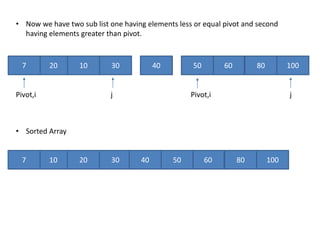
20 10 30 100806050407
Pivot](https://image.slidesharecdn.com/quicksort-181009161203/85/Quick-sort-7-320.jpg)



![ppt daaa[1].pptxdaaaaaaaaaaaaaaaaaaaaaaaaaaaaaaaaa](https://cdn.slidesharecdn.com/ss_thumbnails/pptdaaa1-251211161628-1cb28a51-thumbnail.jpg?width=640&height=640&fit=bounds)


