Quicksort
MADE BY
SANIA NISAR
INTRODUCTIO
N
What is sorting?
Sorting breaks large data into smaller data units.
What is quicksort?
Arranges the element of array systematically or orderly.
The order could be ascending (moving from less to greater) or
descending (moving from greater to less).
Quicksort (sometimes called partition-exchange sort) is an efficient
sorting algorithm.
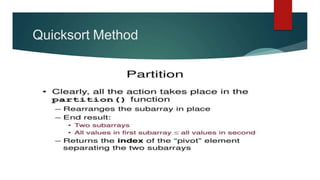
Quicksort Method
Choice of Pivot
Determine the pivot :
Many different approaches
The first element of the current sub-array
The last element
The middle element
The median of first , middle and last elements
Randomly choose an element
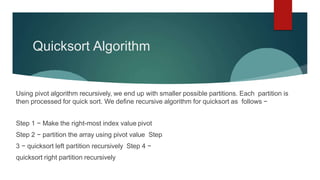
Quicksort Algorithm
Using pivot algorithm recursively, we end up with smaller possible partitions. Each partition is
then processed for quick sort. We define recursive algorithm for quicksort as follows −
Step 1 − Make the right-most index value pivot
Step 2 − partition the array using pivot value Step
3 − quicksort left partition recursively Step 4 −
quicksort right partition recursively
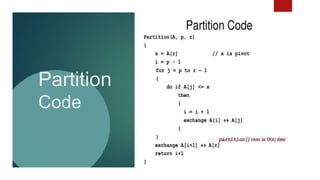
Partition
Code
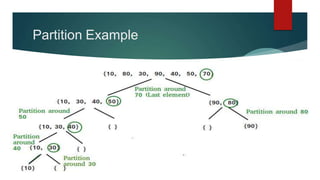
Partition Example
Quicksort Pseudocode
 Procedure quicksort(Left ,
Right)
 if right-left <= 0
 retur
n
 else
 pivot = A[right]
 partition = partitionFunc(left, right, pivot)


quickSort(left,partition-1)
quickSort(partition+1,right)
 end if
 end procedure
Quicksort Implementation
#include < iostream >
using namespace std ;
void quick_sort (int[],int,int); int
partition (int[],int,int);
int main()
{
int a[50],n,i;
cout<<"How many elements?";
cin>>n;
cout<<"n Enter array elements:";
for(i=0;i<n;i++)
cin>>a[i];
quick_sort (a,0,n-1);
cout<<"n Array after sorting:";
for(i=0;i<n;i++)
cout<<a[i]<<" ";
return 0;
}
void quick_sort (int a[],int l,int u)
{
int j;
if(l<u)
{
j=partition(a,l,u);
quick_sort(a,l,j-1);
quick_sort(a,j+1,u);
}
}
int partition (int a[],int l,int u)
{
int v,i,j,temp;
v=a[l];
i=l;
j=u+1;
do
{
do
i++;
while(a[i]<v&&i<=u);
do
j--;
while(v<a[j]);
if(i<j)
{
temp=a[i];
a[i]=a[j];
a[j]=temp;
}
}
while(i<j);
a[l]=a[j];
a[j]=v;
return(j);
}
Output
How many elements?
6
Enter array elements:
9 15 6 7 10 12
Array after
sorting: 6 7 9 10
12 15
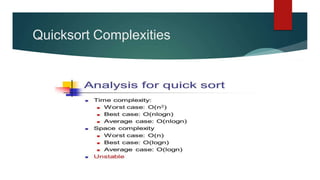
Quicksort Complexities
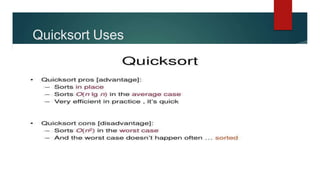
Quicksort Uses
REVIE
W
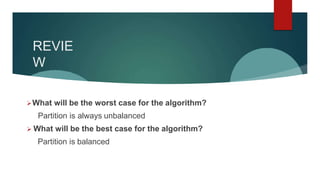
What will be the worst case for the algorithm?
Partition is always unbalanced
 What will be the best case for the algorithm?
Partition is balanced
SUMMAR
Y
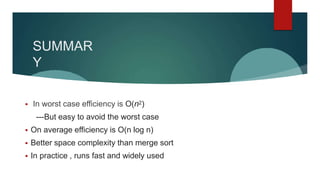
 In worst case efficiency is O(n2)
---But easy to avoid the worst case
 On average efficiency is O(n log n)
 Better space complexity than merge sort
 In practice , runs fast and widely used
EN
D

Quick sort by Sania Nisar

  • 1.
  • 2.
    INTRODUCTIO N What is sorting? Sortingbreaks large data into smaller data units. What is quicksort? Arranges the element of array systematically or orderly. The order could be ascending (moving from less to greater) or descending (moving from greater to less). Quicksort (sometimes called partition-exchange sort) is an efficient sorting algorithm.
  • 3.
  • 4.
    Choice of Pivot Determinethe pivot : Many different approaches The first element of the current sub-array The last element The middle element The median of first , middle and last elements Randomly choose an element
  • 5.
    Quicksort Algorithm Using pivotalgorithm recursively, we end up with smaller possible partitions. Each partition is then processed for quick sort. We define recursive algorithm for quicksort as follows − Step 1 − Make the right-most index value pivot Step 2 − partition the array using pivot value Step 3 − quicksort left partition recursively Step 4 − quicksort right partition recursively
  • 6.
  • 7.
  • 8.
    Quicksort Pseudocode  Procedurequicksort(Left , Right)  if right-left <= 0  retur n  else  pivot = A[right]  partition = partitionFunc(left, right, pivot)   quickSort(left,partition-1) quickSort(partition+1,right)  end if  end procedure
  • 9.
    Quicksort Implementation #include <iostream > using namespace std ; void quick_sort (int[],int,int); int partition (int[],int,int); int main() { int a[50],n,i; cout<<"How many elements?"; cin>>n; cout<<"n Enter array elements:"; for(i=0;i<n;i++) cin>>a[i];
  • 10.
    quick_sort (a,0,n-1); cout<<"n Arrayafter sorting:"; for(i=0;i<n;i++) cout<<a[i]<<" "; return 0; } void quick_sort (int a[],int l,int u) { int j; if(l<u) { j=partition(a,l,u); quick_sort(a,l,j-1); quick_sort(a,j+1,u); } }
  • 11.
    int partition (inta[],int l,int u) { int v,i,j,temp; v=a[l]; i=l; j=u+1; do { do i++; while(a[i]<v&&i<=u); do j--; while(v<a[j]); if(i<j) { temp=a[i]; a[i]=a[j]; a[j]=temp; }
  • 12.
    } while(i<j); a[l]=a[j]; a[j]=v; return(j); } Output How many elements? 6 Enterarray elements: 9 15 6 7 10 12 Array after sorting: 6 7 9 10 12 15
  • 13.
  • 14.
  • 15.
    REVIE W What will bethe worst case for the algorithm? Partition is always unbalanced  What will be the best case for the algorithm? Partition is balanced
  • 16.
    SUMMAR Y  In worstcase efficiency is O(n2) ---But easy to avoid the worst case  On average efficiency is O(n log n)  Better space complexity than merge sort  In practice , runs fast and widely used
  • 17.