College of Computing & Information Technology
King Abdulaziz University
CPCS-204 – Data Structures I
Sorting:
Quick Sort
Sorting: Quick Sort page 2
© Dr. Jonathan (Yahya) Cazalas
Sorting: Quick Sort
 Quick Sort
 Most common sort used in practice
 Why?
 cuz it is usually the quickest in practice!
 Quick Sort uses two main ideas to achieve this
efficiency:
1) The idea of making partitions
2) Recursion
 Let’s look at the partition concept…
Sorting: Quick Sort page 3
© Dr. Jonathan (Yahya) Cazalas
Sorting: Quick Sort
 Quick Sort – Partition
 A partition works as follows:
 Given an array of n elements
 You must manually select an element in the array to
partition by
 You must then compare ALL the remaining elements
against this element
 If they are greater,
 Put them to the “right” of the partition element
 If they are less,
 Put them to the “left” of the partition element
Sorting: Quick Sort page 4
© Dr. Jonathan (Yahya) Cazalas
Sorting: Quick Sort
 Quick Sort – Partition
 A partition works as follows:
 Once the partition is complete, what can we say about
the position of the partition element?
 We can say (we KNOW) that the partition element is
in its CORRECTLY sorted location
 In fact, after you partition the array, you are left with:
 all the elements to the left of the partition element, in the
array, that still need to be sorted
 all the elements to the right of the partition element, in the
array, that still need to be sorted
 And if you sort those two sides, the entire array will be
sorted!
Sorting: Quick Sort page 5
© Dr. Jonathan (Yahya) Cazalas
Sorting: Quick Sort
 Quick Sort
 Partition:
 Essentially breaks down the sorting problem into two
smaller sorting problems
 …what does that sound like?
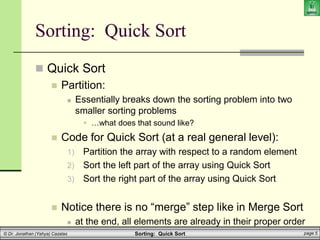
 Code for Quick Sort (at a real general level):
1) Partition the array with respect to a random element
2) Sort the left part of the array using Quick Sort
3) Sort the right part of the array using Quick Sort
 Notice there is no “merge” step like in Merge Sort
 at the end, all elements are already in their proper order
Sorting: Quick Sort page 6
© Dr. Jonathan (Yahya) Cazalas
Sorting: Quick Sort
 Quick Sort
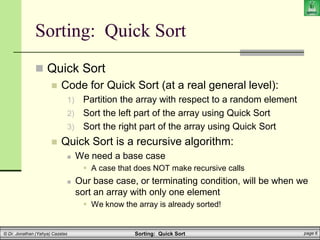
 Code for Quick Sort (at a real general level):
1) Partition the array with respect to a random element
2) Sort the left part of the array using Quick Sort
3) Sort the right part of the array using Quick Sort
 Quick Sort is a recursive algorithm:
 We need a base case
 A case that does NOT make recursive calls
 Our base case, or terminating condition, will be when we
sort an array with only one element
 We know the array is already sorted!
Sorting: Quick Sort page 7
© Dr. Jonathan (Yahya) Cazalas
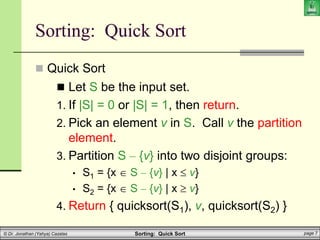
 Let S be the input set.
1. If |S| = 0 or |S| = 1, then return.
2. Pick an element v in S. Call v the partition
element.
3. Partition S – {v} into two disjoint groups:
• S1 = {x  S – {v} | x  v}
• S2 = {x  S – {v} | x  v}
4. Return { quicksort(S1), v, quicksort(S2) }
Sorting: Quick Sort
 Quick Sort
Sorting: Quick Sort page 8
© Dr. Jonathan (Yahya) Cazalas
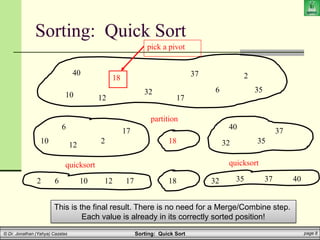
40
10
18
32
2
35
37
17
6
12
pick a pivot
6
10
12
2
17
18
40
37
32 35
partition
quicksort quicksort
18
10 12 17
6
2 40
37
35
32
Sorting: Quick Sort
This is the final result. There is no need for a Merge/Combine step.
Each value is already in its correctly sorted position!
Sorting: Quick Sort page 9
© Dr. Jonathan (Yahya) Cazalas
Sorting: Quick Sort
 The idea of “in place”
 In Computer Science, an “in-place” algorithm is
one where the output usually overwrites the input
 There is more detail, but for our purposes, we stop with
that
 Example:
 Say we wanted to reverse an array of n items
 Here is a simple way to do that:
method reverse(a[0..n]) {
allocate b[0..n]
for i from 0 to n
b[n - i] = a[i]
return b
}
Sorting: Quick Sort page 10
© Dr. Jonathan (Yahya) Cazalas
Sorting: Quick Sort
 The idea of “in place”
 Example:
 Say we wanted to reverse an array of n items
 Here is a simple way to do that:
 Unfortunately, this method requires O(n) extra space to
create the array b
 And allocation can be a slow operation
method reverse(a[0..n]) {
allocate b[0..n]
for i from 0 to n
b[n - i] = a[i]
return b
}
Sorting: Quick Sort page 11
© Dr. Jonathan (Yahya) Cazalas
Sorting: Quick Sort
 The idea of “in place”
 Example:
 Say we wanted to reverse an array of n items
 If we no longer need the original array a
 We can overwrite it using the following in-place algorithm
 Many Sorting algorithms are in-place algorithms
 Quick sort is NOT an in-place algorithm
 BUT, the Partition algorithm can be in-place
method reverse-in-place(a[0..n])
for i from 0 to floor(n/2)
swap(a[i], a[n-i])
Sorting: Quick Sort page 12
© Dr. Jonathan (Yahya) Cazalas
Sorting: Quick Sort
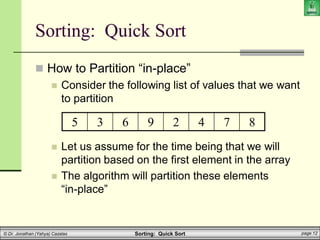
 How to Partition “in-place”
 Consider the following list of values that we want
to partition
 Let us assume for the time being that we will
partition based on the first element in the array
 The algorithm will partition these elements
“in-place”
5 3 6 9 2 4 7 8
Sorting: Quick Sort page 13
© Dr. Jonathan (Yahya) Cazalas
Sorting: Quick Sort
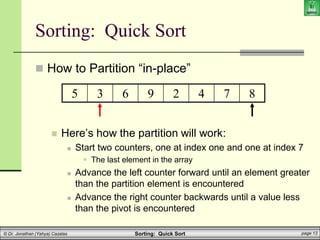
 How to Partition “in-place”
 Here’s how the partition will work:
 Start two counters, one at index one and one at index 7
 The last element in the array
 Advance the left counter forward until an element greater
than the partition element is encountered
 Advance the right counter backwards until a value less
than the pivot is encountered
5 3 6 9 2 4 7 8
Sorting: Quick Sort page 14
© Dr. Jonathan (Yahya) Cazalas
Sorting: Quick Sort
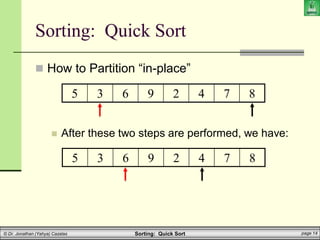
 How to Partition “in-place”
 After these two steps are performed, we have:
5 3 6 9 2 4 7 8
5 3 6 9 2 4 7 8
Sorting: Quick Sort page 15
© Dr. Jonathan (Yahya) Cazalas
Sorting: Quick Sort
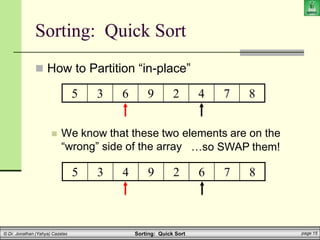
 How to Partition “in-place”
 We know that these two elements are on the
“wrong” side of the array
5 3 6 9 2 4 7 8
5 3 4 9 2 6 7 8
…so SWAP them!
Sorting: Quick Sort page 16
© Dr. Jonathan (Yahya) Cazalas
Sorting: Quick Sort
 How to Partition “in-place”
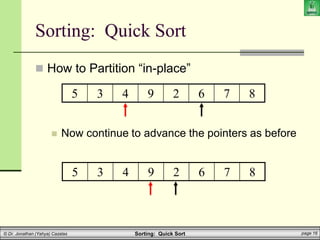
 Now continue to advance the pointers as before
5 3 4 9 2 6 7 8
5 3 4 9 2 6 7 8
Sorting: Quick Sort page 17
© Dr. Jonathan (Yahya) Cazalas
Sorting: Quick Sort
 How to Partition “in-place”
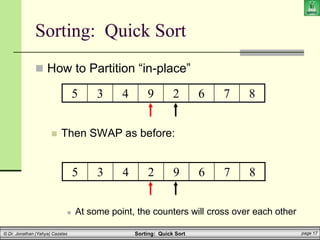
 Then SWAP as before:
 At some point, the counters will cross over each other
5 3 4 9 2 6 7 8
5 3 4 2 9 6 7 8
Sorting: Quick Sort page 18
© Dr. Jonathan (Yahya) Cazalas
Sorting: Quick Sort
 How to Partition “in-place”
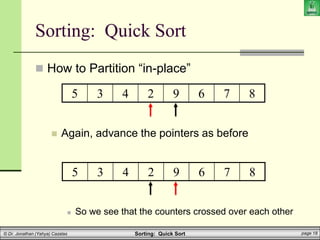
 Again, advance the pointers as before
 So we see that the counters crossed over each other
5 3 4 2 9 6 7 8
5 3 4 2 9 6 7 8
Sorting: Quick Sort page 19
© Dr. Jonathan (Yahya) Cazalas
Sorting: Quick Sort
 How to Partition “in-place”
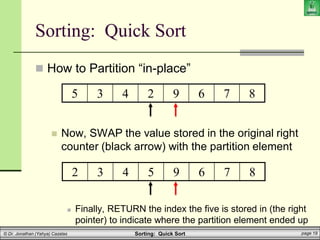
 Now, SWAP the value stored in the original right
counter (black arrow) with the partition element
 Finally, RETURN the index the five is stored in (the right
pointer) to indicate where the partition element ended up
5 3 4 2 9 6 7 8
2 3 4 5 9 6 7 8
Sorting: Quick Sort page 20
© Dr. Jonathan (Yahya) Cazalas
Sorting: Quick Sort
 Partition Code
public int partition(int vals[], int low, int high) {
int temp, randomIndex;
int pivotIdx; // index of the pivot element
// A base case that should never really occur.
if (low == high) return low;
// Pick a random partition element and swap it into index low.
randomIndex = low + (int)(Math.random()*(high-low+1));
temp = vals[randomIndex];
vals[randomIndex] = vals[low];
vals[low] = temp;
// Store the index of the partition element.
pivotIdx = low; // set pivotIdx to the position index of “low”
// Update our low pointer.
low++;
Sorting: Quick Sort page 21
© Dr. Jonathan (Yahya) Cazalas
Sorting: Quick Sort
 Partition Code
// Run Partition so long as low and high counters don't cross.
while (low <= high) {
// Move the low pointer forwards.
while (low <= high && vals[low] <= vals[pivot]) low++;
// Move the high pointer backwards.
while (high >= low && vals[high] > vals[pivot]) high--;
// Now swap the values at those two pointers.
if (low < high)
swap(vals, low, high);
}
// Swap the partition element into it's correct location.
swap(vals, pivotIdx, high);
return high; // Return the FINAL index of the partition element.
}
Sorting: Quick Sort page 22
© Dr. Jonathan (Yahya) Cazalas
Sorting: Quick Sort
 Quick Sort Code
public void quickSort(int numbers[], int low, int high) {
// Only have to sort if we are sorting more than one number
if (low < high) {
// Partition the elements
// Parition function returns the index of the
// partition element. Saved into “pivot”.
int pivotIdx = partition(numbers, low, high);
// Recursively Quick Sort the left side
quickSort(numbers, low, pivotIdx-1);
// Recursively Quick Sort the right side
quickSort(numbers, pivotIdx+1, high);
}
}
Sorting: Quick Sort page 23
© Dr. Jonathan (Yahya) Cazalas
 Choosing a Partition Element
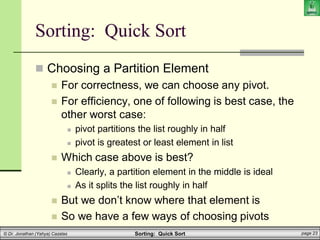
 For correctness, we can choose any pivot.
 For efficiency, one of following is best case, the
other worst case:
 pivot partitions the list roughly in half
 pivot is greatest or least element in list
 Which case above is best?
 Clearly, a partition element in the middle is ideal
 As it splits the list roughly in half
 But we don’t know where that element is
 So we have a few ways of choosing pivots
Sorting: Quick Sort
Sorting: Quick Sort page 24
© Dr. Jonathan (Yahya) Cazalas
 Choosing a Partition Element
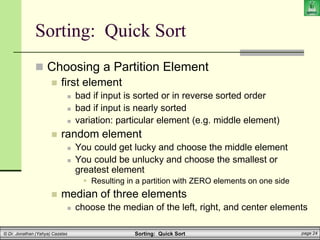
 first element
 bad if input is sorted or in reverse sorted order
 bad if input is nearly sorted
 variation: particular element (e.g. middle element)
 random element
 You could get lucky and choose the middle element
 You could be unlucky and choose the smallest or
greatest element
 Resulting in a partition with ZERO elements on one side
 median of three elements
 choose the median of the left, right, and center elements
Sorting: Quick Sort
Sorting: Quick Sort page 25
© Dr. Jonathan (Yahya) Cazalas
 Choosing a Partition Element
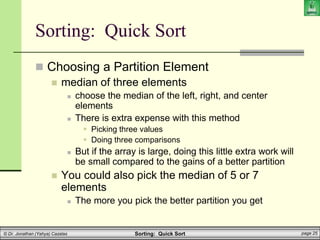
 median of three elements
 choose the median of the left, right, and center
elements
 There is extra expense with this method
 Picking three values
 Doing three comparisons
 But if the array is large, doing this little extra work will
be small compared to the gains of a better partition
 You could also pick the median of 5 or 7
elements
 The more you pick the better partition you get
Sorting: Quick Sort
Sorting: Quick Sort page 26
© Dr. Jonathan (Yahya) Cazalas
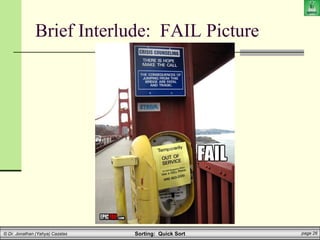
Brief Interlude: FAIL Picture
Sorting: Quick Sort page 27
© Dr. Jonathan (Yahya) Cazalas
Daily UCF Bike Fail
Courtesy of
Benjamin Stanchina
Finding new and
innovative ways
to get your bike
stolen!
Sorting: Quick Sort page 28
© Dr. Jonathan (Yahya) Cazalas
Sorting: Quick Sort
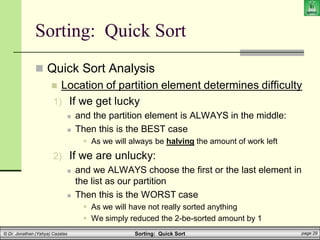
 Quick Sort Analysis
 This is more difficult to do than Merge Sort
 Why?
 With Merge Sort, we knew that our recursive calls always
had equal sized inputs
 Remember: we would split the array of size n into two arrays
of size n/2 (so the smaller arrays were always the same size)
 How is Quick Sort different? (more difficult?)
 Each recursive call of Quick Sort could have a different
sized set of numbers to sort
 Because the size of the sets is based on our partition element
 If partition element is in the middle, each set has about half
 Otherwise, one set is large and one is small
Sorting: Quick Sort page 29
© Dr. Jonathan (Yahya) Cazalas
Sorting: Quick Sort
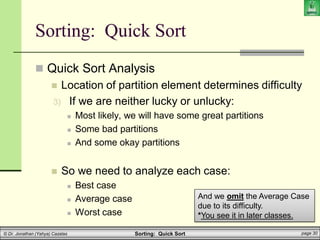
 Quick Sort Analysis
 Location of partition element determines difficulty
1) If we get lucky
 and the partition element is ALWAYS in the middle:
 Then this is the BEST case
 As we will always be halving the amount of work left
2) If we are unlucky:
 and we ALWAYS choose the first or the last element in
the list as our partition
 Then this is the WORST case
 As we will have not really sorted anything
 We simply reduced the 2-be-sorted amount by 1
Sorting: Quick Sort page 30
© Dr. Jonathan (Yahya) Cazalas
Sorting: Quick Sort
 Quick Sort Analysis
 Location of partition element determines difficulty
3) If we are neither lucky or unlucky:
 Most likely, we will have some great partitions
 Some bad partitions
 And some okay partitions
 So we need to analyze each case:
 Best case
 Average case
 Worst case
And we omit the Average Case
due to its difficulty.
*You see it in later classes.
Sorting: Quick Sort page 31
© Dr. Jonathan (Yahya) Cazalas
Sorting: Quick Sort
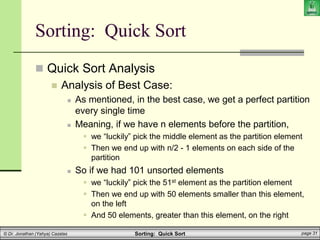
 Quick Sort Analysis
 Analysis of Best Case:
 As mentioned, in the best case, we get a perfect partition
every single time
 Meaning, if we have n elements before the partition,
 we “luckily” pick the middle element as the partition element
 Then we end up with n/2 - 1 elements on each side of the
partition
 So if we had 101 unsorted elements
 we “luckily” pick the 51st element as the partition element
 Then we end up with 50 elements smaller than this element,
on the left
 And 50 elements, greater than this element, on the right
Sorting: Quick Sort page 32
© Dr. Jonathan (Yahya) Cazalas
Sorting: Quick Sort
 Quick Sort Analysis
 Analysis of Best Case:
 Again, here are the steps of Quick Sort:
1) Partition the elements
2) Quick Sort the smaller half (recursive)
3) Quick Sort the larger half (recursive)
 So at each recursive step, the input size is halved
 Let T(n) be the running time of Quick Sort on n elements
 And remember that Partition runs on O(n) time
 So we get our recurrence relation for the best case:
 T(n) = 2*T(n/2) + O(n)
 This is the same recurrence relation as Merge Sort
 So in the best case, Quick Sort runs in O(nlogn) time
Sorting: Quick Sort page 33
© Dr. Jonathan (Yahya) Cazalas
Sorting: Quick Sort
 Quick Sort Analysis
 Analysis of Worst Case:
 Assume that we are horribly unlucky
 And when choosing the partition element, we somehow
end up always choosing the greatest value remaining
 Now for this worst case:
 How many times will the Partition function run?
 Think: when we choose the greatest element (for example)
 We have the partition element, then ALL other elements are to
the left in one partition
 The “partition” to the right will have ZERO elements
 So Partition will run n-1 times
 The first time results in comparing n-1 values, then comparing
n-2 values the second time, followed by n-3, etc.
Sorting: Quick Sort page 34
© Dr. Jonathan (Yahya) Cazalas
Sorting: Quick Sort
 Quick Sort Analysis
 Analysis of Worst Case:
 How many times will the Partition function run?
 Partition will run n-1 times
 The first time results in comparing n-1 values, then comparing
n-2 values the second time, followed by n-3, etc.
 When we sum the number of compares, we get:
 1 + 2 + 3 + … + (n - 1)
 You should know what this equals:
 Thus, the worst case running time is O(n2)
2
)
1
( n
n 
Sorting: Quick Sort page 35
© Dr. Jonathan (Yahya) Cazalas
Sorting: Quick Sort
 Quick Sort Analysis
 Summary:
 Best Case: O(nlogn)
 Average Case: O(nlogn)
 Worst Case: O(n2)
 Compare Merge Sort and Quick Sort:
 Merge Sort: guaranteed O(nlogn)
 Quick Sort: best and average case is O(nlogn) but worst
case is O(n2)
Sorting: Quick Sort page 36
© Dr. Jonathan (Yahya) Cazalas
Sorting: Quick Sort
WASN’T
THAT
THE GREATEST!
Sorting: Quick Sort page 37
© Dr. Jonathan (Yahya) Cazalas
Daily Demotivator
College of Computing & Information Technology
King Abdulaziz University
CPCS-204 – Data Structures I
Sorting:
Quick Sort

quick_sort

  • 1.
    College of Computing& Information Technology King Abdulaziz University CPCS-204 – Data Structures I Sorting: Quick Sort
  • 2.
    Sorting: Quick Sortpage 2 © Dr. Jonathan (Yahya) Cazalas Sorting: Quick Sort  Quick Sort  Most common sort used in practice  Why?  cuz it is usually the quickest in practice!  Quick Sort uses two main ideas to achieve this efficiency: 1) The idea of making partitions 2) Recursion  Let’s look at the partition concept…
  • 3.
    Sorting: Quick Sortpage 3 © Dr. Jonathan (Yahya) Cazalas Sorting: Quick Sort  Quick Sort – Partition  A partition works as follows:  Given an array of n elements  You must manually select an element in the array to partition by  You must then compare ALL the remaining elements against this element  If they are greater,  Put them to the “right” of the partition element  If they are less,  Put them to the “left” of the partition element
  • 4.
    Sorting: Quick Sortpage 4 © Dr. Jonathan (Yahya) Cazalas Sorting: Quick Sort  Quick Sort – Partition  A partition works as follows:  Once the partition is complete, what can we say about the position of the partition element?  We can say (we KNOW) that the partition element is in its CORRECTLY sorted location  In fact, after you partition the array, you are left with:  all the elements to the left of the partition element, in the array, that still need to be sorted  all the elements to the right of the partition element, in the array, that still need to be sorted  And if you sort those two sides, the entire array will be sorted!
  • 5.
    Sorting: Quick Sortpage 5 © Dr. Jonathan (Yahya) Cazalas Sorting: Quick Sort  Quick Sort  Partition:  Essentially breaks down the sorting problem into two smaller sorting problems  …what does that sound like?  Code for Quick Sort (at a real general level): 1) Partition the array with respect to a random element 2) Sort the left part of the array using Quick Sort 3) Sort the right part of the array using Quick Sort  Notice there is no “merge” step like in Merge Sort  at the end, all elements are already in their proper order
  • 6.
    Sorting: Quick Sortpage 6 © Dr. Jonathan (Yahya) Cazalas Sorting: Quick Sort  Quick Sort  Code for Quick Sort (at a real general level): 1) Partition the array with respect to a random element 2) Sort the left part of the array using Quick Sort 3) Sort the right part of the array using Quick Sort  Quick Sort is a recursive algorithm:  We need a base case  A case that does NOT make recursive calls  Our base case, or terminating condition, will be when we sort an array with only one element  We know the array is already sorted!
  • 7.
    Sorting: Quick Sortpage 7 © Dr. Jonathan (Yahya) Cazalas  Let S be the input set. 1. If |S| = 0 or |S| = 1, then return. 2. Pick an element v in S. Call v the partition element. 3. Partition S – {v} into two disjoint groups: • S1 = {x  S – {v} | x  v} • S2 = {x  S – {v} | x  v} 4. Return { quicksort(S1), v, quicksort(S2) } Sorting: Quick Sort  Quick Sort
  • 8.
    Sorting: Quick Sortpage 8 © Dr. Jonathan (Yahya) Cazalas 40 10 18 32 2 35 37 17 6 12 pick a pivot 6 10 12 2 17 18 40 37 32 35 partition quicksort quicksort 18 10 12 17 6 2 40 37 35 32 Sorting: Quick Sort This is the final result. There is no need for a Merge/Combine step. Each value is already in its correctly sorted position!
  • 9.
    Sorting: Quick Sortpage 9 © Dr. Jonathan (Yahya) Cazalas Sorting: Quick Sort  The idea of “in place”  In Computer Science, an “in-place” algorithm is one where the output usually overwrites the input  There is more detail, but for our purposes, we stop with that  Example:  Say we wanted to reverse an array of n items  Here is a simple way to do that: method reverse(a[0..n]) { allocate b[0..n] for i from 0 to n b[n - i] = a[i] return b }
  • 10.
    Sorting: Quick Sortpage 10 © Dr. Jonathan (Yahya) Cazalas Sorting: Quick Sort  The idea of “in place”  Example:  Say we wanted to reverse an array of n items  Here is a simple way to do that:  Unfortunately, this method requires O(n) extra space to create the array b  And allocation can be a slow operation method reverse(a[0..n]) { allocate b[0..n] for i from 0 to n b[n - i] = a[i] return b }
  • 11.
    Sorting: Quick Sortpage 11 © Dr. Jonathan (Yahya) Cazalas Sorting: Quick Sort  The idea of “in place”  Example:  Say we wanted to reverse an array of n items  If we no longer need the original array a  We can overwrite it using the following in-place algorithm  Many Sorting algorithms are in-place algorithms  Quick sort is NOT an in-place algorithm  BUT, the Partition algorithm can be in-place method reverse-in-place(a[0..n]) for i from 0 to floor(n/2) swap(a[i], a[n-i])
  • 12.
    Sorting: Quick Sortpage 12 © Dr. Jonathan (Yahya) Cazalas Sorting: Quick Sort  How to Partition “in-place”  Consider the following list of values that we want to partition  Let us assume for the time being that we will partition based on the first element in the array  The algorithm will partition these elements “in-place” 5 3 6 9 2 4 7 8
  • 13.
    Sorting: Quick Sortpage 13 © Dr. Jonathan (Yahya) Cazalas Sorting: Quick Sort  How to Partition “in-place”  Here’s how the partition will work:  Start two counters, one at index one and one at index 7  The last element in the array  Advance the left counter forward until an element greater than the partition element is encountered  Advance the right counter backwards until a value less than the pivot is encountered 5 3 6 9 2 4 7 8
  • 14.
    Sorting: Quick Sortpage 14 © Dr. Jonathan (Yahya) Cazalas Sorting: Quick Sort  How to Partition “in-place”  After these two steps are performed, we have: 5 3 6 9 2 4 7 8 5 3 6 9 2 4 7 8
  • 15.
    Sorting: Quick Sortpage 15 © Dr. Jonathan (Yahya) Cazalas Sorting: Quick Sort  How to Partition “in-place”  We know that these two elements are on the “wrong” side of the array 5 3 6 9 2 4 7 8 5 3 4 9 2 6 7 8 …so SWAP them!
  • 16.
    Sorting: Quick Sortpage 16 © Dr. Jonathan (Yahya) Cazalas Sorting: Quick Sort  How to Partition “in-place”  Now continue to advance the pointers as before 5 3 4 9 2 6 7 8 5 3 4 9 2 6 7 8
  • 17.
    Sorting: Quick Sortpage 17 © Dr. Jonathan (Yahya) Cazalas Sorting: Quick Sort  How to Partition “in-place”  Then SWAP as before:  At some point, the counters will cross over each other 5 3 4 9 2 6 7 8 5 3 4 2 9 6 7 8
  • 18.
    Sorting: Quick Sortpage 18 © Dr. Jonathan (Yahya) Cazalas Sorting: Quick Sort  How to Partition “in-place”  Again, advance the pointers as before  So we see that the counters crossed over each other 5 3 4 2 9 6 7 8 5 3 4 2 9 6 7 8
  • 19.
    Sorting: Quick Sortpage 19 © Dr. Jonathan (Yahya) Cazalas Sorting: Quick Sort  How to Partition “in-place”  Now, SWAP the value stored in the original right counter (black arrow) with the partition element  Finally, RETURN the index the five is stored in (the right pointer) to indicate where the partition element ended up 5 3 4 2 9 6 7 8 2 3 4 5 9 6 7 8
  • 20.
    Sorting: Quick Sortpage 20 © Dr. Jonathan (Yahya) Cazalas Sorting: Quick Sort  Partition Code public int partition(int vals[], int low, int high) { int temp, randomIndex; int pivotIdx; // index of the pivot element // A base case that should never really occur. if (low == high) return low; // Pick a random partition element and swap it into index low. randomIndex = low + (int)(Math.random()*(high-low+1)); temp = vals[randomIndex]; vals[randomIndex] = vals[low]; vals[low] = temp; // Store the index of the partition element. pivotIdx = low; // set pivotIdx to the position index of “low” // Update our low pointer. low++;
  • 21.
    Sorting: Quick Sortpage 21 © Dr. Jonathan (Yahya) Cazalas Sorting: Quick Sort  Partition Code // Run Partition so long as low and high counters don't cross. while (low <= high) { // Move the low pointer forwards. while (low <= high && vals[low] <= vals[pivot]) low++; // Move the high pointer backwards. while (high >= low && vals[high] > vals[pivot]) high--; // Now swap the values at those two pointers. if (low < high) swap(vals, low, high); } // Swap the partition element into it's correct location. swap(vals, pivotIdx, high); return high; // Return the FINAL index of the partition element. }
  • 22.
    Sorting: Quick Sortpage 22 © Dr. Jonathan (Yahya) Cazalas Sorting: Quick Sort  Quick Sort Code public void quickSort(int numbers[], int low, int high) { // Only have to sort if we are sorting more than one number if (low < high) { // Partition the elements // Parition function returns the index of the // partition element. Saved into “pivot”. int pivotIdx = partition(numbers, low, high); // Recursively Quick Sort the left side quickSort(numbers, low, pivotIdx-1); // Recursively Quick Sort the right side quickSort(numbers, pivotIdx+1, high); } }
  • 23.
    Sorting: Quick Sortpage 23 © Dr. Jonathan (Yahya) Cazalas  Choosing a Partition Element  For correctness, we can choose any pivot.  For efficiency, one of following is best case, the other worst case:  pivot partitions the list roughly in half  pivot is greatest or least element in list  Which case above is best?  Clearly, a partition element in the middle is ideal  As it splits the list roughly in half  But we don’t know where that element is  So we have a few ways of choosing pivots Sorting: Quick Sort
  • 24.
    Sorting: Quick Sortpage 24 © Dr. Jonathan (Yahya) Cazalas  Choosing a Partition Element  first element  bad if input is sorted or in reverse sorted order  bad if input is nearly sorted  variation: particular element (e.g. middle element)  random element  You could get lucky and choose the middle element  You could be unlucky and choose the smallest or greatest element  Resulting in a partition with ZERO elements on one side  median of three elements  choose the median of the left, right, and center elements Sorting: Quick Sort
  • 25.
    Sorting: Quick Sortpage 25 © Dr. Jonathan (Yahya) Cazalas  Choosing a Partition Element  median of three elements  choose the median of the left, right, and center elements  There is extra expense with this method  Picking three values  Doing three comparisons  But if the array is large, doing this little extra work will be small compared to the gains of a better partition  You could also pick the median of 5 or 7 elements  The more you pick the better partition you get Sorting: Quick Sort
  • 26.
    Sorting: Quick Sortpage 26 © Dr. Jonathan (Yahya) Cazalas Brief Interlude: FAIL Picture
  • 27.
    Sorting: Quick Sortpage 27 © Dr. Jonathan (Yahya) Cazalas Daily UCF Bike Fail Courtesy of Benjamin Stanchina Finding new and innovative ways to get your bike stolen!
  • 28.
    Sorting: Quick Sortpage 28 © Dr. Jonathan (Yahya) Cazalas Sorting: Quick Sort  Quick Sort Analysis  This is more difficult to do than Merge Sort  Why?  With Merge Sort, we knew that our recursive calls always had equal sized inputs  Remember: we would split the array of size n into two arrays of size n/2 (so the smaller arrays were always the same size)  How is Quick Sort different? (more difficult?)  Each recursive call of Quick Sort could have a different sized set of numbers to sort  Because the size of the sets is based on our partition element  If partition element is in the middle, each set has about half  Otherwise, one set is large and one is small
  • 29.
    Sorting: Quick Sortpage 29 © Dr. Jonathan (Yahya) Cazalas Sorting: Quick Sort  Quick Sort Analysis  Location of partition element determines difficulty 1) If we get lucky  and the partition element is ALWAYS in the middle:  Then this is the BEST case  As we will always be halving the amount of work left 2) If we are unlucky:  and we ALWAYS choose the first or the last element in the list as our partition  Then this is the WORST case  As we will have not really sorted anything  We simply reduced the 2-be-sorted amount by 1
  • 30.
    Sorting: Quick Sortpage 30 © Dr. Jonathan (Yahya) Cazalas Sorting: Quick Sort  Quick Sort Analysis  Location of partition element determines difficulty 3) If we are neither lucky or unlucky:  Most likely, we will have some great partitions  Some bad partitions  And some okay partitions  So we need to analyze each case:  Best case  Average case  Worst case And we omit the Average Case due to its difficulty. *You see it in later classes.
  • 31.
    Sorting: Quick Sortpage 31 © Dr. Jonathan (Yahya) Cazalas Sorting: Quick Sort  Quick Sort Analysis  Analysis of Best Case:  As mentioned, in the best case, we get a perfect partition every single time  Meaning, if we have n elements before the partition,  we “luckily” pick the middle element as the partition element  Then we end up with n/2 - 1 elements on each side of the partition  So if we had 101 unsorted elements  we “luckily” pick the 51st element as the partition element  Then we end up with 50 elements smaller than this element, on the left  And 50 elements, greater than this element, on the right
  • 32.
    Sorting: Quick Sortpage 32 © Dr. Jonathan (Yahya) Cazalas Sorting: Quick Sort  Quick Sort Analysis  Analysis of Best Case:  Again, here are the steps of Quick Sort: 1) Partition the elements 2) Quick Sort the smaller half (recursive) 3) Quick Sort the larger half (recursive)  So at each recursive step, the input size is halved  Let T(n) be the running time of Quick Sort on n elements  And remember that Partition runs on O(n) time  So we get our recurrence relation for the best case:  T(n) = 2*T(n/2) + O(n)  This is the same recurrence relation as Merge Sort  So in the best case, Quick Sort runs in O(nlogn) time
  • 33.
    Sorting: Quick Sortpage 33 © Dr. Jonathan (Yahya) Cazalas Sorting: Quick Sort  Quick Sort Analysis  Analysis of Worst Case:  Assume that we are horribly unlucky  And when choosing the partition element, we somehow end up always choosing the greatest value remaining  Now for this worst case:  How many times will the Partition function run?  Think: when we choose the greatest element (for example)  We have the partition element, then ALL other elements are to the left in one partition  The “partition” to the right will have ZERO elements  So Partition will run n-1 times  The first time results in comparing n-1 values, then comparing n-2 values the second time, followed by n-3, etc.
  • 34.
    Sorting: Quick Sortpage 34 © Dr. Jonathan (Yahya) Cazalas Sorting: Quick Sort  Quick Sort Analysis  Analysis of Worst Case:  How many times will the Partition function run?  Partition will run n-1 times  The first time results in comparing n-1 values, then comparing n-2 values the second time, followed by n-3, etc.  When we sum the number of compares, we get:  1 + 2 + 3 + … + (n - 1)  You should know what this equals:  Thus, the worst case running time is O(n2) 2 ) 1 ( n n 
  • 35.
    Sorting: Quick Sortpage 35 © Dr. Jonathan (Yahya) Cazalas Sorting: Quick Sort  Quick Sort Analysis  Summary:  Best Case: O(nlogn)  Average Case: O(nlogn)  Worst Case: O(n2)  Compare Merge Sort and Quick Sort:  Merge Sort: guaranteed O(nlogn)  Quick Sort: best and average case is O(nlogn) but worst case is O(n2)
  • 36.
    Sorting: Quick Sortpage 36 © Dr. Jonathan (Yahya) Cazalas Sorting: Quick Sort WASN’T THAT THE GREATEST!
  • 37.
    Sorting: Quick Sortpage 37 © Dr. Jonathan (Yahya) Cazalas Daily Demotivator
  • 38.
    College of Computing& Information Technology King Abdulaziz University CPCS-204 – Data Structures I Sorting: Quick Sort