Quick Sort Divide: Partition the array into two sub-arrays A[p . . q-1]  and A[q+1 . . r] such that each element of  A[p . . q-1] is less than or equal to A[q], which in turn less than or equal to each element of A[q+1 . . r]
Quick Sort Conquer: Sort the two sub-arrays A[p . . q-1]  and A[q+1 . . r] by recursive calls to quick sort.
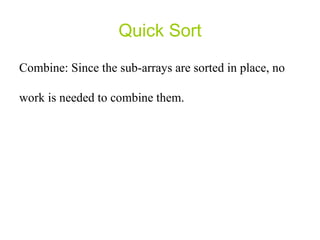
Quick Sort Combine: Since the sub-arrays are sorted in place, no work is needed to combine them.
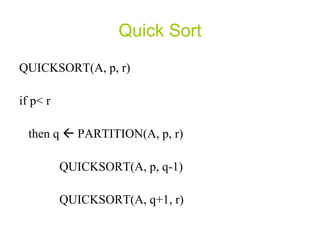
Quick Sort QUICKSORT(A, p, r) if p< r  then q    PARTITION(A, p, r) QUICKSORT(A, p, q-1) QUICKSORT(A, q+1, r)
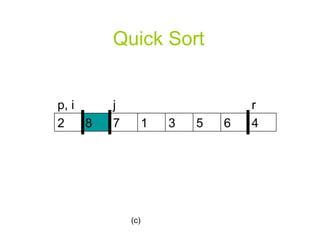
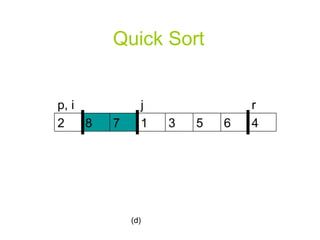
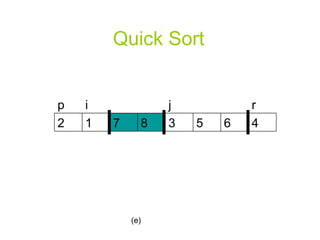
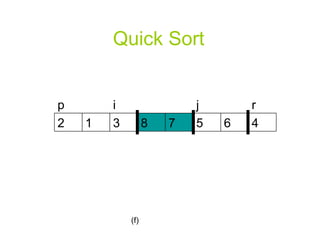
Quick Sort PARTITION(A, p, r) x    A[r] i    p-1
Quick Sort for j    p to r-1 do if A[j] <= x then i   i+1 exchange A[i]       A[j] exchange A[i+1]       A[r] return i+1
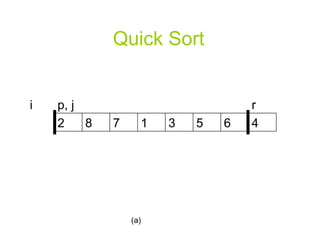
Quick Sort (a) i 4 6 5 3 1 7 8 2 p, j r
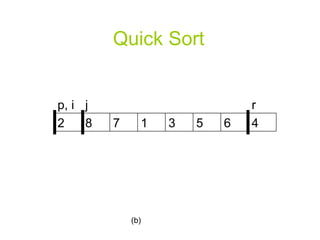
Quick Sort (b) 4 6 5 3 1 7 8 2 j p, i r
Quick Sort (c) 4 6 5 3 1 7 8 2 j p, i r
Quick Sort (d) 4 6 5 3 1 7 8 2 j p, i r
Quick Sort (e) 4 6 5 3 8 7 1 2 j i p r
Quick Sort (f) 4 6 5 7 8 3 1 2 i p r j
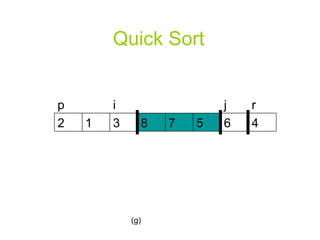
Quick Sort (g) 4 6 5 7 8 3 1 2 i p r j
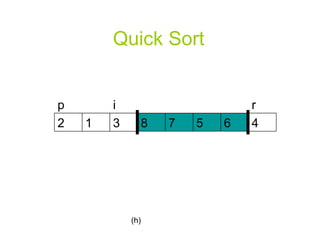
Quick Sort (h) 4 6 5 7 8 3 1 2 i p r
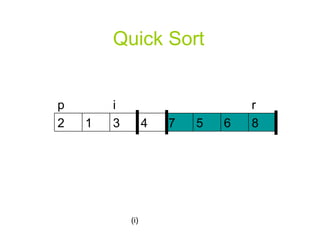
Quick Sort (i) 8 6 5 7 4 3 1 2 i p r
Quick Sort Worst-case partitioning: The partitioning routine produces one sub-problem with n-1 elements and another sub-problem with 0 elements. So the partitioning costs  θ (n) time.
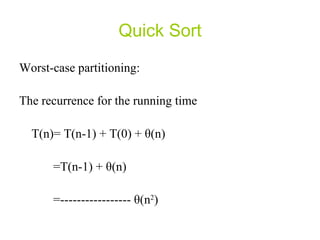
Quick Sort Worst-case partitioning: The recurrence for the running time T(n)= T(n-1) + T(0) +  θ (n) =T(n-1) +  θ (n) =-----------------  θ (n 2 )
Quick Sort Worst-case partitioning: The  θ (n 2 ) running time occurs when the input array is already completely sorted – a common situation in which insertion sort runs in  O (n) time
Quick Sort Best-case partitioning: The partitioning procedure produces two sub-problems, each of size not more than n/2.
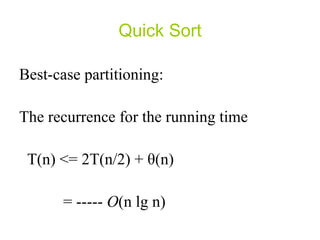
Quick Sort Best-case partitioning: The recurrence for the running time T(n) <= 2T(n/2) +  θ (n) = -----  O (n lg n)
Quick Sort Best-case partitioning: The equal balancing of the two sides of the partition at every level of the recursion produces faster algorithm.
Quick Sort Balanced partitioning: Suppose, the partitioning algorithm always produces 9-to-1 proportional split, which seems quite unbalanced.
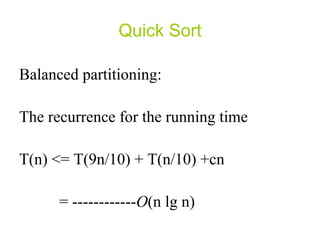
Quick Sort Balanced partitioning: The recurrence for the running time T(n) <= T(9n/10) + T(n/10) +cn  = ------------ O (n lg n)
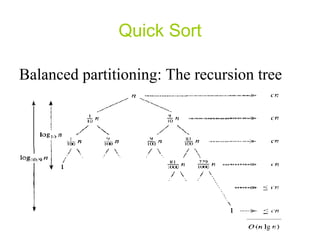
Quick Sort Balanced partitioning: The recursion tree
Quick Sort Balanced partitioning: In fact,  a 99-to-1 split yields an  O (n lg n) running time. Any split of constant proportionality yields a recursion tree of depth  θ (lg n)
Quick Sort Intuition for the average case: It is unlikely that the partitioning always happens in the same way at every level.
Quick Sort Intuition for the average case: In the average case, PARTION produces a mix of “good” and “bad” splits.
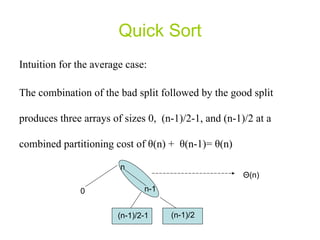
Quick Sort Intuition for the average case: The combination of the bad split followed by the good split produces three arrays of sizes 0,  (n-1)/2-1, and (n-1)/2 at a combined partitioning cost of  θ (n) +  θ (n-1)=  θ (n)  n n-1 (n-1)/2-1 (n-1)/2 0 Θ (n)
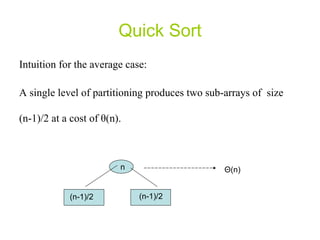
Quick Sort Intuition for the average case: A single level of partitioning produces two sub-arrays of  size (n-1)/2 at a cost of  θ (n).  n (n-1)/2 (n-1)/2 Θ (n)
A Randomized Version of Quick Sort Instead of always using A[r] as the pivot, we will use a randomly chosen element from the sub-array A[p..r].
A Randomized Version of Quick Sort Because the pivot element is randomly chosen, we expect the split of the input array to be reasonably well balanced on average.
A Randomized Version of Quick Sort RANDOMIZED-PARTITION(A, p, r) i    RANDOM(p, r) exchange A[r]       A[i] return PARTITION(A, p, r)
A Randomized Version of Quick Sort RANDOMIZED-QUICKSORT(A, p, r) if p<r then q    RANDOMIZED-PARTITION(A, p, r) RANDOMIZED-QUICKSORT(A, p, q-1) RANDOMIZED-QUICKSORT(A, q+1, r)

Algorithm: Quick-Sort

  • 1.
    Quick Sort Divide:Partition the array into two sub-arrays A[p . . q-1] and A[q+1 . . r] such that each element of A[p . . q-1] is less than or equal to A[q], which in turn less than or equal to each element of A[q+1 . . r]
  • 2.
    Quick Sort Conquer:Sort the two sub-arrays A[p . . q-1] and A[q+1 . . r] by recursive calls to quick sort.
  • 3.
    Quick Sort Combine:Since the sub-arrays are sorted in place, no work is needed to combine them.
  • 4.
    Quick Sort QUICKSORT(A,p, r) if p< r then q  PARTITION(A, p, r) QUICKSORT(A, p, q-1) QUICKSORT(A, q+1, r)
  • 5.
    Quick Sort PARTITION(A,p, r) x  A[r] i  p-1
  • 6.
    Quick Sort forj  p to r-1 do if A[j] <= x then i  i+1 exchange A[i]   A[j] exchange A[i+1]   A[r] return i+1
  • 7.
    Quick Sort (a)i 4 6 5 3 1 7 8 2 p, j r
  • 8.
    Quick Sort (b)4 6 5 3 1 7 8 2 j p, i r
  • 9.
    Quick Sort (c)4 6 5 3 1 7 8 2 j p, i r
  • 10.
    Quick Sort (d)4 6 5 3 1 7 8 2 j p, i r
  • 11.
    Quick Sort (e)4 6 5 3 8 7 1 2 j i p r
  • 12.
    Quick Sort (f)4 6 5 7 8 3 1 2 i p r j
  • 13.
    Quick Sort (g)4 6 5 7 8 3 1 2 i p r j
  • 14.
    Quick Sort (h)4 6 5 7 8 3 1 2 i p r
  • 15.
    Quick Sort (i)8 6 5 7 4 3 1 2 i p r
  • 16.
    Quick Sort Worst-casepartitioning: The partitioning routine produces one sub-problem with n-1 elements and another sub-problem with 0 elements. So the partitioning costs θ (n) time.
  • 17.
    Quick Sort Worst-casepartitioning: The recurrence for the running time T(n)= T(n-1) + T(0) + θ (n) =T(n-1) + θ (n) =----------------- θ (n 2 )
  • 18.
    Quick Sort Worst-casepartitioning: The θ (n 2 ) running time occurs when the input array is already completely sorted – a common situation in which insertion sort runs in O (n) time
  • 19.
    Quick Sort Best-casepartitioning: The partitioning procedure produces two sub-problems, each of size not more than n/2.
  • 20.
    Quick Sort Best-casepartitioning: The recurrence for the running time T(n) <= 2T(n/2) + θ (n) = ----- O (n lg n)
  • 21.
    Quick Sort Best-casepartitioning: The equal balancing of the two sides of the partition at every level of the recursion produces faster algorithm.
  • 22.
    Quick Sort Balancedpartitioning: Suppose, the partitioning algorithm always produces 9-to-1 proportional split, which seems quite unbalanced.
  • 23.
    Quick Sort Balancedpartitioning: The recurrence for the running time T(n) <= T(9n/10) + T(n/10) +cn = ------------ O (n lg n)
  • 24.
    Quick Sort Balancedpartitioning: The recursion tree
  • 25.
    Quick Sort Balancedpartitioning: In fact, a 99-to-1 split yields an O (n lg n) running time. Any split of constant proportionality yields a recursion tree of depth θ (lg n)
  • 26.
    Quick Sort Intuitionfor the average case: It is unlikely that the partitioning always happens in the same way at every level.
  • 27.
    Quick Sort Intuitionfor the average case: In the average case, PARTION produces a mix of “good” and “bad” splits.
  • 28.
    Quick Sort Intuitionfor the average case: The combination of the bad split followed by the good split produces three arrays of sizes 0, (n-1)/2-1, and (n-1)/2 at a combined partitioning cost of θ (n) + θ (n-1)= θ (n) n n-1 (n-1)/2-1 (n-1)/2 0 Θ (n)
  • 29.
    Quick Sort Intuitionfor the average case: A single level of partitioning produces two sub-arrays of size (n-1)/2 at a cost of θ (n). n (n-1)/2 (n-1)/2 Θ (n)
  • 30.
    A Randomized Versionof Quick Sort Instead of always using A[r] as the pivot, we will use a randomly chosen element from the sub-array A[p..r].
  • 31.
    A Randomized Versionof Quick Sort Because the pivot element is randomly chosen, we expect the split of the input array to be reasonably well balanced on average.
  • 32.
    A Randomized Versionof Quick Sort RANDOMIZED-PARTITION(A, p, r) i  RANDOM(p, r) exchange A[r]   A[i] return PARTITION(A, p, r)
  • 33.
    A Randomized Versionof Quick Sort RANDOMIZED-QUICKSORT(A, p, r) if p<r then q  RANDOMIZED-PARTITION(A, p, r) RANDOMIZED-QUICKSORT(A, p, q-1) RANDOMIZED-QUICKSORT(A, q+1, r)