IELTS Listening.
Table Completion Task
Explanation & Useful Tips.
IELTS Listening.
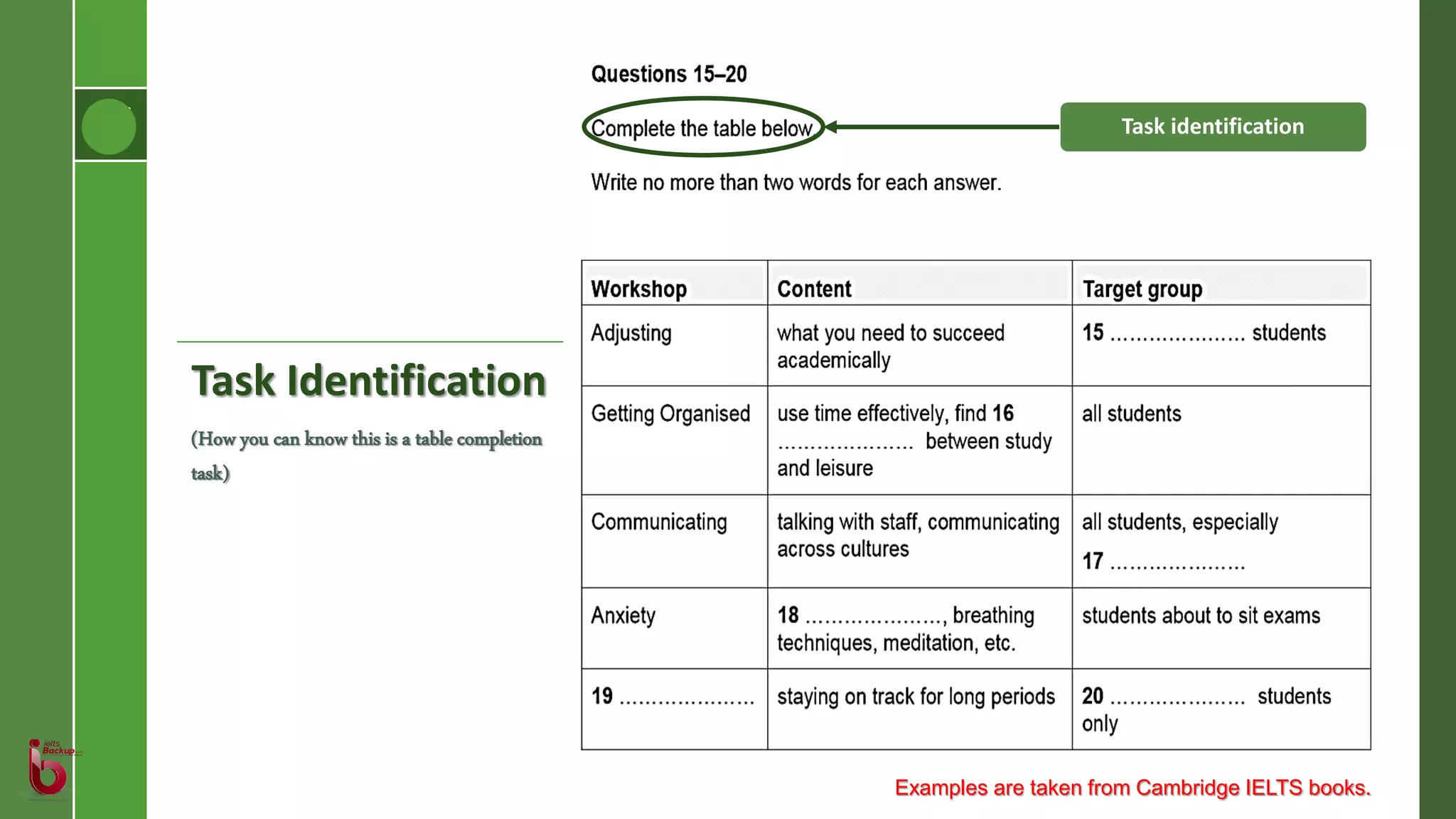
Task Identification
(How you can know this is a table completion
task)
Task identification
Examples are taken from Cambridge IELTS books.
 Task Introduction
 Table completion task is also a fill in the blanks type of
task in the IELTS Listening test.
 In table completion task, you will see a summary of
information in a table like pattern with some of its cells
empty or partially empty.
 The task is to complete the gaps with the right words
from the audio.
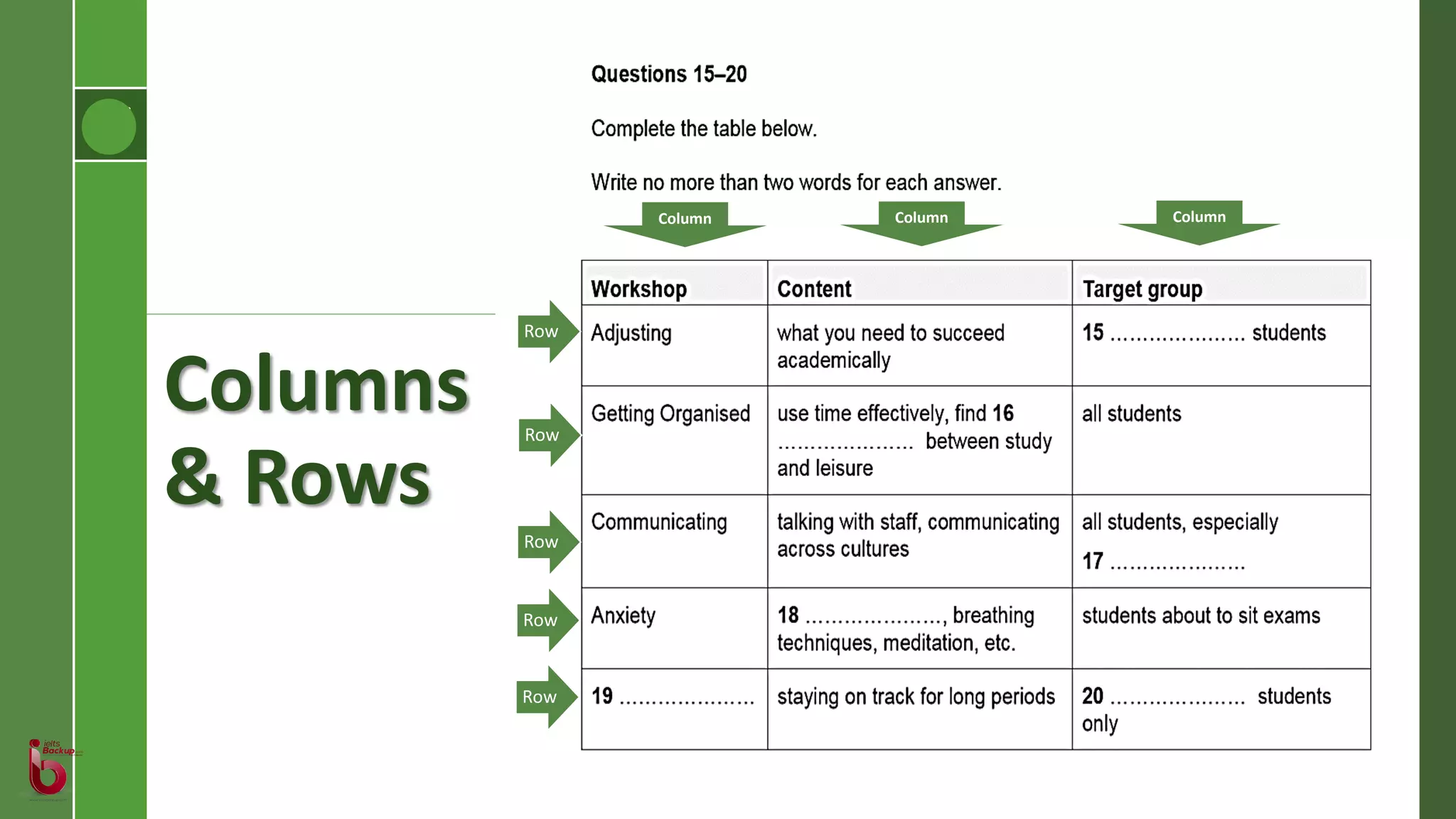
Columns
& Rows
Column
Row
Column Column
Row
Row
Row
Row
 Table completion task in Part 1 and 2 of the
Listening test.
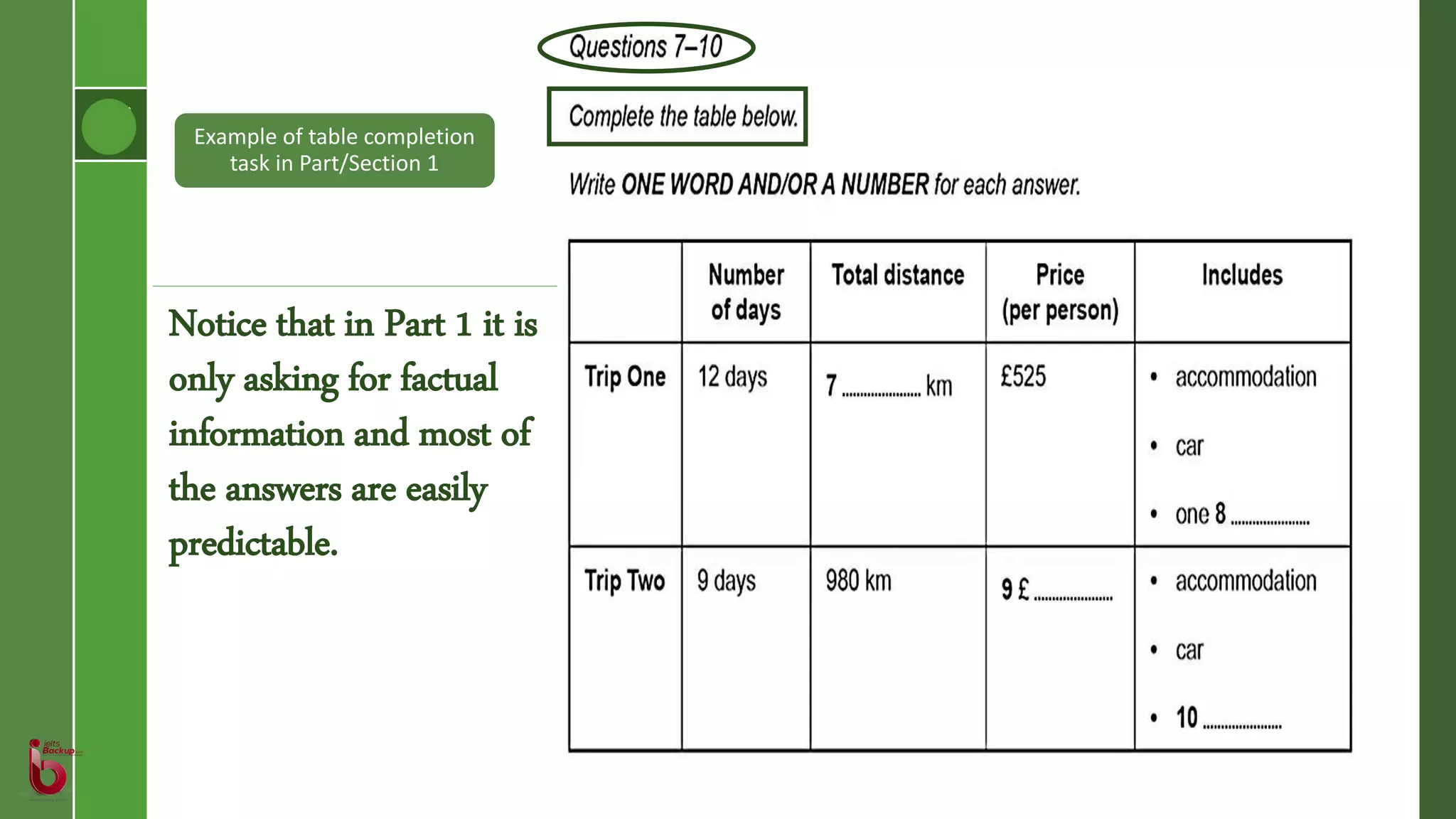
Notice that in Part 1 it is
only asking for factual
information and most of
the answers are easily
predictable.
Example of table completion
task in Part/Section 1
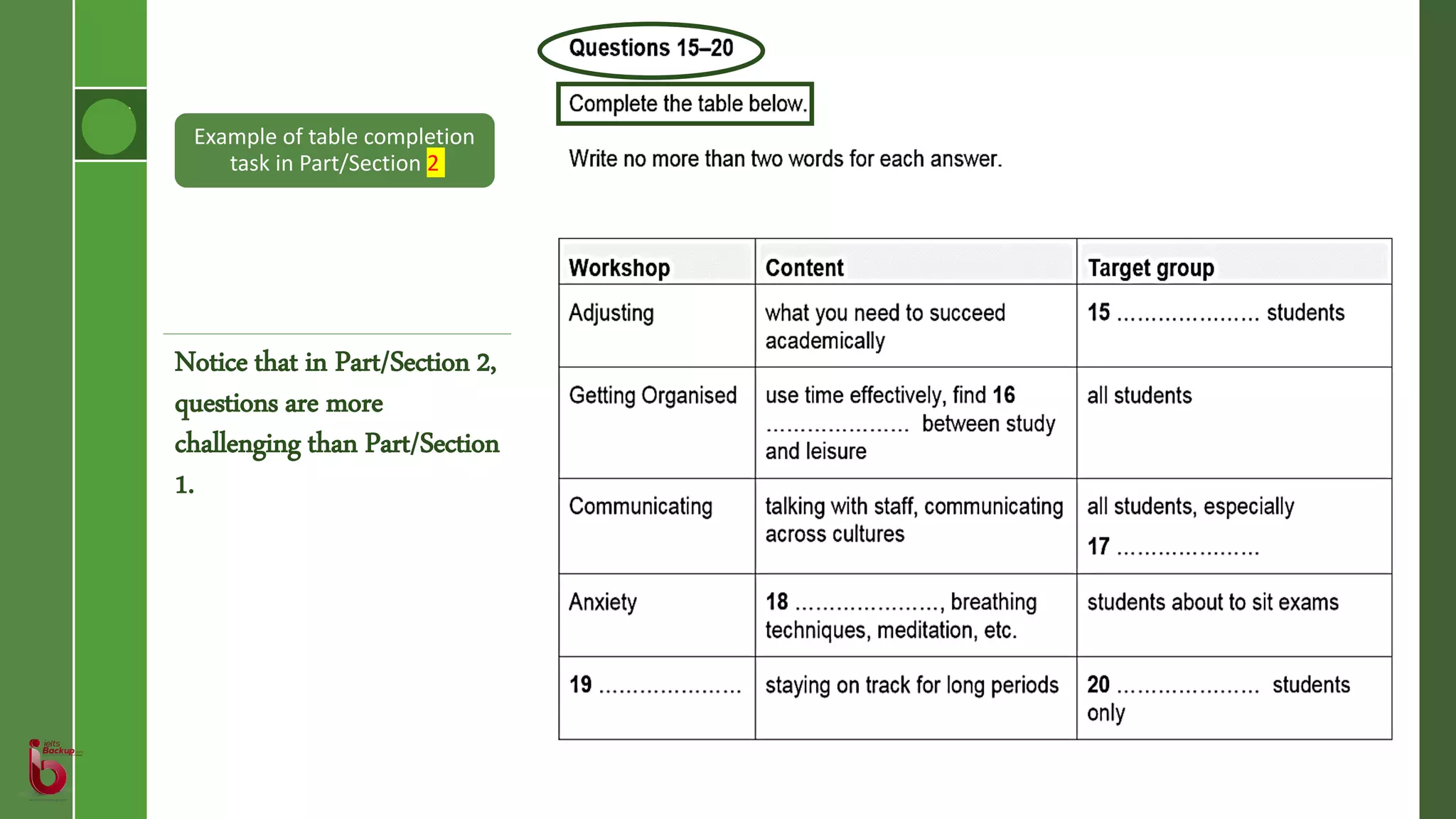
Notice that in Part/Section 2,
questions are more
challenging than Part/Section
1.
Example of table completion
task in Part/Section 2
 It is important to understand how the table is
arranged.
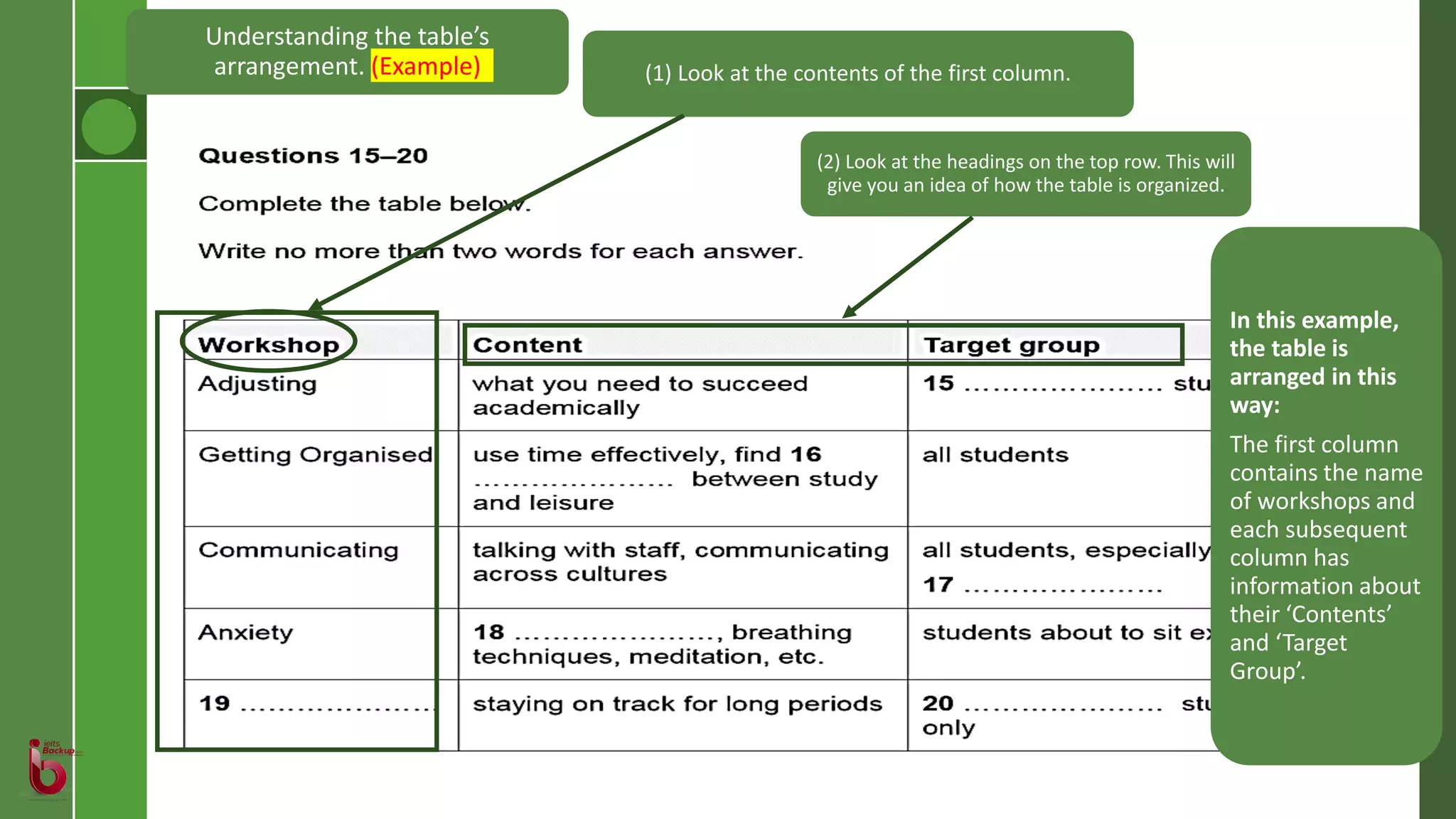
Understanding the table’s
arrangement. (Example) (1) Look at the contents of the first column.
In this example,
the table is
arranged in this
way:
The first column
contains the name
of workshops and
each subsequent
column has
information about
their ‘Contents’
and ‘Target
Group’.
(2) Look at the headings on the top row. This will
give you an idea of how the table is organized.
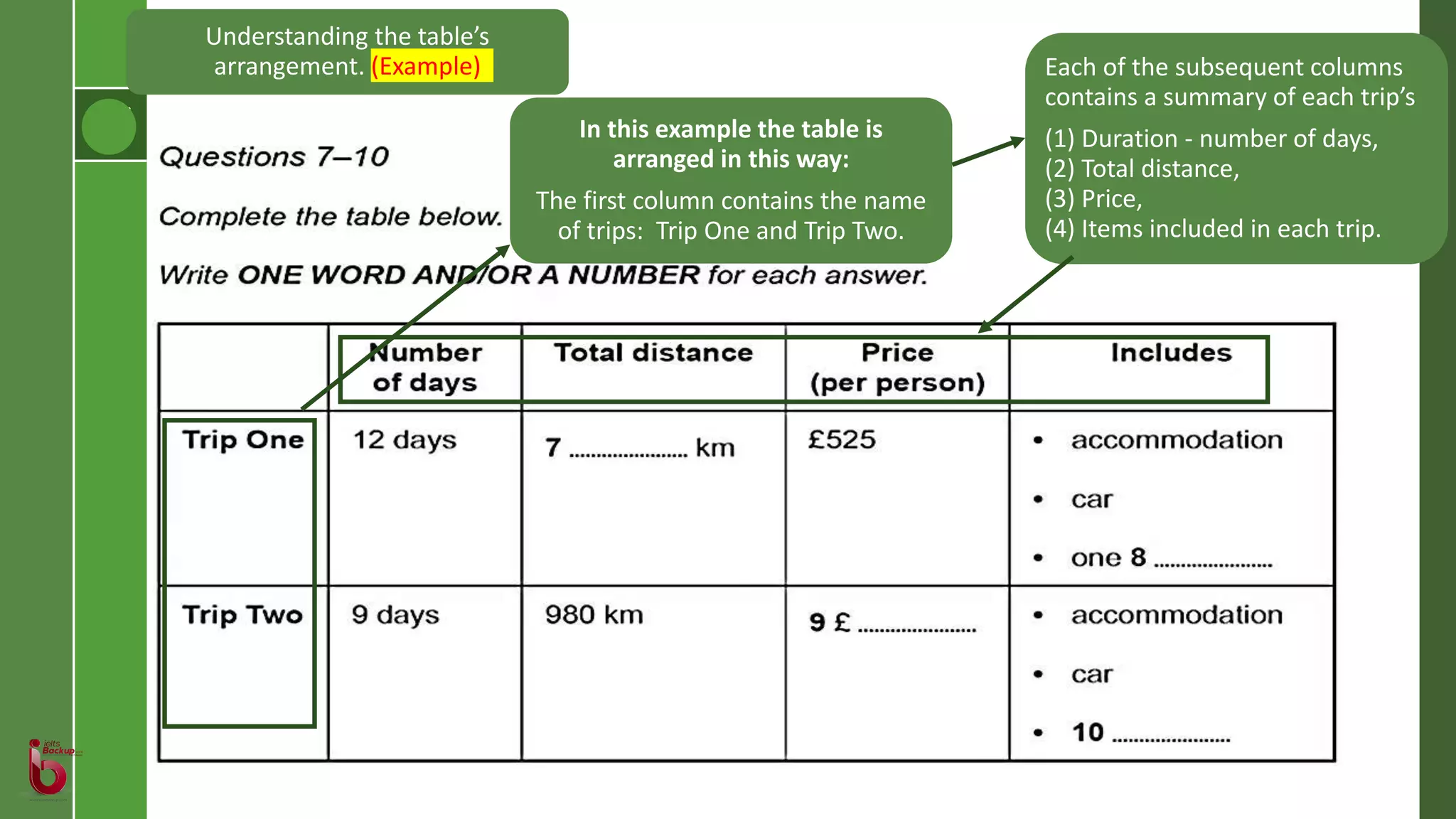
In this example the table is
arranged in this way:
The first column contains the name
of trips: Trip One and Trip Two.
Each of the subsequent columns
contains a summary of each trip’s
(1) Duration - number of days,
(2) Total distance,
(3) Price,
(4) Items included in each trip.
Understanding the table’s
arrangement. (Example)
 Each column’s heading is like a subtitle.
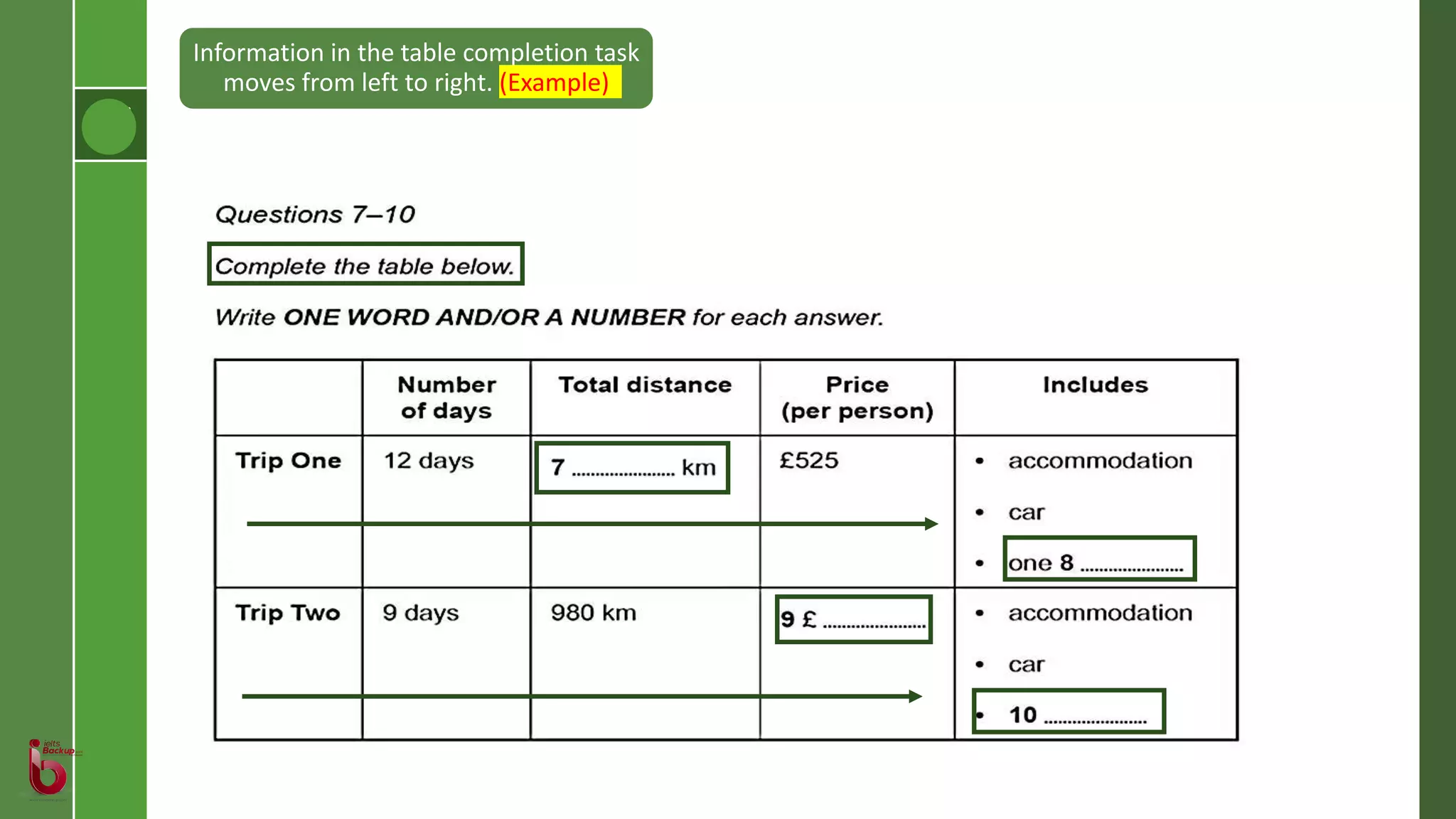
 Information in the table completion task moves
from left to right.
Information in the table completion task
moves from left to right. (Example)
 Each row in the table beings with a new topic.
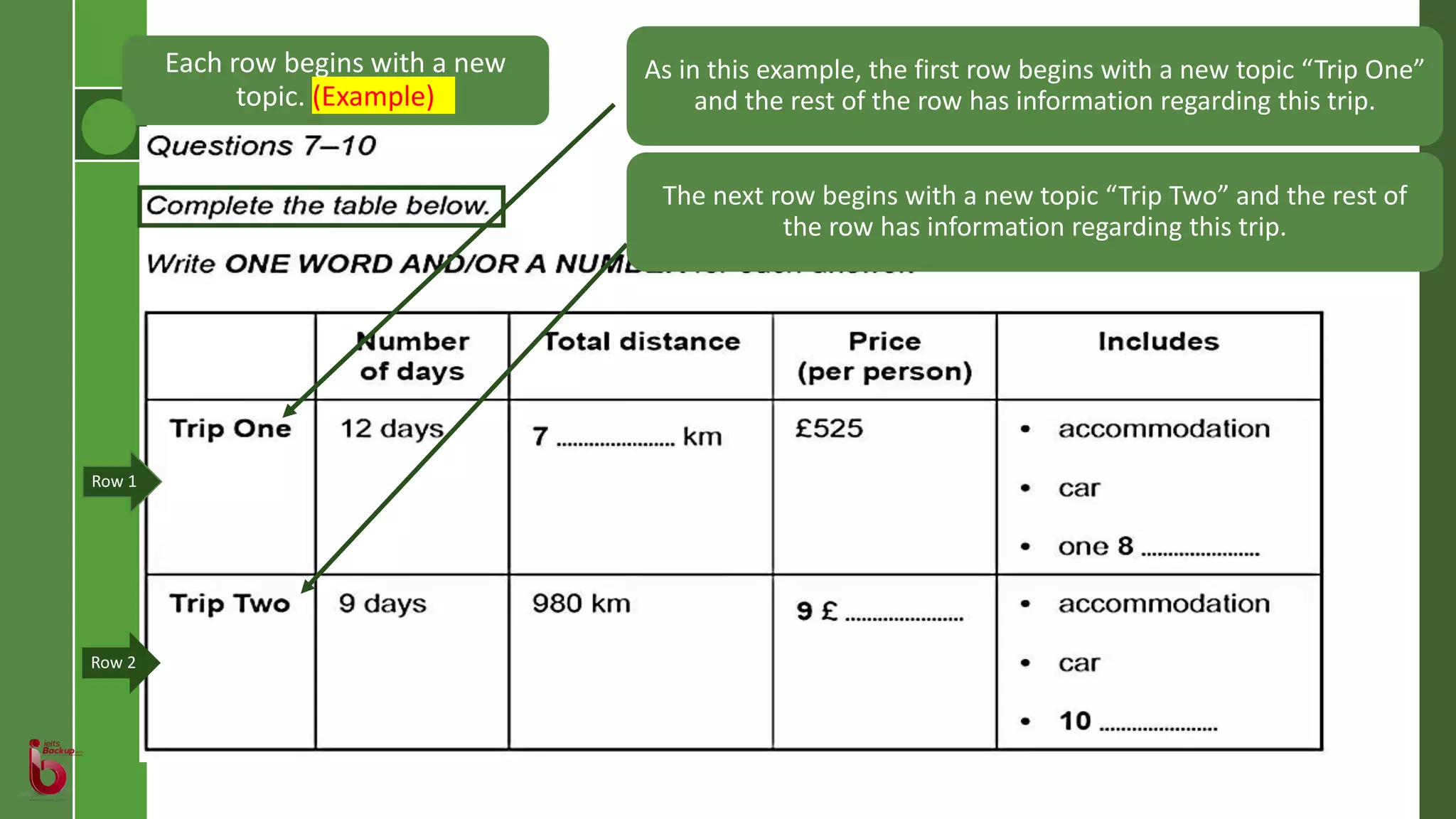
Each row begins with a new
topic. (Example)
Row 1
Row 2
As in this example, the first row begins with a new topic “Trip One”
and the rest of the row has information regarding this trip.
The next row begins with a new topic “Trip Two” and the rest of
the row has information regarding this trip.
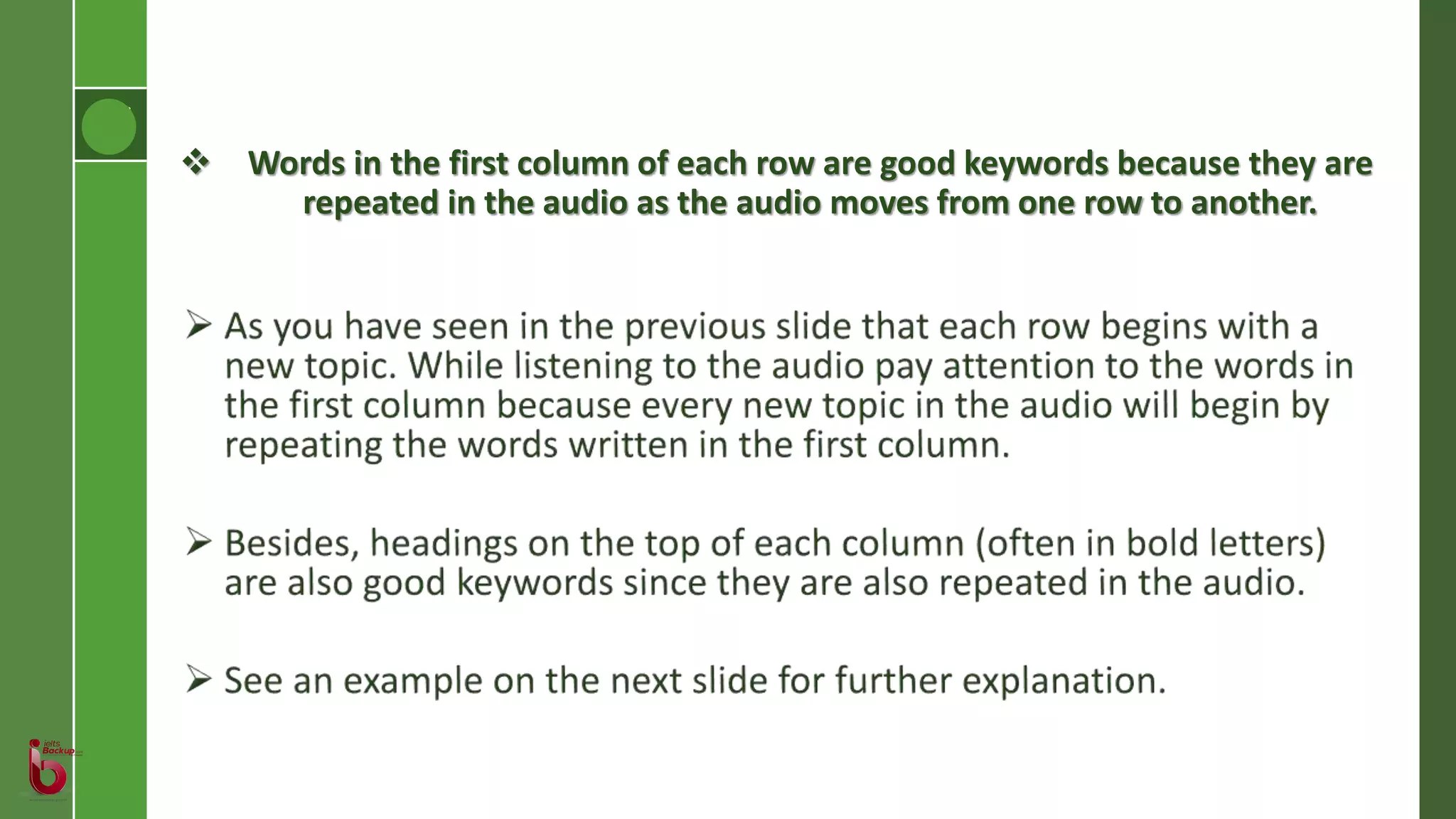
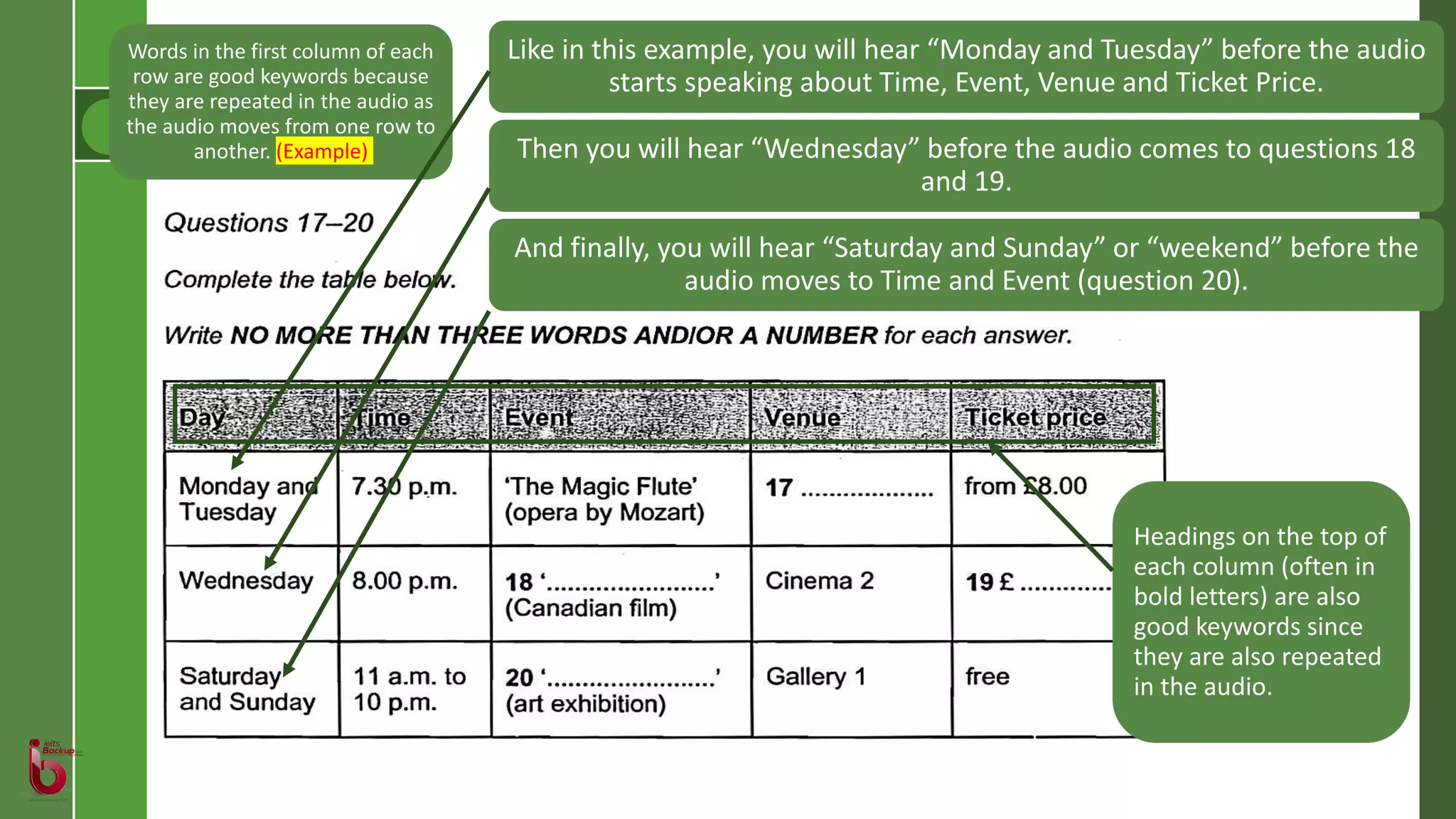
 Words in the first column of each row are good keywords because they are
repeated in the audio as the audio moves from one row to another.
Headings on the top of
each column (often in
bold letters) are also
good keywords since
they are also repeated
in the audio.
Like in this example, you will hear “Monday and Tuesday” before the audio
starts speaking about Time, Event, Venue and Ticket Price.
Then you will hear “Wednesday” before the audio comes to questions 18
and 19.
And finally, you will hear “Saturday and Sunday” or “weekend” before the
audio moves to Time and Event (question 20).
Words in the first column of each
row are good keywords because
they are repeated in the audio as
the audio moves from one row to
another. (Example)
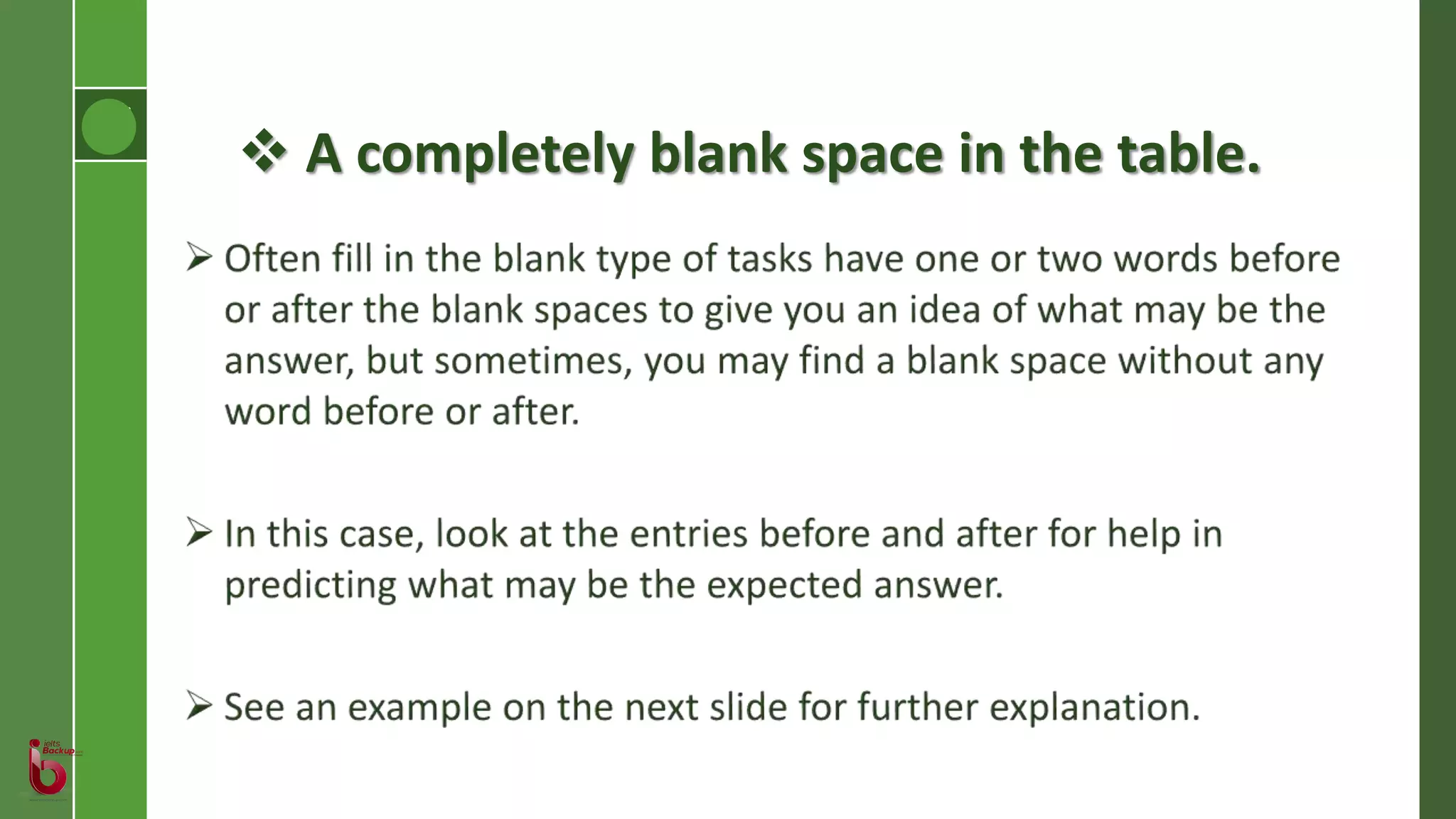
 A completely blank space in the table.
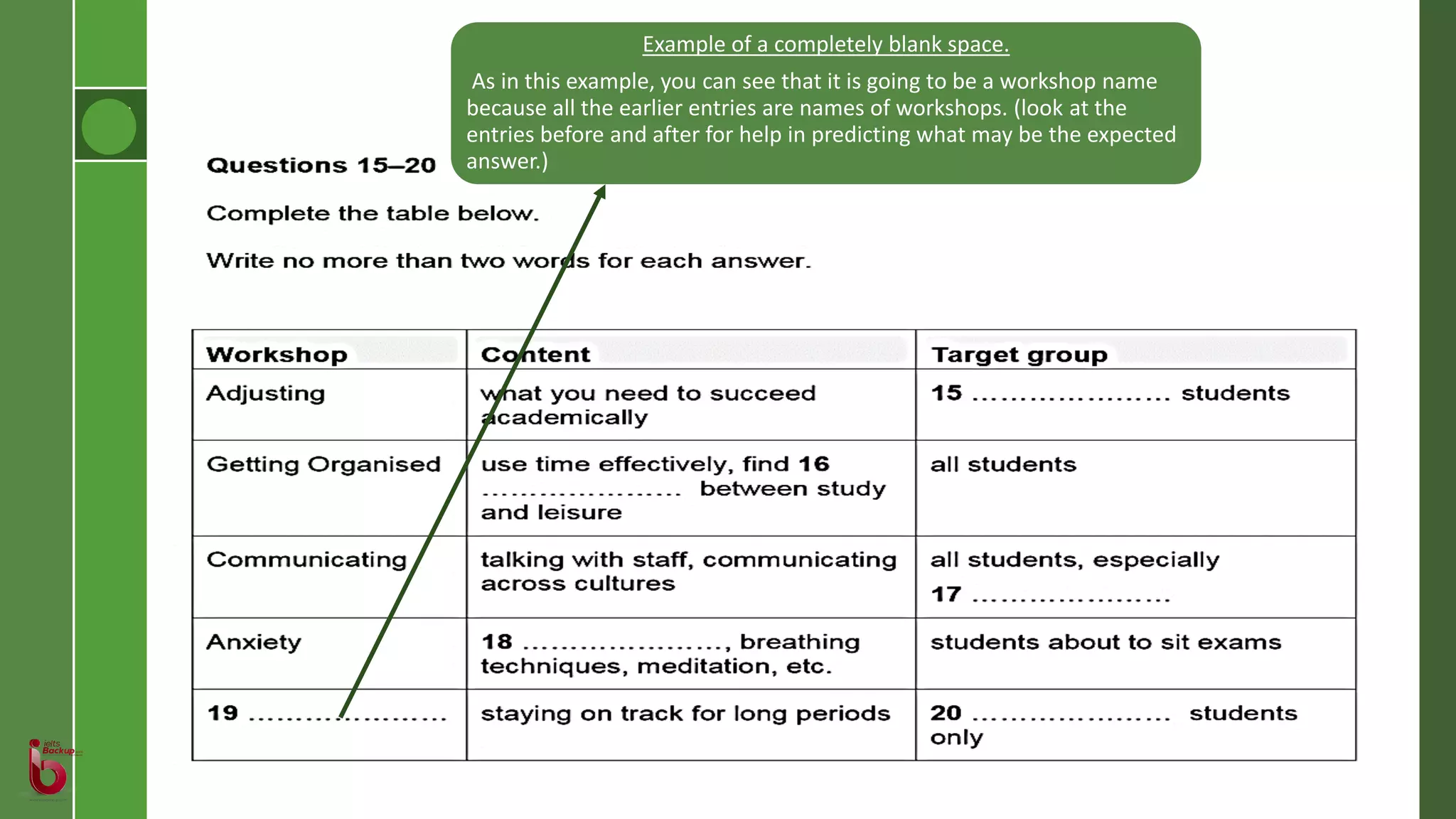
Example of a completely blank space.
As in this example, you can see that it is going to be a workshop name
because all the earlier entries are names of workshops. (look at the
entries before and after for help in predicting what may be the expected
answer.)
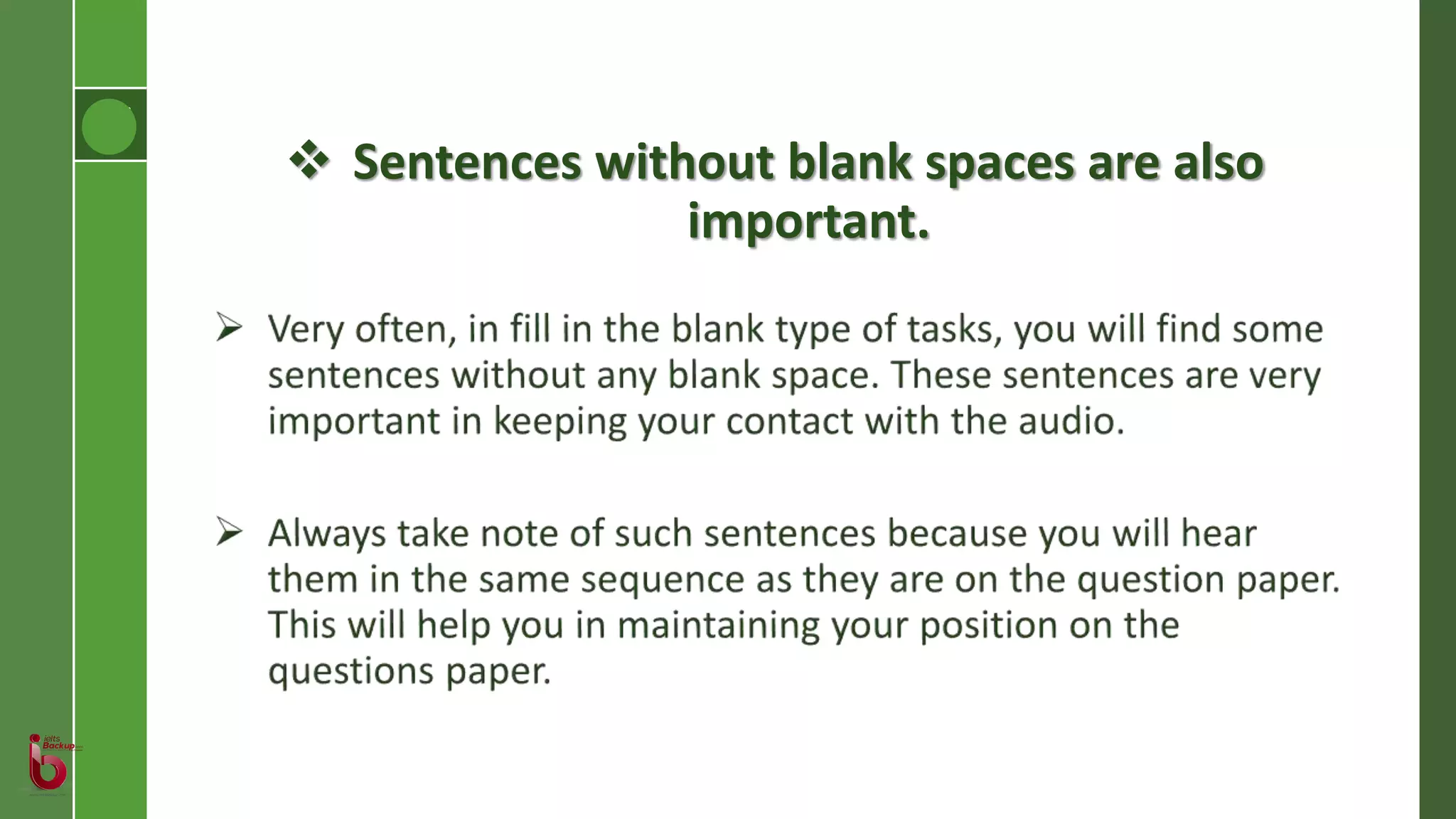
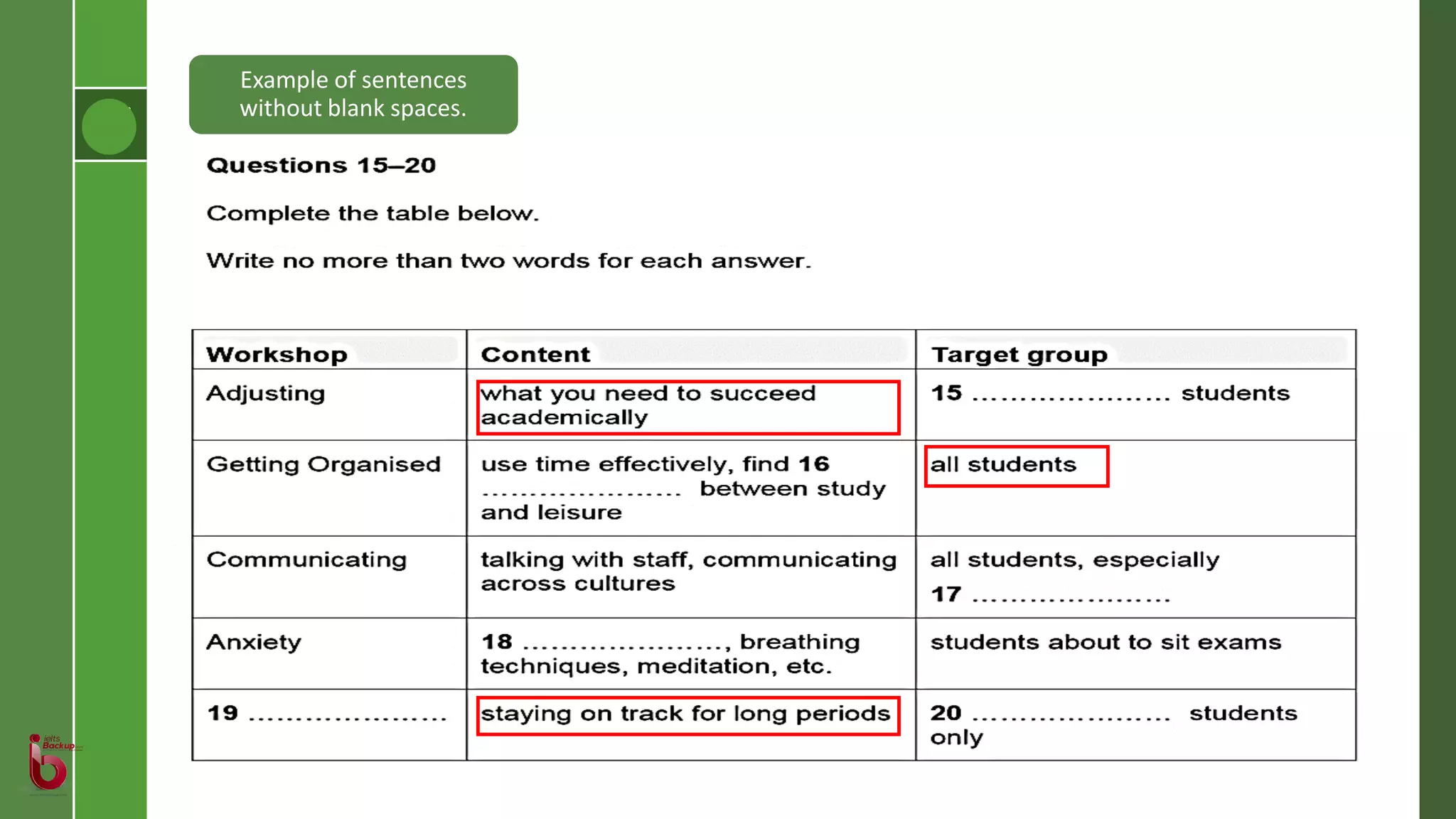
 Sentences without blank spaces are also
important.
Example of sentences
without blank spaces.
This is the end of this presentation.
for watching
Send us your feedback and suggestions on
info@ieltsbackup.com
For a complete IELTS training course
and practice.
Visit: www.ieltsbackup.com
Hi,
I have developed a systematic approach for all question types frequently
appearing in IELTS. Students who tired them in their IELTS exams have
received amazing results.
(Zafar Yar Khan)
Author and Publisher
If you need help in achieving your goals in IELTS,
write to me at info@ieltsbackup.com or visit
www.ieltsbackup.com
and click on “IELTS Tuition”.
I will contact you as soon as I can.

IELTS Listening- Table Completion - Introduction - Useful Tips

  • 1.
  • 2.
    Table Completion Task Explanation& Useful Tips. IELTS Listening.
  • 3.
    Task Identification (How youcan know this is a table completion task) Task identification Examples are taken from Cambridge IELTS books.
  • 4.
     Task Introduction Table completion task is also a fill in the blanks type of task in the IELTS Listening test.  In table completion task, you will see a summary of information in a table like pattern with some of its cells empty or partially empty.  The task is to complete the gaps with the right words from the audio.
  • 5.
  • 6.
     Table completiontask in Part 1 and 2 of the Listening test.
  • 7.
    Notice that inPart 1 it is only asking for factual information and most of the answers are easily predictable. Example of table completion task in Part/Section 1
  • 8.
    Notice that inPart/Section 2, questions are more challenging than Part/Section 1. Example of table completion task in Part/Section 2
  • 9.
     It isimportant to understand how the table is arranged.
  • 10.
    Understanding the table’s arrangement.(Example) (1) Look at the contents of the first column. In this example, the table is arranged in this way: The first column contains the name of workshops and each subsequent column has information about their ‘Contents’ and ‘Target Group’. (2) Look at the headings on the top row. This will give you an idea of how the table is organized.
  • 11.
    In this examplethe table is arranged in this way: The first column contains the name of trips: Trip One and Trip Two. Each of the subsequent columns contains a summary of each trip’s (1) Duration - number of days, (2) Total distance, (3) Price, (4) Items included in each trip. Understanding the table’s arrangement. (Example)
  • 12.
     Each column’sheading is like a subtitle.
  • 13.
     Information inthe table completion task moves from left to right.
  • 14.
    Information in thetable completion task moves from left to right. (Example)
  • 15.
     Each rowin the table beings with a new topic.
  • 16.
    Each row beginswith a new topic. (Example) Row 1 Row 2 As in this example, the first row begins with a new topic “Trip One” and the rest of the row has information regarding this trip. The next row begins with a new topic “Trip Two” and the rest of the row has information regarding this trip.
  • 17.
     Words inthe first column of each row are good keywords because they are repeated in the audio as the audio moves from one row to another.
  • 18.
    Headings on thetop of each column (often in bold letters) are also good keywords since they are also repeated in the audio. Like in this example, you will hear “Monday and Tuesday” before the audio starts speaking about Time, Event, Venue and Ticket Price. Then you will hear “Wednesday” before the audio comes to questions 18 and 19. And finally, you will hear “Saturday and Sunday” or “weekend” before the audio moves to Time and Event (question 20). Words in the first column of each row are good keywords because they are repeated in the audio as the audio moves from one row to another. (Example)
  • 19.
     A completelyblank space in the table.
  • 20.
    Example of acompletely blank space. As in this example, you can see that it is going to be a workshop name because all the earlier entries are names of workshops. (look at the entries before and after for help in predicting what may be the expected answer.)
  • 21.
     Sentences withoutblank spaces are also important.
  • 22.
  • 23.
    This is theend of this presentation. for watching Send us your feedback and suggestions on info@ieltsbackup.com For a complete IELTS training course and practice. Visit: www.ieltsbackup.com
  • 24.
    Hi, I have developeda systematic approach for all question types frequently appearing in IELTS. Students who tired them in their IELTS exams have received amazing results. (Zafar Yar Khan) Author and Publisher If you need help in achieving your goals in IELTS, write to me at info@ieltsbackup.com or visit www.ieltsbackup.com and click on “IELTS Tuition”. I will contact you as soon as I can.