IELTS Listening.
Matching Information Task
Explanation & Useful Tips.
IELTS Listening.
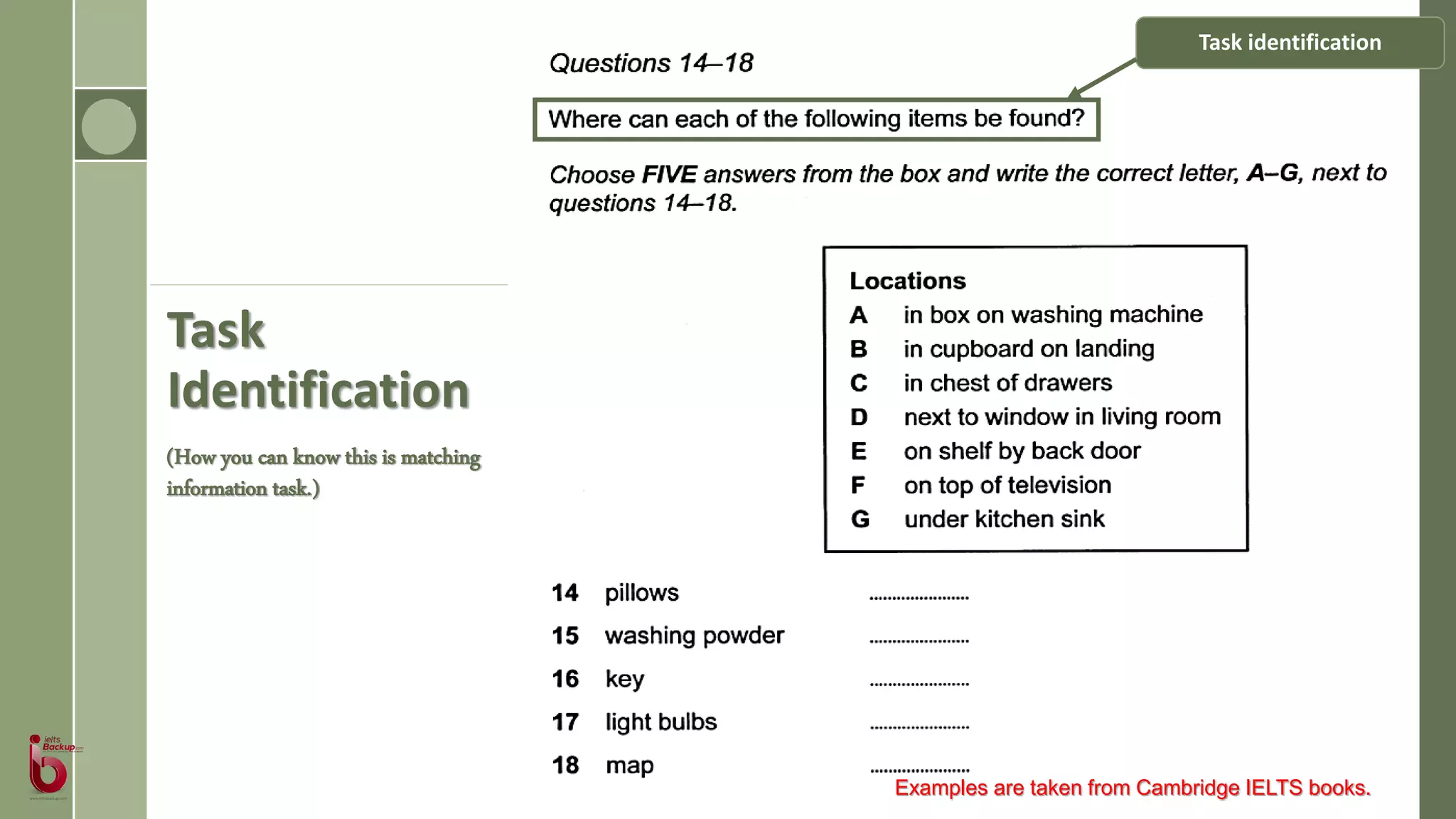
Task identification
Examples are taken from Cambridge IELTS books.
Task
Identification
(How you can know this is matching
information task.)
 Task Introduction
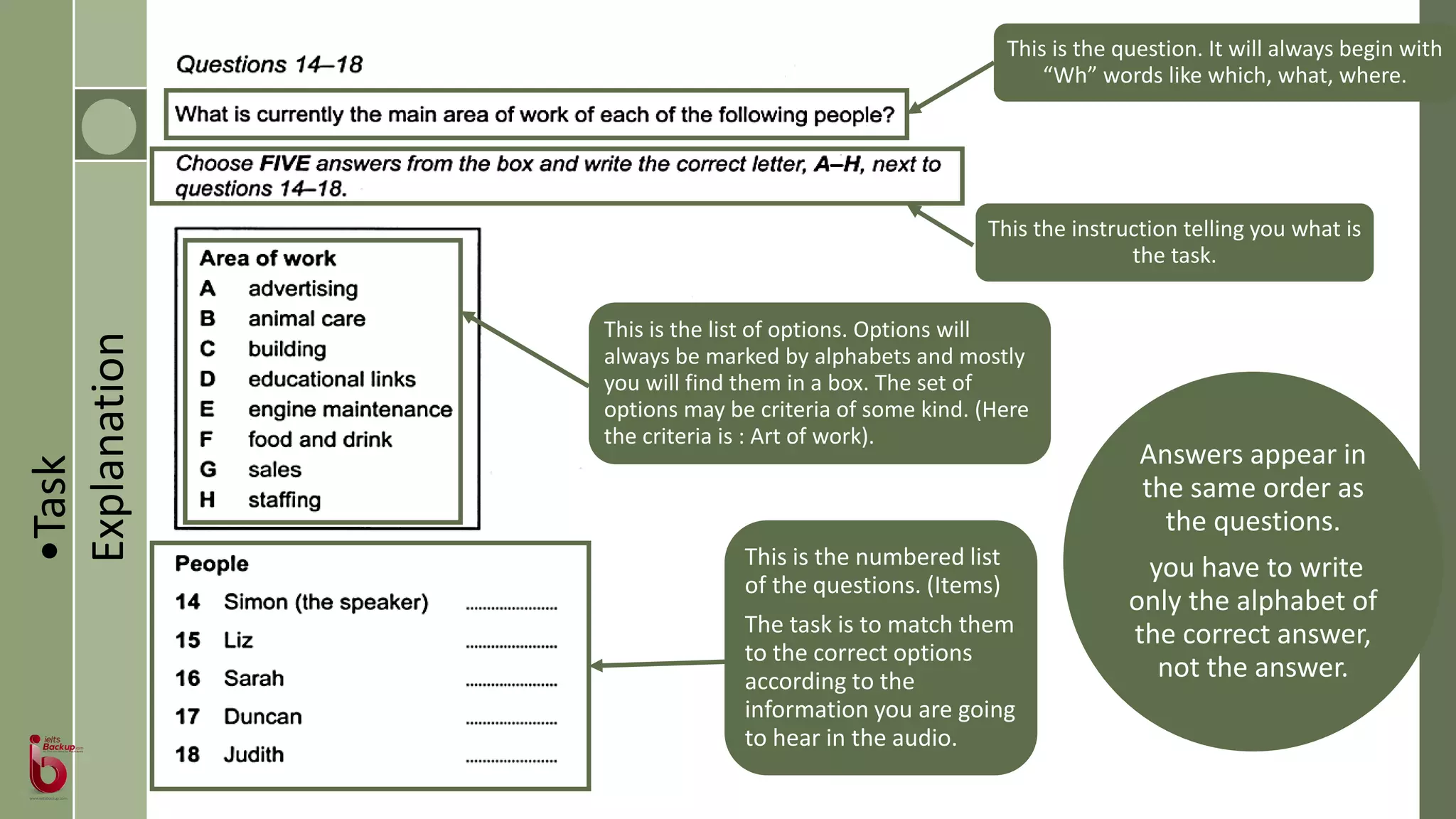
This is the question. It will always begin with
“Wh” words like which, what, where.
This the instruction telling you what is
the task.
This is the list of options. Options will
always be marked by alphabets and mostly
you will find them in a box. The set of
options may be criteria of some kind. (Here
the criteria is : Art of work).
This is the numbered list
of the questions. (Items)
The task is to match them
to the correct options
according to the
information you are going
to hear in the audio.
Answers appear in
the same order as
the questions.
you have to write
only the alphabet of
the correct answer,
not the answer.
•Task
Explanation
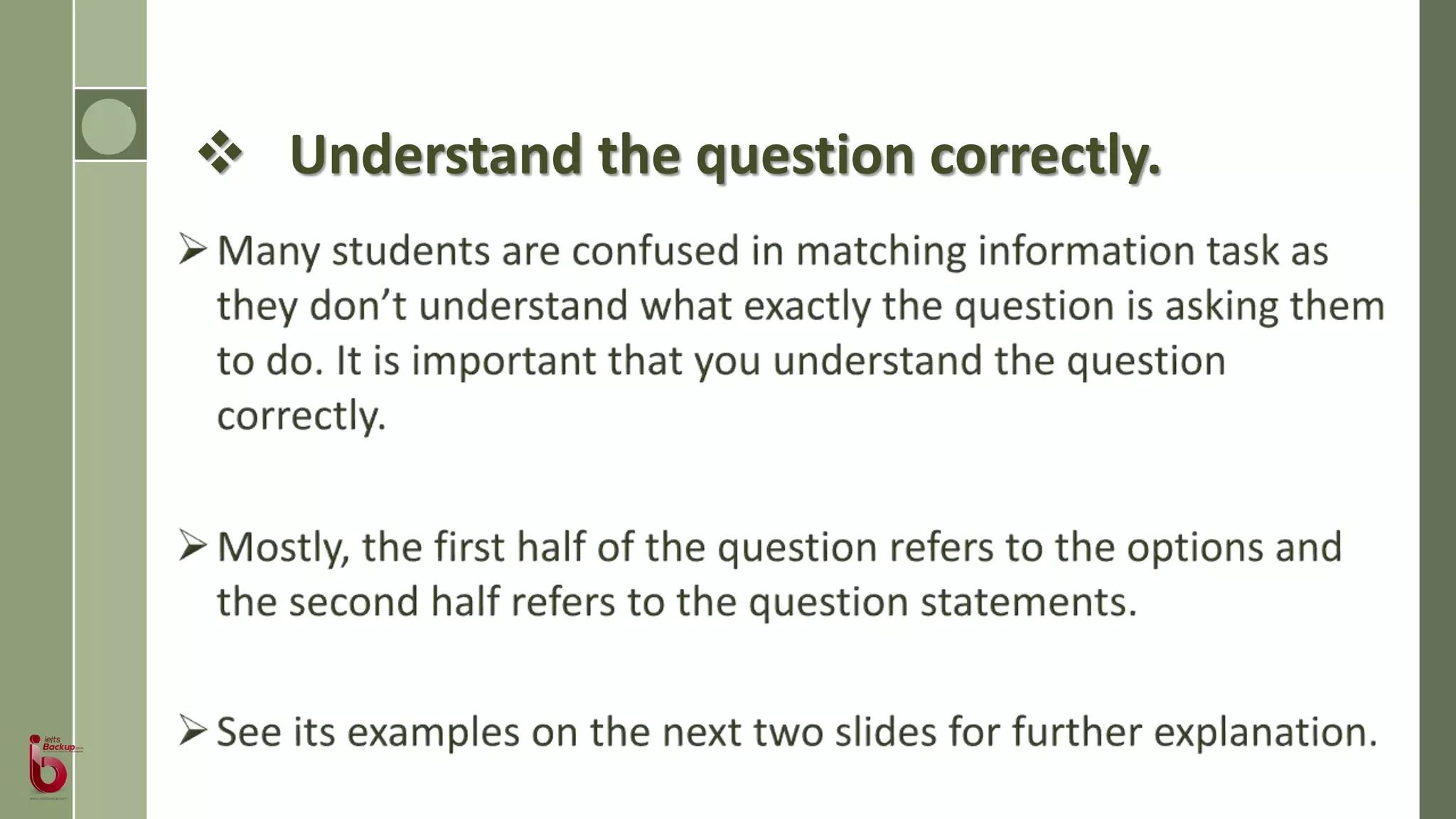
 Understand the question correctly.
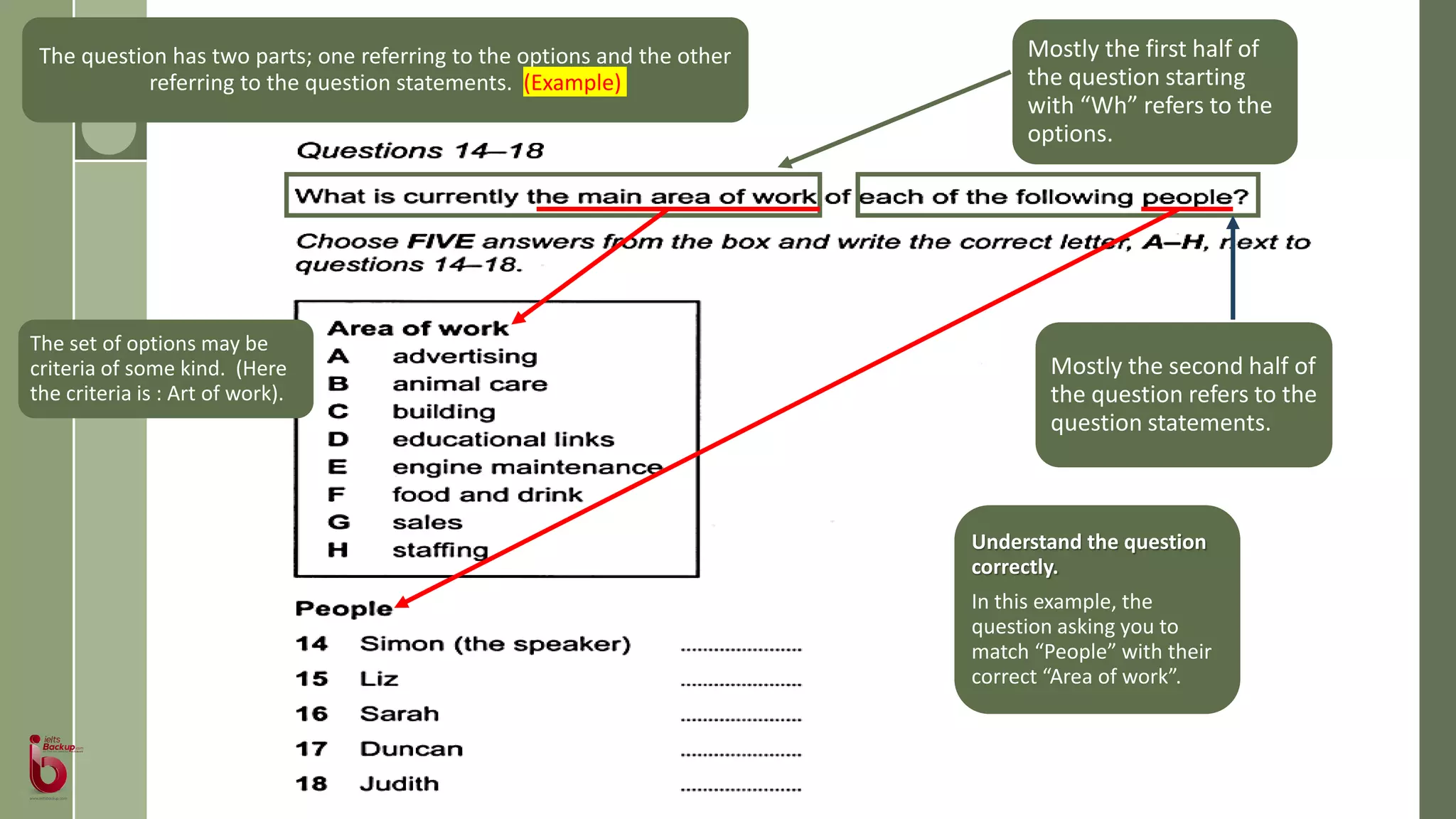
Mostly the first half of
the question starting
with “Wh” refers to the
options.
Mostly the second half of
the question refers to the
question statements.
Understand the question
correctly.
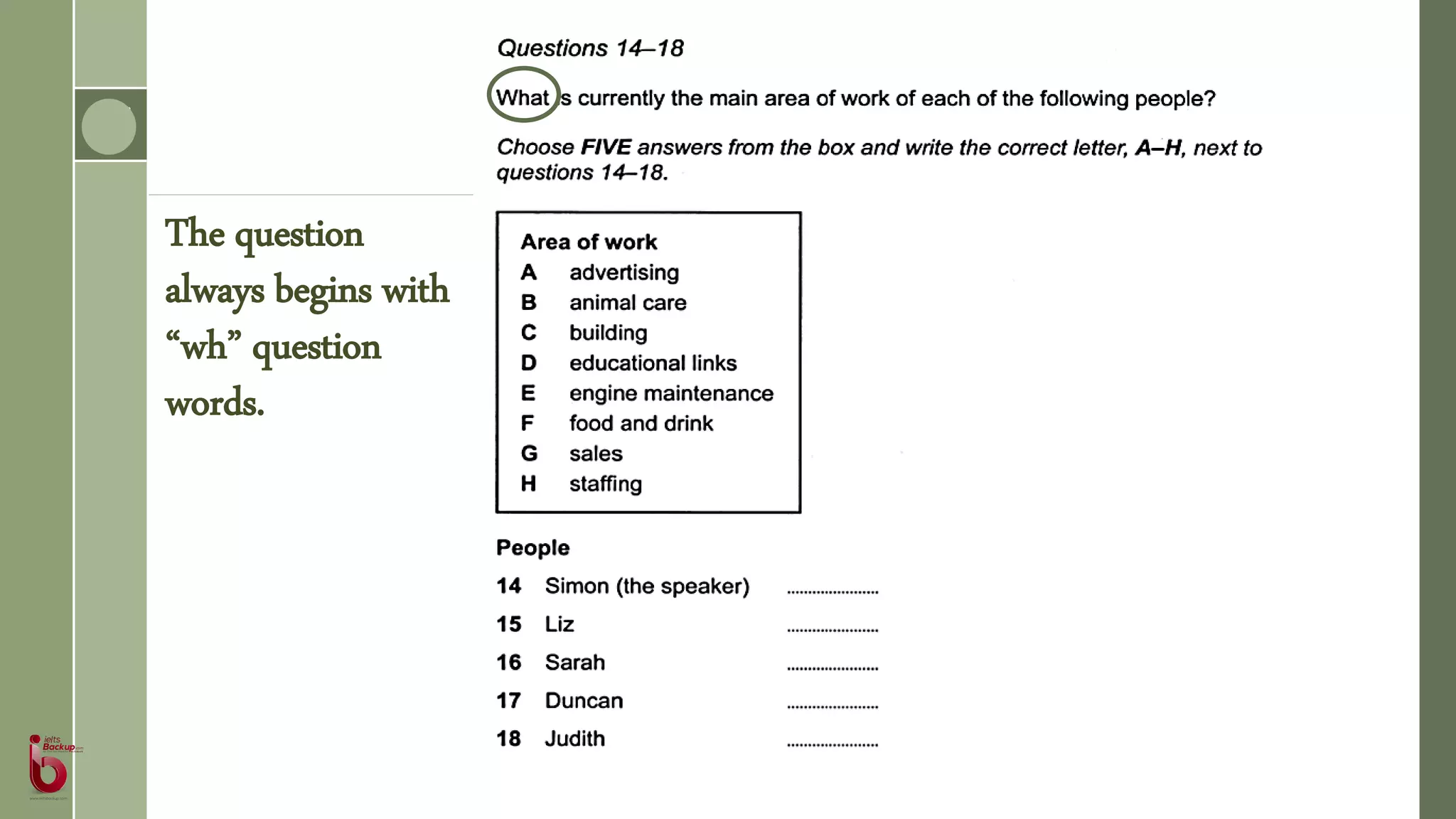
In this example, the
question asking you to
match “People” with their
correct “Area of work”.
The question has two parts; one referring to the options and the other
referring to the question statements. (Example)
The set of options may be
criteria of some kind. (Here
the criteria is : Art of work).
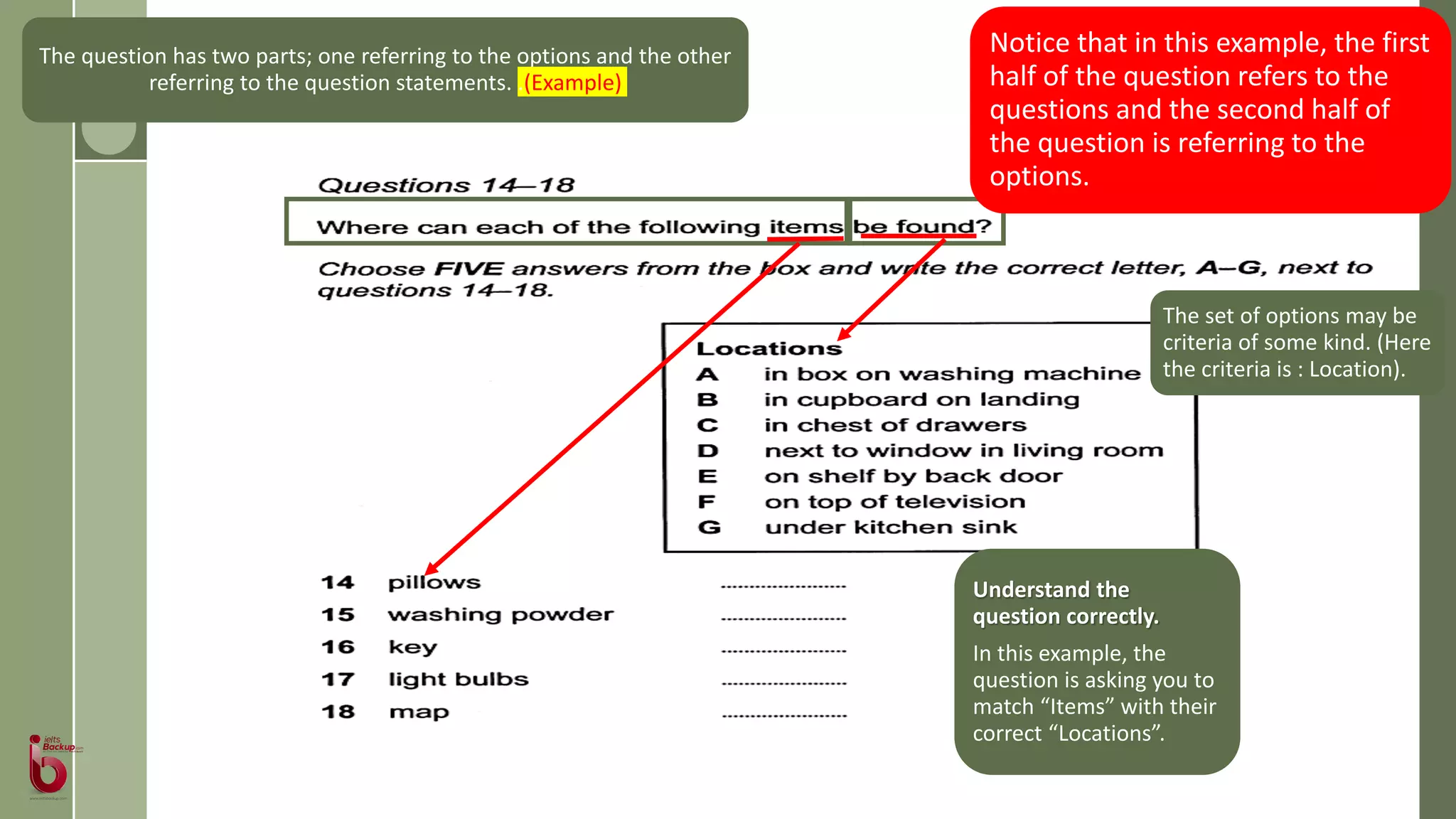
The question has two parts; one referring to the options and the other
referring to the question statements. .(Example)
Understand the
question correctly.
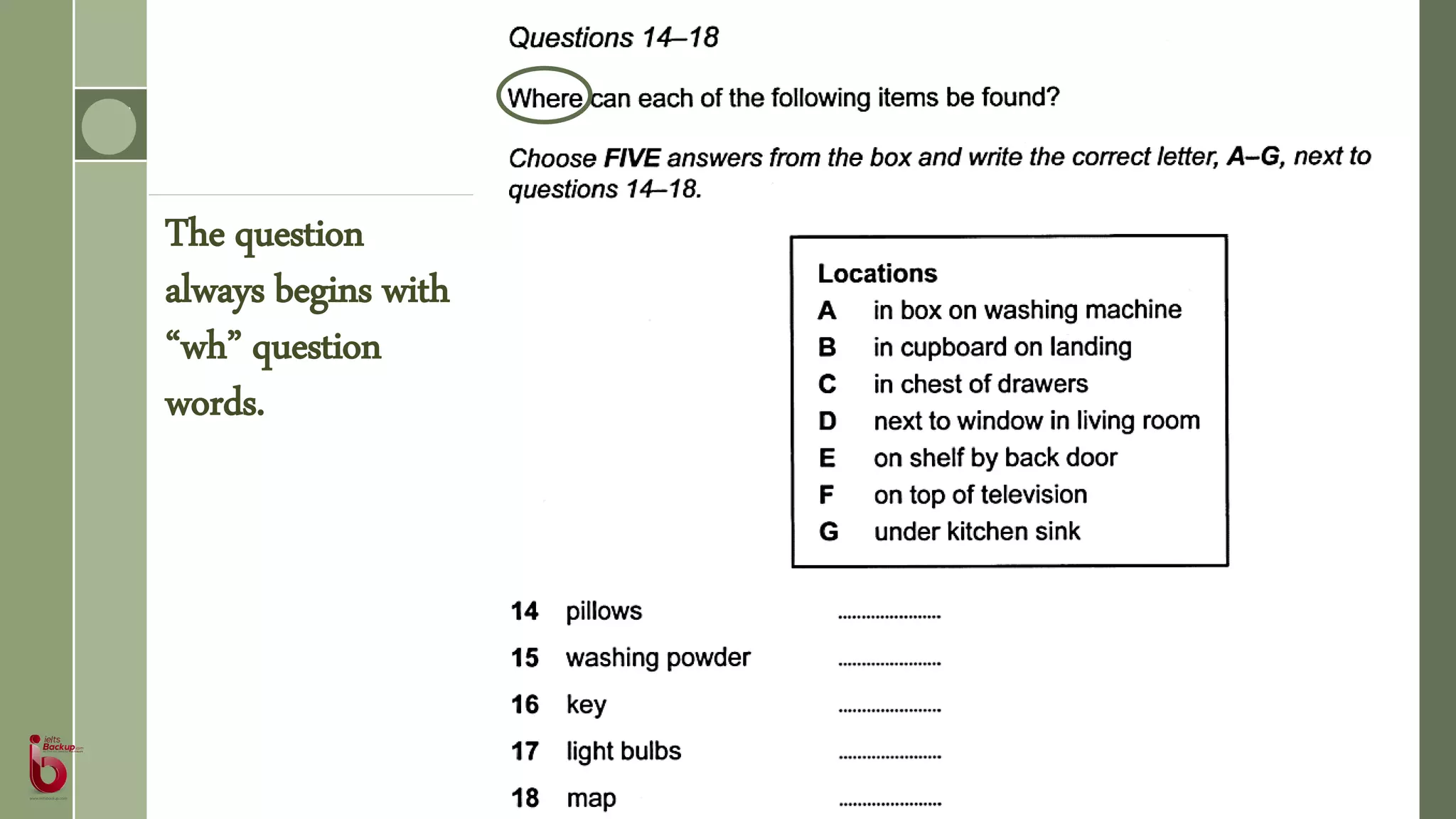
In this example, the
question is asking you to
match “Items” with their
correct “Locations”.
Notice that in this example, the first
half of the question refers to the
questions and the second half of
the question is referring to the
options.
The set of options may be
criteria of some kind. (Here
the criteria is : Location).
Matching Information
Task.
Special Features & Useful Tips.
The question
always begins with
“wh” question
words.
The question
always begins with
“wh” question
words.
The question
always begins with
“wh” question
words.
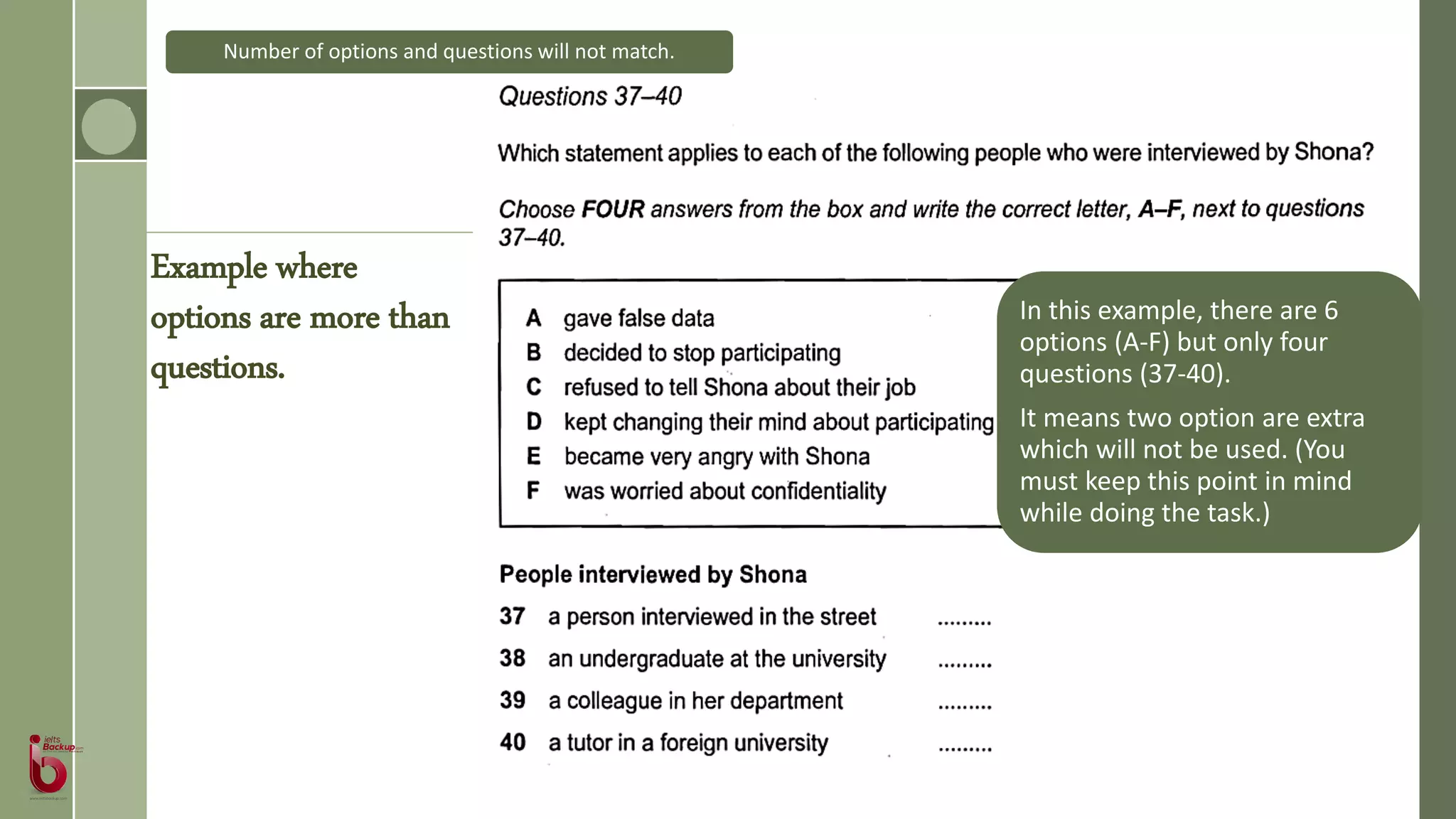
 Number of options and questions will not match.
Example where
options are more than
questions.
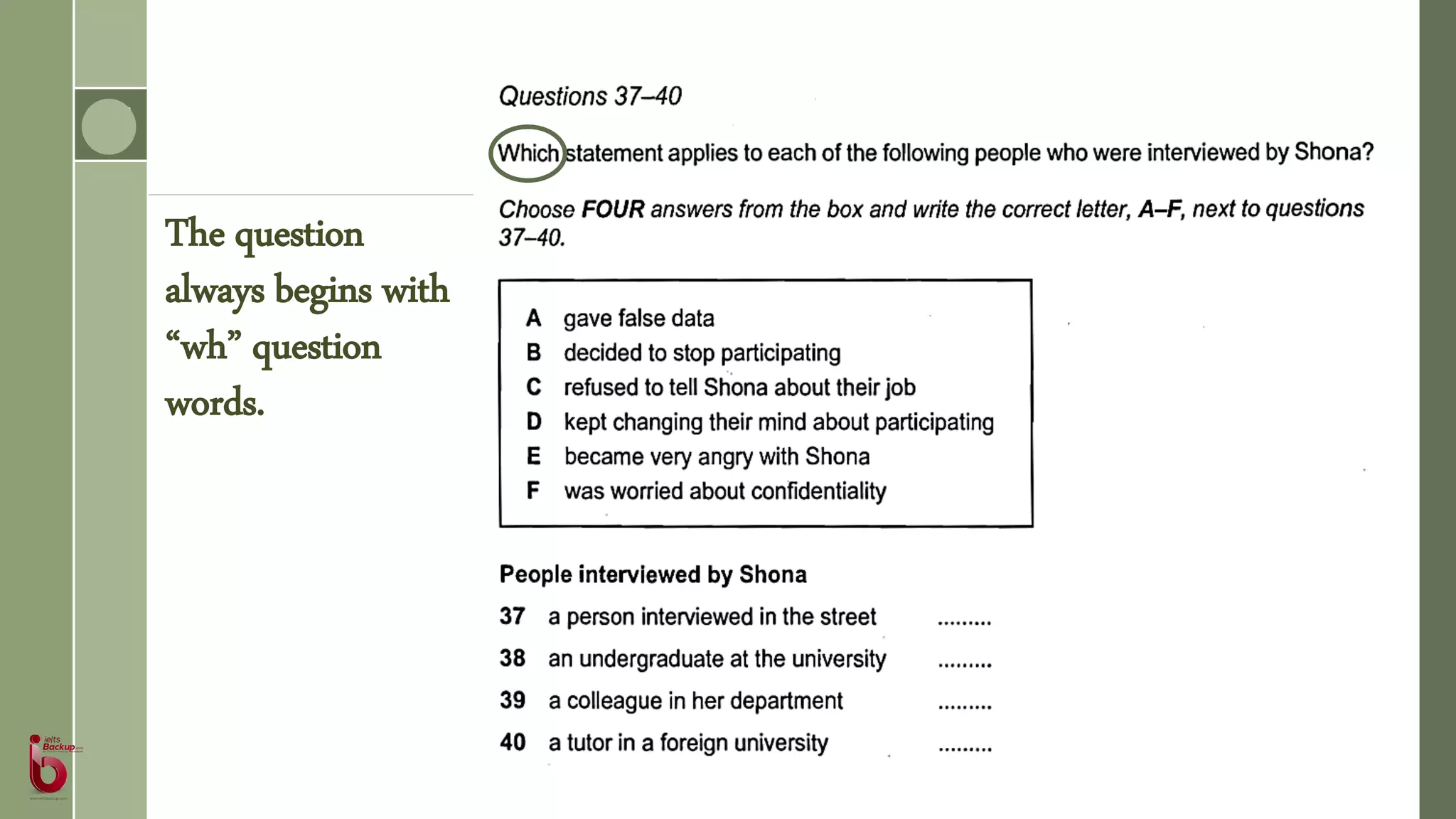
In this example, there are 6
options (A-F) but only four
questions (37-40).
It means two option are extra
which will not be used. (You
must keep this point in mind
while doing the task.)
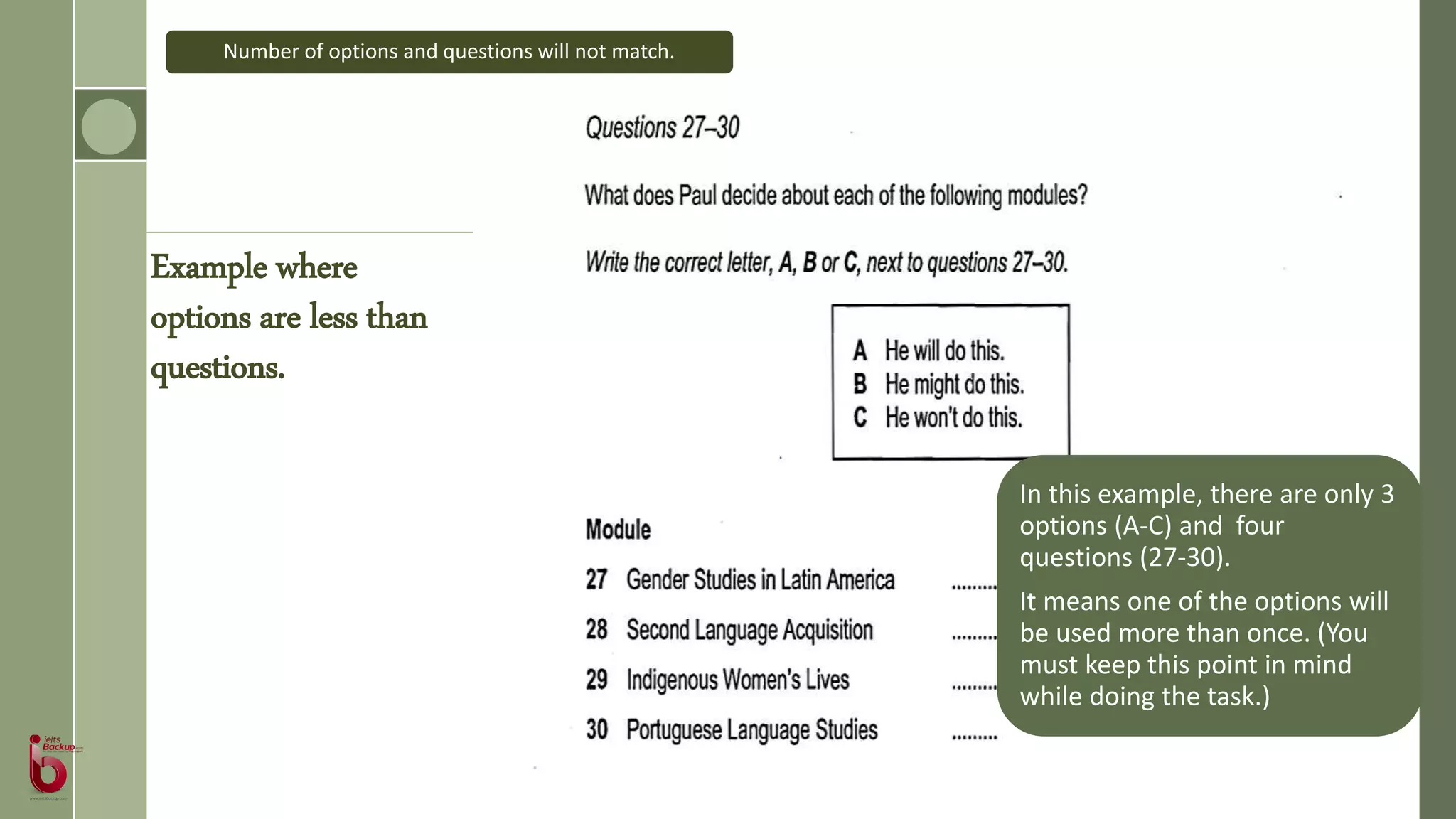
Number of options and questions will not match.
In this example, there are only 3
options (A-C) and four
questions (27-30).
It means one of the options will
be used more than once. (You
must keep this point in mind
while doing the task.)
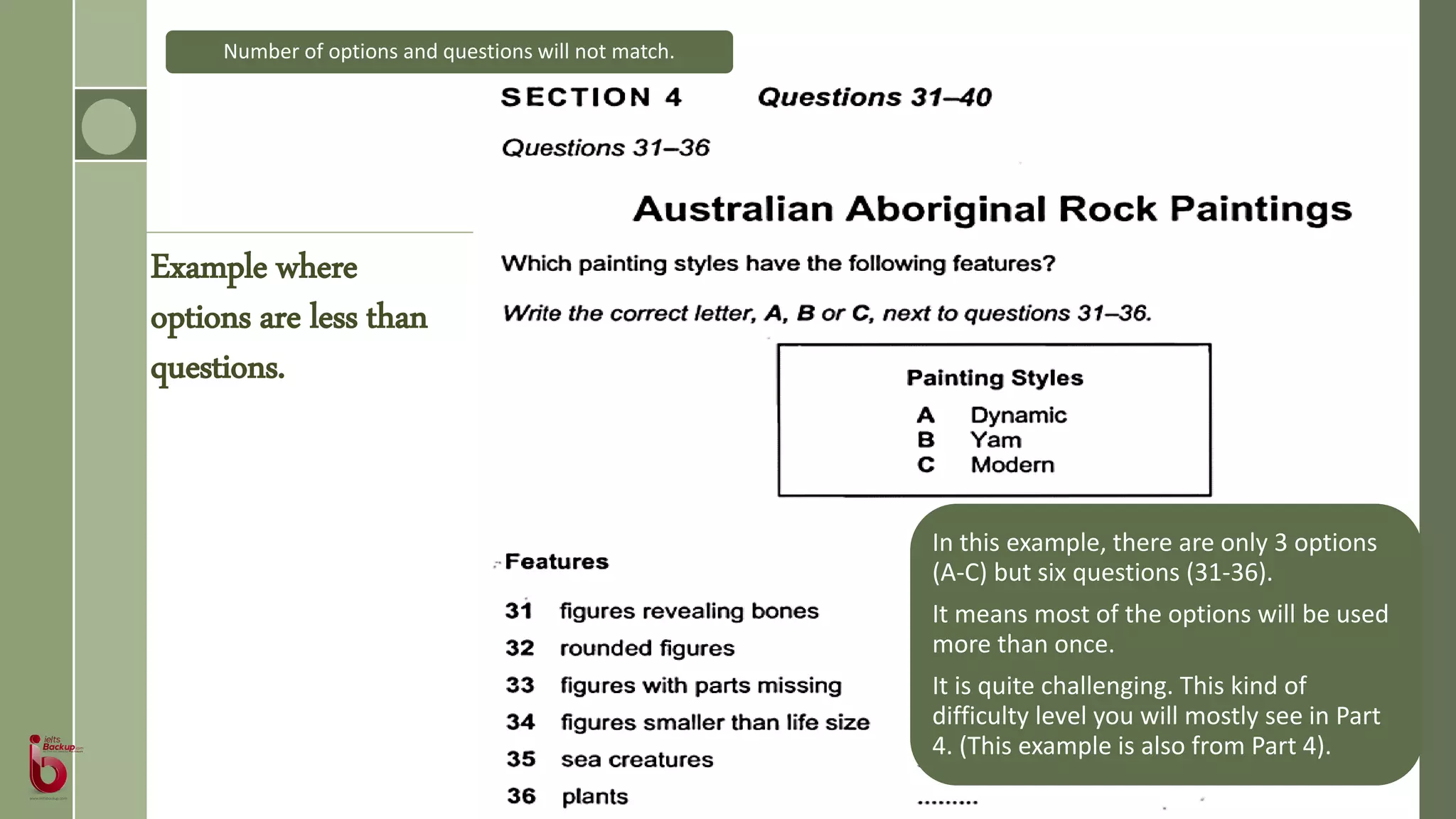
Number of options and questions will not match.
Example where
options are less than
questions.
In this example, there are only 3 options
(A-C) but six questions (31-36).
It means most of the options will be used
more than once.
It is quite challenging. This kind of
difficulty level you will mostly see in Part
4. (This example is also from Part 4).
Number of options and questions will not match.
Example where
options are less than
questions.
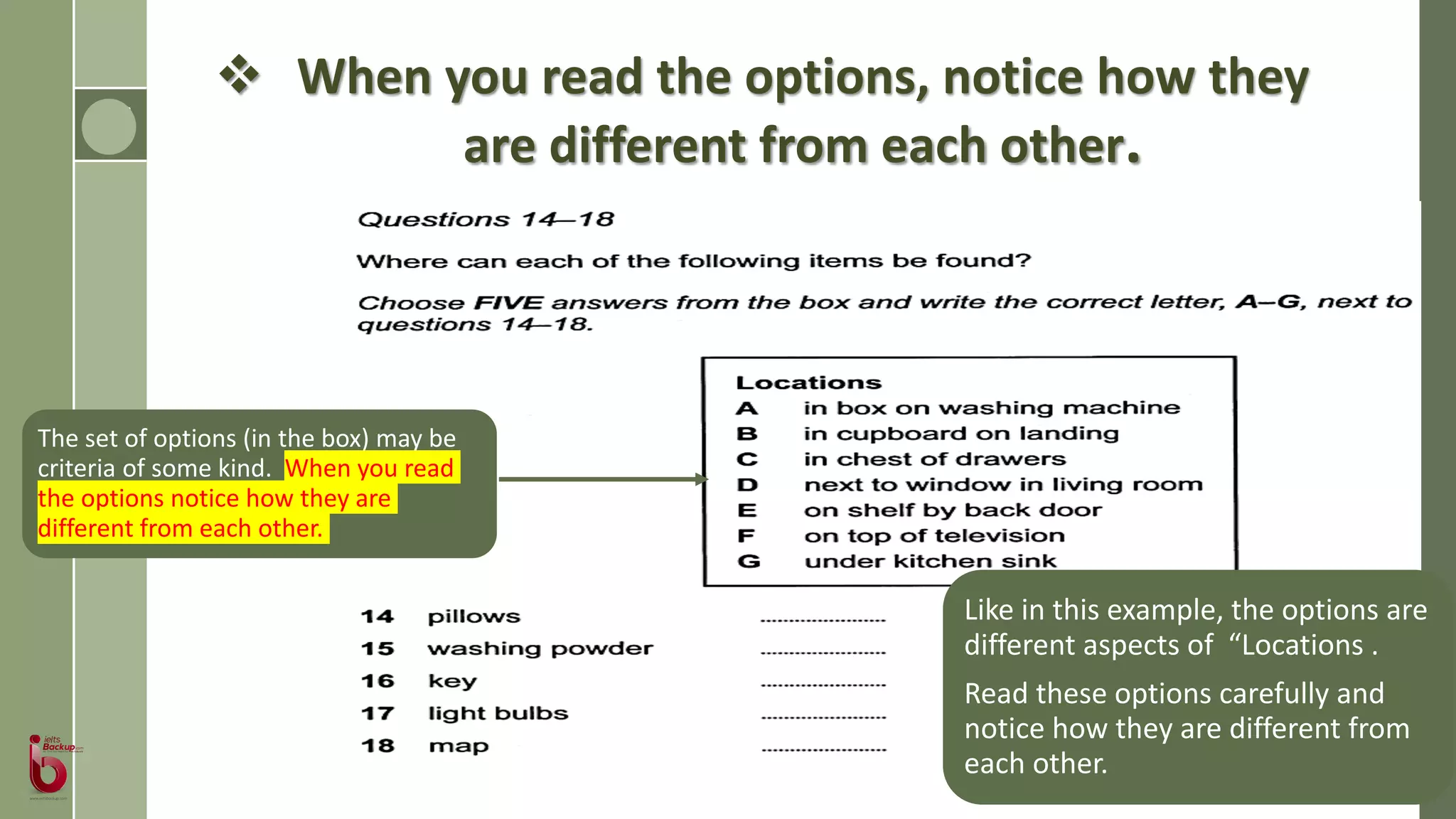
 When you read the options, notice how they
are different from each other.
The set of options (in the box) may be
criteria of some kind. When you read
the options notice how they are
different from each other.
Like in this example, the options are
different aspects of “Locations .
Read these options carefully and
notice how they are different from
each other.
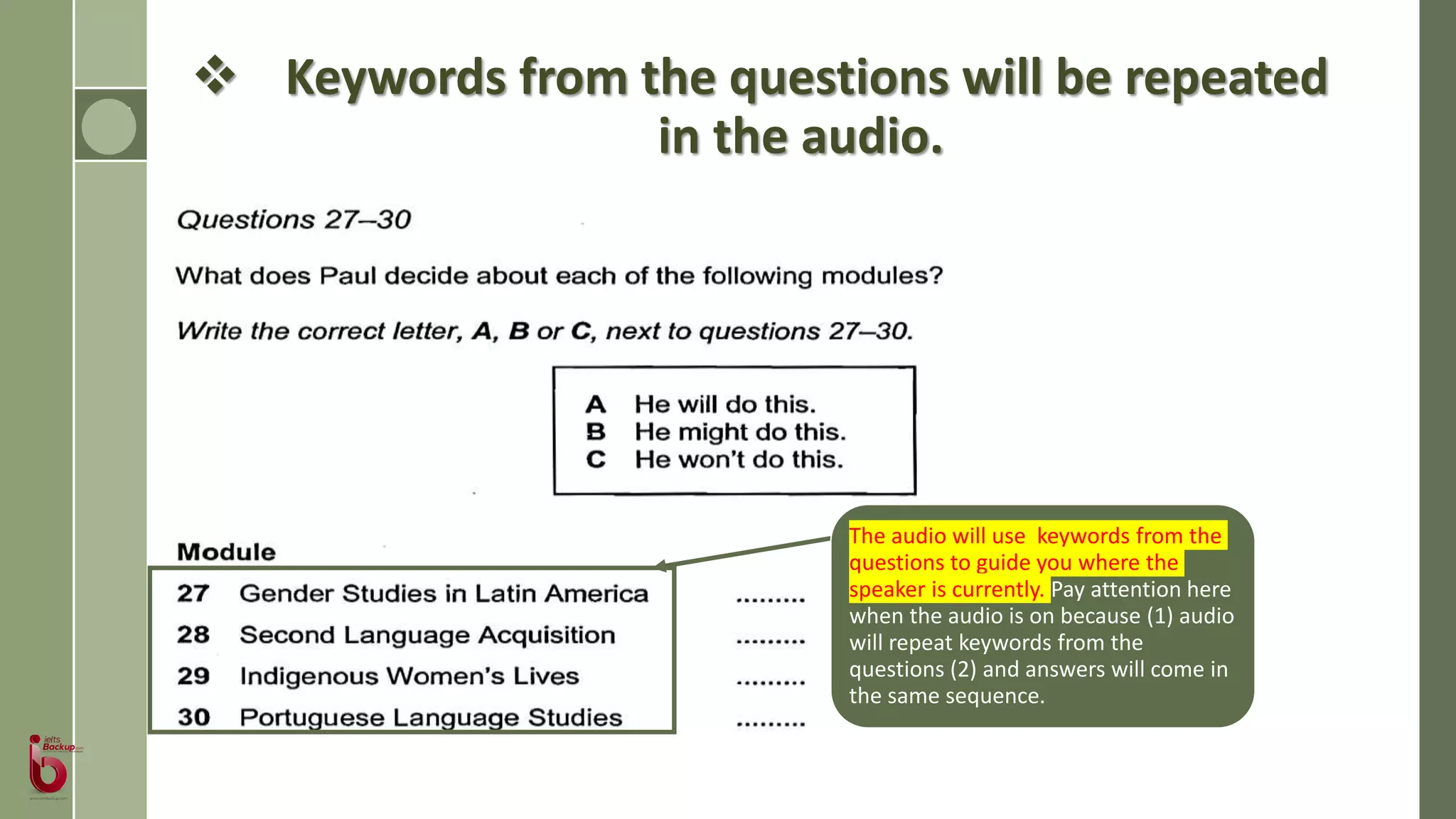
 Keywords from the questions will be repeated
in the audio.
The audio will use keywords from the
questions to guide you where the
speaker is currently. Pay attention here
when the audio is on because (1) audio
will repeat keywords from the
questions (2) and answers will come in
the same sequence.
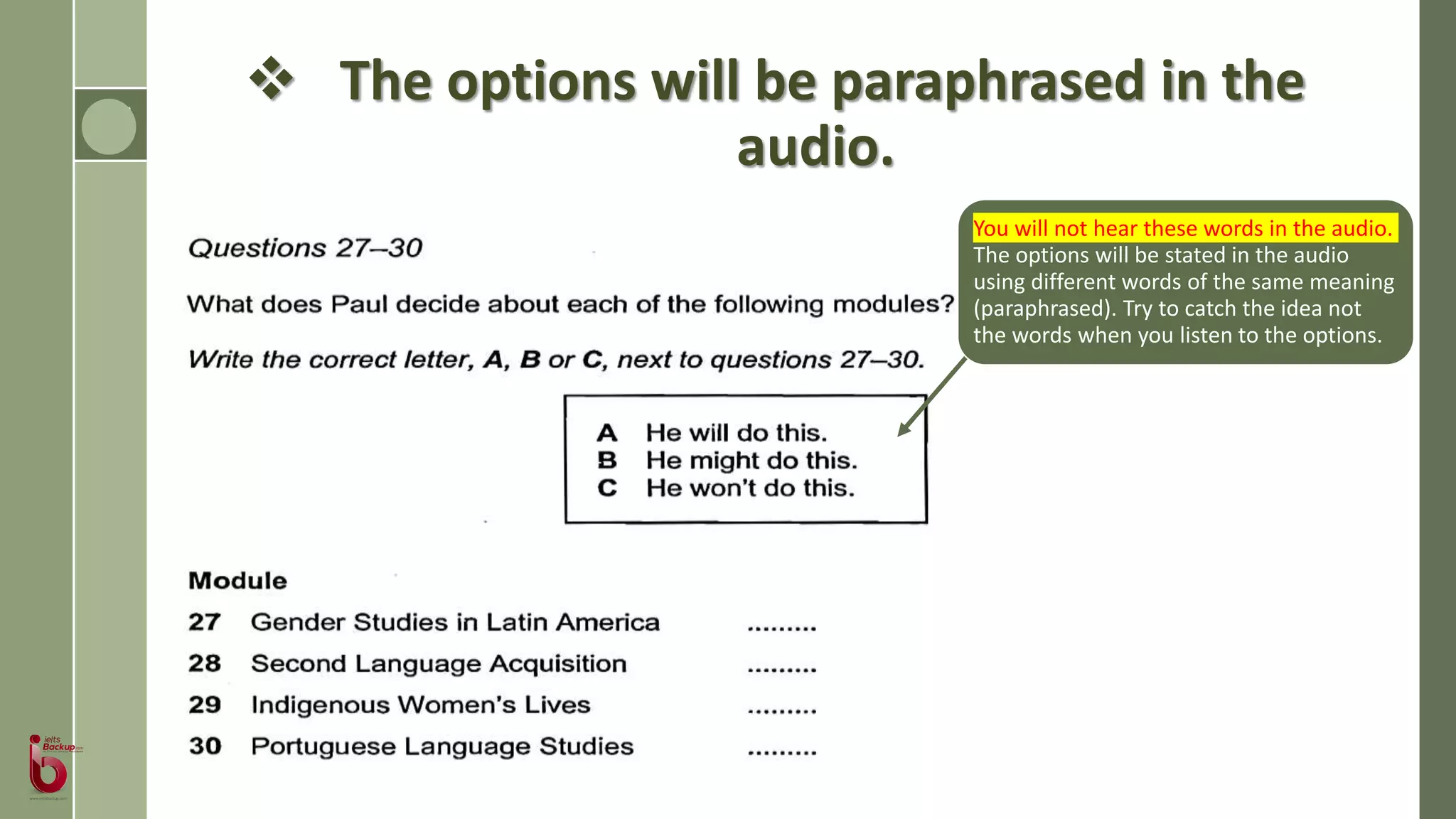
 The options will be paraphrased in the
audio.
You will not hear these words in the audio.
The options will be stated in the audio
using different words of the same meaning
(paraphrased). Try to catch the idea not
the words when you listen to the options.
This is the end of this presentation.
for watching
Send us your feedback and suggestions on
info@ieltsbackup.com
For a complete IELTS training course
and practice.
Visit: www.ieltsbackup.com
Hi,
I have developed a systematic approach for all question types frequently
appearing in IELTS. Students who tired them in their IELTS exams have
received amazing results.
(Zafar Yar Khan)
Author and Publisher
If you need help in achieving your goals in IELTS,
write to me at info@ieltsbackup.com or visit
www.ieltsbackup.com
and click on “IELTS Tuition”.
I will contact you as soon as I can.

IELTS Listening - Matching Information - Introduction - Useful Tips

  • 1.
  • 2.
    Matching Information Task Explanation& Useful Tips. IELTS Listening.
  • 3.
    Task identification Examples aretaken from Cambridge IELTS books. Task Identification (How you can know this is matching information task.)
  • 4.
  • 5.
    This is thequestion. It will always begin with “Wh” words like which, what, where. This the instruction telling you what is the task. This is the list of options. Options will always be marked by alphabets and mostly you will find them in a box. The set of options may be criteria of some kind. (Here the criteria is : Art of work). This is the numbered list of the questions. (Items) The task is to match them to the correct options according to the information you are going to hear in the audio. Answers appear in the same order as the questions. you have to write only the alphabet of the correct answer, not the answer. •Task Explanation
  • 6.
     Understand thequestion correctly.
  • 7.
    Mostly the firsthalf of the question starting with “Wh” refers to the options. Mostly the second half of the question refers to the question statements. Understand the question correctly. In this example, the question asking you to match “People” with their correct “Area of work”. The question has two parts; one referring to the options and the other referring to the question statements. (Example) The set of options may be criteria of some kind. (Here the criteria is : Art of work).
  • 8.
    The question hastwo parts; one referring to the options and the other referring to the question statements. .(Example) Understand the question correctly. In this example, the question is asking you to match “Items” with their correct “Locations”. Notice that in this example, the first half of the question refers to the questions and the second half of the question is referring to the options. The set of options may be criteria of some kind. (Here the criteria is : Location).
  • 9.
  • 10.
    The question always beginswith “wh” question words.
  • 11.
    The question always beginswith “wh” question words.
  • 12.
    The question always beginswith “wh” question words.
  • 13.
     Number ofoptions and questions will not match.
  • 14.
    Example where options aremore than questions. In this example, there are 6 options (A-F) but only four questions (37-40). It means two option are extra which will not be used. (You must keep this point in mind while doing the task.) Number of options and questions will not match.
  • 15.
    In this example,there are only 3 options (A-C) and four questions (27-30). It means one of the options will be used more than once. (You must keep this point in mind while doing the task.) Number of options and questions will not match. Example where options are less than questions.
  • 16.
    In this example,there are only 3 options (A-C) but six questions (31-36). It means most of the options will be used more than once. It is quite challenging. This kind of difficulty level you will mostly see in Part 4. (This example is also from Part 4). Number of options and questions will not match. Example where options are less than questions.
  • 17.
     When youread the options, notice how they are different from each other. The set of options (in the box) may be criteria of some kind. When you read the options notice how they are different from each other. Like in this example, the options are different aspects of “Locations . Read these options carefully and notice how they are different from each other.
  • 18.
     Keywords fromthe questions will be repeated in the audio. The audio will use keywords from the questions to guide you where the speaker is currently. Pay attention here when the audio is on because (1) audio will repeat keywords from the questions (2) and answers will come in the same sequence.
  • 19.
     The optionswill be paraphrased in the audio. You will not hear these words in the audio. The options will be stated in the audio using different words of the same meaning (paraphrased). Try to catch the idea not the words when you listen to the options.
  • 20.
    This is theend of this presentation. for watching Send us your feedback and suggestions on info@ieltsbackup.com For a complete IELTS training course and practice. Visit: www.ieltsbackup.com
  • 21.
    Hi, I have developeda systematic approach for all question types frequently appearing in IELTS. Students who tired them in their IELTS exams have received amazing results. (Zafar Yar Khan) Author and Publisher If you need help in achieving your goals in IELTS, write to me at info@ieltsbackup.com or visit www.ieltsbackup.com and click on “IELTS Tuition”. I will contact you as soon as I can.