IELTS Listening.
Flow Chart Completion Task
Explanation & Useful Tips.
IELTS Listening.
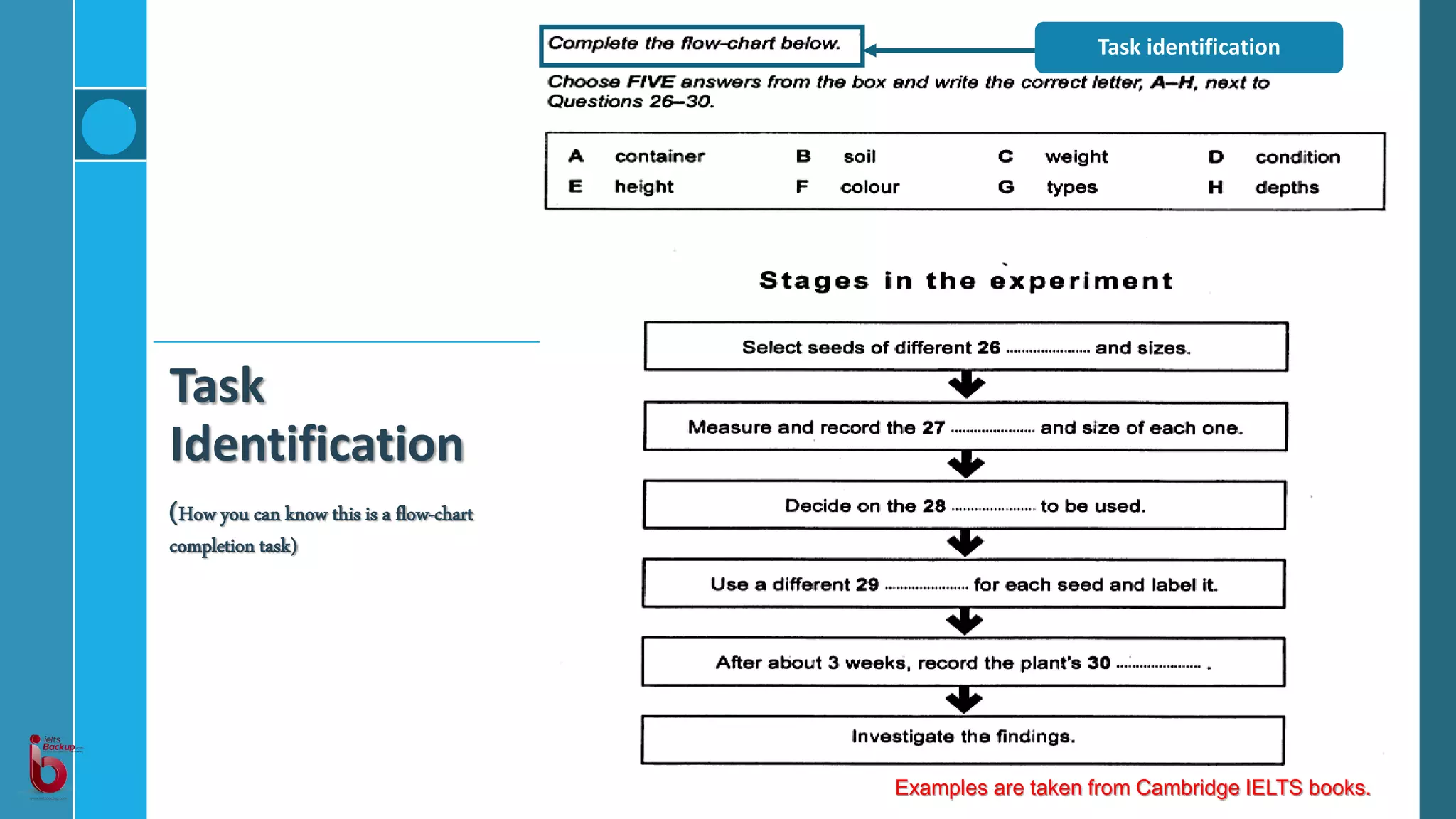
Task identification
Examples are taken from Cambridge IELTS books.
Task
Identification
(How you can know this is a flow-chart
completion task)
 Task Introduction
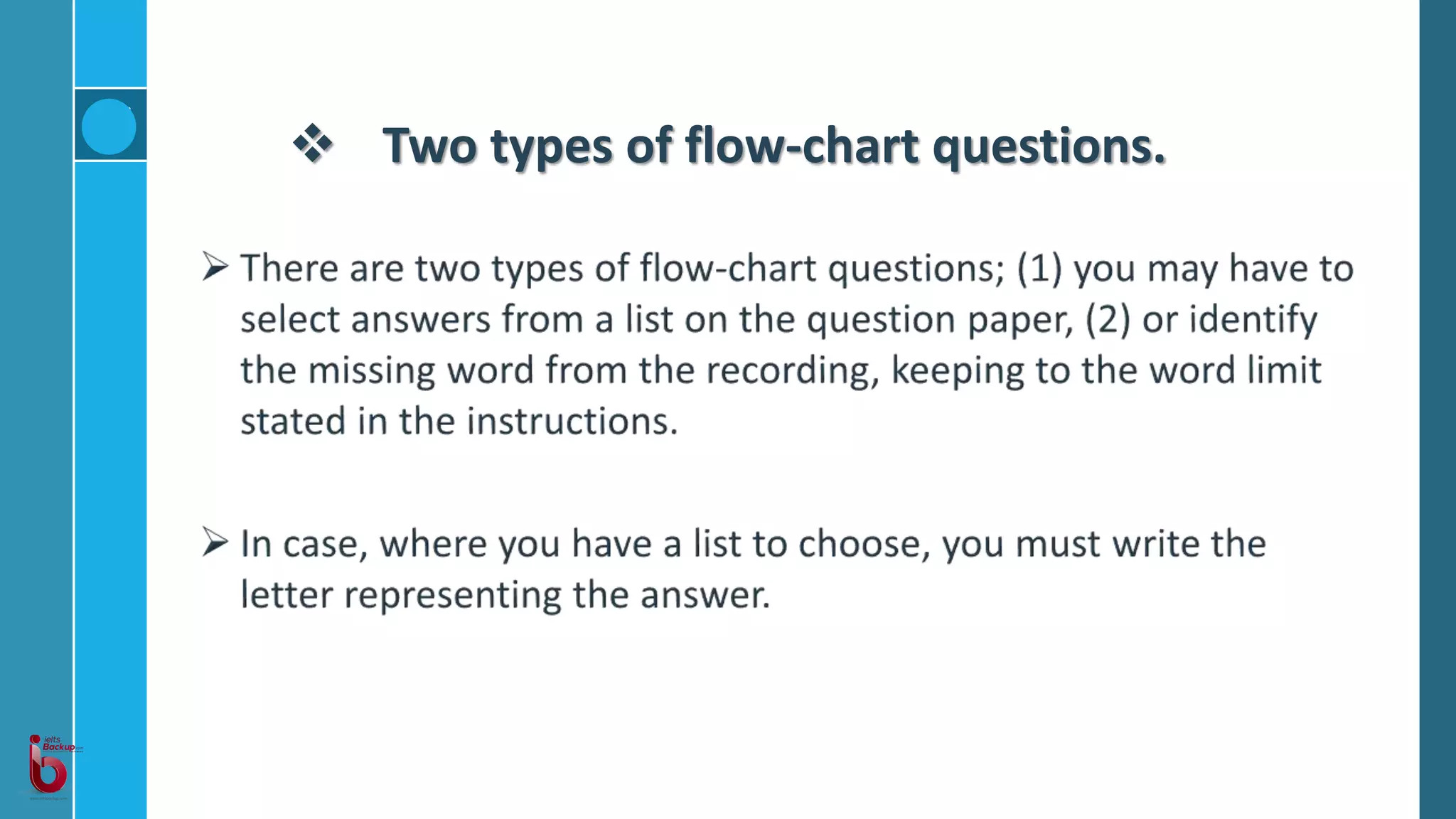
 Two types of flow-chart questions.
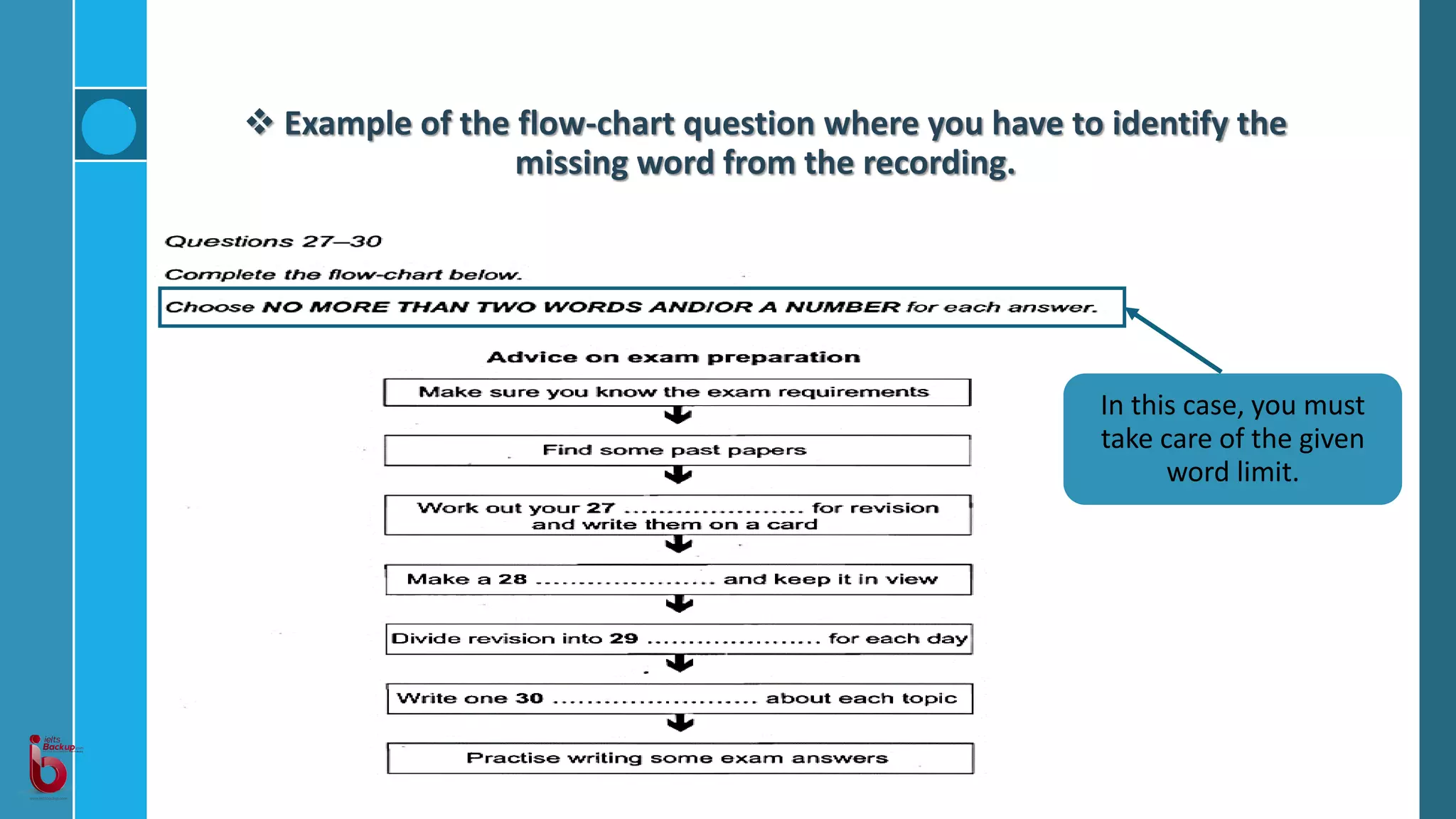
 Example of the flow-chart question where you have to identify the
missing word from the recording.
In this case, you must
take care of the given
word limit.
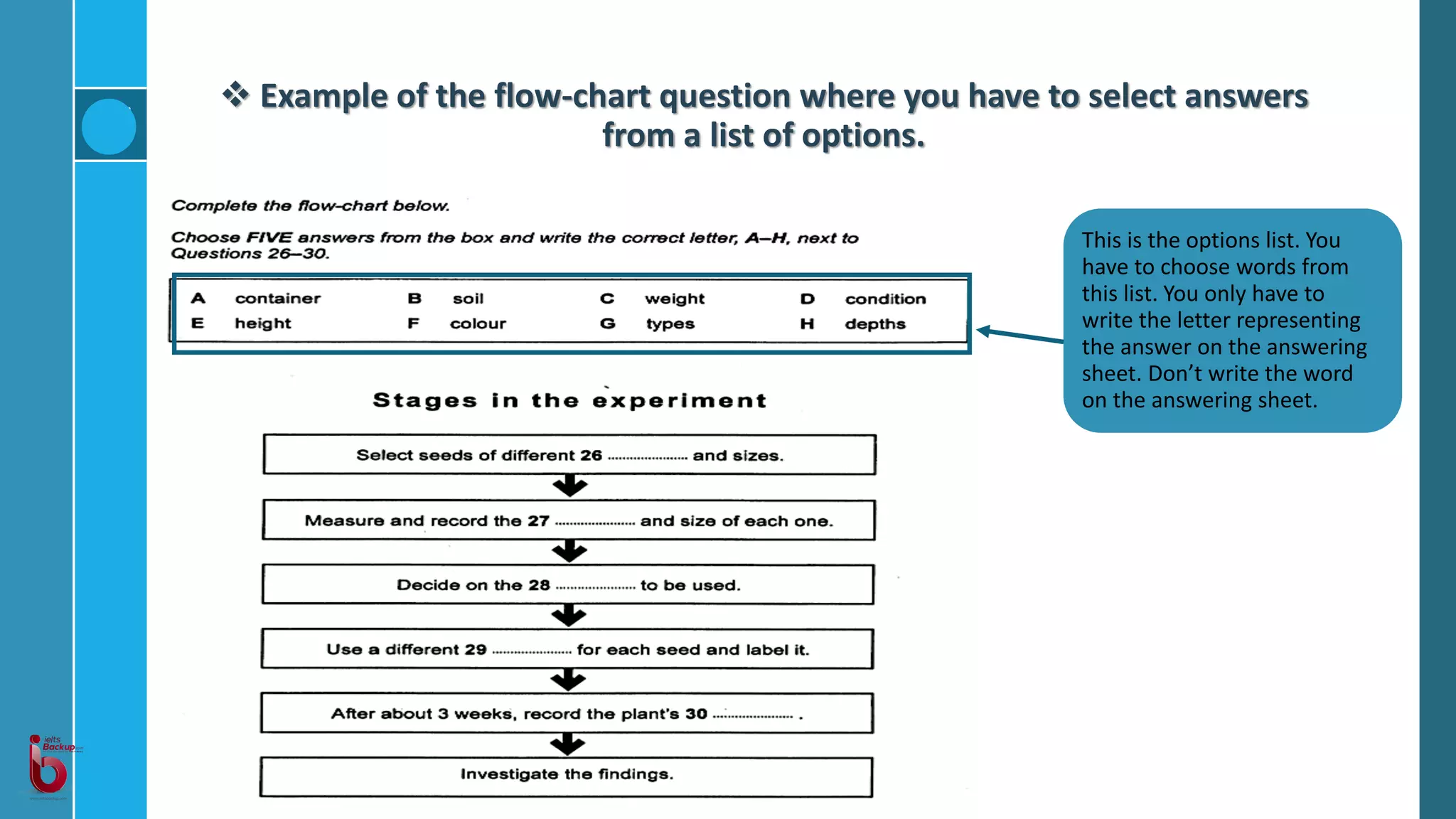
 Example of the flow-chart question where you have to select answers
from a list of options.
This is the options list. You
have to choose words from
this list. You only have to
write the letter representing
the answer on the answering
sheet. Don’t write the word
on the answering sheet.
Flow-Chart
Questions Special
Features and Useful Tips.
 SPECIAL FEATURES:
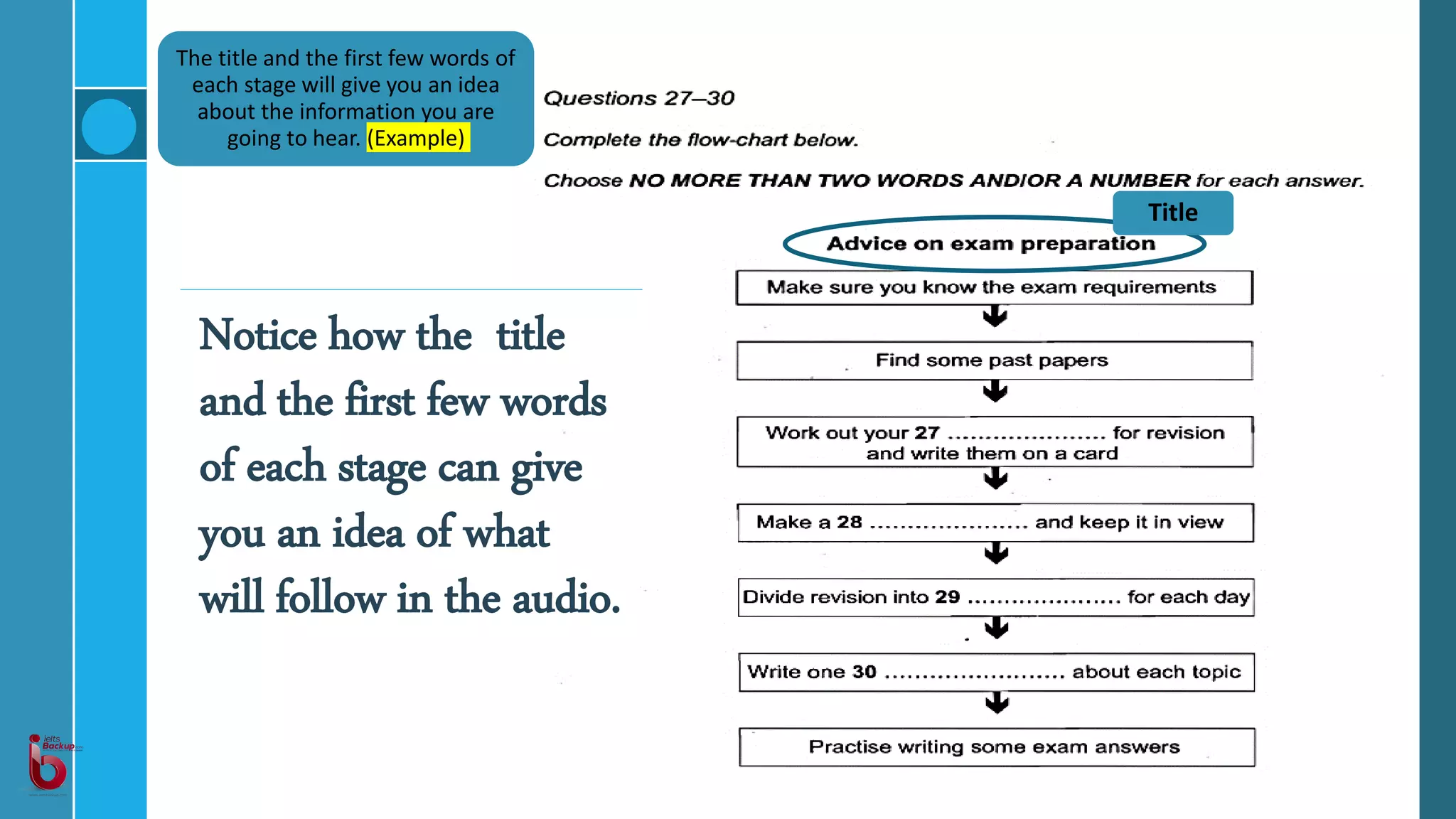
(1) The title and the first few words of each stage are important.
Notice how the title
and the first few words
of each stage can give
you an idea of what
will follow in the audio.
The title and the first few words of
each stage will give you an idea
about the information you are
going to hear. (Example)
Title
Special Features:
(2) Options in the list will always be more than the number of questions.
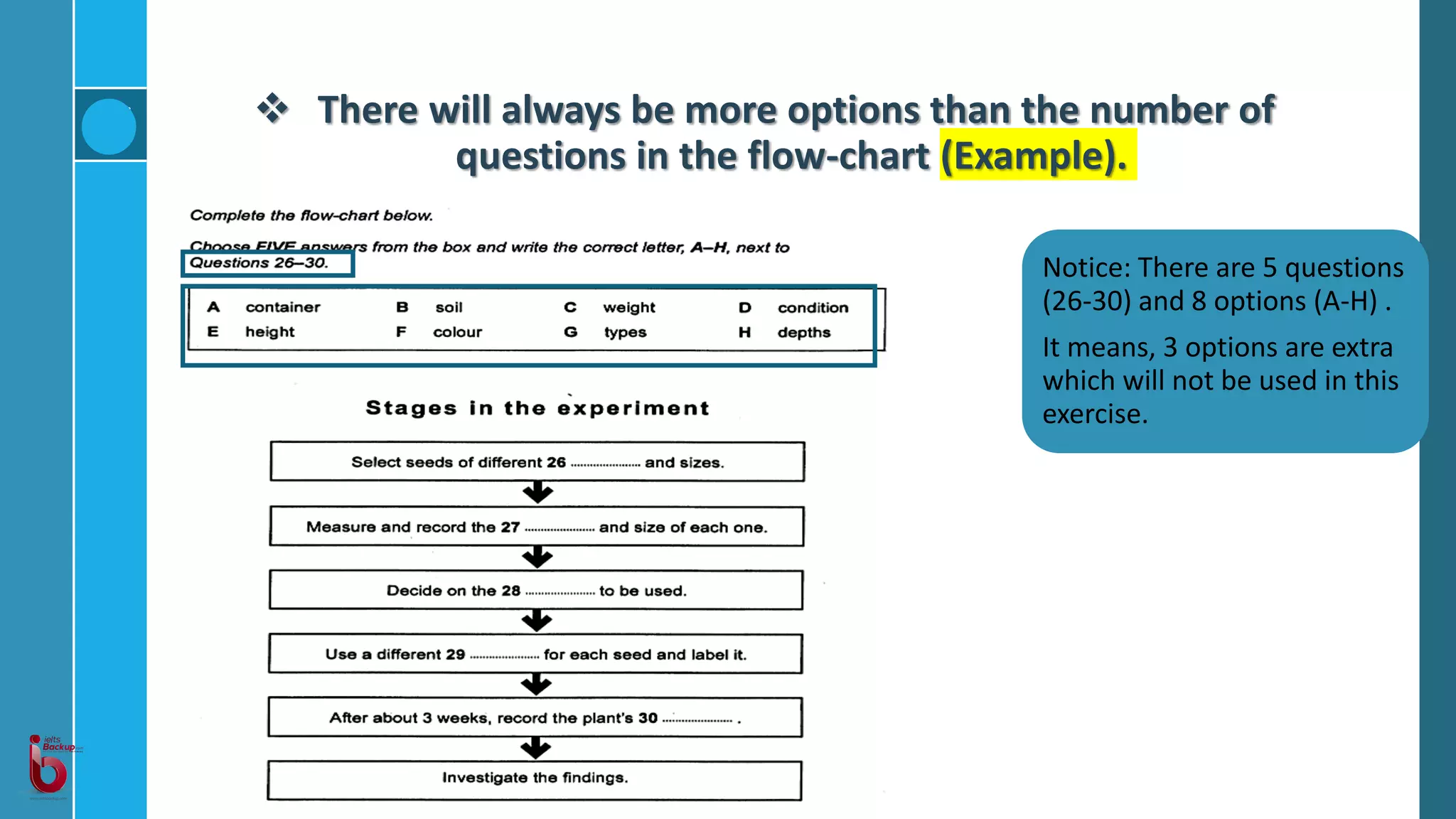
 There will always be more options than the number of
questions in the flow-chart (Example).
Notice: There are 5 questions
(26-30) and 8 options (A-H) .
It means, 3 options are extra
which will not be used in this
exercise.
Special Features:
(3) Short sentences for each stage.
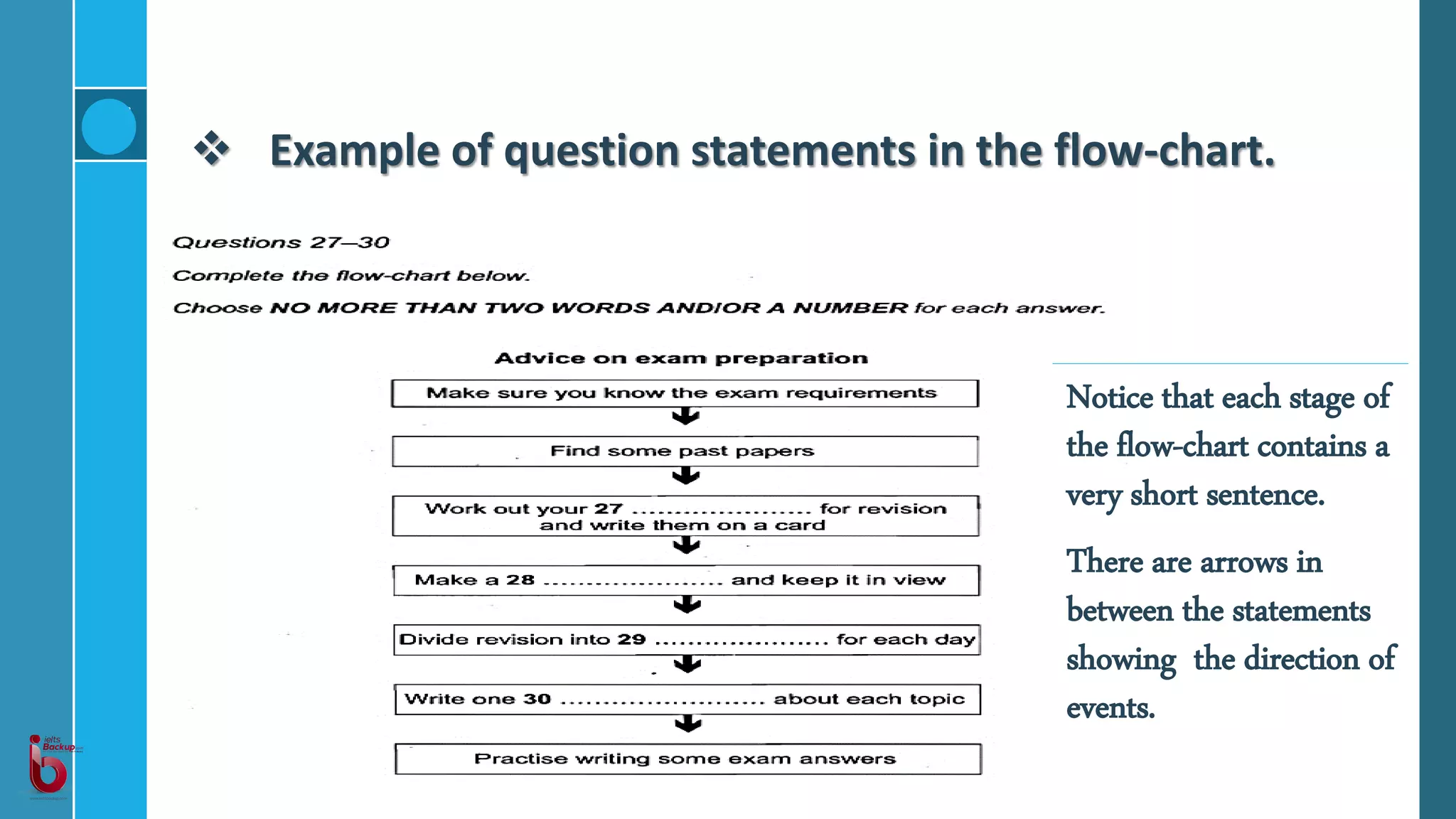
Notice that each stage of
the flow-chart contains a
very short sentence.
There are arrows in
between the statements
showing the direction of
events.
 Example of question statements in the flow-chart.
Special Features:
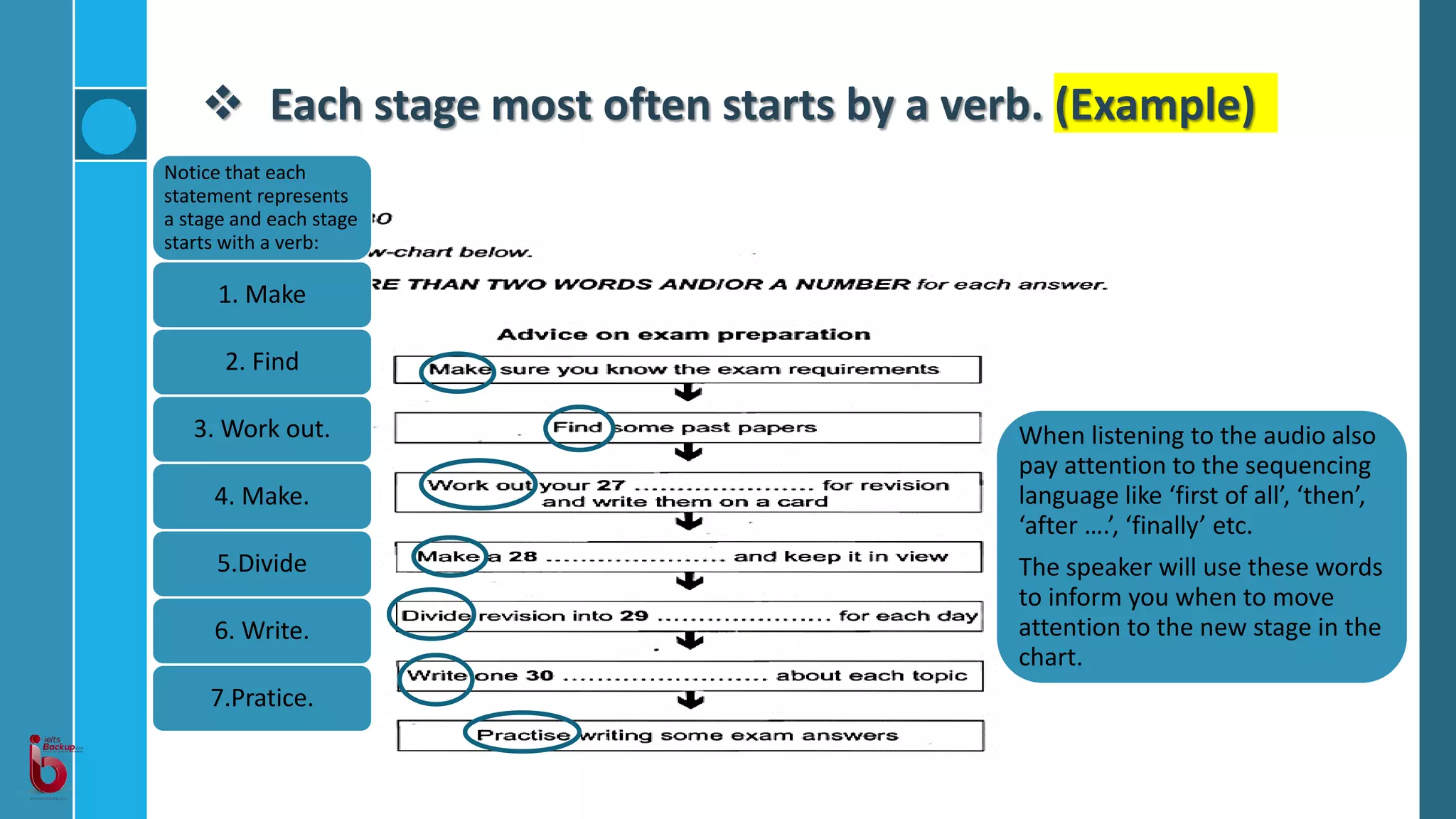
(4) Each stage most often starts with a verb.
 An important feature of the flow-chart is that it represents
different stages of a plan or process and each stage most often
starts with a verb.
 Always note how many stages are there in the flow chart and
listen to the recording carefully and notice that currently, the
speaker is referring to which stage in the chart.
 You need to focus on the important information missing to that
stage in the audio and avoid any extra information.
 Each stage most often starts by a verb. (Example)
When listening to the audio also
pay attention to the sequencing
language like ‘first of all’, ‘then’,
‘after ….’, ‘finally’ etc.
The speaker will use these words
to inform you when to move
attention to the new stage in the
chart.
Notice that each
statement represents
a stage and each stage
starts with a verb:
1. Make
2. Find
3. Work out.
4. Make.
5.Divide
6. Write.
7.Pratice.
 Sentences without blank spaces are also
important.
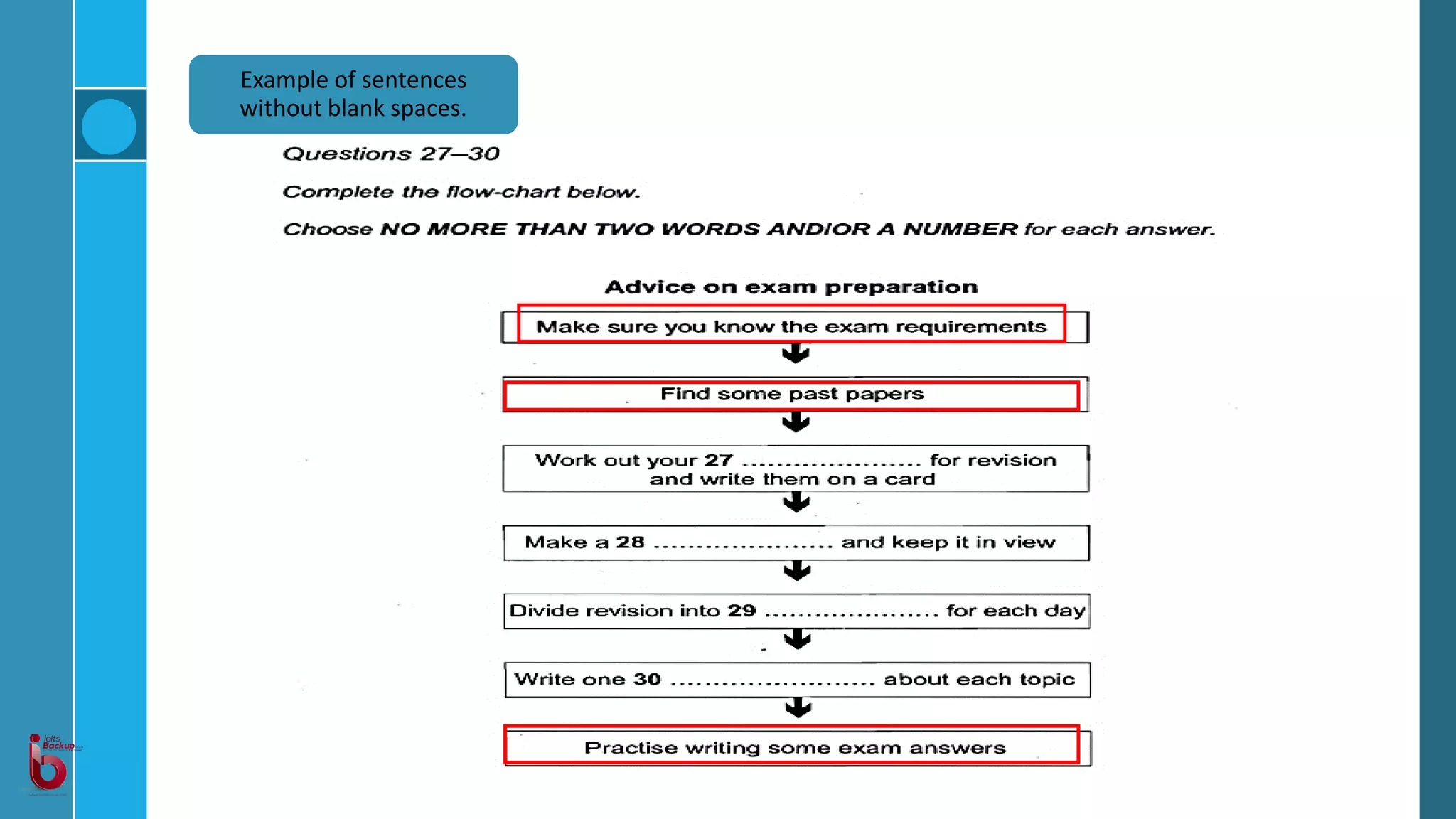
Example of sentences
without blank spaces.
This is the end of this presentation.
for watching
Send us your feedback and suggestions on
info@ieltsbackup.com
For a complete IELTS training course
and practice.
Visit: www.ieltsbackup.com
Hi,
I have developed a systematic approach for all question types frequently
appearing in IELTS. Students who tired them in their IELTS exams have
received amazing results.
(Zafar Yar Khan)
Author and Publisher
If you need help in achieving your goals in IELTS,
write to me at info@ieltsbackup.com or visit
www.ieltsbackup.com
and click on “IELTS Tuition”.
I will contact you as soon as I can.

IELTS Listening - Flow Chart Completion - Introduction and Useful Tips

  • 1.
  • 2.
    Flow Chart CompletionTask Explanation & Useful Tips. IELTS Listening.
  • 3.
    Task identification Examples aretaken from Cambridge IELTS books. Task Identification (How you can know this is a flow-chart completion task)
  • 4.
  • 5.
     Two typesof flow-chart questions.
  • 6.
     Example ofthe flow-chart question where you have to identify the missing word from the recording. In this case, you must take care of the given word limit.
  • 7.
     Example ofthe flow-chart question where you have to select answers from a list of options. This is the options list. You have to choose words from this list. You only have to write the letter representing the answer on the answering sheet. Don’t write the word on the answering sheet.
  • 8.
  • 9.
     SPECIAL FEATURES: (1)The title and the first few words of each stage are important.
  • 10.
    Notice how thetitle and the first few words of each stage can give you an idea of what will follow in the audio. The title and the first few words of each stage will give you an idea about the information you are going to hear. (Example) Title
  • 11.
    Special Features: (2) Optionsin the list will always be more than the number of questions.
  • 12.
     There willalways be more options than the number of questions in the flow-chart (Example). Notice: There are 5 questions (26-30) and 8 options (A-H) . It means, 3 options are extra which will not be used in this exercise.
  • 13.
    Special Features: (3) Shortsentences for each stage.
  • 14.
    Notice that eachstage of the flow-chart contains a very short sentence. There are arrows in between the statements showing the direction of events.  Example of question statements in the flow-chart.
  • 15.
    Special Features: (4) Eachstage most often starts with a verb.  An important feature of the flow-chart is that it represents different stages of a plan or process and each stage most often starts with a verb.  Always note how many stages are there in the flow chart and listen to the recording carefully and notice that currently, the speaker is referring to which stage in the chart.  You need to focus on the important information missing to that stage in the audio and avoid any extra information.
  • 16.
     Each stagemost often starts by a verb. (Example) When listening to the audio also pay attention to the sequencing language like ‘first of all’, ‘then’, ‘after ….’, ‘finally’ etc. The speaker will use these words to inform you when to move attention to the new stage in the chart. Notice that each statement represents a stage and each stage starts with a verb: 1. Make 2. Find 3. Work out. 4. Make. 5.Divide 6. Write. 7.Pratice.
  • 17.
     Sentences withoutblank spaces are also important.
  • 18.
  • 19.
    This is theend of this presentation. for watching Send us your feedback and suggestions on info@ieltsbackup.com For a complete IELTS training course and practice. Visit: www.ieltsbackup.com
  • 20.
    Hi, I have developeda systematic approach for all question types frequently appearing in IELTS. Students who tired them in their IELTS exams have received amazing results. (Zafar Yar Khan) Author and Publisher If you need help in achieving your goals in IELTS, write to me at info@ieltsbackup.com or visit www.ieltsbackup.com and click on “IELTS Tuition”. I will contact you as soon as I can.