A
Complete
Guide to the
IELTS Writing
Test
(General Training)
In this presentation, you will learn the following points about the IELTS
Writing test.
1. General Information
2. Test Format
3. Question Format
4. Question Types
5. Assessment criteria and its key indicators.
6. Marking
IELTS Writing
General
Information
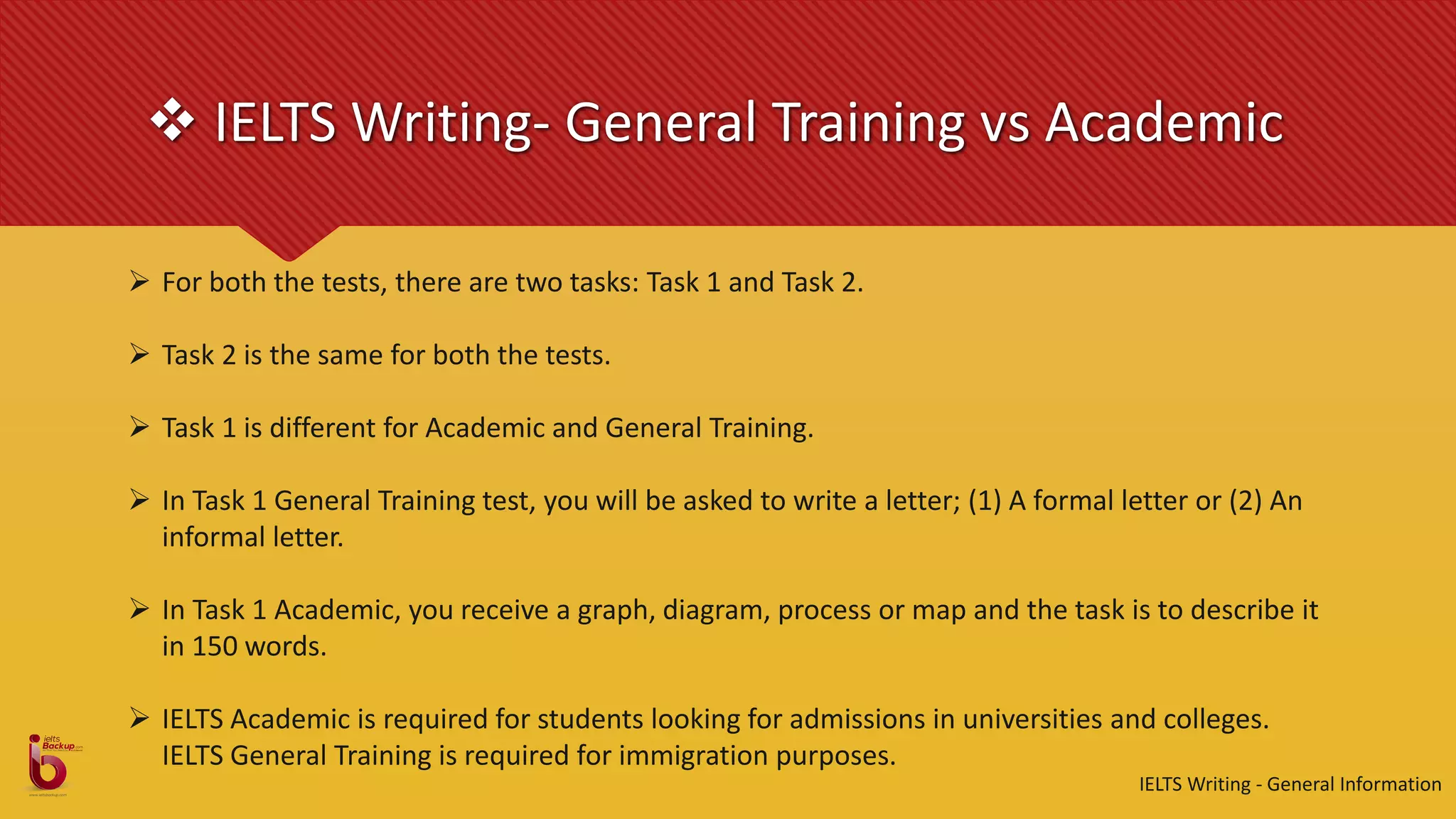
 For both the tests, there are two tasks: Task 1 and Task 2.
 Task 2 is the same for both the tests.
 Task 1 is different for Academic and General Training.
 In Task 1 General Training test, you will be asked to write a letter; (1) A formal letter or (2) An
informal letter.
 In Task 1 Academic, you receive a graph, diagram, process or map and the task is to describe it
in 150 words.
 IELTS Academic is required for students looking for admissions in universities and colleges.
IELTS General Training is required for immigration purposes.
 IELTS Writing- General Training vs Academic
IELTS Writing - General Information
It’s the third
module of the
test.
IELTS Writing - General Information
The Writing test is the third
module of the test. It comes
right after the Listening and
Reading modules.
IELTS Writing Test Format
Task 1
&
Task 2
The module is divided into two parts known as:
Task 1 andTask 2.
Each of the task has one question.
Recommended time for task 1 is 20 minutes
and for task 2 is 40 minutes.
IELTS Writing – Test Format
Task 1
&
Task 2
In Task 1 General Training, you will be asked to
write a letter; (1) A formal letter or (2) An informal
letter. (Min 150 words)
In Task 2, You will be given a topic and asked to
write an essay in 250 words.
IELTS Writing – Test Format
Task 1
Question
Format
In Task 1 General Training test, you will be asked to write a letter:
• A formal letter OR An informal letter
 IELTS Writing – General Training- Task 1
IELTS Writing – Task 1 – Question Format(GT)
General
TrainingTask 1
question
format.
 The format of the General Training IELTS task 1
question is always the same. It will tell you:
(1) The reason why you are writing the letter (the
situation)
(2) Who to write to - formal or informal
(Informal: for example to a friend. Formal: for example
to a business acquaintance, the manager or an
incharge of the local council, etc.)
(3) A suggestion - how to begin your letter (Dear…, Or
Dear Sir/Madam,)
(4) Give you three bullet points that you have to cover.
 You have to write a response in the form of an
informal or formal letter of at least 150 words.
IELTS Writing – Task 1 – Question Format(GT)
Why – the situation
Who to write – a friend (informal)
Three bullet points
Examples are from Cambridge IELTS books.
Suggestions - how to begin
Question
for an
informal
letter.
(Example)
(General Training)
Why – the situation
Who to write – a manager (formal)
Three bullet points
Examples are from Cambridge IELTS books.
Suggestions - how to begin
Question
for a
formal
letter.
(Example)
(General Training)
Task 2
(Academic & General)
These are the four characteristics of an academic essay:
Planned and focused: answers the question and demonstrates an
understanding of the subject.
Structured: is coherent, written in a logical order, and brings together
related points and material.
Evidenced: demonstrates knowledge of the subject area, supports
opinions and arguments with evidence.
Formal in tone and style: uses appropriate language and tenses, and is
clear, concise and balanced.
IELTS Writing – Task 1/Task 2 Marking
 What is an Academic Essay?
Task 2
Question
Format
In Task 2 question there will be a
topic (a point of view, an argument or a problem)
followed by a question asking for
your response.
Task 2 -
Question
Format
The next slide will show you the question format
ofTask 2 as it appears in the actual test.
IELTS Writing – Task 2 – Question Format
Topic
Question
Task 2 question format:
There will be a topic (a point of view, an argument or a problem) followed
by a question asking for your response (Example).
Task 2
Question
Types
InTask 2, you will
be asked to
respond to:
A point of view, or
An argument, or
A problem.
IELTS Writing – Task 2 – Question Types
In the next few slides, you will see
examples of these question types as
they appear in the actual test.
IELTS Writing – Task 2 – Question Types
1. Discuss both views and give your opinion.
2. To what extent do you agree or disagree ?
3. Discuss the advantages and disadvantages?
4. Do the advantages outweigh the disadvantages?
5. Problem and solution essay.
6 Direct question essay.
7. Double question essay.
Here is the
list of Task
2 question
types.
Example of:
“Discuss both these views
and give your opinion”
essay.
“To what extent do you
agree or disagree ?”
essay.
Example of:
“Do the advantages
outweigh the
disadvantages?”
essay
Example of:
“Discuss the
Advantages and
Disadvantages?” essay
Example of:
“Problem and Solution”
essay.
Example of:
“Direct Question”
essay.
Example of:
“Double Question”
essay.
Example of:
Task 2-
Task Focus
The task focuses on your ability to:
(1) To present a clear, relevant,
well-organised argument,
(2) to give evidence or examples
to support the idea and,
(3) to use language accurately.
Task 1 & 2
Assessment
criteria & its key
indicators.
(1)
*Task
Achievement
/Response.
(2)
Coherence &
Cohesion.
(3)
Lexical
Resource.
(4)
Grammatical
Range &
Accuracy.
Each task is assessed independently
on these four criteria:
*The first criteria for Task 1 is called Task Achievement
and for Task 2 called Task Response.
Task 1 & 2 - Assessment Criteria.
Key Indicator:
(1) Task Achievement Task 1
Covers all requirements of the task sufficiently.
Presents, highlights and illustrates all bullet points clearly and
appropriately.
Presents a clear purpose, with the tone consistent and appropriate
(formal/informal)
Key Indicator:
(1) Task Response (Task 2)
Full and relevant response. ( For example, if the topic is a particular aspect of computers, you
should focus on this aspect in your response. You should not simply write about computers
in general.)
Sufficiently addresses all parts/issues of the task.
Presents a clear position throughout the essay. (There can be three positions: totally in
favour, totally against or partially in favour and partially against)
Ideas should be supported by evidence, and examples may be drawn from your own
experience.
 Identify the main topic of the essay
If you incorrectly identify the main idea then you CANNOT score above Band 4.
If you present a main idea that is not sufficiently developed and supported by examples then
you CANNOT score above Band 6.
 Identify all parts of the task
If you address only some parts of the task and not others then you CANNOT score above Band 5.
Even if you identify all parts of the task correctly but fail to cover each of them fully you WILL NOT be
able to score above Band 6.
 Present a position/opinion
If you do not express a clear position then you CANNOT score above Band 5.
 Conclusion
 If you do not write a conclusion at the end you CANNOT score above Band 5.
 If your conclusion is unclear or repetitive then you CANNOT score above Band 6.
IELTS Writing – Task 1/Task 2 Marking
Key Indicator:
(1) Task Response - Explanation (Task 2)
Key Indicators:
(2) Coherence and Cohesion
Cohesion means sentences and paragraphs linked using linking devices (for
example, logical connectors, pronouns and conjunctions)
Logical organization of information.
Coherence refers to the linking of ideas through logical sequencing. Appropriate
paragraphing.
Key Indicators:
(3) Lexical Resource
Correct spellings.
Wide range of vocabulary of precise meaning.
Use of less common words.
Key Indicators:
(4) Grammatical Range & Accuracy
No grammatical errors.
Wide range of sentence structures (simple and
complex sentence structures).
Propper use of tenses.
You will be penalised if…
Notes or bullet points are not acceptable as answers. Contractions (short
forms) are also not allowed.
(1) the response is off-topic (irrelevant),
(2)or, is not written as full (too short of 150 words Task 1, 250 words Task 2),
(3) or, copying from any another source.
Task 1 & 2
Marking
(Academic & general)
(1) Task
Achievement
/Response
(2)
Coherence
and
Cohesion
(3)
Lexical
Resource
(4)
Grammatical
Range and
Accuracy
 Each task is marked independently on the
same four assessment criteria:
 Each segment makes 25% of the total marks.
 Each segment carries equal weight of 1 to 9.
Task 1 & 2 - Marking
The total score of each
task is the average of the
four segments.
Task Achievement / Task Response : Band 7
Coherence & Cohesion: Band 8
Lexical Resource: Band 6
Grammatical Range & Accuracy : Band 7
IELTS Writing – Task 1/Task 2 Marking
Example: If you get….
Your final Band for the task will be 7. (7+8+6+7 = 28/4 = 7)
Your final band score of the
Writing test is NOT the
average of the band scores
of Task 1 and Task 2.
See its explanation on the next slide.
IELTS Writing – Task 1/Task 2 Marking
Final Band Task 2 is worth
approximately 2/3 (60%)
of the overall IELTS
Writing exam score.
Task 1 is worth
approximately 1/3 (30%)of
the overall IELTSWriting
exam score; and
IELTS Writing – Task 1/Task 2 Marking
You get twice the
points for Writing
Task 2 .
See its explanation on the next slide.
IELTS Writing – Task 1/Task 2 Marking
Explanation of how you get twice the points for Writing Task 2.
Estimated score calculation:
For example if you get:
Writing Task 1 - Band score 8 and
Writing Task 2 - Band score 6
Your final band score will be: 8+6+6=20/3=6.66 = 6.5
(one task 1 score and two tasks 2 scores are added and divided by 3)
(IELTS usually round the number up or down to the nearest half score)
IELTS Writing – Task 1/Task 2 Marking
Final score examples:
But if you get a 5.0 in task 1 and a 6.0 in task 2, your final band
score will be 6.0.
 9+0+0=9/3 = 3If you get a band score of 9.0 in task 1and nothing in task 2.
Your final band score will be only 3.0.
If you get a band score of 9.0 in task 2, and gets nothing in task
1, your final band will be 6.0.
If you get a 6.0 in task 1 and a 5.0 in task 2, your final band
score will be 5.0.
 0+9+9=18/3 = 6
 6+5+5 16/3 = 5.333 = 5.0
 5+6+6= 17/3 = 5.66 = 6.0
IELTS Writing – Task 1/Task 2 Marking
 The Overall Band Score is the average of the four component scores, rounded
to the nearest whole or half band. The component scores are weighted equally.
Listening Reading Writing Speaking
Total of the
four individual
component
scores
divided by four.
Band score
Example 1 6.5 6.5 5.0 7.0 6.25 6.5
Example 2 4.0 3.5 4.0 4.0 3.875 4.0
Example 3 6.5 6.5 5.5 6.0 6.125 6.0
If the average of the four components ends in .25, the Overall Band Score is rounded
up to the next half band, and if it ends in .75, the Overall Band Score is rounded up to
the next whole band.
This is the end of this presentation
for watching
Send us your feedback and suggestions on
info@ieltsbackup.com
For a complete IELTS training course
and practice.
Visit: www.ieltsbackup.com
Hi,
I have developed a systematic approach for all question types frequently
appearing in IELTS. Students who tired them in their IELTS exams have
received amazing results.
(Zafar Yar Khan)
Author and Publisher
If you need help in achieving your goals in IELTS,
write to me at info@ieltsbackup.com or visit
www.ieltsbackup.com
and click on “IELTS Tuition”.
I will contact you as soon as I can.

A Complete Guide to the IELTS Writing Test - GT

  • 2.
    A Complete Guide to the IELTSWriting Test (General Training)
  • 3.
    In this presentation,you will learn the following points about the IELTS Writing test. 1. General Information 2. Test Format 3. Question Format 4. Question Types 5. Assessment criteria and its key indicators. 6. Marking
  • 4.
  • 5.
     For boththe tests, there are two tasks: Task 1 and Task 2.  Task 2 is the same for both the tests.  Task 1 is different for Academic and General Training.  In Task 1 General Training test, you will be asked to write a letter; (1) A formal letter or (2) An informal letter.  In Task 1 Academic, you receive a graph, diagram, process or map and the task is to describe it in 150 words.  IELTS Academic is required for students looking for admissions in universities and colleges. IELTS General Training is required for immigration purposes.  IELTS Writing- General Training vs Academic IELTS Writing - General Information
  • 6.
    It’s the third moduleof the test. IELTS Writing - General Information The Writing test is the third module of the test. It comes right after the Listening and Reading modules.
  • 7.
  • 8.
    Task 1 & Task 2 Themodule is divided into two parts known as: Task 1 andTask 2. Each of the task has one question. Recommended time for task 1 is 20 minutes and for task 2 is 40 minutes. IELTS Writing – Test Format
  • 9.
    Task 1 & Task 2 InTask 1 General Training, you will be asked to write a letter; (1) A formal letter or (2) An informal letter. (Min 150 words) In Task 2, You will be given a topic and asked to write an essay in 250 words. IELTS Writing – Test Format
  • 10.
  • 11.
    In Task 1General Training test, you will be asked to write a letter: • A formal letter OR An informal letter  IELTS Writing – General Training- Task 1 IELTS Writing – Task 1 – Question Format(GT)
  • 12.
    General TrainingTask 1 question format.  Theformat of the General Training IELTS task 1 question is always the same. It will tell you: (1) The reason why you are writing the letter (the situation) (2) Who to write to - formal or informal (Informal: for example to a friend. Formal: for example to a business acquaintance, the manager or an incharge of the local council, etc.) (3) A suggestion - how to begin your letter (Dear…, Or Dear Sir/Madam,) (4) Give you three bullet points that you have to cover.  You have to write a response in the form of an informal or formal letter of at least 150 words. IELTS Writing – Task 1 – Question Format(GT)
  • 13.
    Why – thesituation Who to write – a friend (informal) Three bullet points Examples are from Cambridge IELTS books. Suggestions - how to begin Question for an informal letter. (Example) (General Training)
  • 14.
    Why – thesituation Who to write – a manager (formal) Three bullet points Examples are from Cambridge IELTS books. Suggestions - how to begin Question for a formal letter. (Example) (General Training)
  • 15.
  • 16.
    These are thefour characteristics of an academic essay: Planned and focused: answers the question and demonstrates an understanding of the subject. Structured: is coherent, written in a logical order, and brings together related points and material. Evidenced: demonstrates knowledge of the subject area, supports opinions and arguments with evidence. Formal in tone and style: uses appropriate language and tenses, and is clear, concise and balanced. IELTS Writing – Task 1/Task 2 Marking  What is an Academic Essay?
  • 17.
  • 18.
    In Task 2question there will be a topic (a point of view, an argument or a problem) followed by a question asking for your response. Task 2 - Question Format The next slide will show you the question format ofTask 2 as it appears in the actual test. IELTS Writing – Task 2 – Question Format
  • 19.
    Topic Question Task 2 questionformat: There will be a topic (a point of view, an argument or a problem) followed by a question asking for your response (Example).
  • 20.
  • 21.
    InTask 2, youwill be asked to respond to: A point of view, or An argument, or A problem. IELTS Writing – Task 2 – Question Types
  • 22.
    In the nextfew slides, you will see examples of these question types as they appear in the actual test. IELTS Writing – Task 2 – Question Types 1. Discuss both views and give your opinion. 2. To what extent do you agree or disagree ? 3. Discuss the advantages and disadvantages? 4. Do the advantages outweigh the disadvantages? 5. Problem and solution essay. 6 Direct question essay. 7. Double question essay. Here is the list of Task 2 question types.
  • 23.
    Example of: “Discuss boththese views and give your opinion” essay.
  • 24.
    “To what extentdo you agree or disagree ?” essay. Example of:
  • 25.
    “Do the advantages outweighthe disadvantages?” essay Example of:
  • 26.
  • 27.
  • 28.
  • 29.
  • 30.
    Task 2- Task Focus Thetask focuses on your ability to: (1) To present a clear, relevant, well-organised argument, (2) to give evidence or examples to support the idea and, (3) to use language accurately.
  • 31.
    Task 1 &2 Assessment criteria & its key indicators.
  • 32.
    (1) *Task Achievement /Response. (2) Coherence & Cohesion. (3) Lexical Resource. (4) Grammatical Range & Accuracy. Eachtask is assessed independently on these four criteria: *The first criteria for Task 1 is called Task Achievement and for Task 2 called Task Response. Task 1 & 2 - Assessment Criteria.
  • 33.
    Key Indicator: (1) TaskAchievement Task 1 Covers all requirements of the task sufficiently. Presents, highlights and illustrates all bullet points clearly and appropriately. Presents a clear purpose, with the tone consistent and appropriate (formal/informal)
  • 34.
    Key Indicator: (1) TaskResponse (Task 2) Full and relevant response. ( For example, if the topic is a particular aspect of computers, you should focus on this aspect in your response. You should not simply write about computers in general.) Sufficiently addresses all parts/issues of the task. Presents a clear position throughout the essay. (There can be three positions: totally in favour, totally against or partially in favour and partially against) Ideas should be supported by evidence, and examples may be drawn from your own experience.
  • 35.
     Identify themain topic of the essay If you incorrectly identify the main idea then you CANNOT score above Band 4. If you present a main idea that is not sufficiently developed and supported by examples then you CANNOT score above Band 6.  Identify all parts of the task If you address only some parts of the task and not others then you CANNOT score above Band 5. Even if you identify all parts of the task correctly but fail to cover each of them fully you WILL NOT be able to score above Band 6.  Present a position/opinion If you do not express a clear position then you CANNOT score above Band 5.  Conclusion  If you do not write a conclusion at the end you CANNOT score above Band 5.  If your conclusion is unclear or repetitive then you CANNOT score above Band 6. IELTS Writing – Task 1/Task 2 Marking Key Indicator: (1) Task Response - Explanation (Task 2)
  • 36.
    Key Indicators: (2) Coherenceand Cohesion Cohesion means sentences and paragraphs linked using linking devices (for example, logical connectors, pronouns and conjunctions) Logical organization of information. Coherence refers to the linking of ideas through logical sequencing. Appropriate paragraphing.
  • 37.
    Key Indicators: (3) LexicalResource Correct spellings. Wide range of vocabulary of precise meaning. Use of less common words.
  • 38.
    Key Indicators: (4) GrammaticalRange & Accuracy No grammatical errors. Wide range of sentence structures (simple and complex sentence structures). Propper use of tenses.
  • 39.
    You will bepenalised if… Notes or bullet points are not acceptable as answers. Contractions (short forms) are also not allowed. (1) the response is off-topic (irrelevant), (2)or, is not written as full (too short of 150 words Task 1, 250 words Task 2), (3) or, copying from any another source.
  • 40.
    Task 1 &2 Marking (Academic & general)
  • 41.
    (1) Task Achievement /Response (2) Coherence and Cohesion (3) Lexical Resource (4) Grammatical Range and Accuracy Each task is marked independently on the same four assessment criteria:  Each segment makes 25% of the total marks.  Each segment carries equal weight of 1 to 9. Task 1 & 2 - Marking
  • 42.
    The total scoreof each task is the average of the four segments. Task Achievement / Task Response : Band 7 Coherence & Cohesion: Band 8 Lexical Resource: Band 6 Grammatical Range & Accuracy : Band 7 IELTS Writing – Task 1/Task 2 Marking Example: If you get…. Your final Band for the task will be 7. (7+8+6+7 = 28/4 = 7)
  • 43.
    Your final bandscore of the Writing test is NOT the average of the band scores of Task 1 and Task 2. See its explanation on the next slide. IELTS Writing – Task 1/Task 2 Marking
  • 44.
    Final Band Task2 is worth approximately 2/3 (60%) of the overall IELTS Writing exam score. Task 1 is worth approximately 1/3 (30%)of the overall IELTSWriting exam score; and IELTS Writing – Task 1/Task 2 Marking
  • 45.
    You get twicethe points for Writing Task 2 . See its explanation on the next slide. IELTS Writing – Task 1/Task 2 Marking
  • 46.
    Explanation of howyou get twice the points for Writing Task 2. Estimated score calculation: For example if you get: Writing Task 1 - Band score 8 and Writing Task 2 - Band score 6 Your final band score will be: 8+6+6=20/3=6.66 = 6.5 (one task 1 score and two tasks 2 scores are added and divided by 3) (IELTS usually round the number up or down to the nearest half score) IELTS Writing – Task 1/Task 2 Marking
  • 47.
    Final score examples: Butif you get a 5.0 in task 1 and a 6.0 in task 2, your final band score will be 6.0.  9+0+0=9/3 = 3If you get a band score of 9.0 in task 1and nothing in task 2. Your final band score will be only 3.0. If you get a band score of 9.0 in task 2, and gets nothing in task 1, your final band will be 6.0. If you get a 6.0 in task 1 and a 5.0 in task 2, your final band score will be 5.0.  0+9+9=18/3 = 6  6+5+5 16/3 = 5.333 = 5.0  5+6+6= 17/3 = 5.66 = 6.0 IELTS Writing – Task 1/Task 2 Marking
  • 48.
    IELTS Writing –Task 1/Task 2 Marking  The Overall Band Score is the average of the four component scores, rounded to the nearest whole or half band. The component scores are weighted equally. Listening Reading Writing Speaking Total of the four individual component scores divided by four. Band score Example 1 6.5 6.5 5.0 7.0 6.25 6.5 Example 2 4.0 3.5 4.0 4.0 3.875 4.0 Example 3 6.5 6.5 5.5 6.0 6.125 6.0 If the average of the four components ends in .25, the Overall Band Score is rounded up to the next half band, and if it ends in .75, the Overall Band Score is rounded up to the next whole band.
  • 49.
    This is theend of this presentation for watching Send us your feedback and suggestions on info@ieltsbackup.com For a complete IELTS training course and practice. Visit: www.ieltsbackup.com
  • 50.
    Hi, I have developeda systematic approach for all question types frequently appearing in IELTS. Students who tired them in their IELTS exams have received amazing results. (Zafar Yar Khan) Author and Publisher If you need help in achieving your goals in IELTS, write to me at info@ieltsbackup.com or visit www.ieltsbackup.com and click on “IELTS Tuition”. I will contact you as soon as I can.