Language Questions and Answers
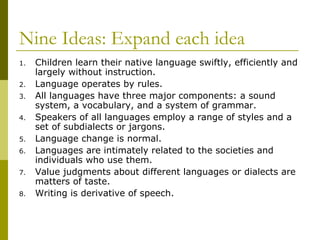
Nine Ideas: Expand each idea Children learn their native language swiftly, efficiently and largely without instruction. Language operates by rules. All languages have three major components: a sound system, a vocabulary, and a system of grammar.  Speakers of all languages employ a range of styles and a set of subdialects or jargons. Language change is normal. Languages are intimately related to the societies and individuals who use them.  Value judgments about different languages or dialects are matters of taste. Writing is derivative of speech.
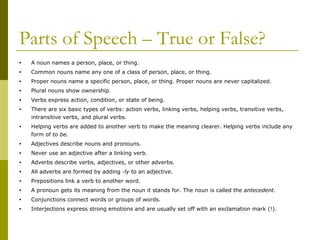
Parts of Speech – True or False? A noun names a person, place, or thing. Common nouns name any one of a class of person, place, or thing. Proper nouns name a specific person, place, or thing. Proper nouns are never capitalized. Plural nouns show ownership. Verbs express action, condition, or state of being. There are six basic types of verbs: action verbs, linking verbs, helping verbs, transitive verbs, intransitive verbs, and plural verbs. Helping verbs are added to another verb to make the meaning clearer. Helping verbs include any form of  to be. Adjectives describe nouns and pronouns. Never use an adjective after a linking verb. Adverbs describe verbs, adjectives, or other adverbs. All adverbs are formed by adding  -ly  to an adjective. Prepositions link a verb to another word. A pronoun gets its meaning from the noun it stands for. The noun is called the  antecedent. Conjunctions connect words or groups of words. Interjections express strong emotions and are usually set off with an exclamation mark (!).
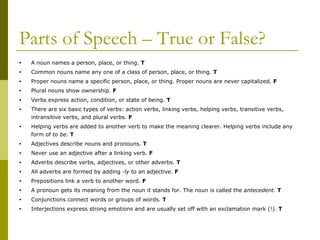
Parts of Speech – True or False? A noun names a person, place, or thing.  T Common nouns name any one of a class of person, place, or thing.  T Proper nouns name a specific person, place, or thing. Proper nouns are never capitalized.  F Plural nouns show ownership.  F Verbs express action, condition, or state of being.  T There are six basic types of verbs: action verbs, linking verbs, helping verbs, transitive verbs, intransitive verbs, and plural verbs.  F Helping verbs are added to another verb to make the meaning clearer. Helping verbs include any form of  to be.  T Adjectives describe nouns and pronouns.  T Never use an adjective after a linking verb.  F Adverbs describe verbs, adjectives, or other adverbs.  T All adverbs are formed by adding  -ly  to an adjective.  F Prepositions link a verb to another word.  F A pronoun gets its meaning from the noun it stands for. The noun is called the  antecedent.  T Conjunctions connect words or groups of words.  T Interjections express strong emotions and are usually set off with an exclamation mark (!).  T
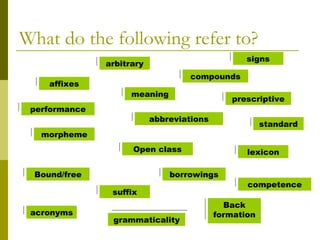
What do the following refer to? affixes performance arbitrary prescriptive Bound/free Open class abbreviations competence signs standard morpheme Back formation lexicon suffix grammaticality acronyms meaning compounds borrowings
Prefixes: cyber Cyber- How many can you think of? What are the connotations?
Prefixes : cyber Cyberspace Cybernetics Cybernetician Cybernate Cyborg Cybermen Cybernaut Cyberpunk Cyberscribe Cyberpublisher Cyber-novellist Cyberzine Cyberthrillers Cybermagazines Cyber-money Cyber-commerce cybersex
Prefixes: e- “ 1998, a year of truly e-mazing events” Give me an e- How many can you think of? What are the connotations?
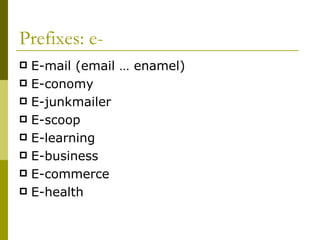
Prefixes: e- E-mail (email … enamel) E-conomy E-junkmailer E-scoop E-learning E-business E-commerce E-health

Question & Answer Session

  • 1.
  • 2.
    Nine Ideas: Expandeach idea Children learn their native language swiftly, efficiently and largely without instruction. Language operates by rules. All languages have three major components: a sound system, a vocabulary, and a system of grammar. Speakers of all languages employ a range of styles and a set of subdialects or jargons. Language change is normal. Languages are intimately related to the societies and individuals who use them. Value judgments about different languages or dialects are matters of taste. Writing is derivative of speech.
  • 3.
    Parts of Speech– True or False? A noun names a person, place, or thing. Common nouns name any one of a class of person, place, or thing. Proper nouns name a specific person, place, or thing. Proper nouns are never capitalized. Plural nouns show ownership. Verbs express action, condition, or state of being. There are six basic types of verbs: action verbs, linking verbs, helping verbs, transitive verbs, intransitive verbs, and plural verbs. Helping verbs are added to another verb to make the meaning clearer. Helping verbs include any form of to be. Adjectives describe nouns and pronouns. Never use an adjective after a linking verb. Adverbs describe verbs, adjectives, or other adverbs. All adverbs are formed by adding -ly to an adjective. Prepositions link a verb to another word. A pronoun gets its meaning from the noun it stands for. The noun is called the antecedent. Conjunctions connect words or groups of words. Interjections express strong emotions and are usually set off with an exclamation mark (!).
  • 4.
    Parts of Speech– True or False? A noun names a person, place, or thing. T Common nouns name any one of a class of person, place, or thing. T Proper nouns name a specific person, place, or thing. Proper nouns are never capitalized. F Plural nouns show ownership. F Verbs express action, condition, or state of being. T There are six basic types of verbs: action verbs, linking verbs, helping verbs, transitive verbs, intransitive verbs, and plural verbs. F Helping verbs are added to another verb to make the meaning clearer. Helping verbs include any form of to be. T Adjectives describe nouns and pronouns. T Never use an adjective after a linking verb. F Adverbs describe verbs, adjectives, or other adverbs. T All adverbs are formed by adding -ly to an adjective. F Prepositions link a verb to another word. F A pronoun gets its meaning from the noun it stands for. The noun is called the antecedent. T Conjunctions connect words or groups of words. T Interjections express strong emotions and are usually set off with an exclamation mark (!). T
  • 5.
    What do thefollowing refer to? affixes performance arbitrary prescriptive Bound/free Open class abbreviations competence signs standard morpheme Back formation lexicon suffix grammaticality acronyms meaning compounds borrowings
  • 6.
    Prefixes: cyber Cyber-How many can you think of? What are the connotations?
  • 7.
    Prefixes : cyberCyberspace Cybernetics Cybernetician Cybernate Cyborg Cybermen Cybernaut Cyberpunk Cyberscribe Cyberpublisher Cyber-novellist Cyberzine Cyberthrillers Cybermagazines Cyber-money Cyber-commerce cybersex
  • 8.
    Prefixes: e- “1998, a year of truly e-mazing events” Give me an e- How many can you think of? What are the connotations?
  • 9.
    Prefixes: e- E-mail(email … enamel) E-conomy E-junkmailer E-scoop E-learning E-business E-commerce E-health