Grammar reference unit 5
Adverbs of frequency
   The most common adverbs of frequency
    are:never, sometimes, often, usually and
    always.

   We use these adverbs to express how
    often we do something.

   Advebs of frequency go before the main
    verb, but with the verb BE we place them
    after the verb.
Adverbs of frequency
   In negative and questions we place the adverb
    of frequency before the main verb, except with
    the verb BE.

   How often is the question particle we use to
    ask for the frequency we do or not do
    something.

   Often is the only adverb that can be modified
    by very. In that case, we put the frequency
    expression at the end of the sentence.
Word order in questions
   BE
    (question word) + am/is /are/was/were + subject +
    other words ?
   HAVE GOT
    (question word)+ have / has / had + subject + got +
    other words?
   OTHER VERBS
    (question word) + auxiliary verb + subject + main verb
    + other words?
    Auxiliary verbs include: do,does, did, am, is, are, was, were,
    can, could, etc. They can be followed by infinitive, gerund or
    past participle.
Can. Ability
   Affirmative:
    subject + can + infinitive without to + other words.

   Negative:
    subject + can't/cannot + infinitive without to + other
    words.

   Interrogative:
    (question word) can + suject + infinitive without to +
    other words.

   Short answers:
    Yes, subject + can / No, subjet + can't.
Can. Usage.
   We use the verb can to express the ability
    of doing something.

   We have to remember that can is a modal
    verb, and we don't have to add -s to the
    third person singular (he, she, it).

   Can is also used to express possibility and
    to ask for permission.
Adverbs of manner
   Adverbs of manner are used to express
    how (the way) we do things.

   We place these type of adverbs at the end
    of the sentence.
Adverbs of manner.
             Spelling rules.
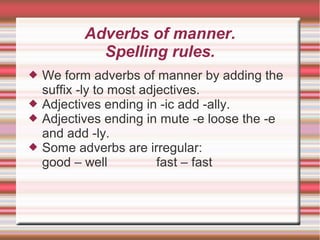
   We form adverbs of manner by adding the
    suffix -ly to most adjectives.
   Adjectives ending in -ic add -ally.
   Adjectives ending in mute -e loose the -e
    and add -ly.
   Some adverbs are irregular:
    good – well           fast – fast
Adverbs of manner.
             Spelling rules.
   We form adverbs of manner by adding the
    suffix -ly to most adjectives.
   Adjectives ending in -ic add -ally.
   Adjectives ending in mute -e loose the -e
    and add -ly.
   Some adverbs are irregular:
    good – well           fast – fast

Grammar reference unit 5

  • 2.
  • 3.
    Adverbs of frequency  The most common adverbs of frequency are:never, sometimes, often, usually and always.  We use these adverbs to express how often we do something.  Advebs of frequency go before the main verb, but with the verb BE we place them after the verb.
  • 4.
    Adverbs of frequency  In negative and questions we place the adverb of frequency before the main verb, except with the verb BE.  How often is the question particle we use to ask for the frequency we do or not do something.  Often is the only adverb that can be modified by very. In that case, we put the frequency expression at the end of the sentence.
  • 5.
    Word order inquestions  BE (question word) + am/is /are/was/were + subject + other words ?  HAVE GOT (question word)+ have / has / had + subject + got + other words?  OTHER VERBS (question word) + auxiliary verb + subject + main verb + other words? Auxiliary verbs include: do,does, did, am, is, are, was, were, can, could, etc. They can be followed by infinitive, gerund or past participle.
  • 6.
    Can. Ability  Affirmative: subject + can + infinitive without to + other words.  Negative: subject + can't/cannot + infinitive without to + other words.  Interrogative: (question word) can + suject + infinitive without to + other words.  Short answers: Yes, subject + can / No, subjet + can't.
  • 7.
    Can. Usage.  We use the verb can to express the ability of doing something.  We have to remember that can is a modal verb, and we don't have to add -s to the third person singular (he, she, it).  Can is also used to express possibility and to ask for permission.
  • 8.
    Adverbs of manner  Adverbs of manner are used to express how (the way) we do things.  We place these type of adverbs at the end of the sentence.
  • 9.
    Adverbs of manner. Spelling rules.  We form adverbs of manner by adding the suffix -ly to most adjectives.  Adjectives ending in -ic add -ally.  Adjectives ending in mute -e loose the -e and add -ly.  Some adverbs are irregular: good – well fast – fast
  • 10.
    Adverbs of manner. Spelling rules.  We form adverbs of manner by adding the suffix -ly to most adjectives.  Adjectives ending in -ic add -ally.  Adjectives ending in mute -e loose the -e and add -ly.  Some adverbs are irregular: good – well fast – fast