Verb
Definition, Types, Examples
• Action Verb & Non Action Verb
• Transitive Verb & Intransitive Verb
• Regular Verb & Irregular Verb
• Main Verb & Auxiliary Verb
• Finite Verb & Non-Finite Verb
• Linking Verb
Prepared By : Dr Sudhir Mathpati, Assistant Professor, Dept. of English, Adarsh Mahavidyalaya,
Omerga, Dist. Osmanabad, MS, India.
Verb: Definition, Types, Examples
Definition of Verb:
A verb is a word which is used to describe an action or occurance or
indicates a state of being. Verbs show differences in tense, mood, aspect,
number, person and voice.
Examples: Walk, Run, Read, Watch, Feel, Look, Play, Stay, Live, etc.
Types :
• Action / Dynamic Verb – Non-Action / Stative Verb
• Transitive Verb – Intransitive Verb
• Regular Verb – Irregular Verb
• Main / Lexical Verb – Auxiliary / Helping Verb
• Finite Verb – Non Finite Verb
• Linking Verb
Dr Sudhir Mathpati
Verb: Definition, Types, Examples
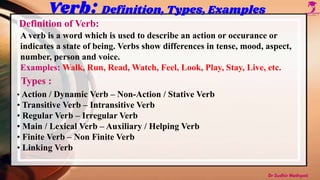
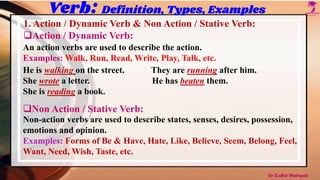
1. Action / Dynamic Verb & Non Action / Stative Verb:
Action / Dynamic Verb:
An action verbs are used to describe the action.
Examples: Walk, Run, Read, Write, Play, Talk, etc.
He is walking on the street. They are running after him.
She wrote a letter. He has beaten them.
She is reading a book.
Non Action / Stative Verb:
Non-action verbs are used to describe states, senses, desires, possession,
emotions and opinion.
Examples: Forms of Be & Have, Hate, Like, Believe, Seem, Belong, Feel,
Want, Need, Wish, Taste, etc.
Dr Sudhir Mathpati
Verb: Definition, Types, Examples
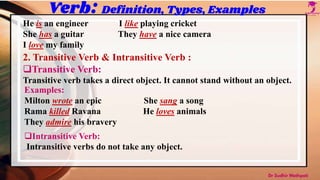
He is an engineer I like playing cricket
She has a guitar They have a nice camera
I love my family
2. Transitive Verb & Intransitive Verb :
Transitive Verb:
Transitive verb takes a direct object. It cannot stand without an object.
Examples:
Milton wrote an epic She sang a song
Rama killed Ravana He loves animals
They admire his bravery
Intransitive Verb:
Intransitive verbs do not take any object.
Dr Sudhir Mathpati
Verb: Definition, Types, Examples
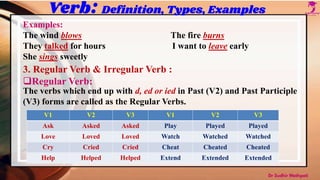
Examples:
The wind blows The fire burns
They talked for hours I want to leave early
She sings sweetly
3. Regular Verb & Irregular Verb :
Regular Verb:
The verbs which end up with d, ed or ied in Past (V2) and Past Participle
(V3) forms are called as the Regular Verbs.
V1 V2 V3 V1 V2 V3
Ask Asked Asked Play Played Played
Love Loved Loved Watch Watched Watched
Cry Cried Cried Cheat Cheated Cheated
Help Helped Helped Extend Extended Extended
Dr Sudhir Mathpati
Verb: Definition, Types, Examples
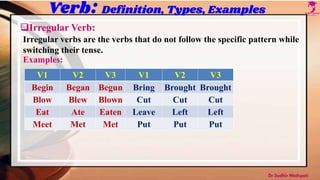
Irregular Verb:
Irregular verbs are the verbs that do not follow the specific pattern while
switching their tense.
Examples:
V1 V2 V3 V1 V2 V3
Begin Began Begun Bring Brought Brought
Blow Blew Blown Cut Cut Cut
Eat Ate Eaten Leave Left Left
Meet Met Met Put Put Put
Dr Sudhir Mathpati
Verb: Definition, Types, Examples
4. Main / Lexical Verb & Auxiliary / Helping Verb :
Main / Lexical Verb:
The main verb is also called as the Lexical verb or Full verb or Principal
Verb. It shows action and state of being of the subject. It can stand alone and
it does not require any other verb. It has three forms – V1, V2 & V3.
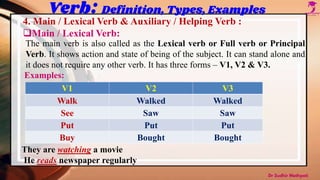
Examples:
V1 V2 V3
Walk Walked Walked
See Saw Saw
Put Put Put
Buy Bought Bought
They are watching a movie
He reads newspaper regularly
Dr Sudhir Mathpati
Verb: Definition, Types, Examples
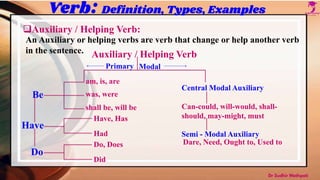
Auxiliary / Helping Verb:
An Auxiliary or helping verbs are verb that change or help another verb
in the sentence.
Be
Have
am, is, are
was, were
shall be, will be
Have, Has
Had
Do
Do, Does
Did
Auxiliary / Helping Verb
Primary
Central Modal Auxiliary
Modal
Can-could, will-would, shall-
should, may-might, must
Semi - Modal Auxiliary
Dare, Need, Ought to, Used to
Dr Sudhir Mathpati
Verb: Definition, Types, Examples
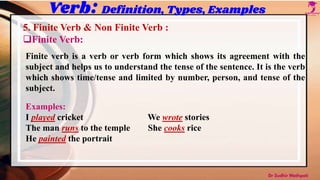
5. Finite Verb & Non Finite Verb :
Finite Verb:
Finite verb is a verb or verb form which shows its agreement with the
subject and helps us to understand the tense of the sentence. It is the verb
which shows time/tense and limited by number, person, and tense of the
subject.
Examples:
I played cricket We wrote stories
The man runs to the temple She cooks rice
He painted the portrait
Dr Sudhir Mathpati
Verb: Definition, Types, Examples
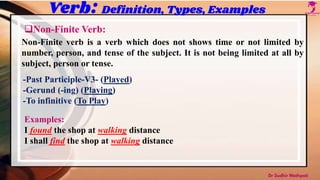
Non-Finite Verb:
Non-Finite verb is a verb which does not shows time or not limited by
number, person, and tense of the subject. It is not being limited at all by
subject, person or tense.
-Past Participle-V3- (Played)
-Gerund (-ing) (Playing)
-To infinitive (To Play)
Examples:
I found the shop at walking distance
I shall find the shop at walking distance
Dr Sudhir Mathpati
Verb: Definition, Types, Examples
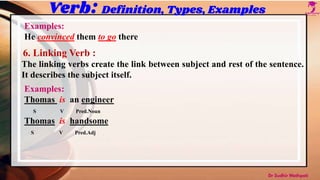
Examples:
He convinced them to go there
6. Linking Verb :
The linking verbs create the link between subject and rest of the sentence.
It describes the subject itself.
Examples:
Thomas is an engineer
S V Pred.Noun
Thomas is handsome
S V Pred.Adj
Dr Sudhir Mathpati
Thank you !
Dr Sudhir Mathpati
(M.A.,B.Ed.,M.Phil.,Ph.D.,NET)
Assistant Professor
Department of English
Adarsh Mahavidyalaya, Omerga, Dist.
Osmanabad, MS
Dr Sudhir Mathpati

Verb HD

  • 1.
    Verb Definition, Types, Examples •Action Verb & Non Action Verb • Transitive Verb & Intransitive Verb • Regular Verb & Irregular Verb • Main Verb & Auxiliary Verb • Finite Verb & Non-Finite Verb • Linking Verb Prepared By : Dr Sudhir Mathpati, Assistant Professor, Dept. of English, Adarsh Mahavidyalaya, Omerga, Dist. Osmanabad, MS, India.
  • 2.
    Verb: Definition, Types,Examples Definition of Verb: A verb is a word which is used to describe an action or occurance or indicates a state of being. Verbs show differences in tense, mood, aspect, number, person and voice. Examples: Walk, Run, Read, Watch, Feel, Look, Play, Stay, Live, etc. Types : • Action / Dynamic Verb – Non-Action / Stative Verb • Transitive Verb – Intransitive Verb • Regular Verb – Irregular Verb • Main / Lexical Verb – Auxiliary / Helping Verb • Finite Verb – Non Finite Verb • Linking Verb Dr Sudhir Mathpati
  • 3.
    Verb: Definition, Types,Examples 1. Action / Dynamic Verb & Non Action / Stative Verb: Action / Dynamic Verb: An action verbs are used to describe the action. Examples: Walk, Run, Read, Write, Play, Talk, etc. He is walking on the street. They are running after him. She wrote a letter. He has beaten them. She is reading a book. Non Action / Stative Verb: Non-action verbs are used to describe states, senses, desires, possession, emotions and opinion. Examples: Forms of Be & Have, Hate, Like, Believe, Seem, Belong, Feel, Want, Need, Wish, Taste, etc. Dr Sudhir Mathpati
  • 4.
    Verb: Definition, Types,Examples He is an engineer I like playing cricket She has a guitar They have a nice camera I love my family 2. Transitive Verb & Intransitive Verb : Transitive Verb: Transitive verb takes a direct object. It cannot stand without an object. Examples: Milton wrote an epic She sang a song Rama killed Ravana He loves animals They admire his bravery Intransitive Verb: Intransitive verbs do not take any object. Dr Sudhir Mathpati
  • 5.
    Verb: Definition, Types,Examples Examples: The wind blows The fire burns They talked for hours I want to leave early She sings sweetly 3. Regular Verb & Irregular Verb : Regular Verb: The verbs which end up with d, ed or ied in Past (V2) and Past Participle (V3) forms are called as the Regular Verbs. V1 V2 V3 V1 V2 V3 Ask Asked Asked Play Played Played Love Loved Loved Watch Watched Watched Cry Cried Cried Cheat Cheated Cheated Help Helped Helped Extend Extended Extended Dr Sudhir Mathpati
  • 6.
    Verb: Definition, Types,Examples Irregular Verb: Irregular verbs are the verbs that do not follow the specific pattern while switching their tense. Examples: V1 V2 V3 V1 V2 V3 Begin Began Begun Bring Brought Brought Blow Blew Blown Cut Cut Cut Eat Ate Eaten Leave Left Left Meet Met Met Put Put Put Dr Sudhir Mathpati
  • 7.
    Verb: Definition, Types,Examples 4. Main / Lexical Verb & Auxiliary / Helping Verb : Main / Lexical Verb: The main verb is also called as the Lexical verb or Full verb or Principal Verb. It shows action and state of being of the subject. It can stand alone and it does not require any other verb. It has three forms – V1, V2 & V3. Examples: V1 V2 V3 Walk Walked Walked See Saw Saw Put Put Put Buy Bought Bought They are watching a movie He reads newspaper regularly Dr Sudhir Mathpati
  • 8.
    Verb: Definition, Types,Examples Auxiliary / Helping Verb: An Auxiliary or helping verbs are verb that change or help another verb in the sentence. Be Have am, is, are was, were shall be, will be Have, Has Had Do Do, Does Did Auxiliary / Helping Verb Primary Central Modal Auxiliary Modal Can-could, will-would, shall- should, may-might, must Semi - Modal Auxiliary Dare, Need, Ought to, Used to Dr Sudhir Mathpati
  • 9.
    Verb: Definition, Types,Examples 5. Finite Verb & Non Finite Verb : Finite Verb: Finite verb is a verb or verb form which shows its agreement with the subject and helps us to understand the tense of the sentence. It is the verb which shows time/tense and limited by number, person, and tense of the subject. Examples: I played cricket We wrote stories The man runs to the temple She cooks rice He painted the portrait Dr Sudhir Mathpati
  • 10.
    Verb: Definition, Types,Examples Non-Finite Verb: Non-Finite verb is a verb which does not shows time or not limited by number, person, and tense of the subject. It is not being limited at all by subject, person or tense. -Past Participle-V3- (Played) -Gerund (-ing) (Playing) -To infinitive (To Play) Examples: I found the shop at walking distance I shall find the shop at walking distance Dr Sudhir Mathpati
  • 11.
    Verb: Definition, Types,Examples Examples: He convinced them to go there 6. Linking Verb : The linking verbs create the link between subject and rest of the sentence. It describes the subject itself. Examples: Thomas is an engineer S V Pred.Noun Thomas is handsome S V Pred.Adj Dr Sudhir Mathpati
  • 12.
    Thank you ! DrSudhir Mathpati (M.A.,B.Ed.,M.Phil.,Ph.D.,NET) Assistant Professor Department of English Adarsh Mahavidyalaya, Omerga, Dist. Osmanabad, MS Dr Sudhir Mathpati