Who would be the audience for your
media product?
The target audience for our production would most likely be
18-25 year olds, of both genders, who enjoy crime, drama and
mystery genres. This conclusion can be reached due to our
extensive surveys to different age ranges and genders, and our
large host of research into the psychological horror genre and
previous, similar productions.
25-35 40-50
18-2515-18
Screenshot from research
http://www.electricsheepmagazine.co.uk/features/20
11/03/28/do-women-prefer-psychological-horror/
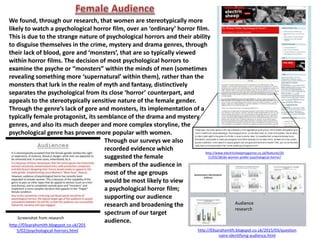
We found, through our research, that women are stereotypically more
likely to watch a psychological horror film, over an ‘ordinary’ horror film.
This is due to the strange nature of psychological horrors and their ability
to disguise themselves in the crime, mystery and drama genres, through
their lack of blood, gore and ‘monsters’, that are so typically viewed
within horror films. The decision of most psychological horrors to
examine the psyche or “monsters” within the minds of men (sometimes
revealing something more ‘supernatural’ within them), rather than the
monsters that lurk in the realm of myth and fantasy, distinctively
separates the psychological from its close ‘horror’ counterpart, and
appeals to the stereotypically sensitive nature of the female gender.
Through the genre’s lack of gore and monsters, its implementation of a
typically female protagonist, its semblance of the drama and mystery
genres, and also its much deeper and more complex storyline, the
psychological genre has proven more popular with women.
Through our surveys we also
recorded evidence which
suggested the female
members of the audience in
most of the age groups
would be most likely to view
a psychological horror film;
supporting our audience
research and broadening the
spectrum of our target
audience.
http://03sarahsmith.blogspot.co.uk/2015/03/question
naire-identifying-audience.html
Audience
research
http://03sarahsmith.blogspot.co.uk/201
5/02/psychological-horrors.html
Similarly however, the psychological genre also appeals to men.
While it may lack the intense blood and violence that
stereotypically appeals to the male gender, its complexity,
implementation of Laura Mulvey’s ‘Male Gaze’ theory, and also
its use of rare (sometimes bloody) violence, all works to engage
the male audience in an effective manner.
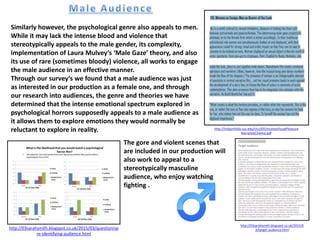
Through our survey’s we found that a male audience was just
as interested in our production as a female one, and through
our research into audiences, the genre and theories we have
determined that the intense emotional spectrum explored in
psychological horrors supposedly appeals to a male audience as
it allows them to explore emotions they would normally be
reluctant to explore in reality. http://imlportfolio.usc.edu/ctcs505/mulveyVisualPleasure
NarrativeCinema.pdf
http://03sarahsmith.blogspot.co.uk/2015/03/questionnai
re-identifying-audience.html
The gore and violent scenes that
are included in our production will
also work to appeal to a
stereotypically masculine
audience, who enjoy watching
fighting .
http://03sarahsmith.blogspot.co.uk/2015/0
3/target-audience.html
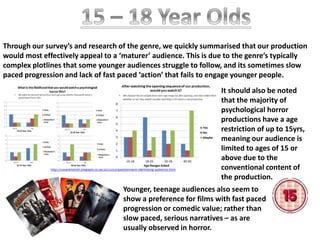
Through our survey’s and research of the genre, we quickly summarised that our production
would most effectively appeal to a ‘maturer’ audience. This is due to the genre’s typically
complex plotlines that some younger audiences struggle to follow, and its sometimes slow
paced progression and lack of fast paced ‘action’ that fails to engage younger people.
http://03sarahsmith.blogspot.co.uk/2015/03/questionnaire-identifying-audience.html
It should also be noted
that the majority of
psychological horror
productions have a age
restriction of up to 15yrs,
meaning our audience is
limited to ages of 15 or
above due to the
conventional content of
the production.
Younger, teenage audiences also seem to
show a preference for films with fast paced
progression or comedic value; rather than
slow paced, serious narratives – as are
usually observed in horror.
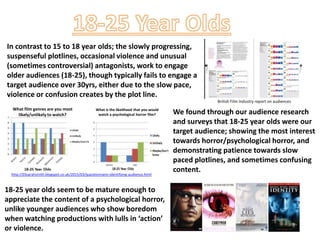
In contrast to 15 to 18 year olds; the slowly progressing,
suspenseful plotlines, occasional violence and unusual
(sometimes controversial) antagonists, work to engage
older audiences (18-25), though typically fails to engage a
target audience over 30yrs, either due to the slow pace,
violence or confusion creates by the plot line.
We found through our audience research
and surveys that 18-25 year olds were our
target audience; showing the most interest
towards horror/psychological horror, and
demonstrating patience towards slow
paced plotlines, and sometimes confusing
content.
18-25 year olds seem to be mature enough to
appreciate the content of a psychological horror,
unlike younger audiences who show boredom
when watching productions with lulls in ‘action’
or violence.
What film genres are you most
likely/unlikely to watch?
What is the likelihood that you would
watch a psychological horror film?
http://03sarahsmith.blogspot.co.uk/2015/03/questionnaire-identifying-audience.html
British Film Industry report on audiences
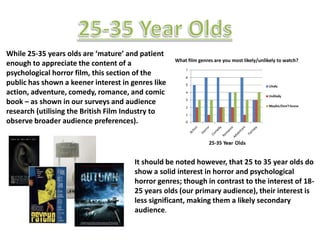
While 25-35 years olds are ‘mature’ and patient
enough to appreciate the content of a
psychological horror film, this section of the
public has shown a keener interest in genres like
action, adventure, comedy, romance, and comic
book – as shown in our surveys and audience
research (utilising the British Film Industry to
observe broader audience preferences).
What film genres are you most likely/unlikely to watch?
It should be noted however, that 25 to 35 year olds do
show a solid interest in horror and psychological
horror genres; though in contrast to the interest of 18-
25 years olds (our primary audience), their interest is
less significant, making them a likely secondary
audience.
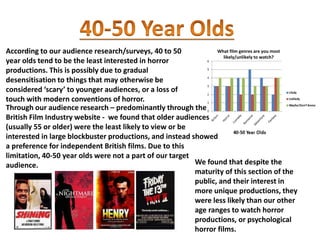
According to our audience research/surveys, 40 to 50
year olds tend to be the least interested in horror
productions. This is possibly due to gradual
desensitisation to things that may otherwise be
considered ‘scary’ to younger audiences, or a loss of
touch with modern conventions of horror.
What film genres are you most
likely/unlikely to watch?
Through our audience research – predominantly through the
British Film Industry website - we found that older audiences
(usually 55 or older) were the least likely to view or be
interested in large blockbuster productions, and instead showed
a preference for independent British films. Due to this
limitation, 40-50 year olds were not a part of our target
audience. We found that despite the
maturity of this section of the
public, and their interest in
more unique productions, they
were less likely than our other
age ranges to watch horror
productions, or psychological
horror films.
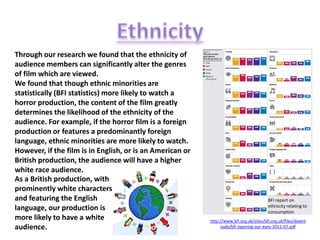
Through our research we found that the ethnicity of
audience members can significantly alter the genres
of film which are viewed.
We found that though ethnic minorities are
statistically (BFI statistics) more likely to watch a
horror production, the content of the film greatly
determines the likelihood of the ethnicity of the
audience. For example, if the horror film is a foreign
production or features a predominantly foreign
language, ethnic minorities are more likely to watch.
However, if the film is in English, or is an American or
British production, the audience will have a higher
white race audience.
http://www.bfi.org.uk/sites/bfi.org.uk/files/downl
oads/bfi-opening-our-eyes-2011-07.pdf
BFI report on
ethnicity relating to
consumption
As a British production, with
prominently white characters
and featuring the English
language, our production is
more likely to have a white
audience.
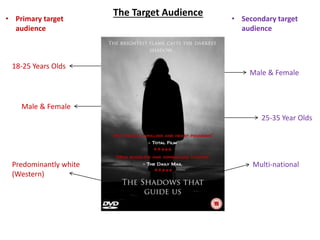
The Target Audience
• Primary target
audience
18-25 Years Olds
Male & Female
Predominantly white
(Western)
• Secondary target
audience
25-35 Year Olds
Male & Female
Multi-national

Question 4

  • 1.
    Who would bethe audience for your media product?
  • 2.
    The target audiencefor our production would most likely be 18-25 year olds, of both genders, who enjoy crime, drama and mystery genres. This conclusion can be reached due to our extensive surveys to different age ranges and genders, and our large host of research into the psychological horror genre and previous, similar productions. 25-35 40-50 18-2515-18
  • 3.
    Screenshot from research http://www.electricsheepmagazine.co.uk/features/20 11/03/28/do-women-prefer-psychological-horror/ Wefound, through our research, that women are stereotypically more likely to watch a psychological horror film, over an ‘ordinary’ horror film. This is due to the strange nature of psychological horrors and their ability to disguise themselves in the crime, mystery and drama genres, through their lack of blood, gore and ‘monsters’, that are so typically viewed within horror films. The decision of most psychological horrors to examine the psyche or “monsters” within the minds of men (sometimes revealing something more ‘supernatural’ within them), rather than the monsters that lurk in the realm of myth and fantasy, distinctively separates the psychological from its close ‘horror’ counterpart, and appeals to the stereotypically sensitive nature of the female gender. Through the genre’s lack of gore and monsters, its implementation of a typically female protagonist, its semblance of the drama and mystery genres, and also its much deeper and more complex storyline, the psychological genre has proven more popular with women. Through our surveys we also recorded evidence which suggested the female members of the audience in most of the age groups would be most likely to view a psychological horror film; supporting our audience research and broadening the spectrum of our target audience. http://03sarahsmith.blogspot.co.uk/2015/03/question naire-identifying-audience.html Audience research http://03sarahsmith.blogspot.co.uk/201 5/02/psychological-horrors.html
  • 4.
    Similarly however, thepsychological genre also appeals to men. While it may lack the intense blood and violence that stereotypically appeals to the male gender, its complexity, implementation of Laura Mulvey’s ‘Male Gaze’ theory, and also its use of rare (sometimes bloody) violence, all works to engage the male audience in an effective manner. Through our survey’s we found that a male audience was just as interested in our production as a female one, and through our research into audiences, the genre and theories we have determined that the intense emotional spectrum explored in psychological horrors supposedly appeals to a male audience as it allows them to explore emotions they would normally be reluctant to explore in reality. http://imlportfolio.usc.edu/ctcs505/mulveyVisualPleasure NarrativeCinema.pdf http://03sarahsmith.blogspot.co.uk/2015/03/questionnai re-identifying-audience.html The gore and violent scenes that are included in our production will also work to appeal to a stereotypically masculine audience, who enjoy watching fighting . http://03sarahsmith.blogspot.co.uk/2015/0 3/target-audience.html
  • 5.
    Through our survey’sand research of the genre, we quickly summarised that our production would most effectively appeal to a ‘maturer’ audience. This is due to the genre’s typically complex plotlines that some younger audiences struggle to follow, and its sometimes slow paced progression and lack of fast paced ‘action’ that fails to engage younger people. http://03sarahsmith.blogspot.co.uk/2015/03/questionnaire-identifying-audience.html It should also be noted that the majority of psychological horror productions have a age restriction of up to 15yrs, meaning our audience is limited to ages of 15 or above due to the conventional content of the production. Younger, teenage audiences also seem to show a preference for films with fast paced progression or comedic value; rather than slow paced, serious narratives – as are usually observed in horror.
  • 6.
    In contrast to15 to 18 year olds; the slowly progressing, suspenseful plotlines, occasional violence and unusual (sometimes controversial) antagonists, work to engage older audiences (18-25), though typically fails to engage a target audience over 30yrs, either due to the slow pace, violence or confusion creates by the plot line. We found through our audience research and surveys that 18-25 year olds were our target audience; showing the most interest towards horror/psychological horror, and demonstrating patience towards slow paced plotlines, and sometimes confusing content. 18-25 year olds seem to be mature enough to appreciate the content of a psychological horror, unlike younger audiences who show boredom when watching productions with lulls in ‘action’ or violence. What film genres are you most likely/unlikely to watch? What is the likelihood that you would watch a psychological horror film? http://03sarahsmith.blogspot.co.uk/2015/03/questionnaire-identifying-audience.html British Film Industry report on audiences
  • 7.
    While 25-35 yearsolds are ‘mature’ and patient enough to appreciate the content of a psychological horror film, this section of the public has shown a keener interest in genres like action, adventure, comedy, romance, and comic book – as shown in our surveys and audience research (utilising the British Film Industry to observe broader audience preferences). What film genres are you most likely/unlikely to watch? It should be noted however, that 25 to 35 year olds do show a solid interest in horror and psychological horror genres; though in contrast to the interest of 18- 25 years olds (our primary audience), their interest is less significant, making them a likely secondary audience.
  • 8.
    According to ouraudience research/surveys, 40 to 50 year olds tend to be the least interested in horror productions. This is possibly due to gradual desensitisation to things that may otherwise be considered ‘scary’ to younger audiences, or a loss of touch with modern conventions of horror. What film genres are you most likely/unlikely to watch? Through our audience research – predominantly through the British Film Industry website - we found that older audiences (usually 55 or older) were the least likely to view or be interested in large blockbuster productions, and instead showed a preference for independent British films. Due to this limitation, 40-50 year olds were not a part of our target audience. We found that despite the maturity of this section of the public, and their interest in more unique productions, they were less likely than our other age ranges to watch horror productions, or psychological horror films.
  • 9.
    Through our researchwe found that the ethnicity of audience members can significantly alter the genres of film which are viewed. We found that though ethnic minorities are statistically (BFI statistics) more likely to watch a horror production, the content of the film greatly determines the likelihood of the ethnicity of the audience. For example, if the horror film is a foreign production or features a predominantly foreign language, ethnic minorities are more likely to watch. However, if the film is in English, or is an American or British production, the audience will have a higher white race audience. http://www.bfi.org.uk/sites/bfi.org.uk/files/downl oads/bfi-opening-our-eyes-2011-07.pdf BFI report on ethnicity relating to consumption As a British production, with prominently white characters and featuring the English language, our production is more likely to have a white audience.
  • 10.
    The Target Audience •Primary target audience 18-25 Years Olds Male & Female Predominantly white (Western) • Secondary target audience 25-35 Year Olds Male & Female Multi-national