Media Theory and Theorists for G325 Section A:  Examining your own productions A2 Revision Session
G325a – Skills and Processes (Hands) Theory not needed explicitly, only if it crops up. Creativity and the DIKY triangle will help G325b – Concepts  (Head) Must use media theory/ theorists I have split them by area of relevance: Genre/ Narrative/ Representation/ Audience/ Media Language
What do you need to be able to do with theorists and theories? You do  NOT  need to: Learn a load of quotes Explain their theories in great depth Know them all You  DO  need to: Use a few Be able to apply them to your work/ case studies Consider how useful/ not useful they are when discussing your work/ case studies
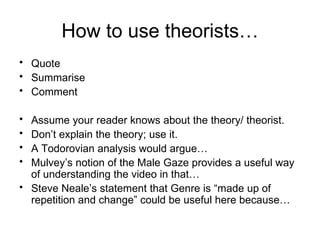
How to use theorists… Quote  Summarise Comment Assume your reader knows about the theory/ theorist. Don ’t explain the theory; use it. A Todorovian analysis would argue… Mulvey ’s notion of the Male Gaze provides a useful way of understanding the video in that… Steve Neale ’ s statement that Genre is  “ made up of repetition and change ” could be useful here because…
Some theorists you MIGHT be able to use
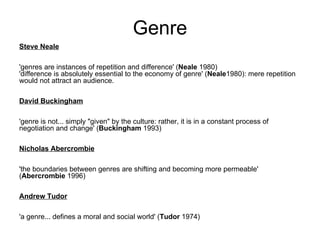
Genre Steve Neale 'genres are instances of repetition and difference' ( Neale  1980) 'difference is absolutely essential to the economy of genre' ( Neale 1980): mere repetition would not attract an audience. David Buckingham 'genre is not... simply "given" by the culture: rather, it is in a constant process of negotiation and change' ( Buckingham  1993) Nicholas Abercrombie 'the boundaries between genres are shifting and becoming more permeable' ( Abercrombie  1996) Andrew Tudor 'a genre... defines a moral and social world' ( Tudor  1974)
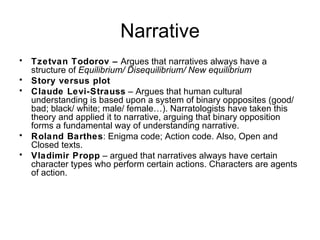
Narrative Tzetvan Todorov –  Argues that narratives always have a structure of  Equilibrium/ Disequilibrium/ New equilibrium Story versus plot Claude Levi-Strauss  – Argues that human cultural understanding is based upon a system of binary oppposites (good/ bad; black/ white; male/ female…). Narratologists have taken this theory and applied it to narrative, arguing that binary opposition forms a fundamental way of understanding narrative. Roland Barthes : Enigma code; Action code. Also, Open and Closed texts. Vladimir Propp  – argued that narratives always have certain character types who perform certain actions. Characters are agents of action.
Representation Laura Mulvey  – argues that cinema positions the audience as male. The camera gazes at the female object on screen. It also frames the male character watching the female. We watch the girl; we see the male watching the girl; we position ourselves within the text as a male objectively gazing at the female.  Can be applied to other media forms also. Hegemony (dominant ideology) Anyone from the Collective Identity powerpoint
Audience Stuart Hall : Encoding and Decoding; Preferred/ negotiated/ oppositional readings Denis McQuail  – Uses and Gratification theory (audiences consume media texts for Surveillance; Personal Identity; Peresnal Relationships; Escapism/ Diversion.
Media Language Any of the theorists from the previous slides

Question 1b general tips

  • 1.
    Media Theory andTheorists for G325 Section A: Examining your own productions A2 Revision Session
  • 2.
    G325a – Skillsand Processes (Hands) Theory not needed explicitly, only if it crops up. Creativity and the DIKY triangle will help G325b – Concepts (Head) Must use media theory/ theorists I have split them by area of relevance: Genre/ Narrative/ Representation/ Audience/ Media Language
  • 3.
    What do youneed to be able to do with theorists and theories? You do NOT need to: Learn a load of quotes Explain their theories in great depth Know them all You DO need to: Use a few Be able to apply them to your work/ case studies Consider how useful/ not useful they are when discussing your work/ case studies
  • 4.
    How to usetheorists… Quote Summarise Comment Assume your reader knows about the theory/ theorist. Don ’t explain the theory; use it. A Todorovian analysis would argue… Mulvey ’s notion of the Male Gaze provides a useful way of understanding the video in that… Steve Neale ’ s statement that Genre is “ made up of repetition and change ” could be useful here because…
  • 5.
    Some theorists youMIGHT be able to use
  • 6.
    Genre Steve Neale'genres are instances of repetition and difference' ( Neale  1980) 'difference is absolutely essential to the economy of genre' ( Neale 1980): mere repetition would not attract an audience. David Buckingham 'genre is not... simply "given" by the culture: rather, it is in a constant process of negotiation and change' ( Buckingham  1993) Nicholas Abercrombie 'the boundaries between genres are shifting and becoming more permeable' ( Abercrombie  1996) Andrew Tudor 'a genre... defines a moral and social world' ( Tudor  1974)
  • 7.
    Narrative Tzetvan Todorov– Argues that narratives always have a structure of Equilibrium/ Disequilibrium/ New equilibrium Story versus plot Claude Levi-Strauss – Argues that human cultural understanding is based upon a system of binary oppposites (good/ bad; black/ white; male/ female…). Narratologists have taken this theory and applied it to narrative, arguing that binary opposition forms a fundamental way of understanding narrative. Roland Barthes : Enigma code; Action code. Also, Open and Closed texts. Vladimir Propp – argued that narratives always have certain character types who perform certain actions. Characters are agents of action.
  • 8.
    Representation Laura Mulvey – argues that cinema positions the audience as male. The camera gazes at the female object on screen. It also frames the male character watching the female. We watch the girl; we see the male watching the girl; we position ourselves within the text as a male objectively gazing at the female. Can be applied to other media forms also. Hegemony (dominant ideology) Anyone from the Collective Identity powerpoint
  • 9.
    Audience Stuart Hall: Encoding and Decoding; Preferred/ negotiated/ oppositional readings Denis McQuail – Uses and Gratification theory (audiences consume media texts for Surveillance; Personal Identity; Peresnal Relationships; Escapism/ Diversion.
  • 10.
    Media Language Anyof the theorists from the previous slides