“GENRE IS A PRACTICAL
WAY OF CREATING A FILM,
FOR PEOPLE TO
UNDERSTAND.”
STEVE MCQUAIL
STEVE NEALE
“GENRE IS A REPETITION WITH AN UNDERLYING
PATTERN OF VARIATIONS.”
Steve Neale stated that genres have 5 terms of which your film could fit
under, these
include:
• Form Finding Itself
• Classic
• Stretching Boundaries
• Parody (A satirical film against a film that already exists).
• Homage (Out of respect of an unfortunate event, for example a patriotic
American film for the 9/11).
How does this link to Lunar Productions ‘ film: Crow’s Field?
In my opinion, our horror genre trailer/ film would typically fit in the classic
facet of
Steve Neale’s theory of 5 key terms. This is because we have researched
plenty of
previous horror films and make links as to how we can involve the best
features of
other scary film; to make ours match the genre (as it’s a difficult genre to
make an
impact). As a production group we have had to explore the features of a
classic horror
film and how they have developed from the classics to still go on to remain
scary.
Therefore ours is modern by still on the ‘classical’ lines.
STEVE NEALE
“DIFFERENCE IS ABSOLUTELY ESSENTIAL TO
THE ECONOMY OF GENRE.”
ROBERT STAN
“STEREOTYPICAL MINEFIELD.”
Robert Stan stated that genres are made up by critics and theorists, and
possibly a
film is just a film no matter what atmosphere or collection of features it has.
I disagree to this, because without genres as a title then production
companies would
find it hard to construct such in-depth films but still stay within the lines of
certain
feelings throughout their film. There is a reason a horror film remains and
is
consistently a horror film all through the duration of the film. This is
because it fits
under a genre and its been given a framework that brings together mise-en-
scene. I
think that not only is a genre a good framework to help production
companies but it’s
a good framework to enable an audience to choose to view a certain film,
so they
know what they’re getting themselves into as such.
RICK ALTMAN
Rick Altman said that within genres there are two steps or two choices:
1. Semantic Elements:
An example for a thriller may be the guns, urban landscapes, victims, stalkers…
Therefore the collection of props etc. within the film that create such an umbrella
term of a genre.
2. Syntactic Elements:
This includes the themes, plots arranging together to create a genre. However
this is much harder to read.
I think that both of these are crucial steps to creating a genre, also if these both
were concepts that were brought together as one whole theory or one whole
step then Rick Altman would have explained the notion and point of a genre,
ultimately. Looking more into his theory, Crow’s Field uses the semantic
elements of an autumn rural landscape, female-fragile victims, a witch that stalks
the lives of these victims. And for the Syntactic the theme of curiosity and
mysteriousness adds to our horror genre.
NARRATIVE THEORY
“A STORY SHOULD HAVE A
BEGINNING, A MIDDLE AND AN
END, BUT NOT NECESSARILY IN
THAT ORDER.”
JEAN LUC GODDARD
CLAUDE LEVI-STRAUSS
• Studied myths and legends.
• Narrative theories have a framework of binary opposites:
Example: Good Vs. Evil.
Crow’s Field has this aspect to a certain extent as we have an turned evil
spirit against a vulnerable, fragile and innocent young lady who is a naïve
student who just wants to explore new boundaries for her aspiring mind.
This is a basic example of Good Vs. Evil: and is very clearly shown; but it
could be contrasted that the witch was once a victim and still could be; she
is just consistently misunderstood, this is where the curiosity and mystery
comes from for the horror genre.
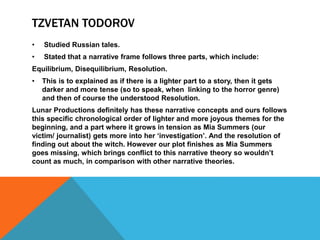
TZVETAN TODOROV
• Studied Russian tales.
• Stated that a narrative frame follows three parts, which include:
Equilibrium, Disequilibrium, Resolution.
• This is to explained as if there is a lighter part to a story, then it gets
darker and more tense (so to speak, when linking to the horror genre)
and then of course the understood Resolution.
Lunar Productions definitely has these narrative concepts and ours follows
this specific chronological order of lighter and more joyous themes for the
beginning, and a part where it grows in tension as Mia Summers (our
victim/ journalist) gets more into her ‘investigation’. And the resolution of
finding out about the witch. However our plot finishes as Mia Summers
goes missing, which brings conflict to this narrative theory so wouldn’t
count as much, in comparison with other narrative theories.
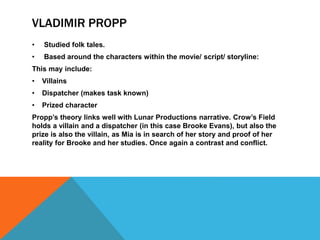
VLADIMIR PROPP
• Studied folk tales.
• Based around the characters within the movie/ script/ storyline:
This may include:
• Villains
• Dispatcher (makes task known)
• Prized character
Propp’s theory links well with Lunar Productions narrative. Crow’s Field
holds a villain and a dispatcher (in this case Brooke Evans), but also the
prize is also the villain, as Mia is in search of her story and proof of her
reality for Brooke and her studies. Once again a contrast and conflict.
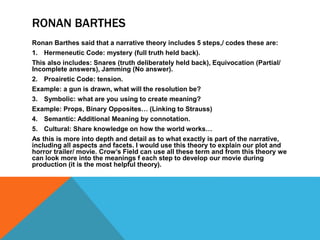
RONAN BARTHES
Ronan Barthes said that a narrative theory includes 5 steps,/ codes these are:
1. Hermeneutic Code: mystery (full truth held back).
This also includes: Snares (truth deliberately held back), Equivocation (Partial/
Incomplete answers), Jamming (No answer).
2. Proairetic Code: tension.
Example: a gun is drawn, what will the resolution be?
3. Symbolic: what are you using to create meaning?
Example: Props, Binary Opposites… (Linking to Strauss)
4. Semantic: Additional Meaning by connotation.
5. Cultural: Share knowledge on how the world works…
As this is more into depth and detail as to what exactly is part of the narrative,
including all aspects and facets. I would use this theory to explain our plot and
horror trailer/ movie. Crow’s Field can use all these term and from this theory we
can look more into the meanings f each step to develop our movie during
production (it is the most helpful theory).

Genre & Narrative Theory

  • 2.
    “GENRE IS APRACTICAL WAY OF CREATING A FILM, FOR PEOPLE TO UNDERSTAND.” STEVE MCQUAIL
  • 3.
    STEVE NEALE “GENRE ISA REPETITION WITH AN UNDERLYING PATTERN OF VARIATIONS.” Steve Neale stated that genres have 5 terms of which your film could fit under, these include: • Form Finding Itself • Classic • Stretching Boundaries • Parody (A satirical film against a film that already exists). • Homage (Out of respect of an unfortunate event, for example a patriotic American film for the 9/11).
  • 4.
    How does thislink to Lunar Productions ‘ film: Crow’s Field? In my opinion, our horror genre trailer/ film would typically fit in the classic facet of Steve Neale’s theory of 5 key terms. This is because we have researched plenty of previous horror films and make links as to how we can involve the best features of other scary film; to make ours match the genre (as it’s a difficult genre to make an impact). As a production group we have had to explore the features of a classic horror film and how they have developed from the classics to still go on to remain scary. Therefore ours is modern by still on the ‘classical’ lines. STEVE NEALE “DIFFERENCE IS ABSOLUTELY ESSENTIAL TO THE ECONOMY OF GENRE.”
  • 5.
    ROBERT STAN “STEREOTYPICAL MINEFIELD.” RobertStan stated that genres are made up by critics and theorists, and possibly a film is just a film no matter what atmosphere or collection of features it has. I disagree to this, because without genres as a title then production companies would find it hard to construct such in-depth films but still stay within the lines of certain feelings throughout their film. There is a reason a horror film remains and is consistently a horror film all through the duration of the film. This is because it fits under a genre and its been given a framework that brings together mise-en- scene. I think that not only is a genre a good framework to help production companies but it’s a good framework to enable an audience to choose to view a certain film, so they know what they’re getting themselves into as such.
  • 6.
    RICK ALTMAN Rick Altmansaid that within genres there are two steps or two choices: 1. Semantic Elements: An example for a thriller may be the guns, urban landscapes, victims, stalkers… Therefore the collection of props etc. within the film that create such an umbrella term of a genre. 2. Syntactic Elements: This includes the themes, plots arranging together to create a genre. However this is much harder to read. I think that both of these are crucial steps to creating a genre, also if these both were concepts that were brought together as one whole theory or one whole step then Rick Altman would have explained the notion and point of a genre, ultimately. Looking more into his theory, Crow’s Field uses the semantic elements of an autumn rural landscape, female-fragile victims, a witch that stalks the lives of these victims. And for the Syntactic the theme of curiosity and mysteriousness adds to our horror genre.
  • 7.
    NARRATIVE THEORY “A STORYSHOULD HAVE A BEGINNING, A MIDDLE AND AN END, BUT NOT NECESSARILY IN THAT ORDER.” JEAN LUC GODDARD
  • 8.
    CLAUDE LEVI-STRAUSS • Studiedmyths and legends. • Narrative theories have a framework of binary opposites: Example: Good Vs. Evil. Crow’s Field has this aspect to a certain extent as we have an turned evil spirit against a vulnerable, fragile and innocent young lady who is a naïve student who just wants to explore new boundaries for her aspiring mind. This is a basic example of Good Vs. Evil: and is very clearly shown; but it could be contrasted that the witch was once a victim and still could be; she is just consistently misunderstood, this is where the curiosity and mystery comes from for the horror genre.
  • 9.
    TZVETAN TODOROV • StudiedRussian tales. • Stated that a narrative frame follows three parts, which include: Equilibrium, Disequilibrium, Resolution. • This is to explained as if there is a lighter part to a story, then it gets darker and more tense (so to speak, when linking to the horror genre) and then of course the understood Resolution. Lunar Productions definitely has these narrative concepts and ours follows this specific chronological order of lighter and more joyous themes for the beginning, and a part where it grows in tension as Mia Summers (our victim/ journalist) gets more into her ‘investigation’. And the resolution of finding out about the witch. However our plot finishes as Mia Summers goes missing, which brings conflict to this narrative theory so wouldn’t count as much, in comparison with other narrative theories.
  • 10.
    VLADIMIR PROPP • Studiedfolk tales. • Based around the characters within the movie/ script/ storyline: This may include: • Villains • Dispatcher (makes task known) • Prized character Propp’s theory links well with Lunar Productions narrative. Crow’s Field holds a villain and a dispatcher (in this case Brooke Evans), but also the prize is also the villain, as Mia is in search of her story and proof of her reality for Brooke and her studies. Once again a contrast and conflict.
  • 11.
    RONAN BARTHES Ronan Barthessaid that a narrative theory includes 5 steps,/ codes these are: 1. Hermeneutic Code: mystery (full truth held back). This also includes: Snares (truth deliberately held back), Equivocation (Partial/ Incomplete answers), Jamming (No answer). 2. Proairetic Code: tension. Example: a gun is drawn, what will the resolution be? 3. Symbolic: what are you using to create meaning? Example: Props, Binary Opposites… (Linking to Strauss) 4. Semantic: Additional Meaning by connotation. 5. Cultural: Share knowledge on how the world works… As this is more into depth and detail as to what exactly is part of the narrative, including all aspects and facets. I would use this theory to explain our plot and horror trailer/ movie. Crow’s Field can use all these term and from this theory we can look more into the meanings f each step to develop our movie during production (it is the most helpful theory).