Genre and Narrative
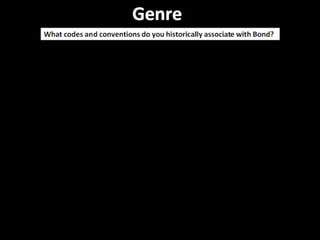
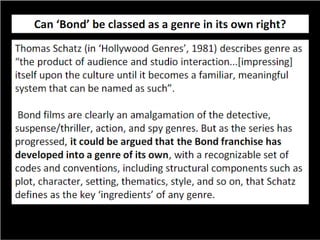
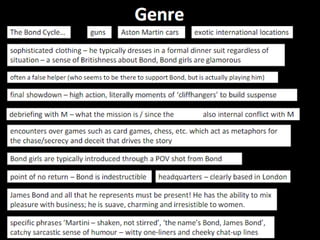
Genre
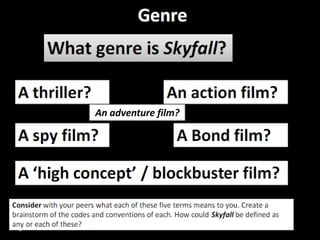
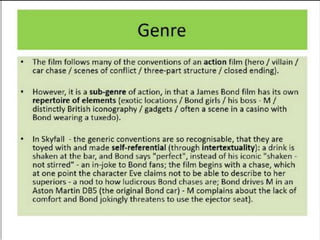
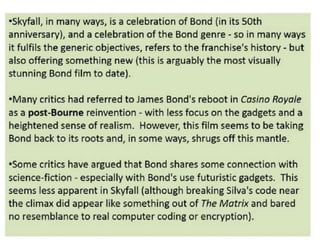
What genre is Skyfall?
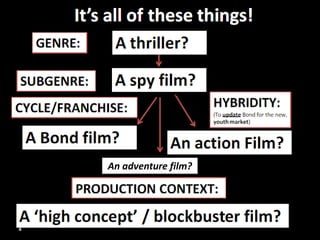
An adventure film?
An adventure film?
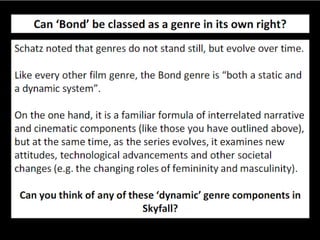
Genre Theory
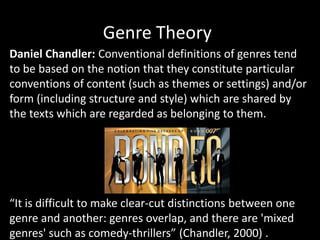
Daniel Chandler: Conventional definitions of genres tend
to be based on the notion that they constitute particular
conventions of content (such as themes or settings) and/or
form (including structure and style) which are shared by
the texts which are regarded as belonging to them.
“It is difficult to make clear-cut distinctions between one
genre and another: genres overlap, and there are 'mixed
genres' such as comedy-thrillers” (Chandler, 2000) .
It is easy to underplay the differences within a genre. Steve
Neale declares that 'genres are instances of repetition and
difference' (Neale 1980, 48). He adds that 'difference is
absolutely essential to the economy of genre': mere repetition
would not attract an audience.
Repertoire of Elements
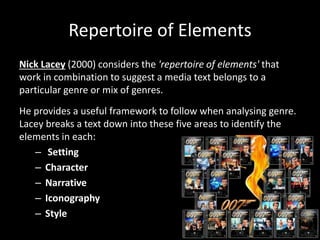
Nick Lacey (2000) considers the 'repertoire of elements' that
work in combination to suggest a media text belongs to a
particular genre or mix of genres.
He provides a useful framework to follow when analysing genre.
Lacey breaks a text down into these five areas to identify the
elements in each:
– Setting
– Character
– Narrative
– Iconography
– Style
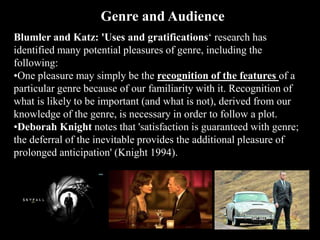
Blumler and Katz: 'Uses and gratifications‘ research has
identified many potential pleasures of genre, including the
following:
•One pleasure may simply be the recognition of the features of a
particular genre because of our familiarity with it. Recognition of
what is likely to be important (and what is not), derived from our
knowledge of the genre, is necessary in order to follow a plot.
•Deborah Knight notes that 'satisfaction is guaranteed with genre;
the deferral of the inevitable provides the additional pleasure of
prolonged anticipation' (Knight 1994).
Genre and Audience
A2 Media Skyfall Lesson 1 Genre

A2 Media Skyfall Lesson 1 Genre

  • 1.
  • 2.
  • 3.
  • 4.
  • 5.
    Genre Theory Daniel Chandler:Conventional definitions of genres tend to be based on the notion that they constitute particular conventions of content (such as themes or settings) and/or form (including structure and style) which are shared by the texts which are regarded as belonging to them. “It is difficult to make clear-cut distinctions between one genre and another: genres overlap, and there are 'mixed genres' such as comedy-thrillers” (Chandler, 2000) .
  • 6.
    It is easyto underplay the differences within a genre. Steve Neale declares that 'genres are instances of repetition and difference' (Neale 1980, 48). He adds that 'difference is absolutely essential to the economy of genre': mere repetition would not attract an audience.
  • 7.
    Repertoire of Elements NickLacey (2000) considers the 'repertoire of elements' that work in combination to suggest a media text belongs to a particular genre or mix of genres. He provides a useful framework to follow when analysing genre. Lacey breaks a text down into these five areas to identify the elements in each: – Setting – Character – Narrative – Iconography – Style
  • 8.
    Blumler and Katz:'Uses and gratifications‘ research has identified many potential pleasures of genre, including the following: •One pleasure may simply be the recognition of the features of a particular genre because of our familiarity with it. Recognition of what is likely to be important (and what is not), derived from our knowledge of the genre, is necessary in order to follow a plot. •Deborah Knight notes that 'satisfaction is guaranteed with genre; the deferral of the inevitable provides the additional pleasure of prolonged anticipation' (Knight 1994). Genre and Audience