By Megan Sellar
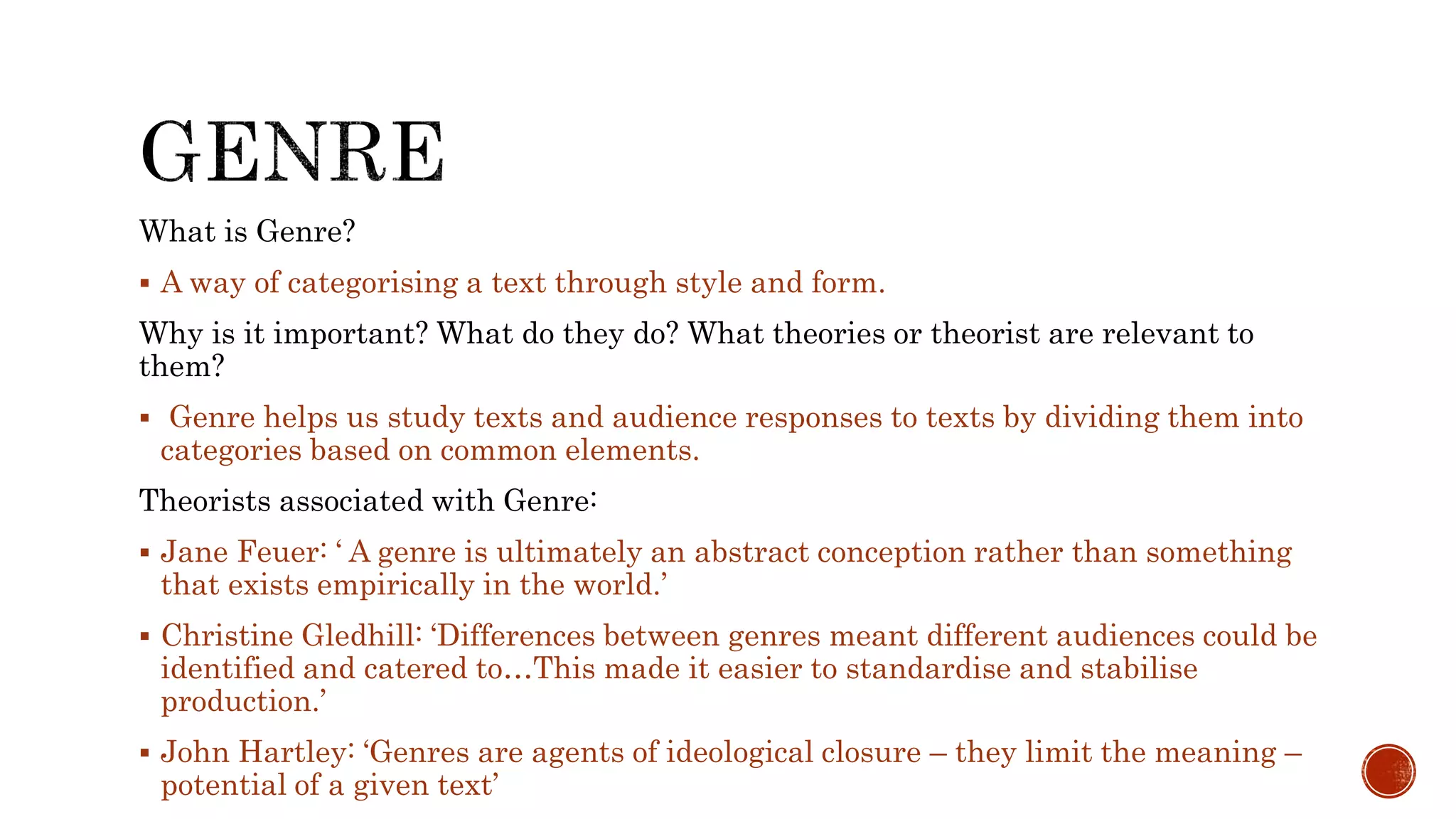
What is Genre?
 A way of categorising a text through style and form.
Why is it important? What do they do? What theories or theorist are relevant to
them?
 Genre helps us study texts and audience responses to texts by dividing them into
categories based on common elements.
Theorists associated with Genre:
 Jane Feuer: ‘ A genre is ultimately an abstract conception rather than something
that exists empirically in the world.’
 Christine Gledhill: ‘Differences between genres meant different audiences could be
identified and catered to…This made it easier to standardise and stabilise
production.’
 John Hartley: ‘Genres are agents of ideological closure – they limit the meaning –
potential of a given text’
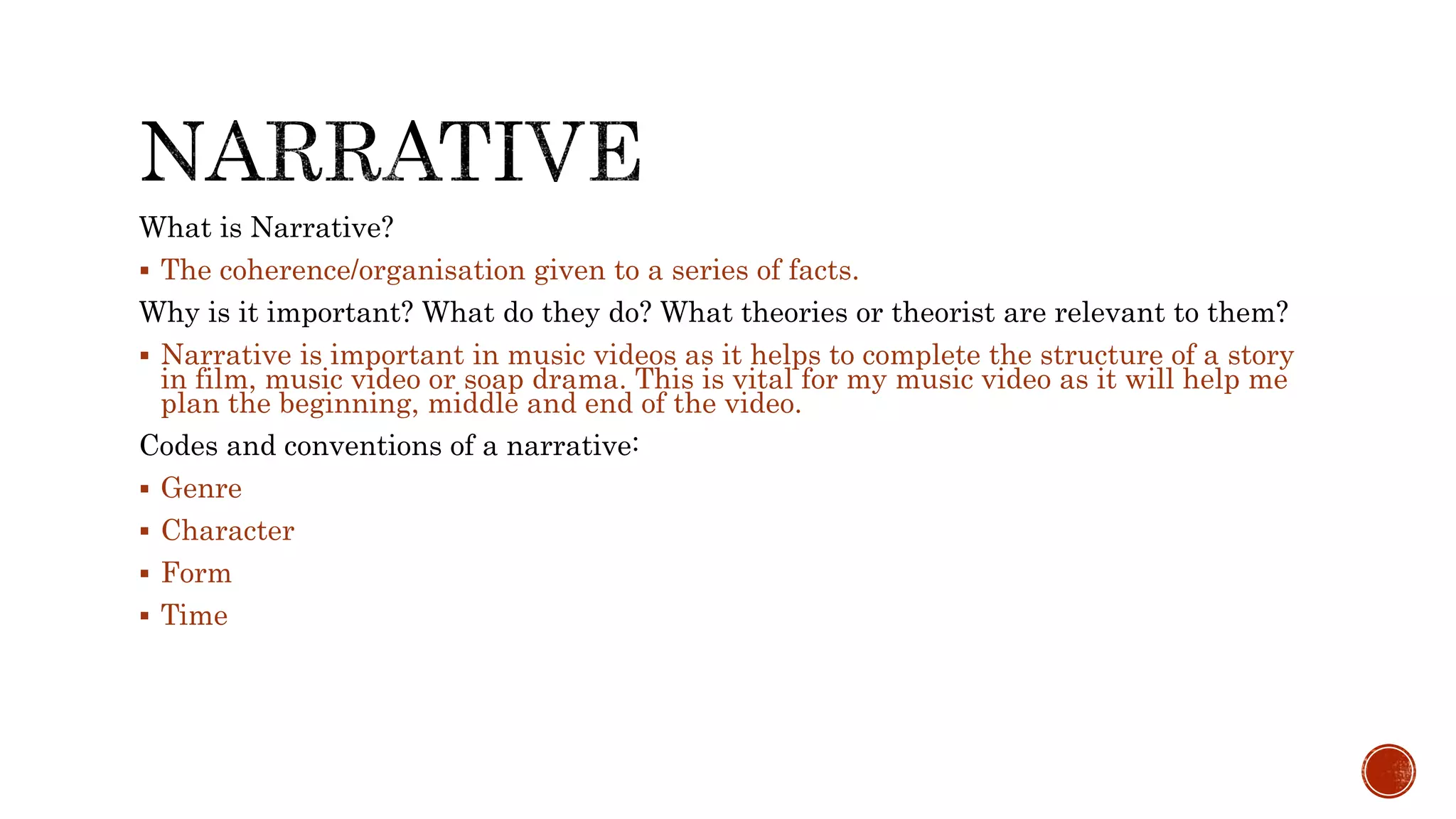
What is Narrative?
 The coherence/organisation given to a series of facts.
Why is it important? What do they do? What theories or theorist are relevant to them?
 Narrative is important in music videos as it helps to complete the structure of a story
in film, music video or soap drama. This is vital for my music video as it will help me
plan the beginning, middle and end of the video.
Codes and conventions of a narrative:
 Genre
 Character
 Form
 Time
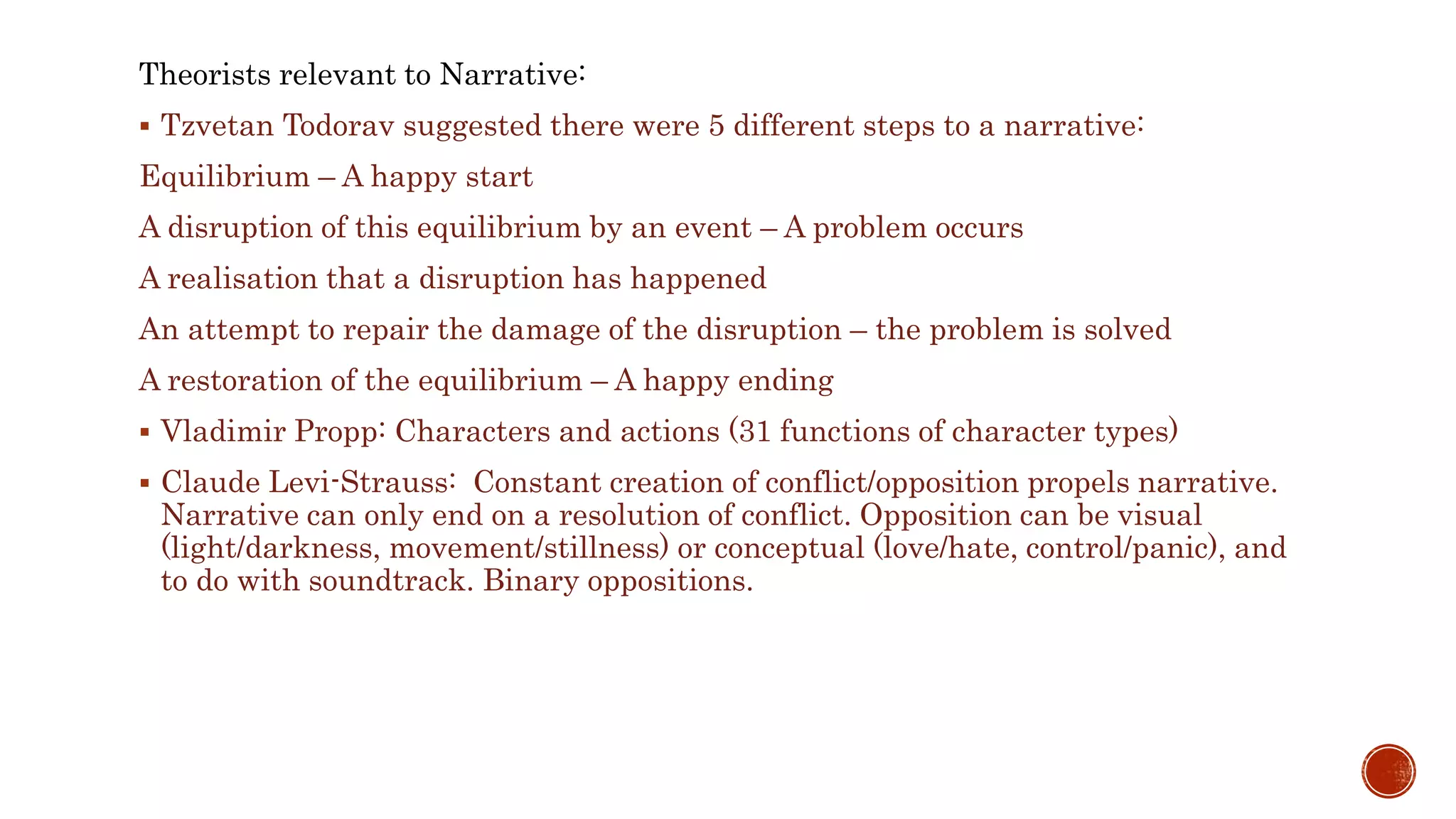
Theorists relevant to Narrative:
 Tzvetan Todorav suggested there were 5 different steps to a narrative:
Equilibrium – A happy start
A disruption of this equilibrium by an event – A problem occurs
A realisation that a disruption has happened
An attempt to repair the damage of the disruption – the problem is solved
A restoration of the equilibrium – A happy ending
 Vladimir Propp: Characters and actions (31 functions of character types)
 Claude Levi-Strauss: Constant creation of conflict/opposition propels narrative.
Narrative can only end on a resolution of conflict. Opposition can be visual
(light/darkness, movement/stillness) or conceptual (love/hate, control/panic), and
to do with soundtrack. Binary oppositions.
What is Representation?
 The description or portrayal of someone or something in a particular way.
Why is it important? What do they do? What theories or theorist are relevant to them?
 Representation is important as without the media, our perception of reality would be
very limited, and that we, as an audience, need these artificial texts to mediate our
view of the world, in other words we need the media to make sense of reality.
Therefore representation is a fluid, two-way process: producers position a text
somewhere in relation to reality and audiences assess a text on its relationship to
reality.
 Representations are also closely linked with stereotypes and semiotics.
 Representation is most commonly addressed by:
 Gender
 Race
 Age
 Disability
Theorists relevant to Representation:
 John Berger Ways Of Seeing (1972) : Men act and women appear. Women watch
themselves being looked at. Women are aware of being seen by a male spectator.
 David Chandler: Representation refers to the construction in any medium
(especially the mass media) of aspects of ‘reality’ such as people, places, objects,
events, cultural identities and other abstract concepts. Such representation may
be in speech or writing as well as still or moving pictures.
 Tessa Perkins (1979): Stereotyping of people is not always a simple process.
Perkins identified that stereotypes are not always negative and are not all about
minority groups or those less powerful. She also argues that if stereotypes were
always so simple then they would not work culturally and over time.
 Laura Mulvey: The Male Gaze
What is Audience?
 The readership of a newspaper, magazine, book or any other type of media.
Why is it important? What do they do? What theories or theorist are relevant to them?
 Audience is important as all media texts are constructed to a specific audience.
Theorists associated with Audience:
 The Uses and Gratifications theory: During the 1960s, as the first generation to grow
up with television became grown ups, it became increasingly apparent to media
theorists that audiences made choices about what they did when consuming texts. Far
from being a passive mass, audiences were made up of individuals who actively
consumed texts for different reasons and in different ways. In 1948 Lasswell suggested
that media texts had the following functions for individuals and society:
 surveillance
 correlation
 entertainment
 cultural transmission
 Reception theory: In the 1980s and 1990s a lot of work was done on the way
individuals received and interpreted a text, and how their individual
circumstances (gender, class, age, ethnicity) affected their reading. This work was
based on Stuart Hall's encoding/decoding model of the relationship between text
and audience - the text is encoded by the producer, and decoded by the reader, and
there may be major differences between two different readings of the same code.
However, by using recognised codes and conventions, and by drawing upon
audience expectations relating to aspects such as genre and use of stars, the
producers can position the audience and thus create a certain amount of
agreement on what the code means. This is known as a preferred reading.
What is Media language?
 Media conventions, formats, symbols and narrative structures which cue the audience to
meaning. He symbolic language of electronic media work much the same way as grammar
works in print media.
Examples of media language:
 Camera shots, angle, movement, composition: High angle, low angle, panning shot
 Mise-en-scene: lighting, props, costumes, setting
 Editing: shot reverse shot, cutaway, fade, zoom
 Sound: diegetic, non-diegetic, synchronous, asynchronous
Theorists relevant to Media language:
 Morley’s Research: Women tend to watch something else e.g. soaps. Men put full
focus onto watching films, sports and the news. If a media text attracts a wealthy
amount of people then it is likely to continue even if that percentage is small.
 Roland Barthes: Barthes came up with the idea of denotation and connotation
which is also similar to signifier and signified.
Denotation – what the object is
Connotation – an adjective before the word

Question 1B

  • 1.
  • 2.
    What is Genre? A way of categorising a text through style and form. Why is it important? What do they do? What theories or theorist are relevant to them?  Genre helps us study texts and audience responses to texts by dividing them into categories based on common elements. Theorists associated with Genre:  Jane Feuer: ‘ A genre is ultimately an abstract conception rather than something that exists empirically in the world.’  Christine Gledhill: ‘Differences between genres meant different audiences could be identified and catered to…This made it easier to standardise and stabilise production.’  John Hartley: ‘Genres are agents of ideological closure – they limit the meaning – potential of a given text’
  • 3.
    What is Narrative? The coherence/organisation given to a series of facts. Why is it important? What do they do? What theories or theorist are relevant to them?  Narrative is important in music videos as it helps to complete the structure of a story in film, music video or soap drama. This is vital for my music video as it will help me plan the beginning, middle and end of the video. Codes and conventions of a narrative:  Genre  Character  Form  Time
  • 4.
    Theorists relevant toNarrative:  Tzvetan Todorav suggested there were 5 different steps to a narrative: Equilibrium – A happy start A disruption of this equilibrium by an event – A problem occurs A realisation that a disruption has happened An attempt to repair the damage of the disruption – the problem is solved A restoration of the equilibrium – A happy ending  Vladimir Propp: Characters and actions (31 functions of character types)  Claude Levi-Strauss: Constant creation of conflict/opposition propels narrative. Narrative can only end on a resolution of conflict. Opposition can be visual (light/darkness, movement/stillness) or conceptual (love/hate, control/panic), and to do with soundtrack. Binary oppositions.
  • 5.
    What is Representation? The description or portrayal of someone or something in a particular way. Why is it important? What do they do? What theories or theorist are relevant to them?  Representation is important as without the media, our perception of reality would be very limited, and that we, as an audience, need these artificial texts to mediate our view of the world, in other words we need the media to make sense of reality. Therefore representation is a fluid, two-way process: producers position a text somewhere in relation to reality and audiences assess a text on its relationship to reality.  Representations are also closely linked with stereotypes and semiotics.  Representation is most commonly addressed by:  Gender  Race  Age  Disability
  • 6.
    Theorists relevant toRepresentation:  John Berger Ways Of Seeing (1972) : Men act and women appear. Women watch themselves being looked at. Women are aware of being seen by a male spectator.  David Chandler: Representation refers to the construction in any medium (especially the mass media) of aspects of ‘reality’ such as people, places, objects, events, cultural identities and other abstract concepts. Such representation may be in speech or writing as well as still or moving pictures.  Tessa Perkins (1979): Stereotyping of people is not always a simple process. Perkins identified that stereotypes are not always negative and are not all about minority groups or those less powerful. She also argues that if stereotypes were always so simple then they would not work culturally and over time.  Laura Mulvey: The Male Gaze
  • 7.
    What is Audience? The readership of a newspaper, magazine, book or any other type of media. Why is it important? What do they do? What theories or theorist are relevant to them?  Audience is important as all media texts are constructed to a specific audience. Theorists associated with Audience:  The Uses and Gratifications theory: During the 1960s, as the first generation to grow up with television became grown ups, it became increasingly apparent to media theorists that audiences made choices about what they did when consuming texts. Far from being a passive mass, audiences were made up of individuals who actively consumed texts for different reasons and in different ways. In 1948 Lasswell suggested that media texts had the following functions for individuals and society:  surveillance  correlation  entertainment  cultural transmission
  • 8.
     Reception theory:In the 1980s and 1990s a lot of work was done on the way individuals received and interpreted a text, and how their individual circumstances (gender, class, age, ethnicity) affected their reading. This work was based on Stuart Hall's encoding/decoding model of the relationship between text and audience - the text is encoded by the producer, and decoded by the reader, and there may be major differences between two different readings of the same code. However, by using recognised codes and conventions, and by drawing upon audience expectations relating to aspects such as genre and use of stars, the producers can position the audience and thus create a certain amount of agreement on what the code means. This is known as a preferred reading.
  • 9.
    What is Medialanguage?  Media conventions, formats, symbols and narrative structures which cue the audience to meaning. He symbolic language of electronic media work much the same way as grammar works in print media. Examples of media language:  Camera shots, angle, movement, composition: High angle, low angle, panning shot  Mise-en-scene: lighting, props, costumes, setting  Editing: shot reverse shot, cutaway, fade, zoom  Sound: diegetic, non-diegetic, synchronous, asynchronous
  • 10.
    Theorists relevant toMedia language:  Morley’s Research: Women tend to watch something else e.g. soaps. Men put full focus onto watching films, sports and the news. If a media text attracts a wealthy amount of people then it is likely to continue even if that percentage is small.  Roland Barthes: Barthes came up with the idea of denotation and connotation which is also similar to signifier and signified. Denotation – what the object is Connotation – an adjective before the word