BQ: what theorists can I use
in 1B?
The areas…
 Genre
 Narrative
 Representation
 Audience
 Media language
Representation
 Levi Strauss – often media texts represent characters in terms of binary
oppositions.
 Consider if you did this? If so how and why? What effects might it have on the
narrative, the audience etc?
 Laura Mulvey
 Women are objectified in the media.
 Looked at with the male gaze and seen as sex objects
 She said women have two roles, the virgin charcter or the whore = called the
‘Virgin/Whore dichotomy’.
 Consider if you can apply it to a construction? Did you conform or challenge the
ideas of representation?
 Propp
 Thoery of narrative suggests texts often represent characters as particular types to make
them identifiable to the audience.
 The hero (or protagonist)
 The villain (or antagonist) – works against the hero
 The dispatcher – the person who sends the hero on their quest
 The donor – prepares the hero or gives them a magic object
 The helper – helps the hero in their quest
 The blocker (or false hero) – attempts to thwart the hero
 The princess (and/or her father) - a sought-for person who exists as a goal to the hero
hero
RichardDyer Stereotypes
• Stereotype (first used asaterm by Walter
Lippmann in 1956)
• Hascome to be defined asanegative
representation or over-simplification ofa
category of people in agroup
• Dyer explains that stereotypes reinforceideas
of differences between people which are
natural – i.e. Criminals are represented aslow-
lifes, untrustworthy...
Counter argument –Tessa Perkins(1979)
• Stereotypes are not alwaysnegative
• Are not always about minoritygroups
• Stereotypes are not alwaysfalse
• Apply this toyour characters in your films
– E.g.What social group(s) do your characters
belong to? How is this madeclear?
– What agegroup do your characters belong to (e.g.
Nervous, unsure teenagers...)
Ferdinand de Saussure-
Semiotics
• Meaning is constructed through the
interpretation of signs.
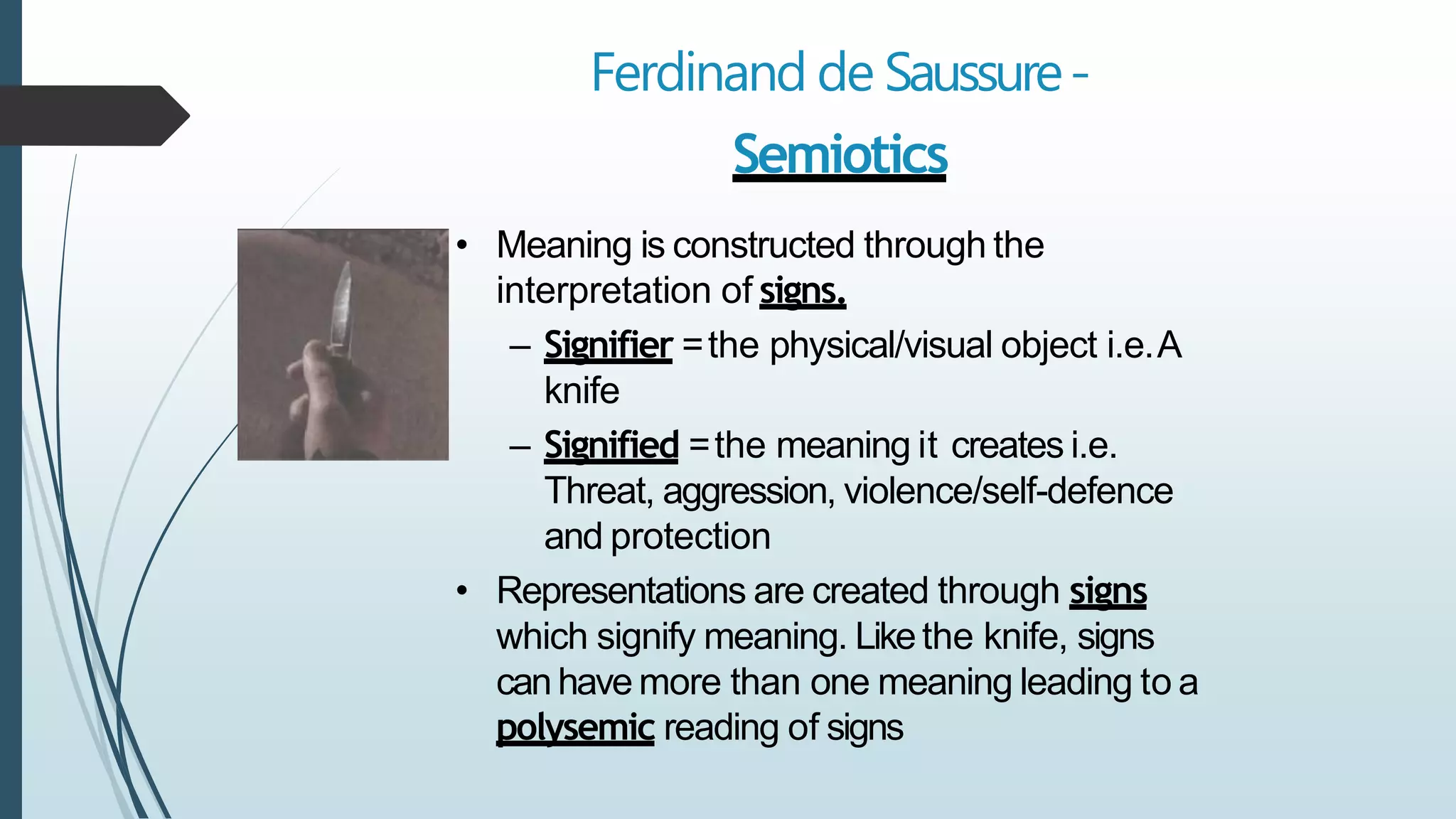
– Signifier =the physical/visual object i.e.A
knife
– Signified =the meaning it creates i.e.
Threat, aggression, violence/self-defence
and protection
• Representations are created through signs
which signify meaning. Likethe knife, signs
can have more than one meaning leading to a
polysemic reading of signs
Other things to consider… How it represents
that character
 Camera shots
 Mise-en-scene
 Editing
 Sound
 You could also consider location and how it represents the genre…
Narrative
• Equilibrium theory – TzvetanTodorov
-Equilibrium, disruption, recognition, attempt torepair,
new equilibrium.
• Binary Opposition – Claude Levi-Strauss
-Contrast or opposites
• Linear/non linear – chronological vs non
• Abstract, narrative, performance and hybrid – (music
video)
• Vladimir Propp – 7 characters
• Roland Barthes – enigma codes, semiotic, action,
cultural, symbolic
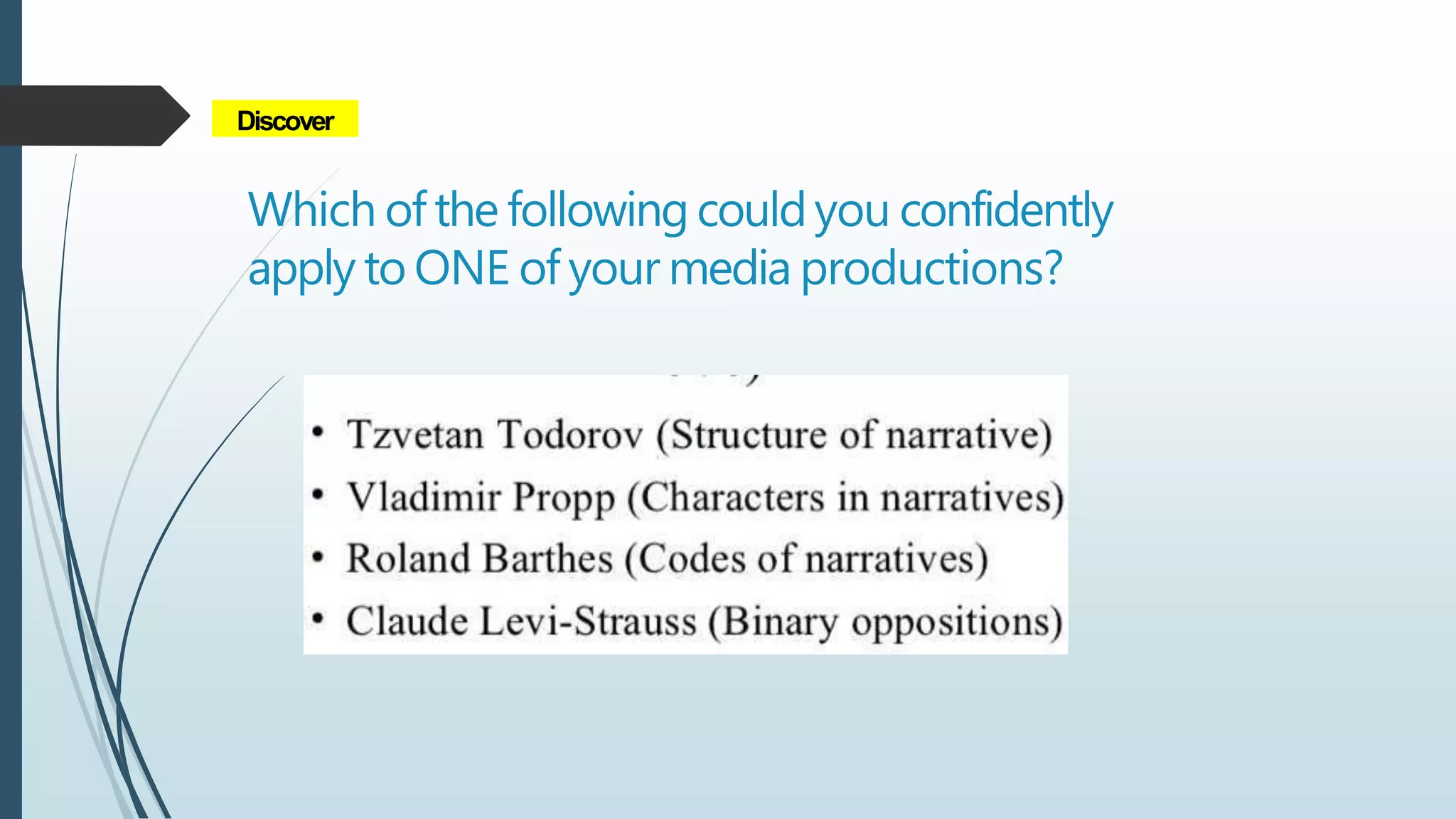
Which of the followingcouldyou confidently
apply to ONE of your media productions?
Discover
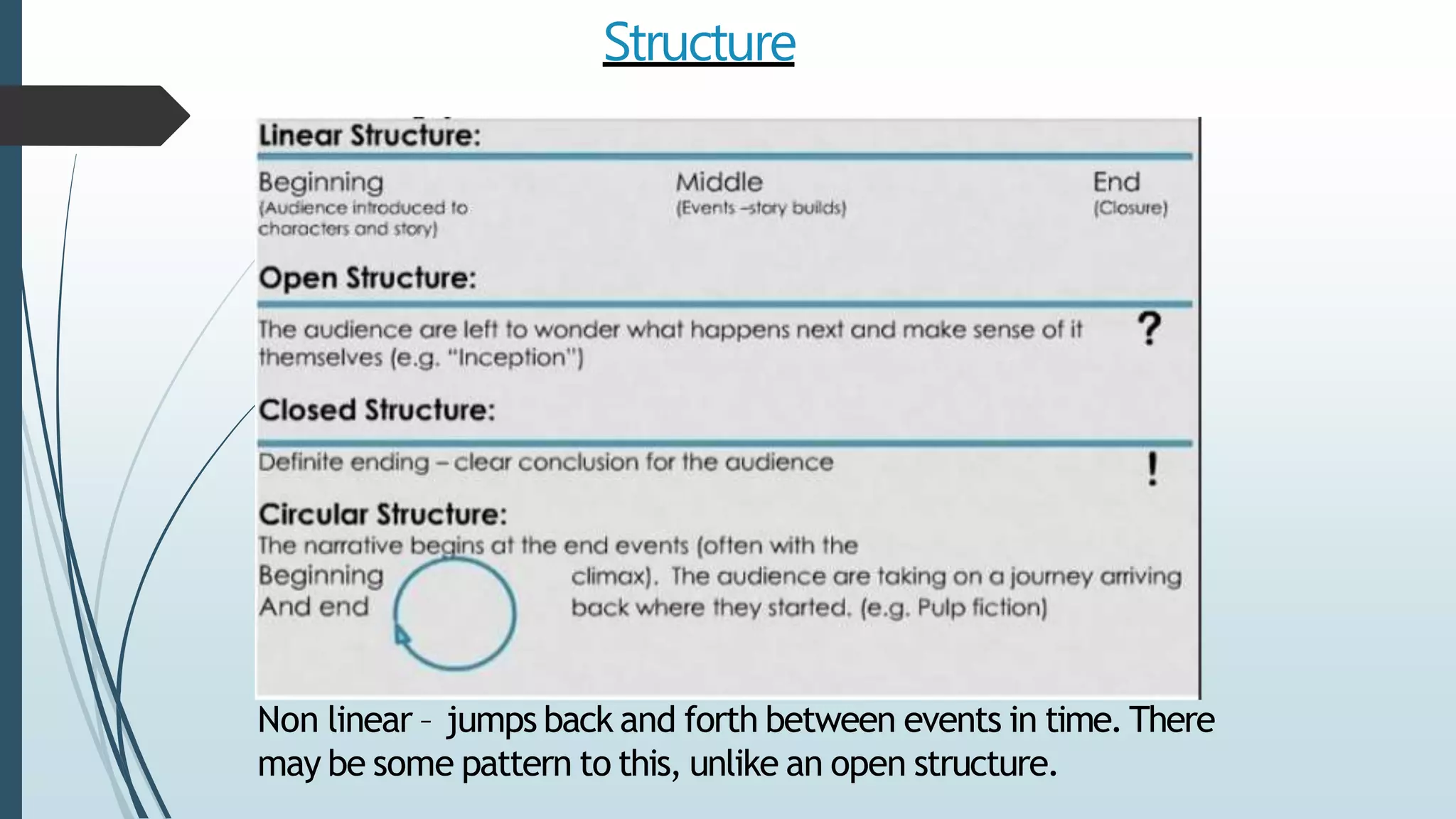
Structure
Non linear – jumps back and forth between events in time. There
may be some pattern to this, unlike an open structure.
• Structuralism:Abelief that there is structure
in all things – that items within a certain
paradigm (a class of elements with
similarities) follow specificpatterns.
Ferdinandde Saussure
5 codes- activate the reader to make sense of 'narrative'
or meaning within atext:
- action code- meaning of specific words, actionsor
looks
- enigma code- puzzles set up to be solved by audience
- the semiccode- the connotations ofa
character/place/object
- the symboliccode- metaphor or figureof
representation
- culturalcode- connections to the world outsidethe
text
Roland Barthes
Binaryopposition
focusing on the different sets of opposite values
which reveal the structure of the media texts.
Claude Levi-Strauss
Media Language
Importance of medialanguage
• Every medium has its own ‘language’ –
or combination of languages – that it
uses to communicate meaning.
• We call these ‘languages’ because
they use familiar codes and
conventions that are generally
understood.
Blumler and Katz
 Uses and Gratifications - It is suggested that the uses and gratifications theory has
to fulfil one the following when we choose a form of media:
 Identify- being able to recognise the product or person in front of you, role
models that reflect similar values to yours, aspiration to be someone else.
 Educate - being able to acquire information, knowledge and understanding
 Entertain – What you are consuming should give you enjoyment and also some
form of ‘escapism’ enabling us to forget our worries temporarily.
 Social Interaction – the ability for media products to produce a topic of
conversation between other people, sparks debates (etc who is left on the x-factor)
Stuart Hall
 Your decision to use media language you chose was to create a ‘preferred reading’
for your text.
 However audiences are used to encoding and decoding texts and could take a
different reading.
Rick Altman
 How you have used media language to include semantic elements
 E.G. Signs such as knives, blood, dark colours, eerie music
 Or
 To signify SYNTACTIC elements (themes like love, revenge)
Propp
 How you have used media language to helps audiences identify particular
characters as heros/ villains etc.
Denotation and Connotation
• In Semiotics, denotation and
connotation are terms describing the
relationship between the signifier (the
‘object’ or what is shown) and its
signified (what the object means) .
• Barthes (1977) argued that in film
connotation can be (analytically)
distinguished from denotation.
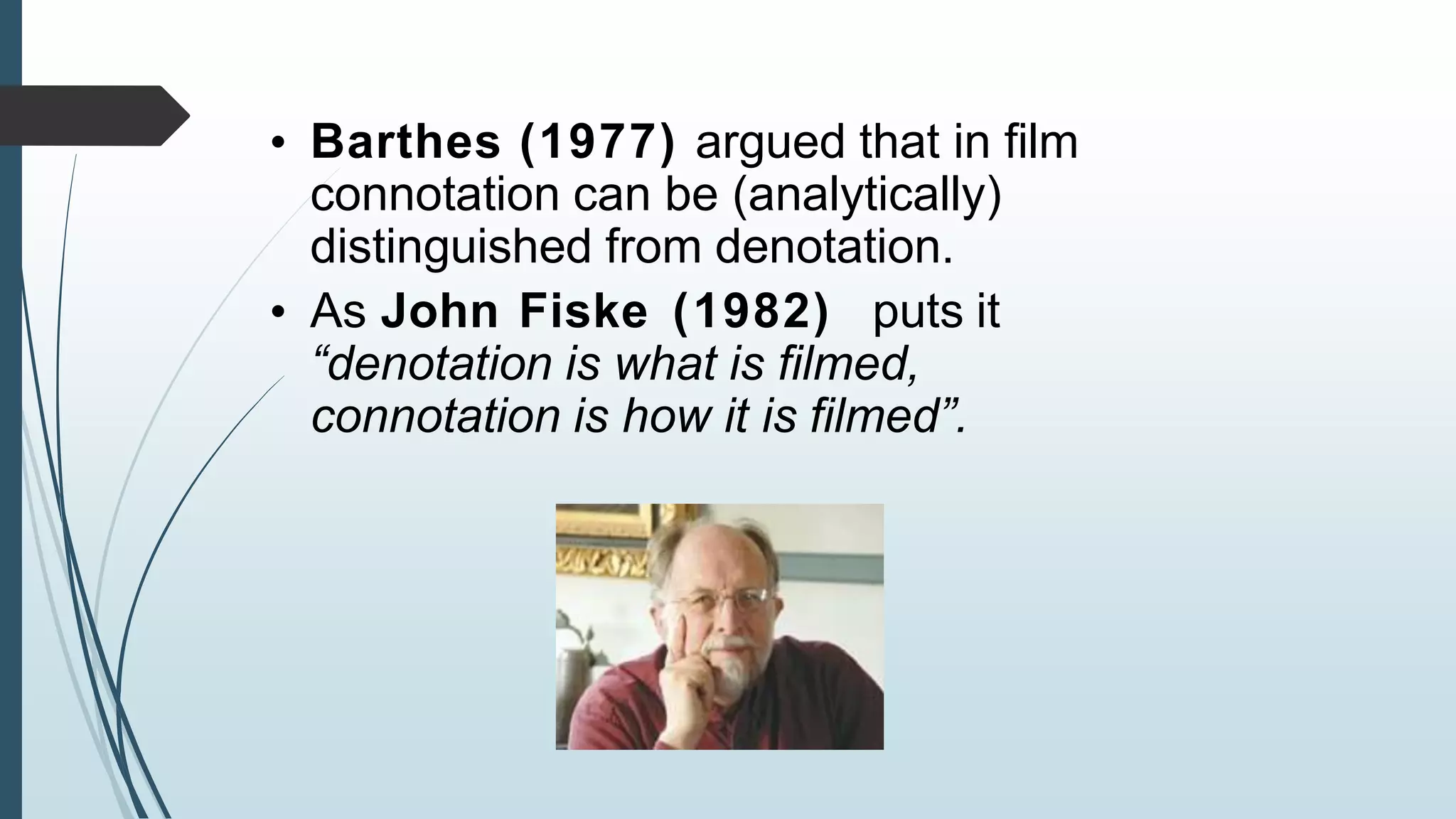
• As John Fiske (1982) puts it
“denotation is what is filmed,
connotation is how it is filmed”.
Makingconnections?
• Evaluating media language is an
evaluation of all micro elements and
how they have created meaning to
inform us about genre, narrative,
representations/ ideology, targeting
of audiences.
• This requires us to use semiotic
terminology to explain our encoding of
elements and codes and conventions
within our texts.
• You can also make reference to Stuart Hall
(dominate/ negotiated/ oppositional
reading)
Audience
Richard Dyer
 Thinks that audiences want media products that offer them Utopian Solutions to
their problems
Blumler and Katz
 Think that audiences want media products that gratify particular needs (Uses &
gratifications) eg escape, entertainment etc
Frankfurt School
Hypodermic needle theory. Think audiences might be directly
influenced by media products
Stuart Hall
Encoding and Decoding tests AND Preferred,
negotiated and oppositional readings. Thinks
audiences will react in different ways to media
products.
Andrew Goodwin
Believes that audiences are often played in the
position of a voyeur within music videos (watching
someone). He also believes that the use of close ups
is important to help the audience appreciate the “star
persona” of the lead singer
Laura Mulvey
 Believes the media texts often encourage the audience to
objectify women and look at them with a “male gaze”
Genre
Basic Definition of Genre - Daniel
Chandler
 Conventional definitions of genres tend to be based on the idea that they are
made up of particular conventions (such as themes or settings - iconography)
and/or form (including narrative structure and visual style) and all text of the
same genre will share these conventions.
 Think about the common elements of the genre opening and Music Videos
Rick Altman argues that genres are usually defined in terms of media language
and codes (in the Thriller, for example: guns, urban landscape, victims, stalkers,
menaced women or even stars, like Leonardo Dicaprio or Jack Nicholson) or
certain ideologies and narratives ( Anxiety, tension, menacing situation)
Jonathan Culler – generic conventions exist to establish a contract between
creator and reader so as to make certain expectations effective, allowing
compliance and deviation from the accepted modes. We understand films
because we understand the generic conventions
Steve Neale (1990) argues that Hollywood’s generic regime performs two
important functions: i) to guarantee meanings and pleasures for audiences ii) to
offset the considerable economic risks of industrial film production by allowing
Institutions be make films they know will be popular (cognitive collateral against
against innovation and difference.)
But he also said 'genres are instances of repetition and difference'
Genre Theorists
Andrew Goodwin
 Thinks that music videos follow the following conventions:
 Conventions depend on the genre of the music
 Star persona is important and companies use close ups to sell them to the
audience
 Voyeuristic images are used to attract an audience
 They often contain intertextual references to other media
 There is a link between the lyrics and the visuals
 There is a link between the visuals and the music / pace etc
Steve Neale
 Steve Neale thinks that film genres are constantly changing and evolving and are
not set in stone. He thinks there are 5 main stages in film genres. Which stage
does your film fit into? Explain why.
 The form finding itself (Psycho)
 The classic (Halloween)
 Stretching the boundaries of the genre (Nightmare on Elm Street)
 Parody (Scary Movie)
 Homage (Scream)
 Robert Stam – suggests genre is hard to define, doesn’t really exist and is just a
concept made up by theorists and critics. Do you agree? Give examples from your
work that suggests that genre either IS or ISN’T easy to define
 Rick Altman says that the way we define a genre is by two main things:
 Semantic Elements (eg signs such as knives, blood, dark colours, eerie music). He
thinks these elements are easier for audiences to recognise and identify
 Syntactic elements (includes THEMES such as fear, revenge, rage as well as plots
such as PLOTS such as group go on trip, one by one they die, last girl survives and
kills killer) He thinks these elements are more subtle and harder to recognise.
 Identify semantic and syntactic elements in your video that might help audiences
identify the genre of your film / music video

Theorist overview

  • 1.
    BQ: what theoristscan I use in 1B?
  • 2.
    The areas…  Genre Narrative  Representation  Audience  Media language
  • 3.
    Representation  Levi Strauss– often media texts represent characters in terms of binary oppositions.  Consider if you did this? If so how and why? What effects might it have on the narrative, the audience etc?
  • 4.
     Laura Mulvey Women are objectified in the media.  Looked at with the male gaze and seen as sex objects  She said women have two roles, the virgin charcter or the whore = called the ‘Virgin/Whore dichotomy’.  Consider if you can apply it to a construction? Did you conform or challenge the ideas of representation?
  • 5.
     Propp  Thoeryof narrative suggests texts often represent characters as particular types to make them identifiable to the audience.  The hero (or protagonist)  The villain (or antagonist) – works against the hero  The dispatcher – the person who sends the hero on their quest  The donor – prepares the hero or gives them a magic object  The helper – helps the hero in their quest  The blocker (or false hero) – attempts to thwart the hero  The princess (and/or her father) - a sought-for person who exists as a goal to the hero hero
  • 6.
    RichardDyer Stereotypes • Stereotype(first used asaterm by Walter Lippmann in 1956) • Hascome to be defined asanegative representation or over-simplification ofa category of people in agroup • Dyer explains that stereotypes reinforceideas of differences between people which are natural – i.e. Criminals are represented aslow- lifes, untrustworthy...
  • 7.
    Counter argument –TessaPerkins(1979) • Stereotypes are not alwaysnegative • Are not always about minoritygroups • Stereotypes are not alwaysfalse • Apply this toyour characters in your films – E.g.What social group(s) do your characters belong to? How is this madeclear? – What agegroup do your characters belong to (e.g. Nervous, unsure teenagers...)
  • 8.
    Ferdinand de Saussure- Semiotics •Meaning is constructed through the interpretation of signs. – Signifier =the physical/visual object i.e.A knife – Signified =the meaning it creates i.e. Threat, aggression, violence/self-defence and protection • Representations are created through signs which signify meaning. Likethe knife, signs can have more than one meaning leading to a polysemic reading of signs
  • 9.
    Other things toconsider… How it represents that character  Camera shots  Mise-en-scene  Editing  Sound  You could also consider location and how it represents the genre…
  • 10.
    Narrative • Equilibrium theory– TzvetanTodorov -Equilibrium, disruption, recognition, attempt torepair, new equilibrium. • Binary Opposition – Claude Levi-Strauss -Contrast or opposites • Linear/non linear – chronological vs non • Abstract, narrative, performance and hybrid – (music video) • Vladimir Propp – 7 characters • Roland Barthes – enigma codes, semiotic, action, cultural, symbolic
  • 11.
    Which of thefollowingcouldyou confidently apply to ONE of your media productions? Discover
  • 12.
    Structure Non linear –jumps back and forth between events in time. There may be some pattern to this, unlike an open structure.
  • 13.
    • Structuralism:Abelief thatthere is structure in all things – that items within a certain paradigm (a class of elements with similarities) follow specificpatterns. Ferdinandde Saussure
  • 14.
    5 codes- activatethe reader to make sense of 'narrative' or meaning within atext: - action code- meaning of specific words, actionsor looks - enigma code- puzzles set up to be solved by audience - the semiccode- the connotations ofa character/place/object - the symboliccode- metaphor or figureof representation - culturalcode- connections to the world outsidethe text Roland Barthes
  • 15.
    Binaryopposition focusing on thedifferent sets of opposite values which reveal the structure of the media texts. Claude Levi-Strauss
  • 16.
  • 17.
    Importance of medialanguage •Every medium has its own ‘language’ – or combination of languages – that it uses to communicate meaning. • We call these ‘languages’ because they use familiar codes and conventions that are generally understood.
  • 18.
    Blumler and Katz Uses and Gratifications - It is suggested that the uses and gratifications theory has to fulfil one the following when we choose a form of media:  Identify- being able to recognise the product or person in front of you, role models that reflect similar values to yours, aspiration to be someone else.  Educate - being able to acquire information, knowledge and understanding  Entertain – What you are consuming should give you enjoyment and also some form of ‘escapism’ enabling us to forget our worries temporarily.  Social Interaction – the ability for media products to produce a topic of conversation between other people, sparks debates (etc who is left on the x-factor)
  • 19.
    Stuart Hall  Yourdecision to use media language you chose was to create a ‘preferred reading’ for your text.  However audiences are used to encoding and decoding texts and could take a different reading.
  • 20.
    Rick Altman  Howyou have used media language to include semantic elements  E.G. Signs such as knives, blood, dark colours, eerie music  Or  To signify SYNTACTIC elements (themes like love, revenge)
  • 21.
    Propp  How youhave used media language to helps audiences identify particular characters as heros/ villains etc.
  • 22.
    Denotation and Connotation •In Semiotics, denotation and connotation are terms describing the relationship between the signifier (the ‘object’ or what is shown) and its signified (what the object means) .
  • 23.
    • Barthes (1977)argued that in film connotation can be (analytically) distinguished from denotation. • As John Fiske (1982) puts it “denotation is what is filmed, connotation is how it is filmed”.
  • 24.
    Makingconnections? • Evaluating medialanguage is an evaluation of all micro elements and how they have created meaning to inform us about genre, narrative, representations/ ideology, targeting of audiences. • This requires us to use semiotic terminology to explain our encoding of elements and codes and conventions within our texts. • You can also make reference to Stuart Hall (dominate/ negotiated/ oppositional reading)
  • 25.
  • 26.
    Richard Dyer  Thinksthat audiences want media products that offer them Utopian Solutions to their problems
  • 27.
    Blumler and Katz Think that audiences want media products that gratify particular needs (Uses & gratifications) eg escape, entertainment etc
  • 28.
    Frankfurt School Hypodermic needletheory. Think audiences might be directly influenced by media products
  • 29.
    Stuart Hall Encoding andDecoding tests AND Preferred, negotiated and oppositional readings. Thinks audiences will react in different ways to media products.
  • 30.
    Andrew Goodwin Believes thataudiences are often played in the position of a voyeur within music videos (watching someone). He also believes that the use of close ups is important to help the audience appreciate the “star persona” of the lead singer
  • 31.
    Laura Mulvey  Believesthe media texts often encourage the audience to objectify women and look at them with a “male gaze”
  • 32.
  • 33.
    Basic Definition ofGenre - Daniel Chandler  Conventional definitions of genres tend to be based on the idea that they are made up of particular conventions (such as themes or settings - iconography) and/or form (including narrative structure and visual style) and all text of the same genre will share these conventions.  Think about the common elements of the genre opening and Music Videos
  • 34.
    Rick Altman arguesthat genres are usually defined in terms of media language and codes (in the Thriller, for example: guns, urban landscape, victims, stalkers, menaced women or even stars, like Leonardo Dicaprio or Jack Nicholson) or certain ideologies and narratives ( Anxiety, tension, menacing situation) Jonathan Culler – generic conventions exist to establish a contract between creator and reader so as to make certain expectations effective, allowing compliance and deviation from the accepted modes. We understand films because we understand the generic conventions Steve Neale (1990) argues that Hollywood’s generic regime performs two important functions: i) to guarantee meanings and pleasures for audiences ii) to offset the considerable economic risks of industrial film production by allowing Institutions be make films they know will be popular (cognitive collateral against against innovation and difference.) But he also said 'genres are instances of repetition and difference' Genre Theorists
  • 35.
    Andrew Goodwin  Thinksthat music videos follow the following conventions:  Conventions depend on the genre of the music  Star persona is important and companies use close ups to sell them to the audience  Voyeuristic images are used to attract an audience  They often contain intertextual references to other media  There is a link between the lyrics and the visuals  There is a link between the visuals and the music / pace etc
  • 36.
    Steve Neale  SteveNeale thinks that film genres are constantly changing and evolving and are not set in stone. He thinks there are 5 main stages in film genres. Which stage does your film fit into? Explain why.  The form finding itself (Psycho)  The classic (Halloween)  Stretching the boundaries of the genre (Nightmare on Elm Street)  Parody (Scary Movie)  Homage (Scream)
  • 37.
     Robert Stam– suggests genre is hard to define, doesn’t really exist and is just a concept made up by theorists and critics. Do you agree? Give examples from your work that suggests that genre either IS or ISN’T easy to define  Rick Altman says that the way we define a genre is by two main things:  Semantic Elements (eg signs such as knives, blood, dark colours, eerie music). He thinks these elements are easier for audiences to recognise and identify  Syntactic elements (includes THEMES such as fear, revenge, rage as well as plots such as PLOTS such as group go on trip, one by one they die, last girl survives and kills killer) He thinks these elements are more subtle and harder to recognise.  Identify semantic and syntactic elements in your video that might help audiences identify the genre of your film / music video