Understanding Genre
   An approach to popular film
Face Value

• At face value, genre doesn’t seem to be a
  very tricky concept at all.
• From the French word for “type”, we all
  know that it simply refers to a type of text.
• We’re all very used to categories like
  Western, Horror, Rom-Com, etc.
Why Genre Theory?
Why Genre Theory?
•   When Film Studies first started, the dominant
    theoretical approach was in terms of directors as
    “authors” of films: auteur theory.
Why Genre Theory?
•   When Film Studies first started, the dominant
    theoretical approach was in terms of directors as
    “authors” of films: auteur theory.

•   But in 1948 there were 2051 films released, 392
    of which were comedies – were they all created
    by auteurs?
Why Genre Theory?
•   When Film Studies first started, the dominant
    theoretical approach was in terms of directors as
    “authors” of films: auteur theory.

•   But in 1948 there were 2051 films released, 392
    of which were comedies – were they all created
    by auteurs?

•   Genre theory sought to recognise film as an
    industrial and commercial medium as well as an
    art form.
Do we need a theory of
         Genre?
• The first question raised by Daniel
  Chandler in his Introduction to Genre
  Theory introduces a real stumbling block:
 • Do genres exist independently of
    analysis?
 • Is there a finite number of genres, or
    are they potentially endless?
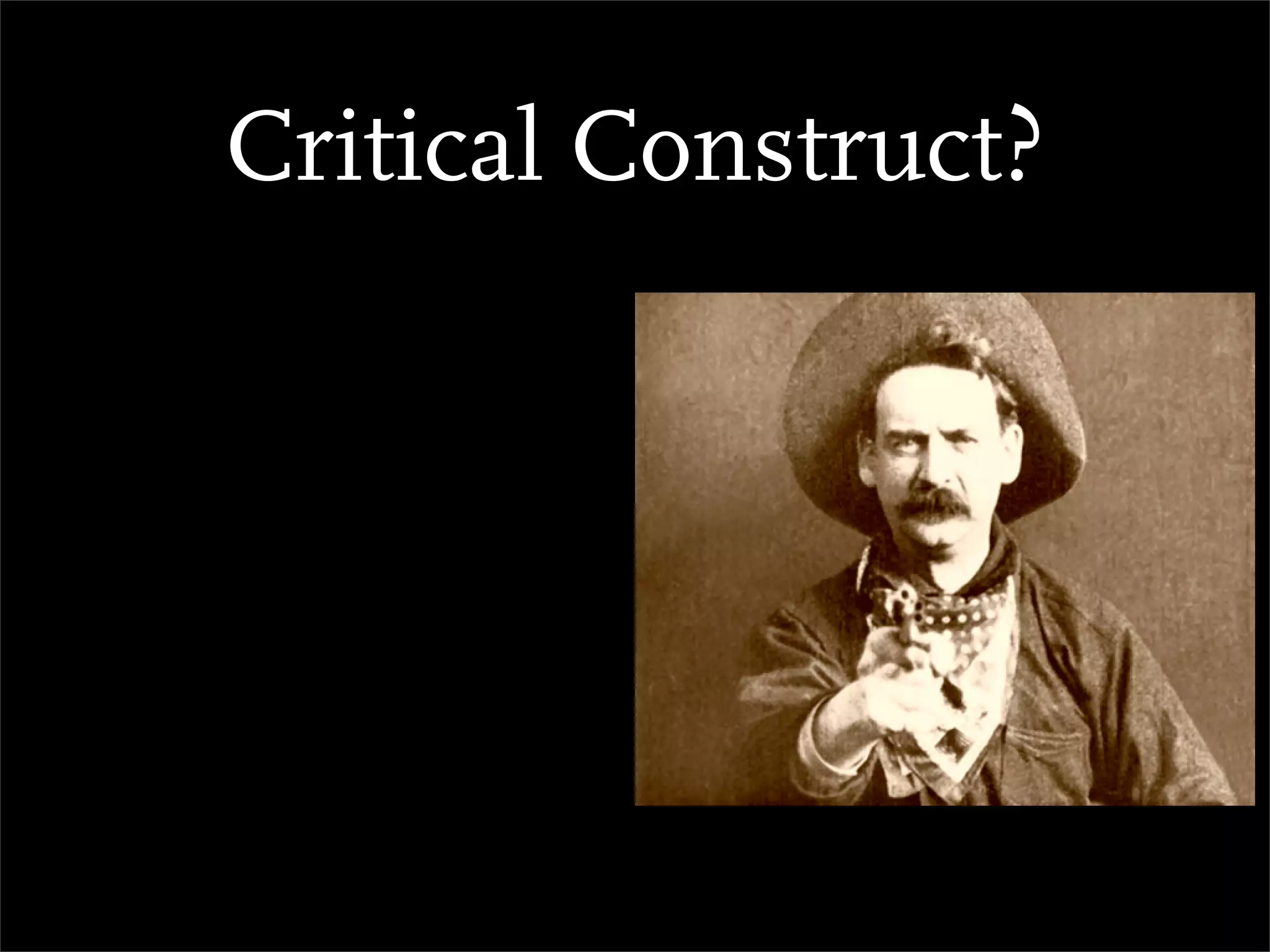
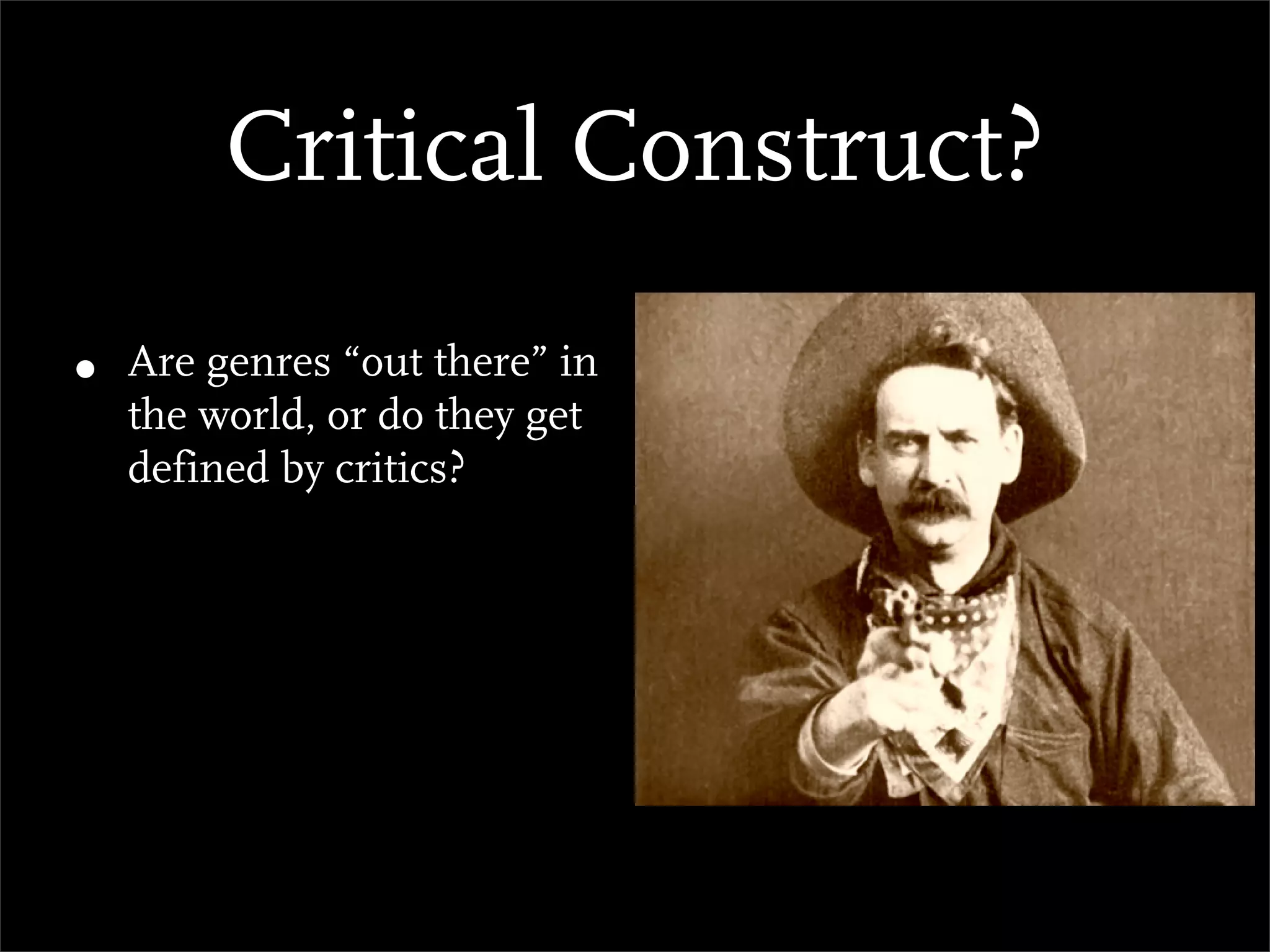
Critical Construct?
Critical Construct?
•   Are genres “out there” in
    the world, or do they get
    defined by critics?
Critical Construct?
•   Are genres “out there” in
    the world, or do they get
    defined by critics?

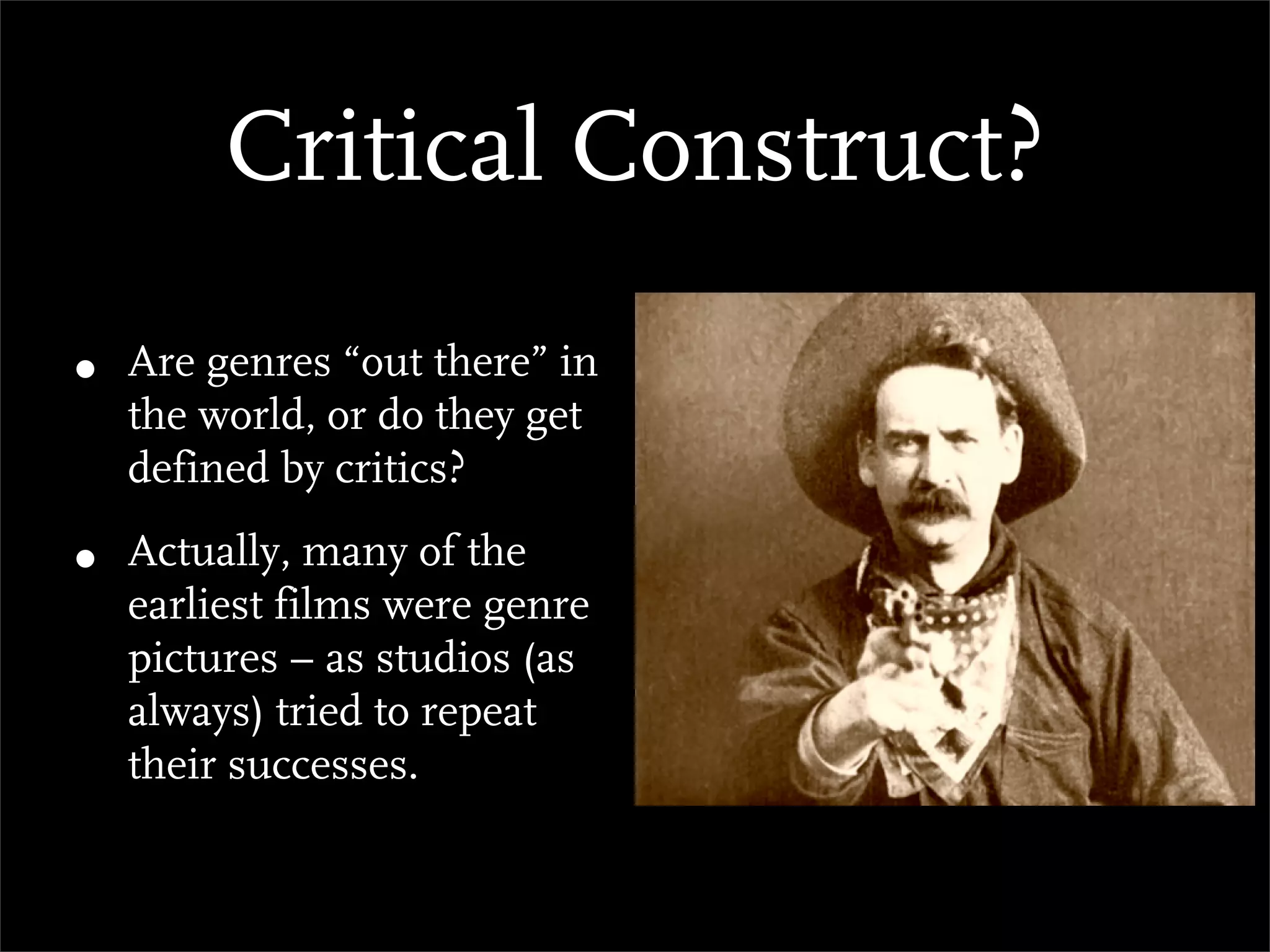
•   Actually, many of the
    earliest films were genre
    pictures – as studios (as
    always) tried to repeat
    their successes.
Types of Text
• Genres differ between fields. Literary
  genres are different from theatrical genres,
  which are different from film genres, etc.

• Science Fiction literature is very different
  from film and TV (so-called) science
  fiction, for example. A Horror novel
  follows different conventions to a Horror
  film.
Shakespeare


• Tragedies, Comedies, Histories
• E.g. Hamlet, The Taming of the Shrew,
  Henry V.
Film
•   There are many more film genres than there are
    Shakespearian genres.

•   Listings magazines, newspapers, web sites etc.
    routinely use recognisable categories like
    Thriller, Action, Romantic Comedy, Road Movie,
    Disaster Movie and various hybrid genres
    including Period Drama, Crime Drama, Horror
    Comedy etc.
But is it a genre at all?

• One person’s genre is another’s thematic
  grouping or mode.
• There could be as many ways of
  categorising films as there are critics.
• Then there are sub-genres, hybrid genres,
  and cycles...
Groupings


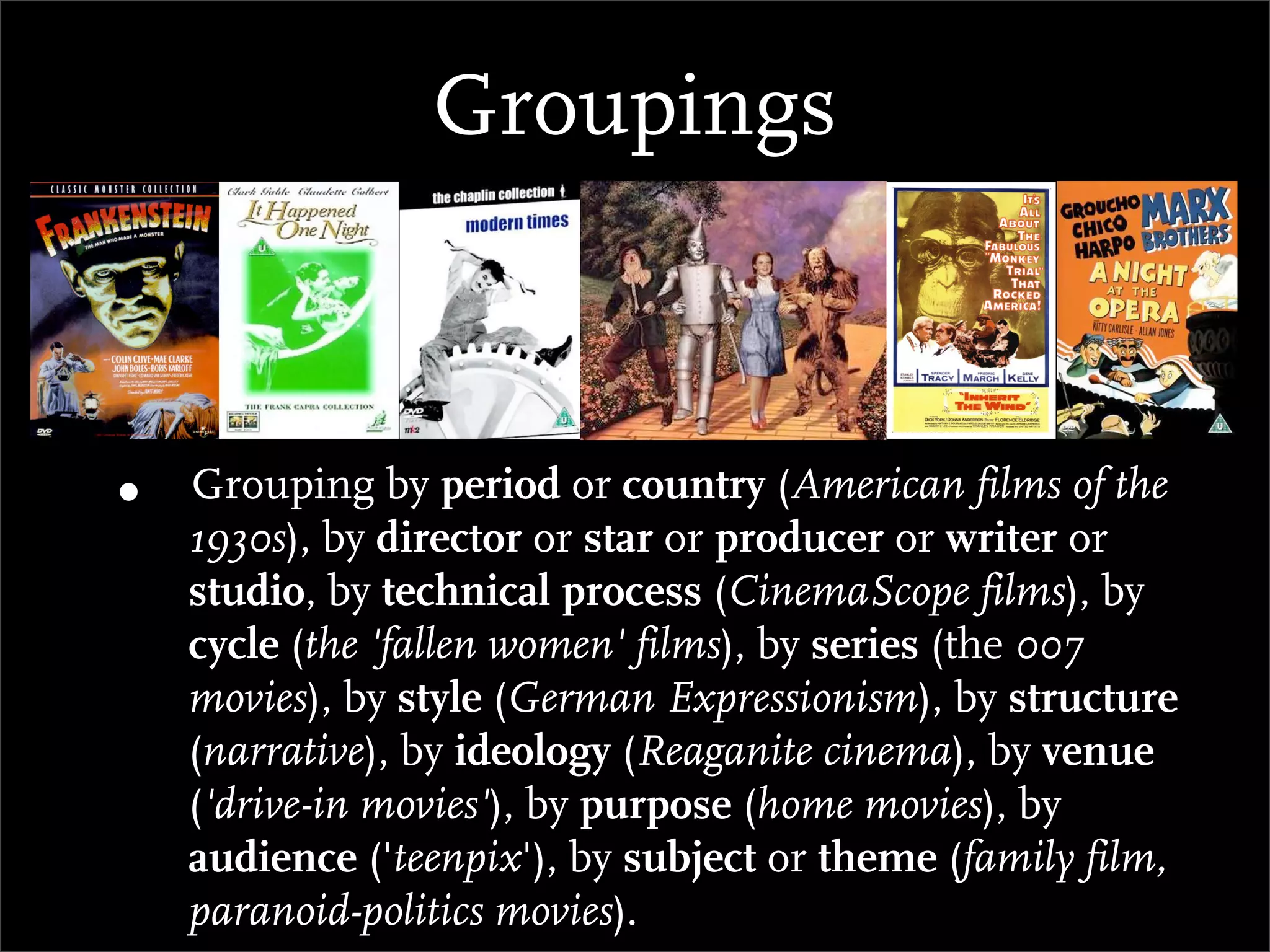
•   Grouping by period or country (American films of the
    1930s), by director or star or producer or writer or
    studio, by technical process (CinemaScope films), by
    cycle (the 'fallen women' films), by series (the 007
    movies), by style (German Expressionism), by structure
    (narrative), by ideology (Reaganite cinema), by venue
    ('drive-in movies'), by purpose (home movies), by
    audience ('teenpix'), by subject or theme (family film,
    paranoid-politics movies).
Still more...

•   While some genres are based on story content
    (the war film), other are borrowed from
    literature (comedy, melodrama) or from other
    media (the musical). Some are performer-based
    (the Astaire-Rogers films) or budget-based
    (blockbusters, indie), while others are based on
    artistic status (the art film), racial identity (Black
    cinema), location (the Western) or sexual
    orientation (Queer cinema).
Form vs. Content
•   A common-sense definition of genre is to say
    that it constitutes a group of films based on
    certain conventions of content and/or form.

•   Content might refer to themes and settings


•   Form might refer to structure and style


•   Alternatively, some critics talk about external
    form vs. internal form.
Inside Outside


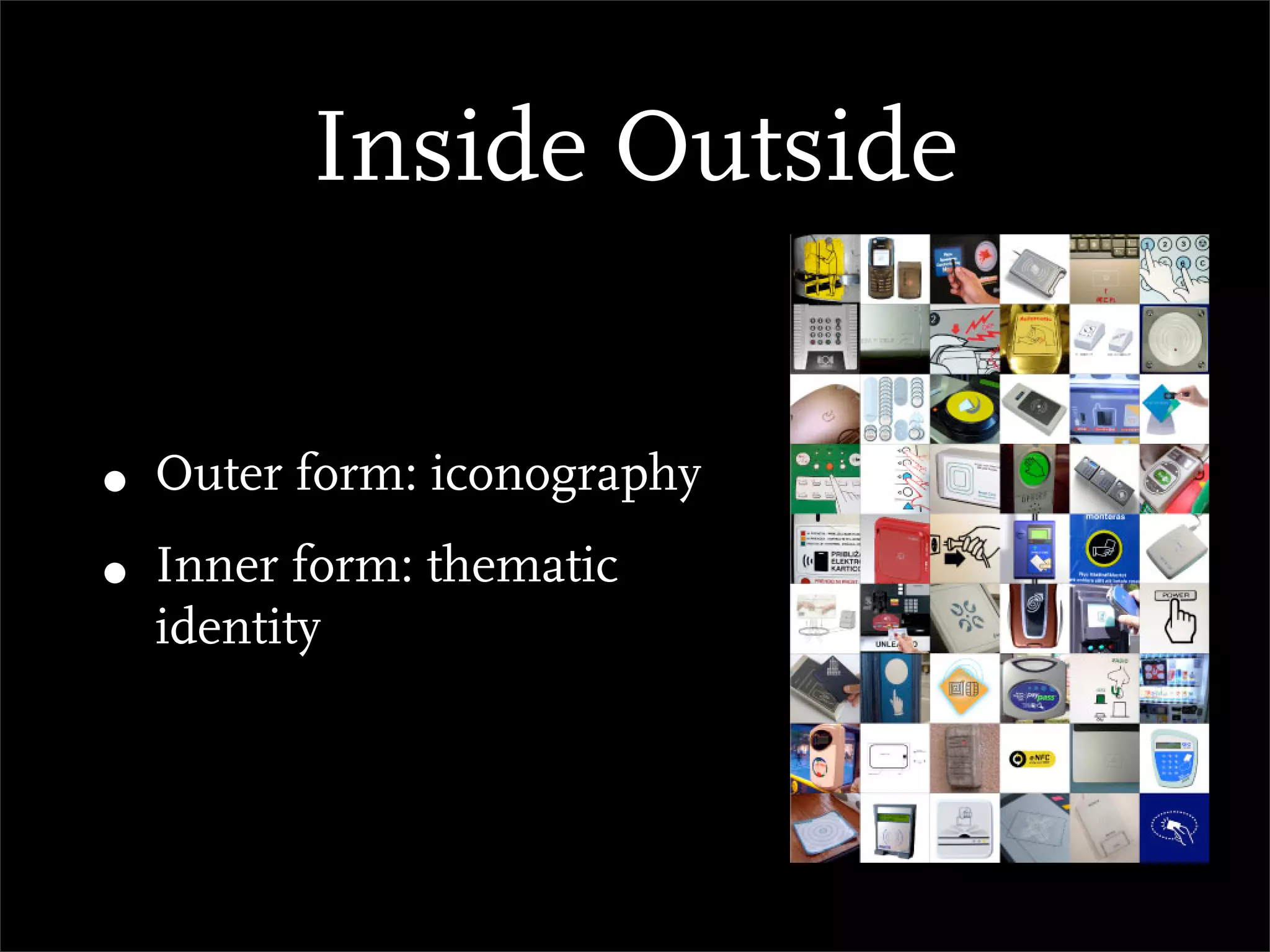
• Outer form: iconography
• Inner form: thematic
  identity
Simple?

•   But what happens to a film that fits one genre
    based on theme/setting, but another based on
    form?

•   Or one based on thematic identity and another
    on iconography?

•   Example...?
Star Trek
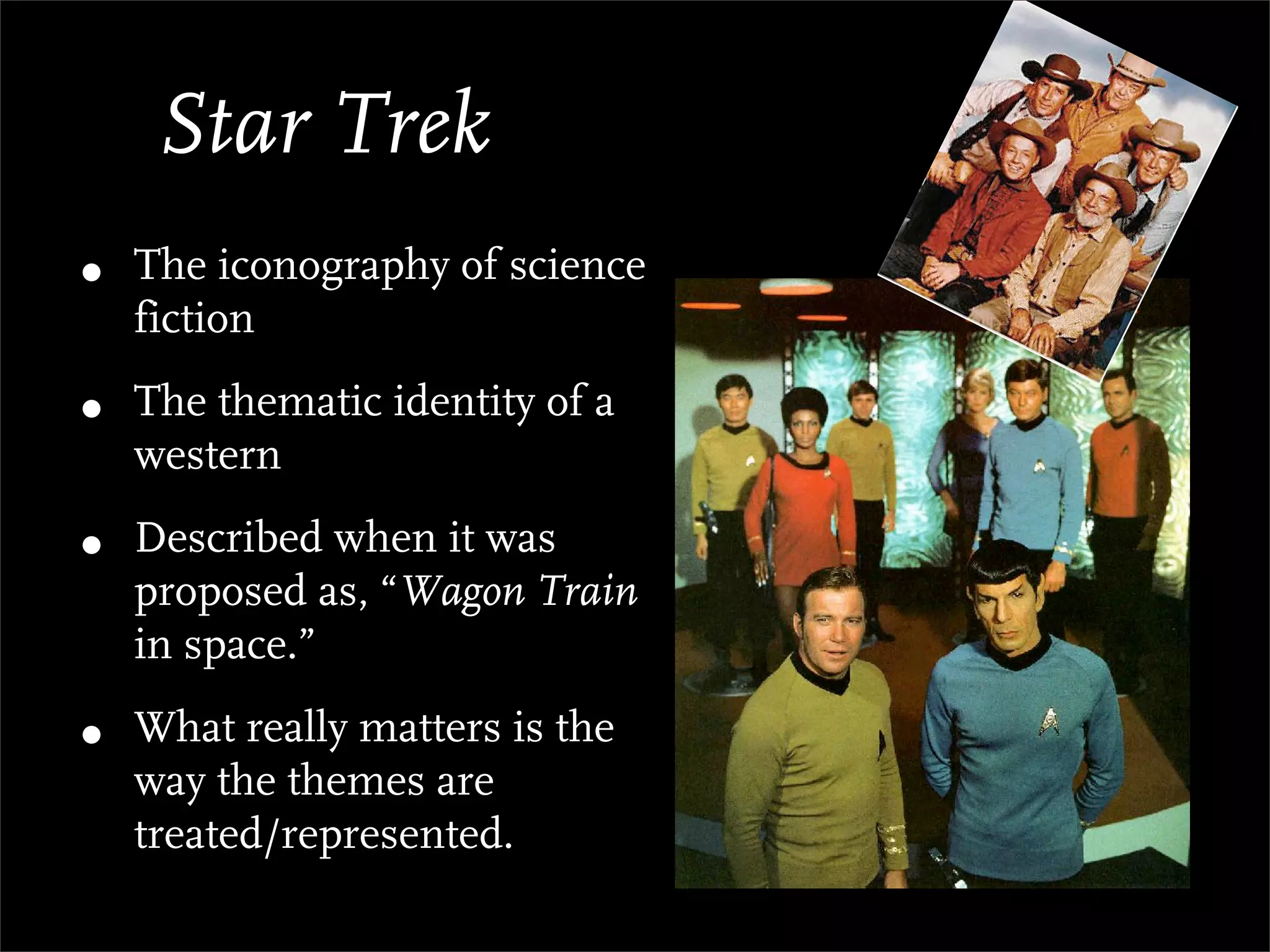
•   The iconography of science
    fiction

•   The thematic identity of a
    western

•   Described when it was
    proposed as, “Wagon Train
    in space.”

•   What really matters is the
    way the themes are
    treated/represented.
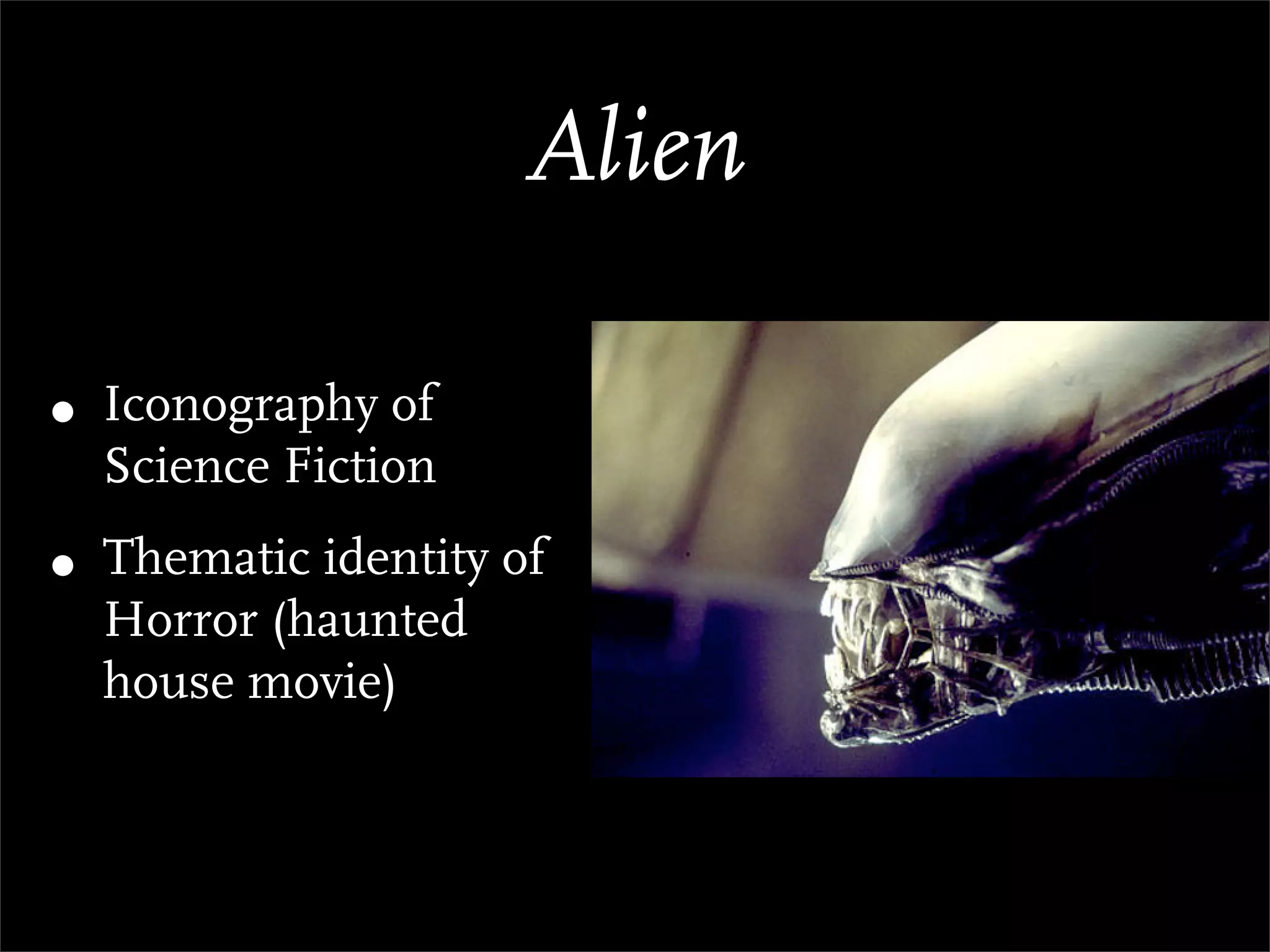
Alien

• Iconography of
  Science Fiction
• Thematic identity of
  Horror (haunted
  house movie)
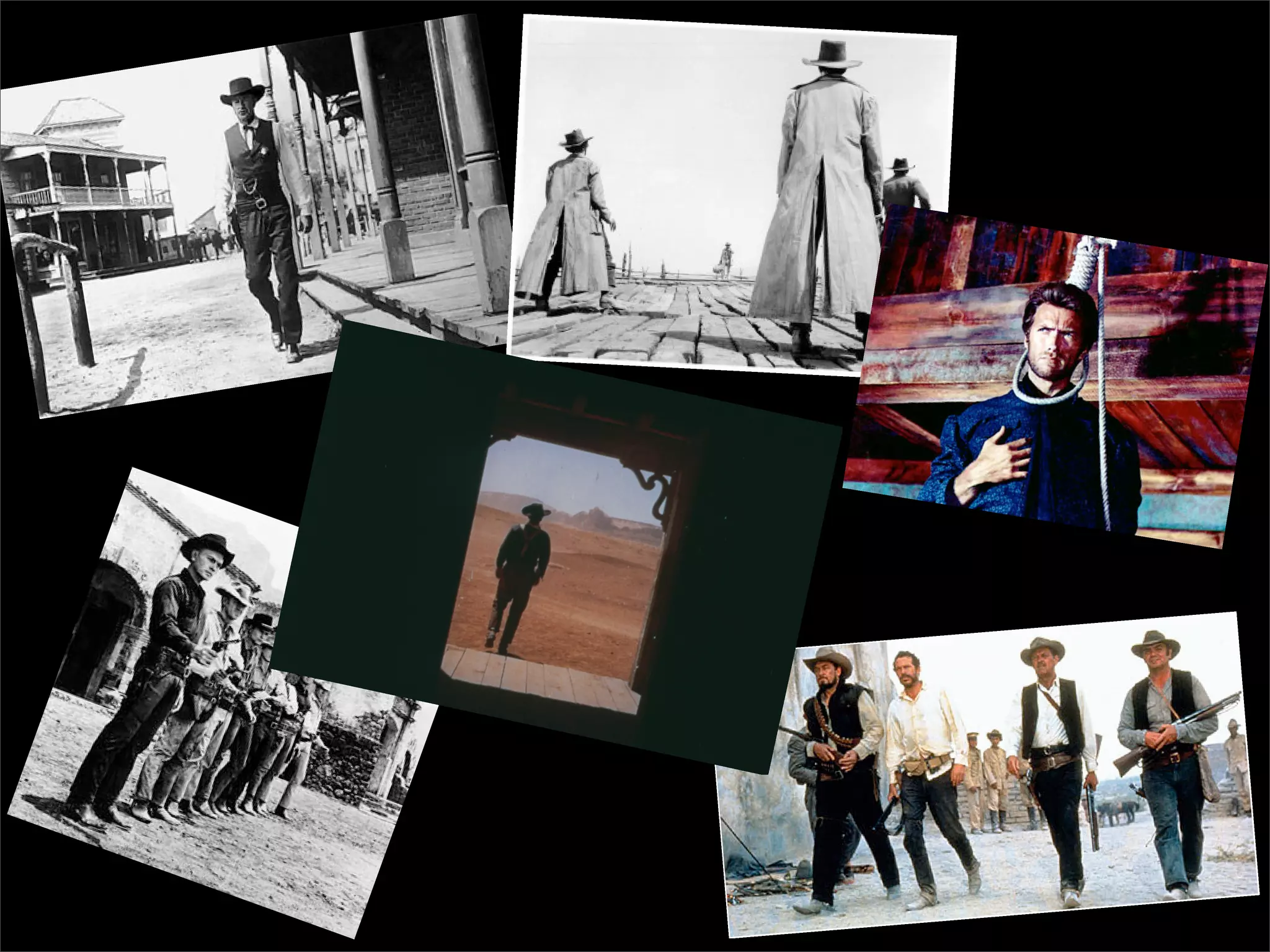
Westerns, for example

• Let’s say we take a group of Western films
  and list the characteristics they share in
  common.
• Have we then defined the Western genre?
Platform Problem

• It’s a classic platform problem.
• Where were we standing when we pre-
  selected the “Western” films we were
  using to define the “Western” genre?
• We already “knew” how we were defining
  “Western” before we started.
Annoyingly...
•   Most of the early work on genre theory was
    based on The Western

•   A lot of it simply doesn’t work for other genres
    like Horror or Rom-Com

•   Western was one of the earliest genres – but why
    was it so popular?

•   Why, in particular, was it so popular outside the
    USA?
Contemporaries

•   A lot of the success of the western is put down to
    its mythological aspects (civilisation vs. wilderness;
    nature vs. culture; individual vs. community etc.)

•   But it’s easy to forget that the first films were
    being made while the last cowboy outlaws were
    still at large...
1895 and all that
•   Lumière invented cinema around
    1895

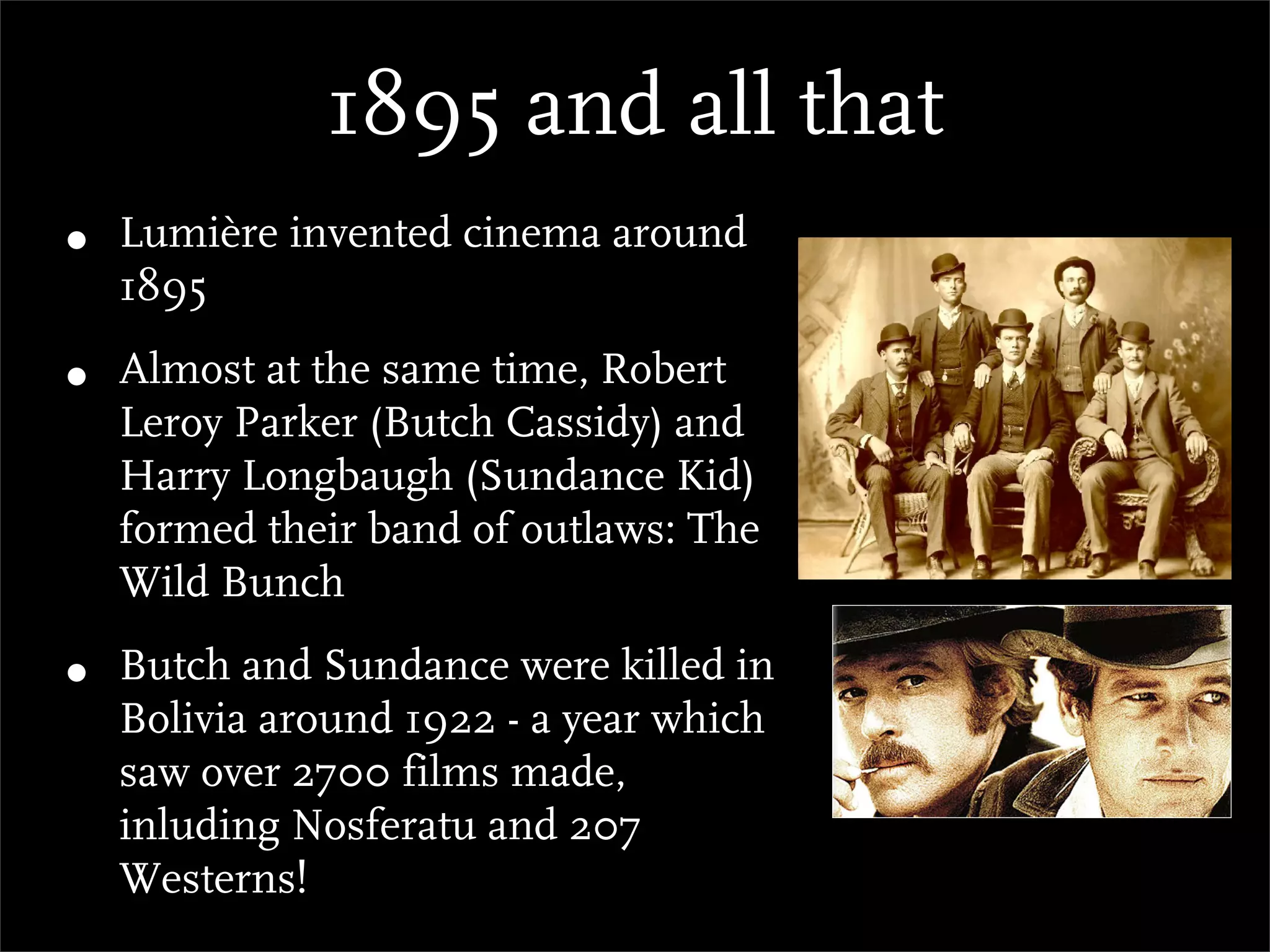
•   Almost at the same time, Robert
    Leroy Parker (Butch Cassidy) and
    Harry Longbaugh (Sundance Kid)
    formed their band of outlaws: The
    Wild Bunch

•   Butch and Sundance were killed in
    Bolivia around 1922 - a year which
    saw over 2700 films made,
    inluding Nosferatu and 207
    Westerns!
Iconography
•   Since film is a visual medium, it’s right that
    iconography tends to take precedence over
    thematic identity.

•   Some critics argue that elements of iconography
    push a genre towards certain themes

•   And some genres – like horror – don’t share a
    common sense of time/place or fixed
    iconography like westerns do
Rational Fears

• Instead, horror depends a lot more on
  shared cultural values and audience fears
  – which are often more psychological
  than visual!
• Where does this leave genre theory?
Keep it loose, keep it
            simple
•   Words like definition and classification imply
    greater precision than actually exists.

•   All critics can really do is identify generic
    tendencies

•   As such, the word genre should not be translated
    but used as a specialist term with a very loose
    meaning.
The Audience
•   Later genre criticism tried to take account of the
    relationship between institutions, texts, and
    audiences.

•   For example, Steven Neale saw genre cinema as
    an attempt to position the audience in order to
    promote feelings of mastery: we can “read” genre
    films, so we feel good about ourselves.

•   Why might this be?
Truly, madly, deeply
•   It’s only in recent years that critics have
    attempted to engage with the real audience – as
    opposed to the imaginary and convenient
    construct they called the audience.

•   Genres are now taken for granted (as defined),
    and genre theory now concentrates on socio-
    historical context, ideology & politics, and
    historical development.

•   Genres have local characteristics and local
    meanings to their audiences
Similarity and Difference

•   Genre refers to groups of films which share a
    pattern of similarity and difference.

•   The pleasure for the audience often lies in the
    experience of difference within the similarity (or
    vice versa!).

•   For the critic, genre theory always places a text in
    relation to other texts, and the context in which it
    is consumed.
Sources/Further Reading


•   An Introduction to Genre Theory by Daniel Chandler
    (http://www.aber.ac.uk/media/Documents/intgenre/
    intgenre.html)

•   Hutchings, Peter: “Genre theory and criticism” in Approaches to Popular
    Film, Edited by Joanne Hollows and Mark Jancovich (Manchester
    University Press, 1995)

Understanding genre

  • 1.
    Understanding Genre An approach to popular film
  • 2.
    Face Value • Atface value, genre doesn’t seem to be a very tricky concept at all. • From the French word for “type”, we all know that it simply refers to a type of text. • We’re all very used to categories like Western, Horror, Rom-Com, etc.
  • 3.
  • 4.
    Why Genre Theory? • When Film Studies first started, the dominant theoretical approach was in terms of directors as “authors” of films: auteur theory.
  • 5.
    Why Genre Theory? • When Film Studies first started, the dominant theoretical approach was in terms of directors as “authors” of films: auteur theory. • But in 1948 there were 2051 films released, 392 of which were comedies – were they all created by auteurs?
  • 6.
    Why Genre Theory? • When Film Studies first started, the dominant theoretical approach was in terms of directors as “authors” of films: auteur theory. • But in 1948 there were 2051 films released, 392 of which were comedies – were they all created by auteurs? • Genre theory sought to recognise film as an industrial and commercial medium as well as an art form.
  • 7.
    Do we needa theory of Genre? • The first question raised by Daniel Chandler in his Introduction to Genre Theory introduces a real stumbling block: • Do genres exist independently of analysis? • Is there a finite number of genres, or are they potentially endless?
  • 8.
  • 9.
    Critical Construct? • Are genres “out there” in the world, or do they get defined by critics?
  • 10.
    Critical Construct? • Are genres “out there” in the world, or do they get defined by critics? • Actually, many of the earliest films were genre pictures – as studios (as always) tried to repeat their successes.
  • 11.
    Types of Text •Genres differ between fields. Literary genres are different from theatrical genres, which are different from film genres, etc. • Science Fiction literature is very different from film and TV (so-called) science fiction, for example. A Horror novel follows different conventions to a Horror film.
  • 12.
    Shakespeare • Tragedies, Comedies,Histories • E.g. Hamlet, The Taming of the Shrew, Henry V.
  • 13.
    Film • There are many more film genres than there are Shakespearian genres. • Listings magazines, newspapers, web sites etc. routinely use recognisable categories like Thriller, Action, Romantic Comedy, Road Movie, Disaster Movie and various hybrid genres including Period Drama, Crime Drama, Horror Comedy etc.
  • 14.
    But is ita genre at all? • One person’s genre is another’s thematic grouping or mode. • There could be as many ways of categorising films as there are critics. • Then there are sub-genres, hybrid genres, and cycles...
  • 15.
    Groupings • Grouping by period or country (American films of the 1930s), by director or star or producer or writer or studio, by technical process (CinemaScope films), by cycle (the 'fallen women' films), by series (the 007 movies), by style (German Expressionism), by structure (narrative), by ideology (Reaganite cinema), by venue ('drive-in movies'), by purpose (home movies), by audience ('teenpix'), by subject or theme (family film, paranoid-politics movies).
  • 16.
    Still more... • While some genres are based on story content (the war film), other are borrowed from literature (comedy, melodrama) or from other media (the musical). Some are performer-based (the Astaire-Rogers films) or budget-based (blockbusters, indie), while others are based on artistic status (the art film), racial identity (Black cinema), location (the Western) or sexual orientation (Queer cinema).
  • 17.
    Form vs. Content • A common-sense definition of genre is to say that it constitutes a group of films based on certain conventions of content and/or form. • Content might refer to themes and settings • Form might refer to structure and style • Alternatively, some critics talk about external form vs. internal form.
  • 18.
    Inside Outside • Outerform: iconography • Inner form: thematic identity
  • 19.
    Simple? • But what happens to a film that fits one genre based on theme/setting, but another based on form? • Or one based on thematic identity and another on iconography? • Example...?
  • 20.
    Star Trek • The iconography of science fiction • The thematic identity of a western • Described when it was proposed as, “Wagon Train in space.” • What really matters is the way the themes are treated/represented.
  • 21.
    Alien • Iconography of Science Fiction • Thematic identity of Horror (haunted house movie)
  • 22.
    Westerns, for example •Let’s say we take a group of Western films and list the characteristics they share in common. • Have we then defined the Western genre?
  • 24.
    Platform Problem • It’sa classic platform problem. • Where were we standing when we pre- selected the “Western” films we were using to define the “Western” genre? • We already “knew” how we were defining “Western” before we started.
  • 25.
    Annoyingly... • Most of the early work on genre theory was based on The Western • A lot of it simply doesn’t work for other genres like Horror or Rom-Com • Western was one of the earliest genres – but why was it so popular? • Why, in particular, was it so popular outside the USA?
  • 26.
    Contemporaries • A lot of the success of the western is put down to its mythological aspects (civilisation vs. wilderness; nature vs. culture; individual vs. community etc.) • But it’s easy to forget that the first films were being made while the last cowboy outlaws were still at large...
  • 27.
    1895 and allthat • Lumière invented cinema around 1895 • Almost at the same time, Robert Leroy Parker (Butch Cassidy) and Harry Longbaugh (Sundance Kid) formed their band of outlaws: The Wild Bunch • Butch and Sundance were killed in Bolivia around 1922 - a year which saw over 2700 films made, inluding Nosferatu and 207 Westerns!
  • 28.
    Iconography • Since film is a visual medium, it’s right that iconography tends to take precedence over thematic identity. • Some critics argue that elements of iconography push a genre towards certain themes • And some genres – like horror – don’t share a common sense of time/place or fixed iconography like westerns do
  • 29.
    Rational Fears • Instead,horror depends a lot more on shared cultural values and audience fears – which are often more psychological than visual! • Where does this leave genre theory?
  • 30.
    Keep it loose,keep it simple • Words like definition and classification imply greater precision than actually exists. • All critics can really do is identify generic tendencies • As such, the word genre should not be translated but used as a specialist term with a very loose meaning.
  • 31.
    The Audience • Later genre criticism tried to take account of the relationship between institutions, texts, and audiences. • For example, Steven Neale saw genre cinema as an attempt to position the audience in order to promote feelings of mastery: we can “read” genre films, so we feel good about ourselves. • Why might this be?
  • 32.
    Truly, madly, deeply • It’s only in recent years that critics have attempted to engage with the real audience – as opposed to the imaginary and convenient construct they called the audience. • Genres are now taken for granted (as defined), and genre theory now concentrates on socio- historical context, ideology & politics, and historical development. • Genres have local characteristics and local meanings to their audiences
  • 33.
    Similarity and Difference • Genre refers to groups of films which share a pattern of similarity and difference. • The pleasure for the audience often lies in the experience of difference within the similarity (or vice versa!). • For the critic, genre theory always places a text in relation to other texts, and the context in which it is consumed.
  • 34.
    Sources/Further Reading • An Introduction to Genre Theory by Daniel Chandler (http://www.aber.ac.uk/media/Documents/intgenre/ intgenre.html) • Hutchings, Peter: “Genre theory and criticism” in Approaches to Popular Film, Edited by Joanne Hollows and Mark Jancovich (Manchester University Press, 1995)