G325 – CRITICAL
PERSPECTIVES IN MEDIA
SectionA , Question B –Theoretical Evaluation of Production
Section A: Theoretical
Evaluation of Production
 Section A, question 1b of the A2 exam is worth 25 marks
 You will choose to evaluate one of your pieces of
coursework in relation to a media concept.
 In the exam one of the following areas will be
selected for you to write about:
 Genre
 Narrative
 Representation
 Audience
 Media language
How to approach 1b.
 You need to understand all 5 concepts, including
relevant theories.
 Your task over the next 2 weeks will be to
produce a detailed evaluation of your
coursework using all 5 concepts.
 The documents you produce will be vital revision
aids for the exam this summer.
 These documents should be tailored to you, and
suit your own learning style. However they must
be detailed and use specific examples from one
of your coursework productions.
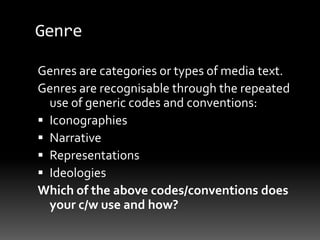
Genre
Genres are categories or types of media text.
Genres are recognisable through the repeated
use of generic codes and conventions:
 Iconographies
 Narrative
 Representations
 Ideologies
Which of the above codes/conventions does
your c/w use and how?
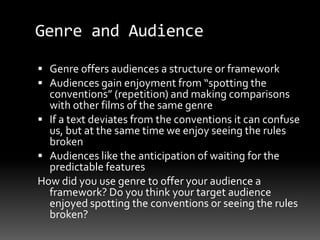
Genre and Audience
 Genre offers audiences a structure or framework
 Audiences gain enjoyment from “spotting the
conventions” (repetition) and making comparisons
with other films of the same genre
 If a text deviates from the conventions it can confuse
us, but at the same time we enjoy seeing the rules
broken
 Audiences like the anticipation of waiting for the
predictable features
How did you use genre to offer your audience a
framework? Do you think your target audience
enjoyed spotting the conventions or seeing the rules
broken?
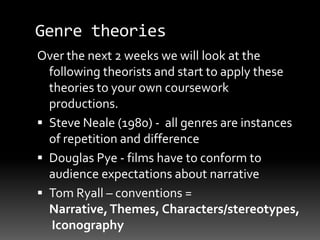
Genre theories
Over the next 2 weeks we will look at the
following theorists and start to apply these
theories to your own coursework
productions.
 Steve Neale (1980) - all genres are instances
of repetition and difference
 Douglas Pye - films have to conform to
audience expectations about narrative
 Tom Ryall – conventions =
Narrative,Themes, Characters/stereotypes,
Iconography
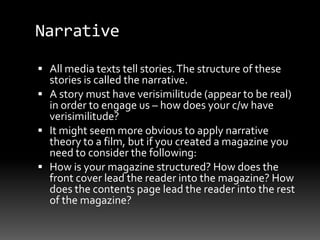
Narrative
 All media texts tell stories.The structure of these
stories is called the narrative.
 A story must have verisimilitude (appear to be real)
in order to engage us – how does your c/w have
verisimilitude?
 It might seem more obvious to apply narrative
theory to a film, but if you created a magazine you
need to consider the following:
 How is your magazine structured? How does the
front cover lead the reader into the magazine? How
does the contents page lead the reader into the rest
of the magazine?
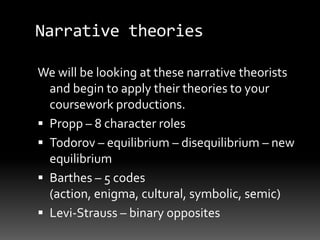
Narrative theories
We will be looking at these narrative theorists
and begin to apply their theories to your
coursework productions.
 Propp – 8 character roles
 Todorov – equilibrium – disequilibrium – new
equilibrium
 Barthes – 5 codes
(action, enigma, cultural, symbolic, semic)
 Levi-Strauss – binary opposites
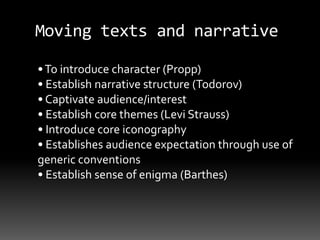
Moving texts and narrative
•To introduce character (Propp)
• Establish narrative structure (Todorov)
• Captivate audience/interest
• Establish core themes (Levi Strauss)
• Introduce core iconography
• Establishes audience expectation through use of
generic conventions
• Establish sense of enigma (Barthes)
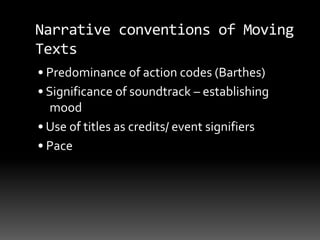
Narrative conventions of Moving
Texts
• Predominance of action codes (Barthes)
• Significance of soundtrack – establishing
mood
• Use of titles as credits/ event signifiers
• Pace
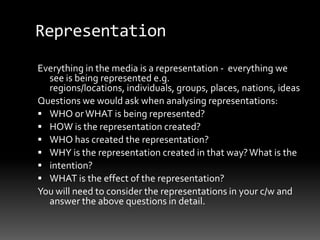
Representation
Everything in the media is a representation - everything we
see is being represented e.g.
regions/locations, individuals, groups, places, nations, ideas
Questions we would ask when analysing representations:
 WHO orWHAT is being represented?
 HOW is the representation created?
 WHO has created the representation?
 WHY is the representation created in that way?What is the
 intention?
 WHAT is the effect of the representation?
You will need to consider the representations in your c/w and
answer the above questions in detail.
Representation
 To maintain a representation of reality, media
language elements such as
lighting, music, editing, camera work and mise
en scene are used. How did you use these micro
aspects to create representations?
 Sometimes, representations are seen to be a
deliberate attempt to create associations and
ideas for the audience – did you represent any
characters in a certain way so as to remind your
audience or someone/something else?
Representation theories
We will be looking at the following theorists and
examining how you can apply these theories
to your coursework production.
 Laura Mulvey (the gaze)
 Marjorie Ferguson (facial expressions)
 Trevor Millum (facial expressions)
Audience
 Every media text is made with a view to
pleasing an audience in some way – how did
you try to please your audience?
 Success is measured by the audience’s
response to a media text and those that do
not attract and maintain an audience do not
survive.
 At the heart of this is the fact that all media
texts are created in order to make money.
Audience
 We will be looking the following
theories/theorists and beginning to apply
these to your coursework productions.
 Demographics
 Stuart Hall (Preferred, negotiated and
oppositional readings)
Media Language
You made lots of decisions regarding the following micro
aspects:
 Camera
 Editing
 Lighting
 Sound
 Mise-en- Scene
 Special Effects: visual, sound and lighting
 These micro elements form a type of “Media Language”
allowing you to “speak” to your audience and
“communicate” your message.
Media Language
You will be using the following theorists to
explain how you have used media language
in your coursework productions.
 Saussure (Signifier and Signified)
 Barthes (Denotation and Connotation)
 Hall (Encoding and Decoding)

Section 1b explanation

  • 1.
    G325 – CRITICAL PERSPECTIVESIN MEDIA SectionA , Question B –Theoretical Evaluation of Production
  • 2.
    Section A: Theoretical Evaluationof Production  Section A, question 1b of the A2 exam is worth 25 marks  You will choose to evaluate one of your pieces of coursework in relation to a media concept.  In the exam one of the following areas will be selected for you to write about:  Genre  Narrative  Representation  Audience  Media language
  • 3.
    How to approach1b.  You need to understand all 5 concepts, including relevant theories.  Your task over the next 2 weeks will be to produce a detailed evaluation of your coursework using all 5 concepts.  The documents you produce will be vital revision aids for the exam this summer.  These documents should be tailored to you, and suit your own learning style. However they must be detailed and use specific examples from one of your coursework productions.
  • 4.
    Genre Genres are categoriesor types of media text. Genres are recognisable through the repeated use of generic codes and conventions:  Iconographies  Narrative  Representations  Ideologies Which of the above codes/conventions does your c/w use and how?
  • 5.
    Genre and Audience Genre offers audiences a structure or framework  Audiences gain enjoyment from “spotting the conventions” (repetition) and making comparisons with other films of the same genre  If a text deviates from the conventions it can confuse us, but at the same time we enjoy seeing the rules broken  Audiences like the anticipation of waiting for the predictable features How did you use genre to offer your audience a framework? Do you think your target audience enjoyed spotting the conventions or seeing the rules broken?
  • 6.
    Genre theories Over thenext 2 weeks we will look at the following theorists and start to apply these theories to your own coursework productions.  Steve Neale (1980) - all genres are instances of repetition and difference  Douglas Pye - films have to conform to audience expectations about narrative  Tom Ryall – conventions = Narrative,Themes, Characters/stereotypes, Iconography
  • 7.
    Narrative  All mediatexts tell stories.The structure of these stories is called the narrative.  A story must have verisimilitude (appear to be real) in order to engage us – how does your c/w have verisimilitude?  It might seem more obvious to apply narrative theory to a film, but if you created a magazine you need to consider the following:  How is your magazine structured? How does the front cover lead the reader into the magazine? How does the contents page lead the reader into the rest of the magazine?
  • 8.
    Narrative theories We willbe looking at these narrative theorists and begin to apply their theories to your coursework productions.  Propp – 8 character roles  Todorov – equilibrium – disequilibrium – new equilibrium  Barthes – 5 codes (action, enigma, cultural, symbolic, semic)  Levi-Strauss – binary opposites
  • 9.
    Moving texts andnarrative •To introduce character (Propp) • Establish narrative structure (Todorov) • Captivate audience/interest • Establish core themes (Levi Strauss) • Introduce core iconography • Establishes audience expectation through use of generic conventions • Establish sense of enigma (Barthes)
  • 10.
    Narrative conventions ofMoving Texts • Predominance of action codes (Barthes) • Significance of soundtrack – establishing mood • Use of titles as credits/ event signifiers • Pace
  • 11.
    Representation Everything in themedia is a representation - everything we see is being represented e.g. regions/locations, individuals, groups, places, nations, ideas Questions we would ask when analysing representations:  WHO orWHAT is being represented?  HOW is the representation created?  WHO has created the representation?  WHY is the representation created in that way?What is the  intention?  WHAT is the effect of the representation? You will need to consider the representations in your c/w and answer the above questions in detail.
  • 12.
    Representation  To maintaina representation of reality, media language elements such as lighting, music, editing, camera work and mise en scene are used. How did you use these micro aspects to create representations?  Sometimes, representations are seen to be a deliberate attempt to create associations and ideas for the audience – did you represent any characters in a certain way so as to remind your audience or someone/something else?
  • 13.
    Representation theories We willbe looking at the following theorists and examining how you can apply these theories to your coursework production.  Laura Mulvey (the gaze)  Marjorie Ferguson (facial expressions)  Trevor Millum (facial expressions)
  • 14.
    Audience  Every mediatext is made with a view to pleasing an audience in some way – how did you try to please your audience?  Success is measured by the audience’s response to a media text and those that do not attract and maintain an audience do not survive.  At the heart of this is the fact that all media texts are created in order to make money.
  • 15.
    Audience  We willbe looking the following theories/theorists and beginning to apply these to your coursework productions.  Demographics  Stuart Hall (Preferred, negotiated and oppositional readings)
  • 16.
    Media Language You madelots of decisions regarding the following micro aspects:  Camera  Editing  Lighting  Sound  Mise-en- Scene  Special Effects: visual, sound and lighting  These micro elements form a type of “Media Language” allowing you to “speak” to your audience and “communicate” your message.
  • 17.
    Media Language You willbe using the following theorists to explain how you have used media language in your coursework productions.  Saussure (Signifier and Signified)  Barthes (Denotation and Connotation)  Hall (Encoding and Decoding)