Theorists You Need To Know
What are you being assessed on?
AO1
• Demonstrate knowledge and understanding of:
• the theoretical framework of media
• contexts of media and their influence on media products and processes.
AO2
• Apply knowledge and understanding of the theoretical framework of media to:
• analyse media products, including in relation to their contexts and through the use of
academic theories
• evaluate academic theories
• make judgements and draw conclusions.
Breakdown
• Compare (AO2) – different media products
• Explain (AO1) – stuff about the media and media products
• Consider (AO2) – to what degree the media operates
• Evaluate (AO2) – the usefulness of theories and concepts
• Discuss (AO1) – ideas and concepts
• Analyse (AO2) – how media language communicates meaning
Theoretical Framework
This sounds more scary than it is. This is the tools you will used
to explore media texts and develop an understanding of them.
Media Language: how the media through their forms, codes,
conventions and techniques communicate meanings
Representation: how the media portray events, issues,
individuals and social groups
Media Industries: how the media industries' processes of
production, distribution and circulation affect media forms and
platforms
Audiences: how media forms target, reach and address
audiences, how audiences interpret and respond to them, and
how members of audiences become producers themselves.
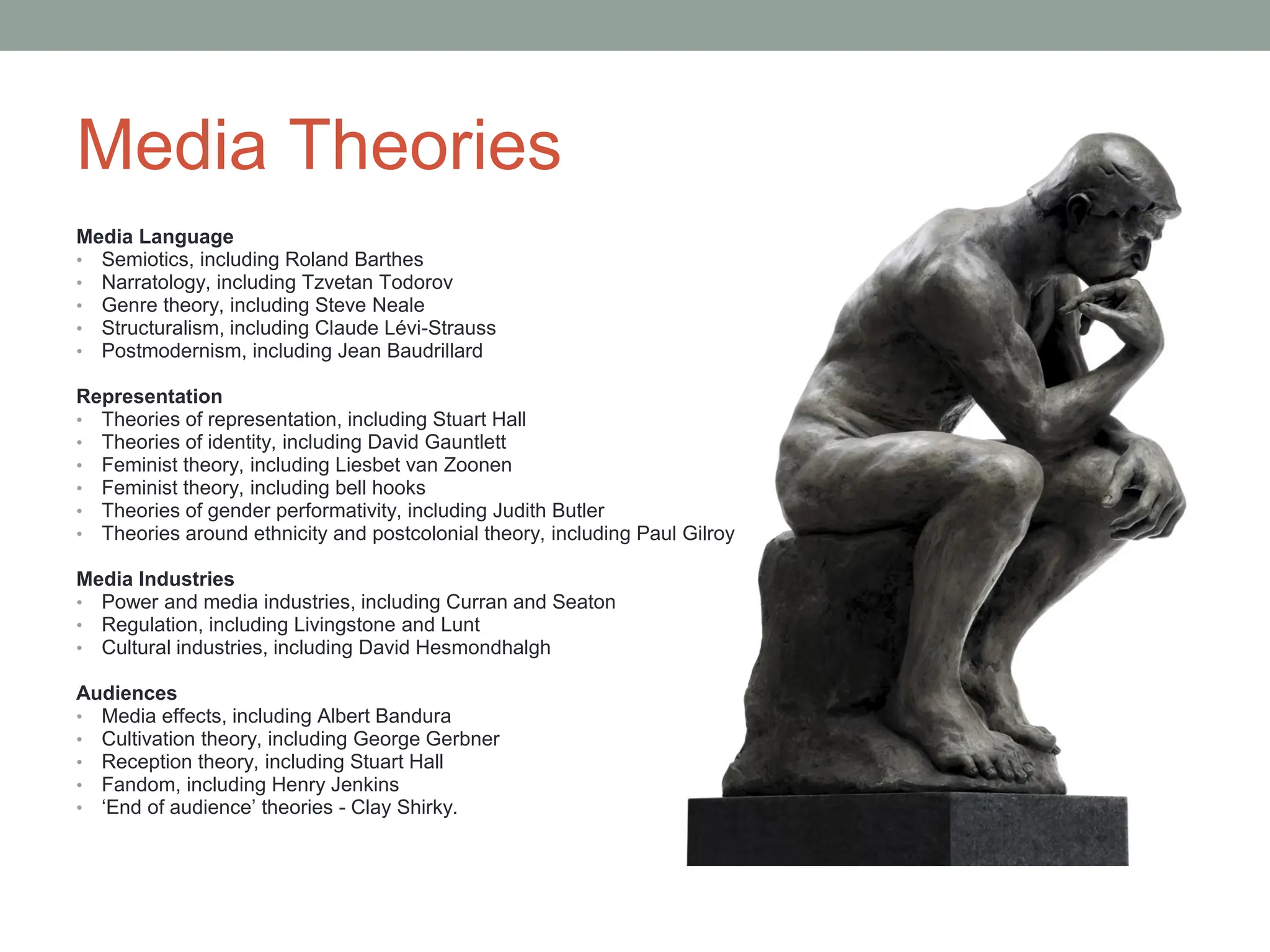
Media Theories
Media Language
• Semiotics, including Roland Barthes
• Narratology, including Tzvetan Todorov
• Genre theory, including Steve Neale
• Structuralism, including Claude Lévi-Strauss
• Postmodernism, including Jean Baudrillard
Representation
• Theories of representation, including Stuart Hall
• Theories of identity, including David Gauntlett
• Feminist theory, including Liesbet van Zoonen
• Feminist theory, including bell hooks
• Theories of gender performativity, including Judith Butler
• Theories around ethnicity and postcolonial theory, including Paul Gilroy
Media Industries
• Power and media industries, including Curran and Seaton
• Regulation, including Livingstone and Lunt
• Cultural industries, including David Hesmondhalgh
Audiences
• Media effects, including Albert Bandura
• Cultivation theory, including George Gerbner
• Reception theory, including Stuart Hall
• Fandom, including Henry Jenkins
• ‘End of audience’ theories - Clay Shirky.
Media Contexts
Historical Contexts
• how genre conventions are historically relative and dynamic
• the effect of historical context on representations
• the relationship of recent technological change and media production, distribution and circulation
• the way in which different audience interpretations reflect historical circumstances
Social and Cultural Contexts
• how genre conventions are socially relative
• the effect of social and cultural context on representations
• how and why particular social groups, in a national and global context, may be under- represented or misrepresented
• how audience responses to and interpretations of media products reflect social and cultural circumstances
Economic Context
• how media products relate to their economic contexts in terms of:
• production, distribution and circulation in a global context
• the significance of patterns of ownership and control
• the significance of economic factors, including funding
Political Context
• how media products reflect the political contexts in which they are made through their representations, themes, values,
messages and ideologies
• how media products reflect the political contexts in which they are made through aspects of their ownership and political
orientation, production, distribution,
• marketing, regulation, circulation and audience consumption.
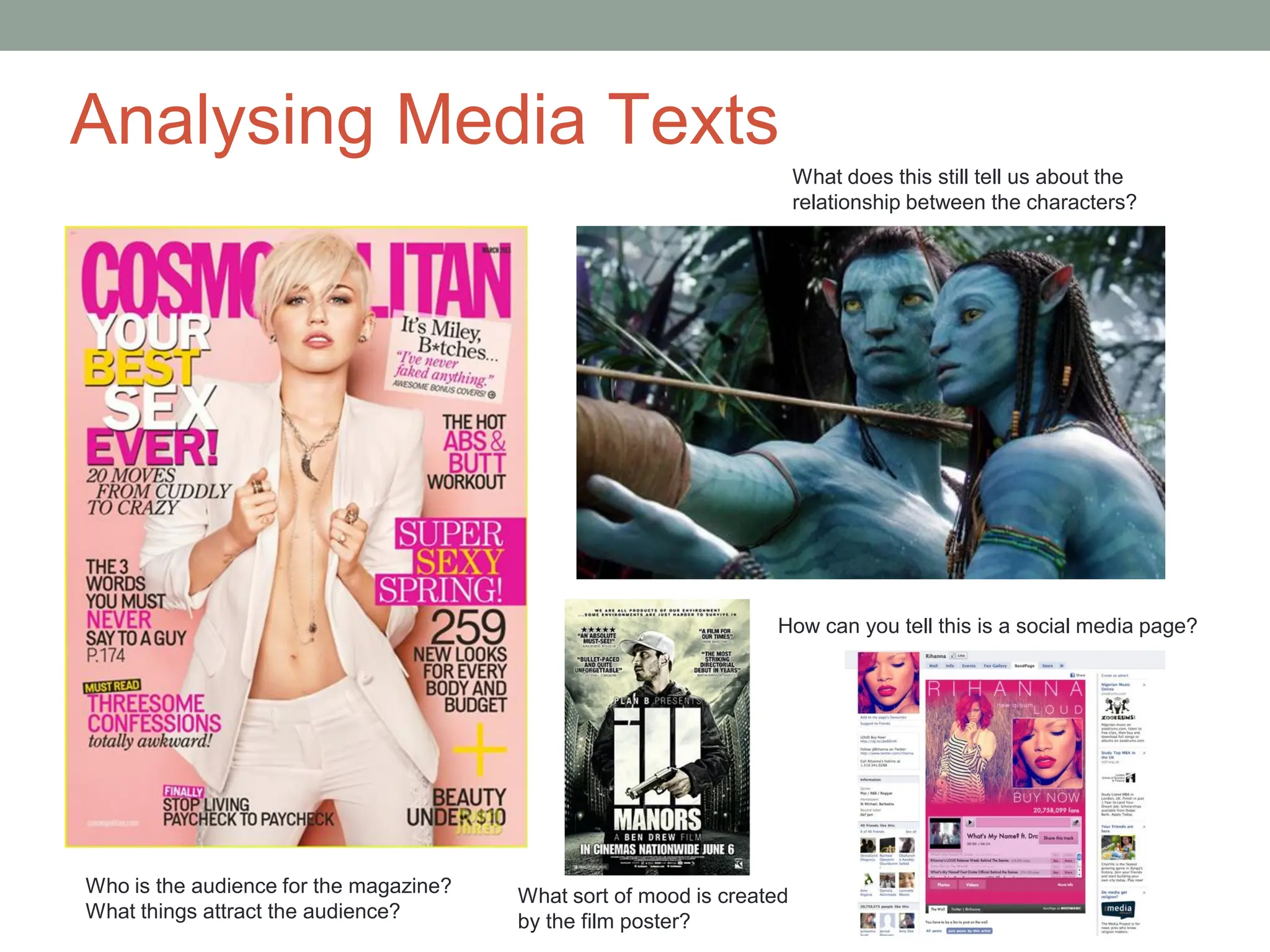
Analysing Media Texts
Who is the audience for the magazine?
What things attract the audience?
What does this still tell us about the
relationship between the characters?
What sort of mood is created
by the film poster?
How can you tell this is a social media page?
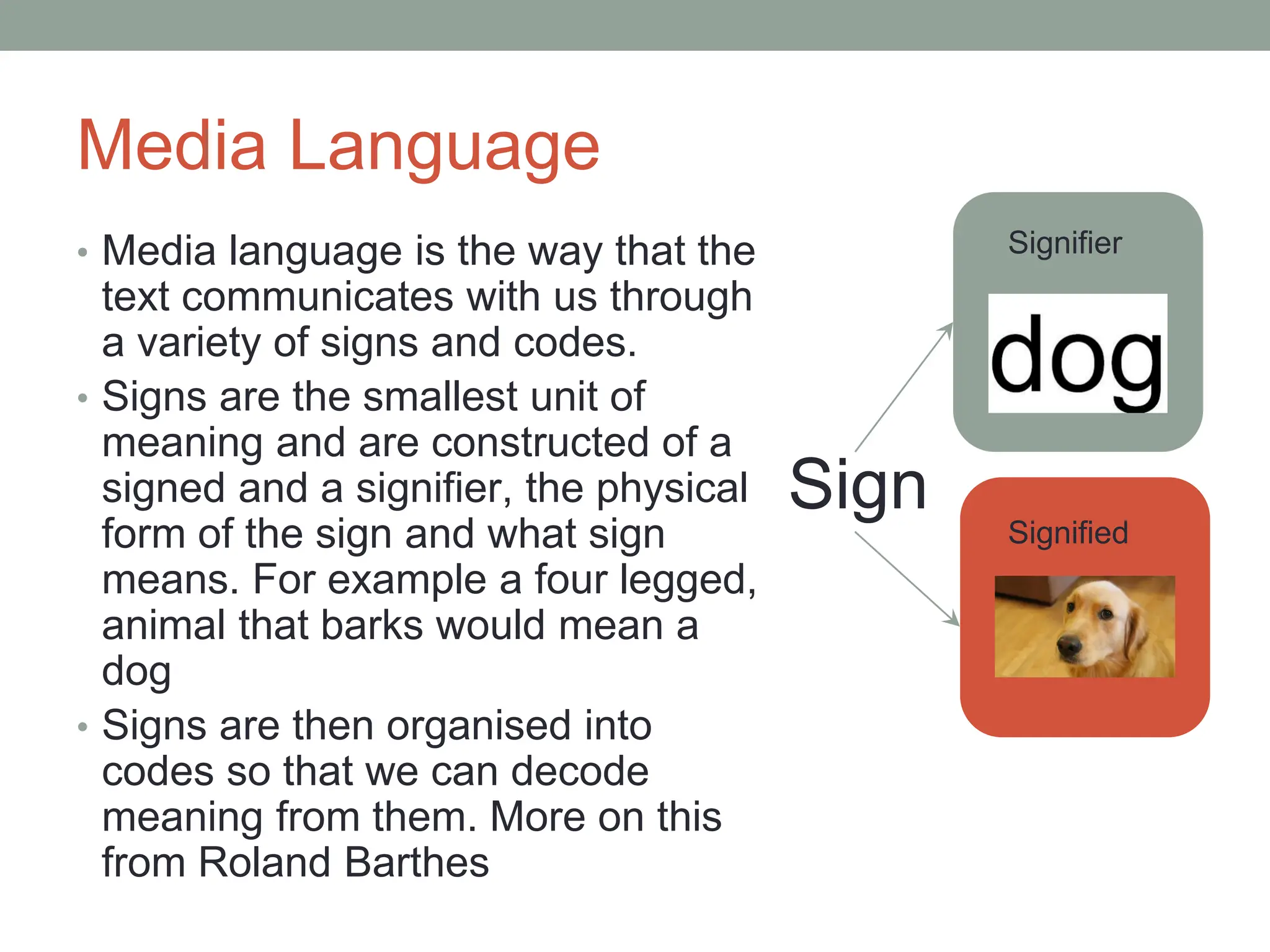
Media Language
• Media language is the way that the
text communicates with us through
a variety of signs and codes.
• Signs are the smallest unit of
meaning and are constructed of a
signed and a signifier, the physical
form of the sign and what sign
means. For example a four legged,
animal that barks would mean a
dog
• Signs are then organised into
codes so that we can decode
meaning from them. More on this
from Roland Barthes
Signified
Signifier
Sign
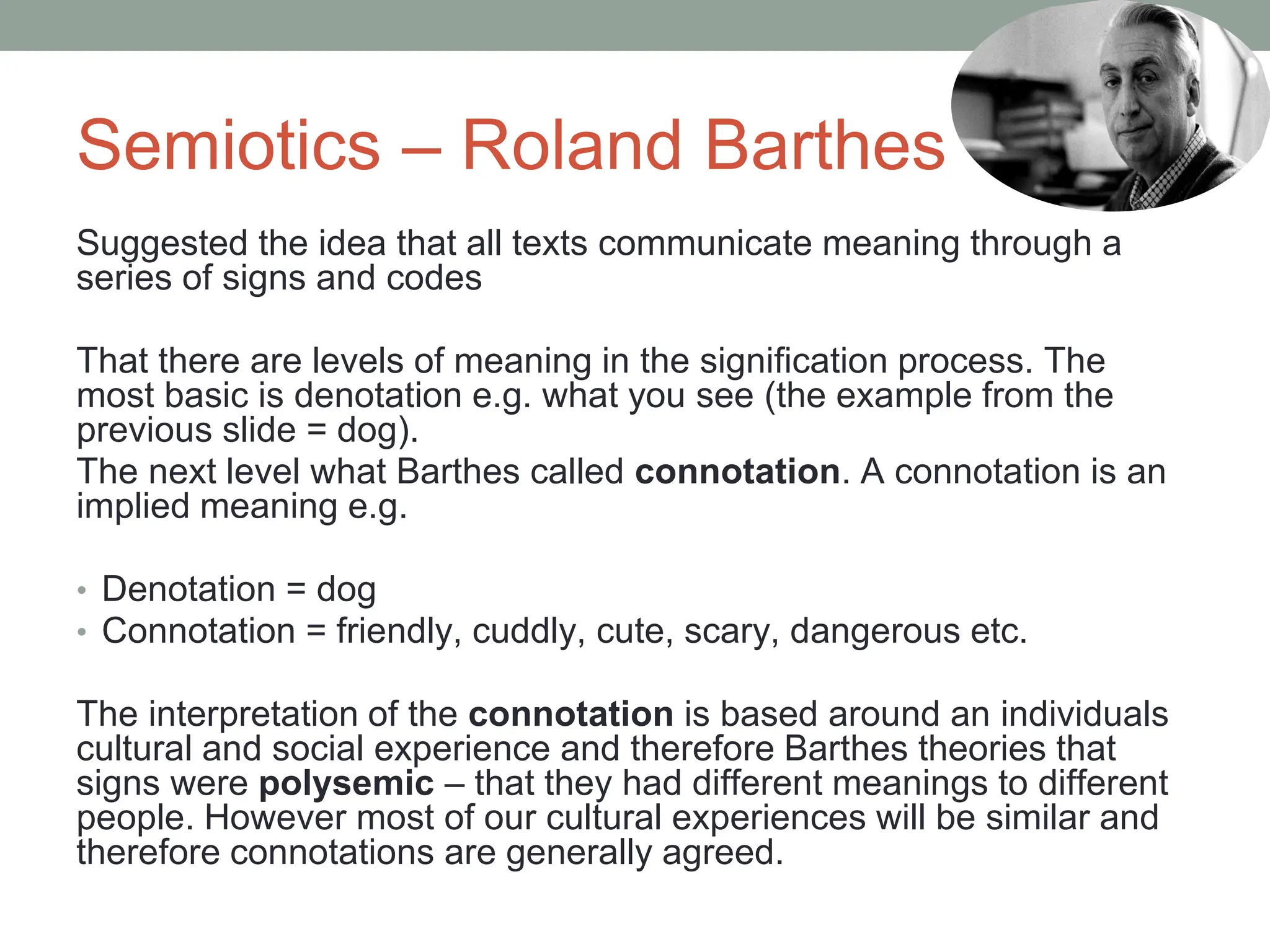
Semiotics – Roland Barthes
Suggested the idea that all texts communicate meaning through a
series of signs and codes
That there are levels of meaning in the signification process. The
most basic is denotation e.g. what you see (the example from the
previous slide = dog).
The next level what Barthes called connotation. A connotation is an
implied meaning e.g.
• Denotation = dog
• Connotation = friendly, cuddly, cute, scary, dangerous etc.
The interpretation of the connotation is based around an individuals
cultural and social experience and therefore Barthes theories that
signs were polysemic – that they had different meanings to different
people. However most of our cultural experiences will be similar and
therefore connotations are generally agreed.
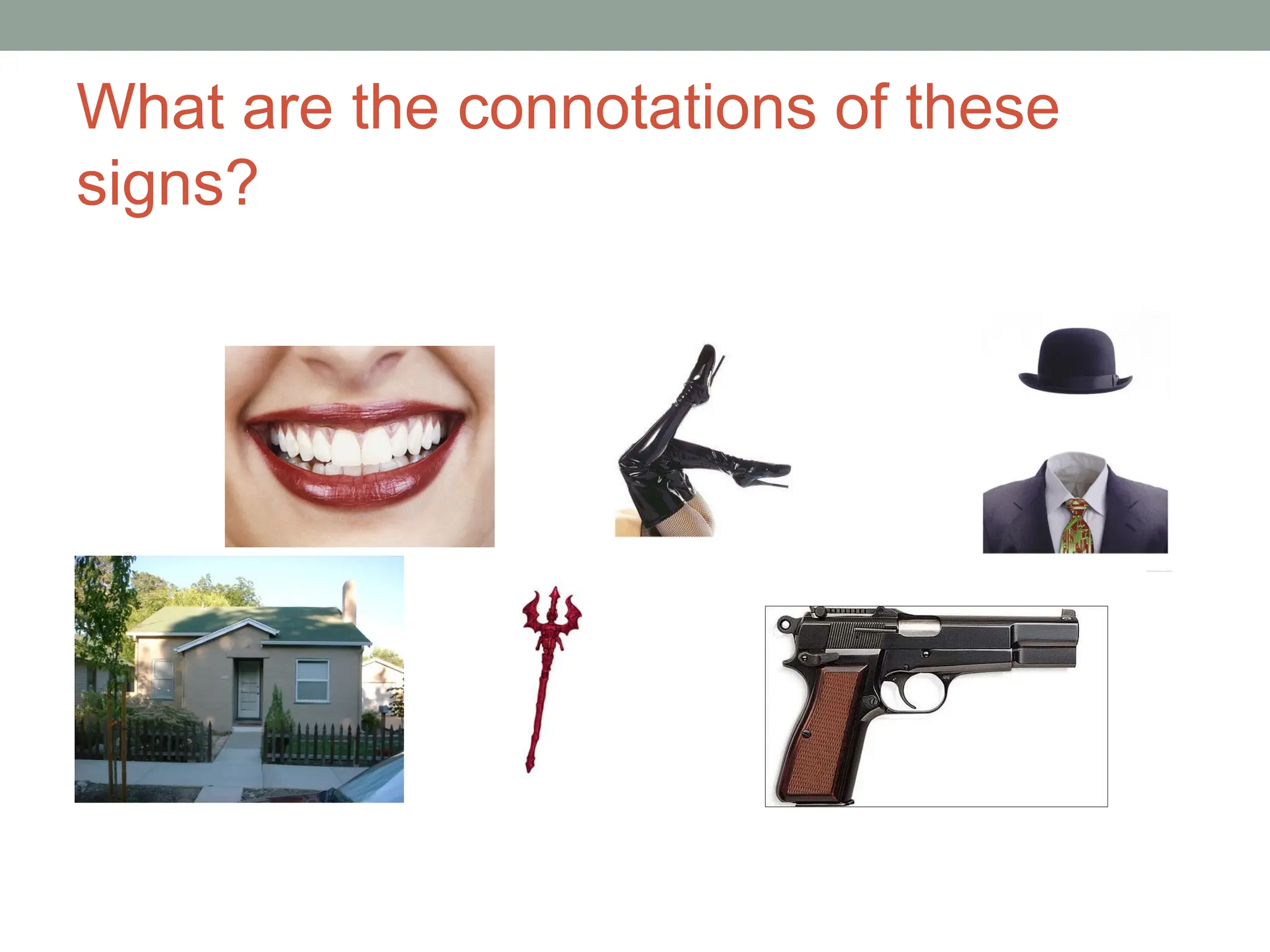
What are the connotations of these
signs?
Semiotics – Roland Barthes
• The third level of signification is myth is where a
connotation of sign becomes so widely used it becomes
accept. It is where the ideology and dominant values of a
culture are bestowed upon the sign. This process is called
naturalisation, where the majority do not question the
meaning.
Consider myth about
• Gypsies
• Terrorist
• Footballers
Media Language: Codes and
Conventions
As a media student, what you will be looking to do is to ‘decode’
the information that media producers have put into media texts
and the possible meanings that come from them. As a rule you
should be looking for the following codes in media texts
• Visual codes – colours, settings, clothing, props etc…
• Audio codes – sound effects, music, accent etc..
• Technical codes – camera angles, shot types, focus, handheld
camera etc…
• Language – what is written, what is said
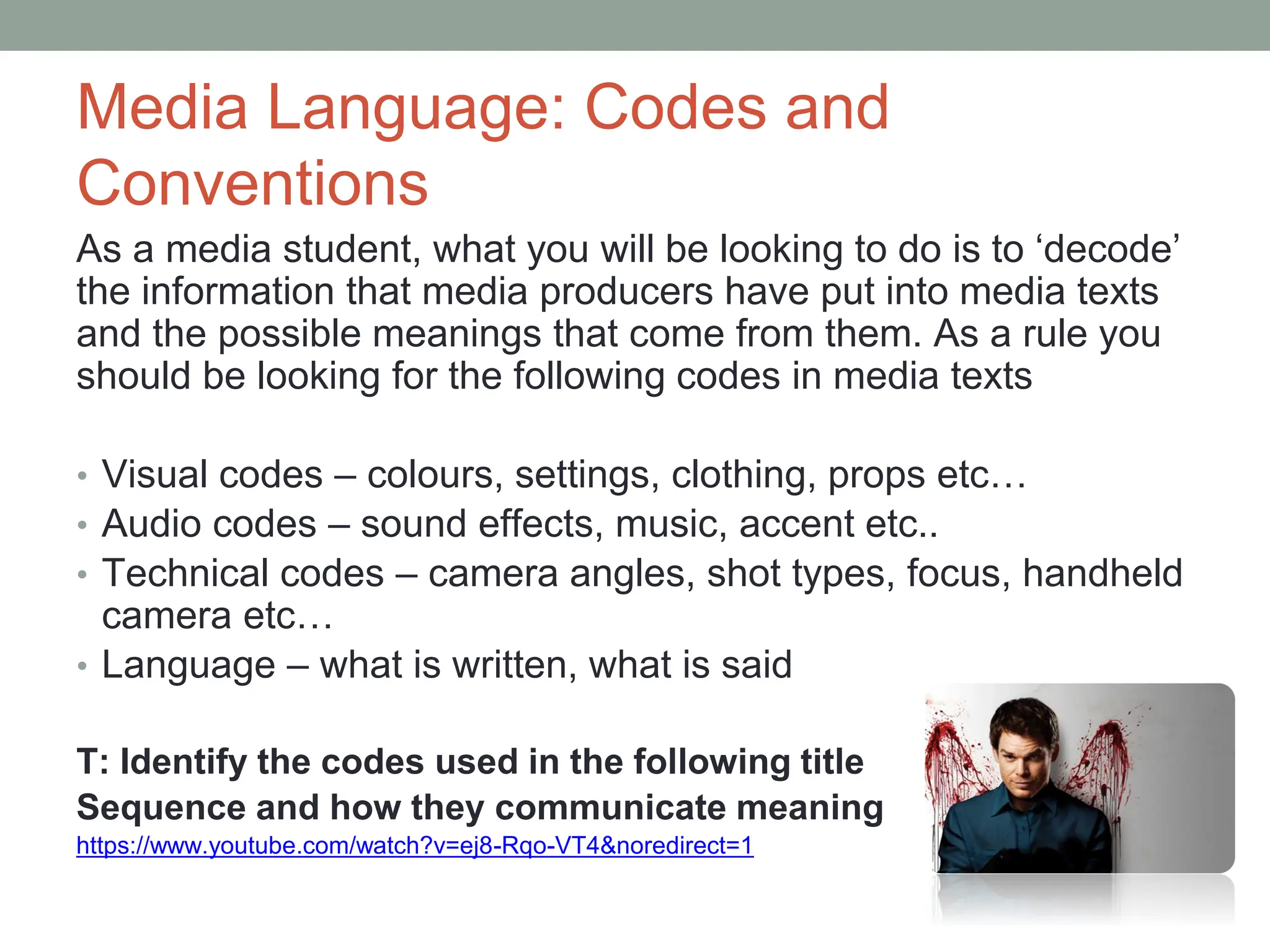
T: Identify the codes used in the following title
Sequence and how they communicate meaning
https://www.youtube.com/watch?v=ej8-Rqo-VT4&noredirect=1
Narratology – TzvetanTodrov
• The idea that all narratives share a basic structure that
involves a movement from one state of equilibrium to
another
• The idea that these two states of equilibrium are
separated by a period of imbalance or disequilibrium
• The idea that the way in which narratives are resolved
can have particular ideological significance.
Narratology – TzvetanTodrov
The theory in it’s basic mode
• Equilibrium
• Disruption
• Resolution
He expanded this theory into a more complex model:
• A state of equilibrium at the outset
• A disruption of the equilibrium by some action
• A recognition that there has been a disruption
• An attempt to repair the disruption
• A reinstatement of the equilibrium
?
T: Think of a film that uses Todorov’s model?
T: Apply Todrov to the following clip
https://www.youtube.com/watch?v=xbuGde3XG6Q
Genre
• Genre is a French word meaning ‘type’ or ‘kind’.
• It is believed that media forms can be grouped into categories
and that each category is marked by certain conventions…
• Reality TV programmes contain certain generic conventions…
• Voice-over
• Goals or competitions
• Non actors
• Competitions & challenges
• “real life” settings
• Character conflict
• Interactivity
• Transformation narratives
Q: what mixture of genres is reality TV?
Genre
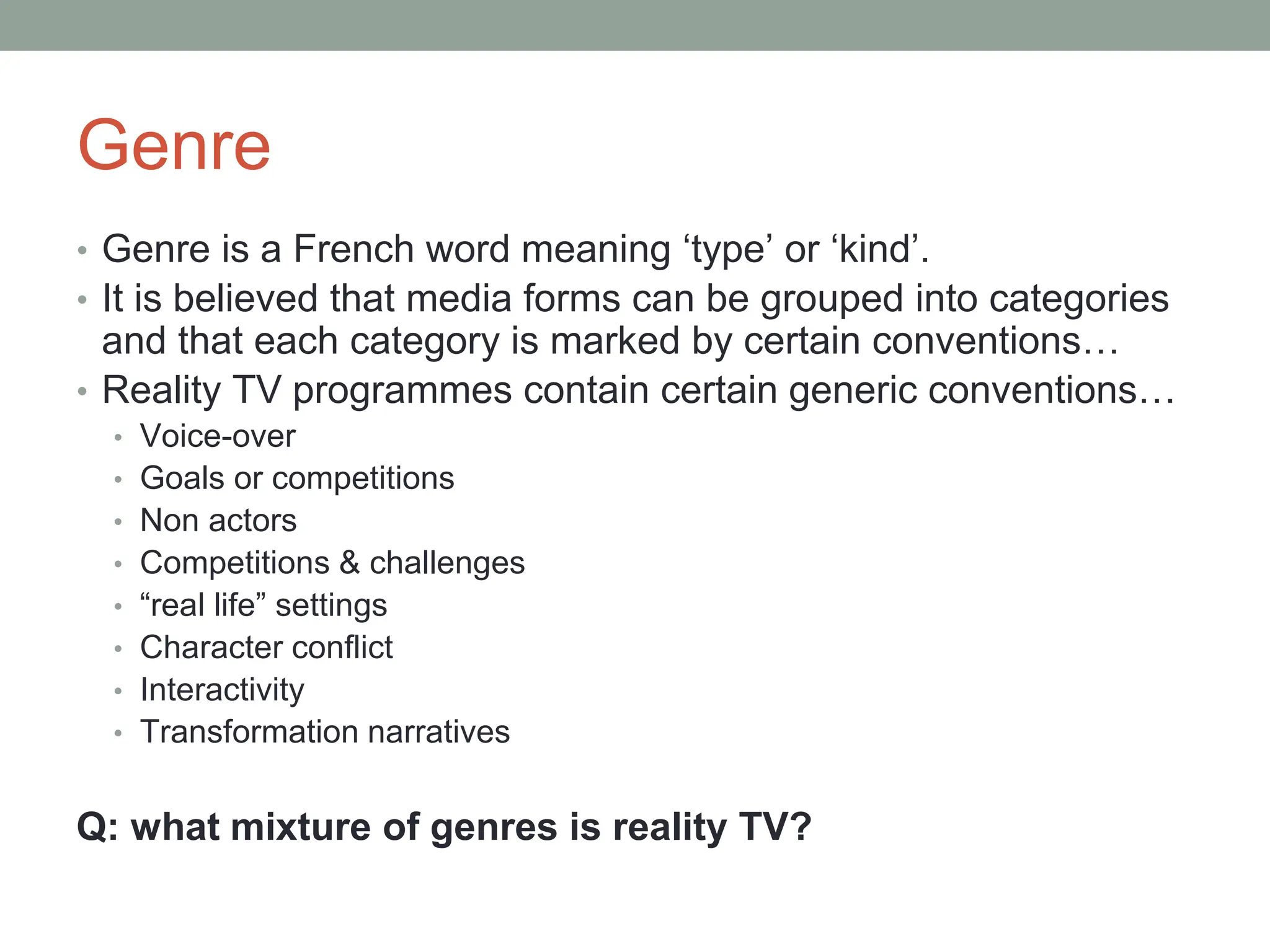
• Identify the genre and genre conventions in the following texts:
https://www.youtube.com/watch
?v=E1ABR4UpDSU&noredirect
=1
Steve Neale
• The idea that genres may be dominated by
repetition, but are also marked by difference,
variation, and change
• The idea that genres change, develop, and
vary, as they borrow from and overlap with one
another
• The idea that genres exist within specific
economic, institutional and industrial contexts.
Genre
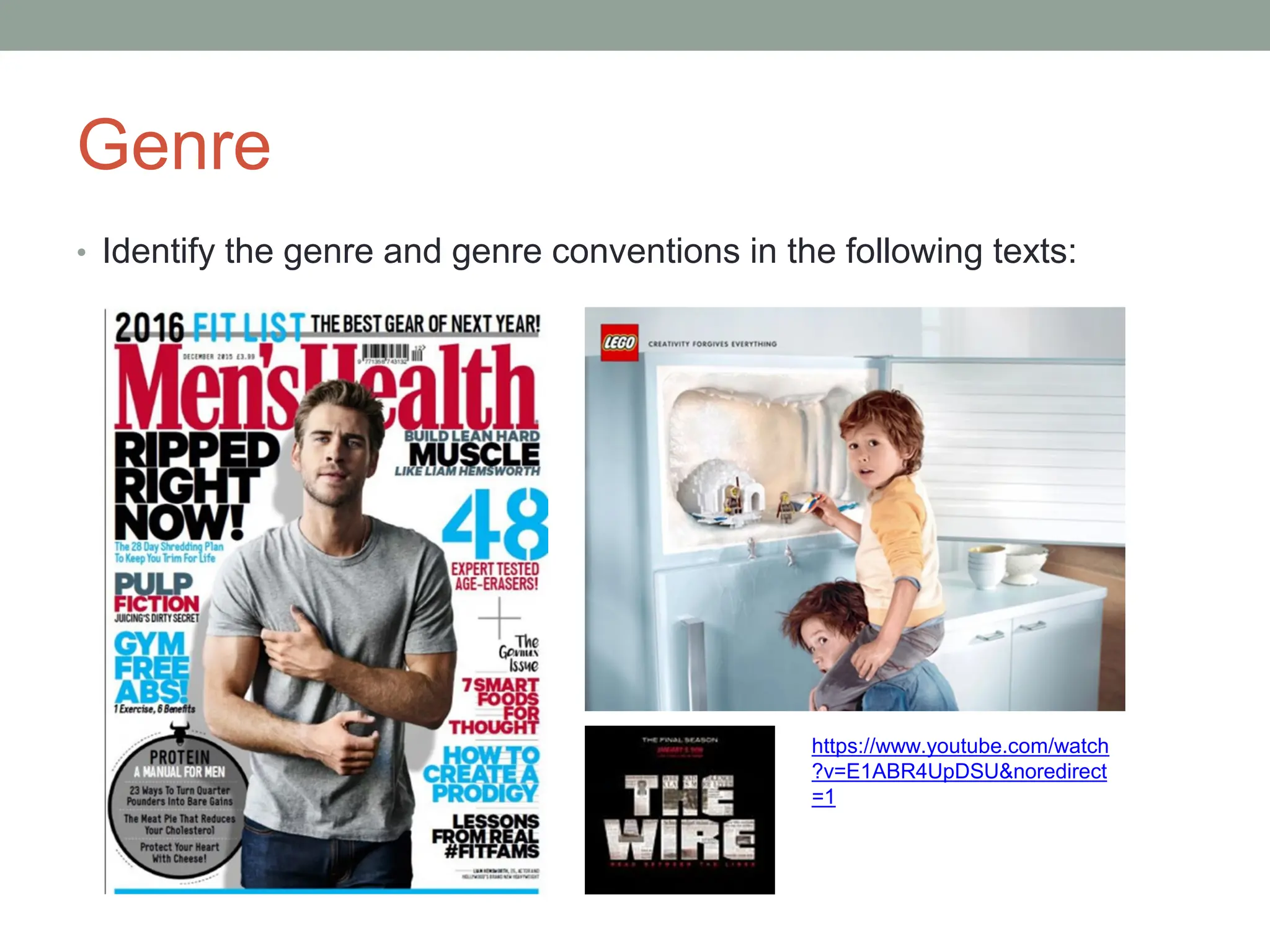
• How might the following clip be an example of a genre
dealing with both repetition and difference?
• How might economic, institutional and industrial contexts
play a part in the existence and formation of the text?
• https://www.youtube.com/watch?v=jsP0W7-tEOc
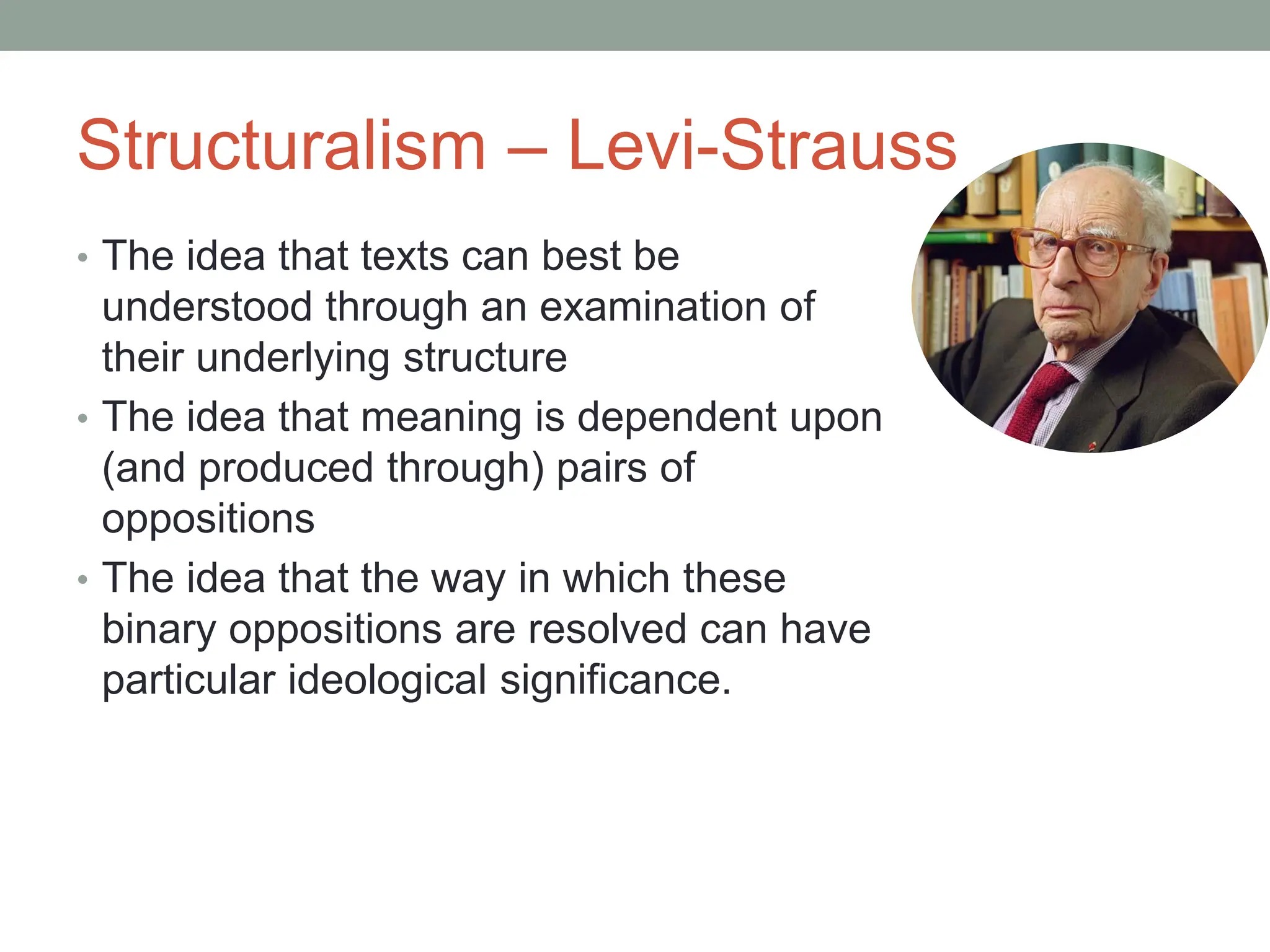
Structuralism – Levi-Strauss
• The idea that texts can best be
understood through an examination of
their underlying structure
• The idea that meaning is dependent upon
(and produced through) pairs of
oppositions
• The idea that the way in which these
binary oppositions are resolved can have
particular ideological significance.
Structuralism – Levi-Strauss
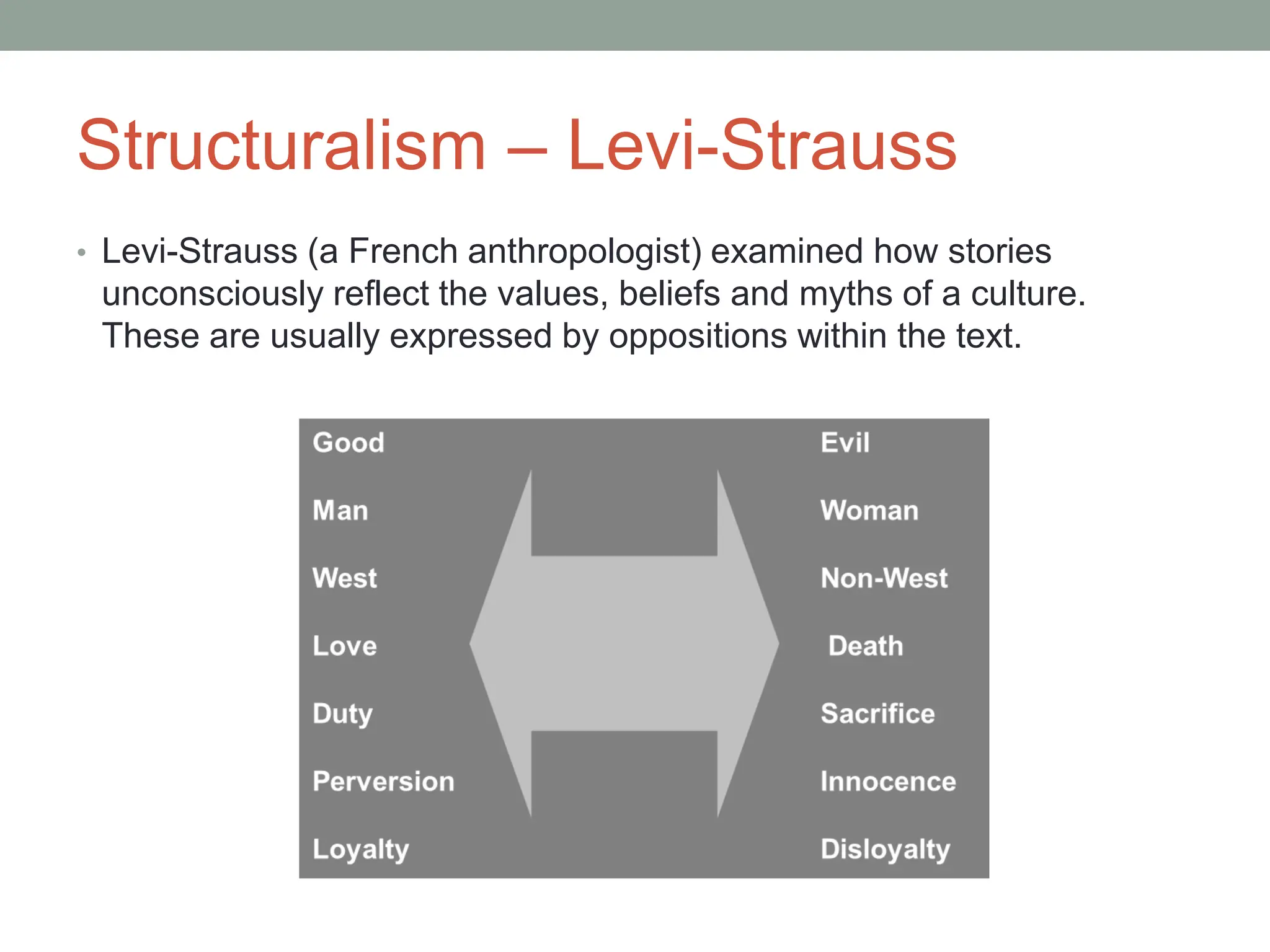
• Levi-Strauss (a French anthropologist) examined how stories
unconsciously reflect the values, beliefs and myths of a culture.
These are usually expressed by oppositions within the text.
Examples of Binary Opposition
http://www.youtube.c
om/watch?v=Pki6jbS
bXIY
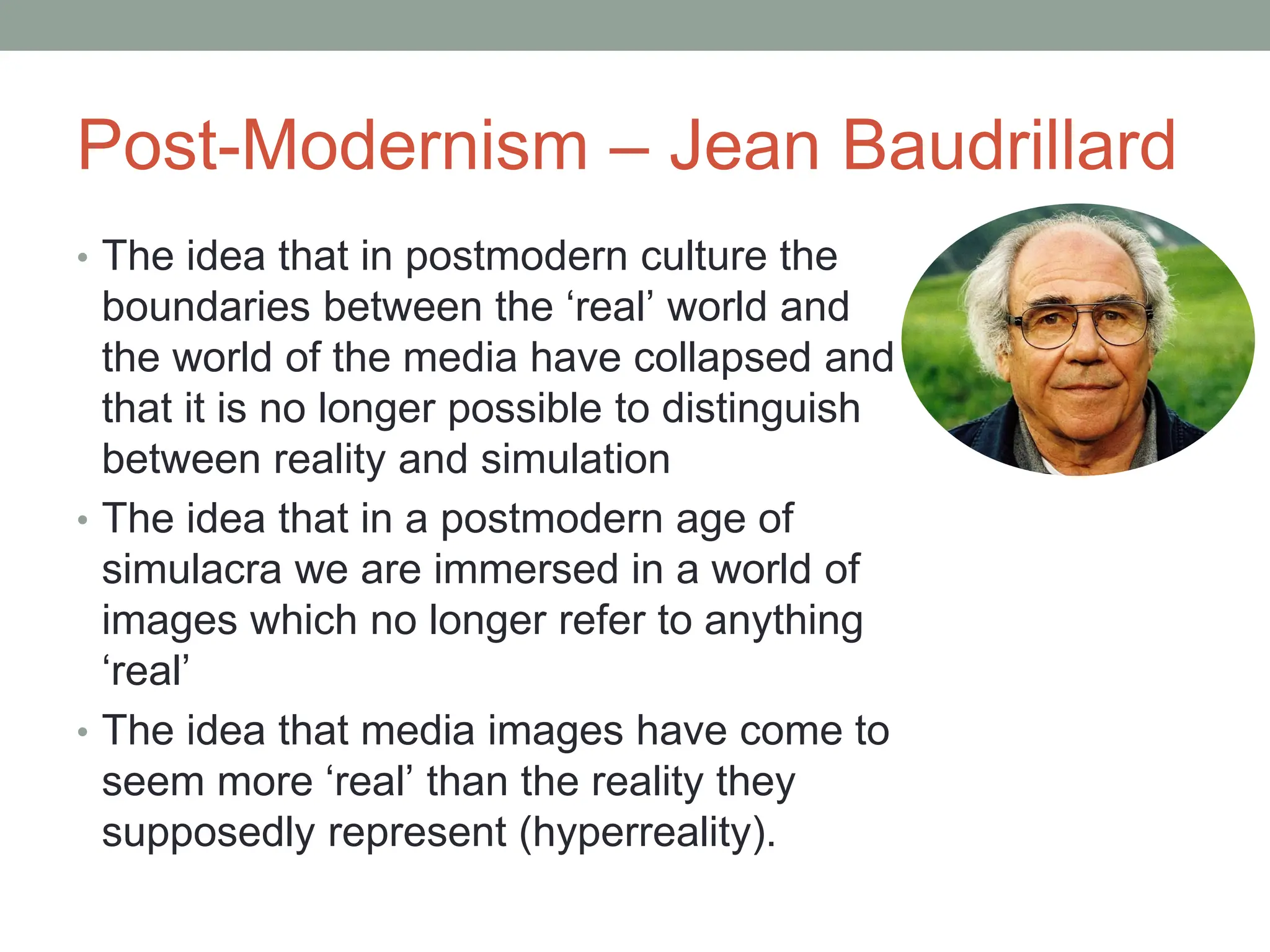
Post-Modernism – Jean Baudrillard
• The idea that in postmodern culture the
boundaries between the ‘real’ world and
the world of the media have collapsed and
that it is no longer possible to distinguish
between reality and simulation
• The idea that in a postmodern age of
simulacra we are immersed in a world of
images which no longer refer to anything
‘real’
• The idea that media images have come to
seem more ‘real’ than the reality they
supposedly represent (hyperreality).
Post-Modernism – Jean Baudrillard
Key features of post-modernism are:
• Hybridity / bricolage – the combining of styles e.g. genres to form
hybrid genres (romantic-comedy)
• Simulacrum / Simularca – is a term that describes the transformation
of the symbolic into the semiotic image – a journey from reflecting
reality, to masking reality, to having no relationship to reality what so
ever. What we call reality is only ‘the simulacrum’ – when we watch
the news we see only a world interpreted and rationalised by the TV
screen.
• Hyper reality – the simulacrum is marked not by its unreality but by
an excess of reality or hyper reality. Reality TV, social realist
cinema, fly-on-the-wall documentary are examples of hyper reality.
Their existence is to replicate reality, to make us believe that reality
can be discovered through the reproduction of reality e.g. I know
about Tribes in Kenya because I watched a documentary on it.
Post-Modernism – Jean Baudrillard
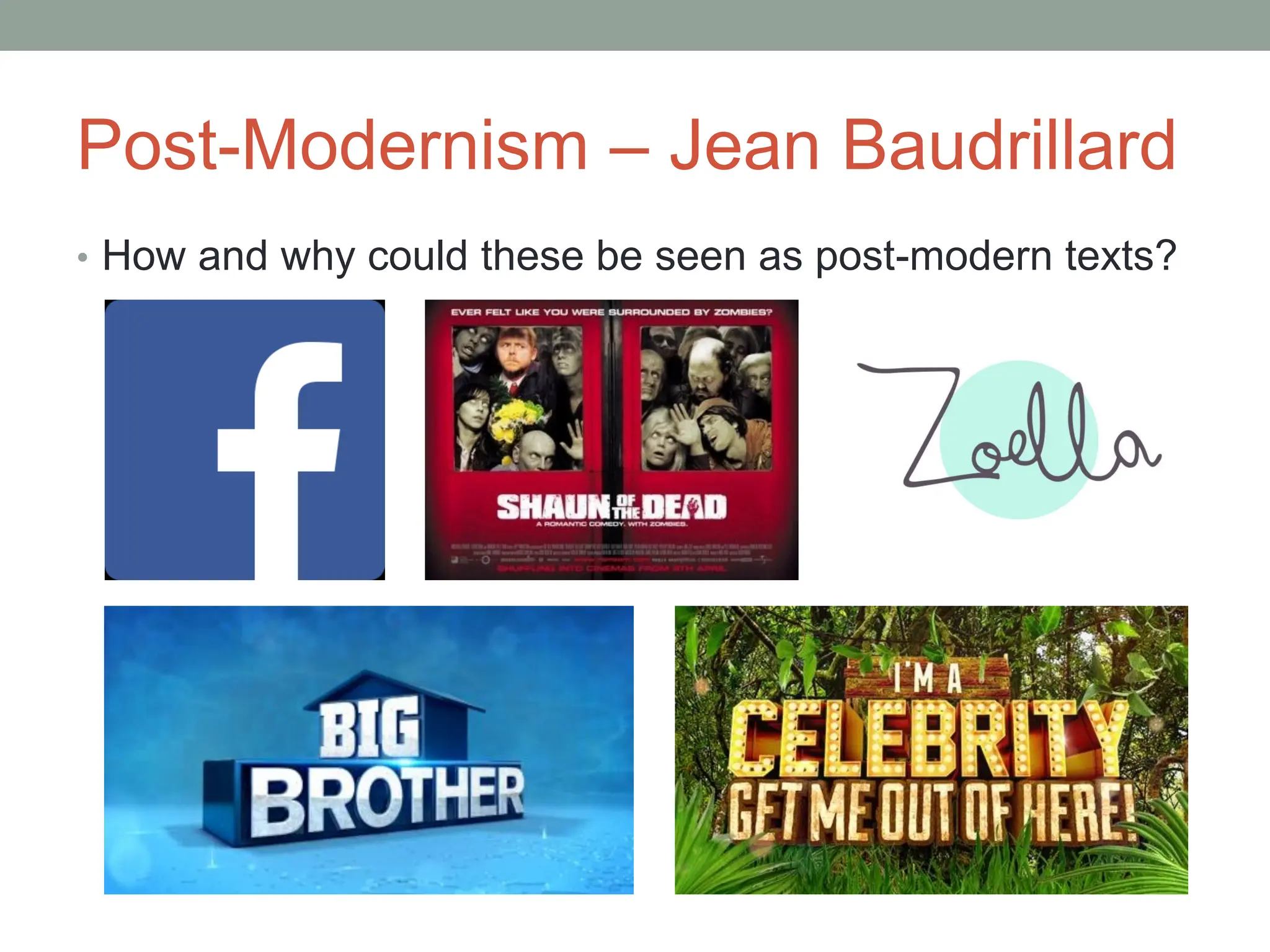
• How and why could these be seen as post-modern texts?
Representation
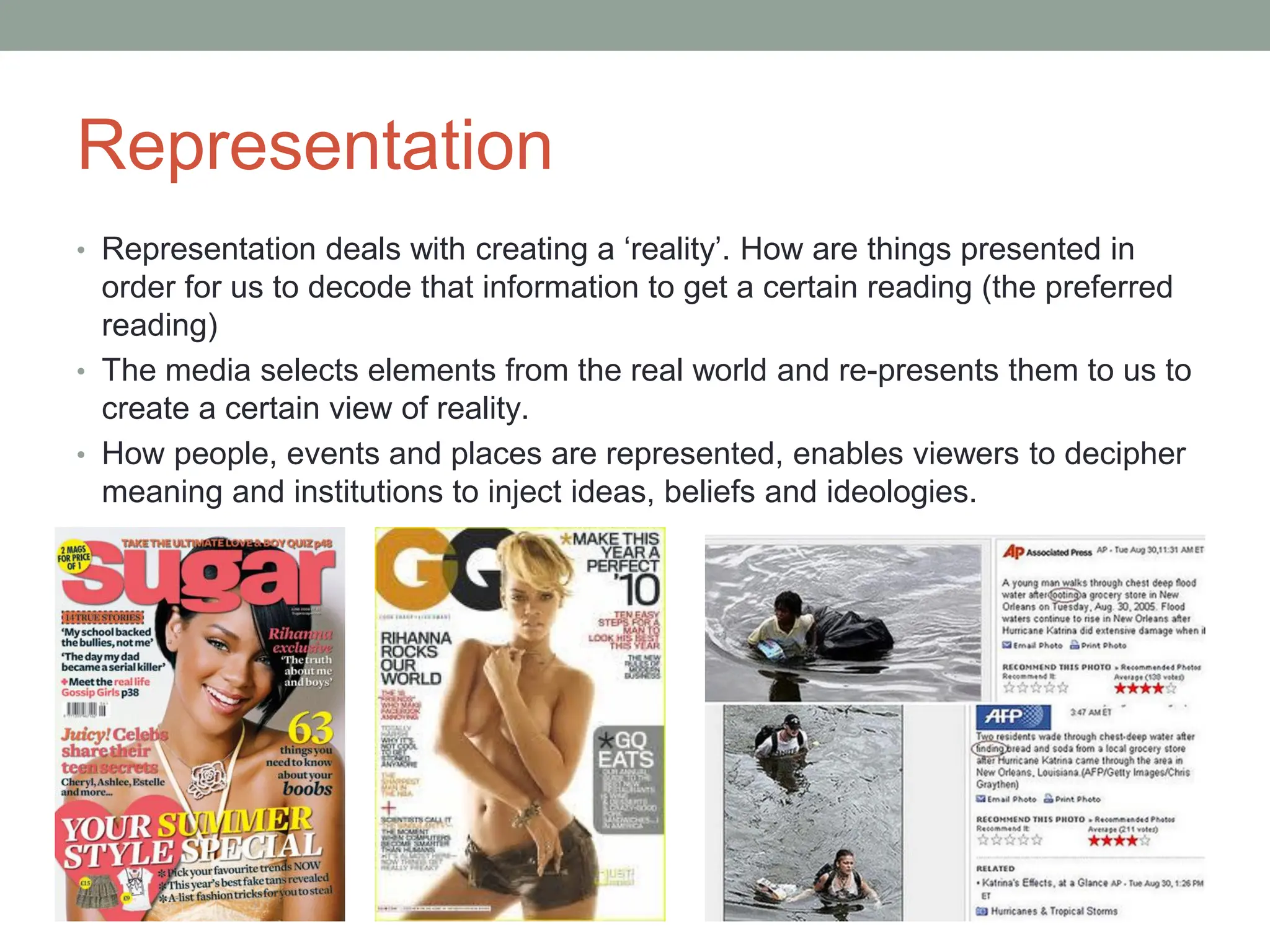
• Representation deals with creating a ‘reality’. How are things presented in
order for us to decode that information to get a certain reading (the preferred
reading)
• The media selects elements from the real world and re-presents them to us to
create a certain view of reality.
• How people, events and places are represented, enables viewers to decipher
meaning and institutions to inject ideas, beliefs and ideologies.
Representation
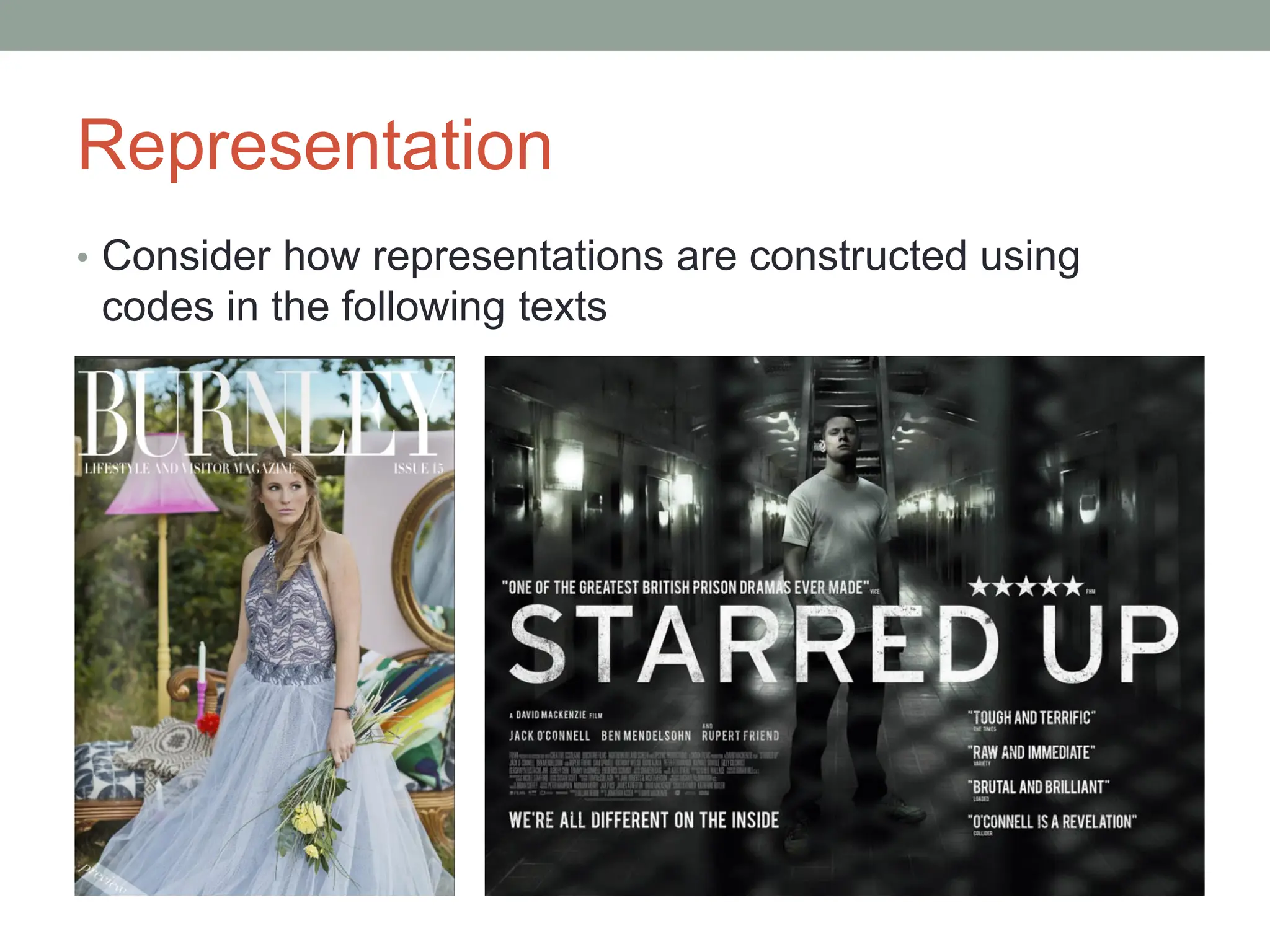
• Consider how representations are constructed using
codes in the following texts
Mediation and Construction
• Mediation is the process by which an institution comes to
represent events based on their ideological perspective. It is
the way the institution tells the story of the events that it has
witnessed.
• Mediation is very important when understanding ideological
values and beliefs of the institution. The way that they
represent events/people/places gives us important information
about the institutions ideologies. When viewing a text you
should constantly be thinking about mediation and how the
institution has constructed the story. For instance: are they
showing both sides of the story? Are they stereotyping people
in the stories? Are they being fair in their representations?
• Remember all texts are constructed to tell the story in a
particular way!
Mediation and Construction
Consider a stabbing in Manchester.
• Do they choose to cover the story (news values)?
• How long do they cover the story for?
• Who does the institution interview about the event?
• Which images do they use in the story?
• Do they create binary opposition in the piece?
• Do they provide a balanced perspective of the story?
All these elements are considered when making the piece about
the story. This is the process of mediation, what the institution
decides to put in and leave out. All text go through the process
of mediation.
Ideology
• Representations create ideology
• In sociological terms, ideology is a body of ideas or set of beliefs
that underpins a process or institution and leads to social relations.
These sets of beliefs are those held by groups within society, and
the prevalent ones are those held by the ruling/dominant groups.
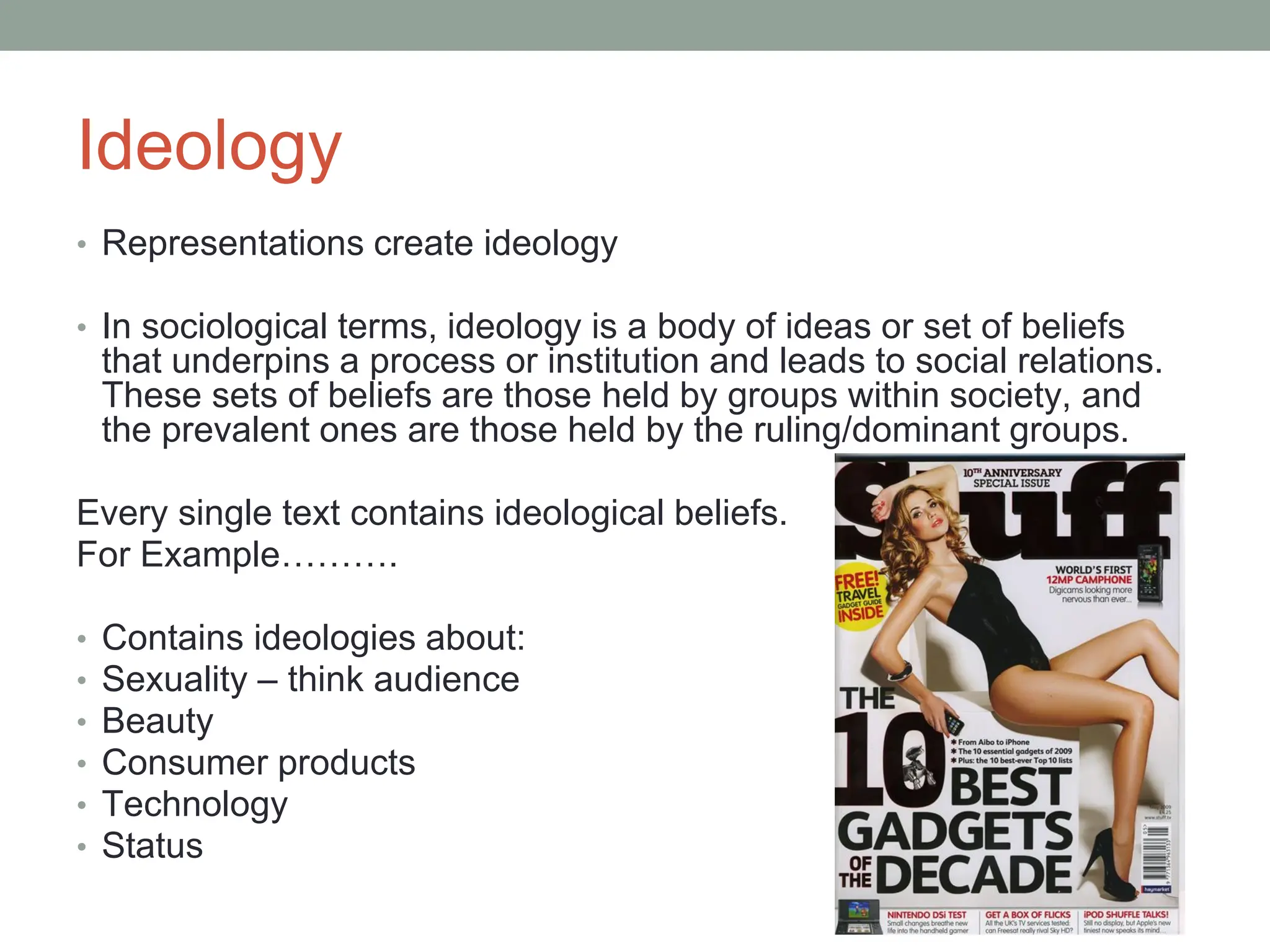
Every single text contains ideological beliefs.
For Example……….
• Contains ideologies about:
• Sexuality – think audience
• Beauty
• Consumer products
• Technology
• Status
Stuart Hall
• The idea that representation is the production of meaning
through language, with language defined in its broadest
sense as a system of signs
• The idea that the relationship between concepts and
signs is governed by codes
• The idea that stereotyping, as a form of representation,
reduces people to a few simple characteristics or traits
• The idea that stereotyping tends to occur where there are
inequalities of power, as subordinate or excluded groups
are constructed as different or ‘other’ (e.g. through
ethnocentrism).
Stereotypes
• Media stereotypes are inevitable, especially in the advertising,
entertainment and news industries, which need as wide an audience as
possible to quickly understand information. Stereotypes act like codes that
give audiences a quick, common understanding of a person or group of
people—usually relating to their class, ethnicity or race, gender, sexual
orientation, social role or occupation.
But stereotypes can be problematic. They can:
• Reduce a wide range of differences in people to simplistic categorizations.
• Transform assumptions about particular groups of people into "realities".
This is called naturalisation.
• Be used to justify the position of those in power.
• Perpetuate social prejudice and inequality.
• More often than not, the groups being stereotyped have little to say about
how they are represented
Examples of Stereotypes
• How are codes used to construct these stereotypes?
Ethnicity Age Gender
David Gauntlett
• the idea that the media provide us with
‘tools’ or resources that we use to
construct our identities
• the idea that whilst in the past the media
tended to convey singular, straightforward
messages about ideal types of male and
female identities, the media today offer us
a more diverse range of stars, icons and
characters from whom we may pick and
mix different ideas.
David Gauntlett
• Given the development of web 2.0 (two way
communication on websites e.g. Facebook), traditional
media theories don’t take into account the ‘new’
relationship between audiences and media industries,
where the audience can become the producer of the text.
• Through web 2.0 audiences are able to construct their
own identities and even influence other people.
• This intern has allowed for more flexibility in peoples
‘identity’ as we are not constricted through traditional
norms of gender. This has resulted in it being more
acceptable to be ‘different’
• We pick and mix our identities based on a wide range of
identities that are presented to us by the media
David Gauntlett – Task
• Consider any social media space that you may have
• How does the page differ from when you first set that
page up?
• List some things that have changed and then the possible
reasons as to why they may have changed
Feminism
What is your understanding of feminism?
Patriarchy: a system of society or government in which
men hold the power and women are largely excluded from
it.
"the dominant ideology of patriarchy"
Laura Mulvey
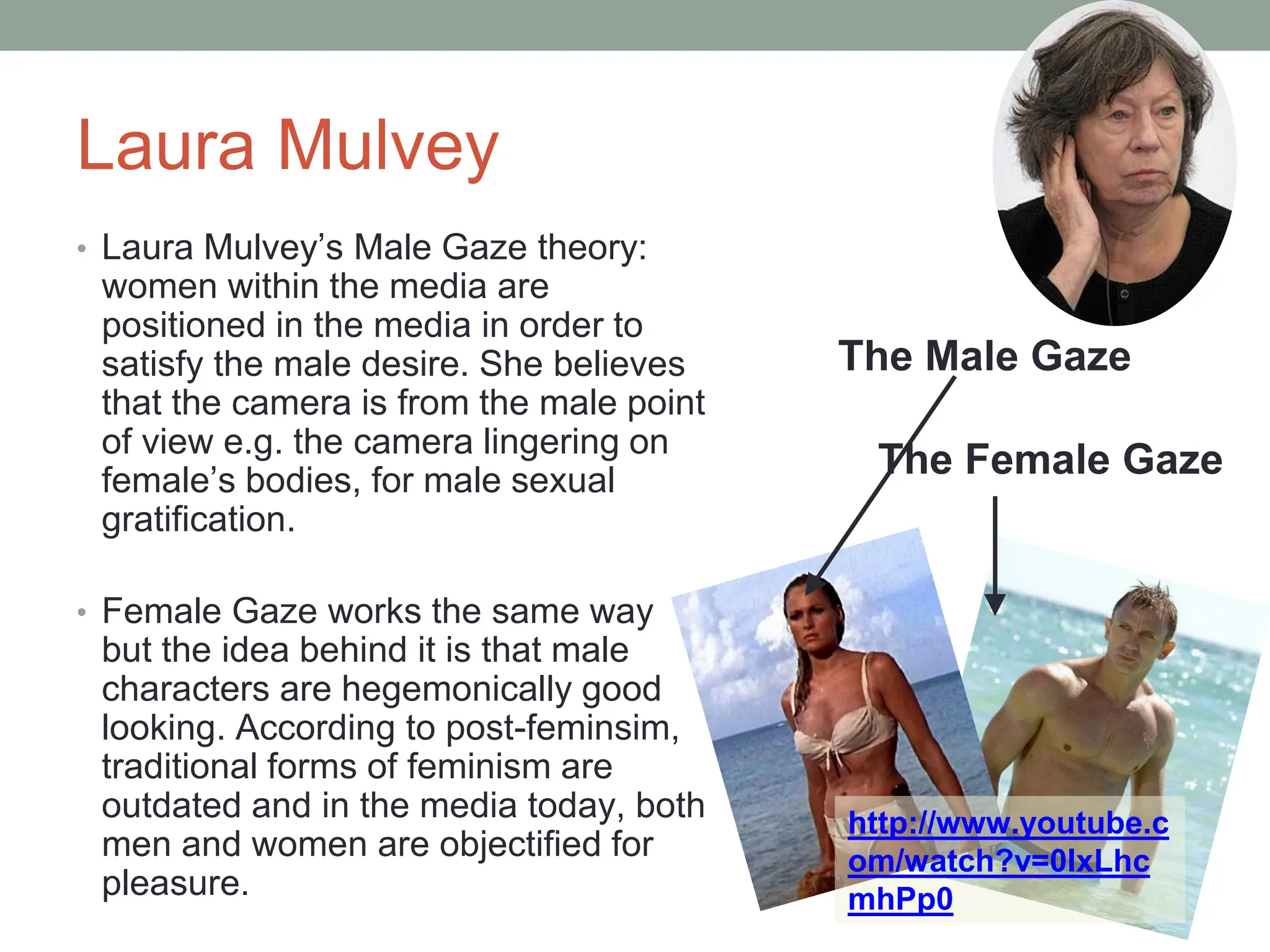
• Laura Mulvey’s Male Gaze theory:
women within the media are
positioned in the media in order to
satisfy the male desire. She believes
that the camera is from the male point
of view e.g. the camera lingering on
female’s bodies, for male sexual
gratification.
• Female Gaze works the same way
but the idea behind it is that male
characters are hegemonically good
looking. According to post-feminsim,
traditional forms of feminism are
outdated and in the media today, both
men and women are objectified for
pleasure.
The Male Gaze
The Female Gaze
http://www.youtube.c
om/watch?v=0lxLhc
mhPp0
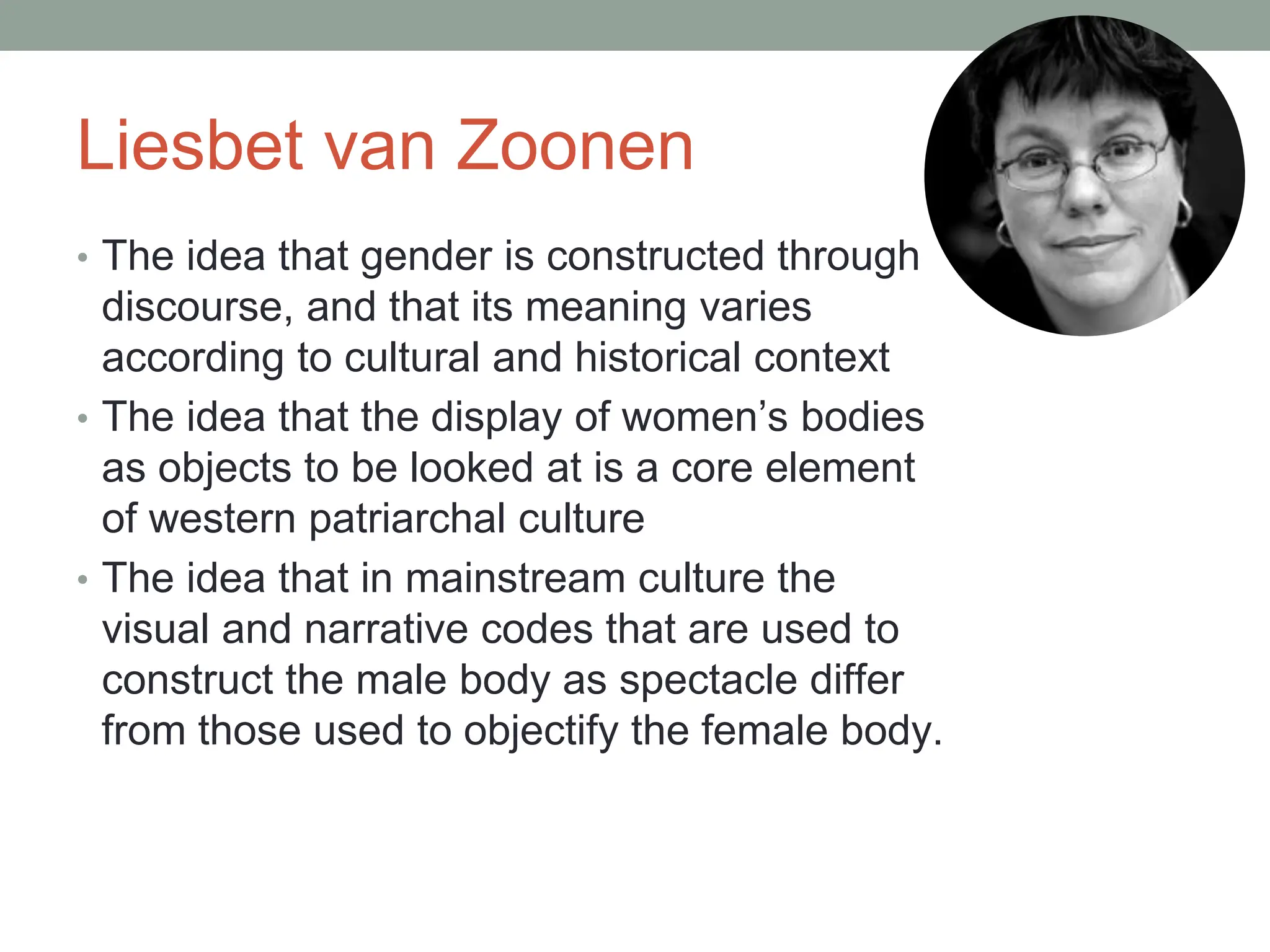
Liesbet van Zoonen
• The idea that gender is constructed through
discourse, and that its meaning varies
according to cultural and historical context
• The idea that the display of women’s bodies
as objects to be looked at is a core element
of western patriarchal culture
• The idea that in mainstream culture the
visual and narrative codes that are used to
construct the male body as spectacle differ
from those used to objectify the female body.
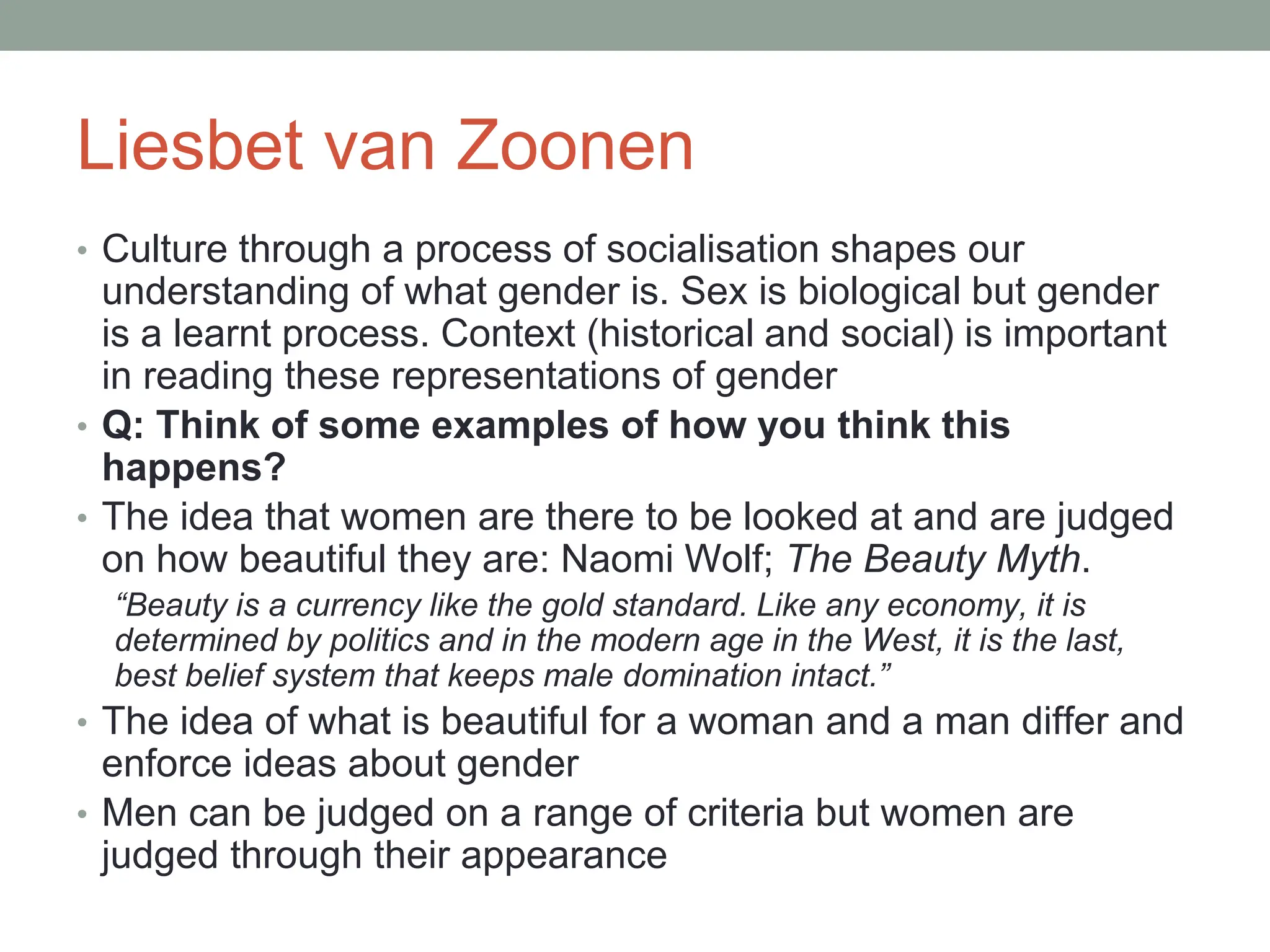
Liesbet van Zoonen
• Culture through a process of socialisation shapes our
understanding of what gender is. Sex is biological but gender
is a learnt process. Context (historical and social) is important
in reading these representations of gender
• Q: Think of some examples of how you think this
happens?
• The idea that women are there to be looked at and are judged
on how beautiful they are: Naomi Wolf; The Beauty Myth.
“Beauty is a currency like the gold standard. Like any economy, it is
determined by politics and in the modern age in the West, it is the last,
best belief system that keeps male domination intact.”
• The idea of what is beautiful for a woman and a man differ and
enforce ideas about gender
• Men can be judged on a range of criteria but women are
judged through their appearance
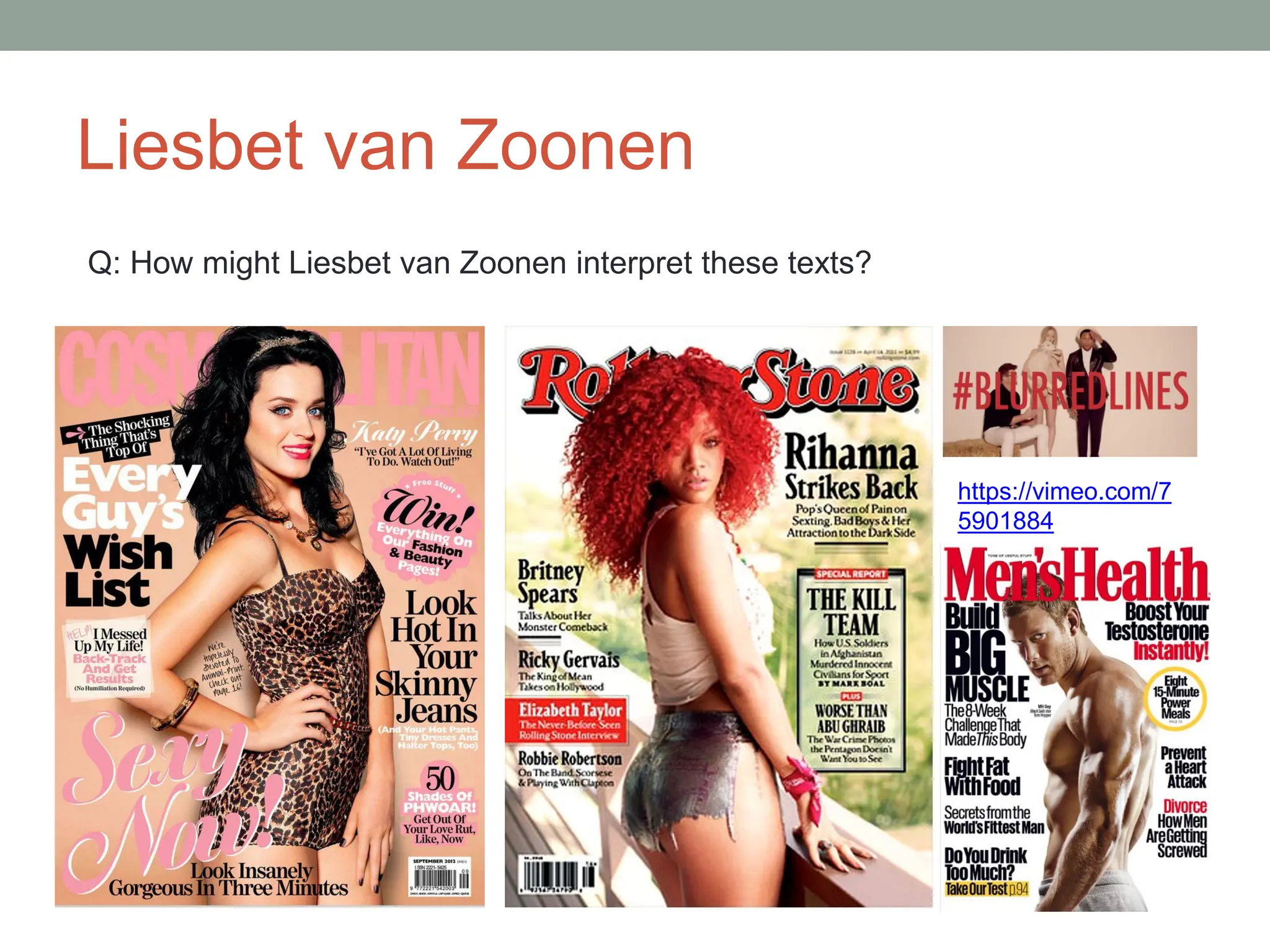
Liesbet van Zoonen
https://vimeo.com/7
5901884
Q: How might Liesbet van Zoonen interpret these texts?
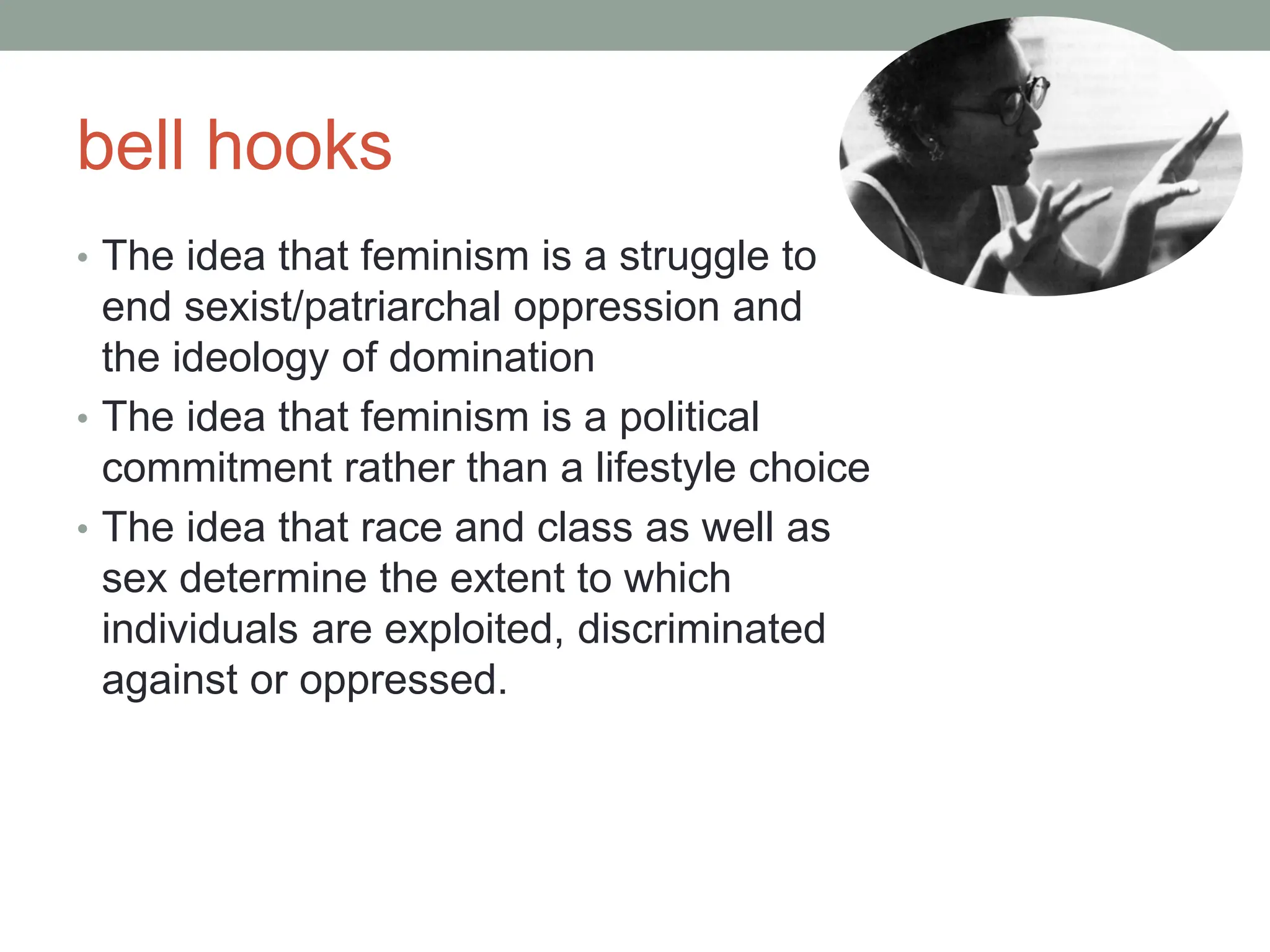
bell hooks
• The idea that feminism is a struggle to
end sexist/patriarchal oppression and
the ideology of domination
• The idea that feminism is a political
commitment rather than a lifestyle choice
• The idea that race and class as well as
sex determine the extent to which
individuals are exploited, discriminated
against or oppressed.
bell hooks
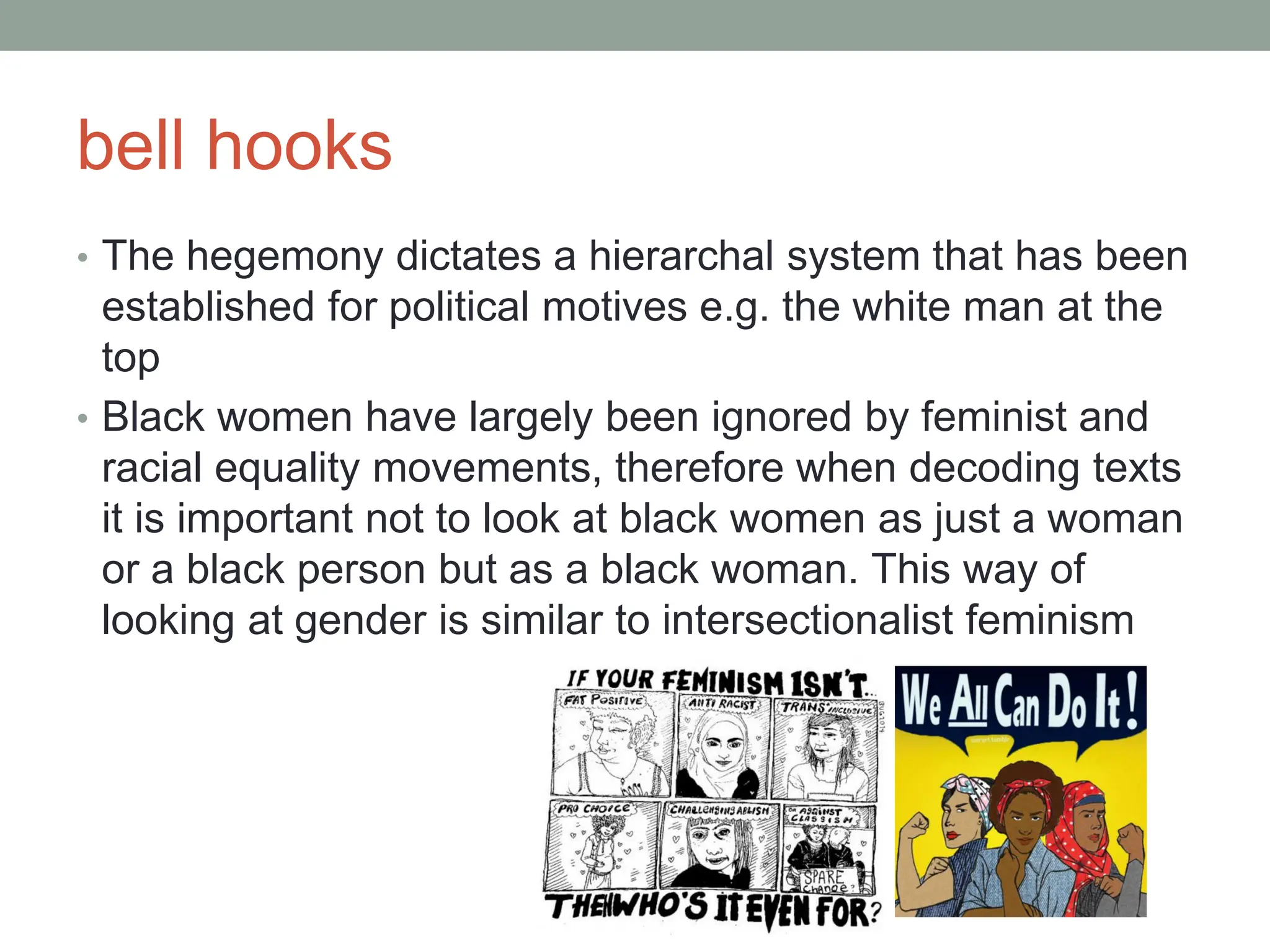
• The hegemony dictates a hierarchal system that has been
established for political motives e.g. the white man at the
top
• Black women have largely been ignored by feminist and
racial equality movements, therefore when decoding texts
it is important not to look at black women as just a woman
or a black person but as a black woman. This way of
looking at gender is similar to intersectionalist feminism
bell hooks
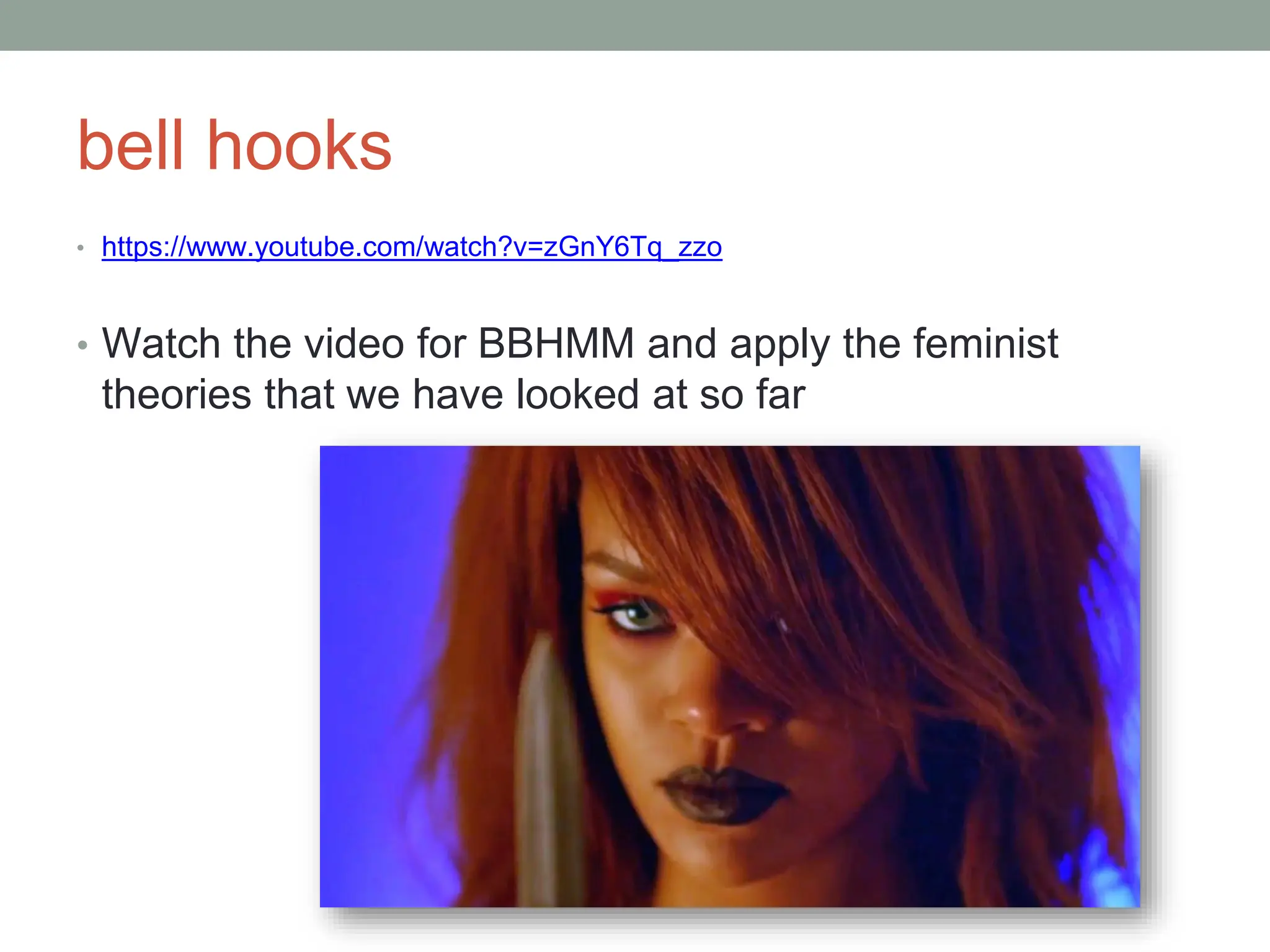
• https://www.youtube.com/watch?v=zGnY6Tq_zzo
• Watch the video for BBHMM and apply the feminist
theories that we have looked at so far
Judith Butler
• The idea that identity is performatively
constructed by the very ‘expressions’ that are
said to be its results (it is manufactured
through a set of acts)
• The idea that there is no gender identity
behind the expressions of gender
• The idea that performativity is not a singular
act, but a repetition and a ritual.
Judith Butler
• That our identities are played out by our performances of
how we present our gender
• That our identity is ‘free-floating’ and can change
• That our identities do not reflect our ‘core self’ (who we
really are)
• The repetitive nature of the blogs and vlogs can be seen
to be conforming to a set of rituals – Zoella’s beauty and
fashion posts for example, and the construction of self-
representations. The ‘Zalfie Sims’ posts where Alfie
Deyes (PointlessBlog) and Zoella play Sims add another
layer of performativity as they play simulated versions of
themselves.
Judith Butler
• Q: Look at the Facebook / Instagram / Twitter page of
your favourite celebrity and comment on how they are
representing themselves and constructing an identity
for themselves.
Paul Gilroy
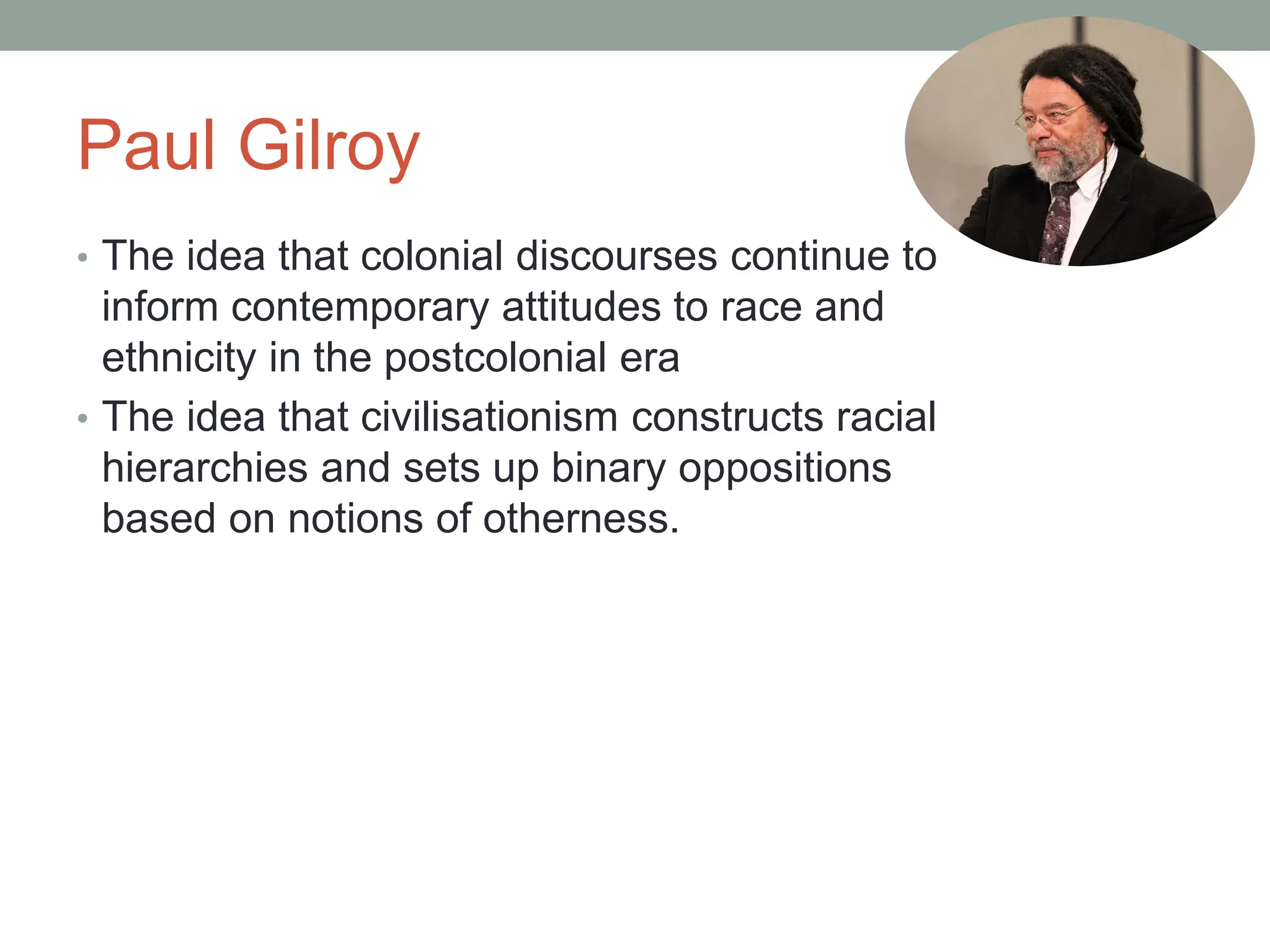
• The idea that colonial discourses continue to
inform contemporary attitudes to race and
ethnicity in the postcolonial era
• The idea that civilisationism constructs racial
hierarchies and sets up binary oppositions
based on notions of otherness.
Paul Gilroy
• Post-Colonialism is the concept that after the European
colonies have been disbanded, the white European's
bourgeoisie (the ruling class) maintain power through
ideological factors. This might take the form of ‘myths’ that are
created in the media about minority groups. Moreover it works
to demonise, stereotype and alienate minority groups by
seeing them as somehow not as ‘worthy’ as the ‘civilised’ white
society, creating what Stuart Hall calls the concept of ‘the
other’
• Ethnocentrism: the tendency to believe that one's own race
or ethnic group is the most important and that some or all
aspects of its culture are superior to those of other groups.
Since within this ideology, individuals will judge other groups in
relation to their own particular ethnic group or culture,
especially with concern to language, behaviour, customs, and
religion. These ethnic distinctions and sub-divisions serve to
define each ethnicity's unique cultural identity.
Paul Gilroy
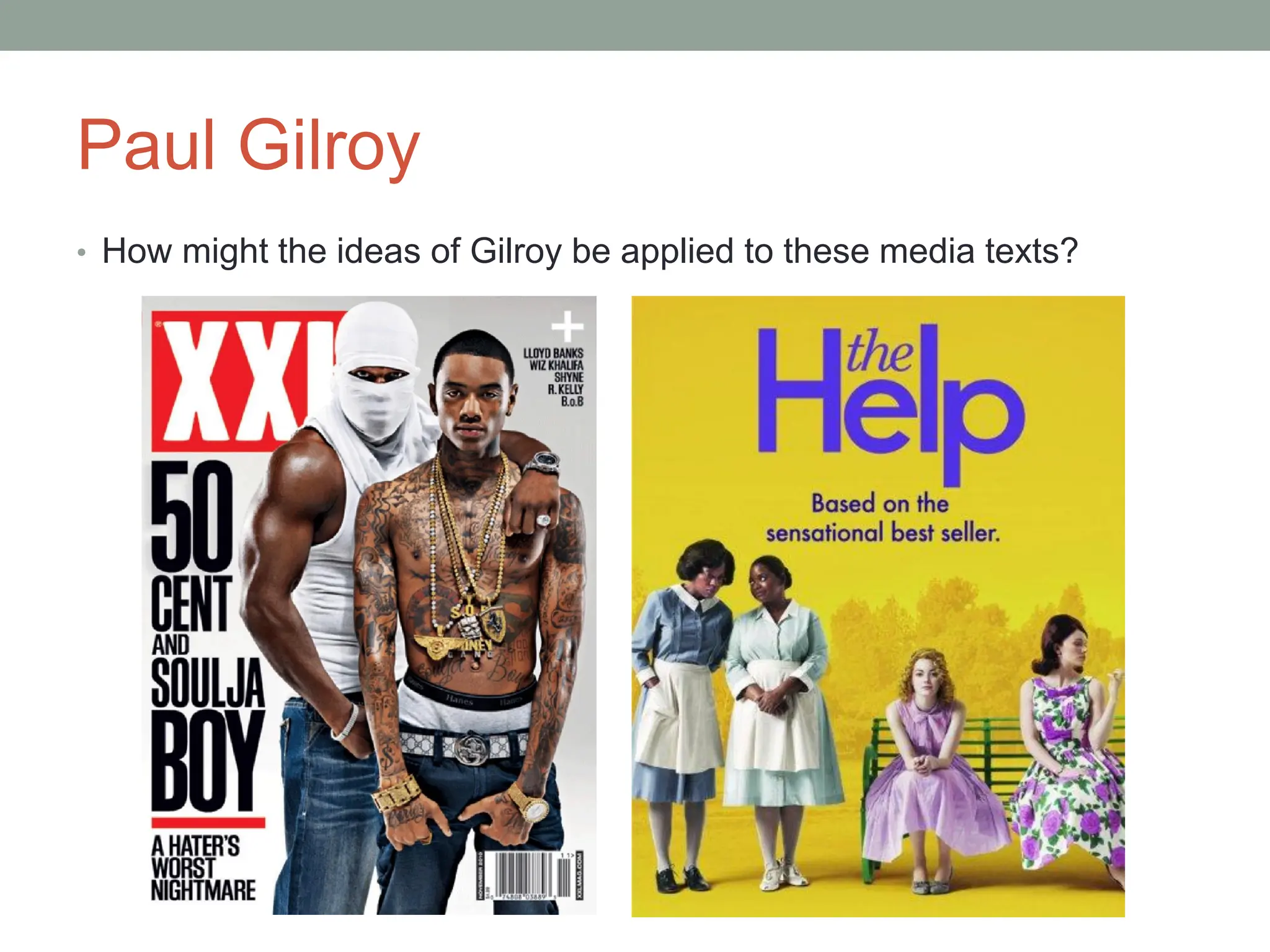
• How might the ideas of Gilroy be applied to these media texts?
Media Industries
Media business covers commercial functions such as finance,
distribution, exhibition and retailing, as well as production. The
owners of media businesses may also be into non media
enterprises. Media institutions may not even be commercial in
their foundation
T: Find out what distribution and exhibition is, in relation to
the media industry
Synergy – In media economics, synergy is the promotion and
sale of a product (and all its versions) throughout the various
subsidiaries of a media conglomerate, e.g. films, soundtracks
or video games. These products can help advertise the film
itself and thus help to increase the film's sales. For example,
the Spider-Man films had toys of web shooters and figures of
the characters made, as well as posters and games.
Curran and Seaton
• The idea that the media is controlled by a small number of
companies primarily driven by the logic of profit and
power
• The idea that media concentration generally limits or
inhibits variety, creativity and quality
• The idea that more socially diverse patterns of ownership
help to create the conditions for more varied and
adventurous media productions.
Curran and Seaton
• The media is predominantly controlled by conglomerates, which are
large multinational companies. The number of conglomerates is
actually very small compared to the number of media texts that are
produced. An example of this is the music industry where only four
major record labels dominate.
• The idea behind this theory is that it creates the homogenization of
culture due to the fact that only a small number of companies are in
charge and therefore there is a lack of alternative messages that
challenge the hegemony. In addition to this the creation of more
smaller companies would widen the cultural scope and present
many different ideological views. It could be argued that the
creation of web 2.0 has helped ‘give a voice’ to more people or
conversely it has not?
• When looking at this theory it might also be pertinent to look at how
marxist commentators, might view this theory. That the media
industry is an ideological tool that is used to keep the masses
passive.
Curran and Seaton
Task
• Track the ownership path of your favorite band / artist
• Find about who owns News Corporation and the
companies that exist within it. Why do you think this could
be problematic?
Livingstone and Lunt
• The idea that there is an underlying struggle in recent UK
regulation policy between the need to further the interests
of citizens (by offering protection from harmful or offensive
material), and the need to further the interests of
consumers (by ensuring choice, value for money, and
market competition)
• ·The idea that the increasing power of global media
corporations, together with the rise of convergent media
technologies and transformations in the production,
distribution and marketing of digital media, have placed
traditional approaches to media regulation at risk
Livingstone and Lunt
• Internet service providers are subject to regulation (and
work with the Internet Watch Foundation to block illegal
content such as child abuse images); however there is
much debate about the extent to which online content can
and/or should be regulated. A 2014 government report
stated that further formal regulation of internet content
might impinge on ‘the free flow of ideas and expression
that lies at the heart of the development of the internet’.
Ofcom is involved in monitoring internet content, advising
on online safety, and has worked with ISPs to ensure they
develop parental control tools.
Blogs
The idea that the increasing power of global media
corporations, together with the rise of convergent media
technologies and transformations in the production,
distribution and marketing of digital media, have placed
traditional approaches to media regulation at risk
• How could this be applied to the Blog that we are going to
look at in year 2 or social media in general?
David Hesmondhalgh
• The idea that cultural industry companies try to minimise
risk and maximise audiences through vertical and
horizontal integration, and by formatting their cultural
products (e.g. through the use of stars, genres, and
serials)
• The idea that the largest companies or conglomerates
now operate across a number of different cultural
industries
• The idea that the radical potential of the internet has been
contained to some extent by its partial incorporation into a
large, profit-orientated set of cultural industries
David Hesmondhalgh
• Vertical Integration is when a Media Company owns different
businesses in the same chain of production and distribution.
For example, a 20th Century Fox owns the studios in
Hollywood, they also own the cinemas, the TV channels and
the DVD rental shops. They own parts of chain so that they
can make money from every part of it.
• Horizontal Integration is a Media Company’s Ownership of
several businesses of the same value. A Media Company can
own a Magazine, Radio, Newspaper, Television and Books.
Almost all Media companies have horizontal integration. It
helps to create more money and makes the company more
popular among readers. Also, not all media readers prefer
reading magazines. The more technology literate people will
read the magazine online, so horizontal integration helps to
reach a wider audience.
David Hesmondhalgh
• Straight Outta Compton was co-produced by members of
NWA and distributed by Universal Pictures, a vertically
integrated subsidiary of NBC Universal, which is owned
by Comcast. The notion of minimising risk and maximising
audiences clearly applies to this musical biopic (a popular
genre) that uses stars (members of NWA, a hugely
popular hip-hop act) to appeal to a range of fans and
audiences. Universal music released the official
soundtrack album, an example of synergy that contributed
to the success of the film. This combination of factors
could be seen to guarantee an audience and minimise the
risk for the producers.
David Hesmondhalgh
• The largest companies or conglomerates now operate
across a number of different cultural industries
• Universal - (film and music)
• News Corporation – (news, book and magazine publishing)
• HBO –Time Warner (film and television)
• The the internet and the ‘independent’ producers that
work within it have been ‘assimilated’ in some way by the
large corporations. This is somewhat similar to what Dick
Hebdige talked about in his book ‘Cut n Paste’ about
subcultural groups eventually being swallowed up by the
mainstream and the ‘capitalist machine’
Audiences
Most media texts work to the principal of being a success is
to either
• Generate money
• Attract as large an audience as possible
• Genres are used to appeal to a specific audience.
Audiences seek out genres that they enjoy
• Media texts are used to bring in advertisers and therefore
generate money
• Subscription services use pay monthly schemes to
generate money
Media Effects & Albert Bandura
• The idea that the media can implant ideas in
the mind of the audience directly
• The idea that audiences acquire attitudes,
emotional responses and new styles of
conduct through modeling
• The idea that media representations of
transgressive behaviour, such as violence or
physical aggression, can lead audience
members to imitate those forms of behaviour.
Media Effects & Albert Bandura
• Bandura looks at the way that media texts have a direct
influence on it’s audience. For instance he argues that
violence is prevalent in the media and therefore exposure
to this violence in various forms (e.g. different TV
programmes) enables us to perceive violence as
acceptable way to deal with situations. Bandura called
this ‘modeling’ of behaviour.
Media Effects & Albert Bandura
• T: Conduct some research into the following
• Moral panics
• Hypodermic Needle Theory
• Media effects theory relating to Marilyn Manson and
Natural Born Killers
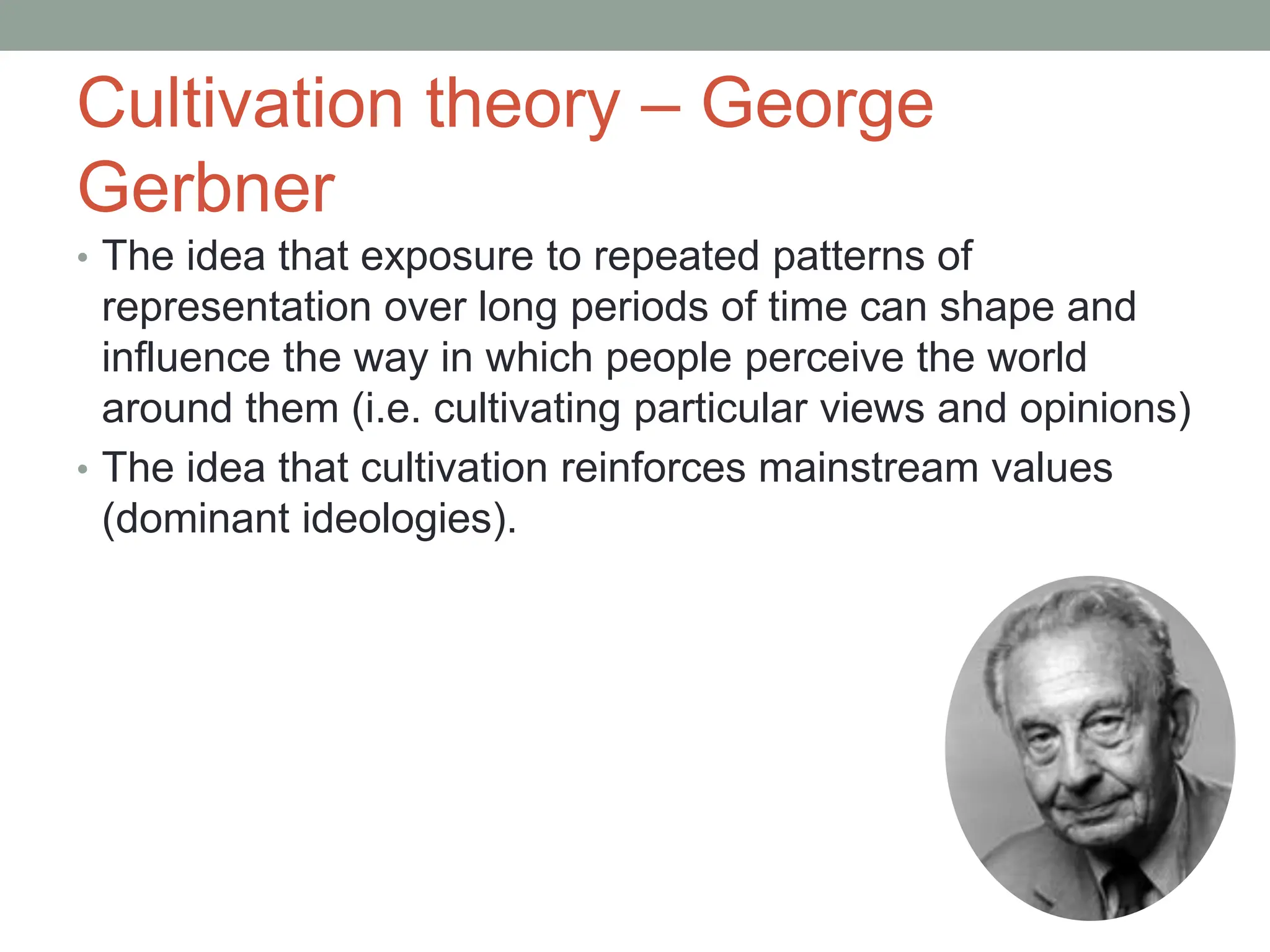
Cultivation theory – George
Gerbner
• The idea that exposure to repeated patterns of
representation over long periods of time can shape and
influence the way in which people perceive the world
around them (i.e. cultivating particular views and opinions)
• The idea that cultivation reinforces mainstream values
(dominant ideologies).
George Gerbner
• Gerbner believes media messages aren’t directly injected
into the passive media audience but they are built up by a
series of repetition and enforcing of the message. This
then instates the hegemony.
• This is similar to what Altusser describes as interpellation
the process of hearing and seeing similar messages in
media texts so that the ideology is enforced onto the
audience, which in turn makes them passive
George Gerbner
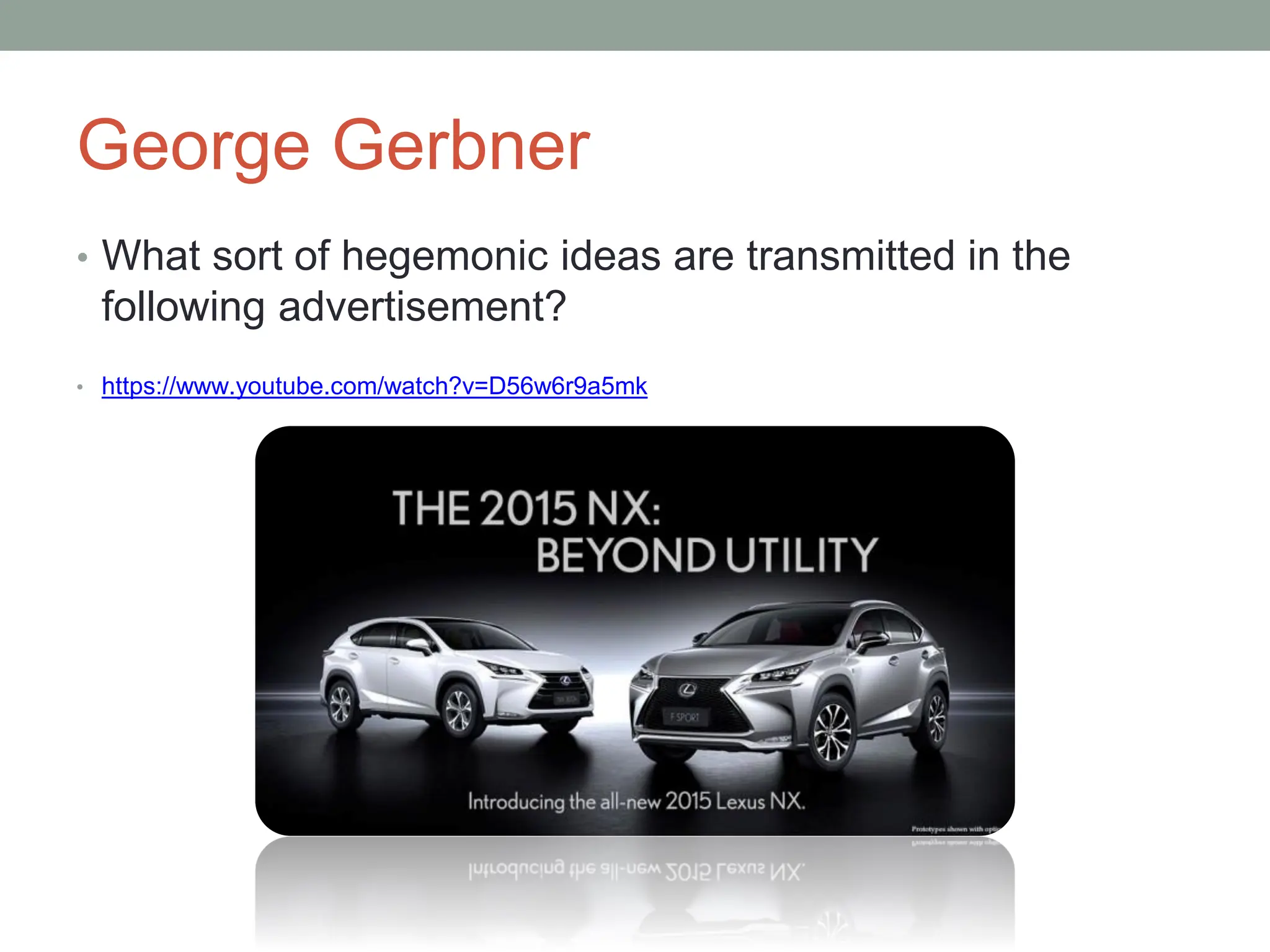
• What sort of hegemonic ideas are transmitted in the
following advertisement?
• https://www.youtube.com/watch?v=D56w6r9a5mk
Reception Theory – Stuart Hall
• the idea that communication is a process involving
encoding by producers and decoding by audiences
• the idea that there are three hypothetical positions from
which messages and meanings may be decoded:
• the dominant-hegemonic position: the encoder’s intended
meaning (the preferred reading) is fully understood and accepted
• the negotiated position: the legitimacy of the encoder’s message
is acknowledged in general terms, although the message is
adapted or negotiated to better fit the decoder’s own individual
experiences or context
• the oppositional position: the encoder’s message is understood,
but the decoder disagrees with it, reading it in a contrary or
oppositional way.
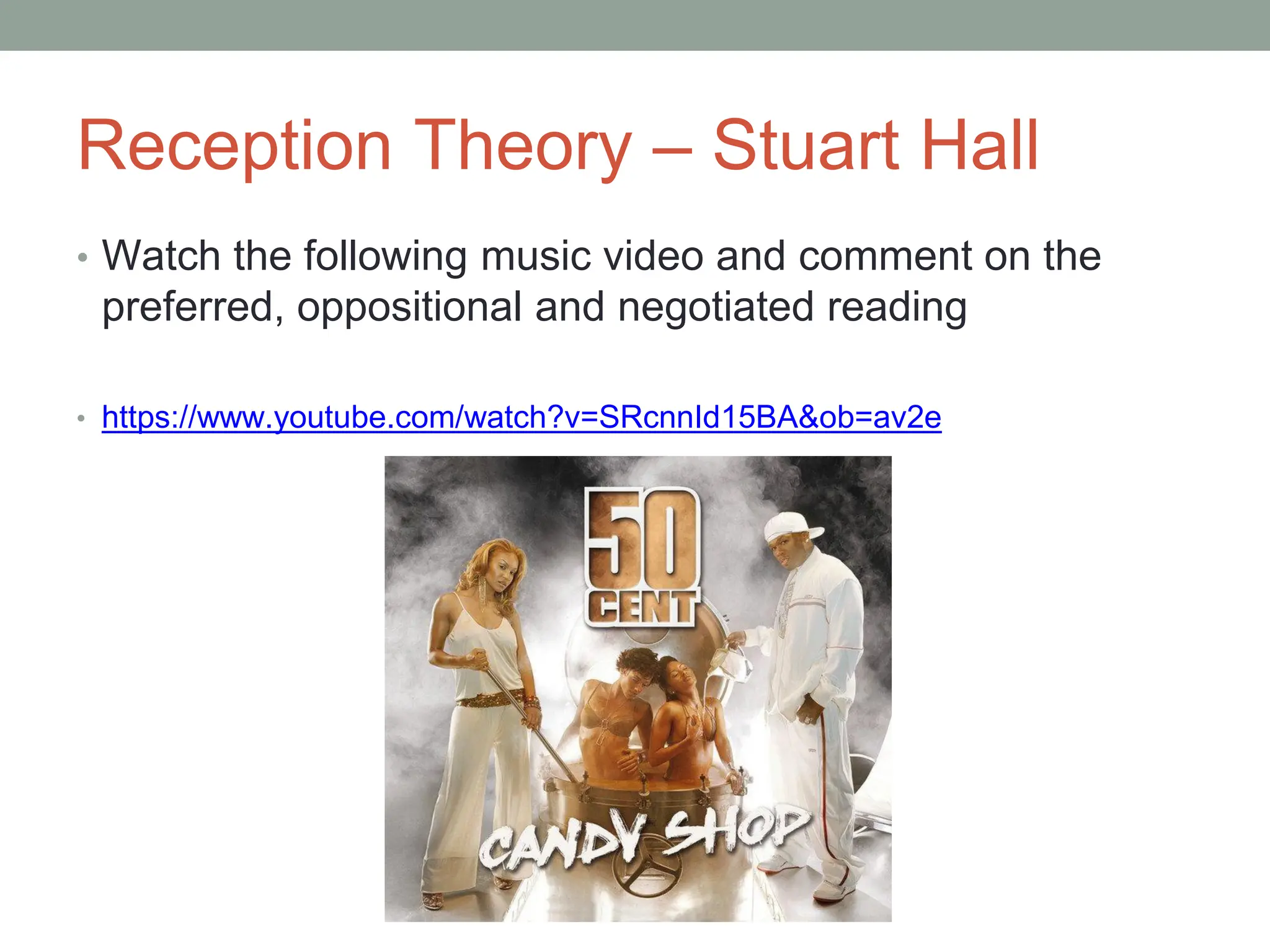
Reception Theory – Stuart Hall
• Watch the following music video and comment on the
preferred, oppositional and negotiated reading
• https://www.youtube.com/watch?v=SRcnnId15BA&ob=av2e
Fandom – Henry Jenkins
• The idea that fans are active participants in the
construction and circulation of textual meanings
• The idea that fans appropriate texts and read them in
ways that are not fully authorised by the media producers
(‘textual poaching’)
• The idea that fans construct their social and cultural
identities through borrowing and inflecting mass culture
images, and are part of a participatory culture that has a
vital social dimension.
Fandom – Henry Jenkins
• Jenkins’ theory applies to many forms, especially online media forms. The
term ‘fandom’ traditionally refers to avid supporters of, for example a music
artist or film franchise. However, fandom can apply to any media form and
the internet has allowed media consumers to experience and engage with
products in a variety of different ways.
• The idea that fans are active participants in the construction and circulation
of textual meanings.
• For example
• Television and radio – e.g. live tweeting during Late Night Woman’s Hour, sharing
responses to the show.
• Video games – active involvement in the narrative, can be extended via online gaming.
• The idea that fans construct their social and cultural identities through
borrowing and inflecting mass culture images, and are part of a
participatory culture that has a vital social dimension.
• This is particularly relevant to the online blogs as audiences respond and
interact with the bloggers as part of a social online community.
Fandom – Henry Jenkins
Textual Poaching
• That audiences are not passive consumers but instead
active interpreters, where each person will create their
own meaning from the same text, depending on their
situation and unique background. Fan cultures which
‘poach’ from their beloved text to create new texts such as
fan fiction, folk songs and manuals/dictionaries to ‘fill-out’
further details not originally explained in the
text. Poaching blurs the line between producer and
consumer by giving the reader power to produce their
own work based upon their own interpretation.
•
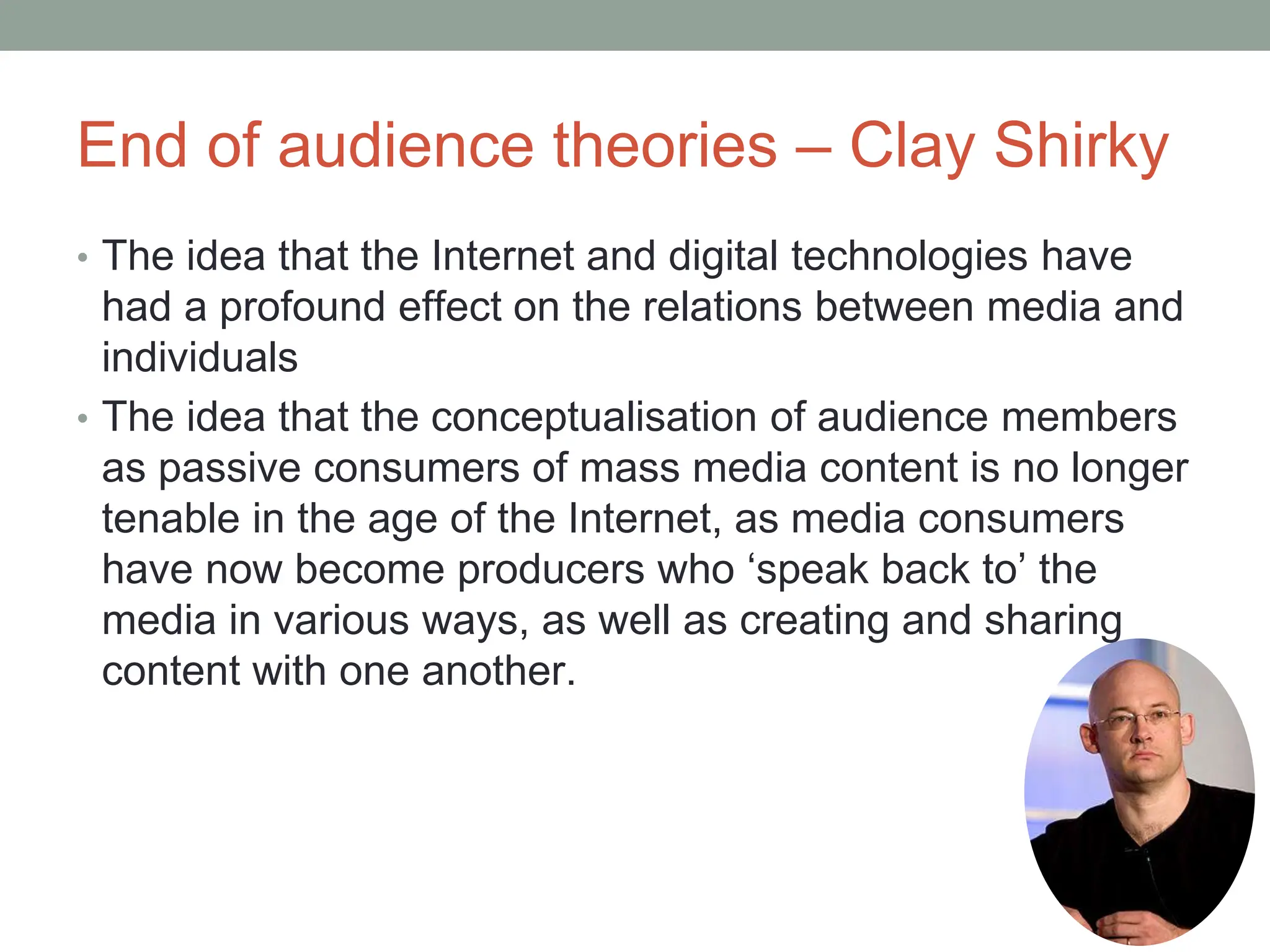
End of audience theories – Clay Shirky
• The idea that the Internet and digital technologies have
had a profound effect on the relations between media and
individuals
• The idea that the conceptualisation of audience members
as passive consumers of mass media content is no longer
tenable in the age of the Internet, as media consumers
have now become producers who ‘speak back to’ the
media in various ways, as well as creating and sharing
content with one another.
End of audience theories – Clay Shirky
• The online blogs are the most obvious products to consider in relation to Shirky’s
ideas due to the interaction between audience and producer/product. Both
bloggers are aware that media producers no longer simply communicate
messages to a passive audience, and offer an environment where audiences can
communicate with them and ‘speak back’ to the media. However, these products
are still mediated and controlled by the producers, so it is worth considering the
extent to which their audiences can become active producers.
•
• Shirky’s theory can also be applied to other forms, by considering the ways in
which digital technologies have allowed audiences to become more active
producers, for example the proliferation of online platforms has enabled radio
listeners and newspaper readers to comment, share and, in some cases, upload
their own content via websites and social media
• Media technological convergence is the tendency that as technology changes,
different technological system sometimes evolves toward performing similar
tasks. The best example of this is a SMART phone.
Beyonce
• T: Do some research into Beyonce and provide
examples of how the ‘Shirky’ theory and the idea of
Fandom could be applied to her
• Consider
• Fan sites
• Social media
• Parody and Pastiche
Context
Historical Contexts
• how genre conventions are historically relative and dynamic
• the effect of historical context on representations
• the relationship of recent technological change and media production, distribution and circulation
• the way in which different audience interpretations reflect historical circumstances
Social and Cultural Contexts
• how genre conventions are socially relative
• the effect of social and cultural context on representations
• how and why particular social groups, in a national and global context, may be under- represented or misrepresented
• how audience responses to and interpretations of media products reflect social and cultural circumstances
Economic Context
• how media products relate to their economic contexts in terms of:
• production, distribution and circulation in a global context
• the significance of patterns of ownership and control
• the significance of economic factors, including funding
Political Context
• how media products reflect the political contexts in which they are made through their representations, themes, values, messages and
ideologies
• how media products reflect the political contexts in which they are made through aspects of their ownership and political orientation,
production, distribution,
• marketing, regulation, circulation and audience consumption.
Context
Historical Contexts
The ways in which products reflect the time/period in which they were produced. Some areas to consider:
• How genre conventions are historically relative and dynamic - and reflect the concerns and ideologies of society at the time in which they were made.
Humans is an example of a sci-fi text that reflects current concerns in society and fears about artificial intelligence through the exploration of a constructed reality (simulacrum)
where ‘synthetic’ humans are almost indistinguishable from ‘real’ humans.
How the period in history has influenced the product in terms of:
• the social norms and ideologies/attitudes of the time
• particular social movements/developments (e.g. the feminist movement or
• civil rights movement)
• specific events or occurrences (e.g. World War II or changes in divorce law).
These factors will impact on the use of media language and construction of representations;
they will also influence audience interpretations of media products.
The historical magazines set for Component 2, Section B are influenced by the historical (and social and cultural) contexts in which they were produced, and by the values and
attitudes of the time, especially in relation to gender. Woman and Woman’s Realm, for example, feature representations of women within a largely domestic sphere (through
references to kitchen improvements and children’s raincoats on the respective front covers, for example), reflecting societal norms of the early 1960s. Vogue features different
female representations in the context of a fashion magazine, constructing idealised notions of female beauty and also suggesting the social changes that were occurring in the
mid-1960s (hints of the ‘permissive society’ through the ‘bare essentials’ advert).
Social and Cultural Contexts
The ways in which products reflect the society and culture in which they are produced. There may be some overlap with historical context in terms of genre conventions and
representations.
Some areas to consider:
•
• the effect of social and cultural context on representations
• how audience responses to and interpretations of media products reflect social and cultural circumstances
•
• Life on Mars is interesting in terms of context – it was produced in 2006 but set predominantly in the 1970s, and the audience is viewing 1970s society through the eyes of a
21st century character (Sam Tyler). We are positioned with Sam to view many of the values and attitudes of the ‘historical’ characters as inappropriate and outdated. Life on
Mars is interesting to explore in relation to audience positioning and reception theory as Gene Hunt (constructed as a stereotypical maverick, who demonstrates sexist and
other prejudiced views, and is not averse to violence) became a hugely popular character with both older and younger, male and female viewers. This could be explained in
terms of nostalgia for the past and possibly a reaction to 21st century political correctness – Hunt is forthright, doesn’t always play by the rules but gets results.
• How and why particular social groups, in a national and global context, may be underrepresented or misrepresented.
Formation and Dream both explore social and cultural contexts – see above section on Postcolonial theory.
Context
Economic Contexts
Some areas to consider:
•
• production, distribution and circulation in a global context
• the significance of patterns of ownership and control, funding and regulation.
Economic contexts can be considered specifically in relation to industry, and in relation to different types of organisation and their sources of funding. For
example, the film products reflect their respective economic and industry contexts in terms of the different organisations and sources of funding (e.g. I, Daniel
Blake funded by the BFI and BBC) which impacted on the distribution and circulation of the films.
The BBC is interesting to explore as a not-for-profit organisation, publically funded by the licence fee, in contrast to a commercial broadcaster such as HBO.
Similarly, it would be interesting to compare the economic context of the mainstream and non-mainstream magazines.
Political Contexts:
Some areas to consider:
• How media products reflect the political contexts in which they are made through their representations, values and messages, and through aspects of their
ownership and political orientation.
Newspapers offer plentiful opportunities for consideration of political contexts in terms of the political landscape in which news stories are constructed and the
political leaning of particular newspapers - the ways in which this influences representations and messages that they construct.
For example, The Daily Mirror front cover set for Component 1 Section A, reporting the US election result, is influenced by the political context of Britain in 2016
(including the recent EU referendum result), as well as the political leaning of the newspaper. The representation of this event as being disastrous, connoted by
the image of the Statue of Liberty holding her head in her hands against a post-apocalyptic background, reflects the newspaper’s left- leaning political stance
and its assumption that this view will be shared by its readers.
Political context is also relevant to other media products that reflect the political context in which they were made, for example the non-English language TV
products such as No Burqas Behind Bars that references politics in a global context or the contemporary magazines such as Adbusters or The Big Issue that
reflect political contexts through the ways in which they are produced and distributed.
Adding context
The Migrant Crisis – The Daily Mail
Read the following article and answer the questions on how context is important in constructing
the story
http://www.dailymail.co.uk/news/article-3317978/Torn-apart-open-door-migrants-Sweden-seen-
Europe-s-liberal-nation-violent-crime-soaring-Far-Right-march-reports-SUE-REID.html
Historical Context
• What was happening at this period in time?
• What ideologies is the Mail projecting?
Social and Cultural Context
• What representations of the migrants are being constructed?
• Why might these representations exist?
• How might this be linked to other major political movements like Trump and Brexit?
Economic Context
• Who owns the Daily Mail?
• What is significant about the Daily Mail’s website?
Political Context
• Is the Mail left winged or right winged?
• What is the Mail’s political agenda?

A-Level Media Studies Theories (Summaries)

  • 1.
  • 2.
    What are youbeing assessed on? AO1 • Demonstrate knowledge and understanding of: • the theoretical framework of media • contexts of media and their influence on media products and processes. AO2 • Apply knowledge and understanding of the theoretical framework of media to: • analyse media products, including in relation to their contexts and through the use of academic theories • evaluate academic theories • make judgements and draw conclusions. Breakdown • Compare (AO2) – different media products • Explain (AO1) – stuff about the media and media products • Consider (AO2) – to what degree the media operates • Evaluate (AO2) – the usefulness of theories and concepts • Discuss (AO1) – ideas and concepts • Analyse (AO2) – how media language communicates meaning
  • 3.
    Theoretical Framework This soundsmore scary than it is. This is the tools you will used to explore media texts and develop an understanding of them. Media Language: how the media through their forms, codes, conventions and techniques communicate meanings Representation: how the media portray events, issues, individuals and social groups Media Industries: how the media industries' processes of production, distribution and circulation affect media forms and platforms Audiences: how media forms target, reach and address audiences, how audiences interpret and respond to them, and how members of audiences become producers themselves.
  • 4.
    Media Theories Media Language •Semiotics, including Roland Barthes • Narratology, including Tzvetan Todorov • Genre theory, including Steve Neale • Structuralism, including Claude Lévi-Strauss • Postmodernism, including Jean Baudrillard Representation • Theories of representation, including Stuart Hall • Theories of identity, including David Gauntlett • Feminist theory, including Liesbet van Zoonen • Feminist theory, including bell hooks • Theories of gender performativity, including Judith Butler • Theories around ethnicity and postcolonial theory, including Paul Gilroy Media Industries • Power and media industries, including Curran and Seaton • Regulation, including Livingstone and Lunt • Cultural industries, including David Hesmondhalgh Audiences • Media effects, including Albert Bandura • Cultivation theory, including George Gerbner • Reception theory, including Stuart Hall • Fandom, including Henry Jenkins • ‘End of audience’ theories - Clay Shirky.
  • 5.
    Media Contexts Historical Contexts •how genre conventions are historically relative and dynamic • the effect of historical context on representations • the relationship of recent technological change and media production, distribution and circulation • the way in which different audience interpretations reflect historical circumstances Social and Cultural Contexts • how genre conventions are socially relative • the effect of social and cultural context on representations • how and why particular social groups, in a national and global context, may be under- represented or misrepresented • how audience responses to and interpretations of media products reflect social and cultural circumstances Economic Context • how media products relate to their economic contexts in terms of: • production, distribution and circulation in a global context • the significance of patterns of ownership and control • the significance of economic factors, including funding Political Context • how media products reflect the political contexts in which they are made through their representations, themes, values, messages and ideologies • how media products reflect the political contexts in which they are made through aspects of their ownership and political orientation, production, distribution, • marketing, regulation, circulation and audience consumption.
  • 6.
    Analysing Media Texts Whois the audience for the magazine? What things attract the audience? What does this still tell us about the relationship between the characters? What sort of mood is created by the film poster? How can you tell this is a social media page?
  • 7.
    Media Language • Medialanguage is the way that the text communicates with us through a variety of signs and codes. • Signs are the smallest unit of meaning and are constructed of a signed and a signifier, the physical form of the sign and what sign means. For example a four legged, animal that barks would mean a dog • Signs are then organised into codes so that we can decode meaning from them. More on this from Roland Barthes Signified Signifier Sign
  • 8.
    Semiotics – RolandBarthes Suggested the idea that all texts communicate meaning through a series of signs and codes That there are levels of meaning in the signification process. The most basic is denotation e.g. what you see (the example from the previous slide = dog). The next level what Barthes called connotation. A connotation is an implied meaning e.g. • Denotation = dog • Connotation = friendly, cuddly, cute, scary, dangerous etc. The interpretation of the connotation is based around an individuals cultural and social experience and therefore Barthes theories that signs were polysemic – that they had different meanings to different people. However most of our cultural experiences will be similar and therefore connotations are generally agreed.
  • 9.
    What are theconnotations of these signs?
  • 10.
    Semiotics – RolandBarthes • The third level of signification is myth is where a connotation of sign becomes so widely used it becomes accept. It is where the ideology and dominant values of a culture are bestowed upon the sign. This process is called naturalisation, where the majority do not question the meaning. Consider myth about • Gypsies • Terrorist • Footballers
  • 11.
    Media Language: Codesand Conventions As a media student, what you will be looking to do is to ‘decode’ the information that media producers have put into media texts and the possible meanings that come from them. As a rule you should be looking for the following codes in media texts • Visual codes – colours, settings, clothing, props etc… • Audio codes – sound effects, music, accent etc.. • Technical codes – camera angles, shot types, focus, handheld camera etc… • Language – what is written, what is said T: Identify the codes used in the following title Sequence and how they communicate meaning https://www.youtube.com/watch?v=ej8-Rqo-VT4&noredirect=1
  • 12.
    Narratology – TzvetanTodrov •The idea that all narratives share a basic structure that involves a movement from one state of equilibrium to another • The idea that these two states of equilibrium are separated by a period of imbalance or disequilibrium • The idea that the way in which narratives are resolved can have particular ideological significance.
  • 13.
    Narratology – TzvetanTodrov Thetheory in it’s basic mode • Equilibrium • Disruption • Resolution He expanded this theory into a more complex model: • A state of equilibrium at the outset • A disruption of the equilibrium by some action • A recognition that there has been a disruption • An attempt to repair the disruption • A reinstatement of the equilibrium ? T: Think of a film that uses Todorov’s model? T: Apply Todrov to the following clip https://www.youtube.com/watch?v=xbuGde3XG6Q
  • 14.
    Genre • Genre isa French word meaning ‘type’ or ‘kind’. • It is believed that media forms can be grouped into categories and that each category is marked by certain conventions… • Reality TV programmes contain certain generic conventions… • Voice-over • Goals or competitions • Non actors • Competitions & challenges • “real life” settings • Character conflict • Interactivity • Transformation narratives Q: what mixture of genres is reality TV?
  • 15.
    Genre • Identify thegenre and genre conventions in the following texts: https://www.youtube.com/watch ?v=E1ABR4UpDSU&noredirect =1
  • 16.
    Steve Neale • Theidea that genres may be dominated by repetition, but are also marked by difference, variation, and change • The idea that genres change, develop, and vary, as they borrow from and overlap with one another • The idea that genres exist within specific economic, institutional and industrial contexts.
  • 17.
    Genre • How mightthe following clip be an example of a genre dealing with both repetition and difference? • How might economic, institutional and industrial contexts play a part in the existence and formation of the text? • https://www.youtube.com/watch?v=jsP0W7-tEOc
  • 18.
    Structuralism – Levi-Strauss •The idea that texts can best be understood through an examination of their underlying structure • The idea that meaning is dependent upon (and produced through) pairs of oppositions • The idea that the way in which these binary oppositions are resolved can have particular ideological significance.
  • 19.
    Structuralism – Levi-Strauss •Levi-Strauss (a French anthropologist) examined how stories unconsciously reflect the values, beliefs and myths of a culture. These are usually expressed by oppositions within the text.
  • 20.
    Examples of BinaryOpposition http://www.youtube.c om/watch?v=Pki6jbS bXIY
  • 21.
    Post-Modernism – JeanBaudrillard • The idea that in postmodern culture the boundaries between the ‘real’ world and the world of the media have collapsed and that it is no longer possible to distinguish between reality and simulation • The idea that in a postmodern age of simulacra we are immersed in a world of images which no longer refer to anything ‘real’ • The idea that media images have come to seem more ‘real’ than the reality they supposedly represent (hyperreality).
  • 22.
    Post-Modernism – JeanBaudrillard Key features of post-modernism are: • Hybridity / bricolage – the combining of styles e.g. genres to form hybrid genres (romantic-comedy) • Simulacrum / Simularca – is a term that describes the transformation of the symbolic into the semiotic image – a journey from reflecting reality, to masking reality, to having no relationship to reality what so ever. What we call reality is only ‘the simulacrum’ – when we watch the news we see only a world interpreted and rationalised by the TV screen. • Hyper reality – the simulacrum is marked not by its unreality but by an excess of reality or hyper reality. Reality TV, social realist cinema, fly-on-the-wall documentary are examples of hyper reality. Their existence is to replicate reality, to make us believe that reality can be discovered through the reproduction of reality e.g. I know about Tribes in Kenya because I watched a documentary on it.
  • 23.
    Post-Modernism – JeanBaudrillard • How and why could these be seen as post-modern texts?
  • 24.
    Representation • Representation dealswith creating a ‘reality’. How are things presented in order for us to decode that information to get a certain reading (the preferred reading) • The media selects elements from the real world and re-presents them to us to create a certain view of reality. • How people, events and places are represented, enables viewers to decipher meaning and institutions to inject ideas, beliefs and ideologies.
  • 25.
    Representation • Consider howrepresentations are constructed using codes in the following texts
  • 26.
    Mediation and Construction •Mediation is the process by which an institution comes to represent events based on their ideological perspective. It is the way the institution tells the story of the events that it has witnessed. • Mediation is very important when understanding ideological values and beliefs of the institution. The way that they represent events/people/places gives us important information about the institutions ideologies. When viewing a text you should constantly be thinking about mediation and how the institution has constructed the story. For instance: are they showing both sides of the story? Are they stereotyping people in the stories? Are they being fair in their representations? • Remember all texts are constructed to tell the story in a particular way!
  • 27.
    Mediation and Construction Considera stabbing in Manchester. • Do they choose to cover the story (news values)? • How long do they cover the story for? • Who does the institution interview about the event? • Which images do they use in the story? • Do they create binary opposition in the piece? • Do they provide a balanced perspective of the story? All these elements are considered when making the piece about the story. This is the process of mediation, what the institution decides to put in and leave out. All text go through the process of mediation.
  • 28.
    Ideology • Representations createideology • In sociological terms, ideology is a body of ideas or set of beliefs that underpins a process or institution and leads to social relations. These sets of beliefs are those held by groups within society, and the prevalent ones are those held by the ruling/dominant groups. Every single text contains ideological beliefs. For Example………. • Contains ideologies about: • Sexuality – think audience • Beauty • Consumer products • Technology • Status
  • 29.
    Stuart Hall • Theidea that representation is the production of meaning through language, with language defined in its broadest sense as a system of signs • The idea that the relationship between concepts and signs is governed by codes • The idea that stereotyping, as a form of representation, reduces people to a few simple characteristics or traits • The idea that stereotyping tends to occur where there are inequalities of power, as subordinate or excluded groups are constructed as different or ‘other’ (e.g. through ethnocentrism).
  • 30.
    Stereotypes • Media stereotypesare inevitable, especially in the advertising, entertainment and news industries, which need as wide an audience as possible to quickly understand information. Stereotypes act like codes that give audiences a quick, common understanding of a person or group of people—usually relating to their class, ethnicity or race, gender, sexual orientation, social role or occupation. But stereotypes can be problematic. They can: • Reduce a wide range of differences in people to simplistic categorizations. • Transform assumptions about particular groups of people into "realities". This is called naturalisation. • Be used to justify the position of those in power. • Perpetuate social prejudice and inequality. • More often than not, the groups being stereotyped have little to say about how they are represented
  • 31.
    Examples of Stereotypes •How are codes used to construct these stereotypes? Ethnicity Age Gender
  • 32.
    David Gauntlett • theidea that the media provide us with ‘tools’ or resources that we use to construct our identities • the idea that whilst in the past the media tended to convey singular, straightforward messages about ideal types of male and female identities, the media today offer us a more diverse range of stars, icons and characters from whom we may pick and mix different ideas.
  • 33.
    David Gauntlett • Giventhe development of web 2.0 (two way communication on websites e.g. Facebook), traditional media theories don’t take into account the ‘new’ relationship between audiences and media industries, where the audience can become the producer of the text. • Through web 2.0 audiences are able to construct their own identities and even influence other people. • This intern has allowed for more flexibility in peoples ‘identity’ as we are not constricted through traditional norms of gender. This has resulted in it being more acceptable to be ‘different’ • We pick and mix our identities based on a wide range of identities that are presented to us by the media
  • 34.
    David Gauntlett –Task • Consider any social media space that you may have • How does the page differ from when you first set that page up? • List some things that have changed and then the possible reasons as to why they may have changed
  • 35.
    Feminism What is yourunderstanding of feminism? Patriarchy: a system of society or government in which men hold the power and women are largely excluded from it. "the dominant ideology of patriarchy"
  • 36.
    Laura Mulvey • LauraMulvey’s Male Gaze theory: women within the media are positioned in the media in order to satisfy the male desire. She believes that the camera is from the male point of view e.g. the camera lingering on female’s bodies, for male sexual gratification. • Female Gaze works the same way but the idea behind it is that male characters are hegemonically good looking. According to post-feminsim, traditional forms of feminism are outdated and in the media today, both men and women are objectified for pleasure. The Male Gaze The Female Gaze http://www.youtube.c om/watch?v=0lxLhc mhPp0
  • 37.
    Liesbet van Zoonen •The idea that gender is constructed through discourse, and that its meaning varies according to cultural and historical context • The idea that the display of women’s bodies as objects to be looked at is a core element of western patriarchal culture • The idea that in mainstream culture the visual and narrative codes that are used to construct the male body as spectacle differ from those used to objectify the female body.
  • 38.
    Liesbet van Zoonen •Culture through a process of socialisation shapes our understanding of what gender is. Sex is biological but gender is a learnt process. Context (historical and social) is important in reading these representations of gender • Q: Think of some examples of how you think this happens? • The idea that women are there to be looked at and are judged on how beautiful they are: Naomi Wolf; The Beauty Myth. “Beauty is a currency like the gold standard. Like any economy, it is determined by politics and in the modern age in the West, it is the last, best belief system that keeps male domination intact.” • The idea of what is beautiful for a woman and a man differ and enforce ideas about gender • Men can be judged on a range of criteria but women are judged through their appearance
  • 39.
    Liesbet van Zoonen https://vimeo.com/7 5901884 Q:How might Liesbet van Zoonen interpret these texts?
  • 40.
    bell hooks • Theidea that feminism is a struggle to end sexist/patriarchal oppression and the ideology of domination • The idea that feminism is a political commitment rather than a lifestyle choice • The idea that race and class as well as sex determine the extent to which individuals are exploited, discriminated against or oppressed.
  • 41.
    bell hooks • Thehegemony dictates a hierarchal system that has been established for political motives e.g. the white man at the top • Black women have largely been ignored by feminist and racial equality movements, therefore when decoding texts it is important not to look at black women as just a woman or a black person but as a black woman. This way of looking at gender is similar to intersectionalist feminism
  • 42.
    bell hooks • https://www.youtube.com/watch?v=zGnY6Tq_zzo •Watch the video for BBHMM and apply the feminist theories that we have looked at so far
  • 43.
    Judith Butler • Theidea that identity is performatively constructed by the very ‘expressions’ that are said to be its results (it is manufactured through a set of acts) • The idea that there is no gender identity behind the expressions of gender • The idea that performativity is not a singular act, but a repetition and a ritual.
  • 44.
    Judith Butler • Thatour identities are played out by our performances of how we present our gender • That our identity is ‘free-floating’ and can change • That our identities do not reflect our ‘core self’ (who we really are) • The repetitive nature of the blogs and vlogs can be seen to be conforming to a set of rituals – Zoella’s beauty and fashion posts for example, and the construction of self- representations. The ‘Zalfie Sims’ posts where Alfie Deyes (PointlessBlog) and Zoella play Sims add another layer of performativity as they play simulated versions of themselves.
  • 45.
    Judith Butler • Q:Look at the Facebook / Instagram / Twitter page of your favourite celebrity and comment on how they are representing themselves and constructing an identity for themselves.
  • 46.
    Paul Gilroy • Theidea that colonial discourses continue to inform contemporary attitudes to race and ethnicity in the postcolonial era • The idea that civilisationism constructs racial hierarchies and sets up binary oppositions based on notions of otherness.
  • 47.
    Paul Gilroy • Post-Colonialismis the concept that after the European colonies have been disbanded, the white European's bourgeoisie (the ruling class) maintain power through ideological factors. This might take the form of ‘myths’ that are created in the media about minority groups. Moreover it works to demonise, stereotype and alienate minority groups by seeing them as somehow not as ‘worthy’ as the ‘civilised’ white society, creating what Stuart Hall calls the concept of ‘the other’ • Ethnocentrism: the tendency to believe that one's own race or ethnic group is the most important and that some or all aspects of its culture are superior to those of other groups. Since within this ideology, individuals will judge other groups in relation to their own particular ethnic group or culture, especially with concern to language, behaviour, customs, and religion. These ethnic distinctions and sub-divisions serve to define each ethnicity's unique cultural identity.
  • 48.
    Paul Gilroy • Howmight the ideas of Gilroy be applied to these media texts?
  • 49.
    Media Industries Media businesscovers commercial functions such as finance, distribution, exhibition and retailing, as well as production. The owners of media businesses may also be into non media enterprises. Media institutions may not even be commercial in their foundation T: Find out what distribution and exhibition is, in relation to the media industry Synergy – In media economics, synergy is the promotion and sale of a product (and all its versions) throughout the various subsidiaries of a media conglomerate, e.g. films, soundtracks or video games. These products can help advertise the film itself and thus help to increase the film's sales. For example, the Spider-Man films had toys of web shooters and figures of the characters made, as well as posters and games.
  • 50.
    Curran and Seaton •The idea that the media is controlled by a small number of companies primarily driven by the logic of profit and power • The idea that media concentration generally limits or inhibits variety, creativity and quality • The idea that more socially diverse patterns of ownership help to create the conditions for more varied and adventurous media productions.
  • 51.
    Curran and Seaton •The media is predominantly controlled by conglomerates, which are large multinational companies. The number of conglomerates is actually very small compared to the number of media texts that are produced. An example of this is the music industry where only four major record labels dominate. • The idea behind this theory is that it creates the homogenization of culture due to the fact that only a small number of companies are in charge and therefore there is a lack of alternative messages that challenge the hegemony. In addition to this the creation of more smaller companies would widen the cultural scope and present many different ideological views. It could be argued that the creation of web 2.0 has helped ‘give a voice’ to more people or conversely it has not? • When looking at this theory it might also be pertinent to look at how marxist commentators, might view this theory. That the media industry is an ideological tool that is used to keep the masses passive.
  • 52.
    Curran and Seaton Task •Track the ownership path of your favorite band / artist • Find about who owns News Corporation and the companies that exist within it. Why do you think this could be problematic?
  • 53.
    Livingstone and Lunt •The idea that there is an underlying struggle in recent UK regulation policy between the need to further the interests of citizens (by offering protection from harmful or offensive material), and the need to further the interests of consumers (by ensuring choice, value for money, and market competition) • ·The idea that the increasing power of global media corporations, together with the rise of convergent media technologies and transformations in the production, distribution and marketing of digital media, have placed traditional approaches to media regulation at risk
  • 54.
    Livingstone and Lunt •Internet service providers are subject to regulation (and work with the Internet Watch Foundation to block illegal content such as child abuse images); however there is much debate about the extent to which online content can and/or should be regulated. A 2014 government report stated that further formal regulation of internet content might impinge on ‘the free flow of ideas and expression that lies at the heart of the development of the internet’. Ofcom is involved in monitoring internet content, advising on online safety, and has worked with ISPs to ensure they develop parental control tools.
  • 55.
    Blogs The idea thatthe increasing power of global media corporations, together with the rise of convergent media technologies and transformations in the production, distribution and marketing of digital media, have placed traditional approaches to media regulation at risk • How could this be applied to the Blog that we are going to look at in year 2 or social media in general?
  • 56.
    David Hesmondhalgh • Theidea that cultural industry companies try to minimise risk and maximise audiences through vertical and horizontal integration, and by formatting their cultural products (e.g. through the use of stars, genres, and serials) • The idea that the largest companies or conglomerates now operate across a number of different cultural industries • The idea that the radical potential of the internet has been contained to some extent by its partial incorporation into a large, profit-orientated set of cultural industries
  • 57.
    David Hesmondhalgh • VerticalIntegration is when a Media Company owns different businesses in the same chain of production and distribution. For example, a 20th Century Fox owns the studios in Hollywood, they also own the cinemas, the TV channels and the DVD rental shops. They own parts of chain so that they can make money from every part of it. • Horizontal Integration is a Media Company’s Ownership of several businesses of the same value. A Media Company can own a Magazine, Radio, Newspaper, Television and Books. Almost all Media companies have horizontal integration. It helps to create more money and makes the company more popular among readers. Also, not all media readers prefer reading magazines. The more technology literate people will read the magazine online, so horizontal integration helps to reach a wider audience.
  • 58.
    David Hesmondhalgh • StraightOutta Compton was co-produced by members of NWA and distributed by Universal Pictures, a vertically integrated subsidiary of NBC Universal, which is owned by Comcast. The notion of minimising risk and maximising audiences clearly applies to this musical biopic (a popular genre) that uses stars (members of NWA, a hugely popular hip-hop act) to appeal to a range of fans and audiences. Universal music released the official soundtrack album, an example of synergy that contributed to the success of the film. This combination of factors could be seen to guarantee an audience and minimise the risk for the producers.
  • 59.
    David Hesmondhalgh • Thelargest companies or conglomerates now operate across a number of different cultural industries • Universal - (film and music) • News Corporation – (news, book and magazine publishing) • HBO –Time Warner (film and television) • The the internet and the ‘independent’ producers that work within it have been ‘assimilated’ in some way by the large corporations. This is somewhat similar to what Dick Hebdige talked about in his book ‘Cut n Paste’ about subcultural groups eventually being swallowed up by the mainstream and the ‘capitalist machine’
  • 60.
    Audiences Most media textswork to the principal of being a success is to either • Generate money • Attract as large an audience as possible • Genres are used to appeal to a specific audience. Audiences seek out genres that they enjoy • Media texts are used to bring in advertisers and therefore generate money • Subscription services use pay monthly schemes to generate money
  • 61.
    Media Effects &Albert Bandura • The idea that the media can implant ideas in the mind of the audience directly • The idea that audiences acquire attitudes, emotional responses and new styles of conduct through modeling • The idea that media representations of transgressive behaviour, such as violence or physical aggression, can lead audience members to imitate those forms of behaviour.
  • 62.
    Media Effects &Albert Bandura • Bandura looks at the way that media texts have a direct influence on it’s audience. For instance he argues that violence is prevalent in the media and therefore exposure to this violence in various forms (e.g. different TV programmes) enables us to perceive violence as acceptable way to deal with situations. Bandura called this ‘modeling’ of behaviour.
  • 63.
    Media Effects &Albert Bandura • T: Conduct some research into the following • Moral panics • Hypodermic Needle Theory • Media effects theory relating to Marilyn Manson and Natural Born Killers
  • 64.
    Cultivation theory –George Gerbner • The idea that exposure to repeated patterns of representation over long periods of time can shape and influence the way in which people perceive the world around them (i.e. cultivating particular views and opinions) • The idea that cultivation reinforces mainstream values (dominant ideologies).
  • 65.
    George Gerbner • Gerbnerbelieves media messages aren’t directly injected into the passive media audience but they are built up by a series of repetition and enforcing of the message. This then instates the hegemony. • This is similar to what Altusser describes as interpellation the process of hearing and seeing similar messages in media texts so that the ideology is enforced onto the audience, which in turn makes them passive
  • 66.
    George Gerbner • Whatsort of hegemonic ideas are transmitted in the following advertisement? • https://www.youtube.com/watch?v=D56w6r9a5mk
  • 67.
    Reception Theory –Stuart Hall • the idea that communication is a process involving encoding by producers and decoding by audiences • the idea that there are three hypothetical positions from which messages and meanings may be decoded: • the dominant-hegemonic position: the encoder’s intended meaning (the preferred reading) is fully understood and accepted • the negotiated position: the legitimacy of the encoder’s message is acknowledged in general terms, although the message is adapted or negotiated to better fit the decoder’s own individual experiences or context • the oppositional position: the encoder’s message is understood, but the decoder disagrees with it, reading it in a contrary or oppositional way.
  • 68.
    Reception Theory –Stuart Hall • Watch the following music video and comment on the preferred, oppositional and negotiated reading • https://www.youtube.com/watch?v=SRcnnId15BA&ob=av2e
  • 69.
    Fandom – HenryJenkins • The idea that fans are active participants in the construction and circulation of textual meanings • The idea that fans appropriate texts and read them in ways that are not fully authorised by the media producers (‘textual poaching’) • The idea that fans construct their social and cultural identities through borrowing and inflecting mass culture images, and are part of a participatory culture that has a vital social dimension.
  • 70.
    Fandom – HenryJenkins • Jenkins’ theory applies to many forms, especially online media forms. The term ‘fandom’ traditionally refers to avid supporters of, for example a music artist or film franchise. However, fandom can apply to any media form and the internet has allowed media consumers to experience and engage with products in a variety of different ways. • The idea that fans are active participants in the construction and circulation of textual meanings. • For example • Television and radio – e.g. live tweeting during Late Night Woman’s Hour, sharing responses to the show. • Video games – active involvement in the narrative, can be extended via online gaming. • The idea that fans construct their social and cultural identities through borrowing and inflecting mass culture images, and are part of a participatory culture that has a vital social dimension. • This is particularly relevant to the online blogs as audiences respond and interact with the bloggers as part of a social online community.
  • 71.
    Fandom – HenryJenkins Textual Poaching • That audiences are not passive consumers but instead active interpreters, where each person will create their own meaning from the same text, depending on their situation and unique background. Fan cultures which ‘poach’ from their beloved text to create new texts such as fan fiction, folk songs and manuals/dictionaries to ‘fill-out’ further details not originally explained in the text. Poaching blurs the line between producer and consumer by giving the reader power to produce their own work based upon their own interpretation. •
  • 72.
    End of audiencetheories – Clay Shirky • The idea that the Internet and digital technologies have had a profound effect on the relations between media and individuals • The idea that the conceptualisation of audience members as passive consumers of mass media content is no longer tenable in the age of the Internet, as media consumers have now become producers who ‘speak back to’ the media in various ways, as well as creating and sharing content with one another.
  • 73.
    End of audiencetheories – Clay Shirky • The online blogs are the most obvious products to consider in relation to Shirky’s ideas due to the interaction between audience and producer/product. Both bloggers are aware that media producers no longer simply communicate messages to a passive audience, and offer an environment where audiences can communicate with them and ‘speak back’ to the media. However, these products are still mediated and controlled by the producers, so it is worth considering the extent to which their audiences can become active producers. • • Shirky’s theory can also be applied to other forms, by considering the ways in which digital technologies have allowed audiences to become more active producers, for example the proliferation of online platforms has enabled radio listeners and newspaper readers to comment, share and, in some cases, upload their own content via websites and social media • Media technological convergence is the tendency that as technology changes, different technological system sometimes evolves toward performing similar tasks. The best example of this is a SMART phone.
  • 74.
    Beyonce • T: Dosome research into Beyonce and provide examples of how the ‘Shirky’ theory and the idea of Fandom could be applied to her • Consider • Fan sites • Social media • Parody and Pastiche
  • 75.
    Context Historical Contexts • howgenre conventions are historically relative and dynamic • the effect of historical context on representations • the relationship of recent technological change and media production, distribution and circulation • the way in which different audience interpretations reflect historical circumstances Social and Cultural Contexts • how genre conventions are socially relative • the effect of social and cultural context on representations • how and why particular social groups, in a national and global context, may be under- represented or misrepresented • how audience responses to and interpretations of media products reflect social and cultural circumstances Economic Context • how media products relate to their economic contexts in terms of: • production, distribution and circulation in a global context • the significance of patterns of ownership and control • the significance of economic factors, including funding Political Context • how media products reflect the political contexts in which they are made through their representations, themes, values, messages and ideologies • how media products reflect the political contexts in which they are made through aspects of their ownership and political orientation, production, distribution, • marketing, regulation, circulation and audience consumption.
  • 76.
    Context Historical Contexts The waysin which products reflect the time/period in which they were produced. Some areas to consider: • How genre conventions are historically relative and dynamic - and reflect the concerns and ideologies of society at the time in which they were made. Humans is an example of a sci-fi text that reflects current concerns in society and fears about artificial intelligence through the exploration of a constructed reality (simulacrum) where ‘synthetic’ humans are almost indistinguishable from ‘real’ humans. How the period in history has influenced the product in terms of: • the social norms and ideologies/attitudes of the time • particular social movements/developments (e.g. the feminist movement or • civil rights movement) • specific events or occurrences (e.g. World War II or changes in divorce law). These factors will impact on the use of media language and construction of representations; they will also influence audience interpretations of media products. The historical magazines set for Component 2, Section B are influenced by the historical (and social and cultural) contexts in which they were produced, and by the values and attitudes of the time, especially in relation to gender. Woman and Woman’s Realm, for example, feature representations of women within a largely domestic sphere (through references to kitchen improvements and children’s raincoats on the respective front covers, for example), reflecting societal norms of the early 1960s. Vogue features different female representations in the context of a fashion magazine, constructing idealised notions of female beauty and also suggesting the social changes that were occurring in the mid-1960s (hints of the ‘permissive society’ through the ‘bare essentials’ advert). Social and Cultural Contexts The ways in which products reflect the society and culture in which they are produced. There may be some overlap with historical context in terms of genre conventions and representations. Some areas to consider: • • the effect of social and cultural context on representations • how audience responses to and interpretations of media products reflect social and cultural circumstances • • Life on Mars is interesting in terms of context – it was produced in 2006 but set predominantly in the 1970s, and the audience is viewing 1970s society through the eyes of a 21st century character (Sam Tyler). We are positioned with Sam to view many of the values and attitudes of the ‘historical’ characters as inappropriate and outdated. Life on Mars is interesting to explore in relation to audience positioning and reception theory as Gene Hunt (constructed as a stereotypical maverick, who demonstrates sexist and other prejudiced views, and is not averse to violence) became a hugely popular character with both older and younger, male and female viewers. This could be explained in terms of nostalgia for the past and possibly a reaction to 21st century political correctness – Hunt is forthright, doesn’t always play by the rules but gets results. • How and why particular social groups, in a national and global context, may be underrepresented or misrepresented. Formation and Dream both explore social and cultural contexts – see above section on Postcolonial theory.
  • 77.
    Context Economic Contexts Some areasto consider: • • production, distribution and circulation in a global context • the significance of patterns of ownership and control, funding and regulation. Economic contexts can be considered specifically in relation to industry, and in relation to different types of organisation and their sources of funding. For example, the film products reflect their respective economic and industry contexts in terms of the different organisations and sources of funding (e.g. I, Daniel Blake funded by the BFI and BBC) which impacted on the distribution and circulation of the films. The BBC is interesting to explore as a not-for-profit organisation, publically funded by the licence fee, in contrast to a commercial broadcaster such as HBO. Similarly, it would be interesting to compare the economic context of the mainstream and non-mainstream magazines. Political Contexts: Some areas to consider: • How media products reflect the political contexts in which they are made through their representations, values and messages, and through aspects of their ownership and political orientation. Newspapers offer plentiful opportunities for consideration of political contexts in terms of the political landscape in which news stories are constructed and the political leaning of particular newspapers - the ways in which this influences representations and messages that they construct. For example, The Daily Mirror front cover set for Component 1 Section A, reporting the US election result, is influenced by the political context of Britain in 2016 (including the recent EU referendum result), as well as the political leaning of the newspaper. The representation of this event as being disastrous, connoted by the image of the Statue of Liberty holding her head in her hands against a post-apocalyptic background, reflects the newspaper’s left- leaning political stance and its assumption that this view will be shared by its readers. Political context is also relevant to other media products that reflect the political context in which they were made, for example the non-English language TV products such as No Burqas Behind Bars that references politics in a global context or the contemporary magazines such as Adbusters or The Big Issue that reflect political contexts through the ways in which they are produced and distributed.
  • 78.
    Adding context The MigrantCrisis – The Daily Mail Read the following article and answer the questions on how context is important in constructing the story http://www.dailymail.co.uk/news/article-3317978/Torn-apart-open-door-migrants-Sweden-seen- Europe-s-liberal-nation-violent-crime-soaring-Far-Right-march-reports-SUE-REID.html Historical Context • What was happening at this period in time? • What ideologies is the Mail projecting? Social and Cultural Context • What representations of the migrants are being constructed? • Why might these representations exist? • How might this be linked to other major political movements like Trump and Brexit? Economic Context • Who owns the Daily Mail? • What is significant about the Daily Mail’s website? Political Context • Is the Mail left winged or right winged? • What is the Mail’s political agenda?