L.O. To review essay writing
skills in preparation for the
mock examination
Tragedy:
Othello Extract
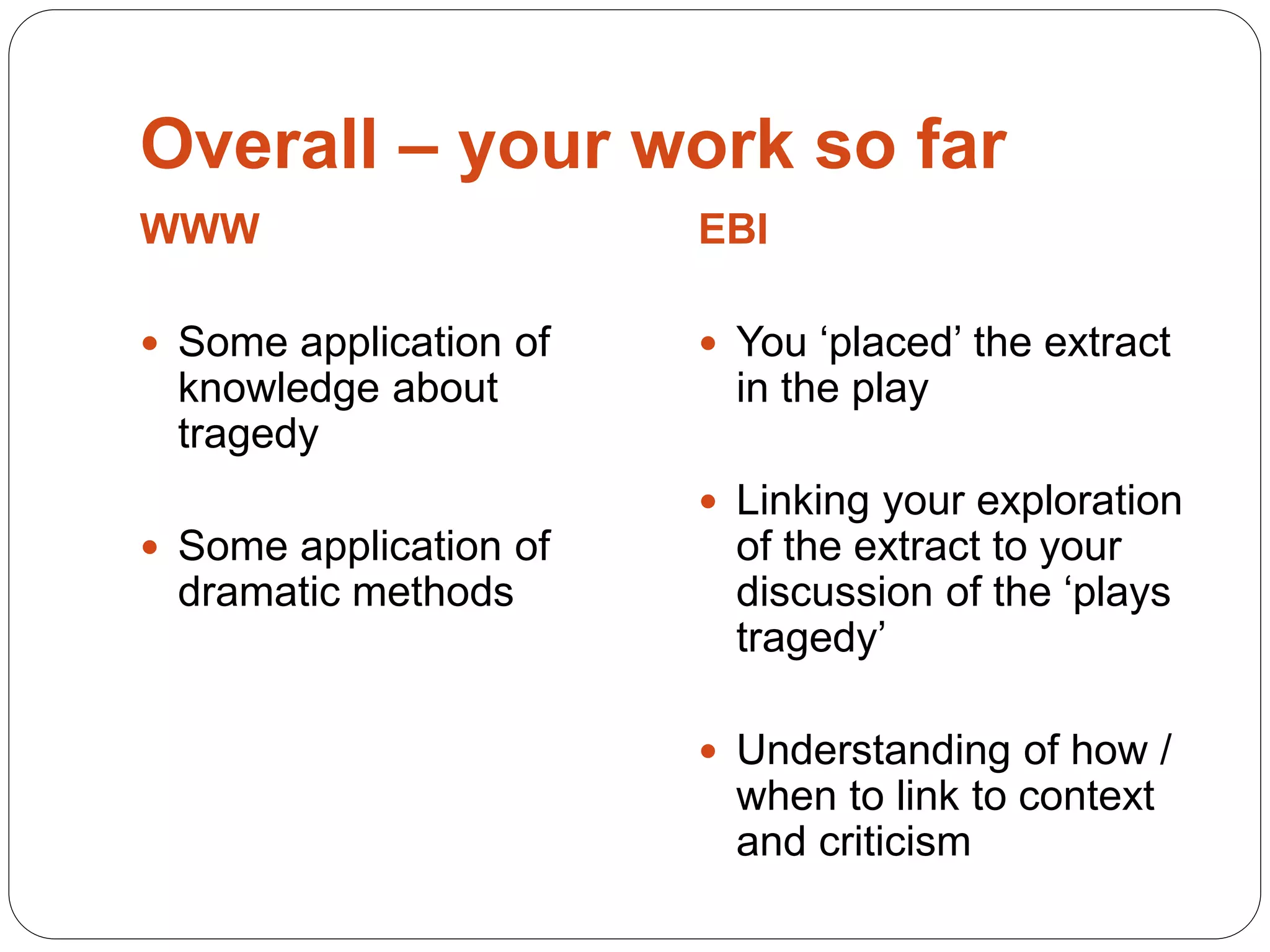
Overall – your work so far
WWW
 Some application of
knowledge about
tragedy
 Some application of
dramatic methods
EBI
 You ‘placed’ the extract
in the play
 Linking your exploration
of the extract to your
discussion of the ‘plays
tragedy’
 Understanding of how /
when to link to context
and criticism
Step One: Think about the ‘big idea’
‘Tragedy as a whole’ ‘dramatic methods
 Tragedy as a whole
-
 Dramatic methods
Step One: Think about the ‘big idea’
‘Tragedy as a whole’ ‘dramatic methods
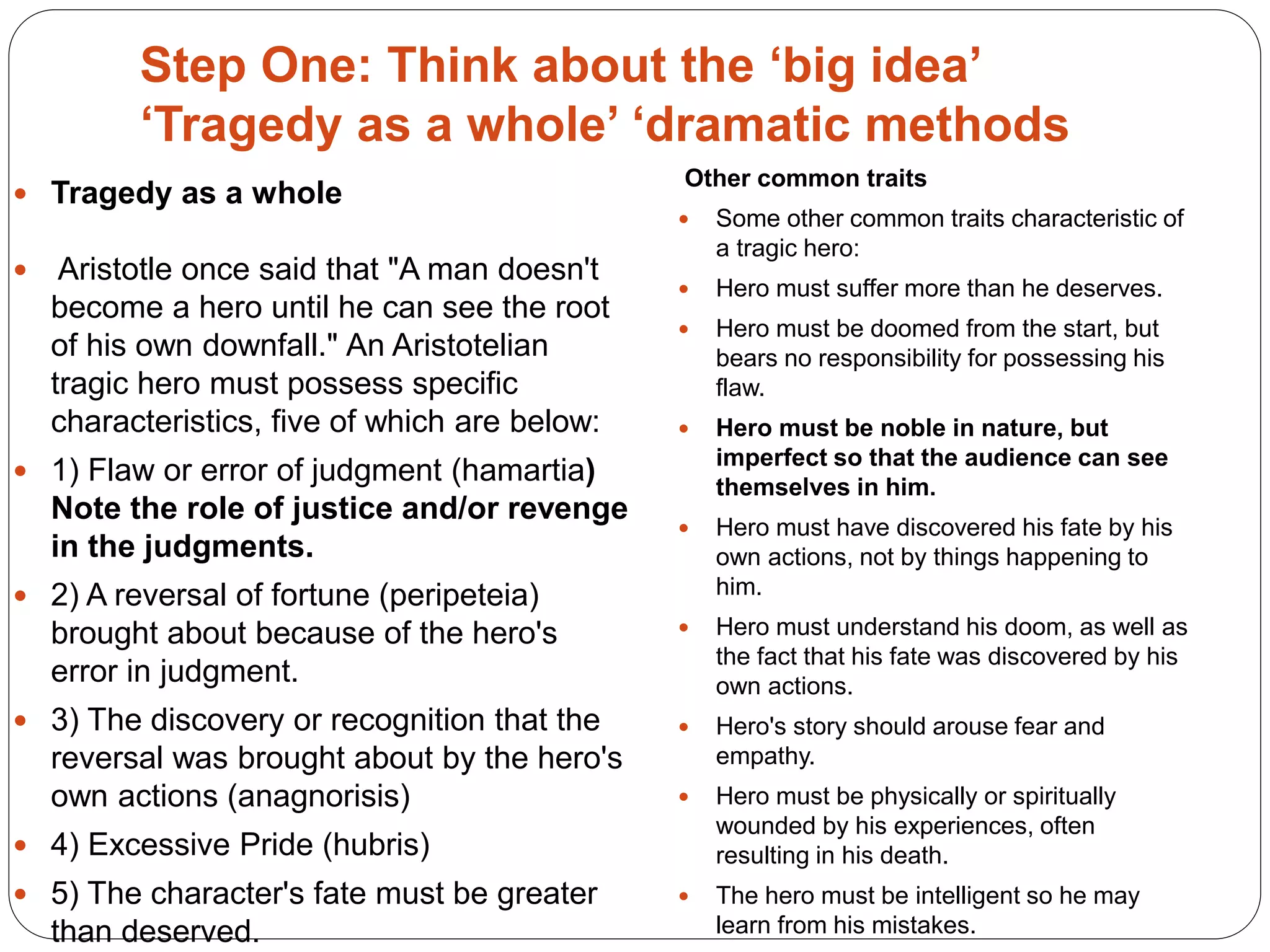
 Tragedy as a whole
 Aristotle once said that "A man doesn't
become a hero until he can see the root
of his own downfall." An Aristotelian
tragic hero must possess specific
characteristics, five of which are below:
 1) Flaw or error of judgment (hamartia)
Note the role of justice and/or revenge
in the judgments.
 2) A reversal of fortune (peripeteia)
brought about because of the hero's
error in judgment.
 3) The discovery or recognition that the
reversal was brought about by the hero's
own actions (anagnorisis)
 4) Excessive Pride (hubris)
 5) The character's fate must be greater
than deserved.
Other common traits
 Some other common traits characteristic of
a tragic hero:
 Hero must suffer more than he deserves.
 Hero must be doomed from the start, but
bears no responsibility for possessing his
flaw.
 Hero must be noble in nature, but
imperfect so that the audience can see
themselves in him.
 Hero must have discovered his fate by his
own actions, not by things happening to
him.
 Hero must understand his doom, as well as
the fact that his fate was discovered by his
own actions.
 Hero's story should arouse fear and
empathy.
 Hero must be physically or spiritually
wounded by his experiences, often
resulting in his death.
 The hero must be intelligent so he may
learn from his mistakes.
Step Two: Does the extract support or challenge
the view that Othello is a tragic hero?
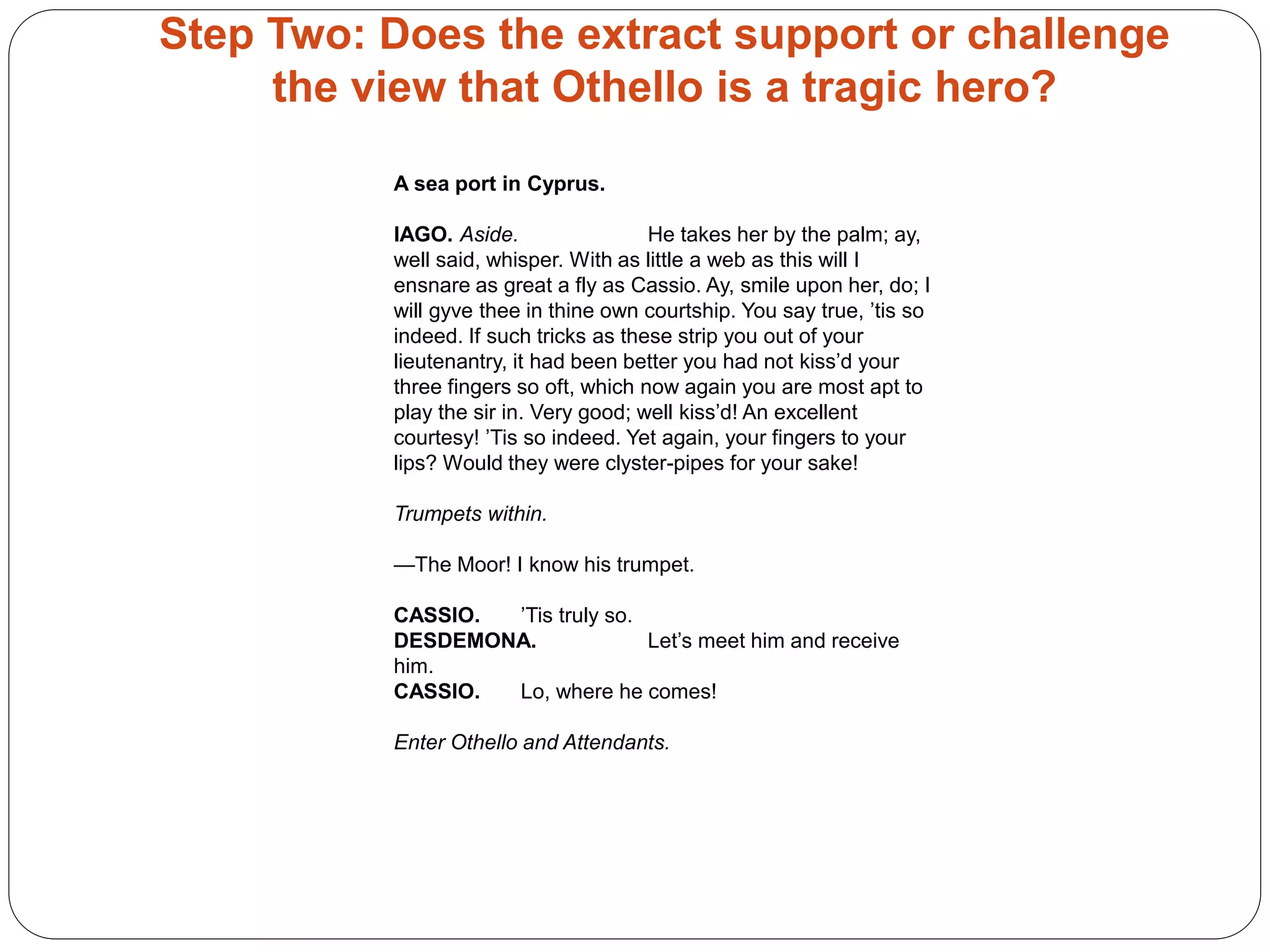
A sea port in Cyprus.
IAGO. Aside. He takes her by the palm; ay,
well said, whisper. With as little a web as this will I
ensnare as great a fly as Cassio. Ay, smile upon her, do; I
will gyve thee in thine own courtship. You say true, ’tis so
indeed. If such tricks as these strip you out of your
lieutenantry, it had been better you had not kiss’d your
three fingers so oft, which now again you are most apt to
play the sir in. Very good; well kiss’d! An excellent
courtesy! ’Tis so indeed. Yet again, your fingers to your
lips? Would they were clyster-pipes for your sake!
Trumpets within.
—The Moor! I know his trumpet.
CASSIO. ’Tis truly so.
DESDEMONA. Let’s meet him and receive
him.
CASSIO. Lo, where he comes!
Enter Othello and Attendants.
Step Two: Does the extract support or challenge
the view that Othello is a tragic hero?
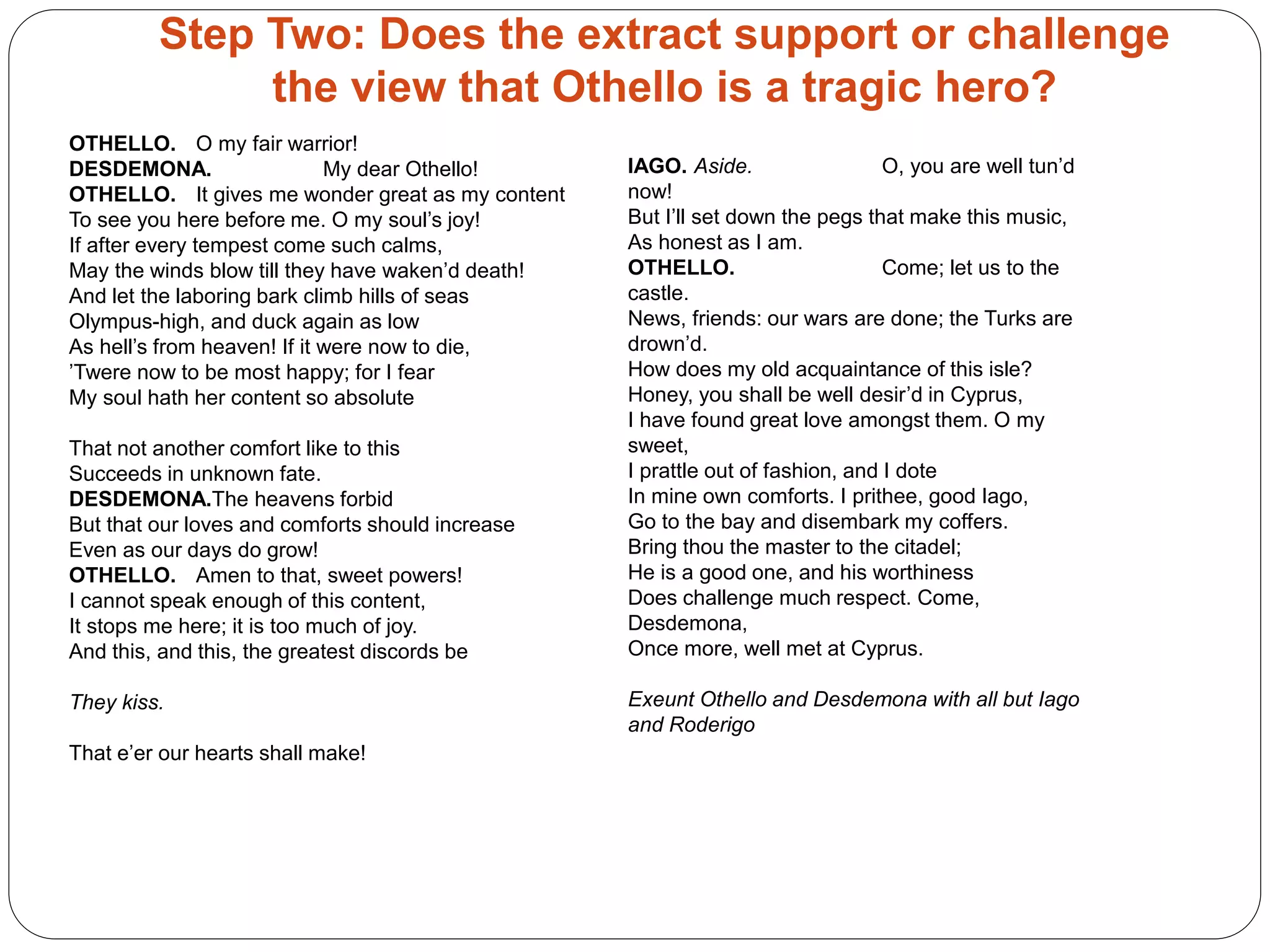
OTHELLO. O my fair warrior!
DESDEMONA. My dear Othello!
OTHELLO. It gives me wonder great as my content
To see you here before me. O my soul’s joy!
If after every tempest come such calms,
May the winds blow till they have waken’d death!
And let the laboring bark climb hills of seas
Olympus-high, and duck again as low
As hell’s from heaven! If it were now to die,
’Twere now to be most happy; for I fear
My soul hath her content so absolute
That not another comfort like to this
Succeeds in unknown fate.
DESDEMONA.The heavens forbid
But that our loves and comforts should increase
Even as our days do grow!
OTHELLO. Amen to that, sweet powers!
I cannot speak enough of this content,
It stops me here; it is too much of joy.
And this, and this, the greatest discords be
They kiss.
That e’er our hearts shall make!
IAGO. Aside. O, you are well tun’d
now!
But I’ll set down the pegs that make this music,
As honest as I am.
OTHELLO. Come; let us to the
castle.
News, friends: our wars are done; the Turks are
drown’d.
How does my old acquaintance of this isle?
Honey, you shall be well desir’d in Cyprus,
I have found great love amongst them. O my
sweet,
I prattle out of fashion, and I dote
In mine own comforts. I prithee, good Iago,
Go to the bay and disembark my coffers.
Bring thou the master to the citadel;
He is a good one, and his worthiness
Does challenge much respect. Come,
Desdemona,
Once more, well met at Cyprus.
Exeunt Othello and Desdemona with all but Iago
and Roderigo
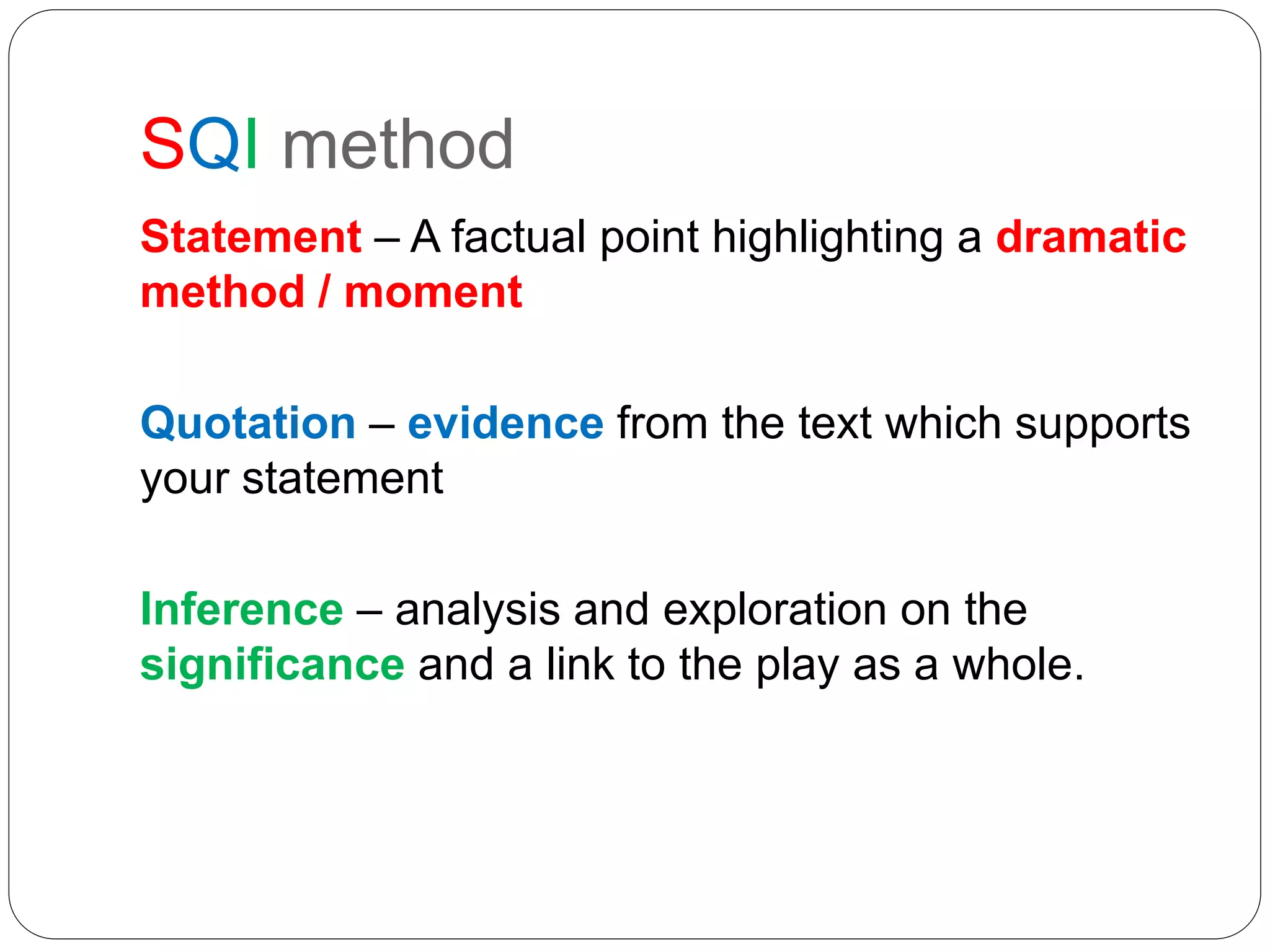
SQI method
Statement – A factual point highlighting a dramatic
method / moment
Quotation – evidence from the text which supports
your statement
Inference – analysis and exploration on the
significance and a link to the play as a whole.
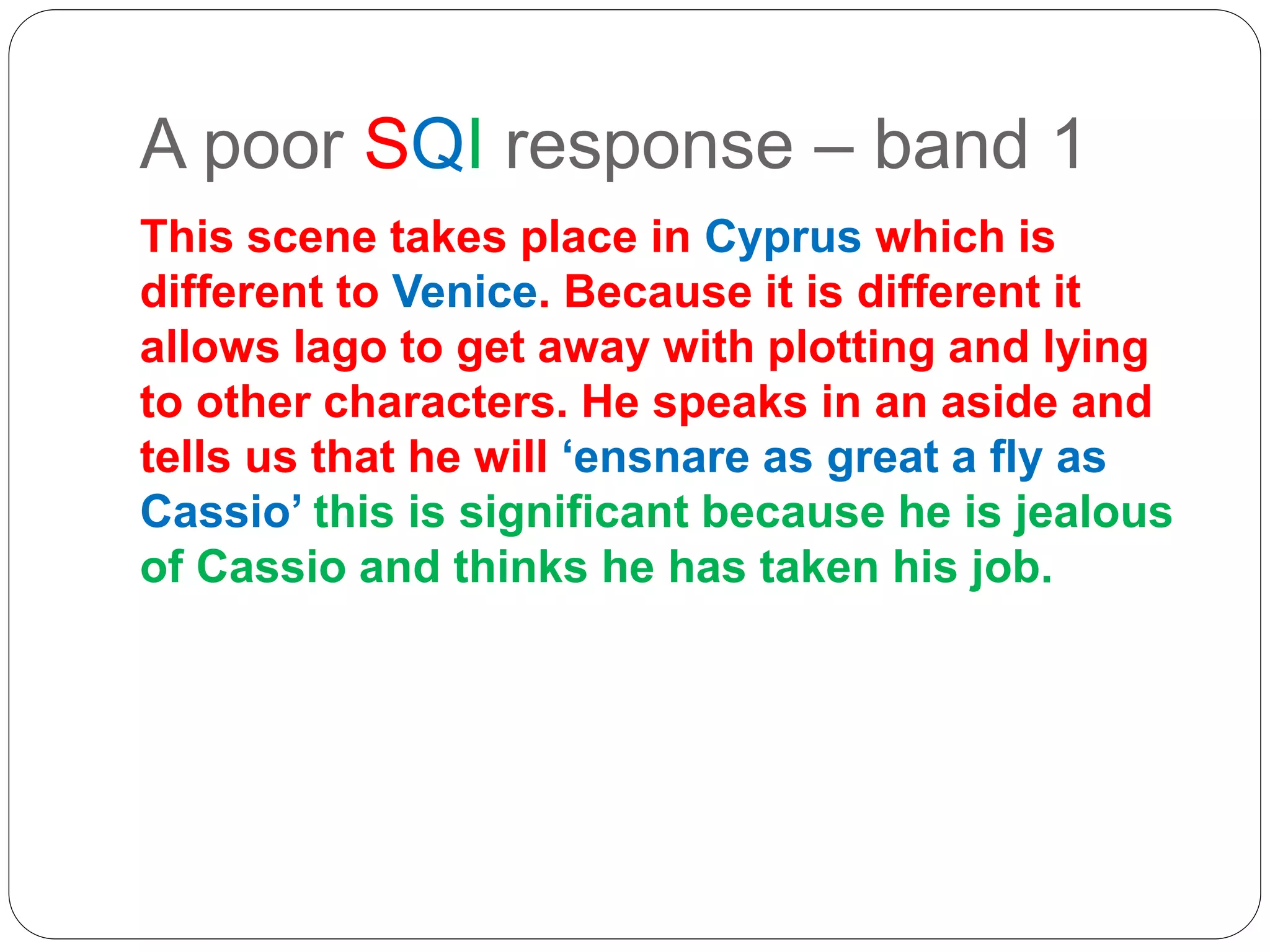
A poor SQI response – band 1
This scene takes place in Cyprus which is
different to Venice. Because it is different it
allows Iago to get away with plotting and lying
to other characters. He speaks in an aside and
tells us that he will ‘ensnare as great a fly as
Cassio’ this is significant because he is jealous
of Cassio and thinks he has taken his job.
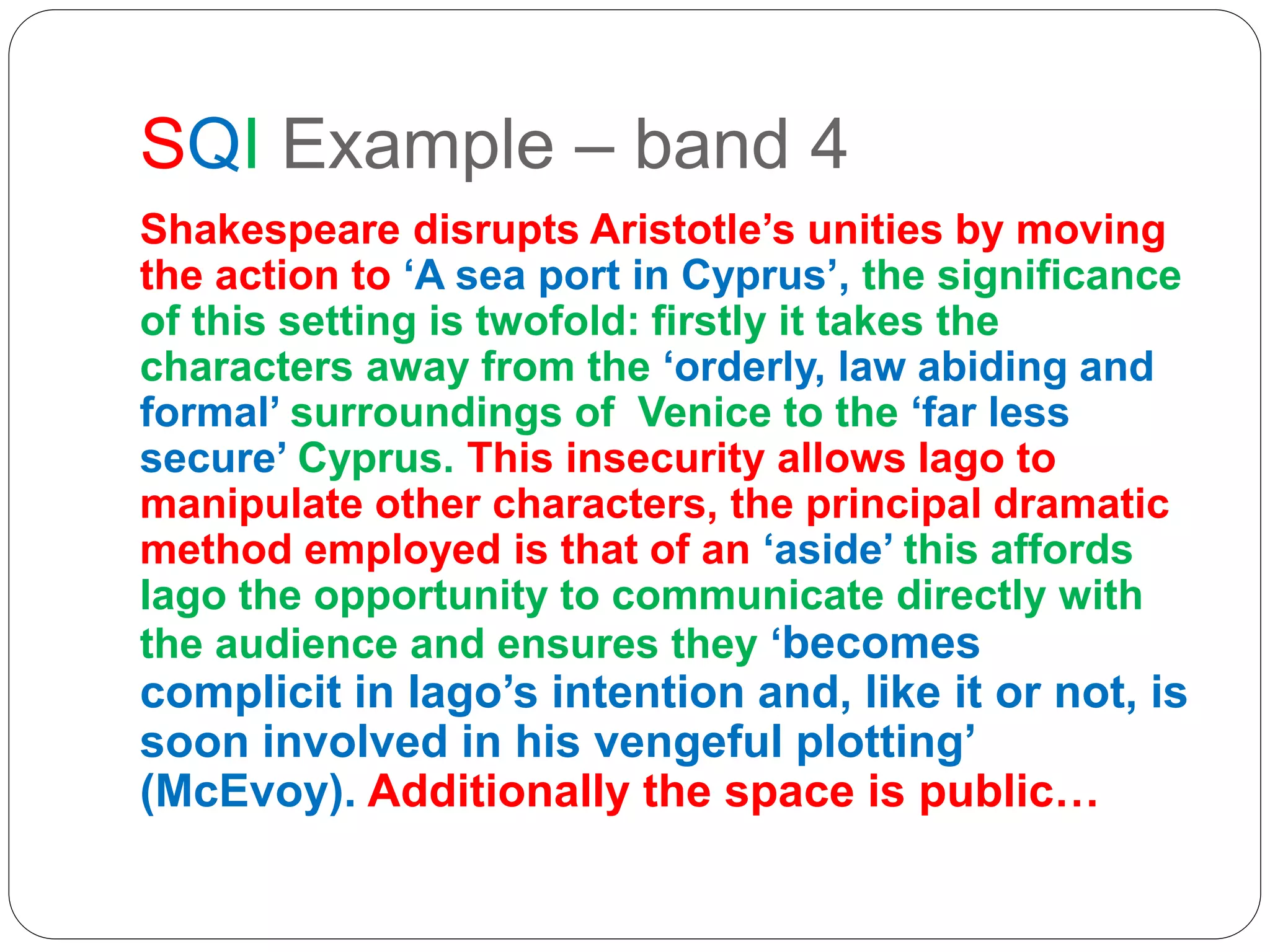
SQI Example – band 4
Shakespeare disrupts Aristotle’s unities by moving
the action to ‘A sea port in Cyprus’, the significance
of this setting is twofold: firstly it takes the
characters away from the ‘orderly, law abiding and
formal’ surroundings of Venice to the ‘far less
secure’ Cyprus. This insecurity allows Iago to
manipulate other characters, the principal dramatic
method employed is that of an ‘aside’ this affords
Iago the opportunity to communicate directly with
the audience and ensures they ‘becomes
complicit in Iago’s intention and, like it or not, is
soon involved in his vengeful plotting’
(McEvoy). Additionally the space is public…
Othello Extract
Essay Structure
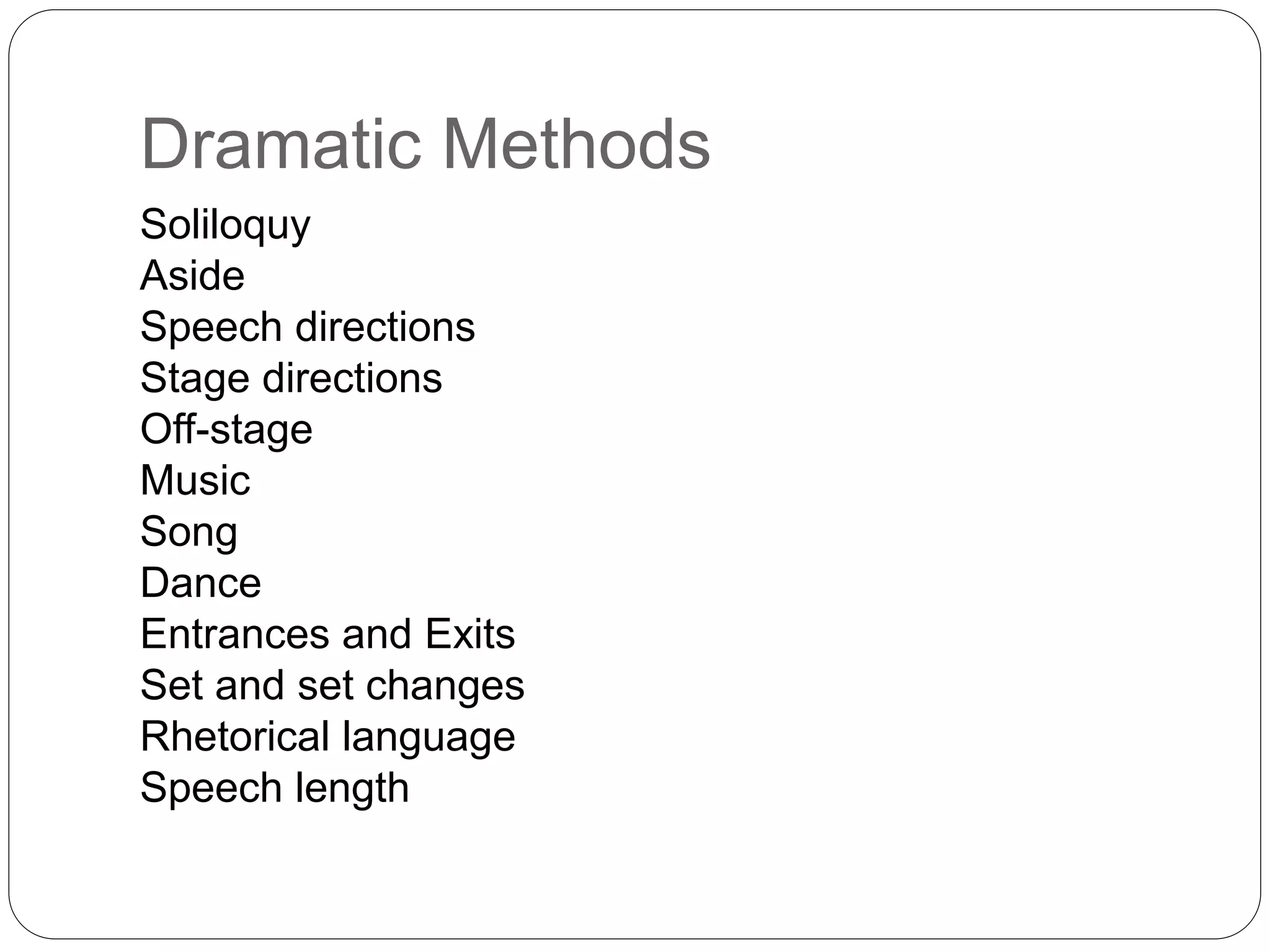
Dramatic Methods
Soliloquy
Aside
Speech directions
Stage directions
Off-stage
Music
Song
Dance
Entrances and Exits
Set and set changes
Rhetorical language
Speech length
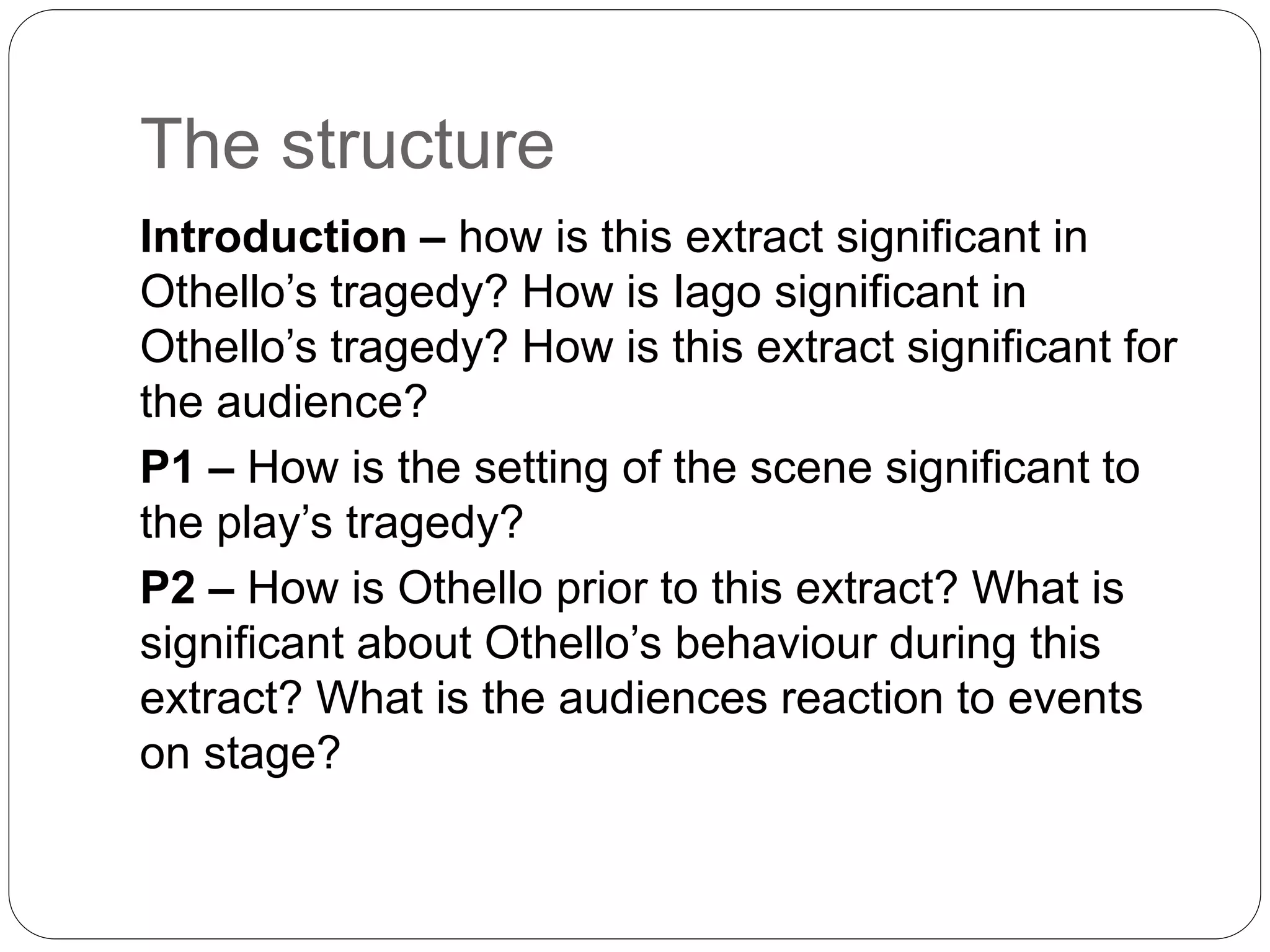
The structure
Introduction – how is this extract significant in
Othello’s tragedy? How is Iago significant in
Othello’s tragedy? How is this extract significant for
the audience?
P1 – How is the setting of the scene significant to
the play’s tragedy?
P2 – How is Othello prior to this extract? What is
significant about Othello’s behaviour during this
extract? What is the audiences reaction to events
on stage?
P3 – What is significant in Iago’s role in the
extract?
P4 – What is the mood and atmosphere of the
extract? How does Shakespeare create it?
P5 – How are other character used as methods of
tragedy in this extract?
P6 – Link Iago to other characters in the extract
and discuss their significance.
Extract assessment prep and feedback act 2 sc1

Extract assessment prep and feedback act 2 sc1

  • 1.
    L.O. To reviewessay writing skills in preparation for the mock examination Tragedy: Othello Extract
  • 2.
    Overall – yourwork so far WWW  Some application of knowledge about tragedy  Some application of dramatic methods EBI  You ‘placed’ the extract in the play  Linking your exploration of the extract to your discussion of the ‘plays tragedy’  Understanding of how / when to link to context and criticism
  • 3.
    Step One: Thinkabout the ‘big idea’ ‘Tragedy as a whole’ ‘dramatic methods  Tragedy as a whole -  Dramatic methods
  • 4.
    Step One: Thinkabout the ‘big idea’ ‘Tragedy as a whole’ ‘dramatic methods  Tragedy as a whole  Aristotle once said that "A man doesn't become a hero until he can see the root of his own downfall." An Aristotelian tragic hero must possess specific characteristics, five of which are below:  1) Flaw or error of judgment (hamartia) Note the role of justice and/or revenge in the judgments.  2) A reversal of fortune (peripeteia) brought about because of the hero's error in judgment.  3) The discovery or recognition that the reversal was brought about by the hero's own actions (anagnorisis)  4) Excessive Pride (hubris)  5) The character's fate must be greater than deserved. Other common traits  Some other common traits characteristic of a tragic hero:  Hero must suffer more than he deserves.  Hero must be doomed from the start, but bears no responsibility for possessing his flaw.  Hero must be noble in nature, but imperfect so that the audience can see themselves in him.  Hero must have discovered his fate by his own actions, not by things happening to him.  Hero must understand his doom, as well as the fact that his fate was discovered by his own actions.  Hero's story should arouse fear and empathy.  Hero must be physically or spiritually wounded by his experiences, often resulting in his death.  The hero must be intelligent so he may learn from his mistakes.
  • 5.
    Step Two: Doesthe extract support or challenge the view that Othello is a tragic hero? A sea port in Cyprus. IAGO. Aside. He takes her by the palm; ay, well said, whisper. With as little a web as this will I ensnare as great a fly as Cassio. Ay, smile upon her, do; I will gyve thee in thine own courtship. You say true, ’tis so indeed. If such tricks as these strip you out of your lieutenantry, it had been better you had not kiss’d your three fingers so oft, which now again you are most apt to play the sir in. Very good; well kiss’d! An excellent courtesy! ’Tis so indeed. Yet again, your fingers to your lips? Would they were clyster-pipes for your sake! Trumpets within. —The Moor! I know his trumpet. CASSIO. ’Tis truly so. DESDEMONA. Let’s meet him and receive him. CASSIO. Lo, where he comes! Enter Othello and Attendants.
  • 6.
    Step Two: Doesthe extract support or challenge the view that Othello is a tragic hero? OTHELLO. O my fair warrior! DESDEMONA. My dear Othello! OTHELLO. It gives me wonder great as my content To see you here before me. O my soul’s joy! If after every tempest come such calms, May the winds blow till they have waken’d death! And let the laboring bark climb hills of seas Olympus-high, and duck again as low As hell’s from heaven! If it were now to die, ’Twere now to be most happy; for I fear My soul hath her content so absolute That not another comfort like to this Succeeds in unknown fate. DESDEMONA.The heavens forbid But that our loves and comforts should increase Even as our days do grow! OTHELLO. Amen to that, sweet powers! I cannot speak enough of this content, It stops me here; it is too much of joy. And this, and this, the greatest discords be They kiss. That e’er our hearts shall make! IAGO. Aside. O, you are well tun’d now! But I’ll set down the pegs that make this music, As honest as I am. OTHELLO. Come; let us to the castle. News, friends: our wars are done; the Turks are drown’d. How does my old acquaintance of this isle? Honey, you shall be well desir’d in Cyprus, I have found great love amongst them. O my sweet, I prattle out of fashion, and I dote In mine own comforts. I prithee, good Iago, Go to the bay and disembark my coffers. Bring thou the master to the citadel; He is a good one, and his worthiness Does challenge much respect. Come, Desdemona, Once more, well met at Cyprus. Exeunt Othello and Desdemona with all but Iago and Roderigo
  • 7.
    SQI method Statement –A factual point highlighting a dramatic method / moment Quotation – evidence from the text which supports your statement Inference – analysis and exploration on the significance and a link to the play as a whole.
  • 8.
    A poor SQIresponse – band 1 This scene takes place in Cyprus which is different to Venice. Because it is different it allows Iago to get away with plotting and lying to other characters. He speaks in an aside and tells us that he will ‘ensnare as great a fly as Cassio’ this is significant because he is jealous of Cassio and thinks he has taken his job.
  • 9.
    SQI Example –band 4 Shakespeare disrupts Aristotle’s unities by moving the action to ‘A sea port in Cyprus’, the significance of this setting is twofold: firstly it takes the characters away from the ‘orderly, law abiding and formal’ surroundings of Venice to the ‘far less secure’ Cyprus. This insecurity allows Iago to manipulate other characters, the principal dramatic method employed is that of an ‘aside’ this affords Iago the opportunity to communicate directly with the audience and ensures they ‘becomes complicit in Iago’s intention and, like it or not, is soon involved in his vengeful plotting’ (McEvoy). Additionally the space is public…
  • 10.
  • 11.
    Dramatic Methods Soliloquy Aside Speech directions Stagedirections Off-stage Music Song Dance Entrances and Exits Set and set changes Rhetorical language Speech length
  • 12.
    The structure Introduction –how is this extract significant in Othello’s tragedy? How is Iago significant in Othello’s tragedy? How is this extract significant for the audience? P1 – How is the setting of the scene significant to the play’s tragedy? P2 – How is Othello prior to this extract? What is significant about Othello’s behaviour during this extract? What is the audiences reaction to events on stage?
  • 13.
    P3 – Whatis significant in Iago’s role in the extract? P4 – What is the mood and atmosphere of the extract? How does Shakespeare create it? P5 – How are other character used as methods of tragedy in this extract? P6 – Link Iago to other characters in the extract and discuss their significance.