A2 Media ExamLesson Objectives: To develop your exam technique.
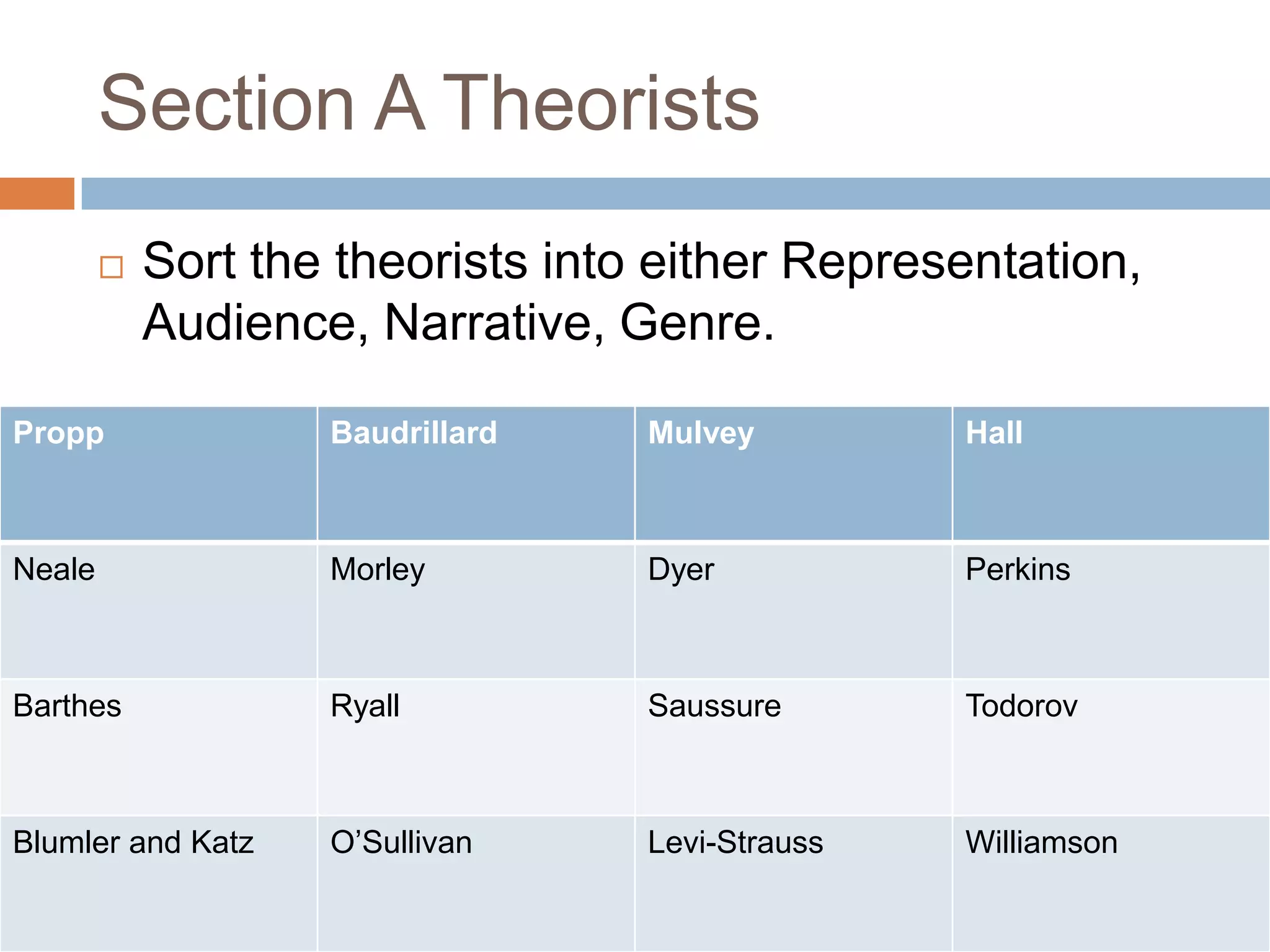
Section A TheoristsSort the theorists into either Representation, Audience, Narrative, Genre.
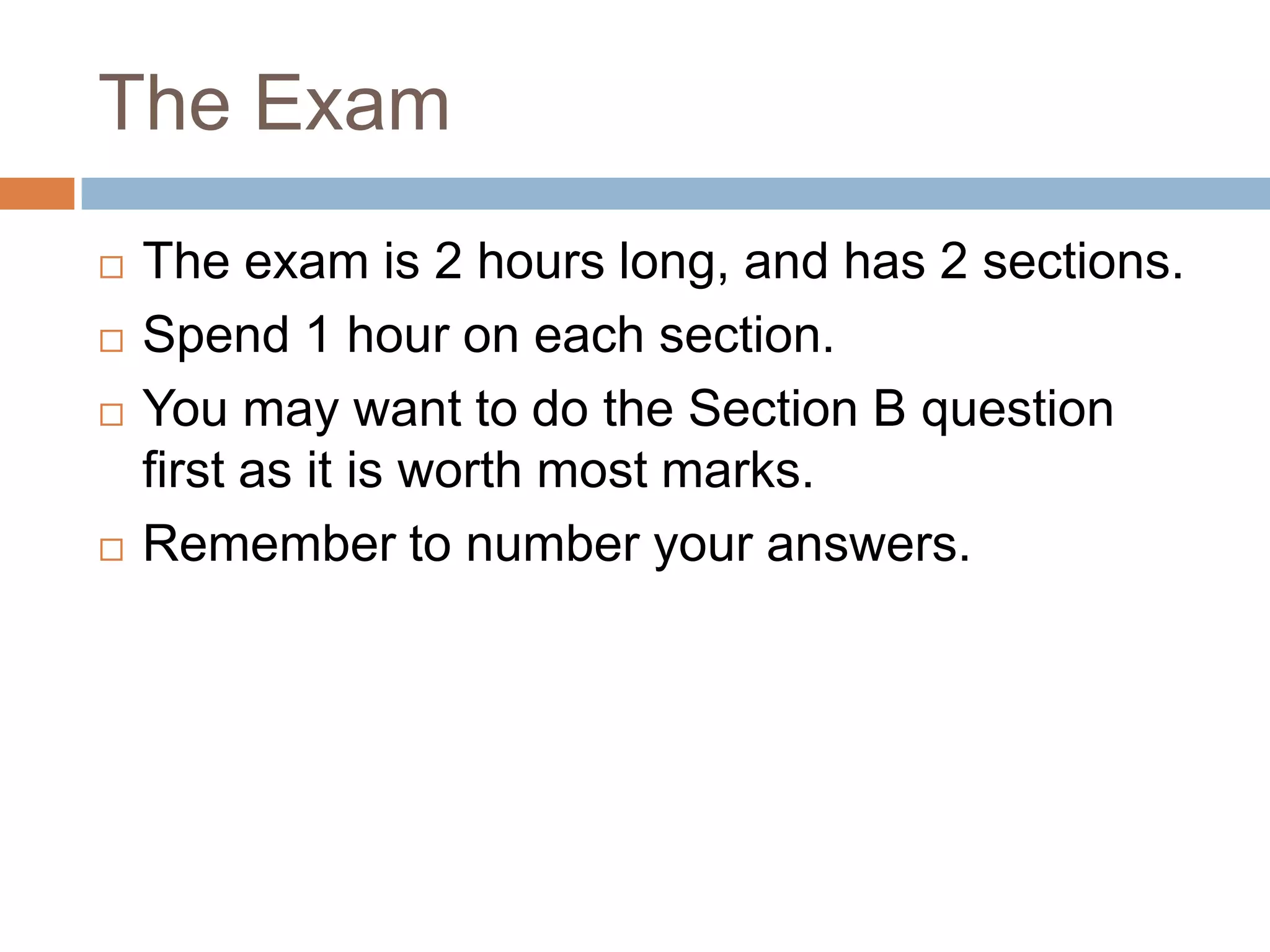
The ExamThe exam is 2 hours long, and has 2 sections.Spend 1 hour on each section.You may want to do the Section B question first as it is worth most marks.Remember to number your answers.
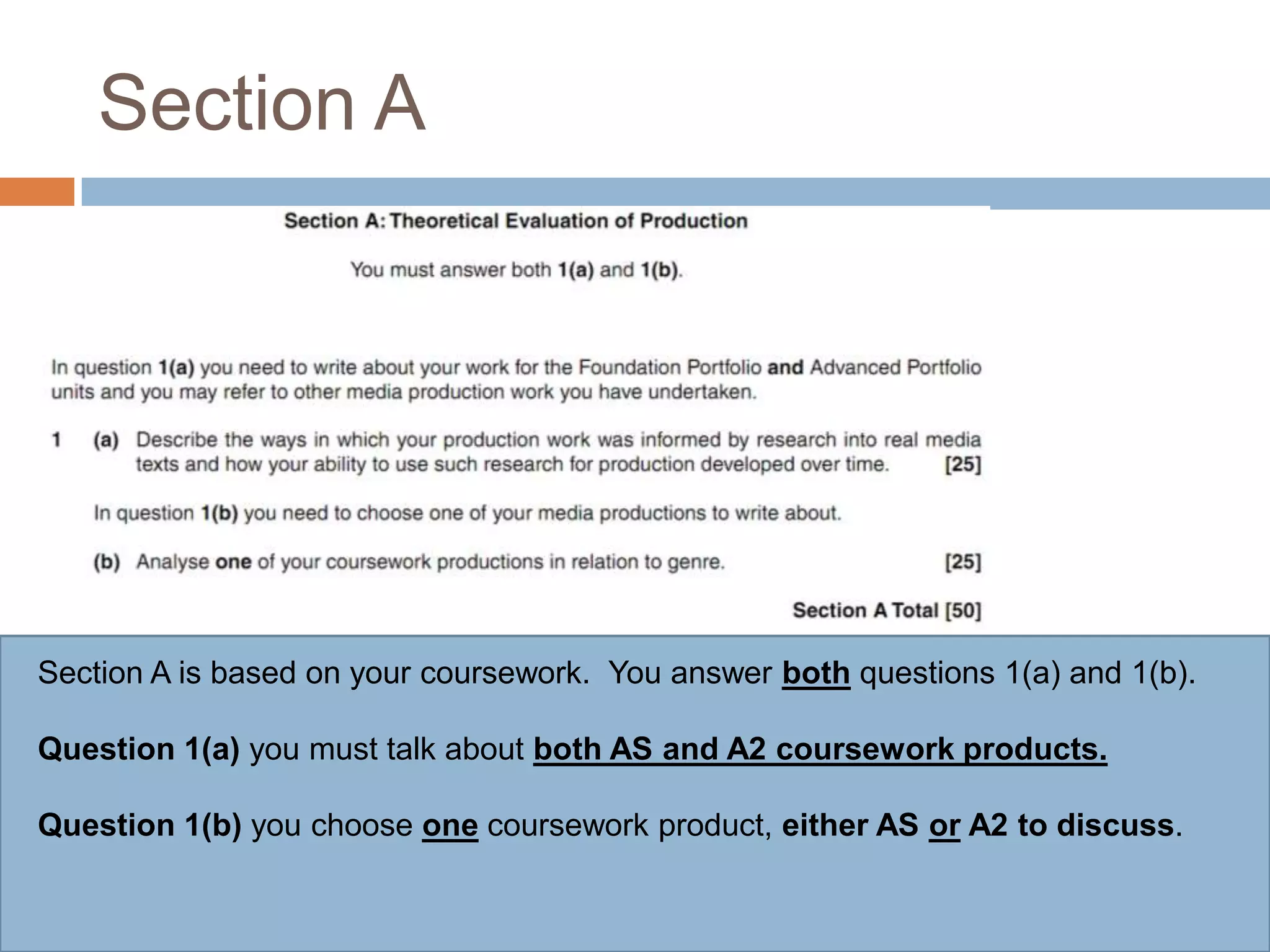
Section ASection A is based on your coursework.  You answer both questions 1(a) and 1(b).Question 1(a)you must talk about both AS and A2 coursework products.Question 1(b) you choose one coursework product, either AS or A2 to discuss.
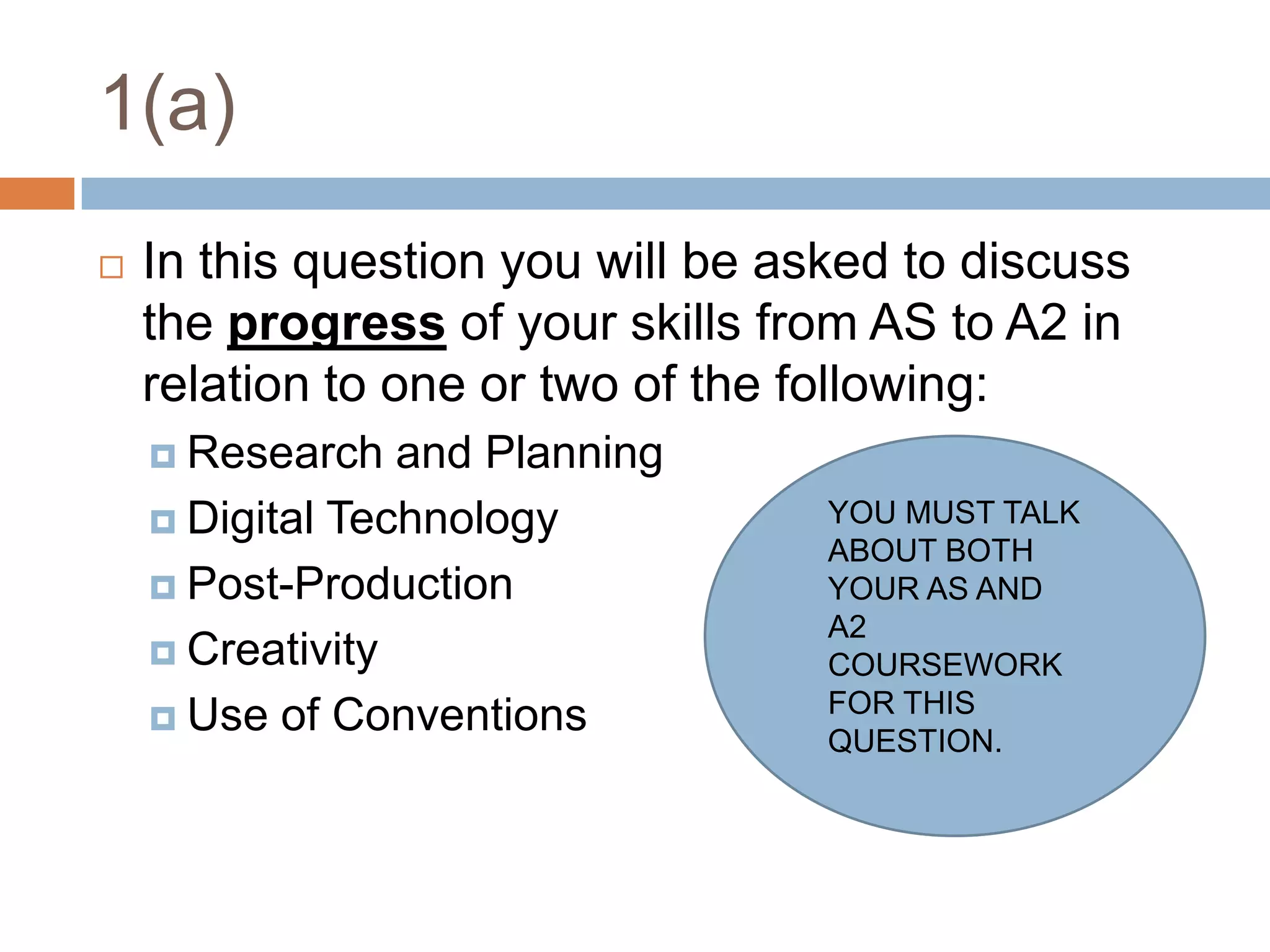
1(a)In this question you will be asked to discuss the progress of your skills from AS to A2 in relation to one or two of the following:Research and PlanningDigital TechnologyPost-ProductionCreativityUse of ConventionsYOU MUST TALK ABOUT BOTH YOUR AS AND A2 COURSEWORK FOR THIS QUESTION.
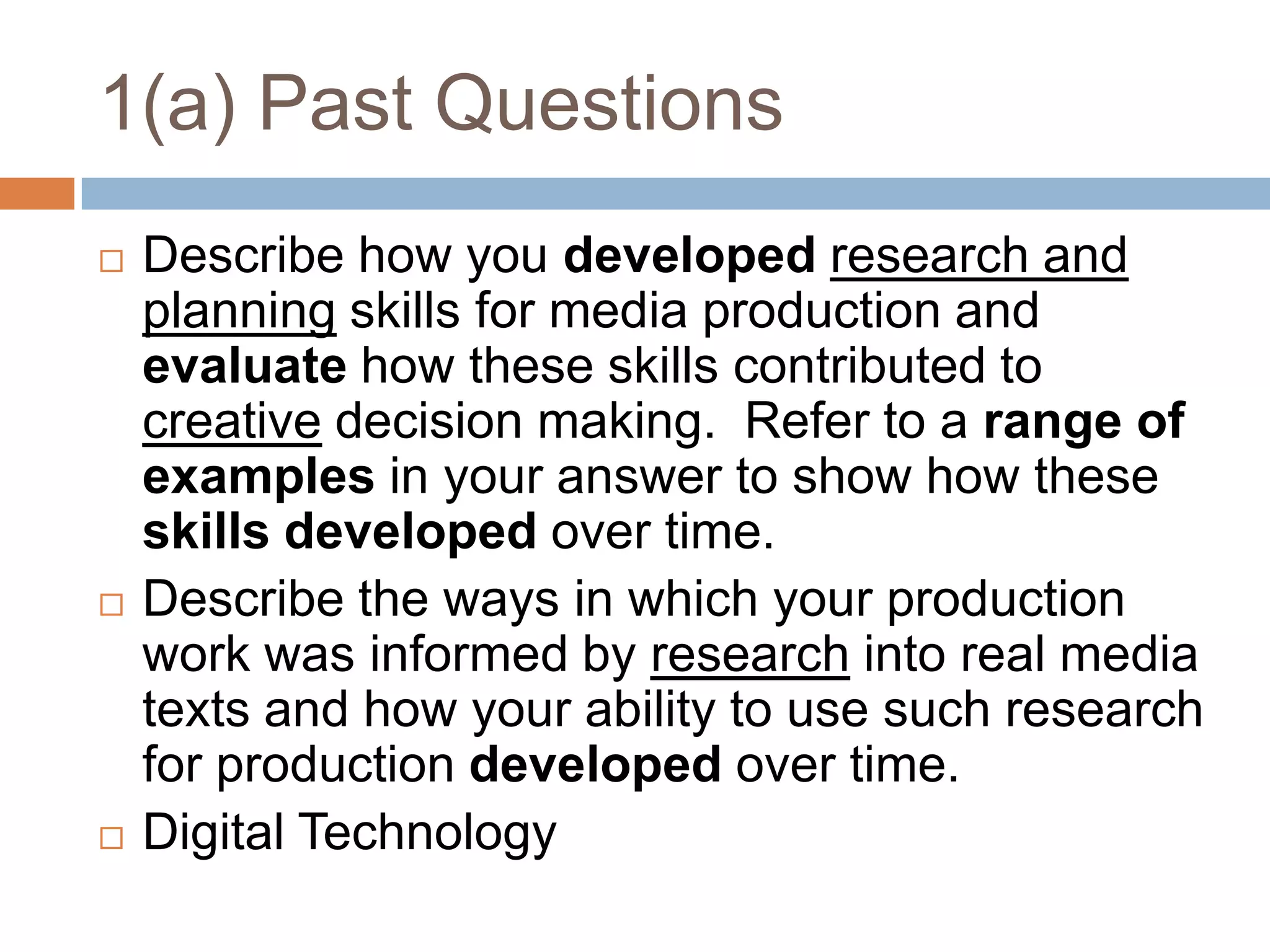
1(a) Past QuestionsDescribe how you developedresearch and planning skills for media production and evaluate how these skills contributed to creative decision making.  Refer to a range of examples in your answer to show how these skills developed over time.Describe the ways in which your production work was informed by research into real media texts and how your ability to use such research for production developed over time.Digital Technology
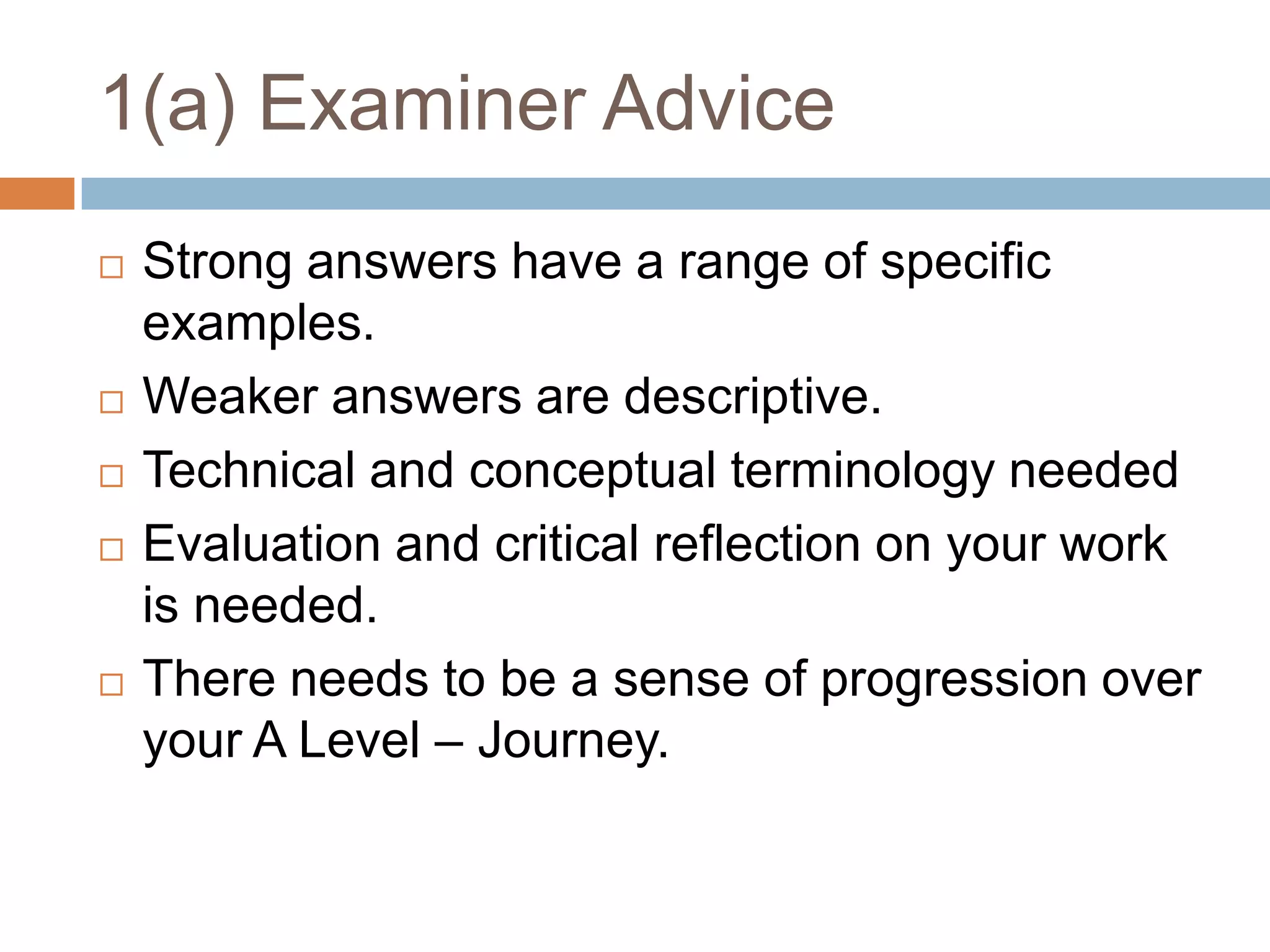
1(a) Examiner AdviceStrong answers have a range of specific examples.Weaker answers are descriptive.Technical and conceptual terminology neededEvaluation and critical reflection on your work is needed.There needs to be a sense of progression over your A Level – Journey.
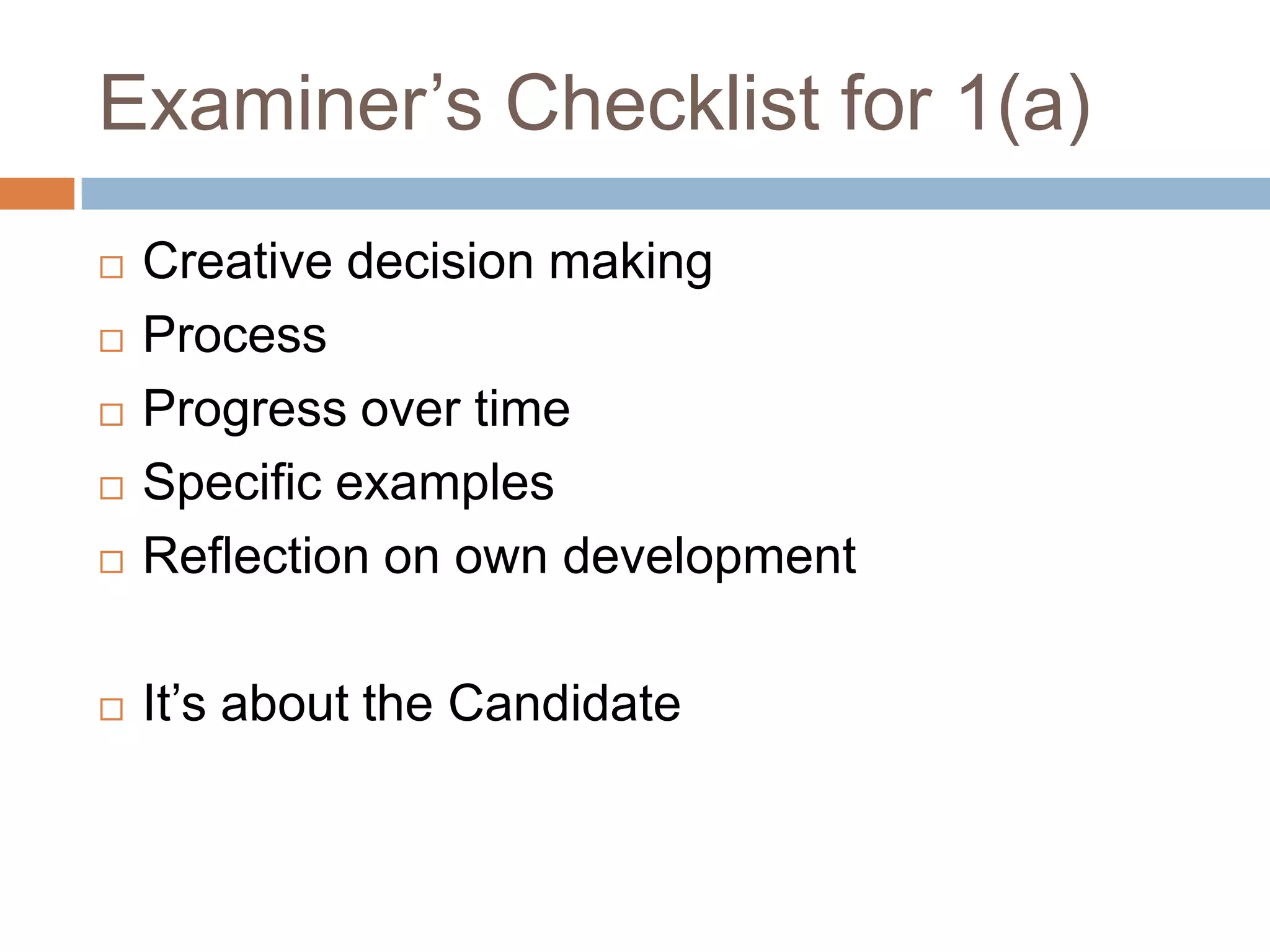
Examiner’s Checklist for 1(a)Creative decision making Process Progress over time Specific examples Reflection on own development It’s about the Candidate
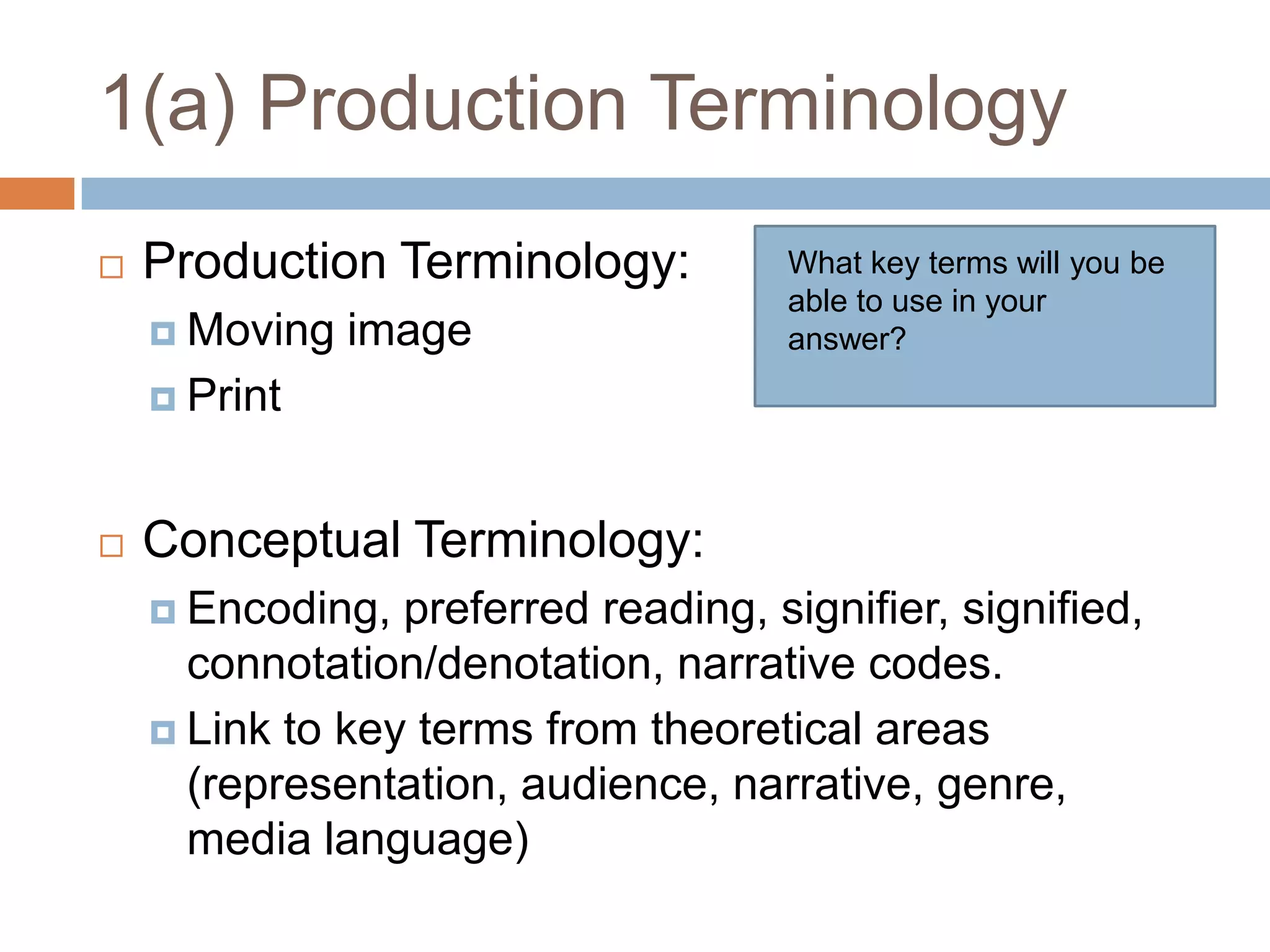
1(a) Production TerminologyProduction Terminology:      Moving imagePrint Conceptual Terminology:Encoding, preferred reading, signifier, signified, connotation/denotation, narrative codes.Link to key terms from theoretical areas (representation, audience, narrative, genre, media language)What key terms will you be able to use in your answer?
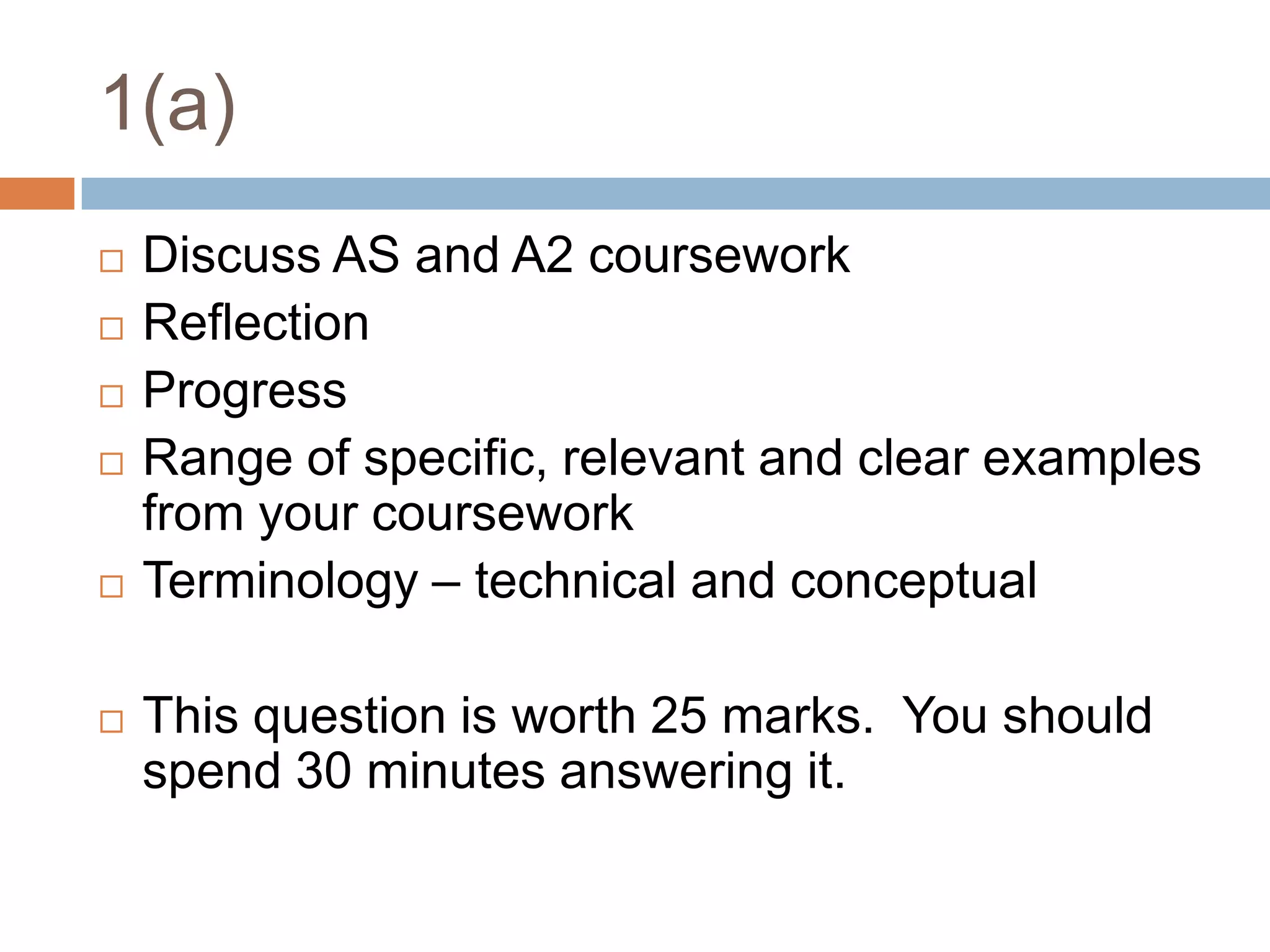
1(a)Discuss AS and A2 courseworkReflectionProgressRange of specific, relevant and clear examples from your courseworkTerminology – technical and conceptualThis question is worth 25 marks.  You should spend 30 minutes answering it.
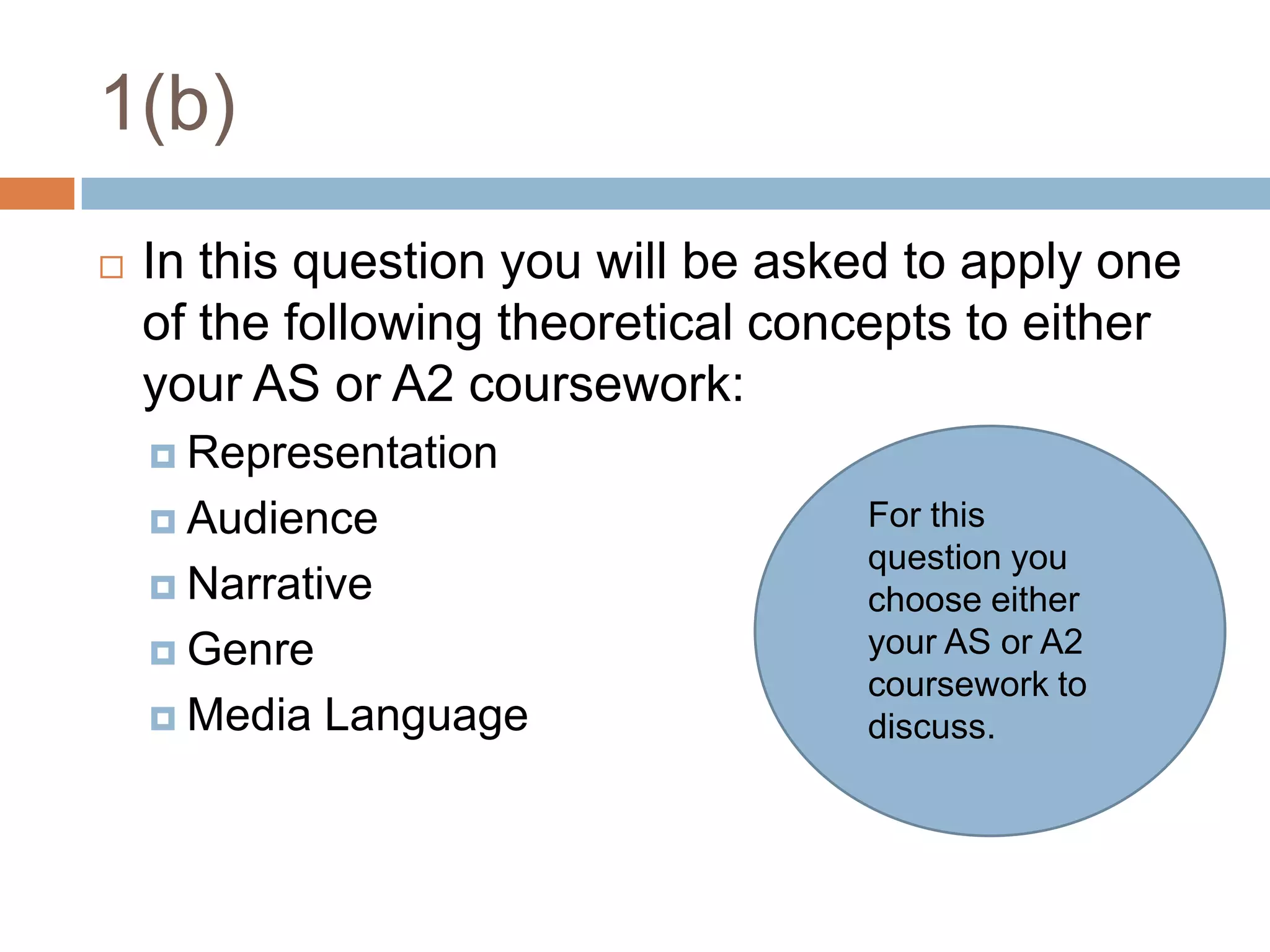
1(b)In this question you will be asked to apply one of the following theoretical concepts to either your AS or A2 coursework:RepresentationAudienceNarrativeGenreMedia LanguageFor this question you choose either your AS or A2 coursework to discuss.
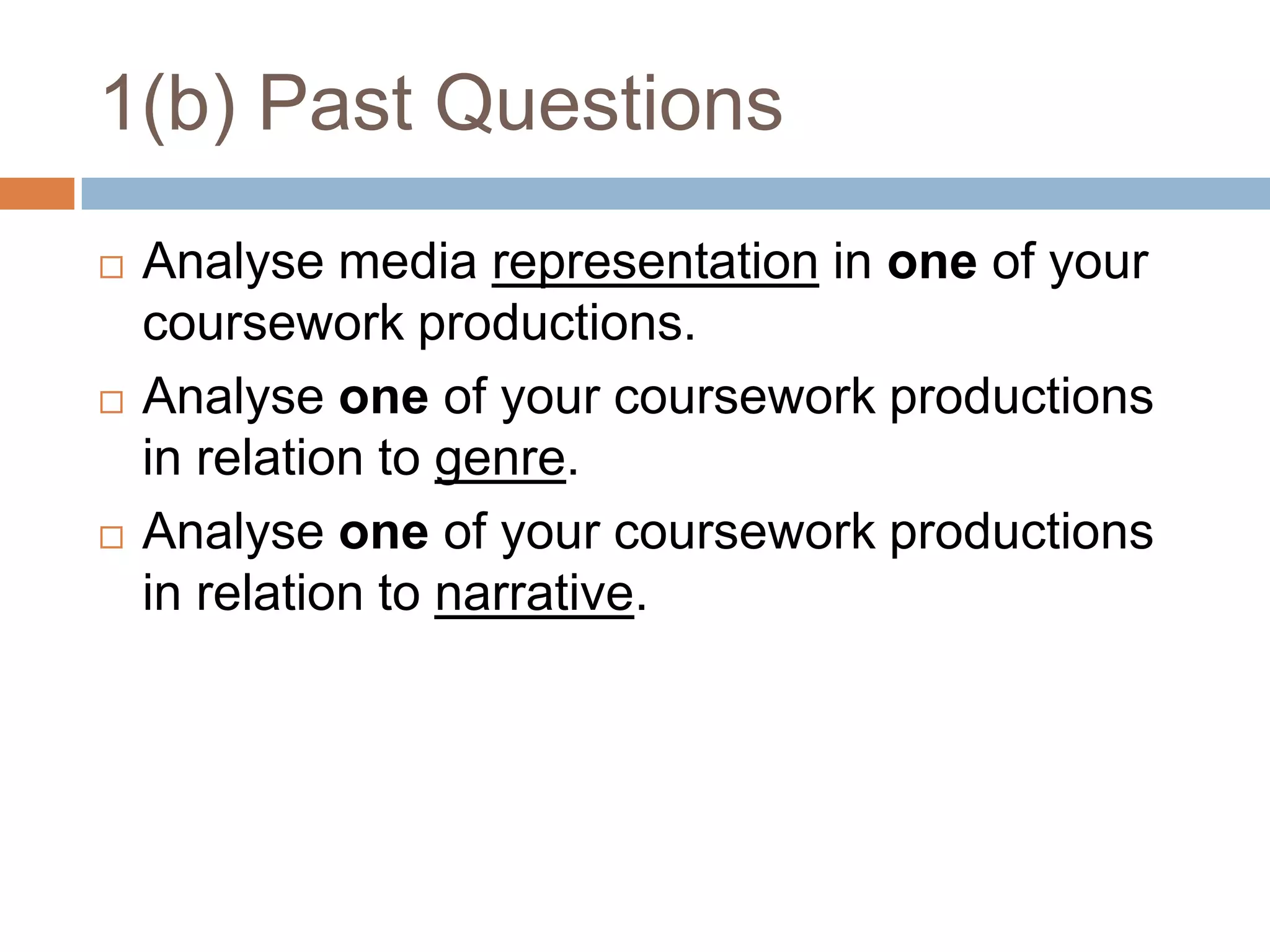
1(b) Past QuestionsAnalyse media representation in one of your coursework productions.Analyse one of your coursework productions in relation to genre.Analyse one of your coursework productions in relation to narrative.
1(b) Examiner’s AdviceStronger answers do 3 things well:Outline the concept for discussion with reference to relevant theoristsApply these ideas to a range of specific elements from your courseworkDiscuss how well the concept/theories relate to your productPoor answers will lack reference to theory and specific answers.Choice of text is important.
1(b) Examiner’s ChecklistShowing understanding of the concept (ideally with references/quotations) Applying the concept Textual analysis of the work (ONE PRODUCTION) using the concept It’s about the work.
1(b) TerminologyWhat key terms can you think of in relation to each of the conceptual areas:RepresentationAudienceNarrativeGenreMedia Language
1(b) TerminologyRepresentation – visual pleasure, object/subject of the gaze, objectification, signs, signifier, signified, connotation/denotation, hyperreality, simulation, simulacra.
1(b) TerminologyAudience – encoding, decoding, dominant, negotiated, oppositional, socio-cultural context, reception, uses and gratifications, surveillance, escapism, personal identity/ relationships, cultivation theory, hypodermic model, passive audience/active audience
1(b) TerminologyNarrative – character types, hero, villain, princess, etc., equilibrium, disequilibrium, resolution, binary oppositions, narrative codes, action, enigma, semic, symbolic, cultural.
1(b) TerminologyGenre – convention, iconography, codes, product differentiation, capitalist, systems of expectation and intelligibility, socio-cultural, myths, genre supervises the relationship between producer and audience
1(b) Media LanguageProduction Terminology - effect of technical choicesPrint MediaMoving ImageUse of genre conventionsUse of narrative structures/codesEncoding of meaning
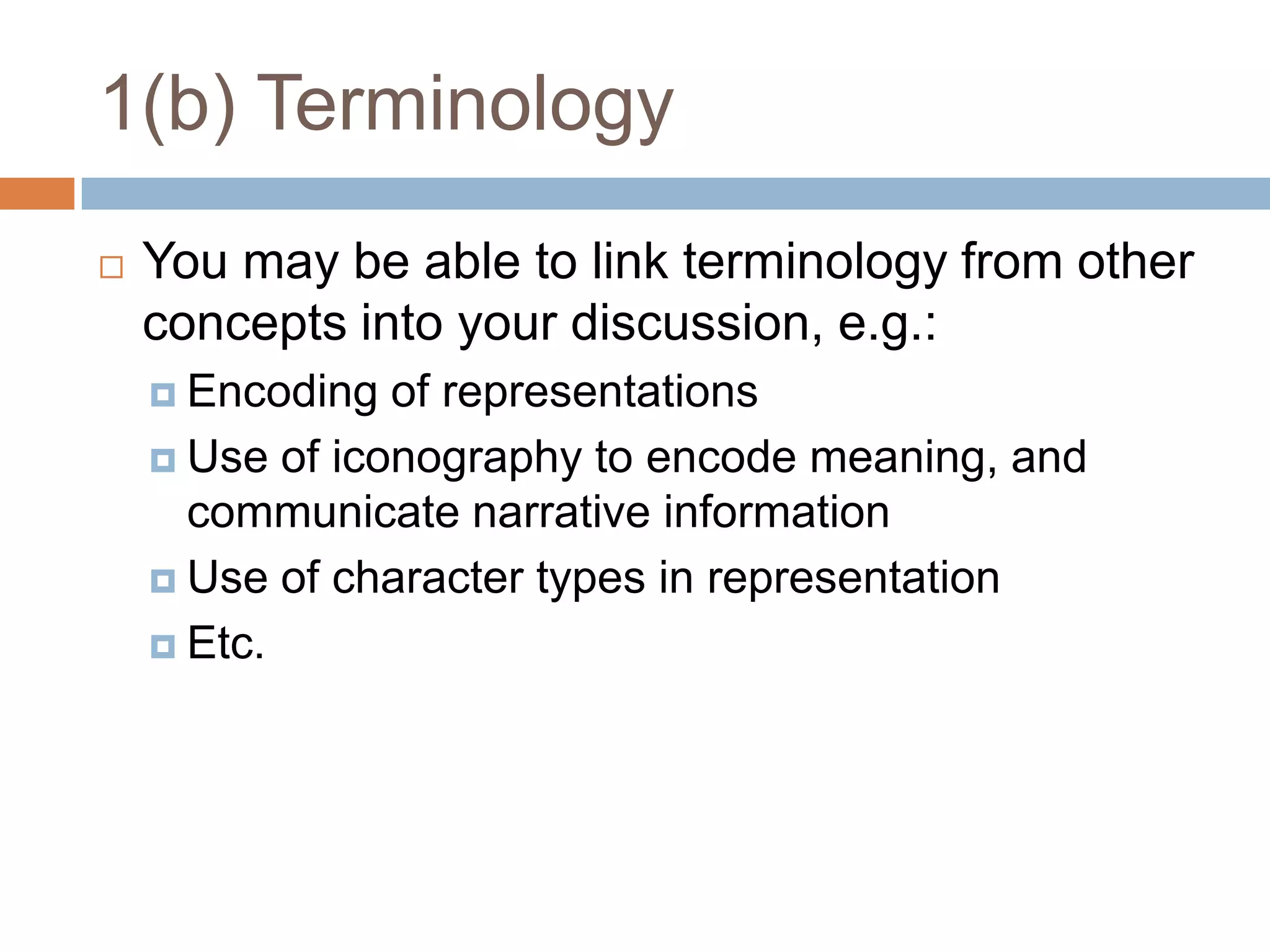
1(b) TerminologyYou may be able to link terminology from other concepts into your discussion, e.g.:Encoding of representationsUse of iconography to encode meaning, and communicate narrative informationUse of character types in representationEtc.
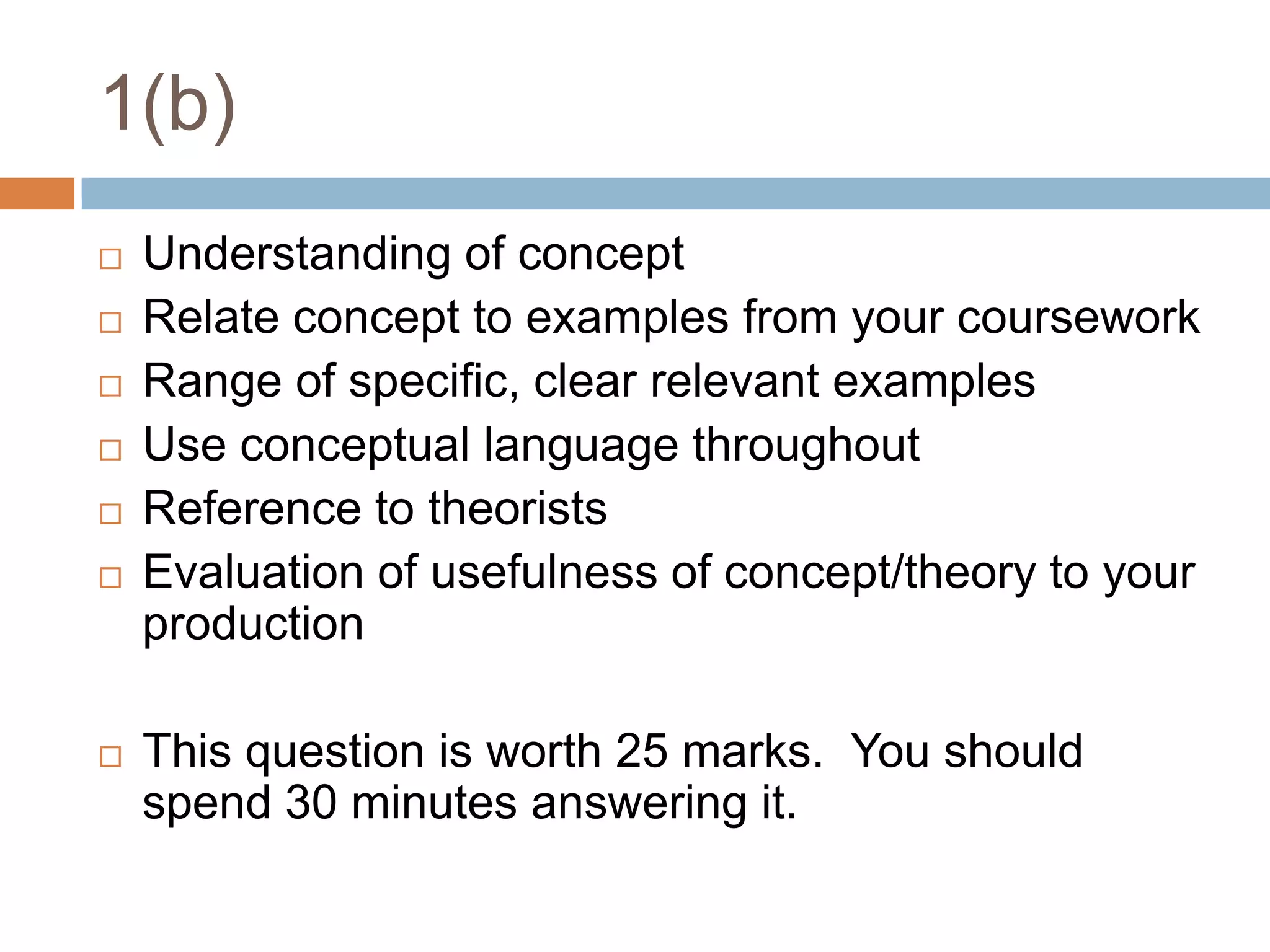
1(b)Understanding of conceptRelate concept to examples from your courseworkRange of specific, clear relevant examplesUse conceptual language throughoutReference to theoristsEvaluation of usefulness of concept/theory to your productionThis question is worth 25 marks.  You should spend 30 minutes answering it.
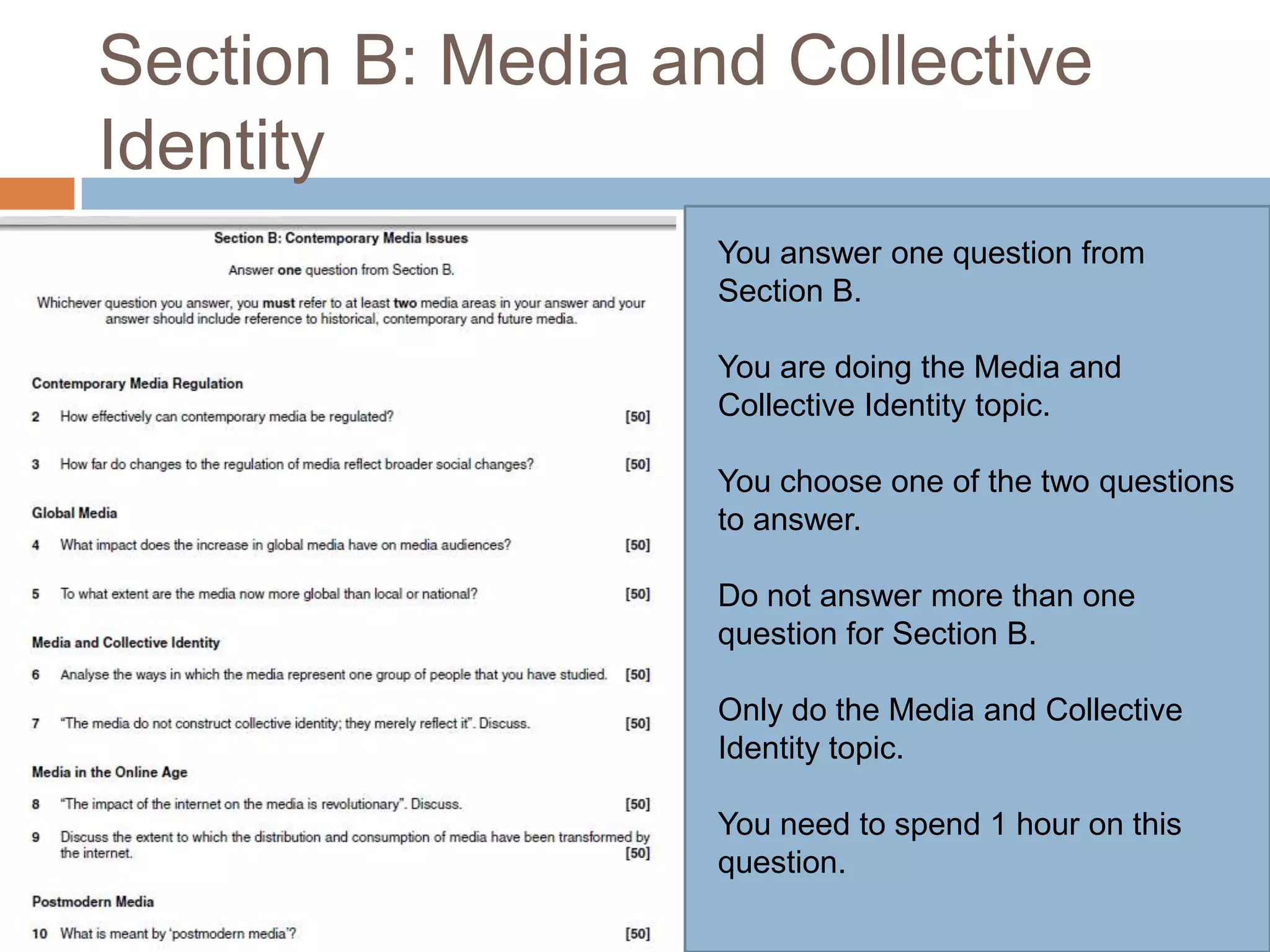
Section B: Media and Collective IdentityYou answer one question from Section B.You are doing the Media and Collective Identity topic.  You choose one of the two questions to answer.Do not answer more than one question for Section B.Only do the Media and Collective Identity topic.You need to spend 1 hour on this question.
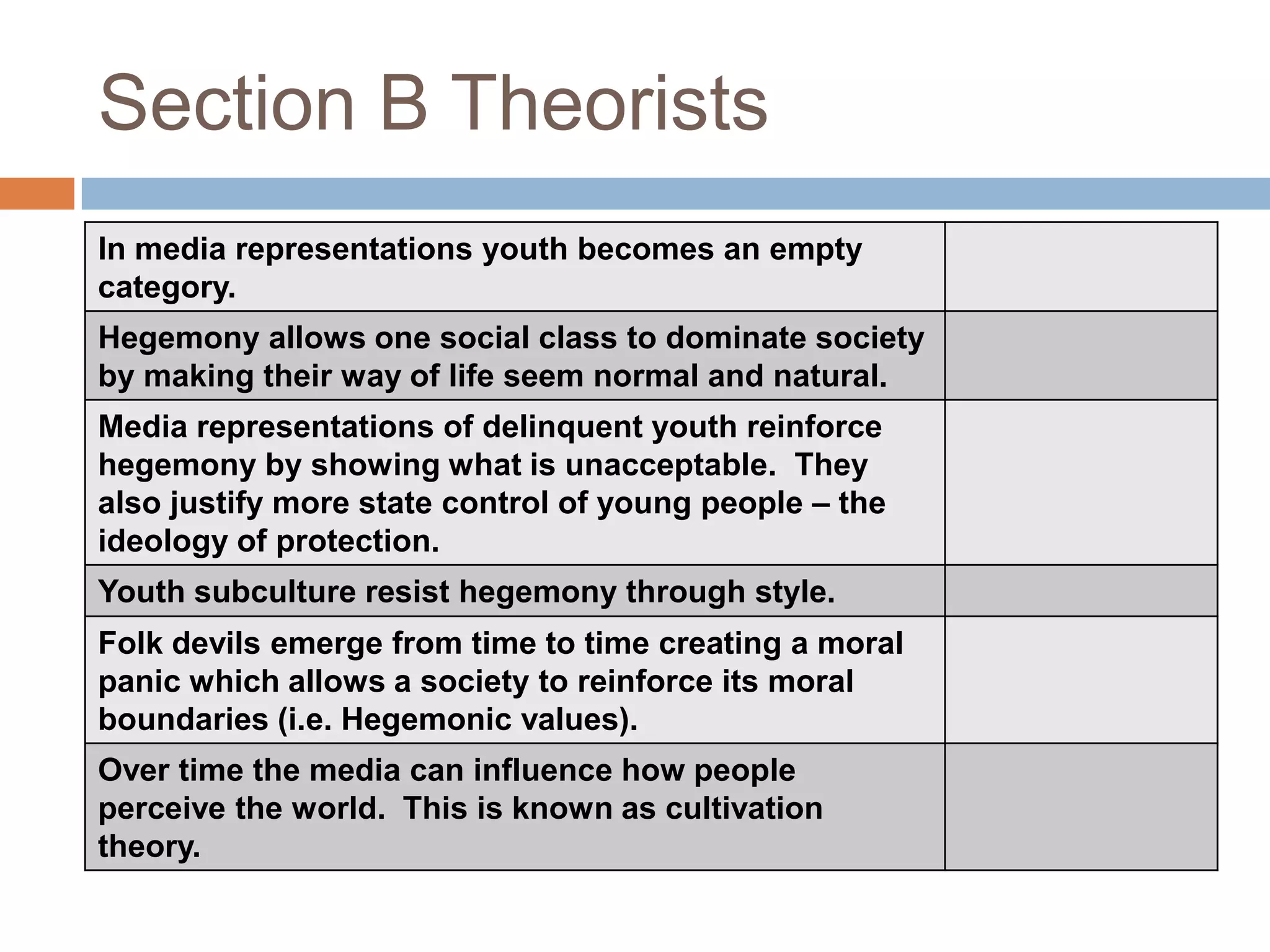
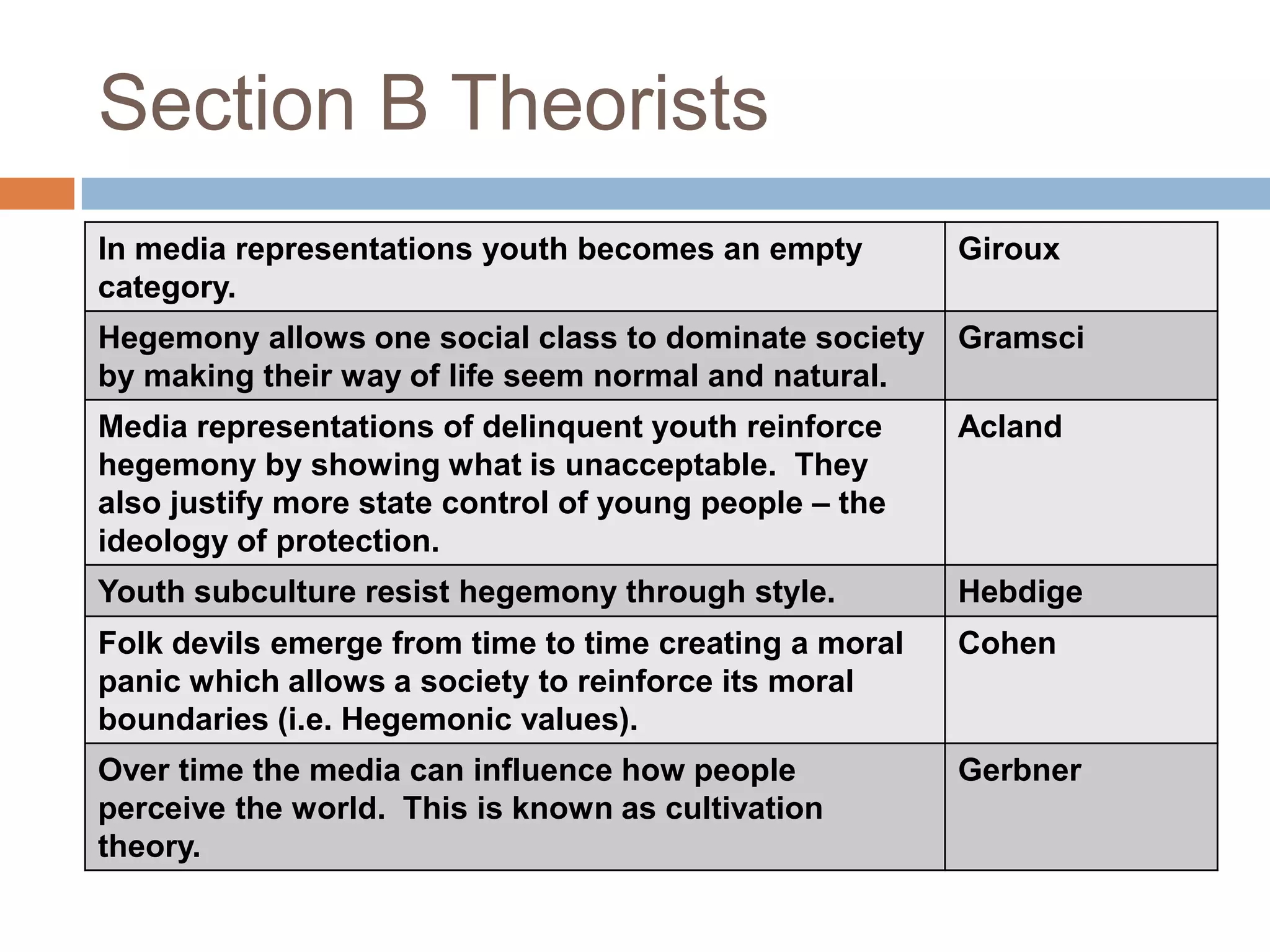
Section B Theorists
Section B Theorists
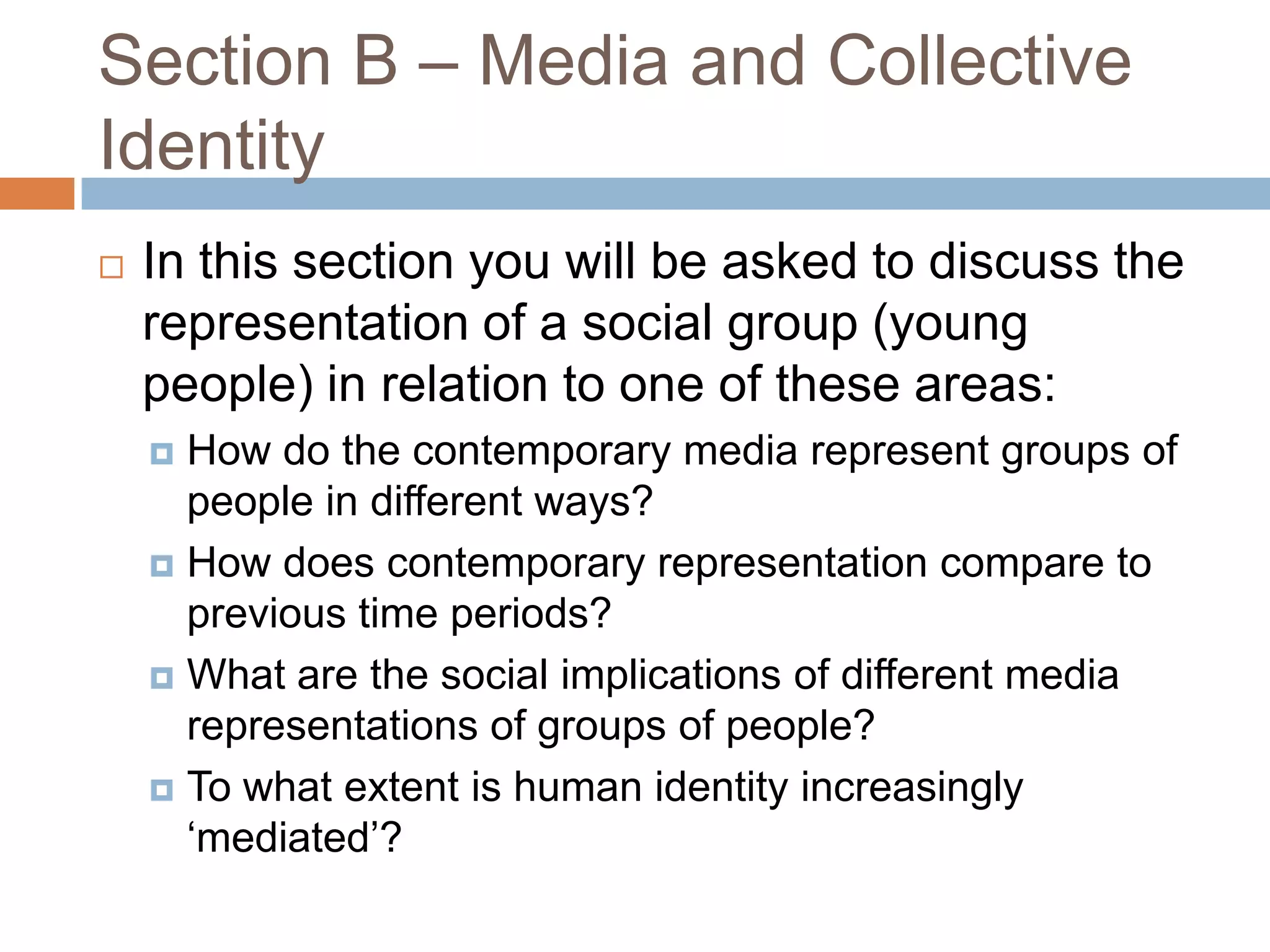
Section B – Media and Collective IdentityIn this section you will be asked to discuss the representation of a social group (young people) in relation to one of these areas:How do the contemporary media represent groups of people in different ways?How does contemporary representation compare to previous time periods? What are the social implications of different media representations of groups of people? To what extent is human identity increasingly ‘mediated’?
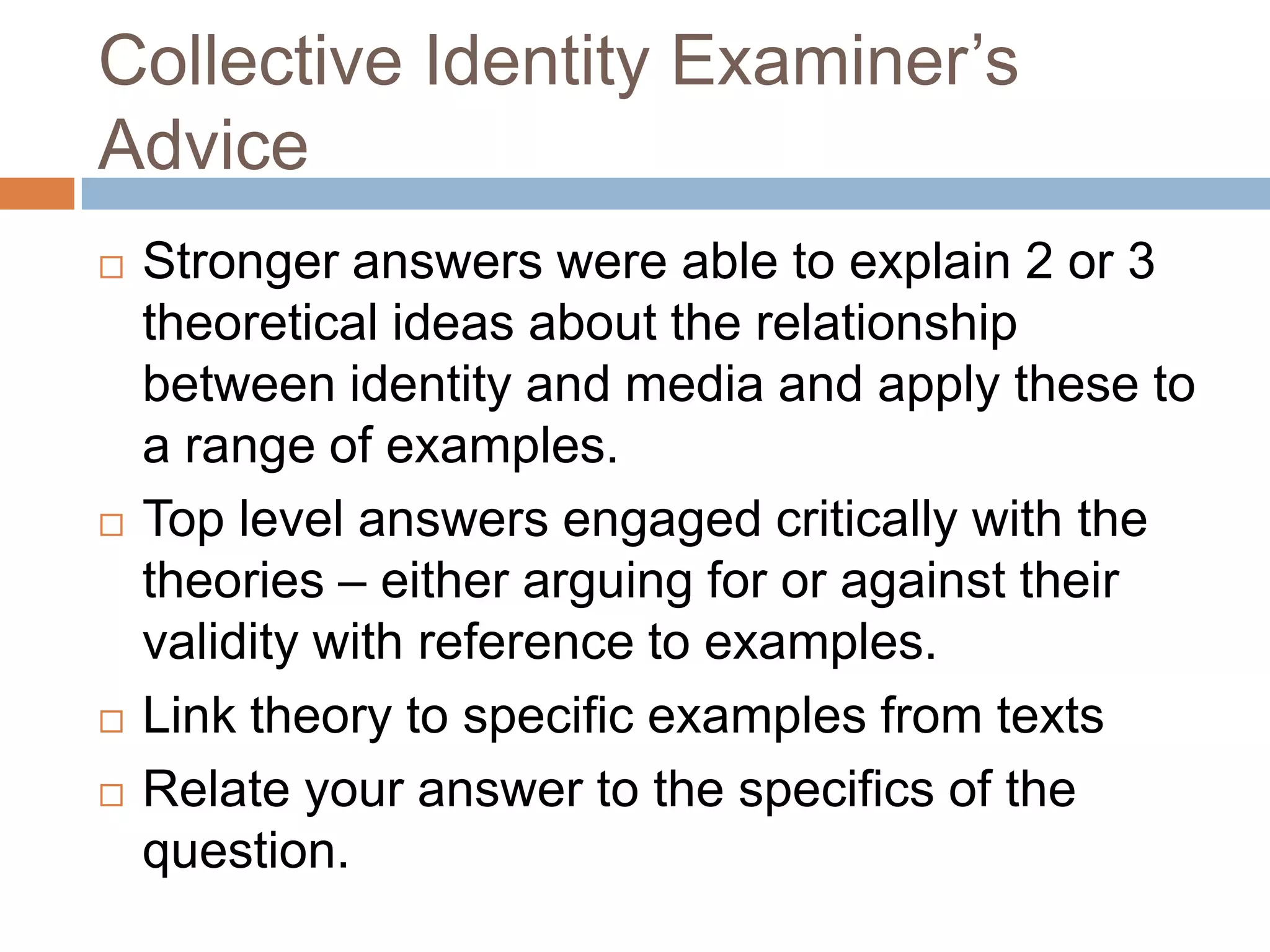
Collective Identity Examiner’s AdviceStronger answers were able to explain 2 or 3 theoretical ideas about the relationship between identity and media and apply these to a range of examples.Top level answers engaged critically with the theories – either arguing for or against their validity with reference to examples.Link theory to specific examples from textsRelate your answer to the specifics of the question.
Collective Identity Examiner’s AdviceYou must refer to at least two types of media (e.g. Film and television).  If you only refer to one type of media you won’t be able to achieve above a Level 1 (U).You must refer to both the past and give a prediction future.  If you don’t you will not be able to achieve above a Level 3 (C/B).The majority of your essay must be about the contemporary texts.  Limit your discussion of historical texts to one paragraph.
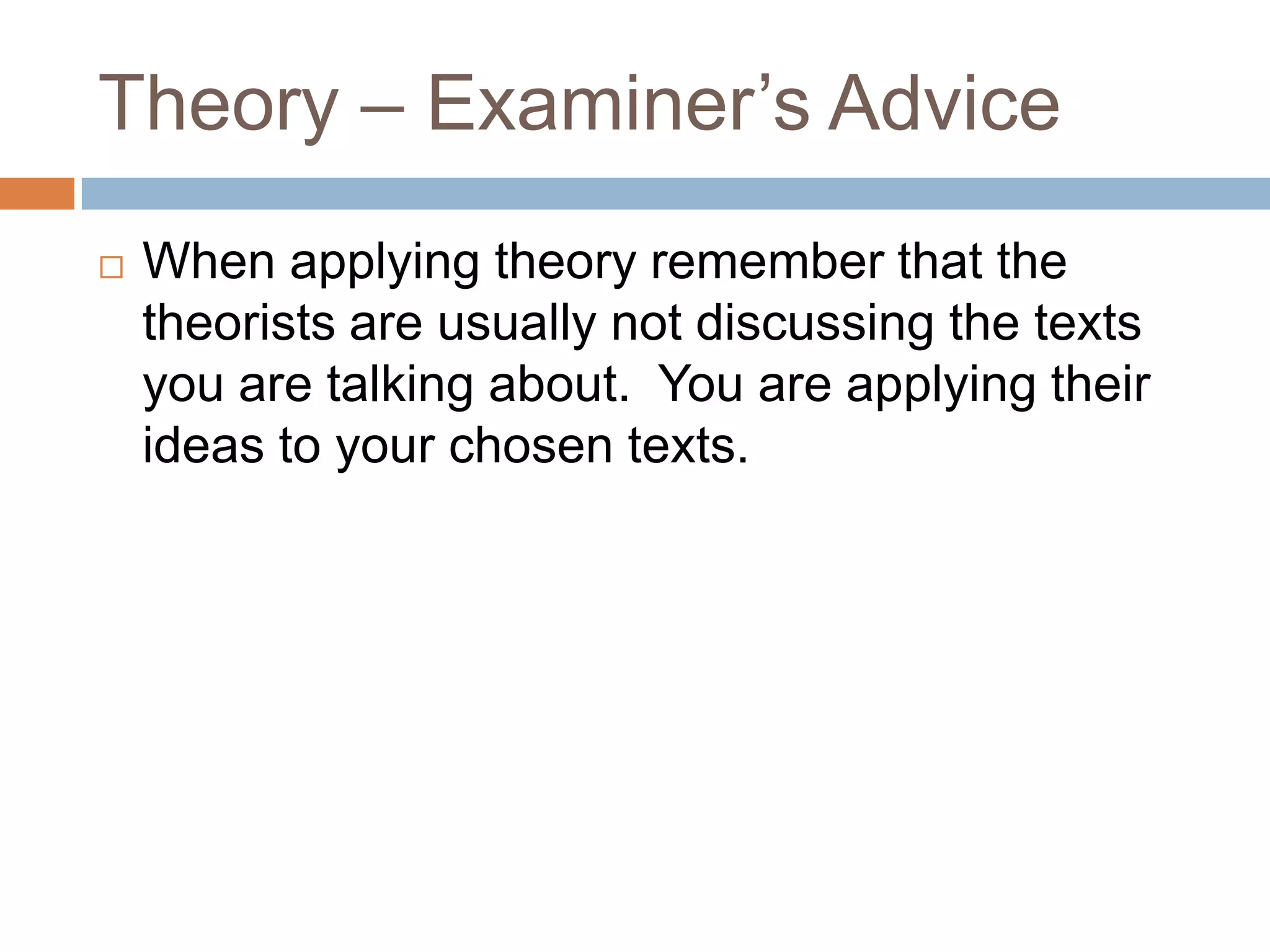
Theory – Examiner’s AdviceWhen applying theory remember that the theorists are usually not discussing the texts you are talking about.  You are applying their ideas to your chosen texts.
Learning adapted to the focus of the questionClear argumentBalance of theory, texts, personal engagementTerminology
Terminology?What key terms can you think of for this section?
Section B TerminologyHegemony, hegemonic values, dominant ideology, subculture, style, ideology of protection, folk devils, moral panic, ideological state apparatus, cultivation theory, symbolic violence.
Historical, contemporary, futureMost of the essay focused on contemporaryAt least 2 types of mediaTerminologyLinks between theories and texts supported by examplesClear Argument
Time ManagementYou need to spend 1 hour on this question.  Most of your time should be spent writing about the contemporary texts.Introduction 5-10 minutesHistorical text 5-10 minutesContemporary Texts 30-40 minutesConclusion 10 minutes
ConclusionIn your conclusion you need to sum up what you have demonstrated in relation to media representations of young people.You need to consider the issue of the relationship between media representations and identity – how does the media effect out understanding of social groups (Gerbner, Gauntlett).You also need to consider how this will develop in the future (e.g. Social networking sites, more power though still limited, e.g. Tuition fees protests).
ReviewHow long is your exam?How many sections?How many questions do you answer in Section A?What topic are you doing in Section B?How many questions do you answer in Section B?What’s 1(a) about?What’s 1(b) about?What’s Section B about?

Final Exam Tips Q1a Q1b and Collective Identity

  • 1.
    A2 Media ExamLessonObjectives: To develop your exam technique.
  • 2.
    Section A TheoristsSortthe theorists into either Representation, Audience, Narrative, Genre.
  • 3.
    The ExamThe examis 2 hours long, and has 2 sections.Spend 1 hour on each section.You may want to do the Section B question first as it is worth most marks.Remember to number your answers.
  • 4.
    Section ASection Ais based on your coursework. You answer both questions 1(a) and 1(b).Question 1(a)you must talk about both AS and A2 coursework products.Question 1(b) you choose one coursework product, either AS or A2 to discuss.
  • 5.
    1(a)In this questionyou will be asked to discuss the progress of your skills from AS to A2 in relation to one or two of the following:Research and PlanningDigital TechnologyPost-ProductionCreativityUse of ConventionsYOU MUST TALK ABOUT BOTH YOUR AS AND A2 COURSEWORK FOR THIS QUESTION.
  • 6.
    1(a) Past QuestionsDescribehow you developedresearch and planning skills for media production and evaluate how these skills contributed to creative decision making. Refer to a range of examples in your answer to show how these skills developed over time.Describe the ways in which your production work was informed by research into real media texts and how your ability to use such research for production developed over time.Digital Technology
  • 7.
    1(a) Examiner AdviceStronganswers have a range of specific examples.Weaker answers are descriptive.Technical and conceptual terminology neededEvaluation and critical reflection on your work is needed.There needs to be a sense of progression over your A Level – Journey.
  • 8.
    Examiner’s Checklist for1(a)Creative decision making Process Progress over time Specific examples Reflection on own development It’s about the Candidate
  • 9.
    1(a) Production TerminologyProductionTerminology: Moving imagePrint Conceptual Terminology:Encoding, preferred reading, signifier, signified, connotation/denotation, narrative codes.Link to key terms from theoretical areas (representation, audience, narrative, genre, media language)What key terms will you be able to use in your answer?
  • 10.
    1(a)Discuss AS andA2 courseworkReflectionProgressRange of specific, relevant and clear examples from your courseworkTerminology – technical and conceptualThis question is worth 25 marks. You should spend 30 minutes answering it.
  • 11.
    1(b)In this questionyou will be asked to apply one of the following theoretical concepts to either your AS or A2 coursework:RepresentationAudienceNarrativeGenreMedia LanguageFor this question you choose either your AS or A2 coursework to discuss.
  • 12.
    1(b) Past QuestionsAnalysemedia representation in one of your coursework productions.Analyse one of your coursework productions in relation to genre.Analyse one of your coursework productions in relation to narrative.
  • 13.
    1(b) Examiner’s AdviceStrongeranswers do 3 things well:Outline the concept for discussion with reference to relevant theoristsApply these ideas to a range of specific elements from your courseworkDiscuss how well the concept/theories relate to your productPoor answers will lack reference to theory and specific answers.Choice of text is important.
  • 14.
    1(b) Examiner’s ChecklistShowingunderstanding of the concept (ideally with references/quotations) Applying the concept Textual analysis of the work (ONE PRODUCTION) using the concept It’s about the work.
  • 15.
    1(b) TerminologyWhat keyterms can you think of in relation to each of the conceptual areas:RepresentationAudienceNarrativeGenreMedia Language
  • 16.
    1(b) TerminologyRepresentation –visual pleasure, object/subject of the gaze, objectification, signs, signifier, signified, connotation/denotation, hyperreality, simulation, simulacra.
  • 17.
    1(b) TerminologyAudience –encoding, decoding, dominant, negotiated, oppositional, socio-cultural context, reception, uses and gratifications, surveillance, escapism, personal identity/ relationships, cultivation theory, hypodermic model, passive audience/active audience
  • 18.
    1(b) TerminologyNarrative –character types, hero, villain, princess, etc., equilibrium, disequilibrium, resolution, binary oppositions, narrative codes, action, enigma, semic, symbolic, cultural.
  • 19.
    1(b) TerminologyGenre –convention, iconography, codes, product differentiation, capitalist, systems of expectation and intelligibility, socio-cultural, myths, genre supervises the relationship between producer and audience
  • 20.
    1(b) Media LanguageProductionTerminology - effect of technical choicesPrint MediaMoving ImageUse of genre conventionsUse of narrative structures/codesEncoding of meaning
  • 21.
    1(b) TerminologyYou maybe able to link terminology from other concepts into your discussion, e.g.:Encoding of representationsUse of iconography to encode meaning, and communicate narrative informationUse of character types in representationEtc.
  • 22.
    1(b)Understanding of conceptRelateconcept to examples from your courseworkRange of specific, clear relevant examplesUse conceptual language throughoutReference to theoristsEvaluation of usefulness of concept/theory to your productionThis question is worth 25 marks. You should spend 30 minutes answering it.
  • 23.
    Section B: Mediaand Collective IdentityYou answer one question from Section B.You are doing the Media and Collective Identity topic. You choose one of the two questions to answer.Do not answer more than one question for Section B.Only do the Media and Collective Identity topic.You need to spend 1 hour on this question.
  • 24.
  • 25.
  • 26.
    Section B –Media and Collective IdentityIn this section you will be asked to discuss the representation of a social group (young people) in relation to one of these areas:How do the contemporary media represent groups of people in different ways?How does contemporary representation compare to previous time periods? What are the social implications of different media representations of groups of people? To what extent is human identity increasingly ‘mediated’?
  • 27.
    Collective Identity Examiner’sAdviceStronger answers were able to explain 2 or 3 theoretical ideas about the relationship between identity and media and apply these to a range of examples.Top level answers engaged critically with the theories – either arguing for or against their validity with reference to examples.Link theory to specific examples from textsRelate your answer to the specifics of the question.
  • 28.
    Collective Identity Examiner’sAdviceYou must refer to at least two types of media (e.g. Film and television). If you only refer to one type of media you won’t be able to achieve above a Level 1 (U).You must refer to both the past and give a prediction future. If you don’t you will not be able to achieve above a Level 3 (C/B).The majority of your essay must be about the contemporary texts. Limit your discussion of historical texts to one paragraph.
  • 29.
    Theory – Examiner’sAdviceWhen applying theory remember that the theorists are usually not discussing the texts you are talking about. You are applying their ideas to your chosen texts.
  • 30.
    Learning adapted tothe focus of the questionClear argumentBalance of theory, texts, personal engagementTerminology
  • 31.
    Terminology?What key termscan you think of for this section?
  • 32.
    Section B TerminologyHegemony,hegemonic values, dominant ideology, subculture, style, ideology of protection, folk devils, moral panic, ideological state apparatus, cultivation theory, symbolic violence.
  • 33.
    Historical, contemporary, futureMostof the essay focused on contemporaryAt least 2 types of mediaTerminologyLinks between theories and texts supported by examplesClear Argument
  • 34.
    Time ManagementYou needto spend 1 hour on this question. Most of your time should be spent writing about the contemporary texts.Introduction 5-10 minutesHistorical text 5-10 minutesContemporary Texts 30-40 minutesConclusion 10 minutes
  • 35.
    ConclusionIn your conclusionyou need to sum up what you have demonstrated in relation to media representations of young people.You need to consider the issue of the relationship between media representations and identity – how does the media effect out understanding of social groups (Gerbner, Gauntlett).You also need to consider how this will develop in the future (e.g. Social networking sites, more power though still limited, e.g. Tuition fees protests).
  • 36.
    ReviewHow long isyour exam?How many sections?How many questions do you answer in Section A?What topic are you doing in Section B?How many questions do you answer in Section B?What’s 1(a) about?What’s 1(b) about?What’s Section B about?