Quantum Cryptography:
The Next-Gen Encryption
Revolution
Presented by: Subhasish Kabi
Regd. No.: 2102081029
DEPARTMENT OF INFORMATION TECHNOLOGY VEER
SURENDRA SAI UNIVERSITY OF TECHNOLOGY BURLA,
SAMBALPUR, ODISHA
In a society increasingly dominated by digital communication and data exchange, quantum
cryptography—a cutting-edge field at the nexus of quantum physics and information security
—offers a novel means of protecting sensitive data. Quantum cryptography uses the
properties of quantum mechanics to provide a new level of security that is theoretically
impervious to emerging threats. In contrast, computational complexity and mathematical
techniques are the foundation of classical cryptography.
Understanding Quantum
Cryptography
Quantum
It describes the minuscule,
fundamental components of the
universe, such as atoms and
particles. It shows wave-particle
duality and superposition of
multiple states.
Cryptography
It is the study and application of
secure communication methods
that encrypt data to prevent it
from being read. In order to both
encrypt and decrypt data, it uses
mathematical formulas and keys.
Quantum Cryptography
It is a branch of quantum physics and cryptography that leverages the
principles of quantum mechanics to provide secure communication and data
encryption.
Journey of Quantum Cryptography
1 1984 - BB84 Quantum Key Distribution
The first QKD protocol, referred to as BB84, was presented by Charles Bennett
and Gilles Brassard.
2 1991 - Proposal for E91 Quantum Key Distribution
Based on quantum entanglement, Artur Ekert proposed the E91 QKD protocol.
3 2008 - Commercial Quantum Key Distribution
This year quantum cryptography moved from theory to real-world applications
when businesses like Toshiba and ID Quantique started to offer commercial
QKD systems.
4 2010s - Quantum Secure Communication
Data centers, financial institutions, and governmental organizations started
using secure communication solutions through quantum cryptography
technologies.
Key Principles of Quantum Cryptography
Quantum Key Distribution
(QKD)
QKD is a method for securely sharing
cryptographic keys between two
parties, in a way that is theoretically
invulnerable to eavesdropping.
Heisenberg's Uncertainty
Principle
In quantum mechanics, the act of
measuring certain properties of a
quantum system necessarily disturbs
the system.
Quantum Entanglement
Quantum cryptography can use
entangled particles, where the
properties of one particle are
instantly correlated with the
properties of another, even when they
are physically separated.
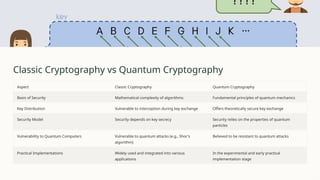
Classic Cryptography vs Quantum Cryptography
Aspect Classic Cryptography Quantum Cryptography
Basis of Security Mathematical complexity of algorithms Fundamental principles of quantum mechanics
Key Distribution Vulnerable to interception during key exchange Offers theoretically secure key exchange
Security Model Security depends on key secrecy Security relies on the properties of quantum
particles
Vulnerability to Quantum Computers Vulnerable to quantum attacks (e.g., Shor's
algorithm)
Believed to be resistant to quantum attacks
Practical Implementations Widely used and integrated into various
applications
In the experimental and early practical
implementation stage
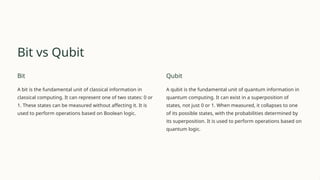
Bit vs Qubit
Bit
A bit is the fundamental unit of classical information in
classical computing. It can represent one of two states: 0 or
1. These states can be measured without affecting it. It is
used to perform operations based on Boolean logic.
Qubit
A qubit is the fundamental unit of quantum information in
quantum computing. It can exist in a superposition of
states, not just 0 or 1. When measured, it collapses to one
of its possible states, with the probabilities determined by
its superposition. It is used to perform operations based on
quantum logic.
BB84 QKD Protocol
1
Step 1: Qubit Generation
Alice generates a string of qubits with distinct
polarization states.
2 Step 2: Transmission
Alice sends the qubits to Bob through a quantum
channel.
3
Step 3: Measurement
Bob measures the received qubits using randomly
chosen bases.
4 Step 4: Basis Comparison
Alice and Bob compare their bases over a classical
channel and keep only the matching measurements.
5
Step 5: Key Generation
The remaining matching measurements form the
shared secret key.
Advantages of Quantum Cryptography
1 Eavesdropping Detection
The act of measuring quantum states disrupts the
communication, allowing legitimate users to detect any
unauthorized interception.
2 Secure Key Distribution
Even if an eavesdropper attempts to intercept the quantum
key, the security mechanisms will detect any tampering.
3 No Hidden Backdoors
Quantum cryptographic systems are less likely to have hidden
vulnerabilities or backdoors that could be exploited by
unauthorized parties, as their security is based on the
properties of quantum particles.
4 Long-Term Security
Quantum cryptography is designed to provide long-term
security, even in the face of advances in computing power and
mathematical breakthroughs.
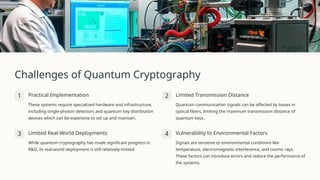
Challenges of Quantum Cryptography
1 Practical Implementation
These systems require specialized hardware and infrastructure,
including single-photon detectors and quantum key distribution
devices which can be expensive to set up and maintain.
2 Limited Transmission Distance
Quantum communication signals can be affected by losses in
optical fibers, limiting the maximum transmission distance of
quantum keys.
3 Limited Real-World Deployments
While quantum cryptography has made significant progress in
R&D, its real-world deployment is still relatively limited.
4 Vulnerability to Environmental Factors
Signals are sensitive to environmental conditions like
temperature, electromagnetic interference, and cosmic rays.
These factors can introduce errors and reduce the performance of
the systems.
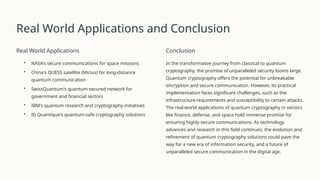
Real World Applications and Conclusion
Real World Applications
• NASA's secure communications for space missions
• China's QUESS satellite (Micius) for long-distance
quantum communication
• SwissQuantum's quantum-secured network for
government and financial sectors
• IBM's quantum research and cryptography initiatives
• ID Quantique's quantum-safe cryptography solutions
Conclusion
In the transformative journey from classical to quantum
cryptography, the promise of unparalleled security looms large.
Quantum cryptography offers the potential for unbreakable
encryption and secure communication. However, its practical
implementation faces significant challenges, such as the
infrastructure requirements and susceptibility to certain attacks.
The real-world applications of quantum cryptography in sectors
like finance, defense, and space hold immense promise for
ensuring highly secure communications. As technology
advances and research in this field continues, the evolution and
refinement of quantum cryptography solutions could pave the
way for a new era of information security, and a future of
unparalleled secure communication in the digital age.

Quantum-Cryptography-The-Next-Gen-Encryption-Revolution.pptx

  • 1.
    Quantum Cryptography: The Next-GenEncryption Revolution Presented by: Subhasish Kabi Regd. No.: 2102081029 DEPARTMENT OF INFORMATION TECHNOLOGY VEER SURENDRA SAI UNIVERSITY OF TECHNOLOGY BURLA, SAMBALPUR, ODISHA In a society increasingly dominated by digital communication and data exchange, quantum cryptography—a cutting-edge field at the nexus of quantum physics and information security —offers a novel means of protecting sensitive data. Quantum cryptography uses the properties of quantum mechanics to provide a new level of security that is theoretically impervious to emerging threats. In contrast, computational complexity and mathematical techniques are the foundation of classical cryptography.
  • 2.
    Understanding Quantum Cryptography Quantum It describesthe minuscule, fundamental components of the universe, such as atoms and particles. It shows wave-particle duality and superposition of multiple states. Cryptography It is the study and application of secure communication methods that encrypt data to prevent it from being read. In order to both encrypt and decrypt data, it uses mathematical formulas and keys. Quantum Cryptography It is a branch of quantum physics and cryptography that leverages the principles of quantum mechanics to provide secure communication and data encryption.
  • 3.
    Journey of QuantumCryptography 1 1984 - BB84 Quantum Key Distribution The first QKD protocol, referred to as BB84, was presented by Charles Bennett and Gilles Brassard. 2 1991 - Proposal for E91 Quantum Key Distribution Based on quantum entanglement, Artur Ekert proposed the E91 QKD protocol. 3 2008 - Commercial Quantum Key Distribution This year quantum cryptography moved from theory to real-world applications when businesses like Toshiba and ID Quantique started to offer commercial QKD systems. 4 2010s - Quantum Secure Communication Data centers, financial institutions, and governmental organizations started using secure communication solutions through quantum cryptography technologies.
  • 4.
    Key Principles ofQuantum Cryptography Quantum Key Distribution (QKD) QKD is a method for securely sharing cryptographic keys between two parties, in a way that is theoretically invulnerable to eavesdropping. Heisenberg's Uncertainty Principle In quantum mechanics, the act of measuring certain properties of a quantum system necessarily disturbs the system. Quantum Entanglement Quantum cryptography can use entangled particles, where the properties of one particle are instantly correlated with the properties of another, even when they are physically separated.
  • 5.
    Classic Cryptography vsQuantum Cryptography Aspect Classic Cryptography Quantum Cryptography Basis of Security Mathematical complexity of algorithms Fundamental principles of quantum mechanics Key Distribution Vulnerable to interception during key exchange Offers theoretically secure key exchange Security Model Security depends on key secrecy Security relies on the properties of quantum particles Vulnerability to Quantum Computers Vulnerable to quantum attacks (e.g., Shor's algorithm) Believed to be resistant to quantum attacks Practical Implementations Widely used and integrated into various applications In the experimental and early practical implementation stage
  • 6.
    Bit vs Qubit Bit Abit is the fundamental unit of classical information in classical computing. It can represent one of two states: 0 or 1. These states can be measured without affecting it. It is used to perform operations based on Boolean logic. Qubit A qubit is the fundamental unit of quantum information in quantum computing. It can exist in a superposition of states, not just 0 or 1. When measured, it collapses to one of its possible states, with the probabilities determined by its superposition. It is used to perform operations based on quantum logic.
  • 7.
    BB84 QKD Protocol 1 Step1: Qubit Generation Alice generates a string of qubits with distinct polarization states. 2 Step 2: Transmission Alice sends the qubits to Bob through a quantum channel. 3 Step 3: Measurement Bob measures the received qubits using randomly chosen bases. 4 Step 4: Basis Comparison Alice and Bob compare their bases over a classical channel and keep only the matching measurements. 5 Step 5: Key Generation The remaining matching measurements form the shared secret key.
  • 8.
    Advantages of QuantumCryptography 1 Eavesdropping Detection The act of measuring quantum states disrupts the communication, allowing legitimate users to detect any unauthorized interception. 2 Secure Key Distribution Even if an eavesdropper attempts to intercept the quantum key, the security mechanisms will detect any tampering. 3 No Hidden Backdoors Quantum cryptographic systems are less likely to have hidden vulnerabilities or backdoors that could be exploited by unauthorized parties, as their security is based on the properties of quantum particles. 4 Long-Term Security Quantum cryptography is designed to provide long-term security, even in the face of advances in computing power and mathematical breakthroughs.
  • 9.
    Challenges of QuantumCryptography 1 Practical Implementation These systems require specialized hardware and infrastructure, including single-photon detectors and quantum key distribution devices which can be expensive to set up and maintain. 2 Limited Transmission Distance Quantum communication signals can be affected by losses in optical fibers, limiting the maximum transmission distance of quantum keys. 3 Limited Real-World Deployments While quantum cryptography has made significant progress in R&D, its real-world deployment is still relatively limited. 4 Vulnerability to Environmental Factors Signals are sensitive to environmental conditions like temperature, electromagnetic interference, and cosmic rays. These factors can introduce errors and reduce the performance of the systems.
  • 10.
    Real World Applicationsand Conclusion Real World Applications • NASA's secure communications for space missions • China's QUESS satellite (Micius) for long-distance quantum communication • SwissQuantum's quantum-secured network for government and financial sectors • IBM's quantum research and cryptography initiatives • ID Quantique's quantum-safe cryptography solutions Conclusion In the transformative journey from classical to quantum cryptography, the promise of unparalleled security looms large. Quantum cryptography offers the potential for unbreakable encryption and secure communication. However, its practical implementation faces significant challenges, such as the infrastructure requirements and susceptibility to certain attacks. The real-world applications of quantum cryptography in sectors like finance, defense, and space hold immense promise for ensuring highly secure communications. As technology advances and research in this field continues, the evolution and refinement of quantum cryptography solutions could pave the way for a new era of information security, and a future of unparalleled secure communication in the digital age.