TOWARDS 3D INTERNET
M Naufara Raihana
&
Farhath Surayya
OUTLINE
 Introduction
 Need For 3D Internet
 3D Internet Architecture
 Performance Of 3D Internet
 Application
 Summary
INTRODUCTION
 3D internet also known as virtual worlds, is a blend
of television,social networking and web
 A powerful new way to reach consumers, business
customers, co-workers, partners, and students
 Internet is inherently interactive and engaging
 Provide immersive 3D experiences that replicate
real life
NEED FOR 3D INTERNET
 In 2d internet Navigating hierarchical data
structures is often cumber-some for large data sets
 In a 3D world we can navigate between places and
organize objects spatially
 It provides an HCI framework that can decrease
mental load and open doors to rich, innovative
interface designs through spatial relationships.
 Webplace metaphore of the 3D Internet enables
interaction between people in a natural way
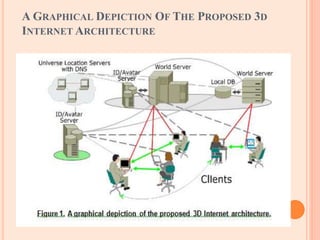
3D INTERNET ARCHITECTURE
World servers
 Provides user or server side created, static and
dynamic content
Avatar/ID servers
 Virtual identity management systems
 Contains identity and avatar information of
registered users and provides these to individual
world servers and relevant client programs
 Ensuring privacy and security of stored information.
3D INTERNET ARCHITECTURE
Universe location servers
 Virtual location management systems
 Providins virtual geographical information as well as
connection to the Internet
Clients
 Browser-like viewer programs running on user’s
computers with extensive networking, caching, and
3D rendering capabilities.
A GRAPHICAL DEPICTION OF THE PROPOSED 3D
INTERNET ARCHITECTURE
PERFORMANCE OF 3D INTERNET
Networking and Distributed Computing
 A hybrid peer-to-peer (P2P) approach to re- duce server load
and ensure scalability of the 3D Internet infrastructure.
 It consists of three types of communications:client to server
(C2S), server to server (S2S) and client to client (C2C)
 Latency Minimization
 3D Internet increases the reliance on graphics and
interactivity, minimizes the latency
 security and Trust
 To handle the authentication information of users’, user
centric identity management approaches such as
CardSpace2 are used
 Allows individual users to retain full control over their own
identity management, without requiring the presence of an
external provider.
PERFORMANCE OF 3D INTERNET
Intelligent Environments
 3D internet draws heavily from adaptive and intelligent
algorithms
 Intelligent Services
 Include speech and gesture recognition, but also implies
interaction with virtual objects and tools inspired by things
existing in the real world.
 Facilitate social interaction of users
 Increases usability of core functionalities of the virtual
environments
 Facilitates personalization of individual users’ avatars and
improves multimedia-information retrieval.
 Intelligent Agents and Rendering
 Services are presented and accessible in a natural way
 Improves the quality of virtual clerks and information personnel.
APPLICATION
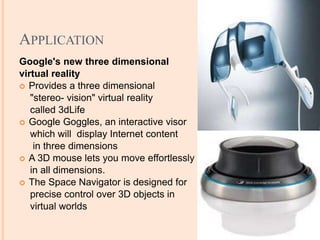
Google's new three dimensional
virtual reality
 Provides a three dimensional
"stereo- vision" virtual reality
called 3dLife
 Google Goggles, an interactive visor
which will display Internet content
in three dimensions
 A 3D mouse lets you move effortlessly
in all dimensions.
 The Space Navigator is designed for
precise control over 3D objects in
virtual worlds
APPLICATION
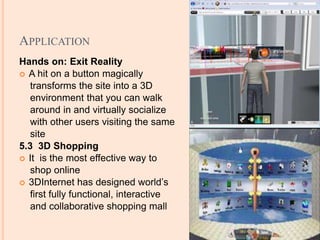
Hands on: Exit Reality
 A hit on a button magically
transforms the site into a 3D
environment that you can walk
around in and virtually socialize
with other users visiting the same
site
5.3 3D Shopping
 It is the most effective way to
shop online
 3DInternet has designed world’s
first fully functional, interactive
and collaborative shopping mall
SUMMARY
 Introduction
 Need for 3D Internet
 3D Internet architecture
 Performance of 3D internet
REFERENCES
[1] The croquet consortium, 2007.
[2] The metaverse roadmap, 2007.
[3] T. Alpcan, C. Bauckhage, and S. Agarwal. An efficient ontology-based
expert peering system. In Proc. 6th IAPR Workshop on Graph-based
Repr. in Pattern Recog. (GbR), Alicante, Spain, June 2007.
[4] B. Gorman, C. Thurau, C. Bauckhage, and M. Humphrys.
Believability Testing and Bayesian Imitation in Interactive Computer
Games. In Proc. Int. Conf. on Simulation of Adap- tive Behavior, September
2006.
[5] R. J. Hayton, J. M. Bacon, and K. Moody. Access Control in an Open
Distributed Environment. In Proc. IEEE Symp. on Sec. and Priv., May
1998.
[6] E. Kotsovinos, T. Moreton, I. Pratt, R. Ross, K. Fraser, S. Hand, and T.
Harris. Global-Scale Service Deployment in the XenoServer Platform. In
Proc. Workshop on Real, Large Distributed Systems, December 2004.
[7] M. Li, W.-C. Lee, and A. Sivasubramaniam. Semantic Small World: An
Overlay Network for Peer-to-Peer Search . In Proc. Int. Conf. on
Networking Protocols (ICNP), December 2004.
[8] N. Li, J. C. Mitchell, and W. H. Winsborough. Design of a Role-Based
Trust Management Framework. In Proc. IEEE Symp. on Sec. and Priv.,
May 2002.
[9] A. Pashalidis and C. Mitchell. A taxonomy of single sign-on
systems. In Proc. 8th Australasian Conf. in Inf. Sec. and Pri. (ACISP), July
2003.
[10] M. Wooldridge and N. R. Jennings. Intelligent Agents: Theory and
Practice. The Knowledge Engineering Review,10(2):115–152,1995.
towards 3d internet
towards 3d internet

towards 3d internet

  • 1.
    TOWARDS 3D INTERNET MNaufara Raihana & Farhath Surayya
  • 2.
    OUTLINE  Introduction  NeedFor 3D Internet  3D Internet Architecture  Performance Of 3D Internet  Application  Summary
  • 3.
    INTRODUCTION  3D internetalso known as virtual worlds, is a blend of television,social networking and web  A powerful new way to reach consumers, business customers, co-workers, partners, and students  Internet is inherently interactive and engaging  Provide immersive 3D experiences that replicate real life
  • 4.
    NEED FOR 3DINTERNET  In 2d internet Navigating hierarchical data structures is often cumber-some for large data sets  In a 3D world we can navigate between places and organize objects spatially  It provides an HCI framework that can decrease mental load and open doors to rich, innovative interface designs through spatial relationships.  Webplace metaphore of the 3D Internet enables interaction between people in a natural way
  • 5.
    3D INTERNET ARCHITECTURE Worldservers  Provides user or server side created, static and dynamic content Avatar/ID servers  Virtual identity management systems  Contains identity and avatar information of registered users and provides these to individual world servers and relevant client programs  Ensuring privacy and security of stored information.
  • 6.
    3D INTERNET ARCHITECTURE Universelocation servers  Virtual location management systems  Providins virtual geographical information as well as connection to the Internet Clients  Browser-like viewer programs running on user’s computers with extensive networking, caching, and 3D rendering capabilities.
  • 7.
    A GRAPHICAL DEPICTIONOF THE PROPOSED 3D INTERNET ARCHITECTURE
  • 8.
    PERFORMANCE OF 3DINTERNET Networking and Distributed Computing  A hybrid peer-to-peer (P2P) approach to re- duce server load and ensure scalability of the 3D Internet infrastructure.  It consists of three types of communications:client to server (C2S), server to server (S2S) and client to client (C2C)  Latency Minimization  3D Internet increases the reliance on graphics and interactivity, minimizes the latency  security and Trust  To handle the authentication information of users’, user centric identity management approaches such as CardSpace2 are used  Allows individual users to retain full control over their own identity management, without requiring the presence of an external provider.
  • 9.
    PERFORMANCE OF 3DINTERNET Intelligent Environments  3D internet draws heavily from adaptive and intelligent algorithms  Intelligent Services  Include speech and gesture recognition, but also implies interaction with virtual objects and tools inspired by things existing in the real world.  Facilitate social interaction of users  Increases usability of core functionalities of the virtual environments  Facilitates personalization of individual users’ avatars and improves multimedia-information retrieval.  Intelligent Agents and Rendering  Services are presented and accessible in a natural way  Improves the quality of virtual clerks and information personnel.
  • 10.
    APPLICATION Google's new threedimensional virtual reality  Provides a three dimensional "stereo- vision" virtual reality called 3dLife  Google Goggles, an interactive visor which will display Internet content in three dimensions  A 3D mouse lets you move effortlessly in all dimensions.  The Space Navigator is designed for precise control over 3D objects in virtual worlds
  • 11.
    APPLICATION Hands on: ExitReality  A hit on a button magically transforms the site into a 3D environment that you can walk around in and virtually socialize with other users visiting the same site 5.3 3D Shopping  It is the most effective way to shop online  3DInternet has designed world’s first fully functional, interactive and collaborative shopping mall
  • 12.
    SUMMARY  Introduction  Needfor 3D Internet  3D Internet architecture  Performance of 3D internet
  • 13.
    REFERENCES [1] The croquetconsortium, 2007. [2] The metaverse roadmap, 2007. [3] T. Alpcan, C. Bauckhage, and S. Agarwal. An efficient ontology-based expert peering system. In Proc. 6th IAPR Workshop on Graph-based Repr. in Pattern Recog. (GbR), Alicante, Spain, June 2007. [4] B. Gorman, C. Thurau, C. Bauckhage, and M. Humphrys. Believability Testing and Bayesian Imitation in Interactive Computer Games. In Proc. Int. Conf. on Simulation of Adap- tive Behavior, September 2006. [5] R. J. Hayton, J. M. Bacon, and K. Moody. Access Control in an Open Distributed Environment. In Proc. IEEE Symp. on Sec. and Priv., May 1998. [6] E. Kotsovinos, T. Moreton, I. Pratt, R. Ross, K. Fraser, S. Hand, and T. Harris. Global-Scale Service Deployment in the XenoServer Platform. In Proc. Workshop on Real, Large Distributed Systems, December 2004. [7] M. Li, W.-C. Lee, and A. Sivasubramaniam. Semantic Small World: An Overlay Network for Peer-to-Peer Search . In Proc. Int. Conf. on Networking Protocols (ICNP), December 2004.
  • 14.
    [8] N. Li,J. C. Mitchell, and W. H. Winsborough. Design of a Role-Based Trust Management Framework. In Proc. IEEE Symp. on Sec. and Priv., May 2002. [9] A. Pashalidis and C. Mitchell. A taxonomy of single sign-on systems. In Proc. 8th Australasian Conf. in Inf. Sec. and Pri. (ACISP), July 2003. [10] M. Wooldridge and N. R. Jennings. Intelligent Agents: Theory and Practice. The Knowledge Engineering Review,10(2):115–152,1995.